
Contents
- Quick Answer: The Yellow Wallpaper in 60 Words
- The Yellow Wallpaper at a Glance (Quick Revision Table)
- About the Author
- Contributions to Literature and Social Reform
- Key Themes in Her Works
- Background
- Historical and Cultural Context of “The Yellow Wallpaper”
- The Rest Cure: What It Was
- The Real-Life Source: Gilman and Dr Weir Mitchell
- Is the Story Autobiography? A Scholarly Debate
- Significance of the Short Story in Feminist Literature
- Study Guide
- Summary of the Short Story
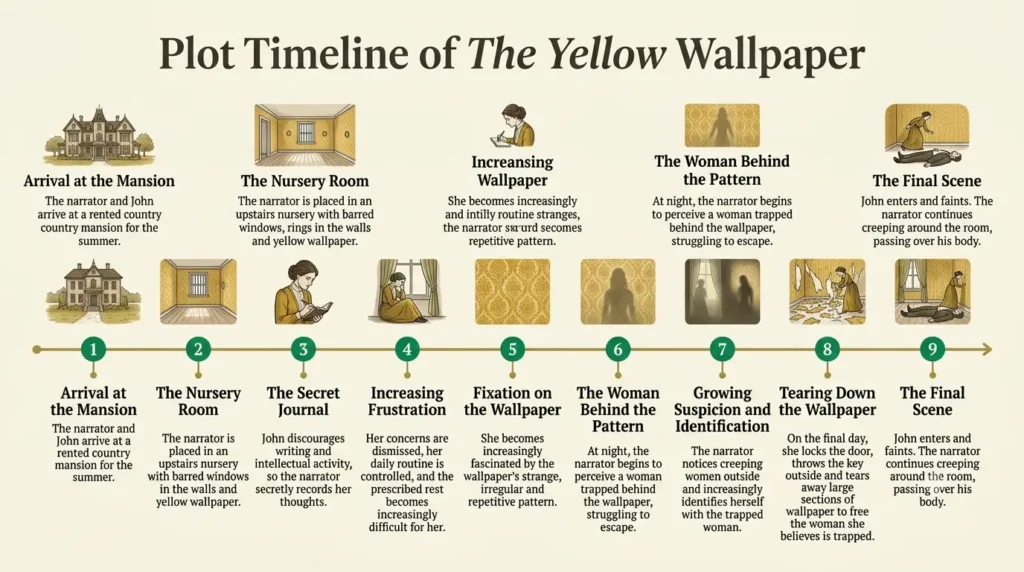
- The Plot Stage by Stage (Revision Table)
- Setting, Time and Place
- Analysis of Major Characters
- Key Plot Points and Themes
- Climax and Ending Explained
- Key Themes
- Early Responses to the Story
- Critical Reception Upon Publication
- From Neglect to Canon: Rediscovery
- Awards and Honors Received by the Story
- Form and Narrative Style
- Journal Form: Is the Story Epistolary?
- Use of First-Person Narrative
- Narrative Techniques Employed by Gilman
- Themes of Mental Health
- Portrayal of Mental Illness and Its Treatment
- Critique of the Medical Practices of the Time
- Impact of Societal Expectations on Mental Health
- Themes of Gender and Patriarchy
- Representation of Gender Roles and Expectations
- Critique of Patriarchal Society
- Impact of Male Dominance on Female Characters
- Symbolism and Imagery
- The Yellow Wallpaper as a Symbol
- Other Symbols and Their Meanings
- Use of Imagery to Show Themes
- Critical Debates: How Scholars Read the Story
- The Yellow Wallpaper Within DSC-18: Confinement in Unit II and Beyond
- Important Quotations from the Story
- How to Write a Strong 20-Mark Answer on This Story
- Conclusion
- Key Points Summary
- Importance of The Yellow Wallpaper Today
- Final Thoughts on Gilman’s Impact on Women’s Writing
- Continue Reading
- University of Delhi Previous Year Questions
- Frequently Asked Questions (FAQs)
- References and Further Reading
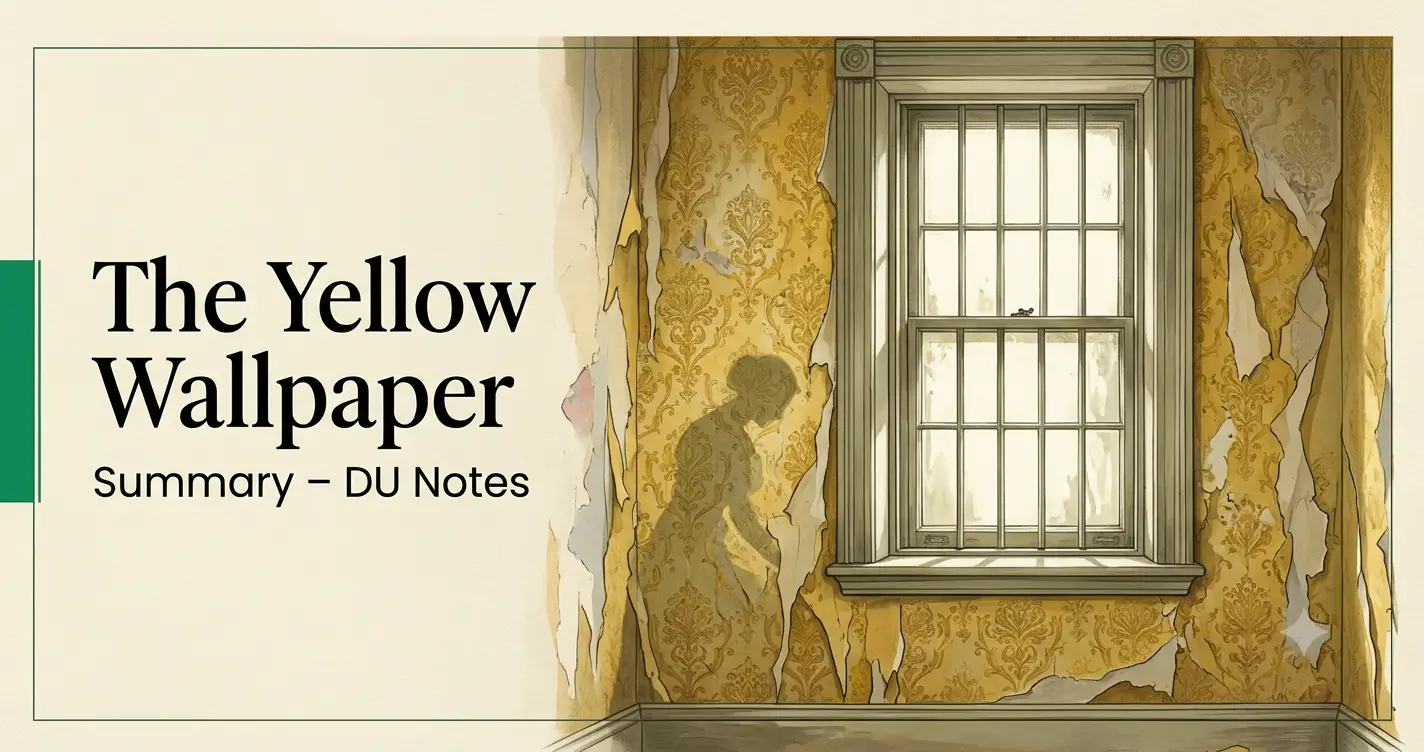
The Yellow Wallpaper is Charlotte Perkins Gilman’s short story about a young wife and new mother who is shut away in an old house “for her own good”, forbidden to work or write, and left alone with the peeling yellow wallpaper of her room. The story first appeared in The New England Magazine in January 1892. It is told entirely through the narrator’s secret journal, and as the entries go on, we watch her thinking slide from irritation to obsession to the belief that a woman is trapped behind the pattern.
These notes cover Unit 2A: Charlotte Perkins Gilman, ‘The Yellow Wallpaper’ of DSC-18: Women Writings (BA (Hons.) English, Semester 6, University of Delhi; the course is listed in the official University of Delhi syllabus). You will find a short summary, a stage-by-stage plot, character analysis, the real story behind the “rest cure”, narrative technique, symbols, themes, the major critical debates, key quotations, a comparison with the other Unit II texts, previous year questions and FAQs. If you are studying the whole unit, the other notes are collected under Women Writings.
Quick Answer: The Yellow Wallpaper in 60 Words
A physician’s wife, recovering from what her husband John calls “temporary nervous depression”, is confined to a barred upstairs nursery for a summer. Forbidden to write, she secretly keeps a journal and becomes fixated on the room’s yellow wallpaper. She begins to see a woman creeping behind its pattern. At the end she strips the paper, declares she has “got out”, and creeps over her fainting husband.
The Yellow Wallpaper at a Glance (Quick Revision Table)
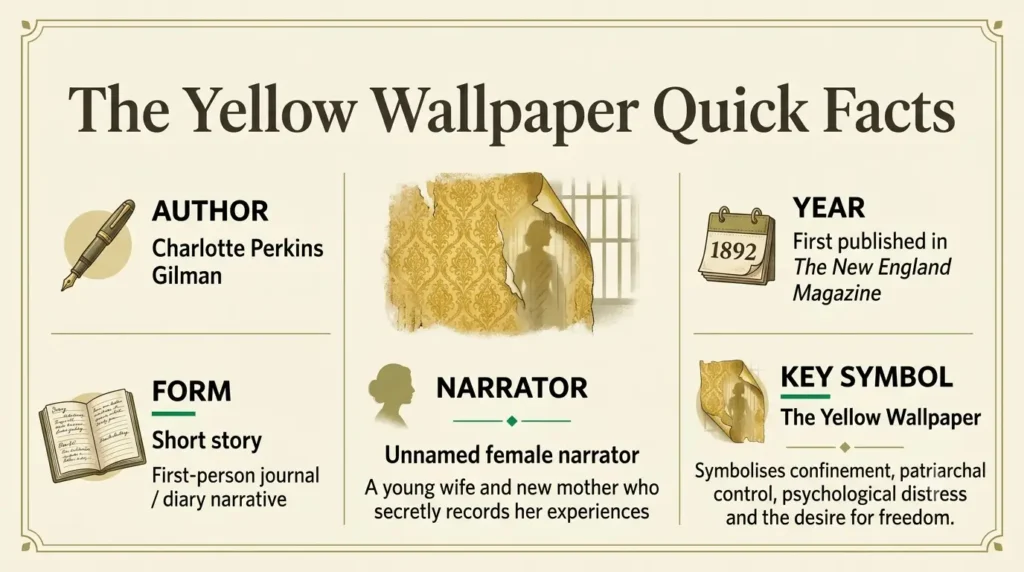
| Detail | Information |
|---|---|
| Author | Charlotte Perkins Gilman (1860–1935), American writer, lecturer and social reformer |
| Original title | “The Yellow Wall-paper. A Story” |
| Written | 1890 (Gilman was then living in Pasadena, California) |
| First published | January 1892, The New England Magazine (Vol. 11, No. 5, pp. 647–656) |
| Later editions | Small, Maynard & Co. (1899); The Feminist Press (1973, afterword by Elaine Hedges); Virago (1981) |
| Form | First-person fictional journal (diary entries) |
| Narrator | An unnamed woman (the name “Jane” slips out once, near the end) |
| Husband | John, a physician |
| Setting | A rented “colonial mansion”, a “hereditary estate”, for one summer; the narrator is kept in a top-floor former nursery. The text never names the place or the year. |
| Central symbol | The yellow wallpaper and the woman “behind” it |
| Real-life source | Gilman’s own 1887 “rest cure” under the neurologist Dr S. Weir Mitchell (with important scholarly qualifications – see below) |
| Main frameworks | Feminist, psychoanalytic, Gothic, disability-studies and medical-humanities readings |
| DU syllabus | BA (Hons.) English, Sem 6, DSC-18 Women Writings, Unit II |
About the Author
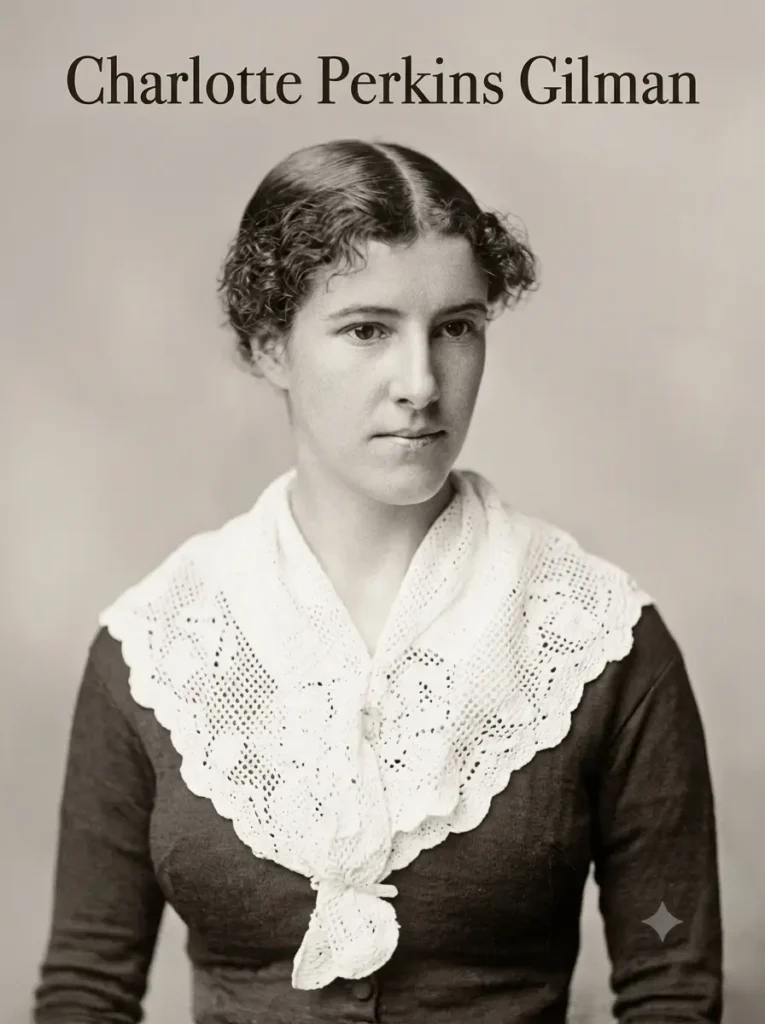
Charlotte Perkins Gilman (born 3 July 1860 in Hartford, Connecticut; died 17 August 1935 in Pasadena, California) was an American writer, lecturer, early sociologist and advocate of social reform. She is remembered for The Yellow Wallpaper, for her economic manifesto Women and Economics (1898), and for the utopian novel Herland (1915).
Her childhood was unsettled. Her father, Frederic Beecher Perkins, left the family shortly after she was born, and she grew up in poverty, moving often. This is worth getting right in an exam answer: the family was abandoned by her father, not bereaved by his death. The Perkins household did, however, belong to the famous Beecher family and stayed in touch with relatives such as the suffragist Isabella Beecher Hooker and the novelist Harriet Beecher Stowe. Her schooling was patchy, so she educated herself largely through reading, studied at the Rhode Island School of Design, and earned a living as a commercial artist and tutor. In 1884 she married the artist Charles Walter Stetson; their daughter Katharine was born in 1885. The marriage ended in separation in 1888 and divorce in 1894. In 1900 she married her cousin Houghton Gilman.
Gilman wrote for a living, mostly by lecturing, and she was a delegate to the 1896 suffrage convention in Washington, D.C. She argued that women’s confinement to the home was not nature’s design but a social and economic arrangement. Her thinking brought together gender, labour, health and architecture in a way that was unusual for her time.
Contributions to Literature and Social Reform
Gilman wrote on women’s rights, the unfairness of traditional gender roles, and the way mental health was treated, especially for women. Besides The Yellow Wallpaper, a few of her works are worth knowing for the exam:
- Women and Economics (1898) – argued that when women depend on men for money, their freedom and potential are limited, and that housework and childcare should be professionalised so that women can work outside the home.
- The Home: Its Work and Influence (1903) – a critical study of the home as a social institution and its effect on women’s lives.
- The Man-Made World (1911) – a critique of what she called an “androcentric” (male-centred) culture.
- The Forerunner (1909–1916) – the monthly magazine she wrote and edited almost single-handedly; much of her fiction, including Herland, first appeared there. Her essay explaining the origins of The Yellow Wallpaper was published in The Forerunner in October 1913.
- Herland (1915) – a utopian novel about a society of women.
- The Living of Charlotte Perkins Gilman (1935) – her autobiography, published after her death.
Her work helped shape feminist literature by showing how gender, health and social norms intersect. Her writing repeatedly called for a fairer and more empowering relationship between men and women, at home and in society.
A necessary caution. Gilman’s reputation is not without difficulty. Scholars have documented that her writing on race and immigration was racist and eugenicist, and some critics, notably Susan S. Lanser, have asked readers of The Yellow Wallpaper to keep this in mind. You do not need to dwell on it in a 20-mark answer on the story, but it is a fair point to raise if the question asks you to evaluate Gilman’s feminism critically.
Key Themes in Her Works
- Mental Health: Gilman often wrote about women’s mental health. In The Yellow Wallpaper, the narrator’s condition worsens through isolation and enforced idleness. Whether we call that postpartum depression, as many modern readers do, is a retrospective judgement; the story itself uses the husband’s phrases “temporary nervous depression” and “a slight hysterical tendency”.
- Gender Roles and Oppression: She criticised traditional roles for women and showed how these expectations restricted freedom and self-discovery.
- Women’s Independence: Her works encourage women to seek financial, social and intellectual independence.
- Marriage and Domestic Life: She criticised marriages in which women were expected to be submissive and dependent, and the way the home could become a place of confinement.
Background
Historical and Cultural Context of “The Yellow Wallpaper”
The Yellow Wallpaper was written in the late nineteenth century, when middle-class American women were expected to be wives and mothers and to stay within the “domestic sphere”, while public life, paid work and medicine belonged to men. These gender roles were enforced in many ways, including through medical advice. A woman who was unhappy, restless, ambitious or exhausted could easily be given a diagnosis such as neurasthenia (nervous exhaustion) or hysteria. The word “hysteria” itself comes from the Greek hystera, “uterus”, and reflects an old, now discredited belief that women’s mental distress came from the female body.
It was also a period of growing campaigns for women’s suffrage and rights. Women were speaking more openly through activism, lecturing and literature, and Gilman was part of that movement.
The Rest Cure: What It Was
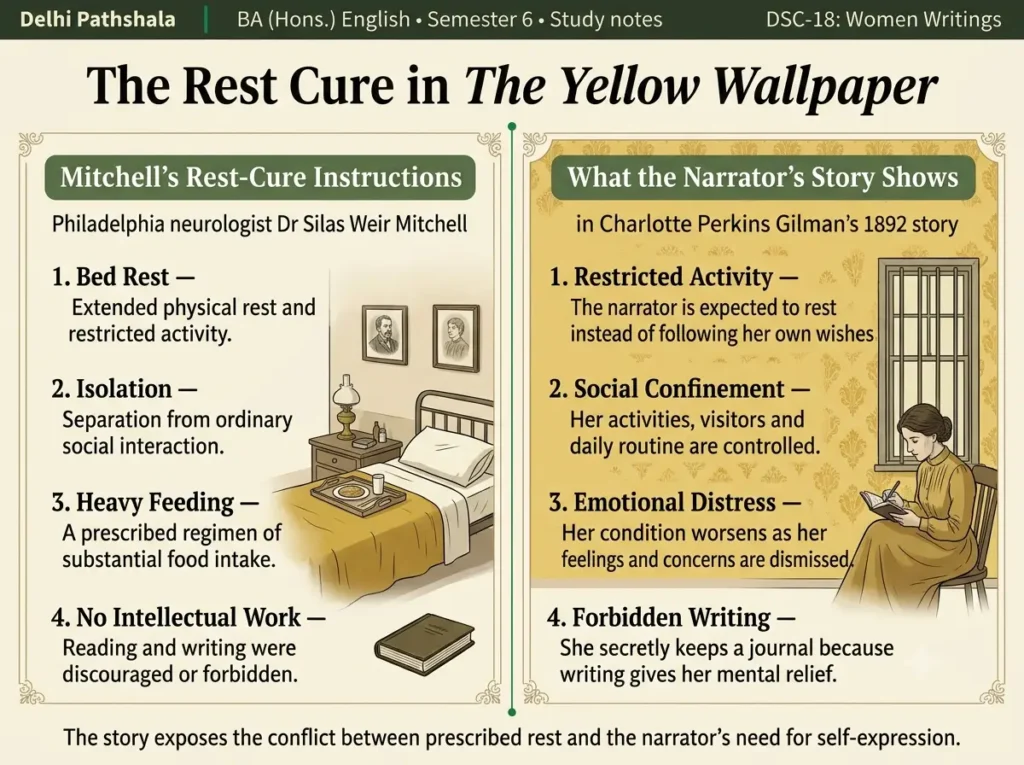
The rest cure was devised by the Philadelphia neurologist Dr Silas Weir Mitchell, who described it in his book Fat and Blood (1877) as a way of renewing the strength of “feeble people” through complete rest combined with heavy feeding (summarised in the American Journal of Psychiatry). In practice, the patient (usually a woman) was kept in bed for weeks, isolated from family and friends, fed a rich diet and given massage, and sometimes electrical treatment. Reading, writing and other mental effort were typically banned. The cure was adopted widely in the United States and abroad and remained popular into the early twentieth century. Today it is studied as an example of medicine that was harmful because it ignored what its patients actually needed. For a neurologist’s account of the Gilman–Mitchell encounter, see Jack Riggs in Hektoen International.
The Real-Life Source: Gilman and Dr Weir Mitchell
The story grows out of Gilman’s own experience, but you should be able to explain the facts precisely.
- After her daughter’s birth in 1885, Gilman suffered a prolonged and severe depression.
- In 1887 she consulted Dr Weir Mitchell. In her 1913 essay she recalls that he put her to bed on the rest cure, found her improved, and sent her home with advice to “live as domestic a life as far as possible”, to have only two hours of intellectual life a day, and never again to touch pen, brush or pencil.
- She says she obeyed for about three months at home, and came close to what she called “utter mental ruin”, before she threw the advice aside and went back to work.
- She wrote the story, she says, “with embellishments and additions”, and sent a copy to the physician. She adds that he never acknowledged it.
Gilman’s own gloss on her purpose is among the most quoted lines on the topic: the story “was not intended to drive people crazy, but to save people from being driven crazy”.
Is the Story Autobiography? A Scholarly Debate
Two points need to be kept apart in an exam answer.
- Gilman’s claim that Mitchell changed his treatment. In the 1913 essay she says she was told years later that the great specialist had altered his treatment of neurasthenia after reading the story. The literary historian Julie Bates Dock has discredited this claim: Mitchell continued his methods, and as late as 1908 was still interested in creating hospitals devoted to the rest cure.
- Who is the “real” target of the story? The historian Helen Lefkowitz Horowitz, in Wild Unrest (2010), argues from Gilman’s diaries and letters that the story in its original form was not a literal protest against Mitchell. It grew out of Gilman’s troubled relationship with her husband Walter Stetson, whom the physician-husband John personifies: a man who wanted a traditional wife and who denied her freedom and intellectual energy.
So the safest way to write is: the story is inspired by Gilman’s experience of the rest cure and of an unhappy marriage, but it is fiction. Gilman herself said she had added exaggerations and that she never had hallucinations.
Significance of the Short Story in Feminist Literature
The Yellow Wallpaper is seen as a key work in feminist literature because it shows how women’s voices were silenced and how male control over a woman’s body, time and activity could be presented as care. The story shows the effect of male authority on a woman’s mind, as the narrator’s condition worsens in the very conditions designed to cure her.
In feminist literary criticism, the story is important for its treatment of the narrator’s struggle for independence and her eventual, ambiguous rebellion. It also criticises the medical practice of its time, which treated women’s mental distress as simple weakness and not as something shaped by social conditions. The narrator’s fantasy of the woman who escapes the wallpaper is, on one reading, a picture of her wish to break free from the limits of her marriage and her society.
In short, the story is central to discussions of women’s writing, of gender and mental health, and of the harm that gender-based restriction can do.
Study Guide
Summary of the Short Story
The Yellow Wallpaper is told by a woman who is never properly named. She has been told to rest because she has what her husband, John, a physician, calls “temporary nervous depression – a slight hysterical tendency”. Her brother, also a doctor, says the same. She has recently had a baby, and the story strongly suggests this is the background to her condition, although the word “postpartum” never appears. John rents an isolated colonial mansion for the summer so that she can recover with “perfect rest and all the air I could get”.
John chooses the top-floor room, a former nursery, for them. It is large and airy, but the windows are barred, there are rings in the walls, the bed is heavy and apparently nailed down, and the room is papered in a yellow paper the narrator finds repellent. She is forbidden to “work”, which includes the writing she loves, and she begins a secret journal in which she describes the house, her husband’s kindness and her own growing fixation on the wallpaper.
Over the weeks she starts to notice a faint sub-pattern behind the main design. By moonlight the outer pattern turns into bars, and the figure behind it becomes clear: a woman, stooping and creeping, shaking the bars as if to get out. The narrator grows secretive and suspicious of John and his sister Jennie, who she thinks are also watching the paper. She begins to believe that the woman gets out by daylight and creeps along the road outside.
On the final day, with John away and the household preparing to leave, she locks herself in the room, throws the key out of the window, and strips the paper, helped, in her mind, by the trapped woman. When John breaks in, she tells him, “I’ve got out at last… in spite of you and Jane.” He faints, and she keeps creeping around the room, passing over his body each time.
The Plot Stage by Stage (Revision Table)
| Stage | What happens | Narrator’s state | Why it matters |
|---|---|---|---|
| 1. Arrival | The couple rent “ancestral halls” for the summer. The narrator jokes that the house might be haunted. John dismisses her ideas. | Sarcastic, self-doubting, still lucid | Opens as a Gothic tale but quickly becomes a study of marriage and medical authority |
| 2. The nursery | John chooses the top-floor nursery. She notes barred windows, rings in the walls, a bed that looks “nailed down” and torn yellow paper. John refuses to repaper it. | Uneasy but compliant | The room already looks like a place of confinement |
| 3. Forbidden writing | She is forbidden to work. She writes in secret and hides the journal when John or Jennie comes in. | Guilty, exhausted, but still resisting | Writing is her only outlet; secrecy shows her lack of power |
| 4. The Fourth of July and Weir Mitchell | Visitors tire her. John threatens to send her to Weir Mitchell in the autumn. | Fretful, tearful, afraid | The text itself names the real-life doctor of the rest cure |
| 5. Fixation | She lies on the immovable bed following the pattern. She starts to see a “sub-pattern” and then a woman creeping behind it. | Obsessed; sleeping badly at night | The wallpaper becomes a text she must “read” |
| 6. Moonlight and bars | At night the pattern turns into bars. She tells John she is not getting better; he refuses to leave early. | Convinced of the woman’s presence | The turning point: her inner world and the physical room merge |
| 7. Secrecy and suspicion | She sees John and Jennie looking at the paper. She notices the yellow smell and a “smooch” running round the wall. She sees creeping women outside. | Paranoid, but energetic and “better” in John’s eyes | John mistakes her fixation for recovery |
| 8. The last day | She and the “woman” peel off the paper. She locks the door, throws away the key and ties herself with a rope. | Determined, calm, exultant | The act of rebellion and the breakdown happen together |
| 9. The ending | John breaks in and faints. She says, “I’ve got out at last,” and creeps over him. | Fully identified with the woman | Ambiguous: triumph, defeat, or both |
Setting, Time and Place
The story gives no date and no place name. The narrator calls the house “a colonial mansion, a hereditary estate”, three miles from a village, with gardens, arbors, a bay and a private wharf. The only clock we get is the summer: the couple have been there two weeks when she picks up her journal, the Fourth of July visit comes during the stay, and a three-month rental is mentioned. Because it was written in 1890 and printed in 1892, a student can safely say the story is set in contemporary late-nineteenth-century America, but the text itself does not specify the year or the state. If a question asks “what year does The Yellow Wallpaper take place”, the accurate answer is that the story is undated; it was written in 1890 and published in 1892.
Analysis of Major Characters
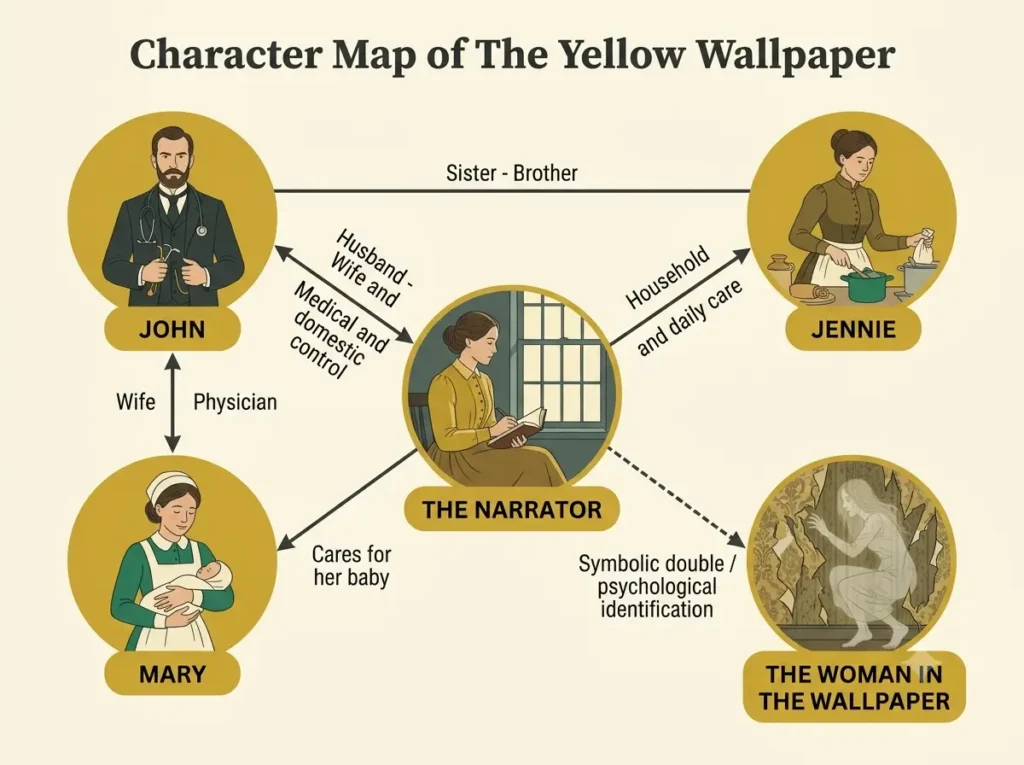
- The Narrator (The Woman)
- Starting point: She is a young wife and mother who is intelligent, imaginative and fond of writing. She calls her condition “nervousness”, defers to her husband and feels guilty at not being the helpful wife she means to be. She says she cannot be with her baby, which makes her “so nervous”, and the baby is looked after by a nurse, Mary.
- Change over time: Her confinement, the ban on writing and the lack of company or stimulation make her mental state worse. Her growing obsession with the wallpaper shows her hunger for something to think about, and ultimately her desire for freedom, which leads her to strip the paper from the wall.
- Meaning: Her “madness” can be read as a symbol of how women’s voices were ignored. Her breakdown represents both her collapse and her attempt to escape social limits. Whether it is a victory or a defeat is a matter of debate (see Critical Debates below).
- The name “Jane”: Almost until the last line the narrator is unnamed. Then she says, “in spite of you and Jane.” Many readers take “Jane” as her own name, which appears just when she thinks she has escaped; others note that John’s sister is called Jennie and read it as a slip in her disordered mind. The text does not settle the question, so in an exam write that the narrator is “unnamed” and that the name “Jane” occurs once at the end.
- John (The Husband)
- Starting point: John is a physician and the narrator’s husband. He is “practical in the extreme”, dislikes any talk of what cannot be “felt and seen and put down in figures”, and believes rest and air will cure her. He is affectionate in his own way: he calls her “little girl” and “blessed little goose”.
- Change over time: John does not notice how much worse his wife is getting. He mistakes her new quietness and appetite for improvement, laughing that she seems to be “flourishing in spite of” the wallpaper. His dismissal of her wishes, such as her request to go downstairs or to visit relatives, shows how completely he controls her life.
- Meaning: John represents the controlling attitudes of the male medical and domestic authority of the late nineteenth century. The point of the story is not that he is cruel; it is that kindness and control can coexist, and that his “caring” contributes to her breakdown. Note also that he does not lock her in; the narrator’s freedom is limited by his authority, not by a key.
- The Woman in the Wallpaper
- Symbolic role: The woman the narrator sees behind the pattern is not real in the story’s world but expresses the narrator’s own wish for freedom, and her sense of being trapped in her house, her marriage and her mind. Some critics call her the narrator’s double.
- Role in the story: At first the figure is “faint”, but she grows clearer; by the end there are “many” women, and the narrator sees them creeping outside. When the narrator frees the woman, she also frees, or loses, herself. Her question, “I wonder if they all come out of that wallpaper as I did?”, suggests that she sees her own situation as that of many women.
- Jennie, Mary and the narrator’s brother (minor characters)
- Jennie, John’s sister, is the housekeeper. She is “a perfect and enthusiastic housekeeper” who hopes for “no better profession”, a model of the domestic woman the narrator is expected to be. She thinks the writing is what made the narrator ill, and is another observer of her behaviour.
- Mary cares for the baby. The narrator is relieved that the baby does not have to live in the wallpapered nursery.
- The narrator’s brother is also a physician “of high standing” who agrees with John, so that two male medical voices speak against her own sense of what she needs.
Key Plot Points and Themes
- The Rest Cure and the Setting
- The story begins with the couple moving to a quiet house. This setting shows her isolation, both physical and emotional. John’s regime of a “schedule prescription for each hour in the day”, plus rest, tonics and an order not to “work”, reflects the rest cure and leads to her mental decline. John also threatens to send her to Weir Mitchell if she does not improve.
- Fixation on the Wallpaper
- As she stays in the room, she becomes obsessed with the yellow wallpaper. At first she is irritated by it, but she begins to see a woman trapped behind it, and the image strengthens as her mental health declines. The wallpaper symbolises her own feeling of being trapped in her life.
- Decline of the Narrator’s Mental State
- As she focuses on the wallpaper, she hides her thoughts from John, sleeps by day and watches by night, and becomes convinced that she must free the woman. Her breakdown reflects the effect of an oppressive regime on women of that time.
- Final Act of Rebellion
- At the climax, the narrator locks herself in, throws away the key, and strips the paper, thinking she is freeing the trapped woman. She creeps around the room, which is both her breakdown and her attempt to be free. When John faints, she creeps over him, the story’s final image of reversed power.
Climax and Ending Explained
The climax comes when John forces the door and the narrator, now creeping, announces that she has “got out at last”. Her last remark, “Now why should that man have fainted?”, is chilling because it shows her cheerful detachment. Three readings are common, and you should be able to state each.
- Triumph: she has escaped John’s control and the role of the obedient patient, and she literally stands over him.
- Defeat: she has escaped only into madness, and she is now confined in her own mind, with no way back.
- Both at once: the story gives her a victory that costs her sanity. This is the safest reading for an exam, because it can be supported with both feminist and psychological evidence.
Key Themes
- Gender Roles and Control
- A main theme is the restrictive gender role that traps the narrator. Her husband, while caring, imposes strict rules that take away her independence. Her distress is dismissed as “hysterical tendency”, reflecting how women’s voices were stifled in the nineteenth century.
- Mental Illness and the Treatment of Women
- The story criticises the way women’s mental health was treated, especially through the rest cure, which kept women isolated and controlled. The narrator’s decline shows how women’s suffering was often misunderstood.
- Freedom vs. Confinement
- Confinement is everywhere: the barred windows, the nailed-down bed, the gate at the head of the stairs, the locked door at the end. Her obsession with the wallpaper shows her desire for freedom, which she seeks in a destructive act.
- Identity and Self-Expression
- Throughout the story, the narrator struggles to express herself. She writes in secret, and she says the journal is “dead paper” and a relief to her mind. Her confinement and the dismissal of her concerns limit her identity, and her focus on the wallpaper expresses her need for autonomy. The story shows how denying someone self-expression can contribute to a breakdown.
- Writing, Reading and Interpretation
- The narrator is forbidden to write, so she begins to “read” the wallpaper instead, searching for order and meaning in its pattern. Critics such as Paula Treichler have argued that this makes the story a story about language and who is allowed to speak (see Critical Debates).
- Motherhood and Domestic Duty
- The narrator feels she is failing as wife and mother, is nervous around her baby, and is relieved that the baby does not have to live in the nursery. The story shows how an ideal of the devoted home-maker can itself weigh on a woman.
In short, The Yellow Wallpaper is a powerful story that critiques the treatment of women in the nineteenth century, especially in relation to mental health and restrictive roles. Through its strong symbols and the narrator’s descent, the story highlights the harmful effects of patriarchal control and the silencing of women.
Early Responses to the Story
Critical Reception Upon Publication
When The Yellow Wallpaper first appeared in January 1892, it got a mixed reception. Several details are documented:
- The editor of the Atlantic Monthly is reported to have rejected the story, saying he could not forgive himself for making readers as miserable as the story had made him.
- In April 1892 a letter in the Boston Evening Transcript (signed “M.D.”) complained that the story gave no pleasure and could even be dangerous to readers who had experience of mental illness or a family history of it. In her 1913 essay Gilman recalls that a Boston physician had protested in the Transcript that the story was enough to drive anyone mad.
- On the other side, Gilman recalls that a physician in Kansas wrote to say it was the best description of incipient insanity he had seen, and asked whether she had been there herself. A review of the 1899 edition in The Woman’s Journal praised it as a graphic account of why women who lead monotonous lives are prone to mental illness.
So, many readers saw the story at first as a horror or psychological case study rather than as social criticism. It resonated with some feminist readers who saw a quiet attack on how society and medicine treated women.
From Neglect to Canon: Rediscovery
The story became a standard classroom text only after feminist criticism took it up. The Feminist Press reprinted it in 1973 with an afterword by Elaine Hedges, and Virago brought out a British edition in 1981. It is now described as the all-time bestselling title of the Feminist Press, and it is anthologised and taught widely. Feminist critics argued that the story had been neglected partly because readers were not trained to read its social critique. Horror writer H. P. Lovecraft had already praised it in 1927, in Supernatural Horror in Literature, as a classic study of madness in a hideously papered room.
Awards and Honors Received by the Story
I could not find any record of formal literary awards for The Yellow Wallpaper, so this should not be treated as a “prize-winning” text in an exam. Its honours are of a different kind: it has been adapted for radio, stage, television and film (for example a 1989 BBC production shown in the United States on Masterpiece Theatre, and radio versions with the actress Agnes Moorehead in 1948 and 1957), and it has become a standard text in courses on feminist literary criticism, American literature, the Gothic, and medical humanities. Its importance has grown a great deal over time.
Form and Narrative Style
Journal Form: Is the Story Epistolary?
The Yellow Wallpaper is told through journal (diary) entries written by the narrator. In the strictest sense, an “epistolary” work is made of letters, so the safest term in an exam is diary or journal form. Some critics loosely group such stories with epistolary fiction because both present the text as a document written by a character, and you can say that if the question uses the word “epistolary”, but it is better to explain what the form actually is: a series of undated, unevenly spaced secret entries.
This format makes the story feel personal and immediate, letting readers see the narrator’s thoughts and feelings with no narrator to filter them. It also lets Gilman show the narrator’s mental breakdown step by step, which makes the climax more powerful. The journal is also part of the story’s argument: she writes it in secret, hiding it whenever John or Jennie comes in, and she calls it “dead paper”, a place where she can say what she cannot say aloud. Her need to hide her writing highlights her growing isolation and frustration. Her sentences also change as the story goes on: they are fluent and ironic in the opening pages, and become short, broken and obsessive as her attention narrows to the wallpaper.
Use of First-Person Narrative
The story is told in the first person by the unnamed woman. This allows readers to understand her mental state and emotional struggles directly, and it is crucial to the story’s impact, because we feel her suspicions and her changing perceptions from inside.
By using the first person, Gilman immerses readers in the narrator’s increasingly unstable consciousness. The narrator’s voice becomes more confusing and unreliable as her obsession with the wallpaper grows, which strengthens the feeling of being trapped: readers see the world only through her limited and distorted view. At the same time, the first-person form lets us notice what she does not: that John’s “care” is a form of control, that her symptoms are worsening, and that her “improvement” is not what John thinks it is. The gap between what she says and what we understand is where much of the story’s dramatic irony lies.
Narrative Techniques Employed by Gilman
- Psychological Realism:
- Gilman shows the narrator’s slow decline into delusion. Her growing obsession with the wallpaper reflects this, and the prose becomes more fragmentary as she loses touch with reality. This makes the story a strong psychological exploration.
- Symbolism:
- The yellow wallpaper is the key symbol. It stands for the restrictions placed on women and for the narrator’s mental confinement. Her growing fixation shows her awareness of her limits, physical and mental. The woman trapped behind the paper symbolises the narrator’s wish to escape her oppressive life.
- Foreshadowing:
- Gilman hints at the narrator’s eventual breakdown early on. The opening mentions a house that might be haunted, and she says there is “something queer about it”. She is uneasy about the wallpaper long before she understands why. Details such as the “sickly” colour become more important as the story goes on, and the mention of Weir Mitchell early on prepares us for the threat of a worse confinement.
- Unreliable Narrator:
- The narrator’s unstable mental state makes her an unreliable storyteller. She tells us the bed is “nailed down, I believe”, and offers explanations for the room’s marks that are plainly wrong (she blames the children). We cannot be sure what is objectively true. This adds tension and creates a feeling of unease. Her inability to tell reality from delusion adds to the story’s horror.
- Use of Repetition:
- Gilman uses repetition, especially of the question “what is one to do?”, of the words “creep” and “creeping”, and of her descriptions of the pattern. These repetitions reflect the narrator’s sense of confinement and the circular movement of her thoughts.
- Irony:
- Dramatic irony runs through the story: John says she is “flourishing in spite of” the paper, when she is flourishing because of it, and the room he insists is airy and comfortable is a nursery with barred windows. Verbal irony appears in the narrator’s remarks, such as her comment that jumping from the window would be “admirable exercise”, but that she would not do it, because a step like that might be “misconstrued”.
- Gothic Elements:
- The story opens with the language of the haunted-house tale (“ancestral halls”, “a haunted house”), and includes a secluded mansion, a locked room, a figure behind the wall and a double. Whether the Gothic is the story’s real subject or its disguise is a matter of critical debate (see below).
In summary, Gilman’s narrative techniques, especially the diary form, the first-person unreliable narrator, the symbolic wallpaper and the realistic portrayal of the narrator’s decline, work together to create a strong critique of how women were treated by medicine and society. The story’s simple form allows a deep exploration of its main themes.
Themes of Mental Health
Portrayal of Mental Illness and Its Treatment
The Yellow Wallpaper shows mental illness through the narrator’s worsening state. Her condition is never named in the story; John’s phrase is “temporary nervous depression – a slight hysterical tendency”. Modern readers, and a number of medical writers, generally interpret her state as postpartum depression that develops into something closer to psychosis, though this is a retrospective reading and not a diagnosis the text itself makes. The same caution applies to Gilman herself: she wrote that she had suffered a “severe and continuous nervous breakdown”, but she insisted she never had hallucinations, so we should not equate her experience with the narrator’s.
The story shows how the narrator’s mental health worsens because she is isolated, confined and has no control over her life. She becomes obsessed with the yellow wallpaper, which represents her struggle: she thinks she sees a woman trapped in it, mirroring her feeling of being trapped in her house and mind. Her distress is repeatedly dismissed by those around her.
A more recent line of reading, associated with feminist disability studies, asks whether the narrator is being treated as a “disabled” or deviant woman whose difference must be corrected. Suhana Simran of Miranda House, University of Delhi, argues in this vein that the woman in the wallpaper can be seen as the reviled “other”, and that the story can be read as a forerunner of later movements in which psychiatric patients speak back to the system.
Critique of the Medical Practices of the Time
A major target of the story is the medical practice of the late nineteenth century, especially the rest cure. The narrator’s husband, who is also her doctor, believes that complete rest and “air” will help her, and he sets a timetable for her day. The text never uses the term “rest cure” itself, but it names Weir Mitchell as the doctor to whom John will send her if she does not improve, and the narrator says that a friend who was in his hands found him “just like John… only more so”.
The story shows that this treatment is harmful. The narrator is not allowed to write or to see the people she likes, and her condition worsens. Gilman criticises a medical approach that treated women as weak and passive and ignored their own descriptions of their needs. As the critic Paula Treichler has argued, the diagnosis in the story is a powerful, public, male voice that dictates how the female patient may describe her own condition and the world around her.
The narrator’s breakdown shows how the medical establishment often overlooked women’s experience and labelled their problems “hysteria”. The failure to understand her condition and the denial of an emotional or intellectual life lead to her collapse, which makes the “cure” seem more like punishment.
Impact of Societal Expectations on Mental Health
Societal expectations for women, especially about home life and motherhood, greatly affect the narrator’s mental health. Women were expected to be caring, devoted to their families and content with domestic duties. Behaviour outside these norms was seen as strange, and women with mental-health problems were often judged weak.
The narrator’s guilt shows the pressure of these roles: she writes that it weighs on her “not to do my duty in any way”, and that she is a “comparative burden” to John. Her confinement, physical and emotional, intensifies her illness. Gilman suggests that women’s mental distress is often linked to social expectations and gender roles, not just to individual weakness.
Themes of Gender and Patriarchy
Representation of Gender Roles and Expectations
The Yellow Wallpaper strongly criticises the strict gender roles of the late nineteenth century. The narrator’s treatment is built on the assumption that as a woman she is weak and cannot be trusted to know what is good for her. John represents male authority: he knows what is best, and the narrator’s own opinion (“personally, I disagree with their ideas”) counts for nothing.
The narrator’s confinement and lack of intellectual freedom reflect a social view that women should stay in the home, be obedient and avoid intellectual activity. Women were seen as emotional and passive, and their desires for independence were ignored. This is the idea of “separate spheres”: a public world for men and a domestic world for women. The wallpaper symbolises her confinement, in her room and by social expectations.
Critique of Patriarchal Society
At its core, The Yellow Wallpaper criticises patriarchy. Through John, Gilman shows how society marginalises women. He treats his wife like a child (“little girl”, “blessed little goose”), disregards her worries and limits her mental and creative activity. His failure to see her need for independence shows the deep-rooted gender bias of the period.
Gilman shows how medical and social systems aimed to control women instead of understanding them. John’s dismissive attitude and insistence on a regimen of rest show how patriarchal authority could harm women’s mental health, even when it came with real affection. The scholar Martha Cutter has described Gilman’s fiction as exposing a struggle in which the male-dominated medical establishment tries to silence women.
The story also shows that traditional family structures, based on male authority, limited women. Women were expected to focus on their husbands and children, and any deviation was viewed negatively.
Impact of Male Dominance on Female Characters
The effect of male dominance is shown through the narrator and John. Even with good intentions, John’s control and dismissal of the narrator’s feelings contribute to her breakdown. He embodies a society that believed women needed to be managed for their own safety and health.
As the story continues, it is clear that John’s treatment and lack of respect for her opinions deepen her obsession with the wallpaper and her decline. He controls her health care, her daily timetable, her room, her company and her creative expression. By treating her like a child, he increases her feeling of powerlessness.
The story suggests that a male-dominated society harmed women’s mental health, self-worth and identity. The narrator’s struggle to regain control and freedom symbolises a larger fight against patriarchal control. At the same time, remember that Jennie, the narrator’s “good” sister-in-law, shows that the system also depended on women who accepted domestic duty and policed one another.
In summary, The Yellow Wallpaper examines how a patriarchal society harms women’s mental health and how strict gender roles and male dominance contribute to their oppression. By depicting the narrator’s descent under these forces, Gilman critiques the medical and social systems that limited women’s freedom and denied them autonomy.
Symbolism and Imagery
The Yellow Wallpaper as a Symbol
The yellow wallpaper is the story’s central symbol. It shows the narrator’s feeling of being trapped, her worsening mental health, and her desire for freedom and self-expression. At first she calls it hideous: “repellent, almost revolting; a smouldering unclean yellow”, with “sprawling flamboyant patterns committing every artistic sin”. But she gradually becomes obsessed with it, and starts to see a woman behind it, trying to escape.
The paper also stands for the limits placed on women. It reflects the male-dominated society that restricts her, forcing her into a limited role as a wife and mother. The narrator tries to find an order in the pattern (“I know a little of the principle of design”) and cannot, which mirrors her failure to make sense of her own situation. The pattern is also like a text she is not allowed to write: critics have noted that when she is forbidden to write and read, she begins to “read” the wallpaper instead.
When she finally tears at the paper, she is fighting back and seeking freedom. When she thinks she has freed the woman, it is a symbol of her own release, but a release that comes with the loss of her reason. The wallpaper represents her fight for freedom and identity, and the price she pays.
Other Symbols and Their Meanings
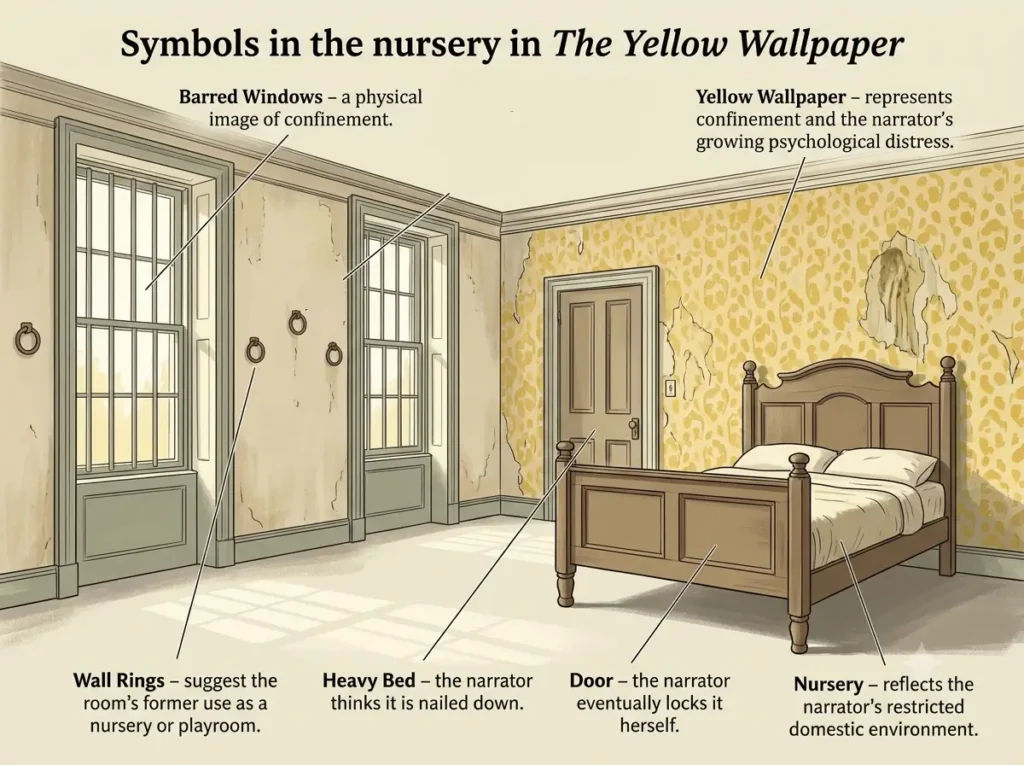
- The Room (the Nursery):
- The room where the narrator is kept is a former nursery, and also, she thinks, a playroom and a gymnasium. The windows are barred “for little children”, there are rings in the walls, and a gate at the head of the stairs. All this makes her room resemble a nursery or even an institution, suggesting that she is being treated like a child. The narrator repeats John’s reasoning that it is “an airy and comfortable room as any one need wish”, but the details undermine that description. It symbolises her mental and emotional confinement. One important correction: the door is not locked by John. The narrator locks it herself at the end and throws the key into the front path.
- The Bed:
- The bed is heavy and, the narrator thinks, nailed down; at the end she tries and fails to move it, and finds it “fairly gnawed”. It stands for her confinement and for the rest regimen (she is made to lie down after meals). Like the room and the wallpaper, it shows the oppressive nature of her treatment.
- The Windows:
- The windows are both a barrier and a promise of escape. From them she sees the garden, the bay and the road, but the bars make it impossible to leave. They show her wish for freedom while highlighting her entrapment. From the window she also sees the creeping women outside, a sign that her delusion has spilled into the outside world.
- The Woman in the Wallpaper:
- The woman represents the narrator’s feeling of being trapped. The narrator believes she wants to escape, as she does. The woman shakes the pattern like prison bars and creeps. When the narrator thinks she has freed her, it is her final act of resistance, even if it costs her sanity.
- The Smell and the “Smooch”:
- The paper has a “yellow smell” that creeps through the house, and it leaves yellow stains on clothes. A long, smooth mark runs round the wall at shoulder height; at the end the narrator finds that her own shoulder “just fits” in it. These details show that the “woman” and the narrator have become one, and that someone has circled this room before.
- The Rope and the Key:
- The narrator keeps a rope hidden, to tie the woman if she tries to get away, and throws the key out of the window. The key is her one act of control over the space, and the rope hints at the danger of that control turning inward.
Use of Imagery to Show Themes
Gilman uses imagery in The Yellow Wallpaper to highlight the themes of mental illness, gender roles and the narrator’s growing obsession with her entrapment.
- Wallpaper Pattern Imagery:
- The detailed and confusing pattern is central. She compares it to “an interminable string of toadstools” and sees eyes in it that “stare at you upside down”. The pattern’s lack of order, which she calls “a defiance of law”, represents her confused mental state. Her obsession shows a growing disconnection from reality.
- Sunlight and Moonlight Imagery:
- Light changes the paper and the narrator’s perception. In the daytime, “by daylight she is subdued, quiet”, the woman is faint; by moonlight and at night, the pattern turns into bars and the woman becomes plain. (A correction: the room is not dim. The narrator says it is “airy”, with “air and sunshine galore”.) The contrast is between day, when she must act the “well” wife, and night, when her fixation takes over.
- Nature Imagery:
- Through the windows she sees the garden, trees, a bay and a lane, representing freedom and life. But she cannot join this world, and when she imagines creeping outside, she says that “everything is green instead of yellow”. Nature highlights what she is missing.
- Imagery of the Woman’s Struggle:
- The woman shaking the bars, “trying to climb through” and being “strangled” by the pattern is an image of the narrator’s own struggle. The more she identifies with her, the more her own fragmentation and hunger for freedom show.
- The Colour Yellow:
- The colour is described as sickly and unclean, “a dull yet lurid orange” in some places and “a sickly sulphur tint” in others. It stands for decay and illness, and some critics also link it to warning or danger. Yellow is not given one fixed meaning, and readers have connected it with everything from the narrator’s illness to the sensational “yellow press” of Gilman’s day (see Critical Debates).
In summary, the symbols and imagery of The Yellow Wallpaper work together to explore mental illness, gender roles, and the narrator’s struggle for freedom. The wallpaper, the room, the window and the changing light show her confinement and her growing obsession with finding mental and emotional freedom.
Critical Debates: How Scholars Read the Story
One of the quickest ways to lift an answer from “summary” to “analysis” is to show that critics disagree. These are the main debates, with attribution. Treat each as an interpretation, not as settled fact.
- Is the ending a victory or a defeat? Some feminist critics read the ending as a woman’s assertion of agency in a marriage that has trapped her, and point to her creeping over John as a symbolic rising above him. Others stress that the victory is bought with her sanity, and that she has escaped only into delusion.
- Horror story or social critique? The story has long been read as a Gothic tale. The editor Alan Ryan called it one of the finest tales of horror ever written, and H. P. Lovecraft praised it in 1927. Later readers, such as Greg Johnson, have argued that it is a Gothic allegory in which the horror carries the social meaning, rather than competing with it.
- Who is the real target: Mitchell, John or society? Gilman presents the story as an attack on the rest cure; Helen Lefkowitz Horowitz argues that its emotional source was Gilman’s marriage to Walter Stetson (see Background above).
- Is it a story about language? Paula Treichler (1984) argues that the story is as much about who is allowed to speak and write as about illness. The diagnosis is a male discourse imposed on the female patient. On her reading, the wallpaper can be taken as a symbol of discourse, and the woman in it as a figure of women’s language that only becomes possible when women gain the right to speak.
- Race and the “politics of color”. Susan S. Lanser (1989) places the story and its feminist criticism within the racial anxieties of turn-of-the-century America, and asks readers to take Gilman’s racism into account. Others, including Denise D. Knight, have written about the “shadow of racism” in Gilman’s work.
- Yellow journalism. Sari Edelstein (2007) argues that the story can be read as an allegory of Gilman’s dislike of the sensational “yellow press”; she links the narrator’s hatred of the “flamboyant” pattern to Gilman’s distaste for tabloid exaggeration.
- Disability studies. Suhana Simran, writing from Miranda House, University of Delhi, reads the story as a case of a woman’s difference being “corrected” by medicine against her will, and the wallpaper woman as the reviled “other”.
- Did Mitchell change his methods? Gilman said so; Julie Bates Dock’s research on the story’s publication and reception discredits the claim.
| Critic / Source | Year | Main argument | Use it when answering on |
|---|---|---|---|
| Gilman, “Why I Wrote The Yellow Wallpaper” | 1913 | The story was a warning, “to save people from being driven crazy” | Authorial intention, rest cure |
| Paula A. Treichler | 1984 | Diagnosis is a male voice that controls the female patient; the wallpaper as discourse | Language, silencing, writing |
| Susan S. Lanser | 1989 | Feminist reading of the story must also consider race and the politics of colour | Critical evaluation, limits of feminist readings |
| Greg Johnson | 1989 | Gothic allegory of rage and redemption | Gothic elements, horror vs critique |
| Julie Bates Dock | 1998 | Discredits Gilman’s claim that Mitchell changed his methods; studies publication and reception | Reception, rest cure |
| Sari Edelstein | 2007 | Wallpaper as an allegory of the yellow press | Alternative symbolism |
| Helen Lefkowitz Horowitz | 2010 | Story emerges from Gilman’s marriage to Stetson more than from Mitchell’s treatment | Autobiography vs fiction |
| Suhana Simran (Miranda House, University of Delhi) | n.d. in source | Feminist disability-studies reading; the wallpaper woman as the “other” | Mental illness, medicine, agency |
The Yellow Wallpaper Within DSC-18: Confinement in Unit II and Beyond
In the DU syllabus, Gilman’s story sits in Unit II alongside Begum Rokeya’s Sultana’s Dream and Rassundari Devi’s Amar Jiban. A question may ask you to compare women’s experience of confinement across two texts, so it helps to see them side by side.
| Text | Space of confinement | Who or what confines | How the woman resists | Outcome |
|---|---|---|---|---|
| The Yellow Wallpaper (Gilman, 1892) | A barred top-floor nursery | A physician-husband, a brother-physician and a medical regime | Secret writing; “reading” the wallpaper; stripping the paper | Ambiguous: freedom and breakdown together |
| Sultana’s Dream (Rokeya, 1905) | Women’s seclusion and the veil in the narrator’s real world | Social and religious custom | Imagination: a dream of Ladyland, where men are kept indoors | Sultana wakes; the vision remains as hope |
| Amar Jiban (Rassundari Devi, 1876) | The household and its duties in nineteenth-century Bengal | Custom and the family’s opposition to women’s literacy | Learning to read in secret, and later writing her life | An autobiography, widely regarded as the first by a Bengali woman |
| The Color Purple (Walker, Unit I) | An abusive marriage and community | Racism, sexism and family violence | Letter-writing and, in time, solidarity with other women | Recovery and community |
A few connections will strengthen an answer:
- Writing as survival. The narrator’s secret journal, Celie’s letters and Rassundari’s autobiography are all forms of self-expression. In Gilman’s story, the writing is forbidden and the outcome is breakdown; in Amar Jiban, the author’s literacy is hard-won and ends in a published life.
- Dream and utopia. Gilman later wrote her own utopia, Herland (1915), which came ten years after Rokeya’s Sultana’s Dream (1905). Both imagine women’s societies, but The Yellow Wallpaper is the dark counterpart: it shows the world those utopias are reacting against.
- Madness and the domestic space will return in Unit III with poets such as Sylvia Plath and Emily Dickinson, so keep your notes on the wallpaper handy for the later poems.
Important Quotations from the Story
All quotations below are short extracts from the 1892 text, which is in the public domain (the full text is free at Project Gutenberg). Learn the context and the point each one helps you make.
| Quotation | Where it comes from | Why it matters |
|---|---|---|
| “John laughs at me, of course, but one expects that in marriage.” | Opening page | Ironic acceptance of marital hierarchy; sets up the relationship |
| “temporary nervous depression – a slight hysterical tendency” | Opening page | John’s diagnosis; shows how medical language minimises her distress |
| “this is dead paper and a great relief to my mind” | Opening page | The secret journal as the narrator’s outlet |
| “sprawling flamboyant patterns committing every artistic sin” | First description of the paper | Early, still lucid and witty view of the wallpaper |
| “I have a schedule prescription for each hour in the day” | Early entry | John’s control over her time; the rest-cure regime |
| “at night… it becomes bars!” | Mid-story | The turning point where the pattern becomes a cage |
| “a woman stooping down and creeping about behind that pattern” | Mid-story | The first clear image of the trapped woman |
| “I wonder if they all come out of that wallpaper as I did?” | Near the end | Her sense that her situation is shared by many women |
| “I’ve got out at last… in spite of you and Jane.” | Final scene | The ambiguous declaration of freedom; the name “Jane” |
| “Now why should that man have fainted?” | Last lines | Chilling detachment; reversal of power |
How to Write a Strong 20-Mark Answer on This Story
- Open with context, in two or three lines: Gilman, 1890/1892, the rest cure, the journal form. Do not spend a paragraph on biography.
- State a line of argument early, for example: the story presents the narrator’s breakdown as produced by the very treatment meant to cure her, and the ending is a victory that costs her sanity.
- Support each point with a detail from the text: the barred windows, “nailed down” bed, the rope, the key, John’s fainting.
- Bring in one critical voice with attribution (Treichler on language, Horowitz on the marriage, or Simran on disability), and use the words “one reading” or “some critics” for contested claims.
- End with the ambiguity: triumph, defeat or both.
For a question such as “a first-person account of the unnamed protagonist’s descent into ‘madness’”, remember that the question has two parts to examine: first-person (reliability, intimacy, irony) and madness (whether it is illness, protest or both). Do not only describe her decline; question the word “madness”.
Conclusion
Key Points Summary
The Yellow Wallpaper by Charlotte Perkins Gilman tells the story of a woman’s struggle with mental illness and confinement. It deals with isolation, control, mental health and the roles of women. It criticises the medical treatments of the late 1800s, above all the “rest cure”, in a story that grew out of Gilman’s own experience but is a work of fiction. The yellow wallpaper symbolises both her physical and mental confinement and her fight for freedom. Her obsession with the woman she believes is trapped inside it reflects her own sense of being trapped and the limits society places on women.
The themes of gender and control are central. John, the narrator’s husband, represents the way society controlled women while sincerely believing it was helping them. As the narrator’s mental health worsens and her isolation grows, the story builds to an ambiguous ending in which freedom and breakdown cannot be separated.
Importance of The Yellow Wallpaper Today
Although it was written well over a century ago, the story still matters. It raises questions about women’s mental health at a time when awareness of postpartum conditions has grown, though problems remain in how women’s symptoms are heard. It anticipates modern debates about whether patients are really listened to by those who treat them, and about the way “care” can turn into control. Its themes of domestic confinement, gender inequality and the fight for women’s independence remain part of feminist discussion.
The story’s symbolism, especially the wallpaper, continues to prompt questions about whose voices are ignored, and its influence can be seen in later writing about women and madness. It has also been adapted repeatedly for stage, radio, television and film, which shows how readily new generations find something in it.
Final Thoughts on Gilman’s Impact on Women’s Writing
Charlotte Perkins Gilman’s The Yellow Wallpaper is a major work in feminist literature and in women’s writing. Through her own experience, and through her criticism of society and medical systems, Gilman created a story that challenges views of women’s mental health and independence and engages broader questions about oppression, identity and self-expression. Reading it critically also means remembering the limits of Gilman’s own thinking on race, as scholars have pointed out.
Ultimately, The Yellow Wallpaper is both a warning and a call for action: a reminder to understand mental health better, to listen to women’s voices, and to keep working for equality and independence.
Continue Reading
Continue Reading – DSC-18: Women Writings
- Alice Walker: The Color Purple Summary – Unit I, for the comparison of women’s writing as survival
- Begum Rokheya: ‘Sultana’s Dream’ – Unit 2B, the next text in Unit II
- Rassundari Devi: Amar Jiban (My Life) – Summary, Themes and Analysis – Unit 2C, women’s life-writing in nineteenth-century Bengal
- All Women Writings notes (BA Hons English, Semester 6)
- DU BA English Previous Year Questions
University of Delhi Previous Year Questions
DU Previous Year Questions
Frequently asked questions from DU exam papers on Charlotte Perkins Gilman’s “The Yellow Wallpaper”. Tap a question to view a quick-answer guide.
1 “The Yellow Wallpaper is a first person account of the unnamed protagonist’s descent into ‘madness.’ Discuss.” +
2 “It is so hard to talk with John about my case, because he is so wise and because he loves me so.” Comment with reference to context. +
3 “Gilman’s ‘The Yellow Wallpaper’ has been variously interpreted as a woman’s descent into madness or a woman’s reclaiming of agency. Explain.” +
4 “Personally, I disagree with their ideas. Personally, I believe that congenial work, with excitement and change, would do me good.” Critically analyse the woman’s disagreement with the male doctors’ diagnosis of her illness and its treatment in Charlotte Perkins Gilman’s ‘The Yellow Wallpaper’. +
Frequently Asked Questions (FAQs)
What is The Yellow Wallpaper about in simple words?
It is the story of a woman who is confined to a barred room by her doctor-husband for a “rest cure”. Forbidden to write, she becomes obsessed with the yellow wallpaper, imagines a woman trapped behind it, and in the end strips the paper and believes she has escaped.
What year does The Yellow Wallpaper take place?
The text gives no year or place. Gilman wrote it in 1890 and it was published in January 1892, so it is set in the contemporary late nineteenth century.
Does the narrator have a name?
She is unnamed for almost the entire story. In the final scene she says “in spite of you and Jane”. Many readers take “Jane” to be her name; others read it as a confused reference. The text does not settle it.
Why does the narrator become obsessed with the wallpaper?
She has been denied work, writing, company and stimulation, so the only thing left to occupy her mind is the pattern. Her search for order in it, and later for a figure behind it, expresses her need for meaning, and her wish to escape. Critics also read the wallpaper as a text that she “reads” because she may not write.
Did she go mad or did she escape?
Both readings are supported by the text. She escapes John’s control, and she literally creeps over him, but she does so in delusion. Many critics therefore describe the ending as a victory that costs her sanity.
Is the woman in the wallpaper real?
Within the story the figure appears only to the narrator, and the narrator’s reliability is questionable, so it is generally read as her projection. The Gothic setting leaves room for a “ghost story” reading, but the text never confirms it.
What was the rest cure, and did Gilman really undergo it?
The rest cure was Dr Silas Weir Mitchell’s treatment of prolonged bed rest, isolation, feeding and limited mental activity. Gilman consulted him in 1887, and later wrote that she followed his advice to give up writing for about three months at home before abandoning it.
Is the story completely autobiographical?
No. It was inspired by Gilman’s experience, but she described it as containing “embellishments and additions”, and she said she never had hallucinations. Scholars such as Helen Lefkowitz Horowitz also argue that her marriage to Walter Stetson was as important a source as her treatment by Mitchell.
Is The Yellow Wallpaper an epistolary story?
Strictly, no: “epistolary” refers to letters. It is told in journal or diary entries. If an exam question uses the word “epistolary”, explain the difference and say that the diary form shares some effects with it.
What does the colour yellow symbolise?
There is no single fixed meaning. In the story it is “sickly”, “unclean” and “lurid”, linked with illness and decay. Critics have also tied it to warning, to the narrator’s fear, and to the sensational “yellow press” of Gilman’s time.
Why does John faint at the end?
The text does not explain it. Most readers see it as his shock at the sight of his wife creeping on the floor, and at the collapse of his confident control. The narrator’s own comment, “Now why should that man have fainted?”, shows how far she has moved from his world.
How does the story connect with the other Unit II texts?
All three Unit II texts deal with women’s confinement and with writing or imagination as a means of resistance. Gilman’s narrator writes in secret and breaks down; Rokeya’s Sultana dreams of Ladyland; Rassundari Devi learns to read and writes her own life.
References and Further Reading
- Gilman, “Why I Wrote The Yellow Wallpaper”, The Forerunner, October 1913 – the author’s own account of the 1887 rest cure and her purpose.
- Project Gutenberg: The Yellow Wallpaper (public-domain text)
- Charlotte Gilman, Weir Mitchell, and “The Yellow Wallpaper”, Hektoen International – a neurologist’s account of the Mitchell consultation.
- Charlotte Perkins Gilman and “The Yellow Wallpaper”, American Journal of Psychiatry, Images in Psychiatry (2007)
- University of Delhi syllabus, BA (Hons.) English, Semester VI DSC (includes DSC-18: Women Writings)
- Wikipedia: The Yellow Wallpaper and Wikipedia: Charlotte Perkins Gilman – useful for the bibliography of critical works.
- Scholarly works named above: Paula A. Treichler, “Escaping the Sentence: Diagnosis and Discourse in ‘The Yellow Wallpaper’” (JSTOR); Susan S. Lanser, “Feminist Criticism, ‘The Yellow Wallpaper’, and the Politics of Color in America” (JSTOR); Helen Lefkowitz Horowitz, Wild Unrest: Charlotte Perkins Gilman and the Making of “The Yellow Wall-Paper” (Oxford University Press, 2010); Julie Bates Dock, Charlotte Perkins Gilman’s “The Yellow Wall-Paper” and the History of Its Publication and Reception (Pennsylvania State University Press, 1998).
Subscribe to keep reading
You've used your free notes for now. Get Delhi Pathshala Premium for unlimited access.
Subscribe — ₹29/30 days