
Contents
- History of China’s Political System
- Imperial China (221 BCE – 1912 CE)
- Late Qing Dynasty and Decline of Imperialism (19th Century)
- Republic of China (1912 – 1949)
- Shift from Imperial Rule to the People’s Republic of China
- Rise of the Communist Party of China (CPC)
- Political Traditions and Constitutional Development: A Timeline
- Key Features of China’s Socialist Political System
- Role of the Communist Party of China (CPC)
- Socialism with Chinese Characteristics
- Government Structure
- Control Over Society and Media
- Foreign Policy and Global Role
- The Constitution of China
- 1. Features of the 1982 Constitution
- 2. Socialism with Chinese Characteristics (Constitutional Dimension)
- 3. The Role of the Communist Party of China in the Constitution
- 4. Constitutional Amendments
- Is China a Unitary State? Structure and Centralization
- 1. Centralized Political Power
- 2. Historical and Cultural Roots of Centralization
- 3. The CPC’s Role in Maintaining Unitary Control
- 4. Economic Decentralization vs. Political Centralization
- 5. Autonomous Regions and Their Limits
- The Executive in China
- The President: Powers, Functions, and Limitations
- The Premier and the State Council: Structure and Responsibilities
- The Role of the People’s Liberation Army (PLA) in Governance
- Comparison Table: President vs. Premier
- The Legislature in China: National People’s Congress (NPC)
- Structure and Composition of the NPC
- Functions and Powers of the NPC
- The Legislative Process in China
- The Role of the Standing Committee of the NPC
- Formal Power vs. Actual Practice — Comparison Table
- The Electoral System
- 1. Direct vs. Indirect Elections
- 2. Election of the National People’s Congress
- 3. The CPC’s Role in Elections
- 4. Village-Level (Grassroots) Elections
- 5. Criticisms of the Electoral System
- 6. The CPC’s Justification
- The Judiciary in China
- Structure and Hierarchy of Courts in China
- The Role of the Supreme People’s Court (SPC)
- Judicial Independence and Its Challenges
- The Role of the People’s Procuratorate
- The Communist Party of China (CPC)
- Structure and Organization of the CPC
- The Role of the Politburo and the Central Committee
- The Relationship Between the CPC and the State
- The CPC’s Role in Shaping Public Policy
- CPC Membership: Scale as a Governance Instrument
- Political Participation and Governance
- The Role of Mass Organizations and People’s Congresses
- Mechanisms of Political Participation in a One-Party System
- The Role of Public Opinion and Media in Governance
- Challenges to Political Participation in China
- Current Issues and Challenges in China
- Economic Reforms and Their Effects on Governance
- Discussions on Political Reform and Democratization
- Criticism of China’s Political System: Domestic and International Perspectives
- Religious and Cultural Dimensions
- Labor and Social Rights
- China’s Role in Regional and International Politics
- Continue Reading
- University of Delhi Previous Year Questions
- Frequently Asked Questions (FAQs)
- Conclusion
In this post, notes of “Unit 5: Introduction to Political System of China” from “DSC 17: Comparative Political Systems“ are given, covering the full DU BA (Hons.) Political Science, Semester 6 syllabus for this unit — useful for students preparing for internal assessments and end-semester exams.
China’s political system has changed a great deal over more than two thousand years — moving from dynastic emperors, through a short-lived republic, to its current socialist one-party system led by the Communist Party of China (CPC). This system is unique to China and shaped by its history, its Confucian intellectual tradition, and the CPC’s own interpretation of Marxism-Leninism.
This article covers, in sequence: the historical evolution of China’s political system; the political traditions and constitutional development that shaped the current state; the 1982 Constitution and its amendments; China’s status as a unitary state; the Executive (President, Premier, State Council, PLA); the Legislature (National People’s Congress); China’s electoral system; the Judiciary; the structure and role of the Communist Party of China; political participation and governance; and the major contemporary issues and challenges facing China today — followed by a Continue Reading box, DU-pattern previous year questions, and FAQs.
For a concise external overview of the system covered in depth below, see the U.S. Congressional Research Service’s China Primer: China’s Political System, and for a broader general reference, see Wikipedia’s Politics of China entry.
History of China’s Political System
China’s political history goes back over 2,000 years, starting from the first dynasties to a modern republic and finally a socialist state. Here are the major phases:
Imperial China (221 BCE – 1912 CE)
(For a broader reference on this period, see Wikipedia’s Political systems of Imperial China entry.)
- Centralized Bureaucracy: Ancient China was ruled by dynasties with a system where the Emperor had the highest power, and officials were chosen through tough exams (the imperial civil service examination system).
- Confucianism: The political system was influenced by Confucian beliefs, which valued hierarchy, moral leadership, and a kind, virtuous ruler governing through moral example rather than coercion alone.
- Feudal Characteristics: Some dynasties had feudal-like arrangements with local warlords or regional nobility, but the emperor remained the formal supreme leader, and successive dynasties (Qin, Han, Tang, Song, Yuan, Ming, Qing) generally strengthened rather than weakened central bureaucratic control over time.
Late Qing Dynasty and Decline of Imperialism (19th Century)
- Opium Wars and Unequal Treaties: The Qing Dynasty faced problems from inside and outside — military defeats in the First (1839–42) and Second (1856–60) Opium Wars against Britain led to a series of “unequal treaties” that ceded territory (including Hong Kong), opened treaty ports, and weakened Qing sovereignty and revenue control.
- Taiping and Boxer Rebellions: The Taiping Rebellion (1850–64) and the Boxer Rebellion (1899–1901) showed how weak the imperial system had become, both in terms of internal legitimacy and in its ability to resist foreign intervention.
- Reform Attempts: The Qing tried to modernize in the late 1800s and early 1900s through efforts such as the Self-Strengthening Movement and the short-lived Hundred Days’ Reform (1898), but these efforts were too limited or too late to prevent dynastic collapse.
Republic of China (1912 – 1949)
- 1911 Revolution: The Qing Dynasty ended after the 1911 Revolution (also called the Xinhai Revolution), leading to the founding of the Republic of China (ROC) on principles associated with Sun Yat-sen’s Three Principles of the People — nationalism, democracy, and the people’s welfare/livelihood.
- Warlord Era: After the early Republic failed to consolidate central power, China entered a period (roughly 1916–1928) in which regional military leaders (“warlords”) controlled different parts of the country.
- Nationalist Government and the Chinese Civil War: The Kuomintang (KMT), led first by Sun Yat-sen and then Chiang Kai-shek, attempted to reunify China via the Northern Expedition, but its uneasy alliance with the Communist Party broke down, leading to the Chinese Civil War, fought intermittently between 1927 and 1949 (interrupted by the united front against Japan during World War II).
Shift from Imperial Rule to the People’s Republic of China
Rise of the Communist Party of China (CPC)
- CPC Formation (1921): The Communist Party started in Shanghai in July 1921, following Marxist-Leninist ideas, with early support and organizational guidance from the Soviet Comintern. It struggled against the KMT and faced periods of severe repression, notably after the 1927 Shanghai Massacre.
- The Long March (1934–1935): During the Civil War, the CPC faced enormous hardships, especially during the Long March, a roughly 9,000-kilometre strategic retreat from KMT encirclement campaigns, which helped consolidate Mao Zedong’s leadership within the party.
- Japanese Invasion (1937–1945): Japan’s invasion during the Second Sino-Japanese War (part of World War II) forced the CPC and KMT into an uneasy Second United Front against Japan, but civil war resumed almost immediately after Japan’s defeat in 1945.
- Victory in the Chinese Civil War (1949): The CPC, gaining support through land reforms and its anti-imperialist stance, ultimately defeated the KMT, which retreated to Taiwan. On 1 October 1949, Mao Zedong proclaimed the founding of the People’s Republic of China (PRC) from Tiananmen Gate in Beijing.
Key Takeaways — History and Founding of the PRC China’s political trajectory moved from a 2,000-year imperial bureaucratic-Confucian order, through a fractured Republican period (1912–49) marked by warlordism and civil war, to the CPC’s 1949 victory and the founding of a one-party socialist state. Each transition was shaped as much by internal legitimacy crises as by external pressure (the Opium Wars, Japanese invasion).
Political Traditions and Constitutional Development: A Timeline
| Year | Development | Significance |
|---|---|---|
| 1949 | People’s Republic of China founded by Mao Zedong and the CPC | Ends imperial/Republican-era political forms; establishes one-party socialist state |
| 1954 | China’s first Constitution adopted | Formalized socialism, public ownership, and collectivization as constitutional principles |
| 1958 | Great Leap Forward launched | Attempted rapid industrialization/collectivization; led to severe famine and major policy course-correction |
| 1966–1976 | Cultural Revolution | Mao-led campaign against perceived capitalist and traditional elements; caused major institutional and social disruption |
| 1978 | Deng Xiaoping launches “Reform and Opening-Up” (Open Door Policy) | Begins market-oriented economic reform while preserving one-party political control |
| 1982 | Current Constitution adopted (Fifth National People’s Congress) | Still in force today (with amendments); legal foundation for the reform era |
| 1988 / 1993 / 1999 / 2004 | Successive constitutional amendments | Progressively recognize the socialist market economy, private enterprise, and private property rights |
| 2018 | Presidential term-limit amendment | Removes the two-term limit on the Presidency, enabling indefinite tenure and further centralizing power under Xi Jinping |
| 2022 | 20th CPC National Congress | Xi Jinping secures a precedent-breaking third term as General Secretary, breaking with the collective-leadership norms established after Deng Xiaoping |
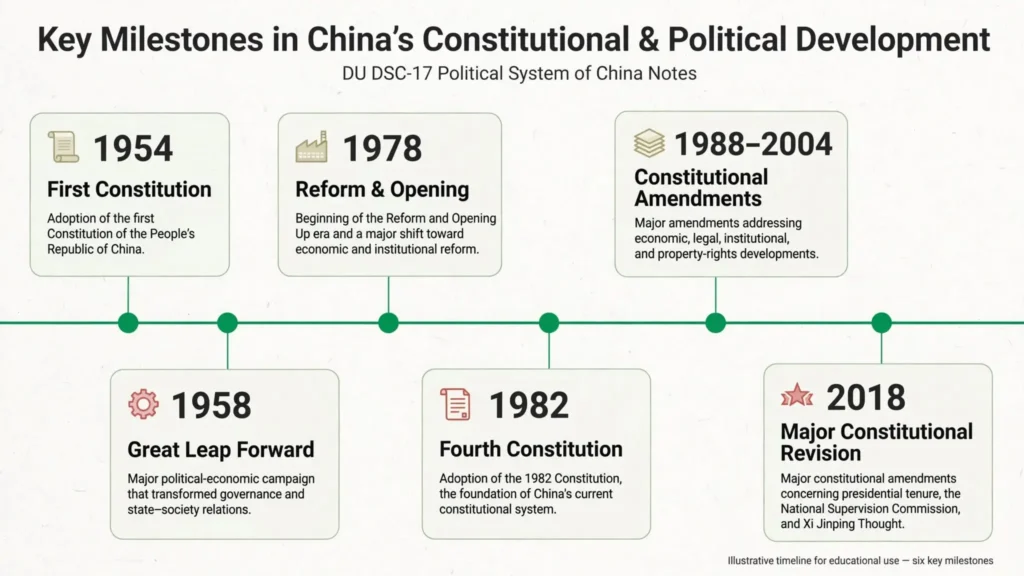
Key Takeaways — Constitutional Timeline China’s constitutional history shows a consistent pattern: each Constitution and amendment set (1954, 1982, and the post-1982 amendments) has combined an expanding, market-oriented economic framework with an unchanging or strengthening political monopoly for the CPC. This is the single most exam-relevant pattern to remember for “critically evaluate” style questions.
Key Features of China’s Socialist Political System
Since the PRC was established, China’s political system has been shaped by socialism. Key features include:
Role of the Communist Party of China (CPC)
- One-Party System: The CPC is the only party with governing power in China. Eight other minor parties are legally recognized, but they operate under CPC leadership rather than as independent opposition (see the Electoral System and CPC sections below for detail).
- Political Ideology: China’s official ideology is based on Marxism-Leninism, adapted for Chinese conditions. Mao Zedong Thought remains constitutionally significant, alongside later contributions from Deng Xiaoping, Jiang Zemin, Hu Jintao, and — most recently — Xi Jinping Thought on Socialism with Chinese Characteristics for a New Era.
- Leadership: The General Secretary of the CPC is the most powerful office-holder in China, typically also serving as President of the PRC and Chairman of the Central Military Commission. Leadership has become markedly more centralized under Xi Jinping, especially after the 2018 term-limit amendment and his 2022 third-term appointment.
Socialism with Chinese Characteristics
- Economic Reforms: Since the late 1970s, China has pursued significant economic liberalization while maintaining strict political control — a combination often summarized as “one country, two systems” in the economic sense (distinct from the Hong Kong/Macau usage of that same phrase — see the Unitary State section below). This allows private businesses and foreign investment while power remains concentrated with the CPC.
- State-owned Enterprises: The government controls major strategic industries such as energy, telecommunications, and transportation, while allowing greater private-sector activity in less strategic sectors like manufacturing and consumer services.
- Dual Track System: China combines market mechanisms with centralized political and social control — market forces operate within boundaries set by the Party-state, rather than displacing it.
Government Structure
- National People’s Congress (NPC): China’s highest formal legislative body on paper, though in practice it primarily ratifies decisions already made within CPC structures (detailed further in the Legislature section below).
- State Council and Premier: The State Council is the main executive body, with the Premier managing day-to-day government affairs, though the President/General Secretary holds the greater share of real political authority.
- Administrative Divisions: China is divided into provinces, autonomous regions, and municipalities, governed by officials who are appointed through a process ultimately controlled by the central CPC leadership rather than by independent local election (see the Electoral System and Unitary State sections).
Control Over Society and Media
- Censorship: The government regulates media and internet access closely, restricting content considered politically sensitive — enforced technically through mechanisms popularly known as the “Great Firewall.”
- Education: Schools and state media promote Marxist-Leninist principles and loyalty to CPC leadership as part of the formal curriculum and public messaging.
Foreign Policy and Global Role
- Belt and Road Initiative (BRI): China has funded infrastructure and connectivity projects across Asia, Africa, and Europe to deepen economic ties and expand its global influence.
- Global Influence: As China’s economic and military capacity has grown, it has taken an increasingly assertive role in global affairs, at times in direct strategic competition with the United States and other established powers.
Key Takeaways — Key Features of the Socialist System The defining feature of China’s political system is the combination of an increasingly market-oriented economy with an unchanged, and in recent years strengthened, one-party political monopoly. Remember this pairing — “economic liberalization + political centralization” — as it recurs across nearly every section of this unit.
The Constitution of China
The Constitution of China is the highest law in the country. It sets up the rules for how the government works, the economy, and how people are governed.
The current Constitution was adopted in 1982 and is central to China’s political and legal order. It has been amended several times to keep up with changes in society and the economy, especially due to economic reforms and the strengthening role of the Communist Party of China (CPC).
1. Features of the 1982 Constitution
The 1982 Constitution was passed by the Fifth National People’s Congress. It marked a significant step in China’s political history, providing a legal foundation for the country after the upheavals of the Mao era and introducing new ideas under Deng Xiaoping. Its main features:
1.1 Socialist Legal Framework
- The 1982 Constitution is based on socialism and reflects China’s commitment to this system under CPC leadership. It declares China a socialist state governed by law, with the Constitution as the highest law.
- It guarantees certain formal rights for citizens, such as freedom of speech and freedom of religious belief, while subordinating individual rights to the interests of the collective and the state where the two are seen to conflict.
1.2 One-Party System
- The Constitution recognizes the Communist Party of China (CPC) as the leading political force, with no constitutional space for genuine multi-party competition. This formalizes China’s one-party system, in which the CPC holds decisive power.
- Eight smaller parties exist but must accept CPC leadership (see the Electoral System section below for how this operates in practice). The Constitution explicitly affirms the CPC’s central role in China’s politics and society.
1.3 Centralized Power
- The Constitution establishes a system of highly centralized power, with the National People’s Congress (NPC), its Standing Committee, the State Council, and the President holding the formal top decision-making authority.
- The President is head of state, and the Premier is head of government — a formal separation that, unlike in Russia’s semi-presidential system, maps onto a single dominant power centre in practice, since real authority rests with the CPC and its senior leadership bodies.
1.4 Commitment to Reform
- The Constitution reflects China’s commitment to modernization and economic reform, emphasizing the importance of developing the economy and technology.
- Following Deng Xiaoping’s reforms, the Constitution came to recognize a mixed economy — combining socialism with market mechanisms — introducing the concept of a socialist market economy and permitting private enterprise and foreign investment in defined areas, moving away from strict Mao-era central planning.
2. Socialism with Chinese Characteristics (Constitutional Dimension)
A key element of the 1982 Constitution is the doctrine of socialism with Chinese characteristics, introduced by Deng Xiaoping in the 1980s to adapt classical socialist principles to China’s specific historical and cultural context. This doctrine has continued to evolve through later amendments, most recently under Xi Jinping.
2.1 Economic Policy
- Market Economy: The Constitution permits a market economy operating within a socialist framework, combining public ownership with private enterprise, and market forces with central planning.
- Modernization: It emphasizes technological innovation, which has supported rapid Chinese progress in infrastructure, manufacturing, and — more recently — advanced technology sectors.
2.2 National Rejuvenation
- The doctrine also targets national rejuvenation — building a strong, modern socialist state capable of competing globally, including improvements in military capability and continued economic advancement.
- It invokes the goal of common prosperity for all citizens, understood as being pursued under continued CPC leadership rather than through political pluralism.
2.3 Stability and Harmony
- The doctrine emphasizes social stability, harmony, and unity as prerequisites for China’s development, with the state framed as the guarantor of social harmony — prioritizing collective goals over individual rights where the two are seen to conflict.
3. The Role of the Communist Party of China in the Constitution
The 1982 Constitution explicitly affirms the CPC’s central role in governance, a role that has been reinforced in subsequent amendments.
- Leading Role: All state institutions are constitutionally required to accept the Party’s guidance; the CPC also controls the military and other key institutions.
- Political and Legal Affairs: All levels of government, including the NPC and the judiciary, are required to operate under CPC leadership, making the Party the practical center of political power.
- Ideology Control: The CPC is responsible for maintaining ideological consistency nationwide, ensuring that Marxist-Leninist principles and socialism with Chinese characteristics are taught and upheld across state institutions.
4. Constitutional Amendments
Since 1982, the Constitution has been amended several times, reflecting shifting political, social, and economic priorities.
4.1 Key Amendments
| Year | Amendment | Significance |
|---|---|---|
| 1988 | Recognized a socialist market economy, permitted private enterprises and foreign investment | First formal opening toward market reform in the Constitution |
| 1993 | Reaffirmed the socialist market economy | Continued and consolidated Deng Xiaoping–era economic reform |
| 1999 | Recognized the role of private property | Affirmed private business activity within the socialist legal framework |
| 2004 | Strengthened private property rights, referenced human rights protection | Extended constitutional recognition of individual economic rights, subject to socialist limits |
| 2018 | Removed presidential term limits | Enabled indefinite tenure for the President and marked a significant further centralization of power under Xi Jinping |
4.2 Importance of Amendments
- Power Consolidation: The 2018 term-limit removal, in particular, signals a decisive shift toward more concentrated leadership under the incumbent General Secretary/President.
- Economic Changes: Successive amendments show the gradual, incremental incorporation of market-economy elements into the constitutional text, allowing growth while preserving political control.
- Ideological Changes: As the Party’s guiding ideology has evolved, the Constitution has been updated to reflect it — most recently by incorporating “Xi Jinping Thought on Socialism with Chinese Characteristics for a New Era,” which emphasizes CPC leadership and the goal of “national rejuvenation.”
Key Takeaways — The 1982 Constitution and its Amendments The 1982 Constitution and its amendments together reflect the principles of socialism with Chinese characteristics and the CPC’s central role in governance. While it includes certain formally protected rights and references to the rule of law, the Constitution primarily functions to legitimize and structure the Party’s control over the state. The amendments trace China’s economic modernization while consistently preserving — and, since 2018, strengthening — the one-party political framework.
Is China a Unitary State? Structure and Centralization
China is formally a unitary state, meaning that all governing authority formally flows from the central government in Beijing, and provincial/local bodies function as administrative extensions of the centre rather than as constitutionally sovereign units. This distinguishes China from federal systems — like the United States or Brazil, also covered in this DSC-17 paper — where sub-national units hold constitutionally protected powers of their own.
1. Centralized Political Power
- No region holds sovereign authority independent of Beijing.
- The central government sets national policy, which is then implemented uniformly (in principle) across provinces, autonomous regions, and municipalities.
- Local governments act as administrative extensions of the central state rather than as independent policymaking bodies.
2. Historical and Cultural Roots of Centralization
- Imperial dynasties, from the Qin (221 BCE) onward, governed through centralized bureaucratic hierarchies directed from the imperial court.
- The Confucian tradition emphasized hierarchical order and top-down moral governance, providing cultural legitimacy for centralized rule.
- The instability of the late Qing collapse, the warlord era, and the civil war reinforced, for CPC leaders, the conviction that only a strong central government could guarantee national unity and stability.
3. The CPC’s Role in Maintaining Unitary Control
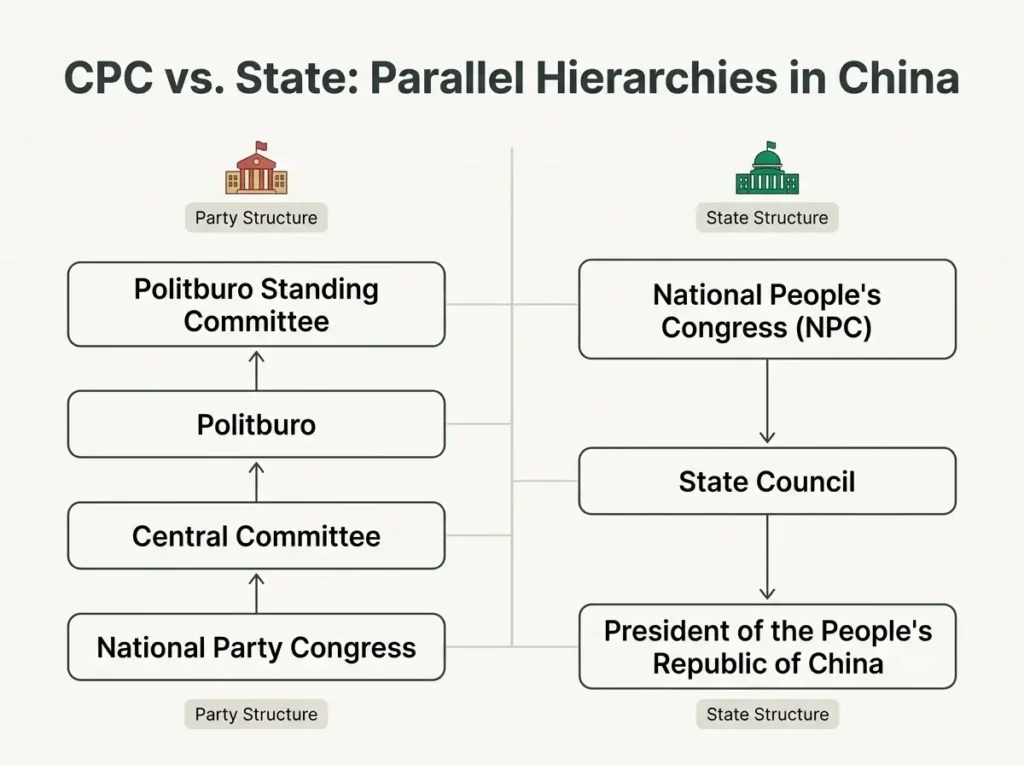
- The CPC operates as a parallel structure above the formal state apparatus: key appointments, policies, and decisions run through Party channels first.
- A vertical chain of command runs from the Politburo Standing Committee in Beijing down to local Party committees, with every level of government paralleled by a corresponding Party committee that, in practice, outranks it.
- This party-state fusion is what gives China’s unitary structure its practical force — even where formal government structures resemble a federal-looking division of administrative responsibility, political authority itself is never devolved.
4. Economic Decentralization vs. Political Centralization
Since 1978, China has selectively decentralized economic decision-making — for example, granting Special Economic Zones (SEZs) such as Shenzhen greater autonomy to attract investment, and giving provinces more fiscal and investment authority. However:
- Provincial and local leaders are still appointed through CPC channels, not independently elected.
- Party discipline-inspection and anti-corruption mechanisms ensure that local officials remain accountable to Beijing rather than to local constituencies.
This produces a distinctive hybrid: economic decentralization combined with unwavering political centralization — a useful phrase to remember for exam answers comparing China with genuinely federal systems.
5. Autonomous Regions and Their Limits
China formally designates several areas as “autonomous regions” — including Tibet, Xinjiang, and Guangxi — but in practice:
- These regions do not enjoy meaningful self-governance independent of central oversight.
- The Party maintains direct control through regional CPC secretaries and a substantial security apparatus.
- Movements advocating greater self-rule are firmly suppressed (see the Human Rights sub-section of Current Issues, below, for the Xinjiang/Uyghur situation specifically).
- China’s two Special Administrative Regions, Hong Kong and Macau, are governed under the distinct “One Country, Two Systems” principle, which formally preserves separate legal and economic systems for a defined transitional period — a different and more limited form of autonomy than that claimed for the “autonomous regions.”
Key Takeaways — Unitary State China is a unitary, not federal, state: sovereignty is not shared with provinces or regions. The CPC’s parallel party structure is what actually enforces this unitary character in practice, even where economic decision-making has been partially decentralized since 1978. “Autonomous regions” and the Hong Kong/Macau “One Country, Two Systems” arrangement are two distinct and commonly confused concepts — be careful to distinguish them in exam answers.
The Executive in China
The Executive branch of China mainly includes two important leaders: the President and the Premier, along with the State Council.
The government is highly centralized, with the Communist Party of China (CPC) exercising ultimate authority over all important matters. The President and Premier hold significant institutional authority, but real power lies with the Party, especially with the General Secretary of the CPC, who is ordinarily also the President.
The President: Powers, Functions, and Limitations
The President of China is formally a largely ceremonial head of state, but in practice combines this role with other, more powerful positions.
- Powers of the President:
- Symbolic Leadership: Represents China in international meetings, signs agreements, and receives foreign dignitaries.
- Appointment Powers: Nominates the Premier and other senior officials, subject to formal approval by the National People’s Congress (NPC).
- Military Leadership: Leads the Central Military Commission (CMC), giving direct command authority over the armed forces.
- Foreign Policy: Shapes China’s foreign relations and oversees major international agreements.
- Functions of the President:
- Head of State: Serves as the formal figurehead of the government in both domestic and international matters.
- Constitutional Role: Signs laws passed by the NPC — a largely formal step, since the Party and NPC leadership have already made the substantive decisions.
- Party Leadership: Is typically also the General Secretary of the Communist Party, which is the office that actually links the presidency to the Party’s real decision-making structures.
- Limitations of the President:
- Lack of Independent Power: The President’s authority is bounded by the CPC, which retains final decision-making power; the President rarely, if ever, acts independently of the Party leadership.
- Ceremonial Role: Many of the most significant decisions are actually made by the Politburo and its Standing Committee, bodies composed of the Party’s top leaders.
The Premier and the State Council: Structure and Responsibilities
The Premier is the head of government and manages the country’s day-to-day administration, working through the State Council — China’s equivalent of a cabinet.
- Powers of the Premier:
- Executive Authority: Leads the State Council and is responsible for implementing laws and policies set by the NPC.
- Economic Management: Develops and executes economic policy aimed at growth and social welfare.
- Administration: Ensures the smooth day-to-day functioning of government.
- State Council — Structure and Responsibilities:
- China’s top executive body, managing routine government work and implementing NPC legislation.
- Structure: Comprises the Premier, vice premiers, state councilors, and ministers, all formally appointed by the NPC.
- Key Functions: formulating and applying national policy; approving budgets and economic plans; overseeing government departments; reporting to the NPC on government performance.
The Role of the People’s Liberation Army (PLA) in Governance
The People’s Liberation Army (PLA) plays a central role in China’s governance and is closely integrated into the political structure.
- Military Leadership: The Central Military Commission (CMC), chaired by the President/General Secretary, oversees the PLA — giving that office direct and significant military authority.
- Political Role: The PLA is not merely a national-defense force; it is also constitutionally and organizationally a political force loyal to the CPC rather than to the state as an abstract entity.
- CPC–Military Connection: The Party leads the military directly, ensuring PLA loyalty to Party interests, particularly during periods of internal political tension.
- Defense Policy: The PLA is central to China’s national defense posture and materially shapes both security policy and foreign policy (notably in the South China Sea and around Taiwan — see Current Issues below).
Comparison Table: President vs. Premier
| Feature | President | Premier |
|---|---|---|
| Formal role | Head of State | Head of Government |
| Typical office holder | Usually also CPC General Secretary and CMC Chairman | Senior CPC official appointed on presidential nomination |
| Real decision-making power | High — via concurrent Party/military posts, not the presidency alone | Moderate — executes rather than sets top-level policy |
| Controls | Foreign policy signing authority, military (via CMC) | State Council, day-to-day economic administration |
| Term | Previously two 5-year terms; unlimited since the 2018 amendment | Conventionally limited to two 5-year terms by informal norm |
| Accountability (formal) | Elected by the NPC | Nominated by the President, confirmed by the NPC |
Key Takeaways — The Executive China’s formal executive (President + Premier + State Council) closely mirrors many other systems on paper, but its real power flows through the parallel Party structure — specifically the General Secretaryship and the Central Military Commission chairmanship, both usually held by the same individual as President. Do not conflate the formal presidency with the actual source of political power, which is the CPC leadership.
The Legislature in China: National People’s Congress (NPC)
The National People’s Congress (NPC) is formally the highest organ of state power in China and is central to the law-making process. In practice, however, it primarily ratifies decisions already made by the CPC leadership.
Structure and Composition of the NPC
- Composition: The NPC comprises around 3,000 members, elected indirectly from provinces, autonomous regions, municipalities, and the military. The great majority of delegates are CPC members or are otherwise closely aligned with Party interests.
- Role of the Standing Committee: The NPC Standing Committee is a smaller body that meets far more frequently than the full Congress (which meets in full session for roughly two weeks a year), and handles ongoing law-making and legal interpretation between sessions.
Functions and Powers of the NPC
The NPC has broad powers on paper, but its real influence is shaped decisively by the CPC.
- Legislative Power: The NPC can pass laws, but the most significant legislative initiatives originate with the CPC leadership rather than with NPC delegates.
- Supervisory Power: The NPC formally reviews government work and approves major decisions such as the national budget.
- Electoral Power: The NPC formally elects the President, confirms the Premier, and elects other senior officials — though candidates are effectively pre-selected by the CPC.
- Constitutional Amendments: The NPC has the formal power to amend the Constitution, but such amendments in practice reflect CPC priorities that have already been settled internally (see the 2018 term-limit amendment above).
The Legislative Process in China
- Proposal Stage: Most law proposals originate with the CPC or with government ministries operating under Party guidance.
- Deliberation: Draft laws are reviewed by the NPC Standing Committee; genuine open debate is limited, and Party-driven initiatives dominate the agenda.
- Approval: After generally minor revisions, laws are typically passed by the full NPC with limited substantive floor discussion.
The Role of the Standing Committee of the NPC
The Standing Committee of the NPC is highly influential and makes binding decisions when the full Congress is not in session (i.e., most of the year).
- Law-Making Power: Passes laws and provides authoritative interpretation of the Constitution and existing statutes.
- Supervisory Role: Monitors whether government actions comply with law and constitutional provisions.
Formal Power vs. Actual Practice — Comparison Table
| NPC Function | Formal/Constitutional Position | Actual Practice |
|---|---|---|
| Law-making | “Highest organ of state power”; sole body that can pass national law | Ratifies laws that originate with, and are pre-approved by, CPC leadership |
| Electing the President | Elects the President by vote | Candidate is pre-determined by the CPC; election is a formality |
| Approving the budget | Reviews and approves the national budget | Approves budgets prepared by the State Council under CPC direction |
| Constitutional amendment | Sole body empowered to amend the Constitution | Amendments (e.g., 2018 term-limit removal) reflect decisions already finalized within CPC bodies |
| Meeting frequency | Full Congress convenes annually | Meets for roughly two weeks a year; Standing Committee handles the rest, itself operating under CPC guidance |
Key Takeaways — The Legislature The gap between the NPC’s formal constitutional powers and its actual practice is one of the most frequently tested concepts in comparative government courses on China — it is often summarized as the NPC functioning as a “rubber stamp” legislature. Be ready to substantiate this claim with specific examples (the 2018 amendment, presidential elections) rather than asserting it without evidence.
The Electoral System
China’s electoral system is best understood as a hierarchical and controlled framework operating under the overall leadership of the CPC.
1. Direct vs. Indirect Elections
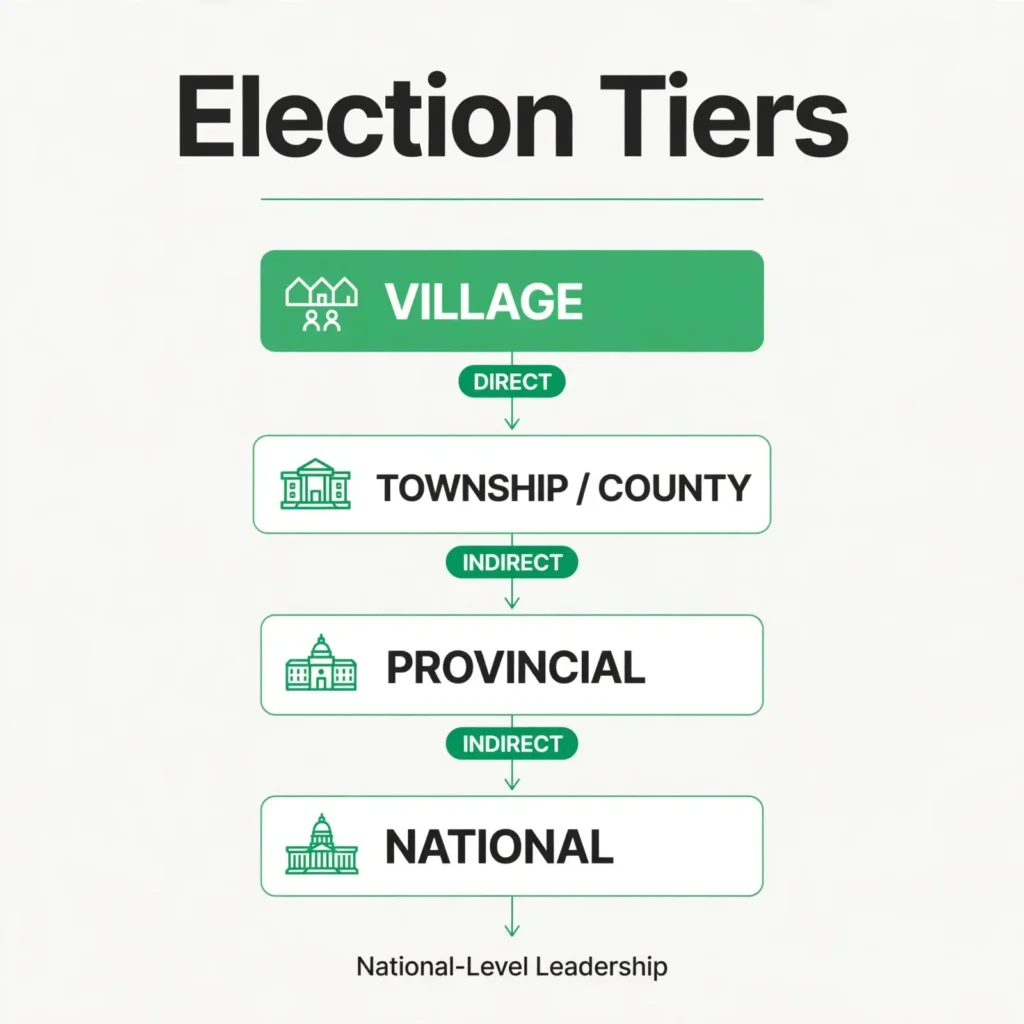
- Direct elections are held only at the village and township levels — the lowest tiers of governance.
- At the district, municipal, provincial, and national levels, elections are indirect: representatives at each tier are chosen by delegates from the tier immediately below, rather than by the general public voting directly.
This structure reflects the CPC’s preference for centralized political control while still permitting a limited, controlled form of grassroots participation.
2. Election of the National People’s Congress
- NPC delegates are elected indirectly, through provincial-level congresses, which are themselves composed of representatives chosen by lower-level congresses.
- The President and Premier are formally elected/confirmed by the NPC, but the candidates presented for these positions have already been selected and endorsed by CPC leadership before the vote is taken.
3. The CPC’s Role in Elections
The Party controls essentially every stage of the electoral process:
- Candidate nomination and screening.
- Approval of final delegate lists.
- Supervision of the voting process itself.
The eight other legally recognized political parties (such as the China Democratic League) may exist and even hold a share of NPC seats, but they operate within the CPC-led United Front system and cannot form an independent opposition or contest elections against CPC-endorsed candidates.
4. Village-Level (Grassroots) Elections
The most genuinely competitive layer of China’s electoral system is at the village level:
- Citizens directly elect Village Committee members, including the village head, through processes institutionalized during the 1980s and 1990s as part of rural administrative reform.
- These committees handle local governance matters — dispute resolution, local infrastructure, and basic administration.
- Candidates typically still require informal CPC approval to be viable, and CPC oversight of the process remains significant — but relative to higher-tier elections, village elections are meaningfully more competitive and function as a channel for local grievance resolution.
5. Criticisms of the Electoral System
- Lack of genuine competition: Candidates are effectively screened by the CPC rather than emerging through open, competitive nomination.
- Limited transparency: Vote-counting and delegate-selection processes are not independently monitored.
- Media and civil-society restrictions: State-controlled media limits independent scrutiny of the electoral process; independent election monitoring is not permitted.
- Suppression of independent candidates: Individuals attempting to run independently, particularly at district or municipal level, can face administrative disqualification or more serious consequences.
6. The CPC’s Justification
The Party and Chinese government defend this model on several grounds: that it delivers political stability in a country of vast size and diversity; that it has enabled sustained economic transformation and large-scale poverty reduction; and that a Western-style multiparty system, in their assessment, risks fragmentation rather than delivering better governance. Chinese officials describe the system as a form of “whole-process people’s democracy,” built around consultation (via the CPPCC — see the Political Participation section below) rather than electoral competition.
Key Takeaways — Electoral System Remember the tiered structure: direct elections only at the village/township level; indirect elections at every level above that. This single fact answers a large share of DU exam questions on Chinese elections. Pair it with the CPC’s own justification (stability, consultative “whole-process democracy”) to write a balanced, examiner-friendly answer rather than a one-sided critique.
The Judiciary in China
The judiciary is an important institution within China’s legal and governance system, with the Supreme People’s Court (SPC) at its apex.
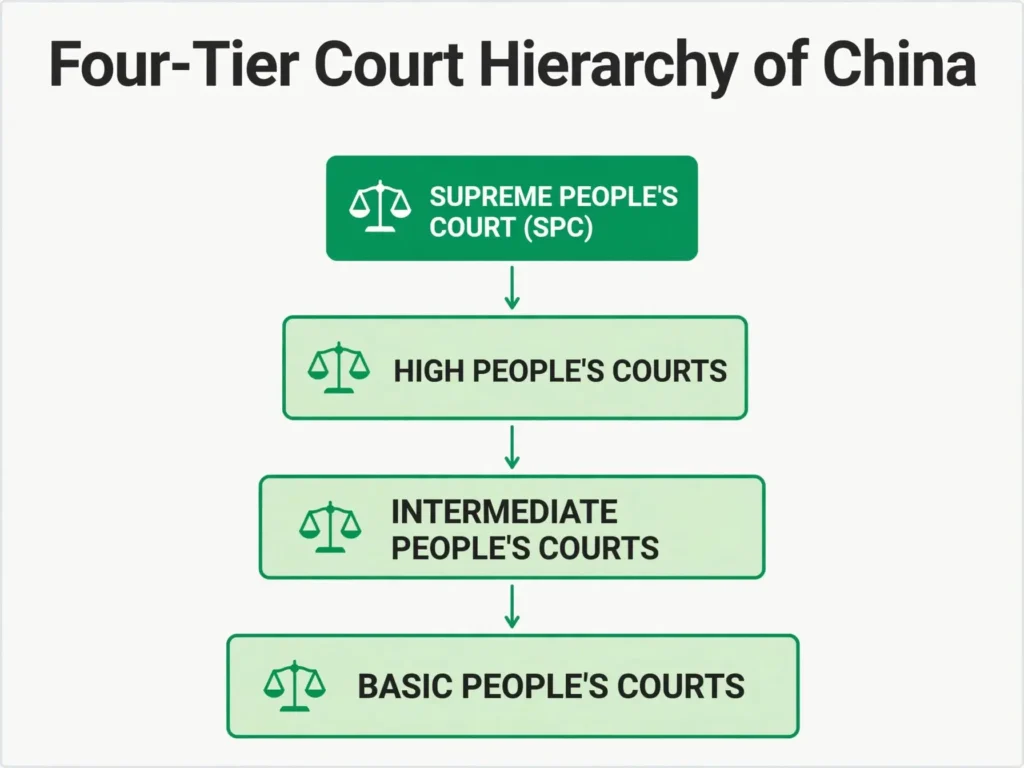
Unlike in many liberal-democratic systems, China’s judiciary is not independent of the political system — it operates under the guidance of the Communist Party of China, which shapes judicial appointments, priorities, and outcomes in significant ways.
Structure and Hierarchy of Courts in China
China’s courts are organized into a tiered system, with each level handling different categories of cases:
- Supreme People’s Court (SPC): The highest court, responsible for interpreting national law, reviewing significant or complex cases, and issuing guiding opinions to lower courts.
- High People’s Courts: Serve provinces and major cities, hearing appeals from lower courts, particularly in significant cases.
- Intermediate People’s Courts: Located in major cities; handle medium-level cases and often serve as the first-instance court for more serious matters.
- Basic People’s Courts: Local courts handling minor criminal matters, family disputes, and small civil cases — the entry point for most citizens seeking legal recourse.
Specialized Courts also exist for particular areas: Military Courts (military-related cases), Railway Transportation Courts, Maritime Courts (shipping and marine disputes), and Intellectual Property Courts (patents and copyrights).
The Role of the Supreme People’s Court (SPC)
- Judicial Review: Reviews significant or complex lower-court decisions.
- Guiding Legal Interpretation: Interprets national law, including constitutional provisions, to clarify how they should be applied.
- Issuing Judicial Opinions: Provides guidance to lower courts to promote consistency in legal decision-making.
- Supervising Lower Courts: Oversees local courts to ensure compliance with national law, and can intervene directly in specific cases.
- Leadership and Composition: The President of the SPC is a significant office-holder but does not exercise power independently of the CPC; SPC judges are formally appointed by the NPC and operate under overall Party guidance.
Judicial Independence and Its Challenges
In liberal-democratic systems — for instance, the United Kingdom, where judicial independence is a foundational constitutional convention — judges are expected to decide cases free of political direction. In China, several structural factors limit this kind of independence:
- Party Control over the Judiciary: The CPC influences judicial appointments and, in politically sensitive cases, case outcomes; judges are expected to align decisions with Party policy where the two intersect.
- Lack of Binding Precedent: Chinese courts do not follow a common-law-style system of binding precedent; SPC guiding opinions inform but do not formally bind subsequent decisions in the same way case law does elsewhere.
- Political Pressure: Local officials or influential individuals can, in practice, pressure courts to influence outcomes, particularly in politically or economically sensitive matters.
- Limited Role of Civil Society: While citizens hold certain formal legal rights, the broader rule-of-law culture remains constrained by Party oversight, limiting the development of a fully independent legal profession and civil-society legal advocacy.
The Role of the People’s Procuratorate
The People’s Procuratorate functions similarly to a public prosecution service in other systems — investigating and prosecuting crimes and reviewing the legality of government actions.
- Structure: Operates at national and local levels, with the Supreme People’s Procuratorate (SPP) as the highest authority.
- Powers: criminal prosecution; public-interest litigation (including anti-corruption cases); and supervision of law-enforcement bodies to ensure investigations follow proper legal procedure.
- Relationship with the CPC: While formally an independent state organ, the procuratorate’s decisions in practice align closely with Party priorities, particularly in high-profile anti-corruption cases.
Key Takeaways — The Judiciary China’s court hierarchy (Basic → Intermediate → High → Supreme) closely resembles many other systems structurally, but the defining comparative-politics concept here is “rule by law” rather than “rule of law” — the law functions primarily as an instrument through which the state (and the Party) governs society, rather than as an independent constraint on the state’s own power. This distinction is a favourite in DU exam questions on China’s judiciary.
The Communist Party of China (CPC)
The Communist Party of China (CPC) is the dominant political organization in the country, exercising decisive influence over politics, the economy, society, and the military. Although China has formal government bodies such as the National People’s Congress (NPC) and the State Council, the CPC is, in practice, the institution that actually governs.
For a detailed academic treatment of the Party’s role, see IGNOU eGyanKosh’s Unit 12: Role of Communist Party in China; for a visual breakdown of the Party and state hierarchy, see the CRS’s chart-based report, China’s Political System in Charts (originally published as a snapshot before the 2022 Party Congress, so treat leadership names in it as historical rather than current).
Structure and Organization of the CPC
The CPC is a tightly organized body whose structure is designed to secure and maintain its authority over both government and society.
Key Organizational Bodies of the CPC:
- The National Party Congress: The CPC’s most important formal body, meeting every five years. Delegates from across China attend to discuss major policy directions, set political priorities, and elect senior Party leadership. It approves amendments to the Party Constitution and elects the Central Committee, Politburo, and other top officials. (The 20th National Congress, held in 2022, is the most recent — see the Constitutional Timeline above.)
- The Central Committee: Comprising roughly 200 full members (plus alternates), it decides on major Party policy between Congresses. Members are elected by the National Party Congress and meet at least once a year (in “plenums”) to set the Party’s direction.
- The Politburo: A smaller body of around 24–25 members drawn from the Central Committee, responsible for the CPC’s day-to-day policy direction. Its inner core, the Politburo Standing Committee — typically 7 members — is the single most powerful decision-making body in China, holding the top positions across Party, government, and military.
- The General Secretary of the CPC, currently Xi Jinping, leads the Politburo and holds the greatest concentration of formal and informal authority in the system.
- The Central Military Commission (CMC): Oversees the People’s Liberation Army (PLA); its Chairman (currently Xi Jinping) is China’s top military authority.
- The Secretariat: Senior Party officials responsible for the day-to-day implementation of Central Committee decisions across the country.
- The Central Commission for Discipline Inspection: Enforces internal Party discipline and leads anti-corruption enforcement — central to Xi Jinping’s anti-corruption campaign since 2012.
The Role of the Politburo and the Central Committee
- The Politburo includes the most powerful individuals in the CPC and, by extension, in China; it makes the country’s most important policy decisions.
- The Politburo Standing Committee is where the very top leadership — including the General Secretary and Premier — meets to make the most consequential decisions.
- The Central Committee governs between Party Congresses, formally elects the Politburo and Standing Committee, and sets significant policy directions, though in practice most decisive authority sits with the Standing Committee.
The Relationship Between the CPC and the State
The CPC is constitutionally described as the “leading core” of China’s political system, and in practice is more powerful than the formal government structure it oversees — extending its influence into the military, the courts, and every level of administration.
- Leadership over Government: The General Secretary typically also serves as President and CMC Chairman, unifying Party, state, and military leadership in a single individual.
- Integration of Party and State: Senior government officials — the Premier, ministers, provincial governors — are almost always Party members whose appointments require Party endorsement.
- The Military: The PLA is constitutionally and organizationally subordinate to the CPC (not simply to “the state” as an abstract entity), reinforcing the Party’s control over the single most significant instrument of coercive power in the country.
The CPC’s Role in Shaping Public Policy
- Economic Policy: Sets national economic goals (GDP growth targets, trade policy) and issues Five-Year Plans outlining development priorities — the central instrument of China’s economic policy since the 1950s.
- Social Policy: Shapes education, healthcare, and welfare policy in line with Party goals around stability, equality, and social harmony.
- Foreign Policy: Sets China’s international stance through the Politburo and State Council, including flagship initiatives like the Belt and Road Initiative.
CPC Membership: Scale as a Governance Instrument
As of the end of 2024, official Chinese government data reported CPC membership at over 100 million — making it, by a wide margin, the largest single-party organization of its kind in the world, and (after India’s ruling party) the world’s second-largest political party by membership overall. This scale matters analytically: CPC branches exist not only in government bodies but inside state-owned enterprises, universities, and even many private companies, giving the Party a reach into everyday institutional life that goes well beyond the formal machinery of government described elsewhere in this article.
Key Takeaways — The CPC The single most important fact to internalize about China’s political system is that the CPC is not simply a powerful institution alongside the state — it is structured as a parallel hierarchy that runs through, and ultimately outranks, the formal state apparatus at every level, from the Politburo Standing Committee down to village Party branches. Any exam answer about “how China is governed” should describe the CPC’s structure before describing the formal state institutions.
Political Participation and Governance
While China is a one-party state, it does allow certain forms of political participation and consultative governance, operating within limits set firmly by the CPC.
The Role of Mass Organizations and People’s Congresses
Mass Organizations: Represent different sectors of society and operate under Party oversight — they provide a channel for citizen concerns but ultimately support CPC policy rather than acting as independent interest groups. Examples include the All-China Federation of Trade Unions (ACFTU) and the Communist Youth League of China (CYLC).
People’s Congresses: Function as a formal representative structure, with the National People’s Congress (NPC) as the apex body (see the Legislature section above) and its Standing Committee handling ongoing decisions between full sessions. As discussed above, NPC power is constrained by CPC control over both membership and agenda.
Mechanisms of Political Participation in a One-Party System
In a one-party system, political participation centers on supporting and engaging with the CPC rather than choosing between competing parties. There are no rival parties capable of contesting for governing power, and dissent is closely managed.
- Consultation and Feedback: Mechanisms such as opinion polling exist, but they are primarily designed to gauge whether public sentiment aligns with existing Party goals rather than to generate independent policy alternatives.
- Local Elections: Village-level elections (detailed in the Electoral System section above) represent the most direct form of participation, though CPC-approved candidates remain the norm.
- The CPPCC: The Chinese People’s Political Consultative Conference brings together the eight minor parties and various social organizations in an advisory, consensus-building capacity — without legislative or executive power of its own.
The Role of Public Opinion and Media in Governance
- Media Control: The CPC closely regulates television, print, and internet media to shape public opinion and ensure alignment with Party positions. The “Great Firewall” restricts access to many foreign platforms and websites, and domestic media operates under content guidelines that favor the Party’s narrative.
- Public Opinion Monitoring: The government tracks public sentiment through surveys and social-media monitoring, treating it as an input into governance — but dissenting views expressed publicly are frequently suppressed rather than incorporated as open political competition.
Challenges to Political Participation in China
- Limited Freedom of Expression: Citizens face significant constraints on publicly opposing CPC positions; dissent can carry serious consequences.
- Lack of Political Pluralism: With no independent opposition party permitted to contest for power, political diversity operates only within limits the Party sets.
- Censorship and Surveillance: Extensive censorship and surveillance infrastructure constrain independent political organizing and public discourse.
Key Takeaways — Political Participation China’s participatory mechanisms (mass organizations, People’s Congresses, the CPPCC, village elections) provide real, if bounded, channels for input — the analytical task in exam answers is to correctly classify each mechanism as consultative rather than competitive: none of them allow citizens to vote a governing party out of power, which is the defining feature that separates China’s system from multiparty democracies.
Current Issues and Challenges in China
China’s government, led by the Communist Party of China (CPC), faces a range of ongoing challenges as the country continues to change politically, economically, and socially. These issues affect not only domestic governance but also China’s relationships with the rest of the world.
Economic Reforms and Their Effects on Governance
Since the late 1970s, China has transformed from a predominantly agrarian economy into the world’s second-largest economy through sustained economic reform.
- Market Reforms and Economic Growth: Under Deng Xiaoping, China pursued market-oriented reforms — opening to foreign trade, establishing Special Economic Zones (SEZs), and gradually restructuring central economic planning. These changes drove substantial growth and, on China’s own official figures, lifted several hundred million people out of extreme poverty over subsequent decades.
- Private businesses and foreign investment have been central to this growth, with the government progressively allowing greater market activity in manufacturing and services while retaining tighter control over strategic sectors.
- Effects on Governance and Party Control: These reforms have also made unqualified economic control harder for the CPC to sustain — the growth of the private sector has produced a wealthy business class with interests that do not always align neatly with Party priorities. The Party continues to prioritize control over strategically important sectors (banking, energy) while allowing greater flexibility elsewhere.
- Inequality: Economic growth has been accompanied by rising inequality — both between individuals and between richer coastal regions and poorer inland areas — creating ongoing pressure on the Party to balance growth with social stability through poverty-alleviation and “common prosperity” initiatives.
- Innovation and Technology: China has become a global leader in areas such as artificial intelligence, 5G, and e-commerce, raising new governance questions around data security, privacy, and the balance between innovation and state control over information.
Discussions on Political Reform and Democratization
Despite substantial economic liberalization, discussion of formal political reform remains tightly bounded — the CPC treats stability and continued development as higher priorities than political pluralism.
- Political Reform within the Party: Some CPC members have advocated for greater internal transparency and accountability to reduce corruption, but the Party leadership continues to reject the introduction of competing political parties.
- Xi Jinping’s Leadership: Under Xi Jinping, the Party has tightened control over political expression. His sustained anti-corruption campaign, run through the Central Commission for Discipline Inspection, has strengthened Party discipline while also — according to many outside analysts — removing potential political rivals. Xi has consolidated personal authority to a degree not seen since Mao Zedong, formalized through the removal of presidential term limits in 2018 and his third term as General Secretary from 2022.
- Civil Society: NGOs and social movements exist but operate under significant restriction, especially on sensitive subjects such as labor and human rights. Online activism is possible but closely monitored through the Great Firewall and related internet-governance laws.
- Calls for Democratization: Some groups advocate for expanded political freedoms, but available evidence suggests most citizens continue to prioritize economic stability and national strength over an immediate transition to multiparty competition — a claim the Party itself makes prominently in its own messaging, and one that is difficult to verify independently given restrictions on free political expression and polling in China.
Criticism of China’s Political System: Domestic and International Perspectives
Domestic Criticism
- Limited democratic accountability: absence of an independent political opposition or competitive national elections.
- Suppression of dissent: reported detentions of journalists, lawyers, and rights activists who challenge Party positions.
- Corruption concerns: despite sustained anti-corruption campaigns, public frustration with abuse of official power persists in various forms.
- Constrained civil liberties: censorship, surveillance, and restrictions on free expression and religious practice.
International Criticism
- Human rights concerns, particularly regarding the treatment of the Uyghur Muslim minority in Xinjiang, where independent reporting and international bodies have documented mass detentions in government-run facilities described by Chinese authorities as vocational/re-education centers — allegations China’s government disputes.
- Authoritarian governance model, viewed by many Western governments and analysts as incompatible with liberal-democratic norms around competitive elections and press freedom.
- Digital surveillance, forced-labor allegations, and press-freedom restrictions, raised repeatedly by international human-rights organizations and some foreign governments.
The CPC’s Own Justification
Presenting only the criticisms above would not fully satisfy DU search intent or academic balance requirements — the Party’s own position is a genuinely examinable perspective:
- The CPC and Chinese government argue that the system has delivered sustained political stability, particularly valuable after the instability of the early twentieth century.
- They point to rapid economic growth and large-scale poverty reduction as evidence the model “delivers” for citizens in ways they argue Western electoral competition often does not, especially over the long planning horizons enabled by continuity of leadership.
- Officials describe China’s system as “whole-process people’s democracy,” arguing that consultative mechanisms (the CPPCC, village elections, public feedback channels) provide meaningful — if non-competitive — representation better suited, in their view, to China’s scale and diversity than a Western multiparty model.
Religious and Cultural Dimensions
- Religious freedom is constitutionally limited to religious groups and practices approved by the state; groups operating outside state-sanctioned structures — including unregistered (“underground”) Christian churches and Falun Gong practitioners — face restriction.
- State policy generally seeks to align religious practice with broader “Chinese culture” and Party ideology rather than treating religious institutions as fully autonomous.
Labor and Social Rights
- Labor conditions have improved in various respects over recent decades, but trade unions remain state-controlled, and independent strikes or labor organizing are restricted.
- Manufacturing-sector workers, in particular, continue to face reports of demanding conditions and comparatively low pay in some regions/sectors.
- The government has expanded certain social safety net and poverty-reduction programs, though access and quality remain uneven across regions.
China’s Role in Regional and International Politics
- Belt and Road Initiative (BRI): China funds infrastructure projects across Asia, Africa, and Europe to expand trade links and geopolitical influence.
- South China Sea: China maintains extensive territorial claims disputed by neighboring states including Vietnam and the Philippines, and has built military infrastructure on several contested features.
- Taiwan: China regards Taiwan as part of its territory and pursues eventual “reunification” through combined diplomatic and military pressure, while Taiwan’s government maintains its own separate governing institutions — one of the most closely watched flashpoints in contemporary East Asian politics.
- United Nations and Global Trade: China is an increasingly active participant in international institutions, including the UN (where it holds a permanent Security Council seat) and the WTO, using this position to advance its interests on trade, development, and climate policy.
- Strategic Rivalry with the United States: Competition over trade, advanced technology, and military capability continues to shape China–US relations and, by extension, much of contemporary global politics.
Key Takeaways — Current Issues and Challenges China’s contemporary challenges cluster around a single underlying tension: sustaining rapid economic and technological development while preserving unwavering one-party political control. The strongest exam answers on this topic present both the domestic/international criticism and the CPC’s own stability-and-delivery justification, rather than treating the criticism as the only valid perspective.
Continue Reading
Continue Reading — Comparative Political Systems
University of Delhi Previous Year Questions
University of Delhi Previous Year Questions
Source: DU officially scheduled this paper (UPC 2322203602) for its May–June 2025 examination cycle, and the 2023–24 paper covers the same syllabus currently taught to the first NEP UGCF batch.
1 Discuss the significance of the Cultural Revolution in terms of the evolution of Chinese politics. +
Hint: Cover Mao’s motivations (reasserting authority after the Great Leap Forward’s failure, targeting “capitalist roaders”), the role of the Red Guards, its effects on Party institutions and the succession question, and its lasting influence on how the CPC discusses its own history today.
2 Analyze one-party versus multi-party systems. Contrast China with Germany in terms of political competition. +
Hint: Define both system types; use China’s CPC monopoly against Germany’s competitive multi-party coalition politics; conclude with the trade-offs each model claims to offer — stability versus representativeness.
3 Write an essay on the political system of China. Explain its various facets in relation to its unitary nature and one-party system. +
Hint: Structure the essay around Constitution (1982, unitary form + CPC leadership) → Unitary State → CPC structure and the NPC/CPPCC → Electoral System. Use “unitary nature” and “one-party system” as the two organizing threads throughout.
1 Write a short note on: the Great Leap Forward. +
Hint: Cover the 1958 launch under Mao, rapid industrialization and collectivization goals, the resulting famine, and its role as the immediate backdrop to the Cultural Revolution. Be prepared to briefly explain how the failure of the Great Leap Forward contributed to Mao’s 1966 power struggle.
Note: The questions below could not be matched to a specific verified past paper. They are written to match the style and difficulty of the DSC paper, based on the syllabus and the unit’s core themes. Treat them as practice material, not confirmed PYQs.
1 What is meant by “socialism with Chinese characteristics”? +
2 Explain the structure of the National People’s Congress (NPC). +
3 What is the Politburo Standing Committee? +
4 Distinguish between direct and indirect elections in China. +
5 What is meant by China being a “unitary state”? +
6 What is the role of the People’s Procuratorate? +
1 Critically examine the role of the Communist Party of China in shaping the country’s governance structure. +
2 Discuss the process of constitutional development in China since 1949. How has the 1982 Constitution been amended, and what do these amendments reveal about the evolution of the Chinese political system? +
3 Examine the nature of China’s electoral system. To what extent does it allow genuine political participation? +
4 “China’s judiciary operates on the principle of ‘rule by law’ rather than ‘rule of law.’” Discuss. +
5 Analyze the major challenges facing China’s political system today. +
6 Compare the powers of the President and the Premier in China’s political system. +
Frequently Asked Questions (FAQs)
Is China a democracy?
China describes its system as “whole-process people’s democracy,” built on consultation rather than competitive multiparty elections. By the standard comparative-politics definition — requiring competitive elections in which the governing party can be voted out — China is classified as a one-party authoritarian state, not a liberal democracy.
What is the difference between the President and the General Secretary of the CPC in China?
The Presidency is a formal state office (head of state); the General Secretaryship is the top Party office and the real seat of power. Since the 1990s, the same individual has typically held both positions simultaneously, along with the Central Military Commission chairmanship.
Is China a unitary or a federal state?
China is a unitary state. All governing authority formally originates from the central government in Beijing; provinces and regions have no constitutionally protected sovereign powers of their own, unlike in federal systems such as the US or Brazil.
How are elections conducted in China?
Direct elections occur only at the village and township level. At the district level and above (municipal, provincial, national), elections are indirect — delegates at each level are chosen by representatives from the level below, up to the National People’s Congress.
What is the Politburo Standing Committee?
It is the smallest and most powerful decision-making body within the CPC, typically comprising around 7 members, including the General Secretary. It functions as the practical centre of political power in China.
Why is the National People’s Congress called a “rubber stamp” legislature?
Because although it formally holds “highest state power” on paper — including the power to pass laws, elect the President, and amend the Constitution — in practice it ratifies decisions that have already been made within CPC leadership bodies, with limited independent debate or amendment.
What happened to China’s presidential term limits?
The two-term limit on the presidency was removed by a 2018 constitutional amendment, enabling indefinite tenure. Xi Jinping subsequently secured a third term as CPC General Secretary at the 20th Party Congress in 2022, breaking with the collective-leadership norms established after Deng Xiaoping.
What does “rule by law” mean in the Chinese context, and how is it different from “rule of law”?
“Rule of law” means the law constrains the state itself. “Rule by law” means the state uses law primarily as a tool to govern and control society, while remaining largely unconstrained by it. China’s judiciary, operating under CPC guidance, is generally described in comparative-politics scholarship as an example of rule by law.
How many members does the Communist Party of China have?
Official Chinese government data reported CPC membership at over 100 million by the end of 2024, making it the largest single ruling-party organization of its kind in the world.
Is Hong Kong governed the same way as mainland China?
No. Hong Kong and Macau are governed under the “One Country, Two Systems” principle, which formally preserves separate legal, economic, and (to a more limited extent) political systems, distinct from the mainland’s direct provincial-level governance and distinct also from the more limited status of “autonomous regions” like Tibet and Xinjiang.
Conclusion
China’s political system represents a distinctive combination: a rapidly modernizing, globally influential economy, governed through a highly centralized, one-party structure in which the Communist Party of China operates as a parallel hierarchy running through — and ultimately outranking — every formal state institution, from the Presidency and the National People’s Congress down to the judiciary and local government. Since 1978, this system has paired significant economic liberalization with an unwavering, and under Xi Jinping strengthening, political monopoly — a tension that runs through nearly every major theme covered in this unit, from the Constitution’s amendment history to the electoral system’s direct/indirect tiers to the ongoing domestic and international debate over the model’s legitimacy. Understanding this core tension — reform without political pluralism — is the single most useful lens for approaching both short-answer and long-answer DU exam questions on this topic.
Subscribe to keep reading
You've used your free notes for now. Get Delhi Pathshala Premium for unlimited access.
Subscribe — ₹29/30 days