
Contents
- Introduction: what “alternative trends” means
- A note on dates and sources
- Unit 4 at a glance
- Background: Gandhian nationalism and the currents around it
- Ambedkar and the Dalit Movement
- Early life and education
- Ideas and beliefs
- Organisations and the press
- The Mahad Satyagraha (1927)
- Temple entry: the Kalaram Satyagraha (1930)
- Round Table Conferences, the Communal Award and the Poona Pact
- Politics in the 1930s and 1940s
- Constitution-making and conversion
- Assessment
- How Ambedkar and Gandhi differed
- Dravidian Movements
- Origins and context
- The Justice Party (South Indian Liberal Federation)
- The Self-Respect Movement
- Dravidar Kazhagam and the DMK
- Assessment and debate
- Hindustan Socialist Republican Association (HSRA) and Revolutionary Movements
- Background and inspiration
- From HRA to HSRA
- Key figures
- Key actions
- The trials and the executions
- Revolutionary literature
- Revolutionary nationalism beyond Punjab and Uttar Pradesh
- Debates, criticism and legacy
- The Ghadar Movement
- Origins abroad
- The newspaper
- Objectives and the outbreak of war
- The 1915 plan and its failure
- Impact and significance
- The Singh Sabha Movement
- Background
- Formation and objectives
- Contributions
- Assessment and debate
- The Akali Movement
- Why the movement began after the First World War
- The SGPC and the Akali Dal (1920)
- The morchas
- The Sikh Gurdwaras Act (1925)
- Role in the national movement
- Peasant Movements
- Causes and context
- Key movements
- Impact and debate
- Workers’ Movements
- Industrial growth and labour conditions
- Early organisation
- The AITUC (1920)
- Strikes and actions
- Role in the national movement
- Tribal Movements
- Causes
- Notable movements
- Significance and debate
- Emergence of the Left
- Ideological foundations
- The founding of the Communist Party of India: Tashkent or Kanpur?
- Activities and challenges
- The Left inside the Congress: the Congress Socialist Party (1934)
- Role in the national movement
- Influence after independence
- Debate
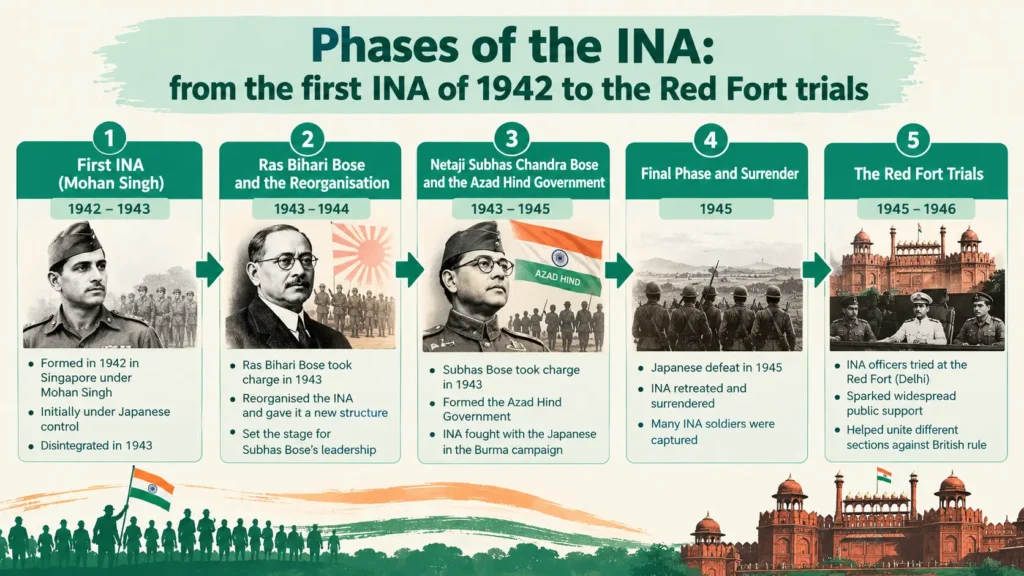
- Subhas Chandra Bose and the Indian National Army
- Early life and political career
- Ideology
- The break with Congress and the Forward Bloc (1939)
- The INA in two phases
- Bose’s journey
- Objectives and alliance
- Azad Hind government and campaigns
- Decline and Bose’s death
- The INA trials (1945–46)
- Significance and debate
- Royal Indian Navy (RIN) Mutiny, 1946
- Causes
- Course of the mutiny
- Demands
- Response and surrender
- Significance and debate
- Important comparisons
- All the movements at a glance
- Violent and non-violent traditions
- Three ways of asking “freedom from what?”
- Criticism, limits and historians’ debates
- Why this unit still matters
- Conclusion
- Continue Reading
- University of Delhi Previous Year Questions
- FAQs
- Sources and further reading
Paper: BA (Hons.) History, Semester 6, DSC-2, History of India – VIII: c. 1857 – 1950, Unit 4: Alternative Trends in National Movement.
Introduction: what “alternative trends” means
By the 1920s Mahatma Gandhi stood at the centre of the Indian national movement, and most textbooks organise the story around Non-Cooperation, Civil Disobedience and Quit India. Yet Indians were also organising in other ways at the same time. Ambedkar was asking whether political freedom meant anything to people denied water from a village tank. Periyar was asking who the “nation” actually belonged to in Madras. Bhagat Singh’s comrades believed non-violence was too slow. Punjabi migrants in California were printing a newspaper that called for revolt. Peasants, mill workers and forest communities were fighting their own landlords, owners and forest officers, and some of them did so in ways that Congress leaders found uncomfortable.
Unit 4 of History of India – VIII collects these currents under one heading. In this unit you study Ambedkar and the Dalit movement, the Dravidian movements, the HSRA and revolutionary nationalism, the Ghadar, Singh Sabha and Akali movements, peasant, workers’ and tribal movements, the emergence of the Left, and finally Subhas Chandra Bose, the INA and the Royal Indian Navy Mutiny. This article follows that topic list in order. Because DU revises its syllabus from time to time, check the unit text against your own department’s latest syllabus before you finalise your revision list.
Quick answer (for revision): “Alternative trends in the national movement” is the syllabus label for the currents that ran alongside, and sometimes against, mainstream Gandhian-Congress nationalism. They differ in their goals (caste emancipation, regional identity, class justice, immediate armed revolt) and in their methods (satyagraha, legislation, revolutionary violence, armed struggle with foreign help), but most also intersected with the Congress at some point.
How to use these notes: read the timeline first so the dates fall into place, then take one movement at a time. Every section ends with a short significance-and-limits paragraph, because DU questions usually ask you to assess a movement, not just narrate it. The comparison tables and the historians’ debates near the end are written to help with long answers.
A note on dates and sources
Where reliable accounts disagree, the notes say so instead of picking one version silently. Examples are the founding year of the Self-Respect Movement (1925 or 1926), the founding year of Ambedkar’s Samata Sainik Dal (1924 or 1927), and the founding date of the Communist Party of India (1920 or 1925). In an exam, state the date you are using and, if you have time, mention that the date is contested.
Unit 4 at a glance
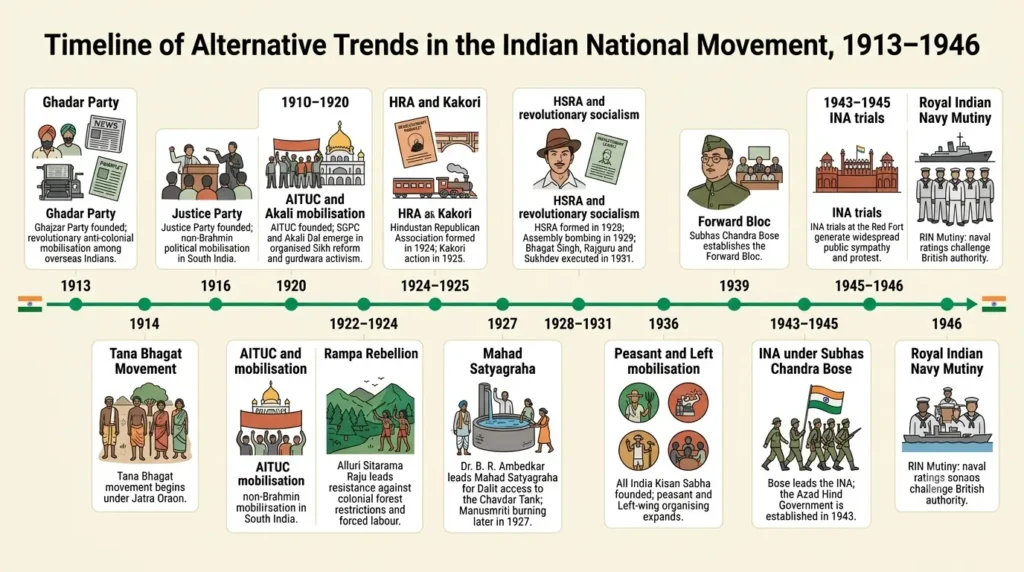
| Year | Event | Section |
|---|---|---|
| 1873 | First Singh Sabha founded at Amritsar | Singh Sabha |
| 1913 | Ghadar Party formed on the US Pacific coast; Ghadar newspaper begins | Ghadar |
| 1914 | Tana Bhagat movement begins among the Oraons | Tribal |
| 1916 | Justice Party (South Indian Liberal Federation) formed | Dravidian |
| 1920 | AITUC founded; SGPC formed (15 Nov); Akali Dal formed (14 Dec) | Workers, Akali |
| 1921 | Nankana Sahib massacre (20 Feb) | Akali |
| 1922–24 | Rampa Rebellion under Alluri Sitarama Raju | Tribal |
| 1924 | Hindustan Republican Association formed; Bahishkrit Hitakarini Sabha founded | HSRA, Ambedkar |
| 1925 | Kakori train action (9 Aug); Self-Respect Movement; Sikh Gurdwaras Act passed; CPI’s Kanpur conference | several |
| 1927 | Mahad Satyagraha (20 Mar) and Manusmriti burning (25 Dec) | Ambedkar |
| 1928 | HSRA formed (Sept); Bardoli Satyagraha; Bombay textile strike; Saunders shot (17 Dec) | several |
| 1929 | Assembly bombing (8 Apr); Meerut arrests; Jatin Das dies on hunger strike (13 Sept) | several |
| 1930 | Kalaram Temple Entry Satyagraha begins (2 Mar) | Ambedkar |
| 1931 | Azad dies (27 Feb); Bhagat Singh, Rajguru, Sukhdev hanged (23 Mar) | HSRA |
| 1932 | Communal Award and Poona Pact (24 Sept) | Ambedkar |
| 1934 | Congress Socialist Party formed | Left |
| 1936 | All India Kisan Sabha formed; Ambedkar’s Independent Labour Party | Peasants |
| 1939 | Bose resigns as Congress president and forms the Forward Bloc | Bose |
| 1943 | Bose takes over the INA/Indian Independence League; Azad Hind government (21 Oct) | INA |
| 1944 | Justice Party renamed Dravidar Kazhagam; INA at Imphal and Kohima | Dravidian, INA |
| 1945–46 | INA (Red Fort) trials | INA |
| 1946 | RIN Mutiny (18–23 Feb); Tebhaga movement | RIN, Peasants |
| 1949 | DMK formed under C.N. Annadurai | Dravidian |
Background: Gandhian nationalism and the currents around it
If you have read Unit 3 on Gandhian nationalism, you know how the Non-Cooperation Movement of 1920–22 brought millions into politics and how Gandhi suspended it after Chauri Chaura in February 1922. That suspension is a good hinge for Unit 4. A generation of young nationalists felt cheated by the sudden retreat. Peasants who had read “Swaraj” in their own way found that Congress would not back their rent struggles. Workers saw strikes disowned. Many non-Brahmin leaders in Madras distrusted a Congress they saw as Brahmin-dominated, and Dalit leaders doubted that a movement led by upper-caste reformers would put social equality ahead of political independence.
Three questions run through the whole unit, and they are useful for organising any long answer:
- Whose freedom? Was independence merely the end of British rule, or did it also mean freedom from caste, landlord and capitalist domination? (Ambedkar, Periyar, peasants, workers, the Left.)
- Which method? Was non-violent mass struggle the only road, or did armed revolt (HSRA, Ghadar) or foreign-supported military action (Bose’s INA) have a place?
- Which community? How should religious, regional and linguistic communities relate to an all-India nation? (Singh Sabha and Akalis, Dravidian movements.)
The world outside India mattered too. The Russian Revolution of 1917, which you can revise in the First World War and Russian Revolutions notes, gave Indian revolutionaries and Marxists a new model. The First World War shaped Ghadar; the Second shaped the INA and the naval mutiny.
Historians do not treat these currents in one way. The older nationalist narrative put the Congress at the centre and saw the other currents as supporting or distracting. Marxist historians stressed class conflict and argued that the national leadership compromised with landlords and capitalists. Historians associated with the Subaltern Studies project (Ranajit Guha and others) argued that peasants and tribal communities had their own political ideas and did not simply follow Congress leaders. You will see these positions in the sections below. A good DU answer names the position and the argument without pretending that one of them is simply “the truth”.
Ambedkar and the Dalit Movement
Early life and education
Dr. Bhimrao Ramji Ambedkar was born on 14 April 1891 in Mhow (in present-day Madhya Pradesh) into a Mahar family. Mahars were treated as “untouchable” in the Bombay Presidency, and the humiliations he faced at school and in daily life, including the experience of being unable to drink water freely, shaped everything he later argued about caste and justice.
He was a brilliant student who studied at Elphinstone College in Bombay and later went abroad with the support of the Maharaja of Baroda. His academic record is part of why his arguments were hard for opponents to dismiss.
| Stage | Institution | Qualification (as usually listed in standard biographies) |
|---|---|---|
| Undergraduate | Elphinstone College, Bombay | B.A. (1912) |
| Postgraduate | Columbia University, New York | M.A. in economics (1915); Ph.D. awarded later (1927) |
| Postgraduate | London School of Economics | M.Sc. (1921) and D.Sc. (1923) |
| Law | Gray’s Inn, London | Called to the Bar (1922) |
Dates for Ambedkar’s degrees are standard in biographies; if you quote them in an exam, Columbia 1915 and LSE 1923 are the two most commonly asked.
Ideas and beliefs
Caste as graded inequality. In his early essay Castes in India: Their Mechanism, Genesis and Development (1916), Ambedkar argued that caste was not simply a division of labour but a division of labourers, arranged in a hierarchy. His later work, especially Annihilation of Caste (1936), the speech he prepared for a Lahore reform society and which was never delivered, argued that caste could not be reformed while the shastras that sanctified it were treated as sacred.
Education, agitation, organisation. He urged Dalits to educate themselves, to agitate for their rights and to organise politically. He combined this with a strong belief in constitutional and legal methods, which is why his career moves between satyagraha, council politics, conferences in London and finally constitution-making.
Political voice for the Dalits. Ambedkar believed that upper-caste reformers, however sincere, could not represent Dalit interests. Dalits needed their own leaders and, in his view, their own electoral safeguards.
Organisations and the press
| Year | Initiative | Purpose |
|---|---|---|
| 1920 | Mooknayak (journal) | Voice for Dalit grievances |
| 1924 (July) | Bahishkrit Hitakarini Sabha, Bombay | Education, hostels and social uplift for the “depressed classes” |
| 1927 | Bahishkrit Bharat (journal) | Political and social agitation |
| 1924 or 1927 | Samata Sainik Dal | Volunteer corps; sources differ on the founding year, with some accounts giving 1924 and others 1927, linked to Mahad |
| 1936 | Independent Labour Party | Joint platform for workers and Dalits; contested the 1937 Bombay elections |
| 1942 | All India Scheduled Castes Federation | Separate political organisation of the Scheduled Castes |
In 1926 Ambedkar entered the Bombay Legislative Council as a nominated member. He used the Council to raise questions on education, civic rights and the condition of workers.
The Mahad Satyagraha (1927)
In January 1924 the Mahad municipality had passed a resolution opening its Chavdar Tank (also spelled Chawdar) to the “depressed classes”, but dominant-caste resistance meant Dalits could not actually use it. A conference of the Kolaba district depressed classes was called at Mahad on 19–20 March 1927 and Ambedkar was invited to it. On 20 March 1927 he led a procession of thousands to the tank and drank water from it, an act designed to assert that Dalits, as Hindus, shared the same rights as others.
Caste-Hindu groups reacted angrily, Dalit participants were reportedly attacked in the aftermath, and the question of access to the tank went to court. The second phase of the satyagraha was planned for December 1927, but a civil court issued a temporary injunction on 14 December 1927. At the conference held on 25 December 1927, a copy of the Manusmriti was burned as a symbolic rejection of the scriptural justification of caste. Accounts differ on who physically set it alight (a colleague, Gangadhar Sahasrabuddhe, is named in some accounts), but the event is remembered as Manusmriti Dahan Din.
Mahad matters for two reasons. First, it extended the idea of civil rights to the most basic resource, water. Second, it marked a shift: the burning of the Manusmriti signalled that Ambedkar was losing hope that Hinduism could simply be reformed from within. The centenary of the Mahad Satyagraha began in March 2026, and ThePrint reported on the state government’s plans for the Chavdar Tale site.
Temple entry: the Kalaram Satyagraha (1930)
On 2 March 1930, Ambedkar launched a satyagraha at the Kalaram temple in Nashik to assert the right of Dalits to enter. The movement continued for several years (1930–35 in most accounts). Its failure to secure entry convinced Ambedkar that Dalit equality could not be won through the goodwill of caste Hindus. In 1935, at Yeola, he declared that although he had been born a Hindu he would not die as one, a statement that points directly to the conversion of 1956.
Round Table Conferences, the Communal Award and the Poona Pact
Ambedkar represented the depressed classes at the Round Table Conferences in London (1930–32). He demanded separate electorates for Dalits so that they could elect their own representatives, a demand he thought essential because Dalits were a small and dependent minority in most general constituencies. Rettamalai Srinivasan, a Dalit leader from Madras, also attended the conferences alongside him.
The British Prime Minister Ramsay MacDonald’s Communal Award (dated 4 August and announced on 16 August 1932) provided separate electorates for the depressed classes. Gandhi, imprisoned at Yerwada, opposed it and began a fast unto death in September 1932 (the fast began on 20 September in most accounts). He feared that separate electorates would split the Hindu community permanently.
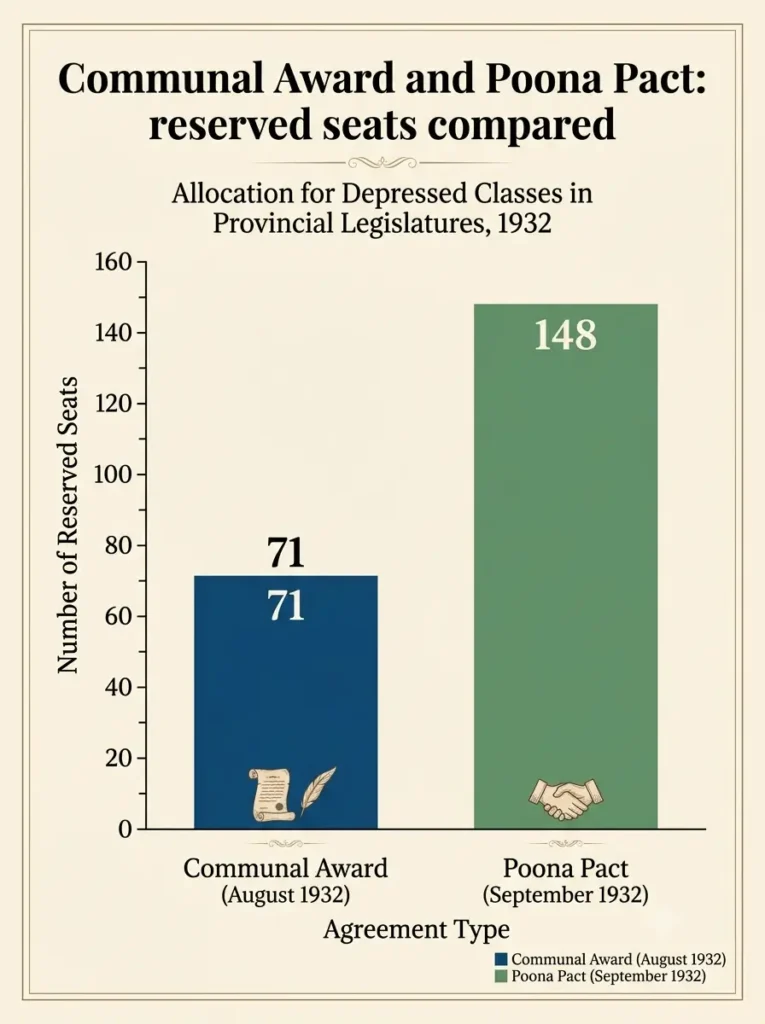
Under public pressure, and with Gandhi’s life at risk, Ambedkar negotiated with caste-Hindu leaders and signed the Poona Pact on 24 September 1932. The pact dropped separate electorates but gave more reserved seats (148 in provincial legislatures, against 71 under the Communal Award; some sources give 147) within a joint electorate, using a two-stage election system for the reserved seats.
| Issue | Communal Award (1932) | Poona Pact (1932) |
|---|---|---|
| Electorate for depressed classes | Separate electorates | Joint (general) electorate |
| Reserved seats in provincial legislatures | 71 | 148 (some sources: 147) |
| Whom candidates answered to | Dalit voters alone | Dalit voters in the first stage, and the wider (including caste-Hindu) electorate in the final election |
Why it is debated. Ambedkar later described the pact as something he accepted under pressure. A commonly cited criticism, later made forcefully by the political organiser Kanshi Ram in The Chamcha Age (1982), is that the system produced Dalit legislators dependent on the major parties. Defenders of Gandhi’s position argue that separate electorates would have deepened division and that the larger reserved quota was a real gain. In an exam, present the pact as both a concession and a gain, and name the argument on each side.
A useful primary text for the pact is the Poona Pact as reproduced on the Constitution of India site, and Britannica’s entry on the Poona Pact gives a short, reliable summary.
Politics in the 1930s and 1940s
The Independent Labour Party (1936) tried to bring Dalits and workers together on a common platform; it contested the 1937 elections and did well in the reserved seats it contested. In 1942 Ambedkar reorganised his politics into the Scheduled Castes Federation and also served as Labour Member of the Viceroy’s Executive Council (1942–46), where he was associated with labour reforms. In What Congress and Gandhi Have Done to the Untouchables (1945) he made his sharpest case against the Congress.
Constitution-making and conversion
Ambedkar chaired the Drafting Committee of the Constituent Assembly. The Constitution was adopted on 26 November 1949 and came into force on 26 January 1950. Its provisions on equality, the abolition of untouchability (Article 17) and reservations reflect the Dalit movement’s demands.
On 14 October 1956, at Deekshabhoomi in Nagpur, Ambedkar embraced Buddhism with a very large crowd of followers (accounts speak of hundreds of thousands, with some estimates as high as six lakh), and administered the twenty-two vows; further conversions followed at Chandrapur two days later. He died on 6 December 1956. His form of Buddhism is commonly called Navayana, because he understood the Buddha’s teaching as a social and ethical philosophy rather than a path of renunciation. 14 October is observed as Dhamma Chakra Pravartan Din, and 14 October 2026 is the seventieth anniversary of the conversion.
Assessment
Ambedkar’s greatest contribution to the national movement was to insist that independence without social democracy was incomplete. Historians also point to limits. The movement was strongest in particular regions and among particular Dalit communities (the Mahars of Maharashtra above all), and there were other Dalit leaders with different strategies, such as Rettamalai Srinivasan in Madras, who founded the Adi Dravida Mahajana Sabha in 1893, and Iyothee Thass, who advocated Buddhism for Tamil Dalits. Ambedkar’s relationship with the Congress combined cooperation in the constitutional field with sharp conflict over strategy.
Revision box: Ambedkar in five lines. (1) Born Mhow 1891, Mahar family. (2) Organised through the Bahishkrit Hitakarini Sabha (1924). (3) Mahad (1927) and Kalaram (1930) satyagrahas. (4) Poona Pact (24 Sept 1932) replaced separate electorates with reserved seats. (5) Drafted the Constitution and embraced Buddhism in 1956.
How Ambedkar and Gandhi differed
| Question | Gandhi | Ambedkar |
|---|---|---|
| Nature of untouchability | A moral stain on Hinduism that caste Hindus should atone for | A structural, institutionalised inequality that needed legal and political remedies |
| Who should lead uplift? | Caste-Hindu reformers (Harijan Sevak Sangh) | Dalits themselves |
| Electorates | Opposed separate electorates | Wanted separate electorates; accepted reserved seats in joint electorates under pressure |
| Varna and shastras | Defended a purified form of varna for much of his career | Held that caste could not survive without the sanction of the shastras and argued for its annihilation |
| Religion | Reform within Hinduism | Left Hinduism for Buddhism in 1956 |
Note on the row on Gandhi and varna: Gandhi’s position changed over time, and his later writing was more critical of caste hierarchy. The table gives the broad contrast that DU answers usually draw.
Dravidian Movements
Origins and context
In the early twentieth century the Madras Presidency had a sharply unequal social order. Brahmins were a small share of the population but held a large share of places in English education, the lawyers’ profession and government service, and they were prominent in the Madras unit of the Congress. Non-Brahmin groups (landholding, trading and professional castes, and below them the Dalits) saw this as a monopoly. The Dravidian movement grew out of this grievance. It was at once a social-justice movement (access to jobs, education and dignity), a cultural movement (the claim that Tamil and other Dravidian languages and traditions had their own worth, independent of Sanskritic Brahmanical culture) and, increasingly, a political movement.
A note on terms: “Dravidian” in this context is a political and cultural identity, not merely a synonym for “non-Brahmin”. Dalits were part of the Dravidian category in theory, but the early leadership came largely from the non-Brahmin elite, a point historians often raise (see the assessment below). An earlier organisation, the Madras Dravidian Association (1912), prepared the ground.
The Justice Party (South Indian Liberal Federation)
The South Indian Liberal Federation, better known as the Justice Party after its English newspaper Justice, was formed in 1916 by C. Natesa Mudaliar, T.M. Nair and P. Theagaraya Chetty (spelled Thyagaraya in some books). Its “Non-Brahmin Manifesto” of December 1916 demanded that non-Brahmins be given a fair share in politics and administration.
- Outlook. The party was loyalist and liberal in its approach: it believed that under the Montagu-Chelmsford reforms the British could be pressed to protect non-Brahmin interests, and it distrusted the Home Rule agitation and the Congress, which it saw as a vehicle of Brahmin dominance.
- In office. Under the 1919 Act, the Justice Party formed the government in the Madras Presidency after the first elections of 1920 (which the Congress boycotted) and held office for much of the period 1920–37, though not continuously (it lost power for a few years in the mid-1920s and again in 1937). Remember this when a question says “1920–37”: the party governed in two long phases, with a break.
- Achievements. The Justice ministries are credited with a Communal Government Order (1921) that provided reservation of posts for non-Brahmins, extending school education, and legislation on the management of Hindu temples (the 1926 Hindu Religious Endowments Act). These measures are why DU questions often present the Justice Party as the first government in India to put reservation into administrative practice, but if you use that line, qualify it (“one of the earliest”).
- Decline. The party relied on elite non-Brahmin support, did not build a mass base, and was badly beaten by the Congress in the 1937 elections. In 1939 Periyar became its president.
The Self-Respect Movement
E.V. Ramasamy (“Periyar”, born 1879) began his public career in the Congress (he joined in 1919). He took part in the Vaikom Satyagraha (1924–25), an agitation for the right of lower-caste people to use the roads near the Vaikom temple in the princely state of Travancore. He left the Congress in 1925, convinced that it served Brahmin interests. The Self-Respect Movement that he started is dated 1925 in most textbooks, though some sources say 1926.
Its programme was radical and its tone often confrontational:
- Against caste, priesthood and superstition. It questioned religious authority and ritual and promoted rationalism. The aim was a society where people were judged by their ability, not their birth.
- Women’s rights. It argued for women’s education, property and dignity, opposed child marriage and dowry, and supported widow remarriage.
- Self-respect marriages. Priestless marriages conducted without Brahmin priests or Sanskrit rituals became a signature of the movement. They gained legal recognition in Madras State in 1967.
- Inter-caste marriage was encouraged.
- The press. The movement’s Tamil weekly Kudi Arasu (1925) and the English weekly Revolt (1928) carried its arguments. From 1929 to 1932 Periyar toured Malaya, Europe and the Soviet Union, which strengthened his interest in socialism and rationalism.
- The Chengalpattu conference (1929) is associated with the call to drop caste titles; Periyar himself dropped “Naicker”.
The movement also took on language politics. When the Congress ministry in Madras proposed making Hindi compulsory in schools (1937–38), Periyar and others led a sustained anti-Hindi agitation that continued into 1940, a landmark in Tamil political identity.
Dravidar Kazhagam and the DMK
In 1944, at Salem, the Justice Party was renamed the Dravidar Kazhagam (DK) under Periyar’s leadership, merging its political tradition with the Self-Respect Movement’s social radicalism. Note the sequence: Periyar, who had led the Justice Party since 1939, changed its name and agenda in 1944; the Self-Respect Movement is the social-reform current he merged into it. The DK demanded an independent Dravida Nadu and refused to take part in electoral politics.
In 1949 C.N. Annadurai and others left the DK and formed the Dravida Munnetra Kazhagam (DMK), which chose to contest elections. The DMK came to power in Tamil Nadu in 1967, ending Congress rule there, and Dravidian parties have dominated state politics since. This is the answer to the common question, “why is the Dravidian movement important beyond Tamil Nadu?”: it created the first durable regional challenge to the Congress, shaped debates on federalism, language and reservation, and gave the Indian Union an example of a movement turning from secession-style demands to state politics.
| Organisation | Period | Leaders | Core idea | Method |
|---|---|---|---|---|
| Justice Party (SILF) | 1916–44 | Natesa Mudaliar, T.M. Nair, Theagaraya Chetty | Share for non-Brahmins in jobs and politics | Constitutional politics, ministries |
| Self-Respect Movement | 1925/26 onwards | Periyar | Rationalism, anti-caste, gender equality | Propaganda, conferences, social practice |
| Dravidar Kazhagam | 1944 onwards | Periyar | Dravida Nadu, social revolution | Agitation, avoided elections |
| DMK | 1949 onwards | C.N. Annadurai | Dravidian identity and social justice within the Indian Union | Electoral politics |
Assessment and debate
- Elite or radical? Critics argue that the Justice Party’s leaders were landholders and professionals who sought a share of power for themselves. Defenders reply that its reservation policy opened government posts and education to many groups that had been excluded. Periyar’s movement is generally seen as more radical, because it attacked religious authority and gender hierarchy directly.
- Race, language and the “Aryan” idea. Early Dravidian thinking drew on the idea of an Aryan-Dravidian divide. Later scholarship treats such racial categories with caution, though the political identity itself proved durable.
- Limits. The demand for Dravida Nadu found little support beyond Tamil-speaking areas, and relations with Dalit movements were sometimes strained. Ambedkar and Periyar met and shared an anti-Brahmanical position, but they did not always agree on strategy.
- Relation to nationalism. The Dravidian movements were not “anti-national” in a simple sense. Their dispute was about whose nation it would be and what kind of equality it would deliver. For a longer, scholarly summary, the National University of Singapore’s ISAS special report on Dravidian politics provides a short historical introduction.
Revision box. Justice Party 1916 → Periyar leaves Congress 1925 → Self-Respect Movement → Justice Party renamed DK 1944 → DMK 1949 → DMK in government 1967.
Hindustan Socialist Republican Association (HSRA) and Revolutionary Movements
Background and inspiration
After the Non-Cooperation Movement was withdrawn in 1922, many young nationalists felt that Gandhian methods had reached a dead end. They looked to older revolutionary traditions (you can revise those in the notes on the Swadeshi Movement and early revolutionary movements), to the Ghadar tradition and, increasingly, to the example of the Russian Revolution of 1917 and to socialist literature. The shift from the earlier cult of the individual assassin to a political programme of socialism and mass revolution is the key idea in this section.
From HRA to HSRA
The Hindustan Republican Association (HRA) was formed in October 1924, with Sachindra Nath Sanyal, Jogesh Chandra Chatterjee and Ram Prasad Bismil among its founders. Its manifesto, The Revolutionary, set out an armed-revolution programme aimed at a federal republic. In 1926 Bhagat Singh and Bhagwati Charan Vohra founded the Naujawan Bharat Sabha in Lahore as a youth organisation working as the open, public face of the movement.
After the Kakori arrests and executions, the group regrouped. At a meeting in Feroz Shah Kotla, Delhi, on 8–9 September 1928, the HRA was reorganised under the leadership of Chandrashekhar Azad and renamed the Hindustan Socialist Republican Association (HSRA). Adding the word “Socialist” marked its new goal: not only the end of British rule but a socialist republic ending exploitation. In place of the individual-action model, the HSRA wanted to prepare for mass revolution, though it kept armed actions as part of its strategy.
Key figures
- Chandrashekhar Azad (1906–31) was the military commander of the HSRA. After being arrested at fifteen during the Non-Cooperation Movement, he gave his name as “Azad” (“free”) in court. He died on 27 February 1931 at Alfred Park, Allahabad, when surrounded by police; he used his last bullet on himself rather than be captured.
- Bhagat Singh (1907–31) was the group’s leading thinker. He read widely in socialist and European revolutionary history and became its most famous voice.
- Sukhdev Thapar organised the Lahore group. Rajguru (Shivaram Rajguru) took part in the Saunders shooting.
- Bhagwati Charan Vohra was the group’s main political writer and organiser. He died on 28 May 1930 while testing a bomb on the bank of the Ravi near Lahore.
- Batukeshwar Dutt joined Bhagat Singh in the Assembly action.
- Ram Prasad Bismil and Ashfaqulla Khan were earlier leaders and the best-known figures of the Kakori case.
Key actions
Kakori train action (9 August 1925). HRA members stopped a train near Kakori, close to Lucknow, and took the government money it was carrying, to fund the organisation. The government responded with a large conspiracy case. Four men (Ram Prasad Bismil, Ashfaqulla Khan, Roshan Singh and Rajendra Lahiri) were hanged in December 1927, and others received long sentences. Bismil and Ashfaqulla became powerful symbols, and the case shows how the movement included Hindus and Muslims working together.
Lajpat Rai’s death and the Saunders killing (1928). The Simon Commission reached Lahore on 30 October 1928 and was met with black-flag protests. Police charged the procession, and Lala Lajpat Rai, who was struck, died on 17 November 1928. The HSRA decided to avenge him. On 17 December 1928, Bhagat Singh, Rajguru, Sukhdev and Azad shot J.P. Saunders, an Assistant Superintendent of Police, in Lahore. According to several accounts, the intended target was Superintendent James Scott, who had ordered the lathi charge, and Saunders was shot in a case of mistaken identity.
The Assembly bombing (8 April 1929). Bhagat Singh and Batukeshwar Dutt threw bombs, designed not to kill, into the Central Legislative Assembly in Delhi to protest the Public Safety Bill (which would have given the government power to deport suspected foreign-born agitators) and the Trade Disputes Bill (which restricted strikes). They also threw leaflets and shouted “Inquilab Zindabad”, then allowed themselves to be arrested. The leaflet explained that the purpose was, in its own words, to “make the deaf hear”. About the slogan: it is usually credited to the Urdu poet and Congress and Communist figure Hasrat Mohani (1921); the HSRA made it famous. Aparna Vaidik’s study of revolutionaries, Waiting for Swaraj (Cambridge University Press), discusses how the slogan came to be associated with Bhagat Singh.
The jail hunger strikes (1929). In jail, Bhagat Singh, Dutt and others demanded that they be treated as political prisoners, with better food, books and facilities, rather than as ordinary criminals. The hunger strike spread across prisons. Jatin Das died on 13 September 1929, after about 63 days of fasting, and the funeral procession drew large crowds. The strikes brought the prisoners nationwide attention and turned the trial into a public platform.
Attack on the Viceroy’s train (23 December 1929). HSRA members planted a bomb on the railway line near Delhi; the train was derailed, but Viceroy Lord Irwin escaped unhurt. Gandhi condemned the act in The Cult of the Bomb, to which the HSRA replied (see “Revolutionary literature” below).
The trials and the executions
After the Assembly bombing, Bhagat Singh and Dutt were sentenced to transportation for life. Police investigation then linked Bhagat Singh to the Saunders killing, leading to the Lahore Conspiracy Case. A special tribunal tried the accused, and the judgment on 7 October 1930 sentenced Bhagat Singh, Sukhdev and Rajguru to death. They were hanged on 23 March 1931, a few weeks after the Gandhi-Irwin Pact had been signed (5 March), and the fact that the pact did not secure their reprieve caused bitter anger against the Congress leadership.
Bhagat Singh used the courtroom to state a political position: that the revolutionaries were not mere criminals but were fighting an unjust system, and that “revolution” meant a transformation of society, not just bomb-throwing. If you want to quote him in an exam, use passages from his published statements and letters; many lines attributed to him online are paraphrases of uncertain origin.
Revolutionary literature
- The Philosophy of the Bomb (January 1930) was written by Bhagwati Charan Vohra in consultation with Azad (and with Bhagat Singh’s input, according to some accounts) in reply to Gandhi’s Cult of the Bomb. The pamphlet argued that revolutionary violence was a phase in the larger process of revolution, not the revolution itself. Scroll.in’s discussion of the pamphlet and the Bipan Chandra controversy is a readable starting point.
- Why I Am an Atheist was written by Bhagat Singh in Lahore Central Jail in 1930, as a reasoned account of his rejection of religious belief. It was published in the Lahore weekly The People in 1931 after his execution. He argued that belief in God and fate made people accept injustice, and he valued reason and science.
- The Revolutionary (1925) was the HRA’s manifesto.
Revolutionary nationalism beyond Punjab and Uttar Pradesh
The HSRA was only one part of the revolutionary current. In Bengal, Surya Sen’s Chittagong Armoury Raid (18 April 1930) was an organised armed attack on government arsenals and drew many young people, including women, into revolutionary action; you should mention it in answers on “revolutionary movements” even though this article does not treat it in detail.
Debates, criticism and legacy
- Violence and non-violence. Gandhi and the Congress leadership disapproved of the HSRA’s methods, arguing that violence harmed the mass movement and could provoke repression. The revolutionaries replied that non-violence could not be the only road for all people and that their acts were meant to awaken the public.
- The word “terrorist”. In their widely used textbook, the historian Bipan Chandra and his co-authors described Bhagat Singh’s group as “revolutionary terrorists”, which led to a public controversy in 2016. Supporters of the usage point out that the revolutionaries themselves used the term “terrorism” in their writing; critics say the label is misleading today. For an exam, say that the debate is about terminology and context, and cite both sides.
- Social base. Historians note that the HSRA was urban and middle-class, and had a limited rural base, a point that explains both its dramatic effect and its small organisational reach.
- Ideological development. Bhagat Singh’s later writing shows a clear shift from individual terror to the idea of mass organisation, a socialist state and workers’ and peasants’ mobilisation.
- Legacy. The execution made Bhagat Singh a symbol for students and youth, and the “Inquilab Zindabad” slogan became a rallying cry. Respect for the revolutionaries was widespread even among those who disagreed with their methods.
| HSRA revolutionaries | Gandhian Congress | |
|---|---|---|
| Method | Armed action combined with propaganda; trials used for publicity | Non-violent mass movement |
| Goal | Socialist republic | Swaraj (with a mixed social programme) |
| Base | Urban, student and middle-class youth | Wider, from towns to villages |
| Attitude to religion | Secular; Bhagat Singh openly atheist | Religion central to Gandhi’s politics |
| Response to the 1931 executions | Became martyrs | Divided opinion; Congress criticised for the pact |
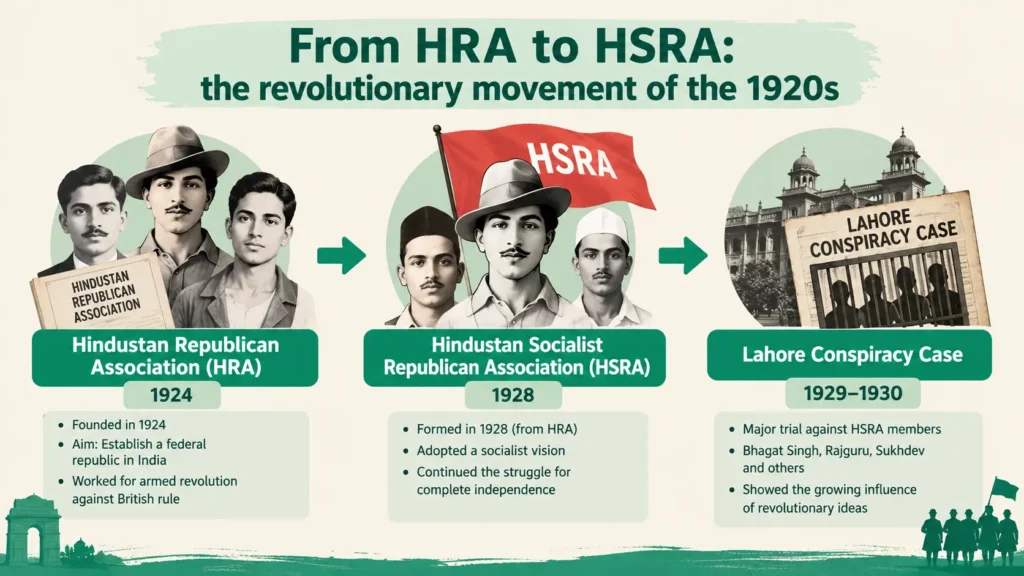
Revision box. HRA (Oct 1924) → Kakori (9 Aug 1925) → HSRA at Feroz Shah Kotla (8–9 Sept 1928) → Saunders (17 Dec 1928) → Assembly bomb (8 Apr 1929) → Lahore Conspiracy Case verdict (7 Oct 1930) → executions (23 Mar 1931).
The Ghadar Movement
Origins abroad
Between the 1900s and 1914 thousands of Indians, most of them Punjabi Sikh farmers and labourers, migrated to the Pacific coast of the United States and to British Columbia in Canada. They worked in lumber mills, railways and farms and faced racial prejudice and restrictive immigration laws. Many of them concluded that the humiliation they met abroad was connected to India’s colonial status, since an Indian could not claim the protection of a free nation.
In 1913 these migrants, together with students and intellectuals, formed the Pacific Coast Hindustan Association, which became known as the Ghadar Party (from ghadar, “revolt”). It was founded at a meeting in Astoria, Oregon, and soon had its headquarters in San Francisco, in a building called the Yugantar Ashram. Baba Sohan Singh Bhakna was its founding president and Lala Har Dayal its general secretary and chief ideologue; Kartar Singh Sarabha, a very young student, helped to run its press. The party included Sikhs, Hindus and Muslims, and it adopted a secular and republican outlook (many exam answers call Ghadar “socialist”; most scholarly accounts prefer “secular, egalitarian and republican”, with socialist influence present but uneven).
The newspaper
The weekly Ghadar first appeared on 1 November 1913 in Urdu, with a Gurmukhi edition following on 9 December 1913; Hindi and other languages were added later. It reported on British exploitation, the economic drain, taxes and famines, and called on Indians in the colonial army to revolt. For readers abroad and in Punjab it was both news and propaganda.
Objectives and the outbreak of war
The party aimed at an armed rebellion to end British rule, built on the idea that Indian soldiers, once persuaded, would turn their weapons on the British. The Komagata Maru incident (1914) accelerated its work. The Japanese ship, chartered by Baba Gurdit Singh to carry Indian passengers to Canada, was refused entry under Canada’s immigration rules and was forced to return; when it reached Calcutta there was violence. The incident deepened anger among Indians abroad. With the outbreak of the First World War in 1914, Ghadar leaders called on members to go home and prepare a rebellion, and many did.
Lala Har Dayal, it should be noted, was arrested by the US authorities in March 1914, not by the British; he jumped bail and left for Europe, where Ghadar’s contacts with Germany developed under the wider “Hindu-German conspiracy” that was later tried in San Francisco (1917–18).
The 1915 plan and its failure
Returnees tried to win over regiments in Punjab and to coordinate with revolutionaries such as Rash Behari Bose, with a rising planned for February 1915. The plan failed because the authorities had informers, the date was brought forward and rescheduled, and coordination was poor. The government used the Defence of India Act (1915) to try suspects in the Lahore Conspiracy Cases (1915–16). Many were sentenced to death or transportation; Kartar Singh Sarabha was hanged on 16 November 1915 when still a teenager, and Bhagat Singh later spoke of him with great respect. Bhakna was sentenced to long imprisonment. (Casualty and sentence numbers differ between sources, so use “dozens” unless your textbook gives a figure.)
Impact and significance
- Internationalisation. Ghadar showed that Indian nationalism could organise abroad, linking the anti-colonial struggle to global ideas about imperialism and migration.
- Radical example. Its secular, direct-action approach influenced later revolutionaries, including the HSRA. The revolutionary tradition moved from a Bengal-centred story to a Punjab-centred one.
- Limits. The plan depended on mutiny that never became general, it relied on German support during the war, and British surveillance was effective. As a result the movement achieved martyrs and memory more than immediate political change.
The Singh Sabha Movement
Background
After the British annexation of the Punjab in 1849 the Sikh community faced several pressures at once: Christian missionary activity, the spread of Western education, and the revival movements of the Arya Samaj (founded in Punjab at Lahore in 1877) and other reformers who sometimes treated Sikhism as a branch of Hinduism. Sikh elites worried that the community’s distinct identity, practices and institutions were being eroded. Ideas about the “19th century reform movements” are covered in the notes on popular movements and reforms in the nineteenth century.
Formation and objectives
The first Singh Sabha was founded at Amritsar in 1873; another important Sabha followed at Lahore in 1879. Their leaders differed: the Amritsar Sabha drew in aristocrats and traditional scholars, while the Lahore Sabha, associated with the “Tat Khalsa” (the “pure” Khalsa), was more reformist and insisted on a clear, distinct Sikh identity, separate from Hindu practice. Over time the Tat Khalsa view became dominant. The Sabhas aimed to:
- Purify Sikh practice by returning to the teaching of the Gurus and the Guru Granth Sahib and rejecting practices they saw as later accretions, including idol worship and Brahmanical rituals.
- Spread education, in the Gurmukhi script and in modern subjects.
- Reform society, including attention to women’s education and opposition to caste discrimination within the community.
- Respond to criticism from missionaries and Hindu reformers with their own tracts, schools and public meetings.
Contributions
- Khalsa College, Amritsar (1892) combined modern education with Sikh values and trained many of the community’s leaders.
- Print and literature. The Sabhas published newspapers, tracts and histories and helped establish Gurmukhi and Punjabi as the Sikh community’s literary language. This was part of a larger language dispute in Punjab (Gurmukhi, Persian-Urdu and Devanagari), which was closely tied to religious identity.
- Standardising practice. Efforts such as the move to a distinct Sikh marriage ceremony, later recognised by the Anand Marriage Act of 1909, and tracts such as Kahn Singh Nabha’s Ham Hindu Nahin (1890s) argued that Sikhs were a separate community.
Assessment and debate
Historians disagree about what the Singh Sabha movement did. Some see a recovery of an original Sikh tradition. The historian Harjot Oberoi (The Construction of Religious Boundaries, 1994) argued that the movement drew sharper boundaries around a religious tradition that had earlier been more fluid, and that this was a modern construction of identity. Others reject this reading as too constructivist. Both views agree on the central fact: the movement set the cultural and institutional base that the Akali movement used in the 1920s. For DU, you should be able to place Singh Sabha as cultural and educational reform and Akali as its political and institutional culmination.
The Akali Movement
Why the movement began after the First World War
The 1920s Akali movement grew out of the Singh Sabha tradition and out of the shock of the war years and the Jallianwala Bagh massacre (1919). Many historic gurdwaras were managed by hereditary mahants who treated gurdwara income as personal property and, in some cases, maintained close ties with the British administration. Reformers wanted these shrines to be managed by the Sikh community. The organised movement belongs to 1920 onwards. Around the same time, restrictions on Dalit access inside the Golden Temple were being relaxed, which shows how gurdwara reform and social inclusion were linked.
The SGPC and the Akali Dal (1920)
At an assembly of Sikhs on 15 November 1920 at the Akal Takht, the community formed a representative body, the Shiromani Gurdwara Prabandhak Committee (SGPC), which held its first session on 12 December 1920. The Shiromani Akali Dal was formed on 14 December 1920 to organise volunteer groups (jathas) that would take control of gurdwaras.
The morchas
- Nankana Sahib (20 February 1921). A jatha of Akalis went to the shrine at Guru Nanak’s birthplace, which was under the control of the mahant Narain Das. His armed men attacked the jatha and killed around 130 people in the shrine and its surroundings (figures differ across sources). The event shocked Punjab; Gandhi visited Nankana Sahib on 3 March 1921, and the incident is remembered as Saka Nankana Sahib.
- Keys affair (1921–22). When the government took over the keys of the Golden Temple toshakhana, the Akalis launched an agitation, and the keys were returned in January 1922.
- Guru ka Bagh (1922). The dispute was about land attached to a small shrine near Amritsar. On 9 August 1922 police arrested Akalis who had gone to gather firewood for the community kitchen; in the following weeks jathas marched in an orderly way and accepted police beatings without retaliating. This disciplined non-violence drew wide admiration.
- Jaito (1923–25). After the British forced the Sikh ruler of Nabha, Maharaja Ripudaman Singh, to abdicate in 1923, the Akalis launched a protest at Jaito. Firing on a jatha in February 1924 killed a large number of protestors (reports say about a hundred).
The Sikh Gurdwaras Act (1925)
The Sikh Gurdwaras Bill was passed by the Punjab Legislative Council on 7 July 1925 and became the Sikh Gurdwaras Act, 1925. It gave legal recognition to the SGPC as the elected body managing the major gurdwaras in Punjab. The historian’s caution here is that the Act was a result both of Akali pressure and of government calculations that a settlement would reduce unrest.
Role in the national movement
- The Akalis’ disciplined non-violence was widely praised by Congress leaders and showed that mass non-violent resistance could succeed.
- Many Akalis joined the Non-Cooperation Movement, and later Sikh political currents, including the Central Sikh League, worked with the Indian National Congress at times. The movement is best read as one strand of the wider Indian national movement.
- Over time, relations became more complicated as the Akali Dal developed its own political interests, but the movement remained an example of a community’s organised assertion within, and alongside, the national movement.
Peasant Movements
Causes and context
Colonial agrarian policy fell on cultivators in different ways. In zamindari regions (Bengal, Bihar, Awadh and parts of the United Provinces), peasants were tenants who paid rents that landlords could raise and from which they could be evicted; in ryotwari regions (Bombay and Madras) cultivators paid revenue directly to the state, and revenue enhancements were the main grievance. In both, commercialisation of agriculture, moneylenders, debt and famine pushed families toward ruin. You can revise the background in the notes on land revenue systems and agricultural commercialisation.
Key movements
Kisan Sabhas in Uttar Pradesh and Awadh (1918–22). The United Provinces Kisan Sabha was formed in 1918, and Awadh Kisan Sabhas under Baba Ramchandra and others grew after 1920. In the same period the Eka (unity) movement of 1921–22, led by figures such as Madari Pasi, spread across several districts of Awadh, and tenants resisted rent enhancements and illegal exactions. These movements overlapped with the Non-Cooperation Movement, but peasants often interpreted the national message in terms of their own grievances, which is why Gandhi and the Congress were uneasy about “no-rent” campaigns.
Bardoli Satyagraha (1928). Bardoli taluka in Surat district, Gujarat, was a ryotwari area. The Bombay government’s revised assessment (originally proposed at around 30 per cent and settled at about 22 per cent) was challenged by a no-tax campaign led by Vallabhbhai Patel, whom the local Congress committee invited in early 1928. Mahadev Desai, Mithuben Petit and others helped; women had a visible role, and the “Sardar” title is associated with the women of Bardoli. The campaign ran through the summer. The government agreed to an enquiry (the Broomfield-Maxwell Committee) that cut the enhancement to 6.03 per cent; seized land was returned. Note that the increase was reduced, not abolished. Bardoli’s participants were relatively prosperous Patidar cultivators, which helps explain its discipline and also its limits. Patel’s rise at Bardoli is described on the Indian National Congress’s tribute page.
All India Kisan Sabha (1936). Provincial Kisan Sabhas, such as the Bihar Provincial Kisan Sabha (1929) under Swami Sahajanand Saraswati, led to the founding of the All India Kisan Sabha (AIKS) at Lucknow in April 1936, with Sahajanand as its first president. The AIKS drew in Congress Socialists and Communists and demanded abolition of the zamindari system and relief from debt and rent. Its relations with the Congress oscillated between cooperation and conflict. The sequence to remember is local sabhas in 1918–20 and the national body in 1936.
Tebhaga movement (1946–47). In Bengal, sharecroppers (bargadars) demanded two-thirds (tebhaga) of the crop rather than the half that landlords usually took. Led by the Bengal Provincial Kisan Sabha, which was linked to the Communist Party, the movement was strongest in northern and eastern Bengal and was met with police repression. It brought the question of sharecroppers’ rights into law-making, and a later West Bengal Act (the Bargadari Act, 1950) recognised some rights. Other post-war peasant struggles, such as the Telangana armed struggle (1946–51), sit at the edge of this unit but are useful for “Left and peasants” questions.
| Movement | Region and period | Leadership | Main issue | Outcome |
|---|---|---|---|---|
| Kisan Sabhas / Eka | Awadh, 1918–22 | Baba Ramchandra, Madari Pasi and local leaders | Rent, eviction, exactions | Suppressed; peasant militancy visible |
| Bardoli | Gujarat, 1928 | Vallabhbhai Patel | Land revenue enhancement | Enhancement cut to 6.03% |
| AIKS | All India, 1936 onwards | Swami Sahajanand Saraswati and others | Zamindari, debt, rent | National peasant platform |
| Tebhaga | Bengal, 1946–47 | Bengal Provincial Kisan Sabha (Communists) | Two-thirds crop share | Led to later legislation |
Impact and debate
- Empowerment and politicisation. The movements made peasants aware of their own interests and drew them into the national movement.
- Peasants and Congress. Congress leaders valued peasant support but were cautious about rent and class conflict, especially when zamindars were also allies.
- Peasant consciousness. Historians of the Subaltern Studies tradition argue that peasants had their own idioms of protest; nationalist historians stress the role of Congress organisation. A good answer says that peasants used the national movement for their own ends and that this explains both unity and tension.
Workers’ Movements
Industrial growth and labour conditions
Factories grew in Bombay and Ahmedabad (cotton), Calcutta (jute), in the railway workshops and in mines and plantations. Workers were drawn from villages, often in debt, and lived in crowded chawls and bustees. Reports of the period describe long working days, low wages, unsafe machinery and little protection against sudden dismissal. The industrial side of the story is covered in the notes on colonial economy and the rise of modern industry.
Early organisation
Before the AITUC there were local initiatives: the Bombay Millhands Association (1890), the Madras Labour Union (1918) and the Ahmedabad Textile Labour Association (1918), which followed Gandhi’s approach of arbitration and trusteeship.
The AITUC (1920)
The All India Trade Union Congress was founded in Bombay on 31 October 1920, with Lala Lajpat Rai as its first president and leaders such as Joseph Baptista, N.M. Joshi and Diwan Chaman Lall prominent in the early years. It brought unions together on a national platform and linked them to the nationalist movement. Legislation followed: the Trade Unions Act (1926) gave unions legal status, while the Trade Disputes Act (1929), whose bill Bhagat Singh’s Assembly protest targeted, restricted strikes. In 1929 the AITUC split at Nagpur between moderate and Communist-influenced groups; this reflects the larger tension between reformist and class-struggle ideas.
Strikes and actions
- Assam-Bengal Railway strike (1921), an early “sympathetic strike”, which drew local community support.
- Bengal Nagpur Railway strike at Kharagpur (February 1927), which responded to retrenchment, and the Liluah (Howrah) strike (1928).
- Bombay textile strike (1928), led by the Communist-led Girni Kamgar Union, a prolonged mill strike that showed the growing influence of Communists among Bombay’s workers.
- South Indian Railway strike (29 June – 2 August 1928), which began in response to plans to lay off over 3,000 workers; the company and the Madras government cracked down and the union was outlawed.
- The Meerut Conspiracy Case (1929) was the government’s major attempt to break the Communist-led labour movement; in March 1929 it arrested trade union and Communist leaders, and the long trial drew international attention.
Note: these are the documented railway strikes of the late 1920s. Be wary of notes that refer to a single “Great Indian Railway Strike of 1927”; the documented events are the Kharagpur strike of 1927 and the South Indian Railway strike of 1928.
Role in the national movement
Workers joined the Non-Cooperation Movement, the Civil Disobedience Movement and, in 1942 and 1946, major political strikes, but organised labour did not simply follow Congress. Gandhian unions emphasised arbitration and cooperation between employers and workers; Communists emphasised class conflict. Employers’ interests were also present in Congress, so the party’s relationship with labour was never simple. The post-1947 labour landscape (INTUC, HMS and left unions) grew from these early divisions.
| Gandhian approach (Ahmedabad) | Communist approach (Bombay) | |
|---|---|---|
| View of employers | Trustees who should be persuaded | Class adversaries |
| Method | Arbitration, non-violence | Strikes, mass mobilisation |
| Organisation | Textile Labour Association | Girni Kamgar Union |
| Link to nationalism | Within Congress politics | Anti-imperialist and anti-capitalist |
Tribal Movements
Causes
Tribal (Adivasi) communities had lived with their own systems of land, forest use and authority. Colonial policy transformed their conditions: forest laws (such as the Madras Forest Act of 1882) turned forests into state-controlled reserves, restricted shifting cultivation and the collection of forest produce, and made tribal people dependent on forest departments and contractors; outsiders (moneylenders, traders, landlords and officials, often called dikus in eastern India) took land and imposed debt; and missionaries and administrators intervened in religion and custom. The earlier great revolts (the Santhal Hul of 1855, Birsa Munda’s Ulgulan of 1899–1900) form the background to the 20th-century movements below.
Notable movements
Tana Bhagat movement (1914 onwards). The movement began in April 1914 among the Oraon people of the Chotanagpur region (Gumla, Ranchi) with a young man named Jatra Oraon (Jatra Bhagat), who announced a revelation from the Oraon supreme deity and called for a new, purified way of life, including refusing to pay rent and tax and giving up certain customs. Tens of thousands joined. The “Tana” in the name refers to the sect’s followers and practice; it is not the name of a leader. Jatra was jailed in 1914 and, after release in 1915, withdrew from leadership; others took over. From about 1920–21 the Tana Bhagats were increasingly drawn into Gandhian nationalism: they took the Congress flag, wore khadi, attended the Gaya Congress (1922) on foot, and joined the Nagpur Flag Satyagraha (1923). The movement began with its own religious and agrarian aims and was later absorbed into Gandhian politics, losing some of its earlier radicalism. Sources: Banglapedia’s entry on the Oraon Tana Bhagat movement, the Ranchi district government history page and a Yale agrarian studies paper on the Tana Bhagats.
Rampa (Manyam) Rebellion (1922–24). In the Godavari Agency hills of the Madras Presidency, tribal communities such as the Koyas and Konda Reddis were hit by the Madras Forest Act of 1882, which restricted their forest movement and banned podu (shifting cultivation), and by forced labour. Alluri Sitarama Raju, a charismatic leader whom the people called the “hero of the jungle” (Manyam Veerudu), organised guerrilla warfare from August 1922, attacking police stations and taking arms. He was inspired by the Non-Cooperation Movement (he promoted khadi and urged people to give up drink) but did not accept non-violence. He was captured and shot on 7 May 1924 at Koyyuru. Gandhi reportedly acknowledged his courage but did not endorse his methods.
| Tana Bhagat | Rampa rebellion | |
|---|---|---|
| Region | Chotanagpur (Jharkhand) | Godavari Agency (Andhra) |
| Leader | Jatra Oraon (Bhagat) and successors | Alluri Sitarama Raju |
| Main grievances | Rent, tax, religious revival and agrarian issues | Forest law, podu ban, forced labour |
| Method | Non-violent refusal, later Gandhian | Guerrilla armed resistance |
| Relation to Congress | Absorbed from c. 1920–21 | Inspired by NCM but separate |
Significance and debate
Tribal movements asserted tribal rights over land and forest and challenged colonial authority, and they influenced post-independence tribal politics. The scholarly debate is about whether such movements were autonomous assertions of tribal identity or were integrated into the national movement as “part of the freedom struggle”. The Tana Bhagat case suggests that both are true at different stages. Remember too that most tribal movements were also movements against non-tribal moneylenders and landlords, not only against the British.
Emergence of the Left
Ideological foundations
The Left in India drew on Marxism, on the example of the Russian Revolution (1917) and on the Communist International (Comintern), founded in 1919. Marxists argued that colonialism was a form of capitalist exploitation, that landlords, moneylenders and industrialists shared in that exploitation, and that real independence required a transformation of class relations as well as the end of British rule. Revolutionaries such as Bhagat Singh also moved in this direction, but the Left proper emerged through three streams: émigré revolutionaries led by M.N. Roy, groups of Indian communists and trade unionists (S.A. Dange, Muzaffar Ahmad, S.V. Ghate, Singaravelu Chettiar and others), and socialists within the Congress.
The founding of the Communist Party of India: Tashkent or Kanpur?
This is a classic question because the date itself is disputed.
| Claim | Date and place | Who holds it | Reasoning |
|---|---|---|---|
| Tashkent | 17 October 1920 | CPI(M) and some historians | An émigré Communist Party of India was constituted by M.N. Roy and others on Comintern lines |
| Kanpur | 26 December 1925 | CPI | The first Indian Communist Conference at Kanpur established the party inside India |
The dispute hardened after the party split in 1964. The Kanpur conference of 1925 is commonly dated to December 1925, with Satyabhakta and others as key organisers and the Communist trade unionists and Bombay and Calcutta groups taking part; M.N. Roy was abroad. (Many notes list “M.N. Roy and S.A. Dange” as the founders at Kanpur; Roy was not at Kanpur.) For a short scholarly discussion, see the Kafila essay on a hundred years of Indian communism. If a question asks for “the formation of the CPI”, say that the founding date is itself contested and give both.
Activities and challenges
- Propaganda and organisation. Communists spread Marxist ideas through journals and study circles and organised unions and peasant groups. Roy wrote India in Transition (1922), arguing that the Indian bourgeoisie could not lead a real anti-imperialist revolution.
- Workers and Peasants Parties (1925–28). Communists worked through legal “Workers and Peasants Parties” in Bombay, Bengal and elsewhere.
- Government repression. Early conspiracy cases (such as the Kanpur Bolshevik case in the early 1920s) were followed by the Meerut Conspiracy Case (1929), in which about thirty leaders were arrested; the long trial publicised the Communist case and also temporarily weakened the party.
- Comintern line. In 1928 the Comintern’s “ultra-left” turn urged Communists to break with the national bourgeoisie, which isolated them from the Congress in the early 1930s.
The Left inside the Congress: the Congress Socialist Party (1934)
In 1934 a group of Congress members, including Acharya Narendra Dev, Jayaprakash Narayan, Ram Manohar Lohia, Minoo Masani and Asoka Mehta, formed the Congress Socialist Party (CSP) within the Congress. It wanted to push the Congress to adopt socialist and peasant-friendly policies without leaving the national movement. Jawaharlal Nehru, though not a CSP member, was a leading socialist voice in the Congress. From the mid-1930s Communists were allowed to work through the CSP, which expanded their reach.
Role in the national movement
- Labour and peasant organisation. Left activists helped to form trade unions (AITUC, Girni Kamgar Union) and Kisan Sabhas (AIKS), and the strikes and agrarian movements discussed above.
- Quit India and the “People’s War”. After Germany attacked the Soviet Union in 1941, the CPI moved from calling the war “imperialist” to calling it a “People’s War” and, in 1942, did not support the Quit India Movement, which isolated it from many nationalists. The government lifted the ban on the party in July 1942. This episode remains one of the most debated chapters of the Left’s history.
- Post-war struggles. After 1945 the Left was active in the Tebhaga movement in Bengal, in the Telangana armed struggle and in labour agitation, and it supported the RIN sailors in 1946.
Influence after independence
The Communist Party became the principal opposition party in the Lok Sabha after the first general elections, and in 1957 a CPI-led government came to power in Kerala. The CPI split in 1964, and the CPI(M) became the larger party. Left ideas influenced debates on land reform, planning and labour law, but the Nehruvian mixed economy was shaped by many currents and cannot be attributed to the Left alone, and the actual extent of land redistribution after independence was limited. (A line often found in notes, that the Five-Year Plans show Left influence, needs this qualification.)
Debate
Marxist historians such as R. Palme Dutt (in India Today) argued that the national leadership, dominated by the bourgeoisie, compromised with imperialism, while nationalist historians reply that the Congress was a broad front that the Left itself needed. Ambedkar’s argument was different again: he thought both Marxism and Congress nationalism neglected caste, a point he developed in his 1956 essay Buddha or Karl Marx. For answers, set out these three positions: class, nation and caste.
| Left strand | Period | Key persons | Position |
|---|---|---|---|
| M.N. Roy’s émigré group | 1920s | M.N. Roy | Comintern-linked; critical of the bourgeoisie |
| CPI (inside India) | 1925 onwards | Dange, Ahmad, Ghate and others | Class struggle; labour and peasant organisation |
| CSP | 1934 onwards | Narendra Dev, JP, Lohia, Masani, Mehta | Socialism within the Congress |
Subhas Chandra Bose and the Indian National Army
Early life and political career
Subhas Chandra Bose was born on 23 January 1897 in Cuttack, Odisha, into a well-off and educated family, and studied at Presidency College, Calcutta. He went to England and passed the Indian Civil Service examination in 1920 (placing fourth), then resigned in April 1921 to join the national movement, working under C.R. Das. He rose in the Congress and was elected president at the Haripura session (1938) and re-elected at Tripuri (1939), against the wishes of Gandhi’s supporters.
Ideology
Bose wanted complete independence, not dominion status, and he doubted that non-violence alone would be enough, especially once war in Europe weakened Britain. He combined nationalism with a socialist leaning and a belief in strong, disciplined organisation. He disagreed with Gandhi on methods, timing and the leadership of the Congress, though both men respected each other.
The break with Congress and the Forward Bloc (1939)
After the Tripuri election, opposition from the Congress Working Committee made it impossible for Bose to function, and he resigned as president on 28 April 1939. He formed the All India Forward Bloc on 3 May 1939 to bring together radical and leftist elements and was later barred from Congress office for three years. He was arrested in July 1940 and, in January 1941, escaped from house arrest in Calcutta.
The INA in two phases
The INA is best understood as having two phases.
| First INA | Second INA | |
|---|---|---|
| Date | 1942 (formed after the fall of Singapore; assembly at Farrer Park, 17 Feb 1942; formally raised Sept 1942) | 1943–45 |
| Leader | Captain Mohan Singh, with Japanese officer Major Fujiwara Iwaichi as liaison | Subhas Chandra Bose, with Rash Behari Bose’s Indian Independence League as political base |
| Base | Indian prisoners of war in Singapore and Malaya | The same POWs, plus recruits from the Indian civilian population in Southeast Asia |
| Outcome | Dissolved in December 1942 amid mistrust between Mohan Singh and the Japanese | Reorganised as the army of the Azad Hind government |
Rash Behari Bose, a veteran revolutionary living in Japan, headed the Indian Independence League, whose conferences in Tokyo and Bangkok in 1942 supported the idea of an Indian army. Bose took over the League’s leadership on 4 July 1943 in Singapore.
Bose’s journey
Escaping from India, Bose travelled through Afghanistan and the Soviet Union to Berlin (April 1941). He found that Germany would not give the support he sought for an Indian army, and he travelled by German and Japanese submarines to Southeast Asia, reaching Singapore on 2 July 1943.
Objectives and alliance
The INA’s aim was to carry the war into India and to inspire Indian soldiers in the British army to switch sides. It depended on Japanese support, which made the alliance controversial: many Indians were anti-British but also anti-fascist. Bose’s view was that India’s enemy was the British Empire, and he treated the Axis alliance as a tactical choice.
Azad Hind government and campaigns
- On 21 October 1943, in Singapore, Bose proclaimed the Provisional Government of Free India (Azad Hind) and declared war on Britain and the United States two days later. The Axis powers and their associates recognised it; most of the world did not. Japan placed the Andaman and Nicobar Islands under its limited administration in late 1943.
- The Rani of Jhansi Regiment, a women’s unit led by Captain Lakshmi (Swaminathan) Sahgal, was formed in 1943, which was unusual for an army of the time.
- The INA’s units (including the “Subhas”, “Gandhi”, “Azad” and “Nehru” brigades) took part with the Japanese in the 1944 campaign towards Imphal and Kohima. Disease, monsoon, supply failures and British air and ground power defeated the offensive.
Decline and Bose’s death
After the Japanese retreat from Burma and Japan’s surrender in August 1945, the INA ended. Bose is reported to have died on 18 August 1945 after a plane crash at Taihoku (Taipei). This account is officially debated: the Shah Nawaz Committee (1956) and the Khosla Commission (1970) accepted the crash; the Mukherjee Commission (1999–2005) concluded that Bose had not died in a crash. The Government of India rejected the Mukherjee Commission’s conclusion in 2006. In an exam, state the position that a sourced textbook gives, mention that the official inquiries disagreed, and avoid claiming certainty either way.
The INA trials (1945–46)
The British decided to try some INA officers for “waging war against the King”. In November 1945 the first court-martial at the Red Fort, Delhi, tried three officers, Prem Sahgal (Hindu), Gurbaksh Singh Dhillon (Sikh) and Shah Nawaz Khan (Muslim), a deliberate choice that made them symbols of communal unity. A Congress legal team led by Bhulabhai Desai defended them. Public protests erupted across India under the slogan “Lal Qile se aayi awaaz, Sahgal, Dhillon, Shah Nawaz”. The officers were found guilty, but the Commander-in-Chief, Auchinleck, commuted their sentences in January 1946 because of the public reaction.
Significance and debate
- Psychological impact. The INA, whatever its military failure, showed that Indian soldiers could turn against the British, and the trials made it a national cause that transcended religious divisions.
- Armed forces and British confidence. The British army in India depended on Indian soldiers; by 1945–46 the INA trials and the naval mutiny made officials doubt their reliability.
- Disputed credit. Historians differ on how much the INA and related events contributed to British withdrawal compared with the war’s economic effects on Britain, Congress pressure and the global shift against empires. Treat the INA as an important contributing factor, not as the single cause.
- Alliance. The collaboration with Axis powers remains controversial. Some historians treat it as a pragmatic anti-colonial strategy, others stress the risks and the character of the powers Bose worked with.
For an accessible account of the INA’s formation, see the National Library Board Singapore’s entry on Bose and the Banglapedia entry on the INA.
| Gandhi | Bose | |
|---|---|---|
| Method | Non-violent mass movement | Armed struggle, with external support if necessary |
| View of the war | Opposed supporting Britain without freedom | Saw the war as the chance to attack British rule |
| Social vision | Gandhian, village-centred | Socialist-leaning, centralised and disciplined |
| Congress position | Dominant | Left the presidency in 1939; Forward Bloc |
Royal Indian Navy (RIN) Mutiny, 1946
Causes
- Racial discrimination and poor conditions. Indian “ratings” (non-officer sailors) were poorly paid, badly fed and subjected to racial abuse by British officers while serving in a wartime navy that had expanded greatly.
- Nationalist atmosphere. The Quit India Movement, the INA trials and the end of the war created a charged political mood. On the night of 1–2 February 1946, signalman B.C. Dutt painted “Quit India” slogans at HMIS Talwar and was arrested, which angered the other ratings.
- Weakened British authority. After the war, Britain was economically exhausted, and the armed forces’ reliability was in doubt.
Course of the mutiny
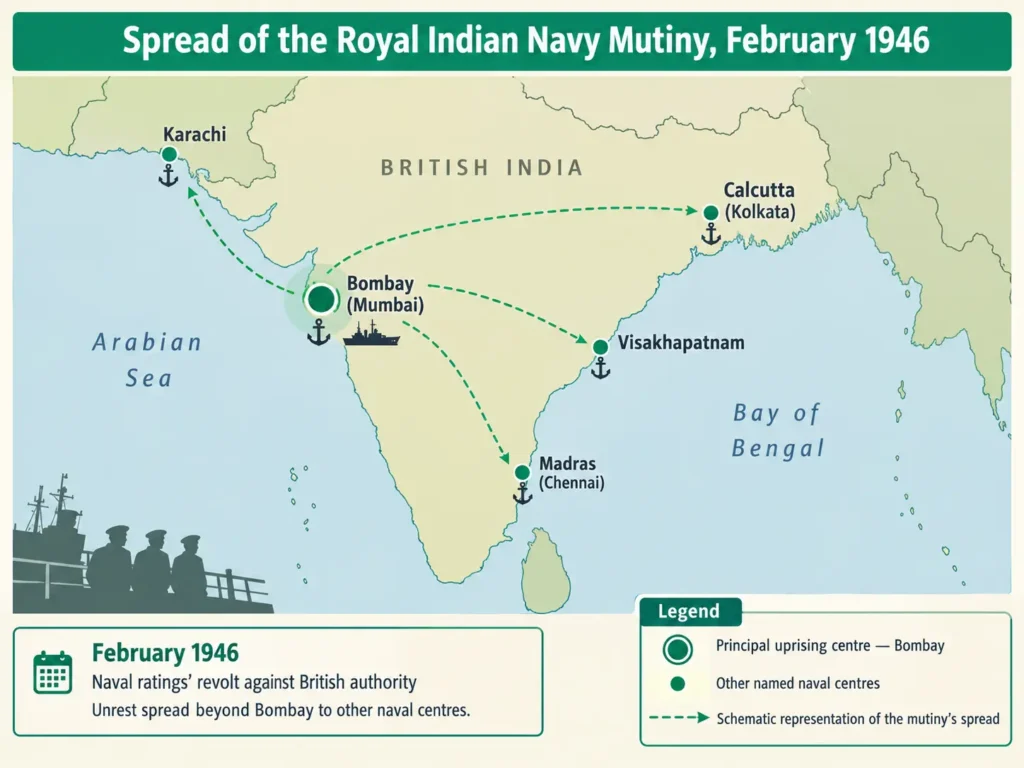
On 18 February 1946, ratings at HMIS Talwar, a signals training establishment in Bombay, went on strike (“no food, no work”) in protest at food and treatment. Because they were signallers, the news travelled by wireless to ships and shore bases. A Naval Central Strike Committee was formed on 19 February with M.S. Khan as president and Madan Singh as vice-president. The mutiny spread to Karachi (including HMIS Hindustan), Calcutta, Madras and Visakhapatnam; ships hoisted the flags of the Congress, the Muslim League and the Communist Party together, which was a visible sign of unity.
Demands
The ratings’ demands, in different lists, included better food, pay and treatment, an end to racial discrimination, the release of INA prisoners and other political prisoners, and the withdrawal of Indian troops from Indonesia; slogans also called for the British to leave India. (Textbooks vary on the exact list, so mention the main categories: service conditions, political prisoners and the INA, and an anti-colonial demand.)
Response and surrender
The British response included armed force and the threat of naval and air action. In Bombay, the Communist Party called a general strike on 22 February, and large crowds, reported as hundreds of thousands, took to the streets; there were clashes and casualties. Aruna Asaf Ali publicly backed the sailors. The Congress and Muslim League leadership did not: Vallabhbhai Patel and Muhammad Ali Jinnah urged the ratings to surrender, partly because they feared violence and communal conflict while the Cabinet Mission was about to arrive. The committee ended the strike on 23 February 1946 (it lasted until 25 February in Karachi). Many mutineers were later punished despite assurances of non-victimisation.
Significance and debate
- Unity across communities. The mutiny showed Hindu, Muslim, Sikh and Christian ratings acting together, an example of cross-communal solidarity as communal tension was rising.
- Weakening of control over the armed forces. For the British, it was proof that the loyalty of the armed forces could no longer be assumed.
- Why the leadership did not support it. The Congress and League leaders prioritised negotiations and the maintenance of order; the Communists argued that they had abandoned a revolutionary opportunity. The Communist Party later regretted that it was not strong enough to persuade the larger parties.
- Assessment. Some writers, such as Pramod Kapoor in 1946: The Last War of Independence, treat it as a neglected final act of the freedom struggle (see the Dawn review); others see it as a short-lived protest in a larger post-war political crisis. Together with the INA trials and strikes, it belongs to the “post-war upsurge” that preceded the transfer of power.
| INA trials (1945–46) | RIN Mutiny (Feb 1946) | |
|---|---|---|
| Nature | Court-martial turned national cause | Service revolt turned political strike |
| Link to nationalism | Direct: INA officers as heroes | Direct: Quit India slogans, INA release demanded |
| Congress response | Defended the accused | Did not back the mutiny |
| Outcome | Sentences commuted | Surrender on 23 Feb; punishments followed |
Map showing the spread of the 1946 Royal Indian Navy mutiny from Bombay to Karachi, Calcutta, Madras and Visakhapatnam The mutiny began at HMIS Talwar, Bombay, on 18 February 1946 and spread to other ports and bases.
Important comparisons
All the movements at a glance
| Movement | Region | Main social base | Main goal | Main method | Relation to Congress |
|---|---|---|---|---|---|
| Ambedkar / Dalit movement | Bombay Presidency and beyond | Dalits, especially Mahars | Social equality, political safeguards | Satyagraha, legislation, conferences, constitution-making | Cooperation and conflict (Poona Pact) |
| Dravidian movements | Madras Presidency / Tamil Nadu | Non-Brahmins; Self-Respect activists | Share in power; end of Brahmin dominance; later Dravida Nadu | Ministries, propaganda, agitation | Rival in Madras |
| HSRA | Punjab, UP, Delhi, Bengal links | Urban youth and students | Socialist republic by revolution | Armed action, trials as publicity | Critical of Gandhian method |
| Ghadar | US/Canada and Punjab | Punjabi migrant workers | Armed revolt to end British rule | Press, return to India, mutiny plan | Outside Congress |
| Singh Sabha / Akali | Punjab | Sikh reformers, peasants | Sikh identity; control of gurdwaras | Education, morchas, legislation | Selective cooperation |
| Peasant movements | UP, Gujarat, Bihar, Bengal | Tenants, cultivators, sharecroppers | Rent and revenue relief, land rights | Kisan sabhas, no-tax campaigns, strikes | Mixed: support and unease |
| Workers’ movements | Bombay, Calcutta, Ahmedabad, railways | Mill, jute, rail workers | Wages, hours, union rights | Trade unions, strikes | Mixed; Communist rivalry |
| Tribal movements | Chotanagpur, Andhra, others | Adivasi communities | Land and forest rights | Religious revival, guerrilla resistance | Absorbed or independent |
| Left | All India | Workers, peasants, intellectuals | Socialism with independence | Parties, unions, ideology | Inside (CSP) and outside (CPI) |
| INA / Bose | Southeast Asia, Imphal | Indian POWs, overseas Indians | Armed liberation | Army with Japanese support | Left Congress in 1939 |
| RIN Mutiny | Bombay, Karachi, Calcutta, Madras | Naval ratings | Service rights; anti-colonial demands | Strike, mutiny | Leaders discouraged it |
Violent and non-violent traditions
The HSRA, Ghadar, Bose’s INA and the Rampa rebels believed armed force could be justified; Akalis, the Tana Bhagats, the Bardoli peasants and Ambedkar’s satyagrahas were non-violent. This does not map neatly onto “alternative” versus “mainstream”: the Akali morchas and Mahad used Gandhian forms, while the Congress itself included a variety of positions.
Three ways of asking “freedom from what?”
| Position | Associated with | Central idea |
|---|---|---|
| Freedom from colonial rule first | Mainstream nationalism | Social questions can be solved after independence |
| Freedom from caste and Brahmanical hierarchy | Ambedkar, Periyar | Without social democracy, independence is incomplete |
| Freedom from class exploitation | Left, peasant and workers’ movements | National freedom must include economic emancipation |
Criticism, limits and historians’ debates
- Were these movements “alternative” or part of one national movement? One view treats them as strands of a single, plural movement; another stresses real conflict (for instance between the Poona Pact negotiators or between Congress and the Dravidian movement). Strong answers show that both are true in different cases.
- Elite and subaltern politics. Historians influenced by Subaltern Studies argue that peasant and tribal movements had autonomous aims; Congress-centred accounts stress the organisational and ideological role of leaders. The Tana Bhagat and Awadh peasant cases give evidence for both.
- Violence. The HSRA and INA raise the question of whether armed action helped or hindered the movement. Gandhi and the Congress argued that it hindered; the revolutionaries answered that it awakened the public; historians commonly say its symbolic and psychological effects were greater than its military ones.
- Identity and religion. Singh Sabha and Dravidian movements built strong communal and regional identities; some scholars see these as necessary assertion against domination, others as sources of later fragmentation. A balanced answer notes that they also supported social reform.
- Limits of each movement. HSRA’s base was narrow and urban; Ghadar’s plan depended on a mass mutiny that did not occur; the Justice Party’s base was elite; Bardoli’s cultivators were relatively prosperous; the Left was divided on strategy; the INA depended on Japan; the RIN mutiny was short-lived. Listing one limit per movement is a quick way to add depth to a long answer.
Why this unit still matters
- 14 October (Dhamma Chakra Pravartan Din) marks Ambedkar’s conversion at Deekshabhoomi; 2026 is its seventieth anniversary. The centenary of the Mahad Satyagraha began in March 2026, so Mahad is currently in public discussion.
- A hundred years of the Communist Party. The CPI marked its centenary in December 2025, which revived the Tashkent versus Kanpur debate.
- Dravidian politics remains central to Tamil Nadu’s debates on language, federalism and reservation.
- Bhagat Singh’s writings on religion, reason and revolution are still widely read in universities.
- Forest and tribal rights, central to the Rampa and Tana Bhagat stories, are still part of present-day policy debates.
Treat these as context for understanding why the topics are still debated, not as exam content.
Conclusion
Taken together, the movements in this unit show that the Indian national movement was a plural, contested process, not a single line from Congress petitions to Gandhian satyagraha. Ambedkar and the Dravidian movements forced the question of social democracy into the centre of nationalist politics. The HSRA and Ghadar insisted that armed revolution and international solidarity were legitimate parts of the struggle. The Singh Sabha and Akali movements show a community reforming itself and then taking institutional control. Peasant, workers’ and tribal movements demonstrated how colonial exploitation was experienced at the bottom of society, and the Left gave these experiences an ideology. Bose’s INA and the RIN Mutiny showed in 1943–46 that the reliability of the armed forces, the colonial state’s last support, was no longer certain.
None of these movements replaced the Congress, and many cooperated with it at critical moments; yet each pushed the national movement to answer questions it could not avoid: who is the nation, what is freedom, and by what means should it be won. For DU answers, the safest structure is the three questions that opened this article: whose freedom, which method, which community, with dates, names and one limit for each movement.
Continue Reading
Continue reading in History of India – VIII (c. 1857 – 1950)
- Emergence and Social Base of Gandhian Nationalism (Unit 3): the mainstream movement against which these alternative trends are read.
- India Towards Independence and After (Unit 5): the next unit, covering the negotiations and the transfer of power that followed the INA trials and the RIN Mutiny.
- Swadeshi and Early Revolutionary Movements: the earlier revolutionary tradition that preceded the HSRA.
- Formation of Identities: Caste, Community, Nation (Unit 6): caste, community and religious identity, which connect to Ambedkar, the Dravidian movements and Singh Sabha.
- Colonial Economy: Rise of Modern Industry in India (Unit 1): the economic background to workers’ and peasants’ movements.
University of Delhi Previous Year Questions
DU Previous Year Questions
University of Delhi Previous Year Questions | दिल्ली विश्वविद्यालय पिछले वर्ष के प्रश्न — Unit 4: Alternative Trends in the National Movement. The questions below are organised by syllabus topic; check the original question papers for exact wording and year-wise verification.
1 Analyze the role of the Left in the Indian national movement. +
2 In what ways did Dr. B. R. Ambedkar raise the concerns of Dalits in the first half of the twentieth century? +
3 Assess the contribution of B. R. Ambedkar in transforming the hierarchical nature of Indian society. +
4 Compare the positions of B. R. Ambedkar and Mahatma Gandhi on the Dalit question, with reference to the Poona Pact. +
5 Critically evaluate the programme and ideology of the Hindustan Socialist Republican Association (HSRA). +
6 Write a short note on the Hindustan Socialist Republican Association (HSRA). +
7 Write a short note on the revolutionaries in the 1920s. +
8 Write a short note on the Self-Respect Movement. +
9 Discuss the Dravidian movement as an alternative trend in the national movement. +
10 Discuss the formation and significance of the Indian National Army (INA). +
11 Assess the role of Subhas Chandra Bose and the Indian National Army in the struggle for independence. +
12 Discuss the peasants’, workers’, and tribal movements in colonial India. +
13 Explain the formation of community identities in colonial India. +
14 Write a short note on the Ghadar Movement. +
15 Write a short note on the Singh Sabha and Akali movements. +
16 Explain the significance of the Royal Indian Navy Mutiny of February 1946. +
FAQs
What does “alternative trends in the national movement” mean in the DU syllabus?
It is the unit’s label for movements that ran alongside, or in tension with, mainstream Congress nationalism, such as the Dalit, Dravidian, revolutionary, Sikh reform, peasant, labour, tribal and Left currents and Bose’s INA. “Alternative” does not mean they were separate from the national movement; many of them cooperated with Congress at times.
What is the difference between the Justice Party and the Self-Respect Movement?
The Justice Party (1916) was a constitutional political party that sought a share in power and jobs for non-Brahmins and formed ministries. The Self-Respect Movement (1925/26), led by Periyar, was a social and cultural movement attacking caste, priesthood and gender inequality. In 1944 Periyar renamed the Justice Party the Dravidar Kazhagam, combining both strands.
Why did Ambedkar sign the Poona Pact if he wanted separate electorates?
Gandhi was fasting unto death against separate electorates, and the public pressure and risk of violence against Dalits were severe. Ambedkar agreed to joint electorates with more reserved seats (148 against 71 offered by the Communal Award). He later described the arrangement as flawed, and the debate over it continues.
Who wrote The Philosophy of the Bomb?
It was written by Bhagwati Charan Vohra in consultation with Chandrashekhar Azad, in reply to Gandhi’s Cult of the Bomb, and was circulated on 26 January 1930. It is often wrongly attributed to Bhagat Singh alone, though he was part of the circle.
Was the Tana Bhagat movement named after a leader called Tana Bhagat?
No. It began in 1914 under Jatra Oraon (Jatra Bhagat) among the Oraons of Chotanagpur; “Tana Bhagats” are the followers of the sect. From about 1920–21 the movement became closely associated with Gandhian nationalism.
Why did the Ghadar movement fail in 1915?
It depended on persuading Indian soldiers to mutiny at the same time, but the authorities had informers, the plan was disrupted and brought forward, coordination was poor and arrests followed under the Defence of India Act. Its leaders and martyrs, such as Kartar Singh Sarabha, nevertheless influenced later revolutionaries.
When was the Communist Party of India founded: 1920 or 1925?
Both dates are used. The CPI(M) points to an émigré party founded in Tashkent on 17 October 1920; the CPI traces its origin to the Kanpur conference of December 1925. If asked, state both and the reason for the dispute.
Was the Bardoli Satyagraha a success?
Yes, largely: the revenue enhancement was cut from about 22% to 6.03% after an inquiry and seized land was restored. But it was a campaign of relatively prosperous cultivators in a ryotwari area, so it does not tell us everything about the condition of tenants and landless labourers.
Why did the Congress and Muslim League not support the RIN Mutiny?
Their leaders were negotiating with the British (the Cabinet Mission was about to arrive) and feared violence and communal conflict. Patel and Jinnah urged the ratings to surrender, while the Communist Party backed the sailors and later regretted that it could not persuade the larger parties.
Did the INA and the RIN Mutiny make the British leave India?
They contributed, by showing that the loyalty of the Indian armed forces could no longer be assumed, but historians treat them as one factor among several, including Britain’s postwar weakness, the pressure of mass politics and the international situation. Avoid presenting either as the sole cause.
How should I answer a long question on this unit?
Open with the three questions (whose freedom, which method, which community), give a short dated narrative of the movement, name one historians’ debate and finish with its limits or significance. Use one comparison table or a clear “similarities and differences” paragraph where the question asks you to compare.
Sources and further reading
- Sumit Sarkar, Modern India, 1885–1947 (Macmillan): a standard DU text.
- Sekhar Bandyopadhyay, From Plassey to Partition: A History of Modern India: standard text.
- Bipan Chandra and others, India’s Struggle for Independence: standard text; read with the 2016 controversy on the term “revolutionary terrorists” in mind.
- Eleanor Zelliot, From Untouchable to Dalit: Essays on the Ambedkar Movement (Manohar, 1992).
- Aparna Vaidik, Waiting for Swaraj: Inner Lives of Indian Revolutionaries (Cambridge University Press).
- Harjot Oberoi, The Construction of Religious Boundaries (University of Chicago Press, 1994), on Singh Sabha.
- Pramod Kapoor, 1946: The Last War of Independence: The Royal Indian Navy Mutiny.
- Official syllabus: check the University of Delhi’s academic affairs page for the current syllabus of this paper; the Programme History syllabus covers related topics such as Phule and Ambedkar, the HSRA and Bhagat Singh, and Bose and the INA.
Subscribe to keep reading
You've used your free notes for now. Get Delhi Pathshala Premium for unlimited access.
Subscribe — ₹29/30 days