
Contents
- 1. Introduction to Sylvia Plath
- Brief Biography
- Overview of Her Literary Contributions
- Context of Her Work Within the Confessional Poetry Movement
- The October 1962 Burst
- 2. Lady Lazarus
- Lady Lazarus Summary
- Movement-by-Movement Reading
- Plath’s Own Introduction to the Poem
- Lady Lazarus Themes (at a Glance)
- Structure of the Poem
- Key Lines and Their Meanings
- Lady Lazarus Themes (in Detail)
- 1. Death and Rebirth
- 2. Identity and Rebirth
- 3. Oppression and Empowerment
- 4. The Gaze and the Commodification of Suffering
- Lady Lazarus Literary Devices
- 1. Metaphors and Similes
- 2. Allusions
- 3. Imagery and Symbolism
- 4. Sound and Tone
- Critical Analysis
- 1. Interpretations of the Poem
- 2. Plath’s Use of Personal Experience
- 3. Reactions and Critiques from Literary Scholars
- Conclusion: Lady Lazarus
- 3. Daddy by Sylvia Plath
- Summary
- Plath’s Own Note on the Poem
- Main Ideas
- Structure and Sound
- Key Lines and Their Meanings
- Main Ideas in Daddy (in Detail)
- 1. Father-Daughter Relationships
- 2. Trauma and Recovery
- 3. Power and Oppression
- Literary Devices in Daddy
- 1. Metaphors and Similes
- 2. Allusions
- 3. Imagery and Symbolism
- 4. Sound, Repetition and Tone
- Critical Analysis
- 1. Interpretations of the Poem
- 2. Plath’s Use of Personal Experience
- 3. Reactions and Critiques from Literary Scholars
- Conclusion: Daddy
- 4. Comparing Lady Lazarus and Daddy
- At a Glance
- Themes
- Literary Devices
- Personal Context
- Conclusion: Comparison
- 5. Key Terms for Revision
- 6. Conclusion
- Summary of Key Points
- Plath’s Impact on Literature and Feminist Writing
- Contemporary Relevance
- Continue Reading
- University of Delhi Previous Year Questions
- Frequently Asked Questions (FAQs)
Quick answer: Lady Lazarus (written 23–29 October 1962) is a dramatic monologue in 28 three-line stanzas. Its speaker, a woman who keeps surviving suicide attempts, turns her “comebacks” into a public spectacle, mocks the doctors and onlookers who profit from it, and ends with a warning that she will rise from the ashes and “eat men like air”. Daddy (written 12 October 1962) is a 16-stanza poem, five lines each, in which a daughter “kills” the memory of a dead, domineering father, and then the husband who resembled him, using Nazi and Holocaust imagery. Both poems belong to Plath’s posthumous collection Ariel (1965) and are prescribed in Unit III of DSC-18: Women Writings, BA (Hons.) English, Semester 6, University of Delhi.
These notes cover both poems for DU students: the summary, a movement-by-movement reading, themes, symbols, literary devices, the long critical argument about Holocaust imagery, a comparison table, previous-year questions and FAQs. Wherever critics disagree, the notes say who is arguing what, so you can quote the debate in your exam answer instead of presenting one reading as settled fact.
A note before you read. Both poems deal with suicide, grief and violence. If these themes are hard for you right now, please take it slowly and talk to someone you trust. In India you can call Tele-MANAS at 14416 (free, 24×7).
Read the poems first. The full texts are on Poets.org – Lady Lazarus and Poets.org – Daddy. The line quotations below are kept short on purpose; always check them against the text in your DU anthology or a reliable edition before using them in an exam.
1. Introduction to Sylvia Plath
Brief Biography
Sylvia Plath was born on 27 October 1932 in Boston, Massachusetts. She became a well-known American poet, novelist and short-story writer. Her father, Otto Plath, a German-born biology professor, died on 5 November 1940, when she was eight, from complications after a leg amputation caused by untreated diabetes. That loss never left her writing; it sits behind Daddy and echoes through Lady Lazarus.
Plath studied at Smith College and then won a Fulbright Scholarship to Newnham College, University of Cambridge. At Cambridge she met the poet Ted Hughes, and they married in 1956. The marriage broke down in 1962, and the separation is the immediate background to the October 1962 poems.
Plath lived with severe depression for much of her adult life. Her first medically documented suicide attempt was in August 1953, when she was twenty. She died by suicide on 11 February 1963 in London, aged 30. Her death, and the way her late poems were read afterwards, made her a central figure in twentieth-century literature and in feminist criticism.
Overview of Her Literary Contributions
Plath is best known for the emotional force and the sharp, sometimes shocking imagery of her poetry. Her first collection was The Colossus and Other Poems (1960). Ariel, the volume that made her famous, appeared after her death in 1965 (Faber & Faber, UK); the American edition followed in 1966. Her only novel, The Bell Jar, was published in January 1963 under the pseudonym Victoria Lucas. It is partly autobiographical and deals with mental illness, gender roles and a young woman’s search for a place in the world. Her Collected Poems (1981) won the Pulitzer Prize for Poetry in 1982; she is widely described as the first poet to win it posthumously (a few sources count her differently, so say “widely described” in an exam answer).
A detail DU students often miss: the Ariel printed in 1965 was not exactly the book Plath had arranged. Ted Hughes, who edited it, changed the selection and order. Later editions have tried to restore her own sequence. When you cite “Ariel”, it helps to know that the book’s shape was itself disputed.
Context of Her Work Within the Confessional Poetry Movement
Plath is usually linked to confessional poetry, a mode that emerged in the late 1950s and 1960s and drew on the poet’s private life: mental illness, family trauma, sexuality and marriage. Her contemporaries in this mode include Robert Lowell, Anne Sexton and W. D. Snodgrass. Confessional poets made material that polite poetry avoided, such as breakdown, suicide and family hatred, into the subject of serious art.
The label is also contested. Critics have argued that “confessional” makes the poems sound like diary entries and hides their craft. Plath herself said that her BBC-read poems had a “speaker” distinct from her, framing them as dramatic monologues. Some commentators think she was being disingenuous; others take her at her word. This disagreement matters for both poems in your syllabus, because every question of the form “Is the poem autobiographical?” depends on it.
The October 1962 Burst
Most of the Ariel poems were written in a few intense months in 1962–63, soon after her separation from Hughes. Daddy is dated 12 October 1962 and Lady Lazarus 23–29 October 1962. Reading them as companions, written within weeks of each other, explains why the same images (Nazis, Jews, a red heart, a body on display) recur.
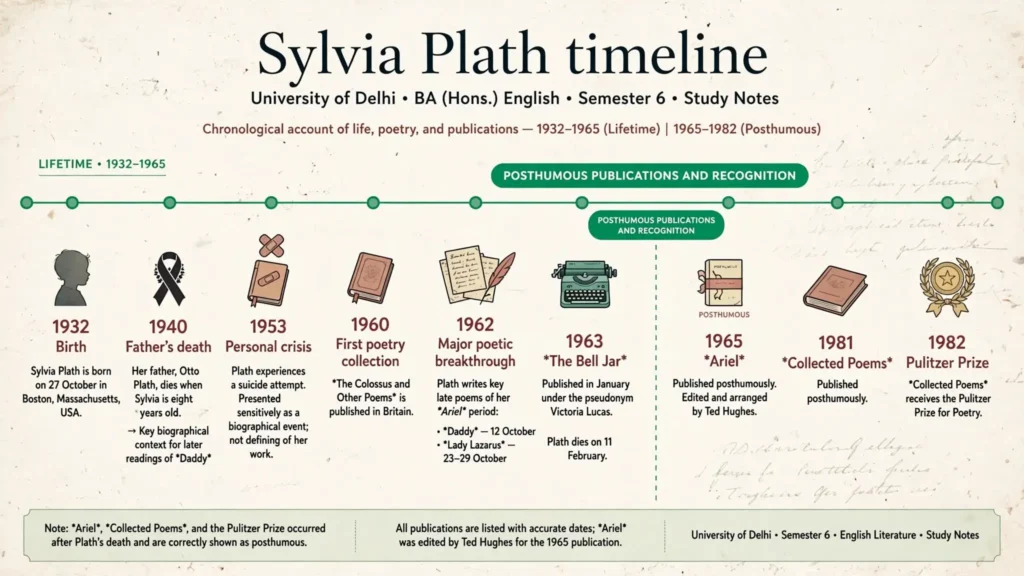
| Year | Event |
|---|---|
| 1932 | Born in Boston, 27 October |
| 1940 | Father Otto Plath dies, 5 November |
| 1953 | First documented suicide attempt, August |
| 1956 | Marries Ted Hughes |
| 1960 | The Colossus and Other Poems |
| 1962 | Marriage breaks down; Daddy (12 Oct) and Lady Lazarus (23–29 Oct) written |
| 1963 | The Bell Jar (January); death, 11 February |
| 1965 | Ariel published (UK) |
| 1982 | Pulitzer Prize for Collected Poems |
2. Lady Lazarus
Lady Lazarus Summary
Lady Lazarus is one of the best-known poems in Ariel (1965), published two years after Plath’s death. The title points to Lazarus, the man Jesus raised from the dead in the Gospel of John (chapter 11). By turning Lazarus into a “Lady”, Plath takes a miracle story of divine rescue and gives it to a woman who survives by her own effort, and not necessarily happily.
The speaker opens by announcing that she has “done it again”, once in every ten years, and describes her own body in grotesque images: skin like a “Nazi lampshade”, a foot like a paperweight, a face like fine “Jew linen”. She calls her listener “my enemy” and asks whether her skull-like face terrifies him. She is thirty, and like a cat has nine times to die; this, she says, is Number Three.
She then recalls the earlier attempts. The first, at ten, was “an accident”. The second she meant to be final: she “rocked shut as a seashell” and had to be dragged back by people who called and called. Dying, she says, is an art, and she does it exceptionally well. What she resents is not death but the theatrical comeback, the crowd that shoves in to watch her unwrapped “hand and foot” in “the big strip tease”, and the shout of “A miracle!” that greets her.
In the second half the tone sharpens into accusation. There is a charge for looking at her scars, for hearing her heart, for a word, a touch, a drop of blood, a lock of hair or a piece of clothing. She addresses a Herr Doktor and a Herr Enemy, tells them she is their “opus”, their “pure gold baby” that melts to a shriek, and sees herself reduced by their poking to ash: a cake of soap, a wedding ring, a gold filling. The last stanzas turn on Herr God and Herr Lucifer, both warned to beware, because from the ash she will rise with her red hair and “eat men like air”.
The poem has 28 stanzas of three lines each (tercets), that is 84 lines, in free verse, with a quick, jagged rhythm and a good deal of internal rhyme and sound-play. The tone is darkly comic, bitter, vulnerable and triumphant by turns.
Correction for older notes: many study notes, including an earlier version of this page, say the poem has “28 lines” or “7 stanzas”. That is wrong. The poem has 28 tercets (84 lines).
Movement-by-Movement Reading
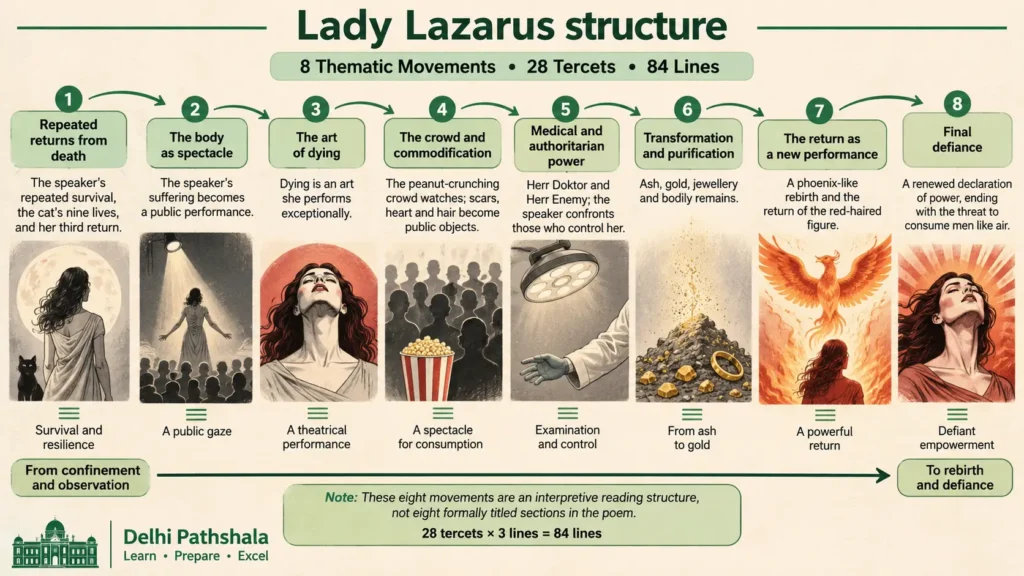
Reading the poem in movements is the quickest way to write a clear answer.
| Stanzas (approx.) | What happens | Key idea |
|---|---|---|
| 1–4 | “I have done it again”; the body described through Nazi-era objects; “Peel off the napkin” | Survival as a grotesque display |
| 5–8 | The terrifying face; age thirty; “nine times to die”; “Number Three” | Death as a repeated, counted act |
| 9–11 | The “peanut-crunching crowd”; the “big strip tease”; “These are my hands” | The body as public spectacle |
| 12–14 | The first time (age ten, “an accident”); the second time (meant to “last it out”) | Earlier attempts recalled |
| 15–17 | “Dying is an art”; “I do it so it feels like hell … real” | Mastery, irony, genuine pain |
| 18–22 | The “theatrical comeback”; “A miracle!”; the repeated “charge” for scars, heart, hair, clothes | Commodified suffering; the gaze |
| 22–26 | “Herr Doktor”, “Herr Enemy”; “opus”, “pure gold baby”; ash, soap, ring, gold filling | Medical and male authority; objectification |
| 27–28 | “Herr God, Herr Lucifer / Beware”; the red-haired rising | Threat, reversal, empowerment |
The stanza numbering follows the text printed on Poets.org (28 tercets); your anthology may break the lines slightly differently, so check it before quoting stanza numbers.
Plath’s Own Introduction to the Poem
When she read the poem for the BBC, Plath described the speaker as a woman with “the great and terrible gift of being reborn”. The catch, she said, was that she has to die first. She added that the speaker is a phoenix and also a plain, resourceful woman. This note is useful in two ways. It supports the “dramatic persona” reading (a created speaker, not simply Plath), and it shows that Plath herself treated the poem partly as dark comedy.
Lady Lazarus Themes (at a Glance)
- Death and Resurrection: The central subject is the speaker’s repeated deaths and returns. Unlike the biblical Lazarus, she is not raised by divine power. Her “miracle” is something she does, and something done to her.
- Suffering and Survival: The poem takes her suffering seriously but insists on survival as a form of defiance.
- Empowerment and Defiance: Lady Lazarus takes charge of the story and turns the audience’s appetite against them. The closing threat reverses the power relation.
- The Gaze of Others: The “peanut-crunching crowd”, the doctor and the paying onlookers show how society consumes a suffering woman as entertainment.
- Patriarchal and Medical Authority: Herr Doktor, Herr Enemy, Herr God and Herr Lucifer line up male authorities over her body and her story.
Structure of the Poem
Lady Lazarus has 28 tercets (84 lines) in free verse. Lines are short, often broken mid-thought, which gives the poem its breathless, jagged quality. There is no fixed metre or rhyme scheme, but sound patterns drive it: repetition (“I do it so it feels like hell. / I do it so it feels real”), the hissing run of “Ash, ash”, and the chant-like close. The second half speeds up as the speaker’s mockery becomes a direct threat, and the final two stanzas deliver the warning and the rising.
Notice also that the poem is a dramatic monologue: a speaker addressing a listener (“my enemy”, “Herr Doktor”), with the audience’s reactions implied inside her speech.
Key Lines and Their Meanings
- “I have done it again. / One year in every ten / I manage it—” The opening announces repetition. “Manage” is the language of competence, almost of housekeeping; the speaker talks about her own near-death as an achievement. The “ten-year” pattern lines up with the ages the poem mentions: the first attempt at ten, the speaker’s present age of thirty, and “Number Three”. The second attempt is usually read as the 1953 attempt at twenty, though the poem itself does not give that age.
- “Bright as a Nazi lampshade” / “Jew linen” These are the poem’s most disturbing images. The speaker’s skin is compared to an object made from the remains of Holocaust victims, and her face to fine linen. They signal at once that the poem will use the Holocaust as a vocabulary for bodily violation (see the debate below).
- “The big strip tease” Her return to life is compared to a striptease performed before a pushing crowd. The metaphor combines bandage-unwrapping (the “napkin” and unwrapped hands and feet) with sexual display, so that the audience is made complicit in voyeurism.
- “Dying is an art, like everything else” Here the poem mixes irony with skill. She is bitterly proud: if death is a craft, she is a professional. The next lines, saying she does it so it “feels like hell” and “feels real”, show that the performance is also genuine pain.
- “There is a charge” The repeated “charge” for her scars, her heartbeat, her hair and clothes turns the audience into customers. Suffering is a commodity, and the “relics” of the survivor are being sold.
- “Herr Doktor … Herr Enemy” She addresses a German-sounding authority, which links the doctor (and the male medical gaze) to Nazi power. The “opus” and the “pure gold baby” show him treating her as his creation and his property.
- “A cake of soap, / A wedding ring, / A gold filling” What remains of her after the “poking and stirring” is a list of objects. The soap and the gold filling carry unmistakable Holocaust associations; the wedding ring adds marriage to the list of things that reduce a woman to a possession.
- “Out of the ash / I rise with my red hair / And I eat men like air” The ending is a phoenix image with a twist. The phoenix’s rebirth is usually a calm, beautiful symbol; here it carries a threat. “Red hair” suggests fire and the flaming anger of the speaker, while “eat men like air” claims unlimited, casual power.
Lady Lazarus Themes (in Detail)
1. Death and Rebirth
The main idea of Lady Lazarus is the cycle of dying and coming back. The speaker treats death as something she attempts and controls, not something that simply defeats her. The poem makes each return both painful and public: the “miracle” is greeted by a crowd, and the speaker both resents and uses their attention. The comparison with the biblical Lazarus makes the point: his return was a sign of Christ’s power; hers is a sign of her own, and she is not grateful.
A caution for exam answers: the poem does not simply celebrate suicide or survival. It holds attraction toward death, anger at those who exploit her, and pride in her endurance in one voice. Good answers explain the tension instead of choosing one side.
2. Identity and Rebirth
Each rebirth makes a new identity. The speaker insists she is “the same, identical woman” even after being unwrapped, but the poem also shows her becoming a performer, a threat and a myth. The phoenix image, a bird that rises from its own ashes, is the final form of this identity, and the “red hair” gives it a fierce, individual face.
3. Oppression and Empowerment
The poem reads naturally through a feminist lens. Lady Lazarus is pressured by an audience that wants a spectacle, by a doctor who treats her as a case, and by male figures of authority (Herr Doktor, Herr God, Herr Lucifer). She answers by turning her pain into an act she owns, and by ending with a threat. Critics disagree on how far this is real empowerment (see “Critical Analysis” below).
4. The Gaze and the Commodification of Suffering
The poem’s repeated “charge” is one of its sharpest ideas. Pain becomes a ticketed show; the relics of the sufferer (blood, hair, clothes) become collectibles. This is often linked to the way Plath herself later became a public figure whose life was consumed as spectacle, though that connection is an interpretation and not stated in the poem.
Lady Lazarus Literary Devices
1. Metaphors and Similes
- “Dying is an art” is an extended metaphor of artistry and craft. It shows the speaker as an expert performer and also hints at the “art” Plath makes from her pain.
- “I rise with my red hair / And I eat men like air” combines metaphor and hyperbole. The “red hair” is fire and anger; “eat men like air” claims effortless power.
- “Skin / Bright as a Nazi lampshade” and “face … Jew linen” are similes and metaphors that draw bodily horror from Holocaust history.
- “Rocked shut as a seashell” is a simile in which the speaker’s attempt to withdraw from life is pictured as closing a shell.
2. Allusions
- Lazarus (John 11): The title alludes to the man raised from the dead. The poem inverts the story: the saviour is absent, the miracle is brutal and public.
- The Holocaust: The lampshade, “Jew linen”, the soap, the gold filling and the “ash” invoke the camps. They place the speaker among victims, a gesture that has caused the poem’s longest-running controversy.
- The phoenix: The final image alludes to the mythical bird that is reborn from its own ashes, giving the poem an ending of defiance.
- The doctor, the creator and the devil: Herr Doktor and Herr Lucifer bring in the figure of the powerful male scientist-creator and the devil, so that the speaker becomes the “opus” of a male maker. (This is an interpretive reading; the poem does not name a specific source.)
3. Imagery and Symbolism
- Ash / the phoenix: destruction first, renewal after.
- The strip tease: the body as spectacle; an audience that is both fascinated and cruel.
- Red hair: fire, anger and unashamed power.
- The cat with nine lives: survival, and also the grim arithmetic of counting attempts.
- Soap, ring and gold filling: a woman reduced to a few objects, evoking both the camps and the commodification of marriage.
4. Sound and Tone
Plath’s sound work is easy to overlook in an exam. Notice the clipped “Ash, ash” and the hissing consonants, the repeated “I do it so…”, and the sing-song bounce of “Herr Doktor / Herr Enemy”. The humour is real but cruel. The tone moves from sarcasm, to accusation, to threat, which is the emotional shape of the poem.
Critical Analysis
1. Interpretations of the Poem
Readers have approached Lady Lazarus in several ways.
- Confessional/biographical: the poem reflects Plath’s suicide attempts, especially the 1953 attempt, and her fear of repeating them.
- Dramatic persona: Plath herself introduced a “speaker”, and several critics argue that Lady Lazarus is a created figure, a mythic, performing woman who shares features with Plath but is not Plath.
- Feminist: the poem exposes how a suffering woman is watched, priced and managed by men (doctor, audience, God, devil) and gives her a revenge fantasy at the end.
- Psychoanalytic / trauma: repeated “dying” and rising reads as trauma repetition, with the father (see Daddy) as an unresolved loss behind it.
2. Plath’s Use of Personal Experience
The poem clearly draws on Plath’s life: the suicide attempt of 1953, her age (the speaker says she is “only thirty”, and Plath herself turned thirty on 27 October 1962, in the very week the poem was being written), the marriage that ended in 1962. But note what we cannot verify. The poem’s “accident” at ten has no confirmed biographical match that I could find, and its “one year in every ten” pattern is poetic structure as much as autobiography. Using “Plath’s life” as evidence in an essay is stronger when you say “the poem resonates with…” than when you say “the poem is about…”.
3. Reactions and Critiques from Literary Scholars
Critical reactions to Lady Lazarus (and Daddy) have clustered around one question: was Plath entitled to use the Holocaust as a metaphor for her own pain? This is the most-examined debate in your unit, and DU has set questions on it.
Critics who object
- Irving Howe (in The Critical Point, 1973) judged the comparison between tangled feelings about a father and the fate of European Jews “monstrous, utterly disproportionate”.
- Leon Wieseltier (New York Review of Books, 1976) made a similar argument: whatever her father did to her, it could not equal what the Germans did to the Jews.
- Other critics, including Marjorie Perloff and Joyce Carol Oates, have also questioned the use of public catastrophes as metaphors for private states, though their arguments differ in tone and emphasis. Seamus Heaney, too, argued that in poems like Lady Lazarus Plath harnesses wider cultural reference to a strongly self-justifying purpose.
Critics who defend or complicate
- George Steiner, in the essay “Dying Is an Art” (collected in Language and Silence), praised Daddy strongly, calling it the “Guernica” of modern poetry, while also asking whether such an appropriation was permissible.
- Jacqueline Rose, in The Haunting of Sylvia Plath (1991), defends the imagery as a deliberate dramatisation of fantasy and identification, arguing that the poems show how historical horror enters private psychic life and that the objection assumes metaphor must be literal.
How to use this in an exam: state the objection, state the defence, then give your own position with evidence from the poem (for instance, the speaker says she is “your opus” and is turned into soap and ash; do these images claim equivalence with the camps, or use their language to describe her sense of being owned?). A balanced answer with named critics scores better than a bare “some critics say”.
Other critical views
- Some readers see the ending as true empowerment; others point out that the poem’s triumph is fantasy, since the speaker’s fire and appetite remain imaginary. Both readings are supported by the text, because the final stanza is a threat, not an event.
Conclusion: Lady Lazarus
In Lady Lazarus, Sylvia Plath presents a woman who has survived repeated brushes with death and refuses to be a passive object of pity or marvel. The poem blends personal pain with defiance, turning the audience’s gaze, the doctor’s authority and even God and the devil into targets. Its closing image, the red-haired phoenix, is both a triumph and a threat. Because Plath’s Holocaust imagery is so disputed, the poem is best read as an argument as well as a lyric: about who owns suffering, who may speak of it, and what it costs to be watched.
3. Daddy by Sylvia Plath
Summary
Daddy is one of Plath’s most famous poems, written on 12 October 1962 and published in Ariel (1965) after her death. It is a daughter’s address to her dead father, and it moves from fear and longing to murderous anger and, finally, to a claim of release. The father died when she was eight, before she could, as she says, “talk to” him or settle accounts. The poem says that she has had to “kill” him, because he never really left.
The speaker begins by telling the father that he no longer “does”: the black shoe in which she has lived “like a foot” for thirty years, “poor and white”, barely daring to breathe or sneeze. She remembers him as a vast, statue-like figure, “marble-heavy”, “a bag full of God”, with a toe like a Frisco seal and a head in the Atlantic. She admits that she used to pray to get him back.
She then ties him to Germany and Poland. She could never find the town he came from (the name is “common”), could not speak to him, and felt her tongue stick in “a barb wire snare”. Every German became him, and the German language obscene. In an extraordinary passage, the sound of trains becomes an engine “chuffing me off like a Jew”, to Dachau, Auschwitz, Belsen, and she begins to “talk like a Jew”. She then sketches the father as a Nazi, with a Luftwaffe, a neat moustache and an “Aryan eye, bright blue”, a “Panzer-man”, “not God but a swastika”. The line “Every woman adores a Fascist” brings in the wider idea that women are trained to love their oppressors.
The poem then returns to the personal. She sees him “at the blackboard” (the father was a university teacher) in a photograph, with a cleft chin, and recalls that she was ten when they buried him (the real age at his death was eight; the poem’s “ten” is poetic licence) and that at twenty she tried to die and “get back, back, back to you”. She was pulled out and “stuck together with glue”. Then she “made a model” of him: a man in black with a “Meinkampf look” and a love of the “rack and the screw”. She married the model: “I do, I do”.
The last movement is the exorcism. The black telephone is “off at the root”; “If I’ve killed one man, I’ve killed two”. The second is the vampire who said he was you and drank her blood for a year, “seven years, if you want to know” (the husband figure; the poem is written during the collapse of Plath’s own marriage). A stake is driven through the “fat black heart”, the villagers dance and stamp on him, and the poem ends with the speaker declaring she is through.
The poem has 16 stanzas of five lines each (80 lines). It is not strictly “free verse” in the usual sense: although it has no fixed metre, it is held together by a powerful, recurring “oo” sound (do, you, shoe, Jew, through, true, blue, screw) and a nursery-rhyme bounce. See “Structure and Sound” below.
Correction for older notes: the earlier version of this page described Daddy as plain free verse and the “vampire” as a symbol of the father’s memory. The poem’s own sound-pattern is its most obvious formal feature, and the vampire is far more commonly read as the husband who resembled the father (a reading, not an explicit statement in the poem).
Plath’s Own Note on the Poem
Introducing the poem for the BBC, Plath described it as spoken by “a girl with an Electra complex”. She said the girl’s father died while she thought he was God, and added that her case was complicated by the fact that her father was also a Nazi and her mother very possibly part Jewish. Two cautions for exam answers:
- This is Plath’s framing of a persona, so it supports reading the speaker as a created character as much as a self-portrait.
- The facts of Plath’s life do not match the persona exactly. Otto Plath was a German-born American academic, not a Nazi; and the poem’s “ten” years is not his actual age-of-death for the daughter. Treat the Nazi father as a metaphor the speaker builds, not a claim of fact.
Main Ideas
- Father-Daughter Relationship and Trauma: The poem presents the daughter’s love, fear and anger toward a father who left her before she could understand him. Her father is both an idol (“God”) and a monster.
- Death, Grief and Unfinished Mourning: Because he died “before I had time”, she never completed the ordinary work of grieving. The poem is that work, done violently and in public.
- Oppression and Patriarchy: The father stands for male authority in general; the line “Every woman adores a Fascist” extends that to women’s training to love power.
- Repetition of the Pattern: She marries a man modelled on the father, so the oppression is repeated in adult life. This is why the poem has to kill two men.
- Resentment and Liberation: The final stanzas are an exorcism, ending with a claim of release. Whether that release is real or only the poem’s wish is part of the critical debate.
Structure and Sound
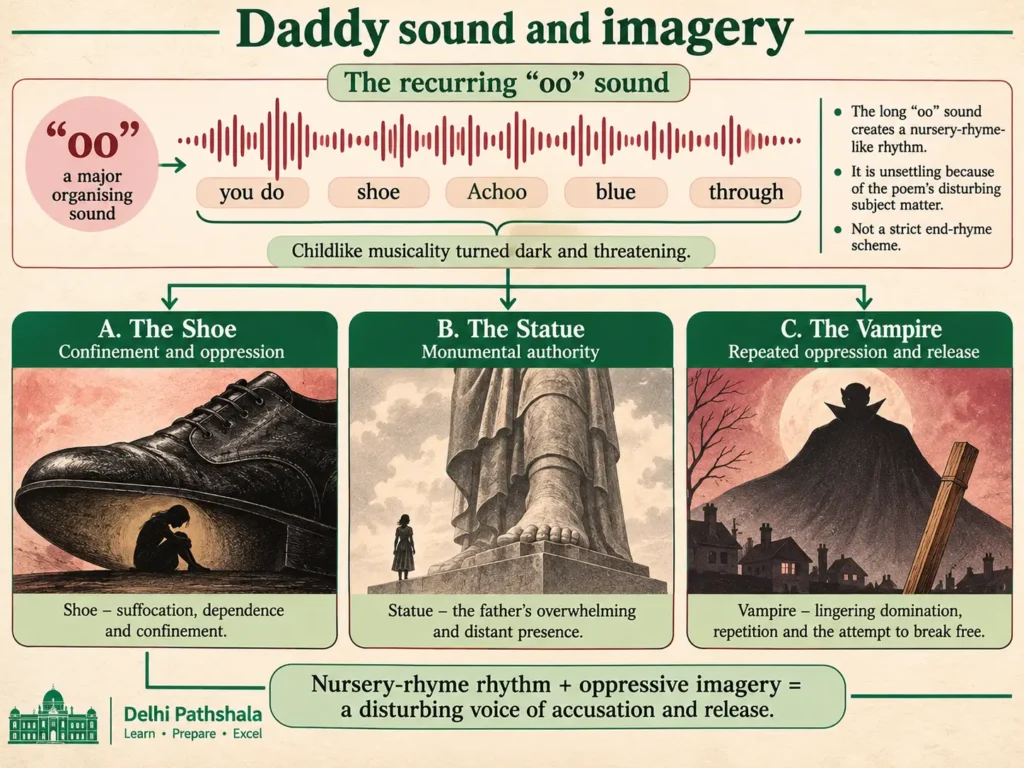
Daddy has 16 five-line stanzas. The sound of “oo” carries across the poem and creates a chant-like, incantatory quality; the poem is often described as a nursery rhyme turned black. Modern commentators note that Plath links the first image of the shoe with the nursery rhyme about the old woman who lived in a shoe. The speaker also breaks into broken German (“Ach, du”, “Ich, ich, ich, ich”), which shows both the father’s language and her struggle to speak.
The tone moves through four stages: address (the shoe), memory (the statue, the town), accusation (the Nazi, the Jew), and exorcism (the vampire and the stake). That sequence is useful for structuring a long answer.
Key Lines and Their Meanings
- “You do not do, you do not do / Any more, black shoe” The speaker tells the father that he no longer works for her. The black shoe is a confining home and a sign of the father’s weight; she has lived in it “like a foot”. The nursery-rhyme echo makes the confinement both comic and sinister.
- “Daddy, I have had to kill you” The speaker “kills” him because she never had the chance to confront him. The line sets up the poem’s central action: a symbolic murder, not a literal one.
- “In the German tongue, in the Polish town / Scraped flat by the roller / Of wars, wars, wars” Her father’s origin is a blurred, devastated landscape, “scraped flat” by war, a place she can never locate. Her private loss is tied to European history.
- “I used to pray to recover you. / Ach, du.” She once wanted to bring him back, as in prayer. The German “Ach, du” shows her still speaking in his language.
- “Chuffing me off like a Jew” The train image links her sense of being carried away from herself to deportation. This is the centre of the Holocaust-imagery controversy: she says “I may be a bit of a Jew”, but the poem frames this as her feeling, not a claim of identity.
- “Not God but a swastika” She revises the childhood idea of the father as God: he is not a divine father but a symbol of tyranny.
- “Every woman adores a Fascist” A hard, bitter generalisation about women’s conditioning, and one of the poem’s most quoted lines.
- “I made a model of you” She constructs a husband who matches the father, marrying the image of oppression (“I do, I do”).
- “The vampire who said he was you” The vampire drinks her blood for years. It is often read as the husband, whose claim to be the father-figure was false.
- “There’s a stake in your fat black heart” The folk-tale ending: the vampire is staked and the villagers dance on the grave.
- “Daddy, daddy, you bastard, I’m through” The final line is both a curse and a declaration of release. Many readers hear in it a mix of triumph and exhaustion.
Main Ideas in Daddy (in Detail)
1. Father-Daughter Relationships
The poem looks at a bond the daughter could not finish. She feels abandoned by a father who died before she could understand or challenge him, and trapped by the image she still carries. The father is presented as both a large, almost divine figure and a tyrant, and the poem never settles this contradiction.
2. Trauma and Recovery
Daddy dramatises grief that has turned into rage. Recovery is not gentle: the speaker fights her way out through ritual violence (the stake, the dancing villagers). Note that the poem’s recovery is a performance within the poem; it does not tell us that Plath herself recovered.
3. Power and Oppression
The father’s authority is not only domestic but political. The Fascist and Nazi imagery turns him into the archetype of male power, so the speaker’s fight against him becomes a protest against patriarchal domination in general. This is why exam questions link Daddy with “patriarchal oppression”.
Literary Devices in Daddy
1. Metaphors and Similes
- The black shoe (father as confining foot-covering, home and burden).
- The statue (“Marble-heavy, a bag full of God”): the father as an idol, huge and cold.
- The vampire (drains the speaker’s life; usually read as the husband).
- The model (the husband as a made-up copy of the father).
2. Allusions
- Nazism and Fascism: the Luftwaffe, the swastika, the “Panzer-man”, the “Meinkampf look”. The father becomes a figure of absolute power.
- The Holocaust: “Dachau, Auschwitz, Belsen” and the speaker’s identification with Jews. This is the poem’s most disputed allusion.
- Nursery rhyme and folklore: the shoe, the vampire, the villagers and the stake draw on children’s rhymes and gothic tales, giving a childlike tone to adult violence.
- Germany and Europe: the German phrases, Vienna, the Tyrol, the “Polish town” and the “gipsy ancestress” situate the speaker among a layered European inheritance.
3. Imagery and Symbolism
- The shoe/foot: confinement, and also the father’s amputated foot in the biography (a link critics have noticed).
- The blackboard and the “black man”: the father as teacher and as devil figure.
- The telephone “off at the root”: the failed communication with the dead father.
- The stake and the dancing villagers: a folk ritual of killing the undead.
4. Sound, Repetition and Tone
The repeated “do/you/Jew/through” sounds, the stutter of “Ich, ich, ich, ich”, and the singsong bounce of the final stanzas create the poem’s almost hypnotic effect. The tone is a mix of childlike address and adult fury, which is why the poem can sound both comic and terrifying.
Critical Analysis
1. Interpretations of the Poem
- Psychoanalytic: the poem dramatises an Electra complex (as Plath’s own BBC note suggests) and a failed mourning; killing the father is the speaker’s attempt to be a whole, independent self.
- Feminist: the father and the husband are two faces of patriarchal power; the poem’s rage is a protest against women’s training to love their oppressors.
- Historical/political: the Nazi imagery links private trauma to the wider violence of the twentieth century.
- Persona-based: the speaker is an invented figure (“a girl with an Electra complex”), not a transparent Plath.
2. Plath’s Use of Personal Experience
The father’s death in 1940 and the daughter’s later attempt to “get back” to him (the poem says “at twenty”, the same age as the 1953 attempt) are plain biographical echoes, and Plath’s own marriage was ending as she wrote. But the poem rearranges the facts, for example “ten” for the age at burial instead of eight, and turns a German-born biology professor into a Nazi. Reading the poem as transformed autobiography is safer than reading it as a record.
3. Reactions and Critiques from Literary Scholars
The Holocaust debate described under Lady Lazarus applies with greatest force to Daddy:
- Irving Howe called the comparison between tangled feelings about a father and the fate of European Jews “monstrous, utterly disproportionate”.
- George Steiner called the poem the “Guernica” of modern poetry, while still asking whether such use of the Shoah was permissible.
- Jacqueline Rose defended the metaphors as the dramatisation of fantasy and identification, and argued that the poem shows how history invades private life.
- Further reading for advanced students: Al Strangeways’s essay on “the problem of the Holocaust” in Plath’s poetry (Contemporary Literature).
Beyond the Holocaust debate, readers also argue about whether the poem’s ending is real liberation or a final entrapment, since the speaker’s language is still the father’s language (“Ich”, “Ach, du”) when she says she is “through”.
Conclusion: Daddy
Daddy is a poem about the lasting pain of losing a father and the way that loss shapes later love. Through harsh, nursery-rhyme sounds, Nazi imagery and the folk ritual of staking a vampire, Sylvia Plath turns personal grief into a ritual of exorcism and a critique of patriarchal power. Whether we accept her use of the Holocaust or not, the poem forces the reader to ask how private injury and public history can be put into the same sentence.
4. Comparing Lady Lazarus and Daddy
At a Glance
| Point | Lady Lazarus | Daddy |
|---|---|---|
| Date written | 23–29 October 1962 | 12 October 1962 |
| Form | 28 tercets (84 lines) | 16 five-line stanzas (80 lines) |
| Speaker’s address | “Herr Doktor”, “Herr Enemy”, “Herr God, Herr Lucifer” | “Daddy” |
| Central figure | The speaker as survivor and spectacle | The father (then the husband) |
| Key myth/symbol | Lazarus, phoenix, ash | Shoe, statue, vampire, stake |
| Holocaust imagery | Lampshade, “Jew linen”, soap, gold filling, ash | Camps, swastika, Luftwaffe, “like a Jew” |
| Main target | The public gaze, doctors, male authority | Father-figure and husband |
| Ending | Warning and rising (“Beware”) | Exorcism (“I’m through”) |
| Sound | Jagged, clipped, sarcastic | Chant-like, “oo” rhymes, nursery rhyme |
Themes
1. Similar Themes
- Death and Rebirth: Both poems deal with death, but differently. In Lady Lazarus, the speaker goes through repeated cycles of dying and coming back, and rebirth is something she claims. In Daddy, the focus is on the father’s death and the speaker’s effort to “kill” its after-effects. In both, death is not an end but a recurring condition that affects identity. The rebirth in Lady Lazarus can be read alongside the exorcism in Daddy as two ways of trying to take back control from a painful past.
- Identity and Change: In Lady Lazarus, each return creates a new, harder self. In Daddy, the speaker tries to break free of her father’s hold in order to become her own person. Both poems end on a note of transformation, whether the speaker is rising (as in Lady Lazarus) or declaring herself “through” (as in Daddy).
- Oppression and Strength: Both poems depict oppression, and in both the speaker turns oppression into strength. In Lady Lazarus, she is pressured by a public that wants to watch her pain and by doctors and male authorities who profit from it; in Daddy, the oppression is personal first (the father) and then general (patriarchy). In both, the speaker ends by confronting the oppressor.
- Holocaust Imagery: Both poems borrow the vocabulary of the camps and Nazism to describe private states, and both are therefore at the centre of the same critical debate.
2. Different Themes
- Father’s Influence: The father is central in Daddy and nearly invisible in Lady Lazarus, where the authority figures are the doctor, God and the devil. The father’s absence in the second poem makes the father-figure a structural, hidden pattern rather than a named character.
- Public vs. Private Struggle: Lady Lazarus stages suffering as a public performance, with an audience, a price and a spectacle. Daddy is a private confrontation between daughter and father, expressed in an almost nursery-like voice. In the first poem the speaker is both victim and performer; in the second she is both child and avenger.
- Role of Humour: Lady Lazarus uses dark, sarcastic wit (“Dying is an art”); Daddy uses grotesque, childlike rhyme. Both are comic and horrifying at once, but in different ways.
Literary Devices
1. Metaphors and Symbols
Both poems use strong metaphors. In Lady Lazarus, the speaker’s death and rebirth are a performance; in Daddy, the father is a Nazi, a statue and a vampire. The imagery in Lady Lazarus centres on resurrection and fire, and in Daddy on power, confinement and ritual killing.
2. Repetition
Lady Lazarus repeats “I do it so…”, “There is a charge”, “Ash, ash”; Daddy repeats “You do not do”, “Ich, ich, ich, ich”, “wars, wars, wars”, and the closing “through”. In both, repetition is how the speaker’s obsession becomes audible.
3. Allusions and References
Both poems allude to the Holocaust and Nazism. Lady Lazarus also draws on the biblical Lazarus and the phoenix; Daddy draws on nursery rhyme, vampire folklore and the Electra story.
4. Imagery
Lady Lazarus uses images of a body on display (strip tease, scars, hair). Daddy uses images of weight and darkness (the shoe, the statue, the “black man”, the black telephone).
Personal Context
1. Lady Lazarus and Personal Pain: The speaker’s repeated “deaths” and returns echo Plath’s own mental illness and suicide attempts, and the sense of being watched has often been connected with how Plath was later seen in the media, though that last link is an interpretation. Because Plath insisted on a “speaker”, it is best to write “the poem draws on” rather than “the poem is”.
2. Daddy and Personal Pain: Plath’s early loss of her father is the emotional engine of the poem. The anger and unresolved grief in the poem are rooted in her real experience of growing up without him, but the Nazi father, the “Polish town” and the vampire husband are creations of the poem.
Conclusion: Comparison
Both Lady Lazarus and Daddy explore death, identity and oppression, but with different emphases. Lady Lazarus focuses on public suffering and rebirth; Daddy centres on private conflict with a father’s legacy. Plath’s own experiences of trauma and grief shape both, and both use Holocaust imagery that critics continue to argue over.
5. Key Terms for Revision
| Term | Meaning in this context |
|---|---|
| Confessional poetry | Poetry of the 1950s–60s that draws on the poet’s private life, including mental illness, family and marriage (Lowell, Sexton, Snodgrass, Plath). |
| Dramatic monologue | A poem spoken by a created speaker to an implied listener; both poems work this way. |
| Persona | The invented speaker, distinct from the poet; Plath’s BBC notes frame both speakers this way. |
| Tercet | A three-line stanza; Lady Lazarus has 28. |
| Electra complex | The Freudian term Plath herself used for the daughter’s attachment to her father in Daddy. |
| Patriarchy | A social system in which men hold power; both poems attack it. |
| Holocaust imagery | Images drawn from the Nazi persecution of Jews, used by Plath as metaphors for private states and criticised and defended by scholars. |
| Phoenix | The mythical bird that rises from its own ashes; the ending of Lady Lazarus. |
| Commodification | Turning something (here, suffering) into a thing to be bought and sold; the “charge” in Lady Lazarus. |
6. Conclusion
Summary of Key Points
Lady Lazarus and Daddy are two of Plath’s most important poems, written within weeks of each other in October 1962. Lady Lazarus shows a woman who survives repeated brushes with death and turns the audience’s gaze and the doctor’s authority into targets, ending with a threat of fiery return. Daddy shows a daughter killing the memory of her father and the husband who resembled him, and ends in a ritual of release. Both use powerful imagery, repetition and Holocaust allusion to link private pain to larger forms of power, and both are among the most debated poems in modern literature.
Plath’s Impact on Literature and Feminist Writing
Plath’s influence on confessional poetry is vast: she showed that depression, rage and grief could be the subject of serious art. Her poems opened discussion about mental health, trauma and women’s anger, and her honesty encouraged later women writers to write directly about their bodies, marriages and minds. She shows women as complex and sometimes angry, which challenged conventional ideas of “femininity”. In your DSC-18 course, Plath’s poems are read alongside Dickinson and Eunice de Souza as examples of how women writers use poetry to document and challenge social constraints.
Contemporary Relevance
Plath’s work remains relevant today because of conversations about mental health and female empowerment, and because the questions she raises are still alive: who owns a story of suffering, and what happens when pain is turned into a public show? Lady Lazarus in particular anticipates modern debates about trauma as content and about the gaze on women’s bodies. Her insights into identity and loss still speak to readers who have gone through grief or the pressure of social expectation, though stigma around mental illness has not disappeared. Movements such as #MeToo have also given new readings to the way her poems expose the control of men over women’s lives and voices.
In short, Plath’s lasting force comes not only from her talent but from her willingness to look directly at the darkest parts of experience and make form out of them.
Continue Reading
Continue with the rest of Unit III, DSC-18: Women Writings, and related notes:
- I cannot live with You & I’m wife; I’ve finished that – Emily Dickinson (Unit 3A) – the poems that come just before Plath in your syllabus.
- Advice to Women and Bequest by Eunice de Souza: Summary, Analysis and DU Notes – the poems that close Unit III.
- The Yellow Wallpaper Summary: Themes, Symbols and Analysis (DU Notes) – another study of female confinement and mental breakdown.
- Rassundari Devi: Amar Jiban (My Life) – Summary, Themes and Analysis – confinement and self-writing in an Indian context.
- Alice Walker: The Color Purple Summary – Unit I of the same paper.
University of Delhi Previous Year Questions
DU Previous Year Questions
Frequently asked questions from DU exam papers on Sylvia Plath’s poetry, particularly Daddy and Lady Lazarus. Tap a question to view a quick-answer guide.
1 In Plath’s poems like Daddy and Lady Lazarus, patriarchal oppression is conveyed through her use of Holocaust images. Elucidate. +
Suggested answer focus:
- Examine Holocaust imagery in both poems, including Nazi, Jewish persecution, concentration camps, and the imagery of victimisation.
- In Daddy, discuss the father as an oppressive patriarchal figure and the speaker’s identification with Jewish victims.
- In Lady Lazarus, analyse the connections between male authority, medical power, exploitation, and the speaker’s repeated suffering and resurrection.
- Explain how historical images become metaphors for personal trauma and male domination.
- Consider the critical debate surrounding Plath’s use of Holocaust imagery, including responses by Marjorie Perloff, Al Alvarez, and other critics.
2 What are the connecting themes in Daddy and Lady Lazarus? Comment on the significance of Holocaust images to the central theme of patriarchal oppression. +
Suggested answer focus:
- Begin with the shared themes of death, rebirth, identity, psychological trauma, oppression, and resistance.
- Discuss the speaker’s struggle to escape oppressive male figures in Daddy.
- Analyse the relationship between persecution, spectacle, suffering, and resurrection in Lady Lazarus.
- Explain Holocaust imagery as a symbolic language for domination, victimisation, and patriarchal power.
- Conclude by comparing the speakers’ attempts to reclaim their identities and assert their strength.
3 “The Nazi torture of Jews provided Plath with a historical framework of oppression and victimisation…” Comment on the use of Holocaust imagery in Plath’s poetry. +
Suggested answer focus:
- Explain how Plath draws upon Nazi persecution and the Holocaust to represent extreme forms of suffering and oppression.
- Discuss the speaker’s identification with Jewish victims in Daddy.
- Analyse the concentration-camp and Nazi-related references as expressions of psychological and patriarchal domination.
- Connect historical victimisation with the speaker’s personal experiences of male authority.
- Discuss the tension between victimhood, resistance, and the recovery of personal power.
4 Elaborate on how Plath’s poetry “expresses rage towards male dominance” referring to the poems in your course. +
Suggested answer focus:
- Discuss Plath’s representation of patriarchal authority, control, and male domination.
- In Daddy, examine the father and husband figures as symbols of oppressive male power.
- In Lady Lazarus, analyse the male doctor, audience, and other figures who exercise control over the female body.
- Explain the use of anger, irony, violent imagery, dramatic monologue, and shocking metaphors.
- Discuss the speaker’s transformation from a victim of oppression into a figure of defiance and resistance.
5 Identify and critically comment on the extract with reference to the context: “That stare of perpetual surprise in those great green eyes will teach you to die alone.” +
Suggested answer focus:
- Identify the extract as coming from Sylvia Plath’s Lady Lazarus.
- Situate the lines in the poem’s exploration of death, suffering, spectatorship, and psychological trauma.
- Discuss the significance of the “great green eyes” and the image of a stare associated with isolation and death.
- Explain how the lines contribute to the poem’s wider themes of vulnerability, male power, and the speaker’s struggle for autonomy.
- Connect the extract with the poem’s dramatic voice, theatrical imagery, and recurring death-and-rebirth motif.
6 “Plath’s poetry explores the relationship between individual trauma and collective history, particularly through Holocaust imagery.” Explain the statement by discussing the poems: Daddy and Lady Lazarus. +
Suggested answer focus:
- Explain the relationship between personal psychological suffering and collective historical trauma.
- Discuss the Holocaust references and the speaker’s identification with persecuted Jewish victims in Daddy.
- Analyse the imagery of Nazi persecution, violence, and spectacle in Lady Lazarus.
- Show how Plath uses historical references to explore patriarchal oppression, domination, and victimisation.
- Compare the speakers’ experiences of trauma, resistance, and attempts at self-reinvention.
- Include a critical perspective on the ethical and literary implications of using Holocaust imagery to represent individual suffering.
7 Identify and critically comment on the extract: “That stare of perpetual surprise / in those great green eyes / will teach you / to die alone.” +
Suggested answer focus:
- Identify the lines as an extract from Sylvia Plath’s Lady Lazarus.
- Explain their context within the poem’s exploration of suffering, death, and the experience of being observed.
- Discuss the significance of the eyes, the gaze, and the image of dying alone.
- Relate the extract to the poem’s larger concerns with power, vulnerability, spectatorship, and psychological isolation.
- Connect it with the recurring themes of death and rebirth and the speaker’s defiant self-presentation.
More English previous-year questions are collected under DU BA English Previous Years Questions.
Frequently Asked Questions (FAQs)
How many stanzas and lines does Lady Lazarus have?
It has 28 stanzas of three lines each (tercets), i.e. 84 lines. Some older notes wrongly say 28 lines.
Is Lady Lazarus about Sylvia Plath herself?
It draws on Plath’s life, but Plath introduced the poem as spoken by a woman with “the great and terrible gift of being reborn”, which makes the speaker a created persona. In an exam, say it is autobiographically charged but dramatised.
Why does the poem say “I am only thirty”?
It fixes the speaker’s age and matches the “one year in every ten” pattern, so that she is at her third attempt: “Number Three”. Plath herself turned thirty on 27 October 1962, while writing it.
Who are “Herr Doktor” and “Herr Enemy”?
They are not identified by name. They stand for the doctor, the male observer and, more broadly, the authority that treats the speaker as a “case” or “opus”. The German “Herr” ties them to Nazi imagery.
Is Daddy written in free verse?
Not in the usual sense. It has 16 five-line stanzas with no fixed metre but with a strong repeated “oo” sound and nursery-rhyme rhythm. Many notes call it free verse, which hides this feature.
Did Plath’s father really die when she was ten?
No. Otto Plath died on 5 November 1940, when Plath was eight. The poem says “ten” as poetic licence, and its “twenty” echoes her 1953 suicide attempt.
Who is the vampire in Daddy?
The poem does not name him. Readers commonly take the vampire as the husband who resembled the father, and the poem’s claim that she “killed two” men supports that reading. State it as an interpretation.
Why is Plath’s use of the Holocaust controversial?
Some critics (for example Irving Howe) see it as a disproportionate comparison between private pain and genocide. Others (for example George Steiner and Jacqueline Rose) praise or defend it as a powerful dramatisation of fantasy and identification. See the critical sections above.
Is Lady Lazarus a feminist poem?
It is widely read as feminist because it exposes a woman’s body being watched, priced and managed by men, and ends with a threat to them. Some critics warn that the empowerment is only imagined, so mention both views.
Where do these poems appear in the DU syllabus?
In DSC-18: Women Writings, Unit III, B.A. (Hons.) English, Semester 6, together with Emily Dickinson’s “I cannot live with you” and “I’m wife; I’ve finished that”, and Eunice de Souza’s “Advice to Women” and “Bequest”. Check the latest official syllabus for changes.
Which poem should I read first for revision?
Read Daddy first if you want the clearer storyline (address, accusation, exorcism), then Lady Lazarus, whose movement is looser. Then do the comparison table, since a comparison question is a recurring pattern in DU papers.
Do I need to learn critics’ names for the exam?
Using two or three named critics (Howe, Steiner, Rose) with one accurate line each is enough to lift an answer, but only if you can explain the argument. Do not invent quotations.
Subscribe to keep reading
You've used your free notes for now. Get Delhi Pathshala Premium for unlimited access.
Subscribe — ₹29/30 days