
Contents
- Nature and Basis of Political Obligation
- What political obligation means
- How the problem developed
- Theories that ground political obligation
- 1. Social contract theory (Hobbes, Locke, Rousseau)
- 2. Consent theories (Locke, Plamenatz, Beran and others)
- 3. Legal positivism and the command view (Austin, Hart, Raz)
- 4. Natural law theory (Aquinas)
- 5. Utility and social benefit (Hume and the utilitarians)
- 6. Idealism: T. H. Green
- 7. Fair play (Hart, Rawls, Klosko)
- 8. Associative (membership) obligations (Dworkin, Horton, Scheffler)
- 9. Natural duty (Rawls, Waldron, Christiano, Wellman, Stilz)
- 10. Pluralist and hybrid approaches
- Master comparison: grounds of political obligation
- Main Arguments For and Against Political Obligation
- Arguments For Political Obligation
- Arguments Against Political Obligation
- Where scholars still disagree
- How Do Different Theories of Political Obligation Deal with Dissent, Disobedience and Resistance?
- Civil disobedience, conscientious refusal and revolution: know the difference
- A debate for Indian answers: Gandhi and Ambedkar
- What Are the Implications of Political Obligation for Democracy and Citizenship?
- Implications for democracy
- Implications for citizenship
- The Indian constitutional text on duties
- The Idea of Political Community
- Quick Revision: Thinkers at a Glance
- Criticism and Limitations of the Debate
- Contemporary Relevance
- Conclusion
- Continue Reading
- University of Delhi Previous Year Questions
- FAQs
- Further Reading and Sources
Why should you obey a law you did not vote for, made by a government you may not support, in a country you did not choose to be born into? Put that way, the question sounds almost rude. Yet it is the central puzzle of Unit 5. Political theorists call it the problem of political obligation (in Hindi texts, राजनीतिक दायित्व), and nearly every major thinker from Socrates to John Rawls has tried to answer it.
Quick answer: Political obligation is the moral duty, if there is one, to obey the laws and authority of the state or political community to which you belong. Theories ground it in consent, fairness, membership, a natural duty of justice or the benefits of social order. Each ground faces serious objections, which is why the debate is still open.
This unit sits at the end of DSC-1 for a reason. Units 1 to 4 taught you what politics is, how to study it, which traditions exist and what feminist and postmodern critics say. Unit 5 asks you to use all of that on one hard question: what do citizens owe the state, and what does the state have to do before it can claim that obedience?
The University of Delhi frames the unit as The Idea of Political Community: Political Obligation. Its stated learning outcome is that students understand the multiple frames through which the idea of political community is debated. The official DU Department of Political Science syllabus for Semester I lists the following Unit 5 readings, and these notes are built around them.
| Prescribed reading (Unit 5) | Topic | Where it is covered below |
|---|---|---|
| Shorten (2016), “Political Community”, Contemporary Political Theory | Political community and its rival conceptions | The Idea of Political Community |
| Brighouse (2008), “Citizenship”, in McKinnon (ed.), Issues in Political Theory | Citizenship | Implications for Democracy and Citizenship |
| Roy (2008), “Citizenship”, in Bhargava and Acharya (eds), Political Theory: An Introduction | Citizenship | Same section |
| Hyams (2008), “Political Authority and Obligation”, in McKinnon (ed.), Issues in Political Theory | Authority, legitimacy and obligation | Nature and Basis of Political Obligation |
| Martin (2003), “Political Obligation”, in Bellamy and Mason (eds), Political Concepts | Political obligation | Same section |
| Knowles (2001), “Political Obligation”, in Political Philosophy | Political obligation | Same section |
| Klosko (2005), Political Obligations (suggestive reading) | Fair play and pluralism | Fair play and pluralism, below |
A small note on spelling: the published DU list prints the author of “Political Authority and Obligation” as “Hyums”. The chapter is by Keith Hyams.
You can see the full list of Unit 5 readings, plus the other units, in DU’s own syllabus document linked above. For the rest of the course, see our Understanding Political Theory notes for all five units.
Nature and Basis of Political Obligation
What political obligation means
Most writers on the subject treat political obligation as a moral duty to obey the law of one’s own country or state, simply because it is the law. That last phrase matters. You may have plenty of other reasons to obey a traffic rule: fear of a fine, or plain common sense. You may also have a moral reason not to murder, whether or not murder is illegal. Political obligation asks something different: does the bare fact that the law requires it give you a moral reason to comply?
Three features are usually attached to the idea:
- Content-independence. The duty is to obey the law as such, regardless of whether you agree with each rule. (Some scholars dispute this, which is worth knowing for a critical answer. George Klosko, for instance, argues that political obligations are not content-independent.)
- Generality. It covers the whole body of law in a jurisdiction, and it falls on everyone living under it.
- Particularity. It is owed to your state or political community, not to all states equally. John Simmons made this requirement famous, and it becomes a decisive test for several theories below.
Most theorists also treat the duty as prima facie: a weighty reason, which a stronger moral reason can sometimes outweigh, rather than an absolute command.
Do not confuse these four ideas. Examiners like answers that separate them cleanly.
| Concept | What it means | Example |
|---|---|---|
| Legal obligation | A description of what the law requires. It says nothing by itself about whether you morally ought to comply. | The law requires you to pay income tax. |
| Moral obligation | A duty arising from morality, whether or not the law says so. | Not harming an innocent person. |
| Political obligation | The moral duty, if it exists, to obey the law because it is the law of your political community. | Do you have a moral reason to pay tax even in a state you think is unjust? |
| Civic duty | A wider call to contribute to the common good, beyond mere obedience. | Voting, volunteering, conserving water in a shortage. |
The distinction between legal and political obligation explains why a person under a tyrannical regime may still have legal obligations yet have no political obligation at all. Bhikhu Parekh has argued for using “civil obligation” for the duty to respect legitimate civil authority and “political obligation” for something broader. Others reply that “civic duty” already does that work. Both positions are legitimate, and you can mention the disagreement in a long answer.
How the problem developed
The phrase political obligation itself seems to be fairly young. The Stanford Encyclopedia of Philosophy entry on political obligation notes that it is apparently no older than T. H. Green’s Lectures on the Principles of Political Obligation, delivered at Oxford in 1879–80. The problem, however, is ancient.
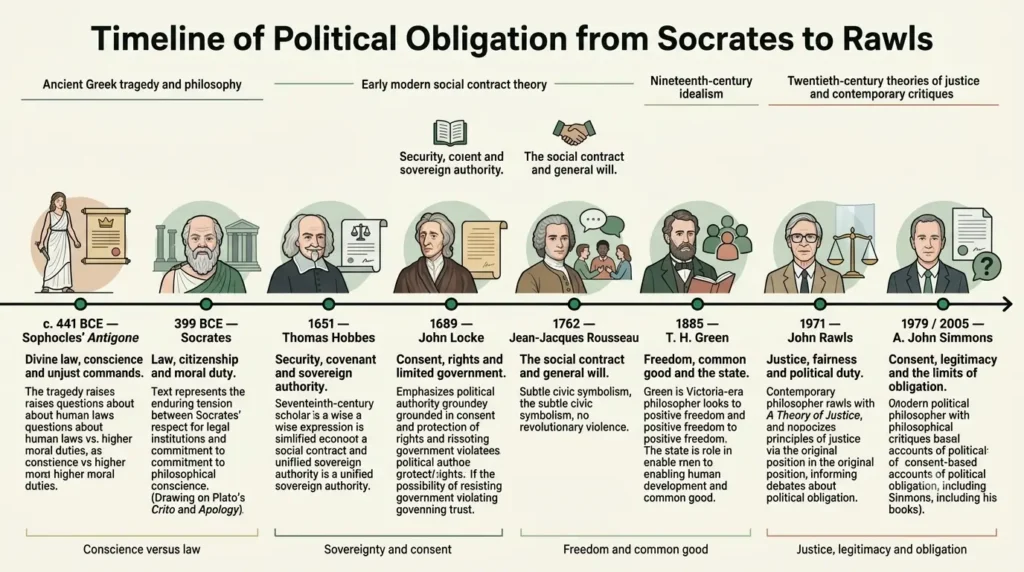
Antigone and the Crito. Sophocles raised the conflict between a ruler’s command and a higher duty in Antigone (first performed around 440 BCE). Plato’s Crito then records Socrates’ refusal to escape after he was condemned in 399 BCE. His reasons are a kind of preview of the whole unit.
| What Socrates says (as Plato tells it) | The later theory it anticipates |
|---|---|
| He has lived in Athens all his life and so has, in effect, agreed to obey its laws. | Consent / social contract |
| He owes his birth, upbringing and education to the laws, as a child owes a parent. | Associative (membership) obligation |
| Escaping would mean enjoying the benefits of the city’s laws while refusing the burden. | Fair play |
| If every individual could nullify court verdicts, the city could not survive. | Utility / social order |
Divine command. For many centuries the common answer was religious: political authority is ordained by God. The text most often cited by Christian writers is Paul’s Epistle to the Romans (13:1–2). Medieval and Reformation thinkers then had to ask what follows when a ruler commands what God forbids. One response separated the office (divinely ordained) from the officeholder (who may rule badly). Another, associated with Martin Luther, separated disobedience from active resistance: Christians may refuse to obey an ungodly command but should not take up arms against the ruler. These ideas return in the dissent section below.
The modern period. The seventeenth-century social contract thinkers gave the problem its modern form: Thomas Hobbes (Leviathan, 1651) and John Locke (Second Treatise of Government, 1690). Rousseau followed with The Social Contract (1762). David Hume’s essay “Of the Original Contract” (1752) launched the most famous attack on contract theory. Immanuel Kant’s Metaphysics of Morals (1797) offered a very different foundation, and in 1879–80 Green delivered the lectures that gave the topic its name.
| Year | Thinker / text | Contribution |
|---|---|---|
| c. 440 BCE | Sophocles, Antigone | Conflict between ruler’s command and a higher duty |
| 399 BCE | Plato, Crito | First sustained argument for obeying the law |
| 1651 | Hobbes, Leviathan | Obligation to a sovereign who can keep order |
| 1690 | Locke, Second Treatise | Consent, limited government, right of revolution |
| 1752 | Hume, “Of the Original Contract” | Attack on tacit consent; appeal to utility |
| 1762 | Rousseau, The Social Contract | Obligation through the general will |
| 1797 | Kant, Metaphysics of Morals | Contract as an Idea; strong duty to obey |
| 1879–80 | T. H. Green, Lectures on the Principles of Political Obligation | The phrase itself; law’s moral function |
| 1955–64 | H. L. A. Hart; John Rawls | The principle of fair play |
| 1970 | R. P. Wolff, In Defense of Anarchism | Autonomy versus authority |
| 1979 | A. J. Simmons, Moral Principles and Political Obligations | The sceptical challenge; particularity |
| 1992–2006 | Horton, Dworkin, Klosko, Gilbert and others | Associative, fairness and hybrid theories |
Theories that ground political obligation
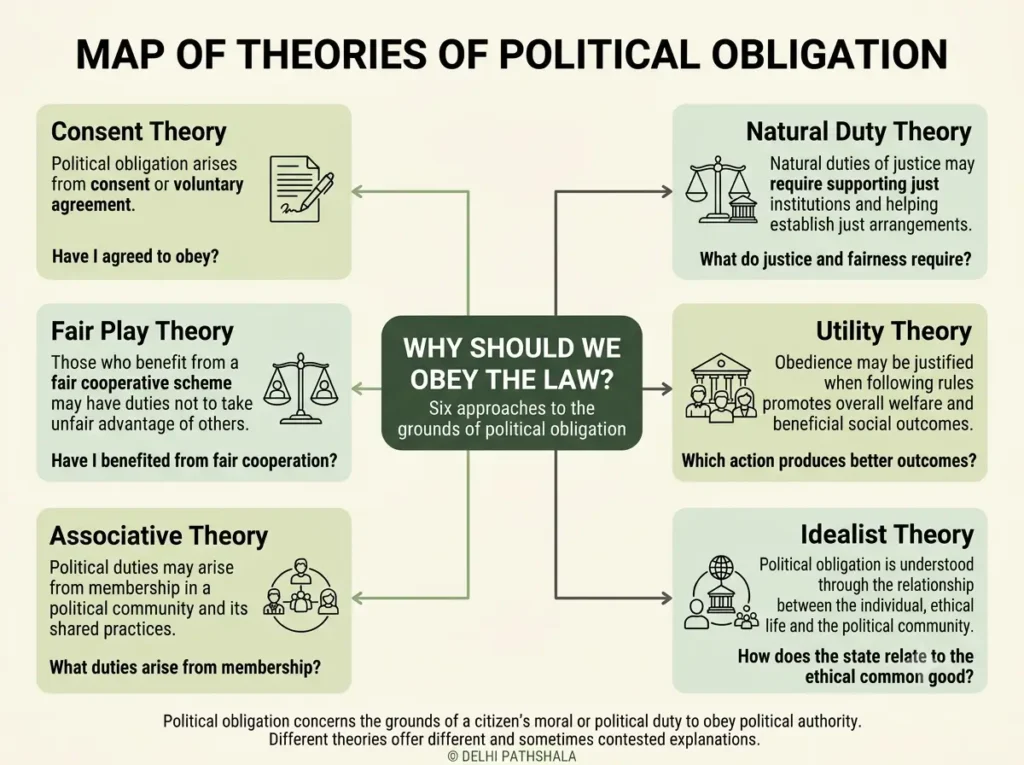
Your textbook probably lists five bases: social contract, legal positivism, natural law, consent and associative obligation. Those remain useful, so each is kept below, but several needed correction, and the modern debate has moved on to fair play and natural duty as well. The order here runs from older to newer.
1. Social contract theory (Hobbes, Locke, Rousseau)
Nature. Individuals leave a “state of nature” by agreeing, in some sense, to form a political society and accept its authority.
Basis. Obligation arises from the agreement itself: because people have (in some sense) agreed, they are bound. But the three classic contract thinkers use the same idea for very different ends.
| Hobbes (1651) | Locke (1690) | |
|---|---|---|
| State of nature | A war of every man against every man | Free and equal individuals, but with “inconveniences” (no settled judge or law) |
| What is agreed | A covenant to obey a sovereign with power to make, enforce and interpret law | Two steps: first form a political society under law, then set up a government |
| Basis of obligation | Consent, including the consent implied by submitting to a conqueror who lets you go about your business | Consent, but within limits |
| Right to resist? | Very narrow (self-preservation) | Yes: a right of revolution against a government that betrays its trust |
| Authority of a conqueror | Conquest creates authority (“sovereignty by acquisition”) | Mere submission to force does not create obligation |
(The Hobbes and Locke rows follow the Stanford Encyclopedia of Philosophy account. Scholars dispute exactly how far Locke differs from Hobbes, so do not present the contrast as settled.)
Rousseau. In The Social Contract (1762), Rousseau grounds obligation in the general will: if a law expresses the common good that citizens, as participants, give themselves, then obeying it is a form of obeying oneself. This is a different route from Hobbes’s submission to a sovereign. Check your class notes and prescribed readings for the version your teachers emphasise.
Problems. Is the contract historical or hypothetical? If historical, few people can show they ever entered it. If hypothetical, it only tells us what people would have agreed to, and Ronald Dworkin’s famous complaint is that a hypothetical contract is no contract at all. Hume added the sharpest objection: to say that merely living in your birthplace amounts to consent is like saying a man who was carried onto a ship while asleep has agreed to obey its captain. Notice, too, that in Hobbes’s version it is unclear that consent is doing the work at all. He seems to say we owe obedience to anyone who can maintain order.
2. Consent theories (Locke, Plamenatz, Beran and others)
Nature. Related to the social contract but different in emphasis. The contract theory is a story about how political society could arise. Consent theory asks whether you personally have actually agreed.
Basis. Obligation arises when individuals have expressly consented (swearing an oath of citizenship, signing up) or tacitly consented (voting, using public services, remaining in the territory).
Debate. Most philosophers now doubt that enough people have given the kind of actual consent that could ground a general obligation. Two responses exist. Harry Beran accepts that only express consent counts and proposes that states should create formal procedures through which members accept or decline the obligation. Others, such as John Plamenatz and Peter Steinberger, widen the idea of consent so that voting and everyday participation in state institutions count. Critics reply that it is hard to call “consent” voluntary when leaving the country is costly. Locke’s own claim that merely being within a territory expresses consent is widely seen as stretching tacit consent too far.
3. Legal positivism and the command view (Austin, Hart, Raz)
This is the most commonly misunderstood section in student notes, so read carefully.
Earlier versions of these notes said that legal positivism derives political obligation from the existence of a legal system, so that we must obey laws regardless of their morality. That is not an accurate summary of the position.
What legal positivism actually is. It is a theory about what makes something law (its source in a recognised authority and procedure, not its moral merit). John Austin saw law as the command of a sovereign backed by sanctions. H. L. A. Hart, in The Concept of Law (1961), refined this, arguing that a legal system rests on rules accepted from an “internal point of view” by officials and citizens.
What it does not say. Positivism separates the question “is this valid law?” from the question “ought I to obey it?” A positivist can say, without contradiction, “this is law, and it is unjust.” In the Stanford Encyclopedia’s account, a legal obligation is a descriptive claim, and it supplies a moral reason to comply only if there is already a moral duty to obey the law, which is exactly what political obligation is. Joseph Raz, a leading positivist, in fact denies that the subjects of any existing state have a general duty to obey the law; for Raz, law’s authority is piecemeal, applying to particular people and particular laws.
What to write in an exam. Treat the “legal” view as a position that stresses obedience to legal authority and the rule of law, and then explain why positivism alone cannot supply the moral ground that political obligation requires.
4. Natural law theory (Aquinas)
Nature. There are moral principles that govern human conduct and that reason can discover.
Basis. On the standard reading of Thomas Aquinas (Summa Theologiae, I–II, qq. 95–96), human law has the force of law only insofar as it derives from natural law. A rule that contradicts natural law is better described as a corruption of law than as law. Aquinas adds an important qualification: even an unjust law may sometimes be obeyed, not because it binds in conscience but to avoid scandal or public disturbance. So natural law is not simply a licence for disobedience. (Treat this as the conventional reading of Aquinas; confirm page references in your prescribed text.)
Problem. Who decides what natural law requires, and how do we handle reasonable disagreement about it?
5. Utility and social benefit (Hume and the utilitarians)
Hume rejected contract and consent and grounded obedience in the plain usefulness of a system of laws that lets people pursue their interests peacefully. Utilitarian thinkers who followed him, such as Bentham and J. S. Mill, said little directly about political obligation. The deeper difficulty is that if the guiding rule is always “maximise good,” obligations lose binding force: whether to obey the law becomes just another calculation of consequences. The Stanford Encyclopedia reports a broad consensus that even sophisticated attempts to ground obligation on utility, such as those of Rolf Sartorius and R. M. Hare, have not succeeded.
6. Idealism: T. H. Green
Green set out “to discover the true ground or justification for obedience to law.” He rejected the view that the state rests on force: his lectures include a section titled “Will, not force, is the basis of the State”. For Green, the moral function of law is to secure the conditions in which people can pursue their common good, and he included under “political obligation” the duties of subjects to the sovereign, of citizens to the state and of individuals to one another as enforced by a political superior. Critics, notably L. T. Hobhouse in The Metaphysical Theory of the State (1918), argued that idealist theories risk glorifying the state. (Hobhouse’s main target was Bernard Bosanquet, though the premise is shared with Green.) You can read Green’s text in the McMaster Archive’s online copy of the Lectures.
7. Fair play (Hart, Rawls, Klosko)
Nature. Obligation arises from taking part in a cooperative scheme that benefits everyone.
Basis. H. L. A. Hart’s classic statement is that when people run a joint enterprise under rules and so restrict their liberty, those who have submitted to the restrictions are entitled to similar submission from those who benefit. John Rawls adopted the idea in his 1964 essay on legal obligation and the “duty of fair play”. Applied to the state: if you benefit from a reasonably just cooperative system whose main form of cooperation is obeying the law, you must bear your fair share of the burdens. A free-rider acts wrongly.
Objections.
- Nozick (1974). If merely receiving benefits created obligations, neighbours could impose duties on us by showering us with unrequested services. His example is a neighbourhood entertainment system in which every resident must take a turn broadcasting.
- Simmons. There is a difference between receiving and accepting benefits. States provide goods (defence, public order) that you cannot refuse.
Defence. George Klosko, the leading advocate, argues that what matters is not acceptance but that the goods are worth the effort, presumptively beneficial and fairly distributed. Simmons replies that Klosko’s theory is really a disguised natural duty theory.
8. Associative (membership) obligations (Dworkin, Horton, Scheffler)
Nature. Some obligations come with roles in relationships: being a parent, friend or colleague. The associative theory says citizenship is similar.
Basis. Citizens owe obedience as members of a political community whose life and identity they share. This answer does not require individual choice, which is an advantage since few people chose their state. It also explains particularity: you owe obligations to your community. Dworkin argued that political association, like family, is “pregnant of obligation,” but only in a “community of principle” that treats all members with equal concern and respect.
Objections.
- Citizens of a modern state are not intimate with one another the way family members are; the analogy may be “stretched beyond recognition” (Diane Jeske).
- If membership alone creates obligation, then oppressed members of an unjust polity are bound to obey (a point pressed by Richard Dagger).
Replies. Associative theorists respond that only a valuable, genuinely inclusive community can ground obligations, so oppressed groups are not bound. Critics counter that this smuggles in an external moral principle and abandons the distinctive associative claim.
9. Natural duty (Rawls, Waldron, Christiano, Wellman, Stilz)
Nature. We owe certain duties simply as moral agents, such as the duty of justice, whether or not we have agreed to anything.
Basis. John Rawls (A Theory of Justice, 1971) argued that everyone has a natural duty to support and comply with just institutions that exist and apply to us. Later writers add that justice can only be achieved through a common legal order, since people reasonably disagree about what justice demands. Many argue the legal order must be democratic or rights-respecting to command obedience.
Objection: particularity. Simmons asks why I must support the institutions of my state rather than other, better states. Natural duty theorists reply in several ways, for instance by pointing to the intensity of interaction among people who live together.
10. Pluralist and hybrid approaches
Because no single ground works for everyone, several writers propose combining them. Klosko relies on fairness as the core and supplements it with natural duty and the common good. Jonathan Wolff and Dudley Knowles (whose chapter is on your reading list) also argue for pluralism. Margaret Gilbert’s A Theory of Political Obligation (2006) develops a “joint commitment” account that blends consent and membership. Sceptics such as Simmons reply that combining several unsatisfactory principles does not produce a satisfactory one.
Master comparison: grounds of political obligation
| Theory | Source of obligation | Key thinkers | Main strength | Main objection |
|---|---|---|---|---|
| Social contract | Agreement to leave the state of nature | Hobbes, Locke, Rousseau | Explains authority by individual choice | Contract is historical fiction or merely hypothetical |
| Consent | Your own express or tacit act | Locke, Beran, Plamenatz | Respects individual will | Too few people actually consent |
| Legal / positivist | Authority of a valid legal system | Austin, Hart, Raz | Explains rule of law | Does not itself supply a moral duty |
| Natural law | Law’s conformity to moral law | Aquinas | Gives a moral test for law | Disagreement about what natural law requires |
| Utility | Social benefits of law | Hume, utilitarians | No need for fictions | Makes obligation a calculation |
| Idealism | Law’s moral function; the common good | T. H. Green | Links state to the moral life | Risk of state worship (Hobhouse) |
| Fair play | Fair share in a cooperative scheme | Hart, Rawls, Klosko | Explains free-riding | Benefits may be unrequested or non-excludable (Nozick, Simmons) |
| Association | Membership of a community | Dworkin, Horton, Scheffler | Does not need consent | Oppressed members; weak analogy to family |
| Natural duty | Duty of justice owed by all | Rawls, Waldron, Wellman, Stilz | Universal and moral | Particularity problem |
Main Arguments For and Against Political Obligation
The theories above are grounds. In an exam you will usually be asked to weigh them as arguments: what can be said for the claim that citizens have a duty to obey, and what can be said against it? Each point below follows the same pattern, so you can reuse it in a 15-mark answer: the argument, the supporting points, and the strongest objection.
Arguments For Political Obligation
1. Social contract and consent
- Argument: Individuals, expressly or tacitly, agree to obey the state in exchange for protection, order and the benefits of living in society. (Hobbes, Locke.)
- Supporting points: The contract gives political authority a legitimate basis, and people are morally bound to keep their side of an agreement.
- Main objection: Hardly anyone has signed anything. Hume’s ship-captain analogy shows why residence alone is a weak form of consent.
2. Stability and order
- Argument: Without a central authority there would be conflict and no peaceful way to settle disputes. Hobbes’s state of nature is the extreme picture; Hume’s version is milder, grounding obedience in the evident usefulness of a legal system.
- Supporting points: Authority provides a framework for resolving conflicts, protecting rights and securing general welfare.
- Main objection: The need for some order does not show that you must obey this regime or every law it makes. Pure utility reasoning also struggles to produce genuine obligations (see the utility section above).
3. The rule of law and legal order
(In earlier versions of these notes this item was labelled “Legal Positivism”. Legal positivism is a theory of what law is, not itself an argument for moral obedience, so the argument is restated here in its defensible form.)
- Argument: A reliable legal system is a precondition of social life, so there is reason to comply with laws because they are laws. H. L. A. Hart and Joseph Raz both stress that law claims to settle what people should do and so removes some considerations from case-by-case deliberation.
- Supporting points: Legal rules coordinate behaviour, give predictability and make peaceful cooperation possible.
- Main objection: A rule being valid law does not by that fact give you a moral duty to follow it. Raz himself denies that subjects of any existing state have a general duty to obey the law.
4. Consent and democracy
- Argument: In a democracy, citizens take part in politics through voting and other forms of engagement, and that participation implies consent to the system and its outcomes.
- Supporting points: Democratic legitimacy derives from the consent of the governed. Writers such as John Plamenatz and Peter Steinberger count voting and ordinary use of state institutions as forms of consent.
- Main objection: Voting for a losing candidate, or not voting at all, is hardly agreement to everything the winner enacts. And those with no real way out of the system have not freely consented.
5. Fairness
- Argument: If you benefit from a reasonably just cooperative scheme, it is unfair to take the benefits and leave others to bear the costs of obeying the law. (Hart, Rawls, Klosko.)
- Supporting points: It explains why free-riding is wrong without needing explicit consent.
- Main objection: Nozick’s entertainment-system example, and Simmons’s distinction between receiving and accepting benefits that states supply whether you want them or not.
6. Associative obligations
- Argument: People owe special duties to the communities they belong to, grounded in shared identity, belonging and interdependence. (Dworkin, Horton, Scheffler.)
- Supporting points: It explains why political obligation is particular (owed to your community), and it does not depend on consent.
- Main objection: Modern states are large and impersonal, and oppressed members of an unjust polity should not owe obedience merely because they are “members”.
7. Natural duty of justice
- Argument: Everyone has a moral duty to support just institutions, and a common legal order is the only way to secure justice among people who disagree about what justice requires. (Rawls, Waldron, Christiano, Wellman, Stilz.)
- Supporting points: It applies to all people as moral agents, so it needs no consent.
- Main objection: The particularity problem: why must I support the institutions of my own state rather than those of another state that does justice better?
Arguments Against Political Obligation
1. Consent and legitimacy
- Argument: The social contract is usually hypothetical, and most people have given no informed consent. If legitimacy needs genuine consent, much political power is on shaky ground.
- Counter-arguments: Critics also ask whether anyone can truly “opt out”, and whether living in a territory (tacit consent) is enough to create an obligation. Defenders of obligation reply that consent can be understood more broadly, as voting and ordinary participation, or that obligation rests on other grounds altogether.
2. Authority is not the same as power
- Argument: Having the power to command is not the same as having the right to be obeyed. Robert Paul Wolff (In Defense of Anarchism, 1970) argued that a person’s “primary obligation” is autonomy, the refusal to be ruled by others. On his view, only a direct democracy in which every law is unanimously approved could be compatible with autonomy.
- Counter-arguments: Critics say Wolff overrates autonomy, which does not automatically override every other value. Authority can also help develop autonomy. And if autonomy forbids obeying authority, it should forbid keeping promises and contracts too, which is why even Simmons calls Wolff’s argument a failed attempt. Defenders of authority add that, whatever its origins, order and the resolution of disputes remain practically necessary.
3. Individual rights and conscience
- Argument: Obeying the state may conflict with morality and rights. Sophocles’ Antigone defied the king’s edict; Henry David Thoreau went to jail in 1846 rather than pay a tax he saw as funding injustice. When a law demands wrongdoing, a person may have a duty to resist.
- Counter-arguments: Legal systems offer mechanisms for change, and individuals can work through them. The overall benefit of political order may outweigh individual objections in some cases.
4. Obligation only to just institutions (conditional obligation)
- Argument: Obligation may depend on the justice of the law or regime. Locke allowed revolution against a government that breaks its trust; Aquinas denied that a law contrary to natural law has the true character of law; Rawls held that most citizens of a reasonably just society have no general obligation to obey, yet do have a natural duty to support just institutions.
- Counter-arguments: If each person decides which laws are just, the result may be subjectivity and instability, since people differ in what they think justice requires.
5. Anarchism, and “philosophical anarchism”
- Argument: Anarchism proper holds that states are necessarily immoral institutions that should be abolished. Philosophical anarchism is more modest: it denies that there is a general obligation to obey the law, yet does not insist that the state must be abolished. Wolff’s argument is a priori: no general obligation is even possible. Simmons’s is a posteriori: no existing theory has worked, so only those who have personally committed themselves, say by swearing an oath of citizenship, have such an obligation.
- Counter-arguments: Defenders say anarchist models are impractical for complex societies. John Horton adds that giving up the idea of political obligation may force us to stop speaking of “our” state at all, which is a bigger step than the philosophical anarchist admits. (See Traditions of Political Theory: Liberal, Marxist, Anarchist and Conservative for the wider anarchist tradition.)
6. Objections to the positive theories themselves
| Theory | Strongest objection |
|---|---|
| Social contract / consent | Little actual consent; hypothetical contracts do not bind |
| Fair play | Receiving is not accepting; states supply non-excludable goods; critics such as Calvin Normore call it “a powerfully conservative principle” because it favours existing arrangements over possibly better alternatives |
| Association | Not intimate enough to be like family; binds the oppressed |
| Natural duty | Cannot explain why this state |
| Utility | Turns obligation into a calculation |
7. Feminist and critical objections (Unit 4 link)
Feminist writers such as Nancy Hirschmann (Rethinking Obligation: A Feminist Method for Political Theory, 1992) have argued that mainstream accounts of obligation and consent rest on a picture of the individual that overlooks gendered and relational experience. If your teachers connect Unit 4 and Unit 5, this is the bridge. Even within the associative camp, Christopher Wellman has questioned whether obligations really arise from family membership. For the feminist and postmodern background, see our notes on Critical Perspectives in Political Theory: Feminist and Postmodern.
Where scholars still disagree
The Stanford Encyclopedia puts it bluntly: many answers have been given and none now commands widespread assent. These are the live disputes, and you should present them as disputes rather than as settled facts.
- Does political obligation exist at all? Sceptics such as Wolff and Simmons say no (or very rarely); most others defend it on one ground or another.
- Is the duty content-independent? Hart and Raz’s tradition says yes: law gives a reason because it is law. Klosko argues we should reject that claim.
- Is it a moral duty at all? Margaret Gilbert argues that political obligation should be “de-moralised”: it is an obligation owed to fellow members through joint commitment, which may exist even when the arrangement is unjust. Critics ask why a coerced or immoral commitment should create any genuine reason.
- Does a single theory suffice? Klosko, Wolff and Knowles say no; Simmons doubts that mixing weak principles helps.
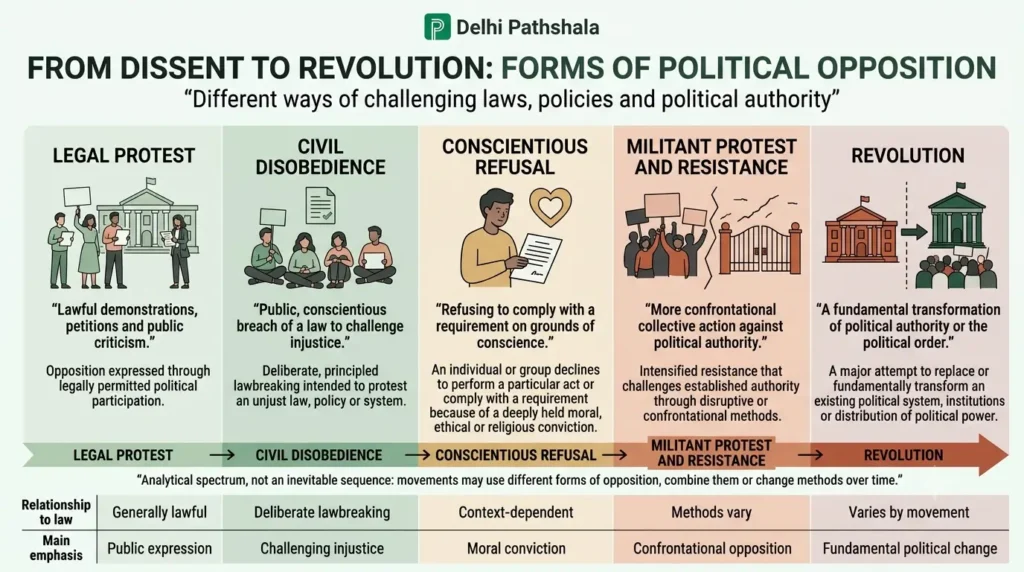
How Do Different Theories of Political Obligation Deal with Dissent, Disobedience and Resistance?
Each theory of obligation implies a view about what you may do when you disagree with the state. It helps to separate three levels:
- Dissent: expressing disagreement, through speech, protest or voting, without breaking the law.
- Disobedience: knowingly breaking a particular law.
- Resistance: organised opposition to the authority itself, which in its extreme form is revolution.
1. Social contract theory
- Dissent: Normal and expected, especially in Locke’s picture of a limited government answerable to the governed.
- Disobedience: Defensible where the government breaks the terms of the contract or infringes natural rights.
- Resistance: Here the two classic contract thinkers sharply differ. Locke’s two-stage contract supports a right of revolution against a government that betrays its trust, because dissolving the government does not return people to the state of nature. Hobbes allows very little, since the sovereign exists to keep order. Kant, who also uses contract ideas, takes the strictest line: subjects may complain about injustice but may not resist.
2. Legal positivism
(An earlier version of these notes said that positivism “discourages disobedience”. That reads too much into the theory.)
- Dissent: Legal channels (courts, legislatures, lobbying) are the normal route for dissent in any legal system.
- Disobedience: Positivism itself is neutral. Because it separates “this is valid law” from “this is morally binding”, a positivist can consistently say that a valid law is unjust and that morality may require disobeying it.
- Resistance: Positivism as a theory of law does not say whether resistance is justified. That depends on the positivist’s wider moral and political views.
3. Natural law theory
- Dissent: A duty where a law violates higher moral principles.
- Disobedience: Justified when a law is contrary to natural law. (Remember Aquinas’s qualification: prudence about scandal or disorder may still counsel obedience.)
- Resistance: Can be supported against grossly unjust regimes, since the moral duty to uphold natural law can override the duty to obey the ruler.
4. Consent theories
- Dissent: Accommodated mainly through democratic participation: voting, protest and other political activity.
- Disobedience: May be justified if the democratic process itself fails or the government acts against the interests of the people it claims to represent.
- Resistance: Locke’s version of consent theory is the source of the right to resist. Later consent theories (Plamenatz, Beran) put more weight on participation and on creating legitimate procedures for consent.
5. Fair play
- Dissent and disobedience: Having a fair-play obligation to others in an ongoing enterprise does not stop anyone from trying to transform it, even by civil disobedience. What it forbids is free-riding, not criticism.
- Resistance: Less central, but the principle only applies if the system is reasonably just and mutually beneficial, which limits it in unjust regimes.
6. Associative obligations
- Dissent: Valuable, since a community of principle (Dworkin) can improve itself by arguing about its own principles.
- Disobedience: Can be justified where the authorities violate the community’s own shared values, or where “members” are routinely oppressed and so are not bound.
- Resistance: Generally a last resort, since the theory stresses maintaining the community. A defender can reply that oppressed groups, treated as non-members, owe no duty at all.
| Theory | Dissent | Disobedience | Resistance |
|---|---|---|---|
| Social contract (Locke) | Natural and expected | Justified when contract broken | Right of revolution |
| Social contract (Hobbes) | Limited | Very limited | Very narrow |
| Kant | Complaint allowed | Not allowed | Not allowed |
| Positivism | Through legal channels | Neutral; morality decides | Not addressed by the theory |
| Natural law | A moral duty against unjust law | Justified for unjust law | Possible against tyranny |
| Consent / democratic | Through participation | If democratic process fails | Locke yes; later theorists emphasise participation |
| Fair play | Compatible | Compatible with reforming the scheme | Limited |
| Association | Valued | Where community values are betrayed | Last resort |
Civil disobedience, conscientious refusal and revolution: know the difference
Examiners reward students who can define terms precisely. On the most widely accepted account, associated with John Rawls (1971), civil disobedience is a public, non-violent and conscientious breach of law, undertaken to bring about a change in laws or government policy. Rawls thought of it as an appeal to the majority’s sense of justice, in a society that is broadly just.
| Form of action | Law broken? | Public? | Violent? | Aim |
|---|---|---|---|---|
| Legal protest / dissent | No | Yes | No | Change policy within the law |
| Civil disobedience | Yes | Yes | No | Change a law or policy |
| Conscientious refusal | Yes | Not necessarily | No | Avoid personally taking part in a wrong |
| Militant protest | Yes | Often | Sometimes | Force change |
| Revolution | Yes | Yes | Often | Replace the regime |
The term is usually credited to Henry David Thoreau. He refused to pay a tax in 1846 and was taken to jail; he lectured on the subject in 1848, and his essay “Resistance to Civil Government” appeared in 1849. It was republished under the title “Civil Disobedience” in 1866, after his death. (Some older sources date the essay to 1848, so check which date your teacher uses.) The Stanford Encyclopedia’s entry on civil disobedience also notes that figures such as Gandhi, Rosa Parks, Martin Luther King Jr. and Nelson Mandela are famous civil disobedients who belonged to the groups whose rights they championed. Some scholars think Rawls’s definition is too narrow, because it makes most civil disobedience come out as morally justified by definition.
A debate for Indian answers: Gandhi and Ambedkar
India supplies two of the most useful reference points for this section, and they point in different directions. Present them as a debate, not as one “right answer”.
- Gandhi and satyagraha. The best-known Indian example is open, non-violent breaking of specific laws, such as the salt laws in 1930, by people who accepted the legal consequences. Some discussions note that Gandhi’s campaigns do not fit neatly into a narrow definition of civil disobedience.
- Ambedkar’s warning. On 25 November 1949, in his final speech to the Constituent Assembly, B. R. Ambedkar argued that once constitutional methods are open, civil disobedience, non-cooperation and satyagraha should be abandoned, because they become the “Grammar of Anarchy”. He also said that when no constitutional way remained, there was great justification for unconstitutional methods. His claim is therefore conditional: it depends on constitutional channels being genuinely available.
- A question worth raising in your answer: how do we decide whether constitutional channels are really open, and who decides? That question connects directly to the conditional-obligation argument above and to Rawls’s idea that civil disobedience belongs in a broadly just society.
You can read the passage in a published reproduction of Ambedkar’s final speech to the Constituent Assembly. Your teachers may prefer the Constituent Assembly Debates themselves, so cite those in your exam answers.
What Are the Implications of Political Obligation for Democracy and Citizenship?
If citizens do have a moral duty to obey, that duty shapes how we think about democracy and about what it means to be a citizen. One caution first: these implications follow if political obligation exists. A philosophical anarchist would deny the premise, and different theories draw different conclusions, as the dissent section showed.
Implications for democracy
1. Legitimacy of democratic institutions. When citizens believe they have a moral reason to obey laws and respect elected representatives, institutions gain authority that goes beyond mere force. Max Weber (1919) famously defined the state by its monopoly on the legitimate use of force, and legitimacy, in his sense, depends on people believing in it. Moral justification and belief are not the same thing, a point we return to under limitations.
2. Democratic participation. A sense of obligation can turn voting, public debate and civic activity into expressions of duty rather than mere preference. Whether there is a duty to vote is itself contested: the Stanford Encyclopedia lists voting among the things people mean by “civic duty”, while noting that whether we really have such duties is a matter of dispute.
3. Social cohesion. Obligation encourages people to see themselves as part of a shared enterprise, not only as defenders of private interests. The associative and fair-play theories rely on exactly this picture.
4. Peaceful resolution of conflicts. A shared commitment to legal and political channels gives disputes an outlet other than violence. Note that this works best where those channels are open to everyone, which is Ambedkar’s condition.
5. Democratic stability. Citizens who accept the moral legitimacy of the order are less likely to act in ways that undermine it. But stability is not the same as justice: a theory that produces obedience to an unjust order cannot claim that stability as a virtue.
Implications for citizenship
1. Civic duty and responsibility. Obeying laws, paying taxes and taking part in civic life are commonly described as the practical content of citizenship. Political obligation supplies a philosophical reason for such duties; it is not the same thing as a list of legal rules.
2. Ethical citizenship. Being a good citizen is often taken to involve more than compliance: advocating justice, equality and the protection of rights. This is Parekh’s wider idea of “political” obligation, as opposed to narrow obedience.
3. Engagement in public affairs. People who feel responsible for their community are more likely to discuss policy, express opinions and take part in decisions.
4. Political education and awareness. If citizens have duties, they arguably have a duty to be informed about the issues on which they vote. This is a normative claim, not an established fact, so present it as an argument.
5. Challenging authoritarianism. Conditional theories (Locke, natural law, Rawls on just institutions, Dworkin’s community of principle) give citizens grounds to resist oppressive rule. But be careful: some theories can justify obedience to any effective power. Hobbes’s version comes close, and Kant allows complaint but not resistance. So “obligation” does not automatically strengthen citizens against tyranny.
6. Social justice advocacy. On some views, the duty to support just institutions includes a duty to help make institutions more just. This is the natural-duty line of thought associated with Rawls.
The Indian constitutional text on duties
Indian students have a concrete reference point here. Article 51A, in Part IVA of the Constitution, lists the Fundamental Duties of citizens. Part IVA was inserted by the Constitution (Forty-second Amendment) Act, 1976, and Article 51A was later amended by the Eighty-sixth Amendment in 2002, bringing the list to eleven duties. The first is to abide by the Constitution and respect its ideals and institutions; others include promoting harmony and the spirit of common brotherhood “transcending religious, linguistic and regional or sectional diversities” and valuing the heritage of India’s composite culture. See the Government of India’s Know India page on Fundamental Duties and the text of Article 51A.
Two points will help you write a sharper answer:
- These are constitutional statements of civic duty. They do not settle the philosophical question of why a citizen is morally bound; they assume an answer. (They are generally described as not directly enforceable by courts, though you should confirm this with your constitutional-law class notes.)
- A list of duties is silent on dissent. For the limits of obedience in India, return to the Gandhi–Ambedkar debate above.
The Idea of Political Community
The unit title joins two ideas: political community and political obligation. The link is straightforward. To ask what citizens owe the state, you must first ask who counts as a member, what binds members together, and what claims the community can make on them.
What is a political community? In broad terms, it is a group of people who live under shared political institutions and who see themselves, to some degree, as belonging together. Two questions keep returning: Where are its boundaries? and What holds it together? Different traditions answer differently, and those answers shape theories of obligation.
Why it matters for obligation. Associative theories rest directly on community: obligation flows from belonging. The particularity problem asks which community your duty is owed to. Even consent theory needs an answer to “who is entitled to consent, and to what?” The Stanford Encyclopedia notes that membership approaches may be well placed to justify citizens’ duties but struggle to explain why short-term visitors or foreigners should obey, which is one reason some writers propose a mix: membership for citizens, consent for others.
Andrew Shorten’s chapter “Political Community” (Contemporary Political Theory, Palgrave, 2016, pp. 18–45 in DU’s list) is organised around five perspectives. The table below summarises each in the way DU examiners usually expect. Treat the thinkers named as indicative, and check Shorten’s chapter for his precise treatment.
| Perspective | Core idea | What binds the community | Link to political obligation | Indicative thinkers |
|---|---|---|---|---|
| Liberalism | Individuals have equal status and rights; the political community is a fair framework for people with different aims | Shared principles of justice and equal rights | Natural duty, fair play and consent fit most naturally | Locke, Rawls |
| Communitarianism | Persons are shaped by their communities, not “unencumbered” individuals who choose all their ends | Shared traditions, practices and common goods | Associative obligation | Sandel, MacIntyre, Taylor, Walzer |
| Liberal nationalism | National identity can support liberal values and solidarity | A shared national culture, interpreted in liberal terms | Community of belonging supports duties to fellow nationals | Yael Tamir, David Miller |
| Constitutional patriotism | Loyalty should attach to constitutional principles, not to an ethnic nation | Shared commitment to constitutional values | Obligation to a constitutional order, not a nation-as-ethnicity | Jürgen Habermas |
| Multiculturalism and difference theory | Equal citizenship may require recognising cultural and group differences | A pluralist community that respects difference | Raises the question of fair terms for minorities | Kymlicka, Taylor, Parekh, Iris Marion Young |
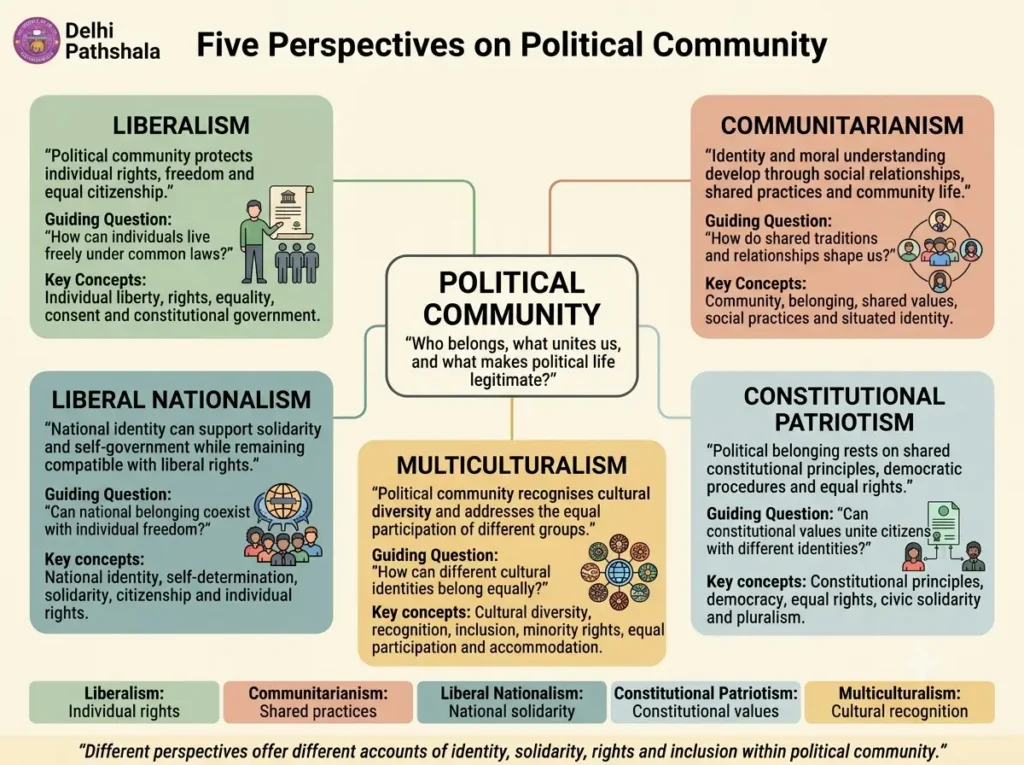
Shorten’s chapter also takes up three questions that connect directly to Unit 5: what rights and duties should citizenship involve? which kinds of political community best nourish democracy? and is political liberalism fair to religious believers? The third is worth pairing with the dissent section: if the community’s law conflicts with deeply held religious or conscientious commitments, what then?
An Indian illustration (our own, not Shorten’s). Article 51A(e) asks citizens to promote harmony “transcending religious, linguistic and regional or sectional diversities”, and 51A(f) asks them to value the “composite culture”. You can use these as a talking point when comparing constitutional patriotism (loyalty to shared constitutional values) with multiculturalism (recognising group differences). Present it as an application of the concepts, not as a claim that the Constitution endorses one theory.
Citizenship. The two Citizenship readings (Brighouse in McKinnon; Roy in Bhargava and Acharya) explain why the unit also looks at the rights and duties of citizens. Read them in full for the precise definitions your teachers expect, and keep a note of how each links membership, rights and duties.
Quick Revision: Thinkers at a Glance
| Thinker | Text / date | One-line position |
|---|---|---|
| Plato (Socrates) | Crito, 399 BCE setting | Obey the laws that raised you; four ancestors of later theories |
| Hobbes | Leviathan, 1651 | Obey the sovereign who keeps order; consent includes submission |
| Locke | Second Treatise, 1690 | Consent, limited government, right to revolt |
| Hume | “Of the Original Contract”, 1752 | Contract is a fiction; obedience rests on utility |
| Rousseau | The Social Contract, 1762 | Obligation through the general will |
| Kant | Metaphysics of Morals, 1797 | Legal order is a moral requirement; complaint, not resistance |
| T. H. Green | Lectures on the Principles of Political Obligation, 1879–80 | Will, not force, is the basis; law’s moral function |
| L. T. Hobhouse | The Metaphysical Theory of the State, 1918 | Idealism risks state worship |
| H. L. A. Hart | “Are There Any Natural Rights?”, 1955; The Concept of Law, 1961 | Fair play; law and morality separable |
| John Rawls | “Legal Obligation and the Duty of Fair Play”, 1964; A Theory of Justice, 1971 | Fair play; natural duty to support just institutions; civil disobedience |
| R. P. Wolff | In Defense of Anarchism, 1970 | Autonomy rules out a general duty to obey |
| Robert Nozick | Anarchy, State, and Utopia, 1974 | Unrequested benefits cannot create obligations |
| A. J. Simmons | Moral Principles and Political Obligations, 1979 | Philosophical anarchism; the particularity requirement |
| Joseph Raz | The Authority of Law, 1979 | Authority is piecemeal; no general duty to obey |
| Ronald Dworkin | Law’s Empire, 1986 | Community of principle |
| John Horton | Political Obligation, 1992; 2nd ed. 2010 | Associative obligation |
| Margaret Gilbert | A Theory of Political Obligation, 2006 | Joint commitment (“plural subject”) |
| George Klosko | Political Obligations, 2005 | Fairness plus other principles |
| B. R. Ambedkar | Constituent Assembly speech, 25 Nov 1949 | Prefer constitutional methods where they are open |
Key terms. Obligation: a duty, often one that must be incurred voluntarily (though most writers use “obligation” and “duty” interchangeably here). Authority: the right to command and be obeyed. Legitimacy: the moral standing of political power. Content-independence: a reason to obey because it is law, whatever its content. Prima facie: a duty that holds unless outweighed. Tacit consent: agreement inferred from conduct. Free-rider: someone who enjoys benefits without bearing costs. Particularity: the duty is owed to one’s own state. Philosophical anarchism: no general duty to obey, without a demand to abolish the state.
Criticism and Limitations of the Debate
It is easy to treat the theories above as a menu from which you pick a winner. A more careful answer recognises limits in the whole debate.
- No theory is a clear winner. The Stanford Encyclopedia notes that sophisticated recent efforts have brought us no closer to agreement than Hobbes and Locke were in the seventeenth century.
- The focus on obedience may be too narrow. Parekh, and the civic-duty debate, remind us that being a good citizen involves more than obeying. Some writers argue the debate is shifting from who must obey to what gives a state the right to rule over a territory.
- Citizens versus everyone else. Because most theories speak about members, they say little about residents who are not citizens, visitors or migrants, which is exactly where associative and consent approaches strain.
- Moral justification versus belief. The Unit 2 distinction between normative and empirical approaches matters here. Why people actually obey (habit, fear, belief in legitimacy) is an empirical question; whether they ought to is the normative one. Review our notes on Approaches to Political Theory: Normative, Historical and Empirical if the distinction is hazy.
- A largely Western canon. The prescribed readings are drawn mainly from Western, analytic political philosophy. This is our observation, not a claim made in the syllabus. If you have studied DSC-2, where Unit 2 covers Dharma, Dhamma, Danda, it is worth asking how those traditions connect rulers’ and subjects’ duties, and whether the questions are the same.
- Hybrids may not rescue the project. Simmons’s worry is that combining several inadequate principles still leaves an inadequate theory.
Contemporary Relevance
Political obligation is not only a classroom puzzle. Three live connections are worth knowing, each of which you can use as an example in an exam.
- Citizens’ duties in a constitution. Article 51A shows how a constitutional text states civic duties without settling the moral foundation of obedience.
- Protest and the limits of dissent. When citizens campaign against a law, the vocabulary of this unit (dissent, civil disobedience, conscientious refusal) provides tests for asking whether the action is public, non-violent and aimed at changing the law. Ambedkar’s 1949 warning and Gandhi’s satyagraha give you two Indian touchstones.
- Non-citizens and borders. Migrants, long-term residents and visitors raise the particularity and membership problems in a very practical form.
For more on how the concept of “the political” frames such questions, see our notes on What Is Politics? Theorizing the Political.
Conclusion
Political obligation asks whether, and why, the fact that something is the law of your community gives you a moral reason to obey it. The classic answers (contract, consent, utility, natural law, Green’s idealism) have been joined by newer ones (fair play, association, natural duty), and each is met by a serious objection: hypothetical or missing consent, unrequested benefits, oppressive “membership”, the particularity problem, and the sceptic’s insistence on autonomy. That is why many writers now favour a pluralist or hybrid view, and why others, like Wolff and Simmons, doubt that a general duty to obey exists.
For your exam, three habits will carry more weight than memorising every thinker. Define the term and separate it from legal obligation. Present each theory with its strongest objection. And show that you know where scholars still disagree, rather than declaring a winner.
Continue Reading
Unit 5 draws on everything earlier in DSC-1. These four notes from the same paper are the best next stops.
- Traditions of Political Theory: Liberal, Marxist, Anarchist and Conservative (Unit 3): the liberal and anarchist traditions behind the contract and philosophical-anarchist arguments above.
- Critical Perspectives in Political Theory: Feminist and Postmodern (Unit 4): the feminist challenge to consent and obligation.
- Approaches to Political Theory: Normative, Historical and Empirical (Unit 2): why “ought citizens obey?” and “why do they obey?” are different questions.
- What Is Politics? Theorizing the Political (Unit 1): the starting point of the whole paper.
- All DSC-1 Understanding Political Theory notes: the five units in one place.
University of Delhi Previous Year Questions
DU Previous Year Questions
DU BA (Hons.) Political Science | DSC-1: Understanding Political Theory | Unit 5: The Idea of Political Community – Political Obligation. Includes a direct question from the 2023 paper, reported questions, and important exam-practice questions. Tap a question to view a quick-answer guide.
1 What are the main arguments in favour of Political Obligation? +
2 Write a short note on Political Community. +
3 Write an essay on the idea of Political Obligation to the State. +
4 Do we have a political obligation to obey the state? +
5 What is Political Obligation? Discuss its nature and basis. +
6 Discuss the major theories of Political Obligation: Consent, Force, Divine, Idealist, and Marxist theories. +
7 What are the limits of Political Obligation? When does civil disobedience become justified? +
8 Is Political Obligation absolute? Can resistance and civil disobedience be justified? +
9 Discuss the relationship between Political Obligation and Political Community. +
10 Differentiate between Legal Obligation, Moral Obligation, and Political Obligation. +
11 Explain the Gratitude Theory and Fairness Theory of Political Obligation. +
12 Discuss Political Obligation as a Rational Exercise and as Established Conventions. +
13 Discuss the significance of Political Obligation in the context of democratic governance. +
FAQs
What is political obligation in simple words?
It is the question of whether, and why, you have a moral duty to obey the laws of your own state, simply because they are the law. Different theories answer through consent, fairness, belonging or a duty of justice.
What is the difference between political obligation and legal obligation?
A legal obligation is what the law requires of you; it is a statement of fact about the legal system. A political obligation is the moral duty, if it exists, to follow the law because it is the law. You can have a legal obligation (such as paying tax under an unjust regime) without having a political obligation to comply.
Are political obligation, political duty and political responsibility the same thing?
In most writing, “obligation” and “duty” are used interchangeably. Some theorists do distinguish them, saying obligations are voluntarily taken on (a promise) while duties need not be. “Responsibility” is usually looser and often means a civic duty such as voting. In an exam, use “political obligation” and state which sense you mean.
Who first used the term “political obligation”?
The Stanford Encyclopedia says the phrase is apparently no older than T. H. Green’s Lectures on the Principles of Political Obligation (delivered 1879–80). The problem is much older, going back to Plato’s Crito.
What is the main difference between Hobbes and Locke on political obligation?
For Hobbes, people leave a violent state of nature by obeying a sovereign who keeps order, and even submission to a conqueror counts as consent. For Locke, authority rests on consent and is limited, and the people may revolt against a government that betrays its trust. Scholars debate how far apart they really are.
What is tacit consent, and why did Hume reject it?
Tacit consent is agreement inferred from conduct, such as staying in a country. Hume argued that this is like saying a person carried onto a ship while asleep has agreed to obey the captain, since he cannot leave without great cost.
What is the fair-play argument for political obligation?
If you benefit from a cooperative scheme that works because others bear burdens, it is unfair to take the benefits without carrying your share. Nozick objected that this would let neighbours impose duties on us by giving us unrequested benefits; Klosko replies that what matters is that the goods are valuable, presumptively beneficial and fairly distributed.
What is philosophical anarchism, and how is it different from anarchism?
Anarchism proper says states are necessarily immoral and should be abolished. Philosophical anarchism says there is no general moral duty to obey the law, without necessarily demanding that the state be abolished. Wolff’s version rests on autonomy; Simmons’s holds that no existing theory has succeeded.
Is civil disobedience compatible with political obligation?
On Rawls’s view, civil disobedience is public, non-violent and aims to change laws while expressing fidelity to the system, so many see it as compatible with a general obligation. Fair-play writers accept that you may try to transform a scheme without owing to abandon it. Others argue the definition is too narrow, and Ambedkar warned against such methods where constitutional channels are open. Present it as a live debate.
How is political obligation connected to political community?
Associative theories ground obligation in membership. The particularity requirement asks which community your obligation is owed to. And any theory must say who counts as a member, which is why Unit 5 pairs the two ideas.
Does the Indian Constitution impose a duty to obey?
Article 51A(a) lists, as a fundamental duty of every citizen, to abide by the Constitution and respect its ideals and institutions. That is a constitutional statement of civic duty. It does not settle the philosophical question of why citizens are morally bound, and the duties are generally described as not directly enforceable by courts.
How should I structure a 15-mark answer on political obligation?
Open with a two-line definition and separate it from legal obligation. Give three or four theories, each with its key thinker and strongest objection. Add a short paragraph on where scholars disagree, then a conclusion that gives your own measured view. Use a small table only for comparison; do not let it replace explanation.
Further Reading and Sources
Official syllabus and course material
- DU Department of Political Science: Semester I syllabus, including DSC-1 Unit 5 readings
- School of Open Learning, University of Delhi: study material for Understanding Political Theory
- Bibliographic record for Hyams, “Political Authority and Obligation”, University of Reading
Scholarly references
- Stanford Encyclopedia of Philosophy: Political Obligation
- Stanford Encyclopedia of Philosophy: Civil Disobedience
- T. H. Green, Lectures on the Principles of Political Obligation (McMaster Archive for the History of Economic Thought)
Indian constitutional context
- Know India (Government of India): Fundamental Duties
- Constitution of India: Article 51A, Fundamental Duties
- Ambedkar’s final speech to the Constituent Assembly, 25 November 1949 (published reproduction)
Prescribed and suggested books and chapters (from the DU syllabus): Shorten, Contemporary Political Theory (ch. “Political Community”); McKinnon (ed.), Issues in Political Theory (Hyams; Brighouse); Bhargava and Acharya (eds), Political Theory: An Introduction (Roy); Bellamy and Mason (eds), Political Concepts (Martin); Knowles, Political Philosophy (Routledge); and, as suggestive reading, Klosko, Political Obligations (OUP, 2005).
Subscribe to keep reading
You've used your free notes for now. Get Delhi Pathshala Premium for unlimited access.
Subscribe — ₹29/30 days