
Contents
- Approaches to Political Theory in Political Concept
- 1. Normative Approach
- Key Concepts in the Normative Approach
- Criticisms of the Normative Approach
- 2. Historical Approach
- Key Thinkers and Periods
- Criticisms of the Historical Approach
- 3. Empirical Approach
- Methods Used in the Empirical Approach
- Key Topics Covered
- Criticisms of the Empirical Approach
- Normative vs Historical vs Empirical: Quick Comparison
- Conclusion
- Previous Year Questions (PYQs)
- FAQs
These are complete notes for Unit 2 (Approaches to Political Theory: Normative, Historical and Empirical) from DSC-1 (Understanding Political Theory) — Semester 1, BA (Hons.) Political Science, University of Delhi. Use these notes to understand the three core approaches to political theory, their key thinkers, criticisms, and previous year exam questions.
Approaches to Political Theory in Political Concept
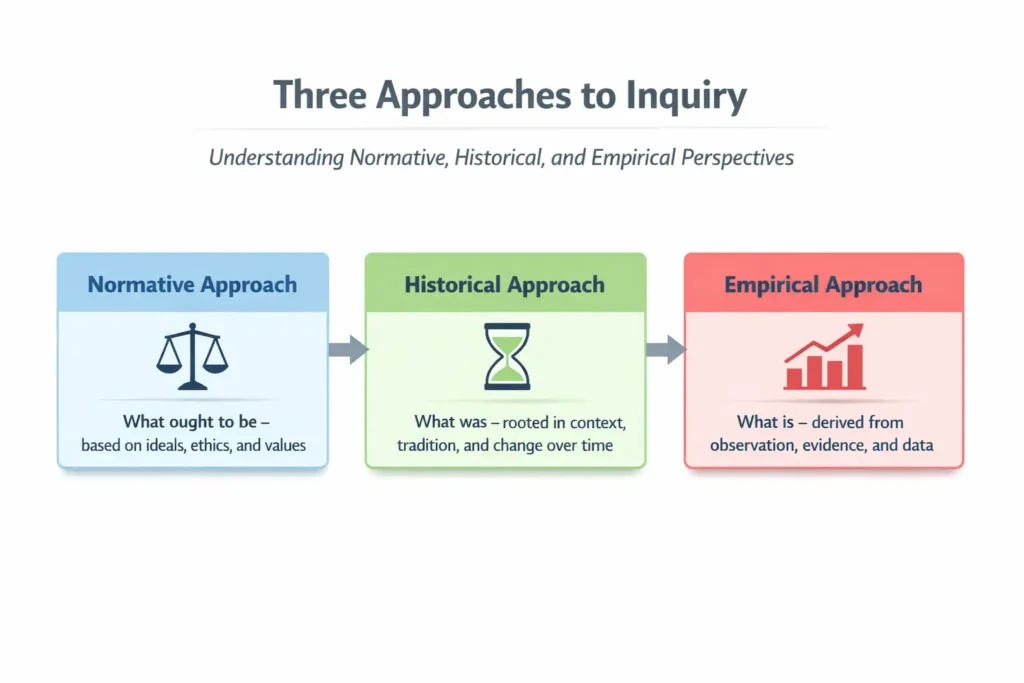
Political theory tries to answer big questions — what makes a state legitimate, what does justice mean, how should power be distributed? Over time, scholars have developed three broad ways of approaching these questions: the normative approach, the historical approach, and the empirical approach. Each one asks a different kind of question and uses a different method to answer it. Most political theorists today agree that a complete understanding of politics needs all three working together, not just one in isolation.
1. Normative Approach
The normative approach asks “what ought to be?” rather than “what is.” It is concerned with values — justice, liberty, equality — and tries to work out which political arrangements are morally right, not just which ones exist.
Normative theorists ask questions like: Is this law fair? Should the state redistribute wealth? What makes a government legitimate? Rather than describing the world as it is, they build ideal models of how political life should be organised, and use those models as a yardstick to judge real institutions.
Key Concepts in the Normative Approach
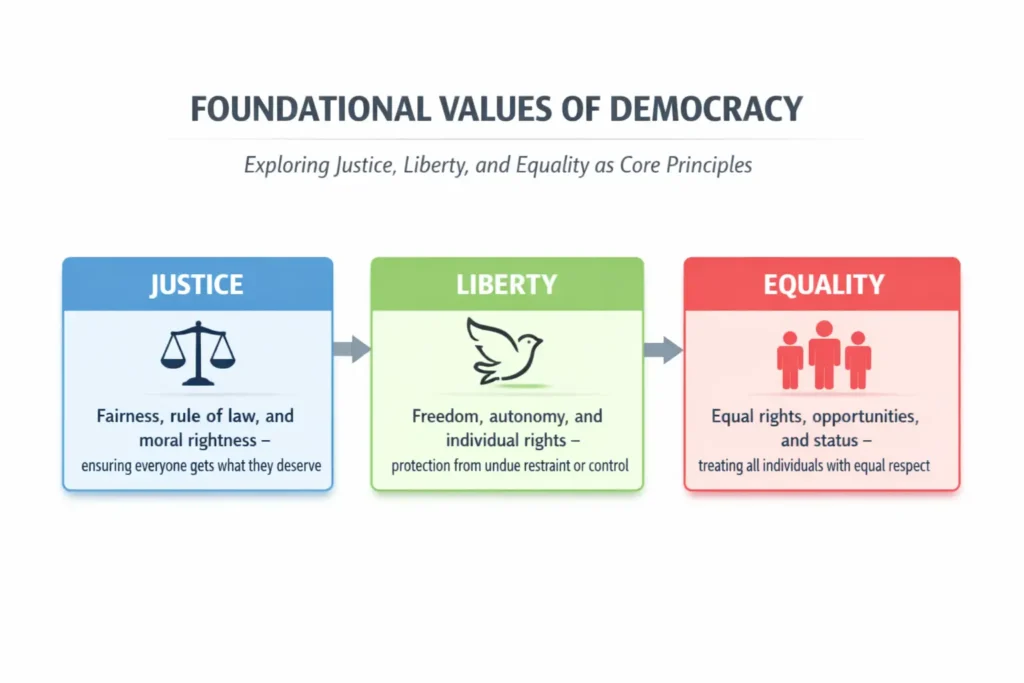
Justice Justice is about how a society fairly distributes its benefits and burdens. Distributive justice focuses on allocating resources according to need, while corrective justice is about righting a specific wrong that has already occurred.
Liberty Liberty is the freedom of individuals to think and act without unnecessary interference. Isaiah Berlin’s classic distinction separates negative liberty (freedom from interference) from positive liberty (the real capacity to act on one’s own goals) — a debate that still shapes how we argue about state intervention today.
Equality Equality theories range from formal equality, which insists on identical treatment regardless of circumstance, to substantive equality, which tries to correct for the unequal starting points created by social, economic, and cultural disadvantage — a distinction that comes up directly in Indian debates over reservation policy.
Criticisms of the Normative Approach
Critics argue that abstract principles like justice and liberty are genuinely hard to define and even harder to measure objectively. Because values differ across societies and even between individuals, normative theory also struggles to resolve conflicts between competing principles — for instance, when liberty and equality pull in opposite directions.
2. Historical Approach
The historical approach studies political ideas by tracing their origin and development through time. Instead of asking whether an idea is right, it asks: where did this idea come from, and how has it changed?
Key Thinkers and Periods
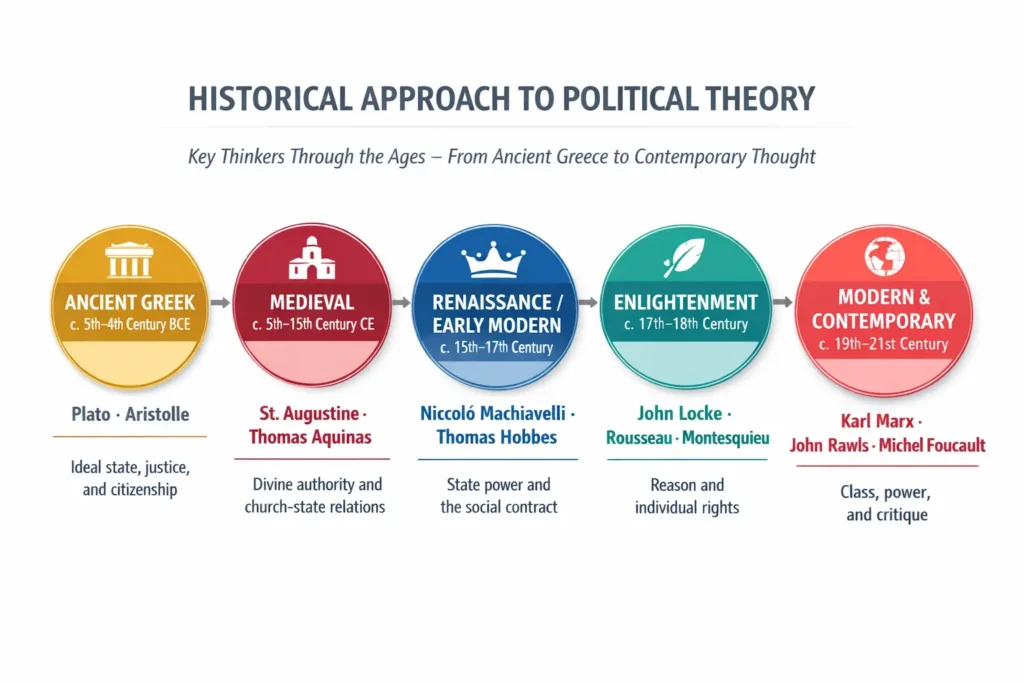
Ancient Greek Philosophers Plato and Aristotle introduced foundational ideas of democracy, republicanism, and natural law, and were among the first to systematically ask what makes a state just.
Medieval Political Thinkers Augustine and Aquinas brought religious and theological questions into political thought, addressing divine authority, natural rights, and the idea of a common good.
Modern Political Philosophers Hobbes, Locke, Rousseau, and Kant challenged older sources of political legitimacy, developing ideas like the social contract, consent of the governed, sovereignty, and the duties of citizens toward the state.
Enlightenment Thinkers Montesquieu, Voltaire, and Adam Smith broadened political inquiry by applying reason and empiricism to politics, economics, and society, laying groundwork for liberal political traditions.
Revolutionary Thinkers Paine, Jefferson, and Marx directly criticised existing political and social orders, arguing for democracy, equality, and emancipation of ordinary people.
Contemporary Political Theorists Rawls, Nozick, and Habermas continue this historical thread into the present, addressing justice, liberty, democracy, and pluralism in the context of modern, globalised societies.
Criticisms of the Historical Approach
Interpreting old texts accurately is difficult, and historians can unintentionally bring their own bias into which sources they highlight. There’s also a genuine question of how relevant centuries-old theories are to today’s political problems.
3. Empirical Approach
The empirical approach studies political behaviour and institutions the way a scientist studies any observable phenomenon — through evidence, not values. It asks “what is?” and tries to explain patterns in political life using data, testing hypotheses rather than asserting ideals.
Methods Used in the Empirical Approach
- Statistics — analysing numerical data to find patterns in political behaviour
- Surveys — structured questionnaires to gather public opinion and attitudes
- Experiments — controlled tests of specific political hypotheses
- Case Studies — in-depth examination of a single event or institution to draw broader lessons
- Comparative Analysis — comparing political systems or behaviours across different countries or contexts
Key Topics Covered
Empirical political theory studies political culture, political socialisation, voting behaviour, public opinion, interest groups, social movements, political leadership, institutional performance, and political change — essentially, how politics actually functions on the ground.
Criticisms of the Empirical Approach
Measuring political concepts precisely is harder than it looks, and political phenomena are often too complex and context-dependent to reduce to clean data. Critics also argue that empirical work can drift toward describing “what is” while quietly ignoring the moral question of “what should be” — which is exactly the gap the normative approach tries to fill.
Normative vs Historical vs Empirical: Quick Comparison
| Approach | Core Question | Method | Focus |
|---|---|---|---|
| Normative | What ought to be? | Philosophical reasoning, ethical analysis | Values — justice, liberty, equality |
| Historical | Where did this idea come from? | Tracing origin and evolution of ideas | Thinkers, texts, and their context |
| Empirical | What actually is? | Statistics, surveys, case studies | Observable political behaviour |
Conclusion
Political theory isn’t a single method — it’s a conversation between three different ways of asking questions about power, justice, and governance. The normative approach tells us what should happen, the historical approach shows us how we got here, and the empirical approach tells us what’s actually happening on the ground. A strong answer in your exam (and a strong understanding of the subject) usually draws on all three together rather than treating them as separate boxes.
For the complete official unit breakdown, refer to the DU syllabus for Understanding Political Theory. For a deeper academic treatment of these methodological debates, see Britannica’s overview of political science and the Internet Encyclopedia of Philosophy’s entry on political philosophy methodology.
Related notes you may find useful:
- What is Politics? Theorizing the Political (Unit 1)
- The Idea of Political Community & Political Obligation (Unit 5)
- Traditions of Political Theory: Liberal, Marxist, Anarchist and Conservative (Unit 3)
- What is Global Politics?
- Browse all Understanding Political Theory notes
- हिंदी में पढ़ें: राजनीतिक सिद्धांत के दृष्टिकोण
Previous Year Questions (PYQs)
These questions have appeared in DU BA (Hons.) Political Science, Semester 1 exams for Understanding Political Theory (DSC-1), and give you a good sense of how this unit is typically tested:
- Explain the difference between Normative and Empirical approaches to the study of political theory.
- What is political theory? Explain the importance of the empirical approach in the study of political theory.
- Discuss the concept of political theory and its relevance in political science.
- Examine the arguments in the “Normative vs Empirical” debate in the study of political theory.
- Distinguish between approach and method in the study of political theory, with reference to the normative, historical and empirical approaches.
- “Political theory is both a normative and an empirical discipline.” Discuss.
Practice tip: Most answers expect you to define the approach, name 2-3 key thinkers/concepts associated with it, and end with a balanced view on its strengths and limitations — exactly the structure used in the sections above.
FAQs
What are the three main approaches to political theory?
The three main approaches are the normative approach (focused on values and what ought to be), the historical approach (tracing the evolution of political ideas), and the empirical approach (studying observable political behaviour through data and evidence).
What is the main difference between normative and empirical approaches?
The normative approach asks “what ought to be” and relies on philosophical and ethical reasoning, while the empirical approach asks “what is” and relies on data, surveys, and observation to describe political reality as it actually exists.
Who are the key thinkers associated with the historical approach to political theory?
Key thinkers include Plato and Aristotle (ancient Greek period), Augustine and Aquinas (medieval period), Hobbes, Locke, Rousseau and Kant (modern period), and Rawls, Nozick and Habermas (contemporary period).
Why is the normative approach criticised?
Critics argue that normative concepts like justice, liberty, and equality are difficult to define precisely and can be measured or interpreted differently by different people, and that competing values can conflict with no clear way to resolve which one should win.
Is this topic important for DU BA Hons Political Science exams?
Yes. Approaches to Political Theory is Unit 2 of DSC-1 (Understanding Political Theory) in Semester 1, and questions distinguishing normative, historical, and empirical approaches appear regularly in university exams.
Can I combine all three approaches in one exam answer?
Yes, and it’s often the strongest strategy. Examiners generally reward answers that show how the three approaches complement each other rather than treating them as completely separate methods.
Subscribe to keep reading
You've used your free notes for now. Get Delhi Pathshala Premium for unlimited access.
Subscribe — ₹29/30 days