

Contents
- Why This Unit Matters for Your Exam
- Paleolithic Cultures of India
- Chronology and Distribution
- Stone Tool Typology and Technology
- Subsistence and Adaptation
- Mesolithic Cultures of India
- Chronology and Distribution
- Stone Tool Typology: Microlithic Technology
- Subsistence and Adaptation
- Microlithic Industries: Regional Variations
- Neolithic Cultures of India
- Chronology and Distribution
- Domestication of Plants and Animals
- Emergence of Village Communities
- Chalcolithic Cultures of India
- Chronology and Distribution
- Stone and Copper Tool Technology
- Trade and Exchange
- Master Comparison Table: Paleolithic vs Mesolithic vs Neolithic vs Chalcolithic
- Top DU Previous Year Questions (PYQs) — DSC-1, Unit 2
- Frequently Asked Questions
- Important Links
- External Links
Quick Summary (for fast revision): Unit 2 of DSC-1 traces how human life in India changed from mobile hunting-and-gathering bands (Paleolithic, from ~2.6 million years ago) to settled farming villages (Neolithic, from ~7000 BCE) and finally to copper-using agricultural communities (Chalcolithic, from ~3000 BCE). The story is told through four overlapping stages — Paleolithic → Mesolithic → Neolithic → Chalcolithic — each defined by its stone/metal tool technology, subsistence pattern, and settlement type. This is the direct bridge unit between Unit 1 (Reconstructing History) and Unit 3 (The Harappan Civilization).
Why This Unit Matters for Your Exam
Unit 2 is consistently one of the highest-weightage units in DSC-1 History of India-I. It connects directly to Unit 1: Reconstructing Ancient Indian History and sets up the background for Unit 3: The Harappan Civilization. Questions from this unit are frequently asked in both short-answer (tool typology, site identification) and long-answer (subsistence transitions, Neolithic Revolution) formats.
Paleolithic Cultures of India
Chronology and Distribution
| Phase | Time Period | Tool Types | Key Sites |
|---|---|---|---|
| Lower Paleolithic | 2.6 million – 200,000 years ago | Handaxes, cleavers, choppers | Attirampakkam (TN), Didwana (Rajasthan), Soan Valley |
| Middle Paleolithic | 200,000 – 40,000 years ago | Flake tools, blades, Levallois cores | Bhimbetka (MP), Patne (Maharashtra), Hunsgi (Karnataka) |
| Upper Paleolithic | 40,000 – 10,000 years ago | Microliths, blades, bone tools | Bhimbetka, Bagor (Rajasthan), Sarai Nahar Rai (UP) |
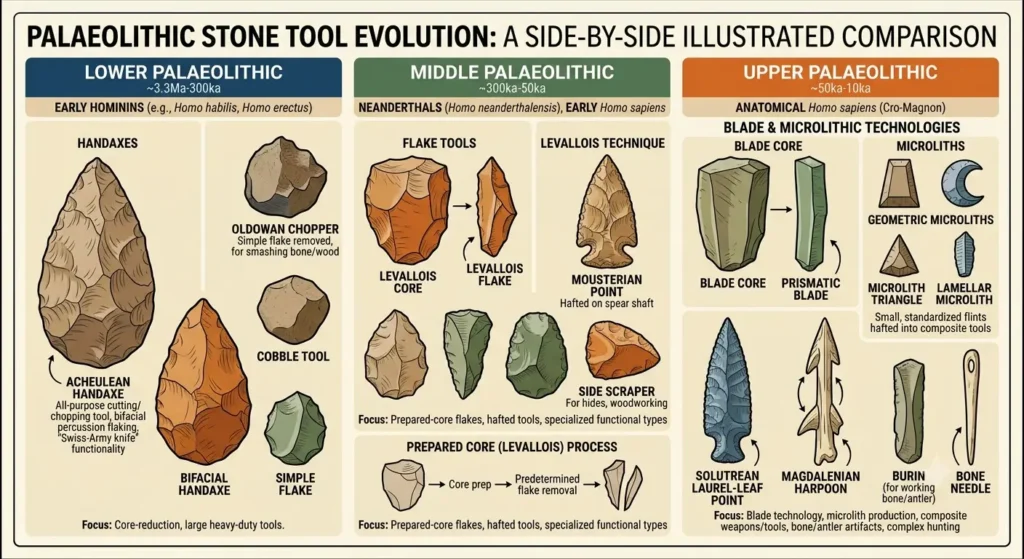
Regional cultures worth remembering for exams:
- Soan Valley Culture — Lower Paleolithic, present-day Pakistan/northern India, handaxes and cleavers.
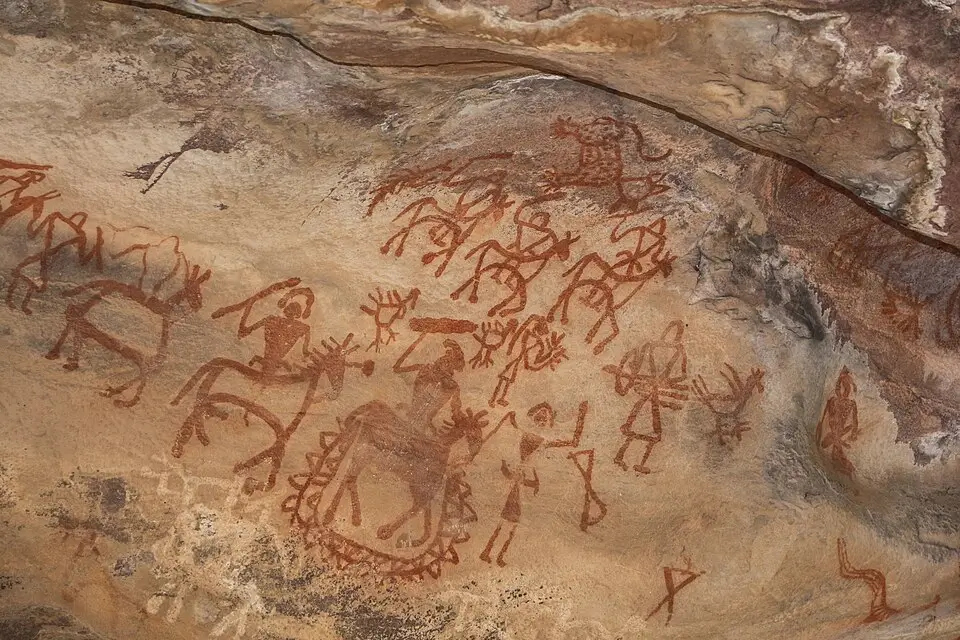
- Bhimbetka Culture — Middle & Upper Paleolithic, Madhya Pradesh, famous for rock shelters and rock art. This site connects well with your notes on Religion and Cultural Developments in India.
- Hunsgi Culture — Middle Paleolithic, Karnataka, cleavers and handaxes.
- Attirampakkam Culture — Lower to Middle Paleolithic transition, Tamil Nadu.
- Bagor & Sarai Nahar Rai — Upper Paleolithic, microliths and early domestication evidence.
Stone Tool Typology and Technology
- Lower Paleolithic: Core tools (handaxes, cleavers, choppers) made via bifacial knapping and core reduction.
- Middle Paleolithic: Levallois technique for standardized flake blanks; Mousterian-influenced tools (side-scrapers, points, denticulates).
- Upper Paleolithic: Microlithic bladelet technology, bone/antler tools (points, awls, harpoons), burin technique for engraving.
Subsistence and Adaptation
Early humans in the Lower Paleolithic hunted large game (elephants, megafauna) with simple tools and led nomadic lifestyles tied to seasonal resource availability — see our detailed piece on Evolution of Humans and Hunting-Gathering Culture for the biological/anthropological background. By the Middle Paleolithic, diets diversified with fishing and smaller game; by the Upper Paleolithic, microlithic composite tools and coastal marine-resource exploitation appear, alongside greater seasonal mobility between ecological zones.
For deeper reading on rock-art and symbolic behaviour at Bhimbetka: UNESCO World Heritage listing for Rock Shelters of Bhimbetka.
Mesolithic Cultures of India
Chronology and Distribution
| Phase | Approx. Dates | Key Development |
|---|---|---|
| Early Mesolithic | c. 12,000 – 8,000 BCE | Continued microliths, early domestication experiments |
| Middle Mesolithic | c. 8,000 – 5,000 BCE | Advanced microlithic technology, diverse ecological adaptation |
| Late Mesolithic | c. 5,000 – 3,000 BCE | Refined tool industries, early social organization |
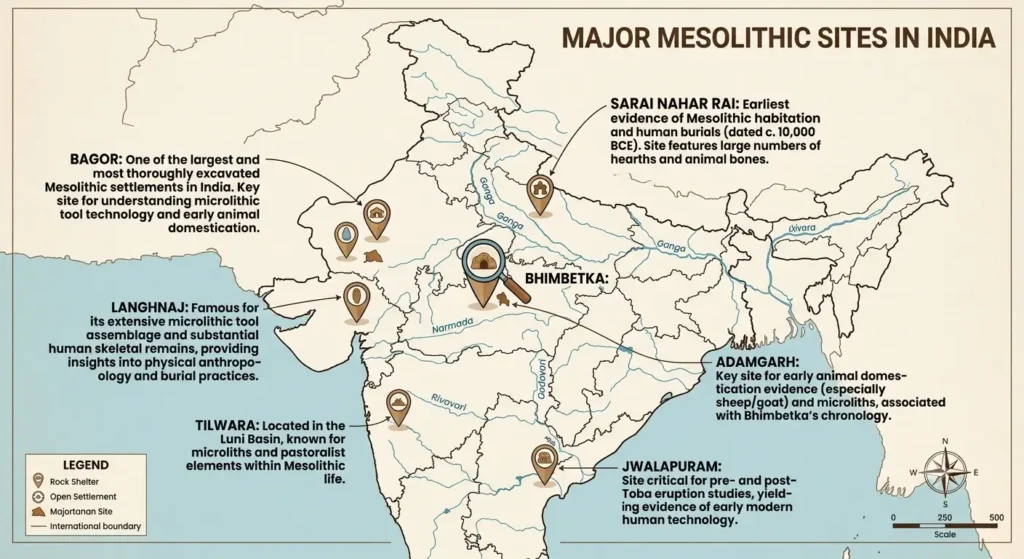
Key sites: Bhimbetka (MP), Bagor (Rajasthan, Aravalli Hills), Adamgarh (Chhattisgarh), Langhnaj (Gujarat), Mahagara & Chopani Mando (UP, Ganges-Yamuna Doab and Son River respectively), Agroha (Haryana), Narmada Valley sites (Morhana Pahar, Chikhalda).
Stone Tool Typology: Microlithic Technology
Microliths (blades, segments, points, crescents, truncations under 5 cm) were hafted onto handles to create composite tools — sickles, arrows, and spears. Retouching used pressure flaking, direct percussion, and indirect percussion. Raw materials were largely local (chert, quartz, obsidian), producing strong site-specific regional variation.
Subsistence and Adaptation
The Mesolithic marks the crucial transition phase: hunting-gathering continues, but sickles with microlithic inserts point to early plant-harvesting experiments — the first steps toward the Neolithic Revolution. Seasonal mobility and flexible settlement patterns dominate, with cooperative hunting suggesting more organized social structures.
Microlithic Industries: Regional Variations
| Region | Character |
|---|---|
| Northwestern (Haryana, Punjab) | Geometric microliths, riverine fishing adaptations |
| Central India (MP, Chhattisgarh) | Rock-shelter associations, e.g. Bhimbetka rock art |
| Western India (Gujarat) | Coastal fishing adaptations |
| Southern India (Karnataka, AP) | Open-air and rock-shelter sites, plant exploitation |
| Eastern India (Odisha, WB) | River valley and coastal adaptations, early cultivation evidence |
Neolithic Cultures of India
Chronology and Distribution
The Neolithic marks the shift from hunting-gathering to settled agriculture and animal domestication.
| Culture | Chronology | Region |
|---|---|---|
| Mehrgarh Culture | ~7000–2500 BCE | Balochistan (Pakistan) — earliest Neolithic site in the subcontinent |
| Hakra/Early Harappan | ~3500–2600 BCE | Pakistan & northwest India, precursor to Harappan Civilization |
| Daimabad Culture | ~3300–2000 BCE | Pravara River basin, Maharashtra |
| Megalithic Cultures | ~2000–500 BCE | South & Central India |
Domestication of Plants and Animals
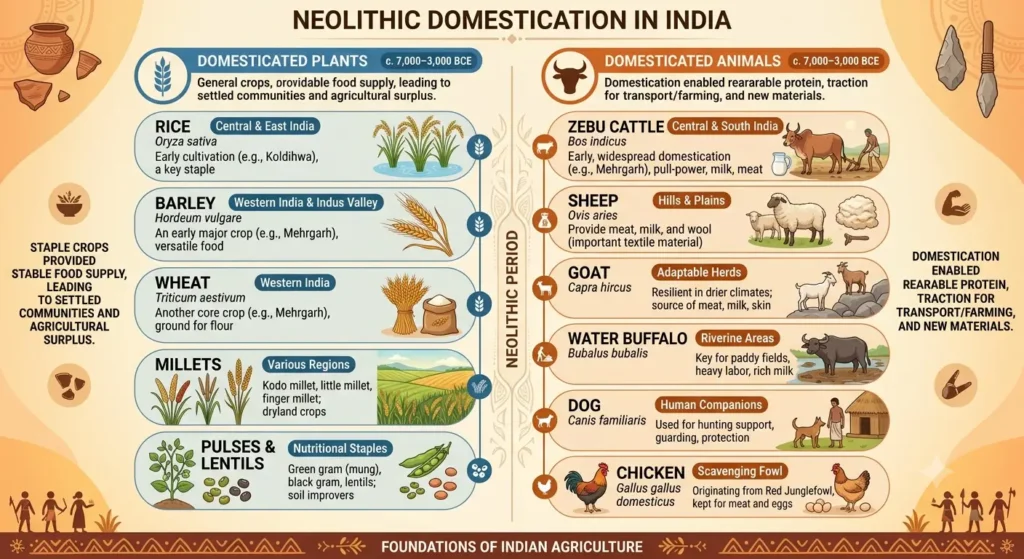
Plants: Wheat, barley (earliest cereals), lentils, chickpeas, peas, sesame, mustard, gourds, melons, cotton. Animals: Zebu cattle, sheep, goats, pigs, water buffaloes, chicken, dogs.
Emergence of Village Communities
Permanent mud-brick and wattle-and-daub dwellings replaced mobile camps; some sites show planned village layouts. Surplus food production enabled craft specialization and early trade — the socio-economic foundation on which the Harappan Civilization would later be built.
For NCERT-aligned background reading: NCERT Class 6 History Chapter — From Hunting-Gathering to Growing Food.
Chalcolithic Cultures of India
Chronology and Distribution
| Culture | Chronology | Region | Notable Feature |
|---|---|---|---|
| Mehrgarh | 7000–2600 BCE | Balochistan | Early copper use, agriculture |
| OCP (Ochre Coloured Pottery) | 2300–1500 BCE | Rajasthan, Haryana, Punjab, UP, Delhi | Ochre-decorated pottery, horse domestication evidence |
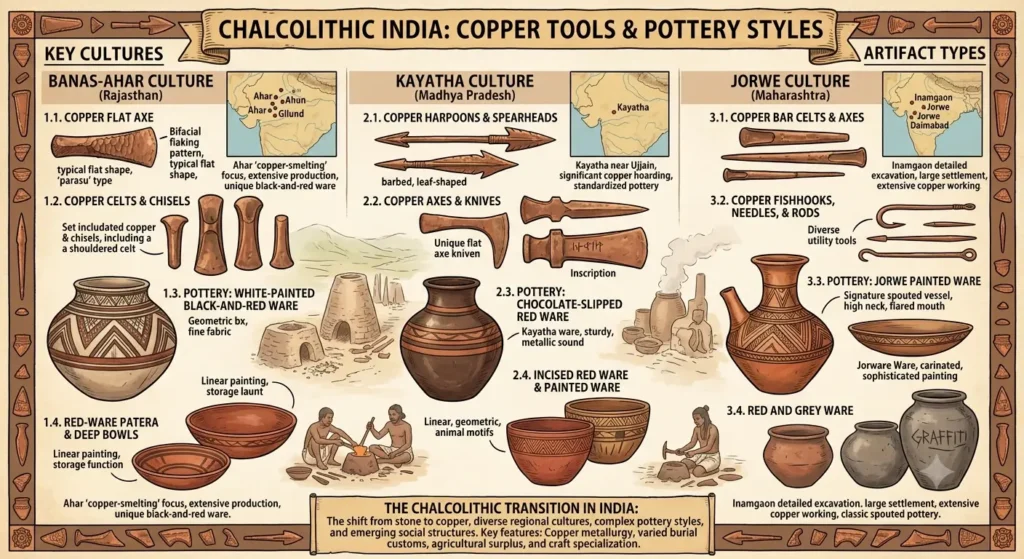
| Ahar-Banas | 3000–1500 BCE | Rajasthan, MP, Gujarat | Red-and-black pottery |
| Malwa Culture | 2600–1800 BCE | Madhya Pradesh | Black-and-red ware |
| Kayatha Culture | 2200–2000 BCE | Madhya Pradesh | Sub-phase of Malwa culture |
| Jorwe Culture | 1400–700 BCE | Maharashtra | Black-on-red pottery |
| Daimabad Culture | 2100–2000 BCE | Maharashtra | Metalwork, black-on-red pottery |
Stone and Copper Tool Technology
Copper blades, points, harpoons, fishhooks (often cast via the lost-wax technique), axes, and adzes appear alongside continued stone tool use (microliths, blades, ground stone tools). This coexistence of stone and metal technology is the defining trait of the Chalcolithic (“Copper Age”).
Trade and Exchange
Regional exchange of copper and stone raw materials, craft specialization in pottery/metalwork, and long-distance trade evidenced by non-local materials (seashells, semi-precious stones) — some sites show possible links to the early Indus Valley trade network.
Master Comparison Table: Paleolithic vs Mesolithic vs Neolithic vs Chalcolithic
| Feature | Paleolithic | Mesolithic | Neolithic | Chalcolithic |
|---|---|---|---|---|
| Time Period | 2.6 mn – 10,000 BCE | 12,000 – 3,000 BCE | 7000 – 2500 BCE | 3000 – 700 BCE |
| Tools | Handaxes, cleavers, flakes | Microliths | Ground stone, polished axes | Stone + copper |
| Subsistence | Hunting-gathering | Hunting-gathering + early domestication experiments | Settled agriculture | Agriculture + metallurgy |
| Settlement | Nomadic | Semi-nomadic | Permanent villages | Permanent villages/towns |
| Key Sites | Bhimbetka, Attirampakkam | Bagor, Langhnaj | Mehrgarh | Ahar-Banas, Jorwe, OCP |
Top DU Previous Year Questions (PYQs) — DSC-1, Unit 2
- Discuss the tool typology and subsistence pattern of Paleolithic cultures in India.
- What is Microlithic technology? Discuss its significance in the Mesolithic period.
- Examine the process of Neolithic domestication of plants and animals in India.
- Write a note on the Chalcolithic cultures of India with special reference to the Ahar-Banas culture.”
- Trace the emergence of village communities in Neolithic India.
- Differentiate between Paleolithic and Mesolithic tool technologies.
Frequently Asked Questions
What is the difference between Paleolithic and Mesolithic cultures in India?
Paleolithic cultures (2.6 million–10,000 years ago) used large core tools like handaxes and cleavers, while Mesolithic cultures (12,000–3,000 BCE) are defined by small, geometric microliths hafted onto composite tools like sickles and arrows.
Which is the earliest Neolithic site in India?
Mehrgarh, located in present-day Balochistan (Pakistan), is considered the earliest Neolithic site in the Indian subcontinent, dating to around 7000 BCE.
What defines a Chalcolithic culture?
A Chalcolithic (“Copper Age”) culture is defined by the parallel use of copper tools alongside continued stone tool technology, combined with settled agriculture.
What were the main domesticated animals in Neolithic India?
Zebu cattle, sheep, goats, pigs, water buffaloes, chickens, and dogs were the primary domesticated animals.
Which sites represent Lower Paleolithic culture in India?
Attirampakkam (Tamil Nadu), Didwana (Rajasthan), and sites in the Soan Valley are key Lower Paleolithic sites.
Why is Bhimbetka important for the study of Indian prehistory?
Bhimbetka’s rock shelters contain both Middle/Upper Paleolithic and Mesolithic deposits, plus extensive rock art, making it one of India’s most continuously significant prehistoric sites — it is a UNESCO World Heritage Site.
What is the significance of the Ochre Coloured Pottery (OCP) culture?
The OCP culture (c. 2300–1500 BCE), found across Rajasthan, Haryana, Punjab, UP and Delhi, marks widespread copper tool use and possible horse domestication, and is often discussed as a link to the late/post-Harappan phase.
Important Links
- Unit-3: The Harappan Civilization
- History of Religion and Cultural Developments in India
- Evolution of Humans and Hunting-Gathering Culture
- BA History Notes Delhi University
- DU BA History Previous Year Questions category
External Links
Subscribe to keep reading
You've used your free notes for now. Get Delhi Pathshala Premium for unlimited access.
Subscribe — ₹29/30 days