
Contents
- What the DU syllabus asks for in Unit 2
- 1. Introduction to IR Theories
- What is an IR theory?
- Theory, approach and paradigm: are they the same?
- Why are theoretical perspectives important in IR?
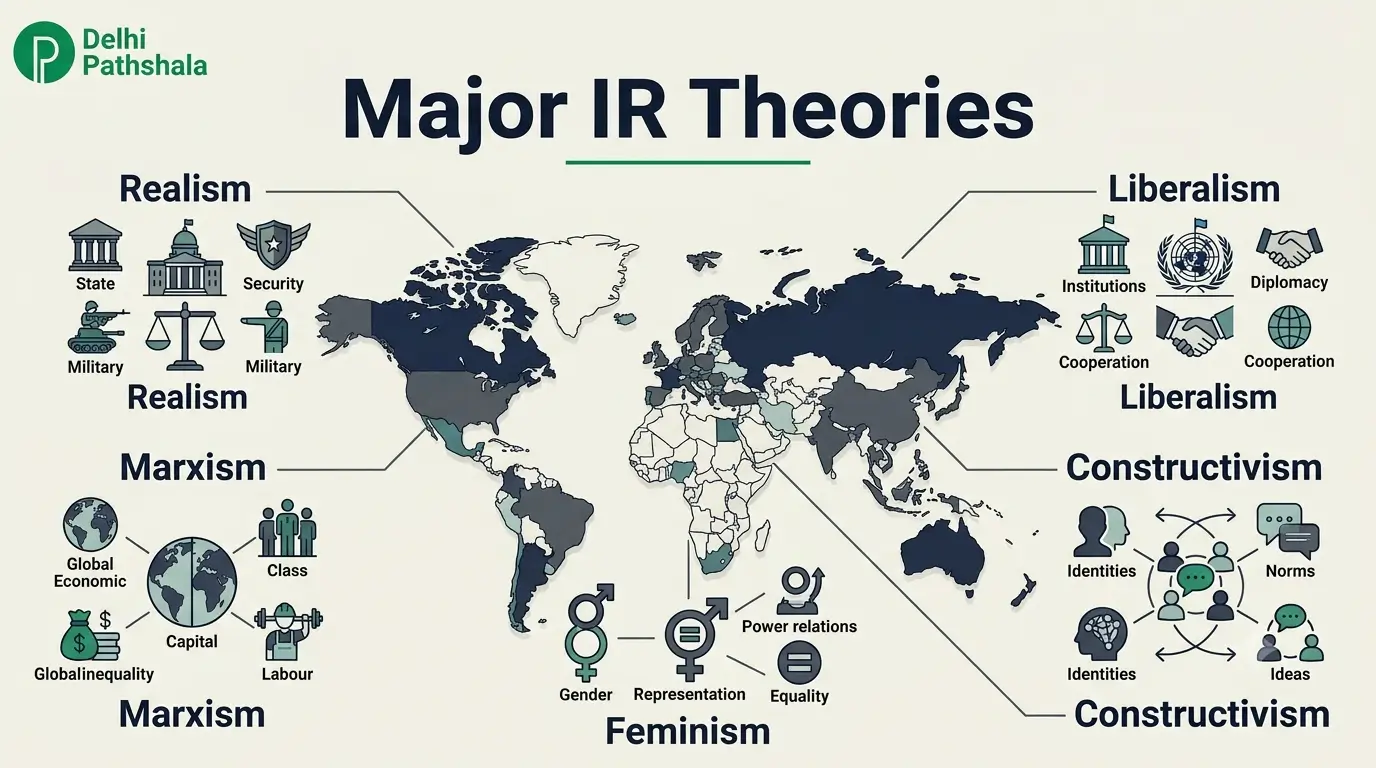
- The major theories at a glance
- The “great debates” of IR: a map of how theories argued with each other
- Is IR theory too Western?
- Comparing IR theories: strengths and weaknesses
- 2. Realpolitik (Kautilya), Realism and Neo-Realism
- 2.1 Realpolitik: what it means
- 2.2 Kautilya’s Arthashastra: an Indian tradition of statecraft
- 2.3 Is Kautilya a realist? A debate
- 2.4 Realpolitik and the Arthashastra compared
- 2.5 Main ideas of Realism in International Relations
- 2.6 Classical Realism
- 2.7 Neo-Realism (Structural Realism)
- 2.8 Classical Realism vs Neo-Realism
- 2.9 Criticisms of Realism
- 2.10 Case studies illustrating Realist theory
- 3. Liberalism and Neo-Liberalism
- 3.1 Origins and development
- 3.2 Strands of liberalism
- 3.3 Core principles
- 3.4 Neo-Liberalism and its variations
- 3.5 Key thinkers
- 3.6 Case studies illustrating the liberal approach
- 3.7 Criticisms of Liberalism
- 4. Marxism and Neo-Marxism
- 4.1 Foundations of Marxist theory
- 4.2 From Marx to Neo-Marxism
- 4.3 Key thinkers
- 4.4 Using Marxist theory in IR
- 4.5 Case studies from a Marxist perspective
- 4.6 Criticisms of Marxism in IR
- 5. Feminism in International Relations
- 5.1 Why feminism entered IR
- 5.2 Key concepts
- 5.3 Types (strands) of feminist IR
- 5.4 Key thinkers
- 5.5 Case studies from a feminist perspective
- 5.6 Criticisms of Feminist IR
- 6. Constructivism in International Relations
- 6.1 The rise of constructivism
- 6.2 Core ideas
- 6.3 The constructivist critique of other theories
- 6.4 Key thinkers
- 6.5 Case studies from a constructivist perspective
- 6.6 Criticisms of Constructivism
- 7. Comparing the Theories: Revision Tables
- 7.1 Big comparison table
- 7.2 Which theory should I use? A quick guide for answers
- 8. One Event, Many Lenses: Russia and Ukraine
- 9. Key Terms for Quick Revision
- 10. Timeline of IR Theory (Quick Reference)
- Conclusion
- Continue Reading
- University of Delhi Previous Year Questions (PYQs)
- Frequently Asked Questions (FAQs)
In this post, you will find notes on Unit 2: Theories of IR from DSC-6: Introduction to International Relations: Theories, Concepts and Debates (BA Hons. Political Science, University of Delhi). The notes follow the unit exactly as the syllabus lists it: an introduction to IR theories, Realpolitik (Kautilya), Realism and Neo-Realism, Liberalism and Neo-Liberalism, Marxism and Neo-Marxism, Feminism, and Constructivism.
A quick word on how to use this page. Every theory is explained the same way: where it came from, what it assumes, who the key thinkers are, how it reads real events, and where it is criticised. Whenever scholars genuinely disagree (for example, on whether Kautilya was a realist, or on why the Cold War ended), the disagreement is shown with names attached, because DU examiners reward answers that show a debate rather than a single verdict. The page ends with comparison tables, DU previous-year questions, and FAQs for revision.
What the DU syllabus asks for in Unit 2
The official University of Delhi syllabus (Appendix-26, Semester II) lists Unit II as Theories of IR, taught over about seven weeks, with six sub-topics. The table below maps each one to the section of this article where it is covered.
| Syllabus topic | What it covers here | Jump to |
|---|---|---|
| (a) Introduction to IR Theories | What a theory is, theory vs approach, why theories matter, the “great debates” | Section 1 |
| (b) Realpolitik (Kautilya) / Realism / Neo-Realism | Realpolitik, Arthashastra, classical realism, neorealism, case studies | Section 2 |
| (c) Liberalism / Neo-Liberalism | Kant, idealism, democratic peace, institutionalism, complex interdependence | Section 3 |
| (d) Marxism / Neo-Marxism | Historical materialism, Lenin, dependency, world-systems, Gramsci | Section 4 |
| (e) Feminism | Gender, patriarchy, types of feminism, Enloe, Tickner, case studies | Section 5 |
| (f) Constructivism | Wendt, norms, identity, three cultures of anarchy | Section 6 |
The syllabus also names essential readings. For this unit they include Stephen Walt’s “International Relations: One World, Many Theories” (Foreign Policy, 1998), Deepshikha Shahi’s work on Kautilya, chapters by Dunne, Kurki and Smith (eds.), International Relations Theories: Discipline and Diversity (OUP, 3rd ed.), and Jackson and Sørensen’s Introduction to International Relations: Theories and Approaches. You can read the full unit text on the University of Delhi’s published syllabus (Appendix-26).
1. Introduction to IR Theories
What is an IR theory?
An international relations theory is a structured set of ideas that explains how states and other actors behave in world politics, why they cooperate or fight, and how the international system changes (or does not). A theory does three jobs: it describes what matters (states? classes? norms? gender?), it explains why events happen, and, in some versions, it evaluates what ought to happen.
International relations theories are tools used to study how countries, international organisations, corporations and movements interact. They help us understand why states cooperate, why they go to war, and why their behaviour changes over time.
Further reading: E-International Relations, “Introducing the Major International Relations Theories“
The main goals of IR theory are:
- To explain complicated international events (why did a war start, why did an alliance form?).
- To anticipate how actors are likely to behave, though IR theories are far weaker at prediction than theories in natural science.
- To guide leaders, diplomats and researchers when they think about international problems.
Theory, approach and paradigm: are they the same?
Students often mix these words, and search queries such as “approaches to international relations” show that many readers do. In practice:
- A theory makes claims about cause and effect (for example, “states in an anarchic system balance against rising power”).
- An approach is a broader way of studying politics: a method or a perspective, such as the historical-traditional approach or the scientific (behavioural) approach.
- A paradigm or school of thought is a family of theories that share basic assumptions about the world. “Realism” is a paradigm; Waltz’s neorealism is a theory inside it.
DU papers and most textbooks use “theories” and “approaches” loosely, so in an exam answer it is safe to say “theories or approaches”, as long as you make the distinction clear once.
Why are theoretical perspectives important in IR?
- They organise knowledge. Without a theory, world events are a pile of unrelated facts.
- They promote critical thinking. Each theory notices some things and ignores others. Studying several teaches you to ask: what is this lens leaving out?
- They guide policy. Diplomats and strategists carry theories in their heads, whether or not they admit it. A leader who thinks anarchy forces self-help will behave differently from one who trusts institutions.
- They help us adapt. Climate change, pandemics and cyber threats do not fit neatly into old frameworks, and new theoretical ideas are needed to make sense of them.
Stephen Walt’s well-known essay “One World, Many Theories” (1998), a DU essential reading, makes a related point: policymakers and scholars need competing theories because no single theory explains everything, and the debate between theories is itself useful.
The major theories at a glance
| Theory | Core idea in one line | Key concern |
|---|---|---|
| Realism / Neo-Realism | Power, security and national interest drive state behaviour in an anarchic system | Survival and the balance of power |
| Liberalism / Neo-Liberalism | Cooperation is possible through institutions, trade, democracy and law | Peace through interdependence and rules |
| Marxism / Neo-Marxism | Global capitalism creates class and core-periphery inequality | Exploitation and structural inequality |
| Feminism | Gender shapes power, security and knowledge in world politics | Who is missing and who is harmed |
| Constructivism | Ideas, norms and identities construct the international system | Meaning, identity and change |
| Critical theories (including Marxist and postcolonial strands) | Question existing orders and ask who benefits | Emancipation and reduced inequality |
Realism and Liberalism are usually called the two mainstream (or traditional) theories of IR, and Constructivism is increasingly treated as the third. Marxism, Feminism and postcolonialism are often grouped as critical or reflectivist approaches because they question the foundations of the mainstream.
The “great debates” of IR: a map of how theories argued with each other
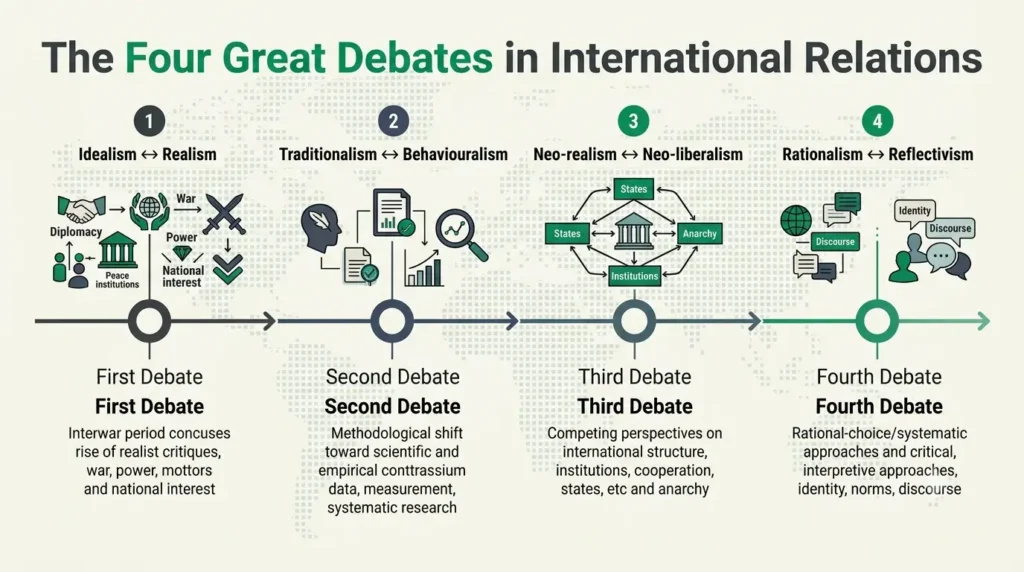
IR textbooks often tell the story of the discipline as a series of “great debates”. The labels are a teaching shortcut, and some historians of the discipline argue the neat story is partly a myth (see the box below), but the map is very useful for exams.
| Debate | Rough period | Who argued with whom | Main question |
|---|---|---|---|
| First: Idealism vs Realism | 1930s to 1940s | Liberal internationalists (Wilson’s legacy, League supporters) vs E. H. Carr, later Hans Morgenthau | Can law and institutions secure peace, or does power decide? |
| Second: Traditionalism vs Behaviouralism | 1950s to 1960s | Hedley Bull (historical, judgement-based) vs scientific-method scholars such as Morton Kaplan | Should IR use scientific, quantitative methods? |
| Third: Inter-paradigm debate | 1970s to 1980s | Realism vs Pluralism (Liberalism) vs Structuralism (Marxism) | Which paradigm best explains a world of interdependence and inequality? |
| Fourth: Rationalism vs Reflectivism | Late 1980s onward | Neorealists and neoliberals vs constructivists, feminists, critical and postcolonial theorists | Is IR about explaining with fixed interests, or understanding how identities and interests are made? |
Debate to know: Some scholars, for example Peter Wilson in a 1998 special issue of the Review of International Studies, have argued that the “first great debate” between idealists and realists was exaggerated after the fact, because few people called themselves “idealists” at the time. The DU syllabus’s Unit 1 (“Reading the Big Bangs”) raises a similar caution about the supposed founding dates of 1648 and 1919. A strong answer can mention that the debate narrative is useful but contested.
Is IR theory too Western?
A recurring DU theme is that most mainstream IR theory grew out of European and American experience. Amitav Acharya and Barry Buzan’s article “Why is there no non-Western International Relations Theory? Ten years on” (2017), listed in the syllabus, asks why theories rooted in Asian, African or Latin American traditions are rarely taught. This is also why the syllabus pairs Realism with Kautilya, and why Unit 4 looks at Global IR and the relational turn.
Comparing IR theories: strengths and weaknesses
Each theory has strengths and weaknesses, and a good comparison shows both:
- Focus: Realism focuses on power, Liberalism on institutions and cooperation, Constructivism on social norms and identity, Marxism on class and capital, Feminism on gender.
- Outlook: Realism is pessimistic about permanent peace and treats conflict as recurring; Liberalism is cautiously hopeful about cooperation; Constructivism says the outlook depends on what actors believe and do.
- Typical criticisms: Realism can underplay non-state actors and change; Liberalism can overrate institutions and underrate power; Constructivism can explain change after it happens better than it predicts it; Marxism can reduce everything to economics; Feminism is sometimes accused of generalising “women’s experience”.
Key Takeaways (Section 1): An IR theory is a lens, not a mirror. No theory explains everything, which is why DU asks you to compare them. Learn the “one-line core idea” of each theory first, then add thinkers, criticisms and examples.
2. Realpolitik (Kautilya), Realism and Neo-Realism
2.1 Realpolitik: what it means
Realpolitik is a German word meaning “realistic politics”. It describes a way of conducting politics and foreign policy that is guided by practical power calculations and national interest rather than by ideology or abstract moral principle.
The term was coined by the German writer and politician August Ludwig von Rochau in his book Grundsätze der Realpolitik (1853), written after the failed revolutions of 1848. It later became closely linked with Otto von Bismarck’s statecraft in unifying Germany. Historian John Bew points out that the modern meaning (cold, amoral power politics) drifts from Rochau’s original argument, which still carried some liberal goals; so it is safest to say that Realpolitik became associated with hard-headed, interest-first politics.
Main ideas of Realpolitik
- Power first. National power and security take priority when they conflict with other goals.
- Practicality. Decisions are judged by what works under real conditions, not by what is ideal.
- State importance. The state is the central actor, and its survival and strength come first.
- Balance of power. Power should be balanced so that no single state dominates the others.
Figures commonly associated with this style of thinking include Niccolò Machiavelli (who wrote long before the word existed), Bismarck, and, in the twentieth century, Henry Kissinger. Note that “ignoring ethics” is a common caricature. Realpolitik practitioners usually argue that ethics must be weighed against consequences, not that ethics do not exist.
2.2 Kautilya’s Arthashastra: an Indian tradition of statecraft
The Arthashastra is an ancient Sanskrit treatise on statecraft, economy, law, diplomacy and war, traditionally attributed to Kautilya (also called Chanakya or Vishnugupta), the minister of the Mauryan emperor Chandragupta.

Debate: when was it written, and by whom? The older tradition places the text in the Mauryan period (around the 4th to 3rd century BCE). Modern textual scholarship, especially the work of Patrick Olivelle and Mark McClish, argues that the surviving text is a layered compilation that most likely took its present form between roughly the 1st century BCE and the 3rd century CE, and that its author or authors cannot be fixed with certainty. Some scholars continue to defend a single Mauryan author. In an exam, write “traditionally attributed to Kautilya, c. 4th century BCE; the dating and authorship are debated” rather than stating the date as settled fact.
Key ideas relevant to IR theory
| Idea | Meaning | Why it matters for IR |
|---|---|---|
| Matsya Nyaya (“law of the fish”) | Without a ruler who wields danda (the rod of punishment), the strong swallow the weak, as big fish eat small ones | Usually introduced to justify the need for the state; IR readers extend it to anarchy among states, but this extension is an interpretation |
| Saptanga (seven limbs of the state) | Swami (ruler), amatya (ministers), janapada (territory and people), durga (fort), kosa (treasury), danda (force), mitra (ally) | An early model of comprehensive national power |
| Rajamandala (circle of states) | A map of states around the would-be conqueror (vijigishu): the neighbour is the natural enemy (ari), the neighbour’s neighbour a natural friend (mitra), with rear states, a madhyama (middle king) and an udasina (neutral, more powerful king) | Geography-based theory of alliances and rivalry. It is conventionally counted as twelve rulers (including the vijigishu) and, with the state elements attached to each, 72 elements |
| Shadgunya (six-fold policy) | Sandhi (peace or treaty), vigraha (hostility or war), asana (staying quiet), yana (marching), samshraya (seeking shelter or alliance with a stronger power), dvaidhibhava (dual policy: peace with one, hostility with another) | A menu of foreign-policy options chosen according to relative strength |
| Upayas | Four means: sama (conciliation), dana (gifts), bheda (division), danda (force) | Combines soft and hard instruments |
| Espionage | An organised intelligence system is treated as a normal tool of the state | Information as a source of advantage |
| Ethics and Dharma | The text separates the dharmavijayi (righteous conqueror), lobhavijayi (greedy conqueror) and asuravijayi (demonic conqueror) | Shows that the text is not only about power; it ranks the kind of victory a ruler should seek |
2.3 Is Kautilya a realist? A debate
This is a favourite DU question (“Can Kautilya be classified as a realist thinker? Explain with reference to his doctrine of Mandala”).
The case for “yes”. The Arthashastra treats the state’s survival and expansion as the ruler’s central duty, assumes that neighbouring states are natural rivals, advises alliances based on interest, and recommends spies, secret agents and division of enemies. These match the realist emphasis on power, self-help and balancing. Many textbook accounts therefore call Kautilya an early realist or an ancient Indian Machiavelli.
The case for “not only”. Deepshikha Shahi, in Kautilya and Non-Western IR Theory (Palgrave Pivot, 2019, a DU essential reading), rejects the purely classical-realist or neorealist reading. She argues that the Arthashastra is an eclectic text that mixes realist elements with idealist and constructivist ones, placing it, in her phrase, between “realpolitik” and “moralpolitik”. In a review in the Journal of Defence Studies, Michael Liebig agrees that the Arthashastra is a classic of IR theory but questions how far Shahi’s constructivist recasting can go, noting the text’s strong realist core.
How to write it. Say that Kautilya shows strong realist features (power, interest, balancing, the mandala), but that treating him only as “an Indian Machiavelli” is contested, because the text also discusses dharma, welfare and the quality of conquest, and because comparing an ancient text with modern theory risks presentism, which is reading today’s categories into the past. For a related Indian discussion of inter-state relations, see this note on Brihaspati: statecraft, justice and inter-state relations.
2.4 Realpolitik and the Arthashastra compared
| Aspect | Realpolitik (19th century and after) | Arthashastra (Kautilya) |
|---|---|---|
| Focus | National interest and power | Security and growth of the state, and the ruler’s success |
| Ethics | Subordinated to results, though argued about | Pragmatic, but framed within dharma and ranking of conquests |
| Diplomacy | Alliance management and balancing | Rajamandala and shadgunya |
| Military strategy | Central to preserving power | Central to the ruler’s duties, alongside intelligence and economy |
| Intellectual setting | Modern European state system | Ancient Indian monarchies and their neighbours |
The Arthashastra shows that sophisticated thinking about power and diplomacy was not confined to Europe, which is one reason DU places it inside the Realism topic.
2.5 Main ideas of Realism in International Relations
Realism is one of the oldest and most influential theories of IR. It focuses on power, self-interest, and the absence of a central authority above states.
Human nature (in classical realism)
- Self-interest. People, and the states they run, are driven by interests and the desire for power and security.
- Conflict. Competition and conflict are common, both inside states and between them.
- Classical thinkers. Thinkers such as Thucydides, Machiavelli, Hobbes and later Hans Morgenthau and Reinhold Niebuhr tie power politics to human nature.
Power and security
- Importance of power. Military and economic strength determine how far a state can protect its interests and influence others.
- Security dilemma. Steps one state takes to feel safer (such as arming) make others feel less safe, which can trigger an arms race. The term was introduced by John Herz (1950) and developed by Robert Jervis (1978).
- Balance of power. States try to prevent any single state from becoming dominant, through alliances or arming (“internal and external balancing”).
Anarchy in the international system
- No central authority. “Anarchy” here does not mean chaos; it means there is no world government above states to enforce rules.
- Sovereignty and self-help. States are the key actors and must rely on themselves for survival.
- Relative gains. Because security is at stake, realists say states worry about how much others gain from cooperation, not only about what they gain themselves.
2.6 Classical Realism
Classical realism grew in the twentieth century partly as a reaction to the failure of interwar liberal internationalism. If you are asked “Which approach to IR was introduced as a movement against liberalism (idealism)?” the expected answer is Realism, associated with E. H. Carr’s The Twenty Years’ Crisis (1939) and Hans Morgenthau’s Politics Among Nations (1948).
Key thinkers
- Thucydides: History of the Peloponnesian War, an early study of power, fear and interest.
- Niccolò Machiavelli: The Prince, advising rulers to judge actions by results and to be prepared to act against conventional morality when survival requires it.
- Thomas Hobbes: Leviathan, on the insecurity of a world without a sovereign, often applied to the international system.
- E. H. Carr: criticised “utopianism” and the idea of a natural harmony of interests.
- Hans Morgenthau: the leading classical realist of the twentieth century.
Morgenthau’s six principles of political realism (summary). (1) Politics is governed by objective laws rooted in human nature. (2) The main signpost is interest defined as power. (3) Interest and power are not fixed forever in meaning. (4) Universal moral principles cannot be applied directly to state action; they must be filtered through circumstances. (5) A nation’s moral aspirations should not be confused with universal moral laws. (6) The political sphere is autonomous and should be judged by its own standards.
2.7 Neo-Realism (Structural Realism)
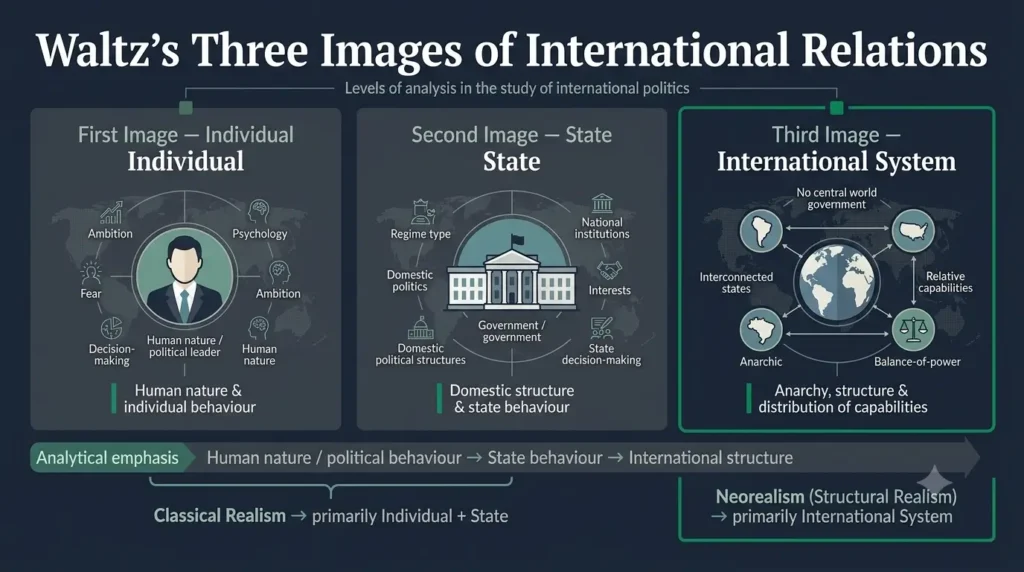
Kenneth Waltz, in Theory of International Politics (1979), argued that to explain state behaviour we should look at the structure of the international system rather than at human nature or at individual leaders. His earlier Man, the State, and War (1959) had already separated explanations into three “images”: the individual, the state, and the international system.
In Waltz’s theory, structure has three parts: the ordering principle (anarchy), the character of units (states are functionally alike, all needing to survive), and the distribution of capabilities (how many great powers there are). Because all states face the same pressures, they tend to behave similarly, usually by balancing. Waltz also argued that a bipolar system (such as the Cold War) was relatively stable.
Variations inside neorealism
- Defensive realism (Waltz and others): states mainly want security, and too much power provokes balancing, so moderation is rational.
- Offensive realism (John Mearsheimer, The Tragedy of Great Power Politics, 2001): because no state can be sure of others’ intentions, great powers seek as much power as possible, ideally regional hegemony, to be safe.
- Balance of threat (Stephen Walt): states balance against threats (power plus proximity, offensive capability and perceived intentions), not just against power.
- Neoclassical realism (for example Gideon Rose, 1998): adds domestic politics and leaders’ perceptions between structure and foreign policy.
2.8 Classical Realism vs Neo-Realism
| Aspect | Classical Realism | Neo-Realism (Structural Realism) |
|---|---|---|
| Main thinkers | Thucydides, Machiavelli, Hobbes, Carr, Morgenthau | Waltz; Mearsheimer (offensive); Walt (balance of threat); Jervis and Herz on the security dilemma |
| Main cause of conflict | Human nature and the lust for power | Anarchy and the distribution of power (system structure) |
| Level of analysis | Mainly the individual and the state | The international system (Waltz’s “third image”) |
| Role of power | Power is a central aim of politics (interest defined as power) | Power is mainly a means to security; security is the end (defensive realism) |
| Explanation of state behaviour | Differs with leaders, regimes and history | Similar across states because structure pushes them alike |
| Method | Historical, philosophical, moral-political judgement | Aims at a scientific, parsimonious theory |
| Ethics and morality | Discussed; prudence is a political virtue | Largely set aside; the theory is about structure |
Similarities. Both treat power as central, both are state-centric, both accept that anarchy shapes behaviour, and both reject “idealist” expectations that law and morality alone can secure peace.
2.9 Criticisms of Realism
- Underplays non-state actors and interdependence. Liberals argue that multinational corporations, institutions and transnational movements matter more than realists admit.
- Difficulty explaining change. Neorealism was criticised for not anticipating or explaining the end of the Cold War, because the structure it emphasised changed without a great-power war.
- Takes anarchy as fixed. Constructivists (Wendt) argue that anarchy’s meaning depends on states’ ideas and relations.
- Gender and class blindness. Feminists argue that realism’s “state of nature” and its idea of power reflect a masculine view; Marxists argue that it ignores capitalism and class.
- Vague on key concepts. Critics say “power” and “national interest” can be stretched to justify almost any policy afterwards.
2.10 Case studies illustrating Realist theory
1. The Peloponnesian War (431 to 404 BCE). Thucydides explains the war between Athens and Sparta by “the growth of Athenian power and the fear this caused in Sparta”. Realists read this as a model of power shifts producing fear and war. The Melian Dialogue (Athens’ ultimatum to the small island of Melos) is often used to illustrate how the strong dictate terms. Modern writers sometimes call a rising-power versus ruling-power rivalry the “Thucydides Trap”, a phrase popularised by Graham Allison. Treat it as an interpretation, not a law.
2. The Concert of Europe after the Congress of Vienna (1815). After the Napoleonic Wars, the great powers (Britain, Russia, Austria, Prussia, and later France) sought to prevent any state from dominating Europe. Realists see a balance-of-power system that kept Europe free of general war until 1914. Debate: historians such as Paul Schroeder argue the system worked less through a simple balance of power and more through shared understandings and restraint among the great powers, and the century also saw wars such as the Crimean War (1853 to 1856) and the wars of German unification, so “stable for almost 100 years” needs qualification.
3. The Cold War (1947 to 1991). A bipolar contest between the United States and the Soviet Union. Neorealists point to the arms race and nuclear deterrence as a classic security dilemma, NATO and the Warsaw Pact as external balancing, and the containment policy as balancing behaviour. Waltz argued bipolarity helped keep the Cold War from becoming a direct great-power war. Counterpoint: constructivists and liberals argue that the way the Cold War ended shows the limits of structural explanations (see Section 6).
4. China’s rise and the US response. Offensive realists such as Mearsheimer have argued that a powerful China will seek regional dominance and that rivalry with the United States is therefore likely. Realists point to the strengthening of US alliances and groupings such as the Quad (United States, India, Japan, Australia) and the AUKUS partnership (United States, United Kingdom, Australia, announced in 2021). Counterpoint: liberals such as G. John Ikenberry have argued that the existing open international order is flexible enough to accommodate China. Because this is an ongoing situation, check recent developments before using it in an answer.
5. Russia and Ukraine: Crimea (2014). Russia annexed Crimea in March 2014. Realists point to Russia’s strategic interests in the Black Sea (it already had a naval base at Sevastopol) and in preventing Ukraine from joining Western institutions. In Foreign Affairs (September/October 2014), Mearsheimer argued that NATO and EU expansion provoked Russia and that “the West” bears much of the responsibility. This was contested at once: Michael McFaul and Stephen Sestanovich replied in the same journal that Russian politics and choices were the key factors.
A correction worth making: the claim that there was “no strong international response” is not accurate. On 27 March 2014 the UN General Assembly adopted Resolution 68/262, affirming Ukraine’s territorial integrity and the invalidity of the Crimean referendum, by 100 votes in favour, 11 against and 58 abstentions (the resolution is non-binding). Russia had earlier vetoed a similar text in the Security Council. For the later full-scale invasion in 2022 and the current state of the conflict, use up-to-date sources.
Key Takeaways (Section 2): Realpolitik is a style; realism is a theory. Kautilya shows strong realist features, but “Indian Machiavelli” is a debated label. Classical realism explains conflict by human nature, neorealism by system structure. Always attach a name (Morgenthau, Waltz, Mearsheimer) to each claim.
3. Liberalism and Neo-Liberalism
Liberalism in IR is the tradition that believes cooperation, law, institutions, trade and democracy can reduce conflict and improve the lives of people across borders. Neo-Liberalism (neoliberal institutionalism) is the late-twentieth-century version that accepts much of realism’s picture of anarchy but argues that institutions still make cooperation possible. (Do not confuse it with “neoliberalism” as an economic policy of markets and deregulation; in IR the word usually means neoliberal institutionalism.)
3.1 Origins and development
- Intellectual roots. John Locke (rights, consent), Adam Smith (free trade and mutual benefit), Jeremy Bentham, and above all Immanuel Kant, whose essay Perpetual Peace (1795) is the best-known liberal statement on international relations.
- After World War I. Liberal internationalists, associated with US President Woodrow Wilson’s ideas (the Fourteen Points, 1918) and the League of Nations (1920), argued that collective security and open diplomacy could prevent war. The League’s failure to stop Japan in Manchuria (1931) and Italy in Abyssinia (1935) damaged this “idealist” project, and E. H. Carr later criticised it as utopian.
- After World War II. Liberalism shifted toward institutions and economic cooperation: the United Nations (1945), the Bretton Woods institutions (the IMF and World Bank), and the trade system that began with the GATT (1947).
- Neo-liberalism. In the 1970s and 1980s, scholars such as Robert Keohane and Joseph Nye responded to realism by showing that institutions and interdependence matter even without a world government.
Kant’s three “definitive articles” for perpetual peace (a point often misreported): (1) the civil constitution of each state should be republican; (2) the law of nations should be based on a federation of free states; and (3) cosmopolitan law should be limited to universal hospitality. Note that Kant’s word is “republican”, not simply “democratic”.
3.2 Strands of liberalism
Jackson and Sørensen’s textbook (a DU additional reading) groups liberal thought into four strands; this is a convenient way to organise your answer.
| Strand | Core claim | Key ideas |
|---|---|---|
| Republican liberalism | Domestic political systems shape foreign policy | Democratic peace theory |
| Commercial (interdependence) liberalism | Trade and economic ties raise the cost of war | Interdependence, globalisation |
| Institutional liberalism | Institutions help states cooperate | International regimes, organisations, law |
| Sociological liberalism | Transnational contacts among people build trust | Transnational society, communication |
3.3 Core principles
Cooperation and interdependence. Liberals argue that states pursue absolute welfare and security, not just relative power. Trade and investment create stakes in peace, and institutions help states share information, reduce uncertainty and solve shared problems such as pandemics and climate change.
Democratic peace theory. The observation that democracies rarely, if ever, fight wars against one another. Michael Doyle’s 1983 articles on Kant and liberal legacies and Bruce Russett’s later work (Russett’s chapter on Liberalism is a DU essential reading) are the standard sources. Explanations offered: shared norms of peaceful conflict resolution, institutional constraints and public accountability. Criticisms: democracies do fight non-democracies, democratising states can be war-prone, the number of democratic pairs is historically small, and realists argue that alliances, not regime type, explain the pattern.
Ideational liberalism. Andrew Moravcsik’s influential liberal theory (1997) argues that state preferences come from domestic society, and distinguishes ideational liberalism (national values and identities), commercial liberalism (economic interests) and republican liberalism (how domestic institutions represent groups). Searching students sometimes meet “ideational liberalism” in this sense.
3.4 Neo-Liberalism and its variations
Neoliberal institutionalism. In After Hegemony (1984), Robert Keohane argued that international regimes (sets of rules, norms and procedures) make cooperation possible even after the decline of a dominant power. Institutions reduce transaction costs, provide information, make commitments more credible and link issues together, so states keep cooperating because repeated interaction makes cheating costly. (The WTO did not exist in 1984; the main trade institution then was the GATT.)
Complex interdependence. Keohane and Nye, in Power and Interdependence (1977), described a situation that differs from the realist picture in three ways: (1) societies are connected by multiple channels, not only state-to-state contact; (2) there is no clear hierarchy of issues, so security does not always dominate trade, environment or technology; and (3) military force plays a minor role among interdependent states. Nye also coined soft power (the ability to shape others’ preferences through attraction), first in 1990.
Absolute gains vs relative gains. This is the core of the neorealism-neoliberalism debate (a favourite short-note topic).
- Neoliberals say states care about absolute gains: if both sides benefit, cooperation is worthwhile even if one benefits more.
- Neorealists such as Joseph Grieco (1988) say states in anarchy also worry about relative gains, because today’s gain of a rival may become tomorrow’s threat.
Neorealism vs Neoliberal Institutionalism
| Aspect | Neo-Realism | Neoliberal Institutionalism |
|---|---|---|
| Shared assumptions | Anarchy, states as the main actors, rational behaviour | The same |
| Main concern | Security and survival | Economic welfare and cooperation, with security included |
| Gains | Relative gains matter | Absolute gains matter |
| Institutions | Reflect power distribution; limited independent effect | Reduce transaction costs and uncertainty; enable cooperation |
| Cooperation | Possible but fragile | More durable under regimes |
| Key texts | Waltz (1979); Grieco (1988) | Keohane (1984); Keohane and Nye (1977) |
3.5 Key thinkers
- Immanuel Kant: perpetual peace through republican government, a federation of free states and cosmopolitan law.
- Woodrow Wilson: promoted collective security and the League of Nations after World War I.
- Michael Doyle and Bruce Russett: democratic peace.
- Robert Keohane: institutionalism and regimes.
- Joseph Nye: complex interdependence and soft power.
- Andrew Moravcsik: liberal theory of state preferences.
3.6 Case studies illustrating the liberal approach
a) The European Union. The path from the European Coal and Steel Community (1951) and the Treaty of Rome (1957) to the EU (established by the Maastricht Treaty, 1993) is read by liberals as a case where economic integration, institutions and shared democratic values built peace among former enemies. The EU received the Nobel Peace Prize in 2012. Counterpoint: realists attribute European peace largely to US security guarantees and the Soviet threat during the Cold War.
b) The post-1945 international order. The UN, IMF, World Bank and the GATT/WTO system are seen as liberal institutions that helped economic recovery and set norms against aggression. Counterpoint: Marxists argue that this order served the interests of the powerful, and realists point out that US power underpinned it.
c) The Paris Agreement on climate change (2015). States worked together through the UN framework (UNFCCC) to set a shared goal. Liberals see this as institutional cooperation on a global public problem; critics point to weak enforcement and the gap between pledges and actions.
d) The ASEAN Regional Forum (established 1994). A forum for security dialogue in the Asia-Pacific, which institutionalists see as a way to build habits of consultation and reduce mistrust without a dominant power. Realists are sceptical about how much it constrains great powers.
3.7 Criticisms of Liberalism
- Overrates institutions and underrates power. Carr criticised the assumption of a “harmony of interests”, and John Mearsheimer (1994/95) argued that institutions have little independent effect on state behaviour.
- Western and liberal bias. Critics argue the “liberal international order” reflects the interests and values of the West.
- The democracy-promotion problem. Spreading democracy by force has produced costly failures, which weakens the claim that democratic peace is a simple foreign-policy recipe.
- Neglects inequality. Marxists argue liberalism’s emphasis on free trade ignores unequal exchange between rich and poor countries.
- Pressure on the order today. Rising nationalism and great-power rivalry have led scholars to debate whether the liberal order is weakening or only changing.
Key Takeaways (Section 3): Liberalism does not say power is irrelevant; it says power is not the only thing and that institutions, trade and domestic politics change what states do. If a question mentions Keohane, think institutions; Nye, think soft power and interdependence; Kant/Doyle, think democratic peace.
4. Marxism and Neo-Marxism
Marxism explains politics through the economy. In IR, it shifts attention from states and security to capitalism, class and exploitation on a world scale. Neo-Marxism updates this for the international level, asking why some countries remain poor while others are rich.
A point many students miss: Marx and Engels wrote very little directly on international relations. Marxist IR was built later by writers such as Lenin, Rosa Luxemburg and Hobson (for imperialism), and then by dependency and world-systems theorists and by Gramsci’s followers.
4.1 Foundations of Marxist theory
Historical materialism. The way a society produces and distributes goods (its economic base) shapes its politics, law and culture (the superstructure). History moves through stages driven by conflicts in the mode of production; for example, feudalism gave way to capitalism.
Class struggle. In capitalism, the bourgeoisie (owners of capital) and the proletariat (workers who sell their labour) have opposed interests. Marx and Engels expected that tensions within capitalism would eventually lead to its overthrow and a classless society.
4.2 From Marx to Neo-Marxism
Theories of imperialism. J. A. Hobson (Imperialism: A Study, 1902) linked imperial expansion to underconsumption and surplus capital at home. Lenin (Imperialism, the Highest Stage of Capitalism, written in 1916 and published in 1917) argued that monopoly capitalism drives rich states to divide the world among themselves, which explains inter-imperialist war. Rosa Luxemburg offered another account of capital’s need for external markets.
Dependency theory (1950s to 1970s). Developed by Latin American and other scholars. The Economic Commission for Latin America (Raúl Prebisch) argued that exporters of raw materials face declining terms of trade. Andre Gunder Frank (Capitalism and Underdevelopment in Latin America, 1967) argued that rich “metropole” countries keep poor “satellite” countries underdeveloped through unequal exchange: “development of underdevelopment”. Others include Samir Amin and Walter Rodney (Africa). Internal debate: Fernando Henrique Cardoso and Enzo Faletto argued that dependency is not a single fixed pattern and that some dependent countries can still industrialise (“associated dependent development”).
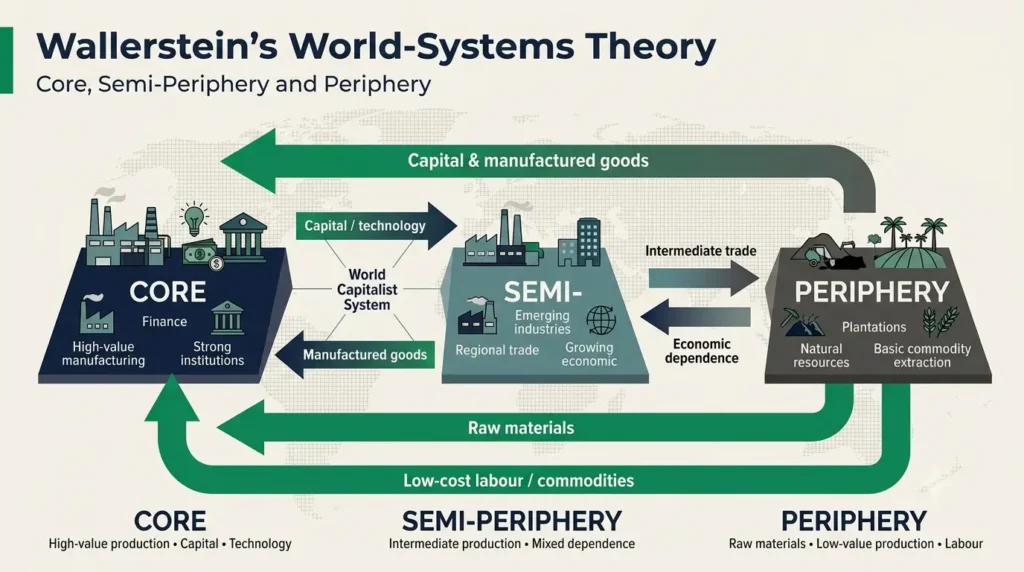
World-Systems Theory. Immanuel Wallerstein (The Modern World-System, first volume 1974) treats the world as a single capitalist world-economy divided into core (wealthy, industrialised, technologically advanced), periphery (supplying raw materials and cheap labour) and semi-periphery (in between; exploited by the core and exploiting the periphery). Countries can move between zones, but the structure persists.
Gramscian and critical approaches. Antonio Gramsci argued that the ruling class maintains power not only by force but by hegemony: winning consent by making its worldview seem common sense. Robert Cox (1981) extended this to world order and distinguished problem-solving theory (which accepts the existing order) from critical theory (which asks how the order arose and whom it serves). The Frankfurt School and later critical theorists (for example Andrew Linklater) developed the emancipatory side.
| Approach | Main thinker(s) | Core claim | Level |
|---|---|---|---|
| Classical imperialism theory | Hobson, Lenin, Luxemburg | Capitalism’s need for markets drives imperialism and war | Between capitalist powers |
| Dependency | Frank, Prebisch, Amin, Cardoso and Faletto | Unequal exchange keeps the periphery underdeveloped | Rich vs poor countries |
| World-systems | Wallerstein | One capitalist world-economy with core, semi-periphery, periphery | Global system |
| Gramscian / critical | Gramsci, Cox | Hegemony works through consent and institutions | Ideas and institutions of world order |
4.3 Key thinkers
- Karl Marx and Friedrich Engels: critique of capitalism, historical materialism, class struggle.
- V. I. Lenin and J. A. Hobson: theories of imperialism.
- Andre Gunder Frank: dependency.
- Immanuel Wallerstein: world-systems analysis.
- Antonio Gramsci: hegemony. Robert Cox: critical theory of world order.
The DU syllabus’s essential readings here are Mark Rupert on Marxism (in Dunne, Kurki and Smith) and Cynthia Weber’s “Neo-Marxism: Is Empire the New World Order?”.
4.4 Using Marxist theory in IR
- Critique of global capitalism. Imperialism, unequal trade, debt and the power of multinational corporations are structural features, not accidents.
- Global South. The persistence of poverty is explained by position in the world economy rather than only by domestic policy failures.
- Ideology. Gramscian hegemony explains why unequal arrangements are accepted as normal.
- Resistance. Anti-capitalist, labour and anti-colonial movements are seen as responses to structural exploitation.
4.5 Case studies from a Marxist perspective
a) Colonialism and imperialism. Marxists read European colonial expansion as driven by the search for raw materials, markets and cheap labour, in line with Lenin’s argument. Counterpoint: historians debate the weight of economic, strategic and ideological motives.
b) Latin America and dependency. Dependency theorists argued that Latin American economies were locked into exporting primary commodities and importing manufactures. Nuance: the picture is not uniform. Countries such as Brazil industrialised substantially in the twentieth century, which is why Cardoso and Faletto spoke of “dependent development” rather than permanent stagnation.
c) The IMF, World Bank and WTO. Critics argue that structural adjustment programmes and trade rules favoured rich countries and increased hardship in poor ones. Counterpoint: defenders argue such reforms were needed to restore stability and that the evidence on outcomes is mixed. Present both sides.
d) China and the global economy. China is governed by a communist party but is deeply integrated into global capitalism. Some Marxist-inspired writers see it as part of the capitalist world-economy and ask whether it is moving toward the core; others argue that the party-state’s control makes it a different model (“socialism with Chinese characteristics” in official terms). This is contested, so use cautious language rather than a firm label.
4.6 Criticisms of Marxism in IR
- Economic reductionism. Kenneth Waltz classed Hobson and Lenin as “reductionist” because they explain state behaviour through domestic economic structure.
- Predictions not borne out. Revolutions occurred mostly in agrarian societies, not in advanced capitalist ones; and several East Asian economies (Taiwan, South Korea) moved up the global hierarchy, which sits uneasily with strict dependency claims.
- Neglects states, security and identity. Realists, constructivists and feminists argue that war and gender cannot be reduced to class.
- Eurocentrism. Postcolonial scholars note that Marxism also shares European assumptions about historical stages.
Key Takeaways (Section 4): Marxist IR asks “who benefits?” at the global scale. Remember the sequence: Marx (class) → Lenin (imperialism) → dependency (Frank) → world-systems (Wallerstein) → hegemony (Gramsci/Cox). For related ideas on the same thinkers in a comparative-politics paper, see the DSC-5 topics of dependency and world-systems theory in the DU BA Political Science syllabus overview.
5. Feminism in International Relations
Feminist IR asks a simple but powerful question: where are the women? It argues that mainstream theories treat world politics as a world of states, soldiers and diplomats, and in doing so ignore how gender shapes who holds power, whose security counts, and what counts as knowledge.
5.1 Why feminism entered IR
Feminist approaches began to take shape in IR in the late 1980s, alongside the wider “fourth debate” that questioned the foundations of the discipline. Feminist scholars argue that:
- Traditional IR focuses on states, military power and economic power, and ignores social life and everyday experience.
- Gender (the roles, expectations and meanings a society attaches to masculinity and femininity, as distinct from biological sex) is built into the basic concepts of IR, such as “security”, “power” and “the state”.
- IR needs to examine how global systems sustain gender hierarchies and silence marginalised voices.
A landmark example is J. Ann Tickner’s article “Hans Morgenthau’s Principles of Political Realism: A Feminist Reformulation” (1988), which argued that Morgenthau’s idea of objectivity and power reflects a masculine standpoint and proposed an alternative understanding of power and security.
5.2 Key concepts
Gender and power. Power in IR is often linked to qualities coded as “masculine” (strength, rationality, aggression), while “feminine” qualities (care, emotion) are devalued. Feminists study how these associations shape policy and decision-making.
Patriarchy. A system in which men hold disproportionate power in politics, the economy and society. In IR it appears as male dominance in diplomacy and leadership, priority given to military security over human security, and neglect of women’s roles in peace and governance.
The personal is international. Cynthia Enloe’s work (for example Bananas, Beaches and Bases, 1989) shows that diplomacy and war depend on gendered labour, such as the work of military wives, nurses, domestic workers and women on factory floors, which mainstream IR does not notice.
Intersectionality. Gender intersects with race, class, caste and colonial history, so women’s experiences differ widely.
5.3 Types (strands) of feminist IR
Textbooks classify feminism in IR in several ways, and different authors use different labels. The commonly discussed strands are below. Your original notes list liberal, radical and postcolonial feminism, which are a good start; the extra strands make your answer more complete.
| Strand | Focus | Typical argument or example |
|---|---|---|
| Liberal feminism | Equality and inclusion within existing systems | More women in politics, diplomacy and UN peacekeeping |
| Radical feminism (a label used in some textbooks) | Critique of patriarchal structures | Gender-based violence, militarism, and power structures need change |
| Critical / standpoint feminism | Knowledge built from the position of women and marginalised groups | Rewrites concepts such as security and power from women’s experience (Tickner) |
| Constructivist feminism | How gender norms are socially constructed in world politics | Study of how institutions and norms are gendered |
| Poststructuralist feminism | Language, discourse and how gender identities are produced | Challenges fixed categories of “man” and “woman” (for example Christine Sylvester’s work) |
| Postcolonial feminism | How race, class and colonial history interact with gender | Criticises Western feminists for generalising; Chandra Mohanty’s work |
5.4 Key thinkers
- Cynthia Enloe: gendered everyday politics of militaries, diplomacy and the global economy.
- J. Ann Tickner: feminist reformulation of realism, security and power. Tickner and Laura Sjoberg’s chapter “Feminism” is a DU essential reading.
- Laura Sjoberg: gender and war, security.
- Chandra Talpade Mohanty: criticised Western feminism for portraying women in the Global South as a single, helpless category (Under Western Eyes; Feminism Without Borders, a DU additional reading).
- Christine Sylvester and V. Spike Peterson: postmodern and critical feminist IR, and gendered states.
- Sylvia Walby: a sociologist (not usually listed as an IR feminist) whose work on patriarchy and globalisation is sometimes cited in this topic. Include her only if your teacher does.
5.5 Case studies from a feminist perspective
a) Gendered impact of conflict. Women and children are often a large share of the displaced and are exposed to sexual and gender-based violence. Example: Rwanda. In 1994 sexual violence was widespread during the genocide. In Prosecutor v. Akayesu (trial judgment, 2 September 1998), the International Criminal Tribunal for Rwanda held that rape and sexual violence can constitute acts of genocide, the first such ruling by an international tribunal. Feminists note this as a shift in how international law treats wartime sexual violence.
b) Women in peace processes and the WPS agenda. UN Security Council Resolution 1325 (31 October 2000) called for women’s participation in peace and security decision-making and for protection of women in conflict, and launched the “Women, Peace and Security” agenda. UN Women reports that women remain a small minority of negotiators and signatories at peace tables, and cites research suggesting that women’s participation is associated with a higher chance that agreements last (UN Women quotes a 35 per cent increase in the probability of an agreement lasting fifteen years). Treat statistics like this as associations from research, not proof of simple cause and effect.
Example: Liberia. A movement of women led by Leymah Gbowee (the Women of Liberia Mass Action for Peace) pressed the warring parties to negotiate, and the civil war ended with a peace agreement in 2003. Gbowee shared the 2011 Nobel Peace Prize with Ellen Johnson Sirleaf and Tawakkol Karman.
c) Globalisation and women’s labour. Feminists argue that global production often relies on low-paid women workers in export zones and on unpaid care work. Enloe’s studies of the global garment and tourism industries are the usual reference.
d) Intersectionality in development. Postcolonial feminists criticise development projects that ignore local conditions and reinforce inequality. Example: microfinance is often presented as empowering women, but studies show mixed results: access to credit can help some women yet can also create debt pressure and does not by itself change wider gender inequalities. Present it as debated.
5.6 Criticisms of Feminist IR
- Essentialism. Critics say some feminist accounts assume that women are naturally more peaceful, which can reinforce stereotypes. Many feminists themselves reject this.
- Generalising “women’s experience”. Postcolonial feminists (Mohanty) say Western feminists have often spoken for women everywhere.
- Method and testability. Positivist scholars say feminist concepts are hard to test; feminists answer that the demand for “testing” itself reflects a narrow idea of knowledge.
- Marginal position in the discipline. Even supporters note that feminist work is still under-represented in mainstream IR journals and syllabi.
Key Takeaways (Section 5): Feminist IR is not only about adding women; it changes the concepts. Security becomes human security, power is not only domination, and the “private” sphere becomes part of the international. In exams, always name at least two thinkers (Enloe, Tickner) and one concrete case (Rwanda/Akayesu, WPS, Liberia).
6. Constructivism in International Relations
Constructivism argues that the international system is not simply a set of material facts such as armies and wealth; it is also made up of shared ideas, norms, identities and meanings, and these are created and changed by social interaction. It is often described as a middle ground between rationalist theories (realism, liberalism) and more radical critical theories.
6.1 The rise of constructivism
- Origins. Nicholas Onuf, in World of Our Making (1989), is usually credited with introducing the label “constructivism” into IR. Alexander Wendt’s article “Anarchy Is What States Make of It” (International Organization, 1992) and his book Social Theory of International Politics (1999) made it a major theory.
- Context. The end of the Cold War, which neither realists nor liberals had predicted, led scholars to look for explanations based on ideas and identity.
- Key assumption. The social world is constructed: structures such as sovereignty, security and alliance exist because actors agree on what they mean.
6.2 Core ideas
Social construction of reality. Concepts like sovereignty, security and power are not natural facts; they acquire meaning through shared understanding and change over time. For example, the idea of sovereignty developed historically and is still reinterpreted.
Norms and identities.
- Norms are shared expectations about appropriate behaviour (for example, norms against slavery, or against using chemical weapons). They can constrain, enable and shape what states want.
- Identities answer “who are we?” and shape interests: a state that sees itself as a peacemaker, a revolutionary power or a democratic community will define its interests differently.
Mutual constitution of agents and structure. States create the international structure through their actions, and the structure shapes states’ identities and interests in return.
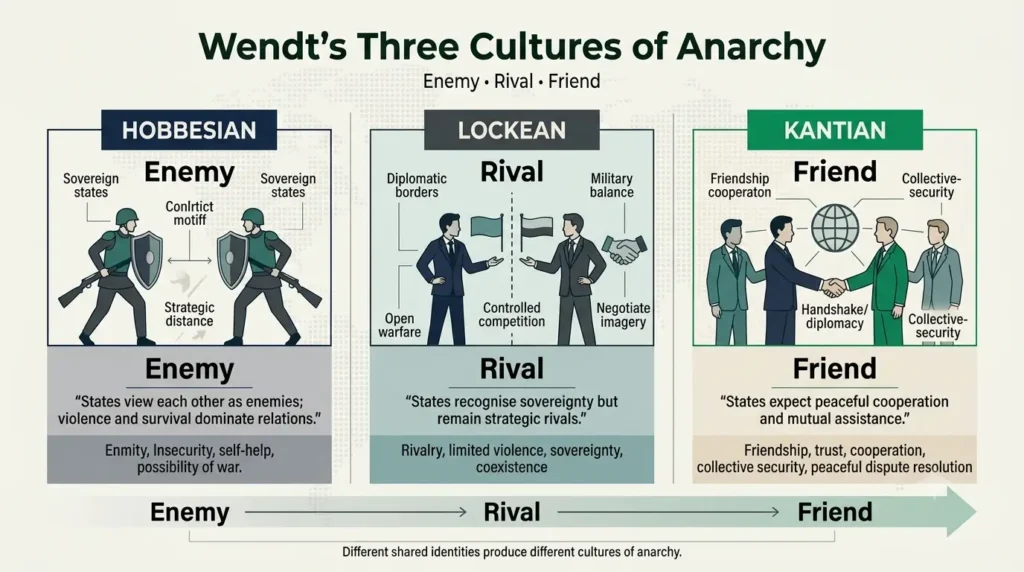
Wendt’s three cultures of anarchy. Wendt argues that anarchy can take different forms depending on how states see each other.
| Culture | States see each other as | Typical logic |
|---|---|---|
| Hobbesian | Enemies | Mutual fear, war is common |
| Lockean | Rivals | Competition within recognised rules; sovereignty respected |
| Kantian | Friends | Security communities; disputes settled peacefully |
The norm life cycle. Martha Finnemore and Kathryn Sikkink (1998) describe norms as passing through three stages: emergence (promoted by “norm entrepreneurs”), cascade (spread as more states adopt them) and internalisation (taken for granted).
6.3 The constructivist critique of other theories
| Theory | Constructivist critique |
|---|---|
| Realism / Neo-Realism | Treats anarchy as a fixed condition that forces self-help; Wendt says anarchy has no single logic, and self-help is an institution that states reproduce through practice |
| Liberalism / Neoliberal institutionalism | Treats state identities and interests as given and then asks how institutions help; constructivists ask where identities and interests come from, and say that trust and shared norms are social, not only material |
| Marxism | Concentrates on economic structure; constructivists emphasise how ideas and norms also shape outcomes (though Gramscian work already attends to ideas) |
An important point: constructivism does not deny that material factors matter. It says material resources acquire meaning through ideas (for example, five hundred British nuclear weapons are less threatening to the United States than five North Korean ones, because of how the states see each other, a famous Wendt example).
6.4 Key thinkers
- Alexander Wendt: anarchy as socially constructed; three cultures of anarchy.
- Nicholas Onuf: introduced the label; focus on rules and language.
- Martha Finnemore and Kathryn Sikkink: norms and the norm life cycle.
- Peter Katzenstein (editor, The Culture of National Security, 1996): national identity and security policy.
- Friedrich Kratochwil and John Ruggie: early constructivist work on rules, norms and institutions.
Constructivism is often divided into conventional (Wendt, who accepts a state-centric and broadly scientific approach) and critical constructivism (which focuses on language, discourse and power, and criticises Wendt’s state-centrism).
6.5 Case studies from a constructivist perspective
a) The end of the Cold War. Constructivists such as Koslowski and Kratochwil (1994) argue that changes in Soviet ideas and identity under Mikhail Gorbachev (“new thinking”) helped end the Cold War peacefully. Counter-argument: the realist William Wohlforth (1994/95) argued that Soviet material decline best explains the end of the Cold War, and that realism is not as badly damaged as critics claimed. Present both views.
b) The growth of human rights norms and R2P. The Responsibility to Protect (R2P), endorsed by world leaders at the UN World Summit in 2005, says that sovereignty carries responsibilities, and that the international community should act when a state fails to protect its population from mass atrocity. Constructivists see it as evidence that norms can reshape the meaning of sovereignty. Counterpoint: its application has been selective and contested (for example the debates over the 2011 intervention in Libya).
c) The nuclear taboo and the NPT. Nina Tannenwald argues that a normative taboo against nuclear use has developed. South Africa dismantled its nuclear weapons in 1989 to 1991 and joined the Non-Proliferation Treaty in 1991. Debate: constructivists point to shifting identity and norms, while rationalists point to changed security conditions and political calculation, so there is no single accepted explanation.
d) The European Union as a “security community”. A shared identity built around peace, democracy and rule of law helped transform relations among former enemies. This overlaps with the liberal reading, but constructivists focus on identity and norms rather than trade and institutions alone.
6.6 Criticisms of Constructivism
- Limited predictive power. It is better at explaining how things changed than at predicting what will change next.
- Material power returns. Realists argue that norms often follow power: powerful states decide which norms count.
- Methodological questions. Positivists ask how ideas and identities can be measured; critical constructivists criticise Wendt for being too state-centric and too close to mainstream science.
- Which norms win, and why? Critics ask who the “norm entrepreneurs” are and whether the story hides inequalities of voice.
- Too abstract. Some find it too philosophical to guide policy, though supporters point to its empirical studies of norms.
Key Takeaways (Section 6): Constructivism’s slogan is that anarchy is what states make of it. It does not deny power; it insists that power and interest have social meaning. For Wendt, remember the three cultures (enemy, rival, friend); for norms, remember Finnemore and Sikkink.
7. Comparing the Theories: Revision Tables
7.1 Big comparison table
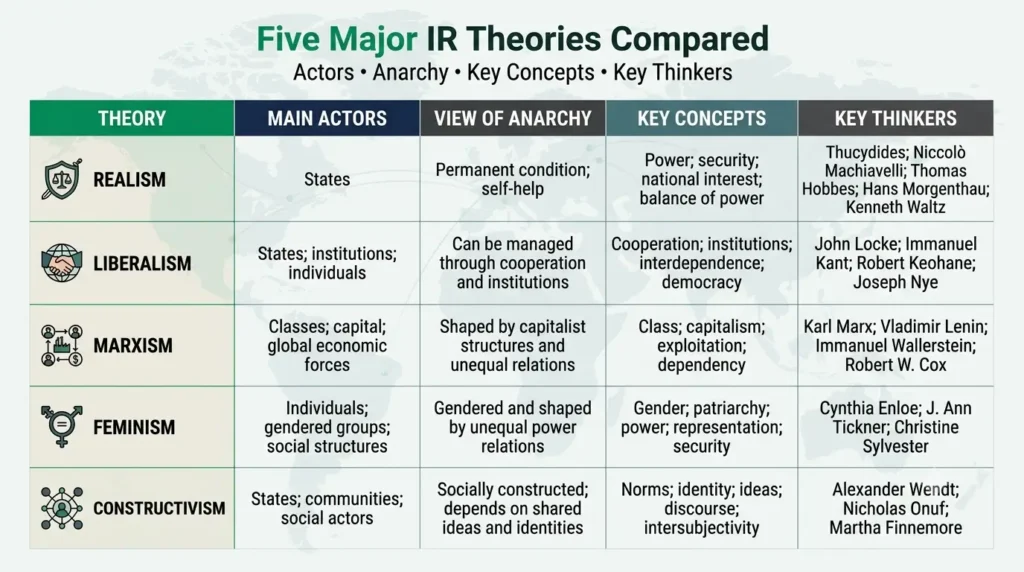
| Aspect | Realism / Neo-Realism | Liberalism / Neo-Liberalism | Marxism / Neo-Marxism | Feminism | Constructivism |
|---|---|---|---|---|---|
| Central question | Who has power, and how do states survive? | How can states cooperate and keep peace? | Who benefits from the global economic order? | Where are women, and how does gender shape world politics? | How do ideas and identities create the international system? |
| Main actors | States | States, institutions, firms, individuals | Classes, core and peripheral states, capital | Individuals, communities, states, institutions seen through gender | States, norm entrepreneurs, institutions, transnational networks |
| View of anarchy | Fixed condition that forces self-help | Real, but moderated by institutions and interdependence | Less important than capitalist structure | Gendered; reflects masculine assumptions | “What states make of it” (Wendt) |
| View of cooperation | Possible but fragile; relative gains matter | More likely; absolute gains matter | Reflects the interest of dominant classes or states | Needs inclusion of women and an expanded idea of security | Possible when identities and norms change |
| Key concepts | Power, balance of power, security dilemma | Interdependence, regimes, democratic peace, soft power | Class, imperialism, dependency, core-periphery, hegemony | Gender, patriarchy, intersectionality, human security | Norms, identity, social construction, culture of anarchy |
| Key thinkers | Morgenthau, Waltz, Mearsheimer, Kautilya (debated) | Kant, Keohane, Nye, Doyle | Marx, Lenin, Frank, Wallerstein, Gramsci | Enloe, Tickner, Sjoberg, Mohanty | Wendt, Onuf, Finnemore and Sikkink, Katzenstein |
| Typical criticism | Ignores non-state actors and change | Overrates institutions, neglects power | Economic reductionism | Essentialism; marginal in the discipline | Weak prediction; material power returns |
| Best at explaining | Great-power rivalry, arms races, alliances | Trade, institutions, integration, climate cooperation | Global inequality, imperialism, debt | War’s gendered effects, WPS, security redefinition | Norm change, identity politics, end of the Cold War |
7.2 Which theory should I use? A quick guide for answers
- Question on war, alliances, arms races, great-power rivalry: start with realism, then add a liberal or constructivist counter.
- Question on institutions, trade, integration, climate, democracy: start with liberalism or neoliberal institutionalism.
- Question on poverty, development, imperialism, global capitalism: Marxism, dependency and world-systems.
- Question on security, peace processes, violence, whose voice counts: feminism, then link to human security.
- Question on identity, norms, human rights, change over time: constructivism.
- Question that says “critically evaluate” or “compare”: use at least two theories and name a debate or case.
8. One Event, Many Lenses: Russia and Ukraine
A good way to revise is to read one event through all five theories. The table below shows how each theory might frame Russia’s annexation of Crimea in 2014 and the conflict that followed. These are summaries of how the theories would argue, and different scholars within each theory disagree. For the latest facts of the conflict, consult current sources before writing an exam answer.
| Theory | Likely reading |
|---|---|
| Realism (offensive/structural) | A great power reacting to NATO and EU expansion toward its borders and protecting its strategic space (Mearsheimer, 2014); the security dilemma and spheres of influence |
| Liberalism | A violation of international law and the rules-based order by a non-democratic state; sanctions and UN resolutions (such as UNGA 68/262) as institutional responses; critics of Mearsheimer (McFaul) stress Russian domestic politics |
| Marxism / Neo-Marxism | Competition over resources, energy routes and markets within a capitalist world-economy; the role of economic interests of ruling elites and Western capital |
| Feminism | The gendered effects of war: displacement, sexual violence, militarised masculinity, and the exclusion of women from decision-making |
| Constructivism | Competing identities and historical narratives about who Ukrainians and Russians are; norms against changing borders by force |
9. Key Terms for Quick Revision
| Term | Meaning (short) | Linked to |
|---|---|---|
| Anarchy | Absence of a central authority above states | Realism; Wendt |
| Security dilemma | One state’s steps to be safe make others feel unsafe | Herz; Jervis |
| Balance of power | Distribution of power so no state dominates | Realism; Concert of Europe |
| Relative gains / absolute gains | Care about how much others gain / care about one’s own gain | Grieco; neoliberal institutionalism |
| Regime | Rules, norms and procedures in an issue area | Keohane |
| Complex interdependence | Multiple channels, no hierarchy of issues, minor role of force | Keohane and Nye |
| Soft power | Influence through attraction and shared values | Nye |
| Democratic peace | Democracies rarely fight each other | Kant; Doyle; Russett |
| Core, semi-periphery, periphery | Zones of the capitalist world-economy | Wallerstein |
| Hegemony (Gramscian) | Rule by consent plus coercion | Gramsci; Cox |
| Patriarchy | System of male dominance | Feminism |
| Intersectionality | Overlapping systems of gender, race, class | Feminism; postcolonial theory |
| Norm | Shared expectation of appropriate behaviour | Constructivism |
| Rajamandala | Kautilya’s circle of states around the conqueror | Arthashastra |
| Shadgunya | Kautilya’s six-fold foreign policy | Arthashastra |
10. Timeline of IR Theory (Quick Reference)
| Year / period | Development |
|---|---|
| c. 5th century BCE | Thucydides writes on the Peloponnesian War |
| 1513 (written) | Machiavelli’s The Prince |
| 1651 | Hobbes’s Leviathan |
| 1795 | Kant’s Perpetual Peace |
| 1853 | Rochau coins “Realpolitik” |
| 1902, 1917 | Hobson’s Imperialism; Lenin’s Imperialism |
| 1919 to 1939 | Liberal internationalism and the League of Nations; interwar crisis |
| 1939 | E. H. Carr’s The Twenty Years’ Crisis |
| 1948 | Morgenthau’s Politics Among Nations |
| 1967, 1974 | Frank on dependency; Wallerstein’s world-systems theory |
| 1977, 1979 | Keohane and Nye’s Power and Interdependence; Waltz’s Theory of International Politics |
| 1981 | Robert Cox on critical theory |
| 1984 | Keohane’s After Hegemony |
| 1988, 1989 | Tickner’s feminist reformulation of realism; Enloe’s Bananas, Beaches and Bases; Onuf’s World of Our Making |
| 1992 | Wendt’s “Anarchy Is What States Make of It” |
| 1998 | Walt’s “One World, Many Theories”; Finnemore and Sikkink on norm dynamics |
| 2001 | Mearsheimer’s The Tragedy of Great Power Politics |
Conclusion
IR theories do not compete to be “the one true story”. Each is a lens that brings some features of world politics into focus and leaves others in the background. Realism helps explain power rivalry and security fears; liberalism explains cooperation, institutions and the conditions for peace; Marxism exposes structural inequality; feminism shows how gender shapes security, power and knowledge; constructivism explains why ideas, norms and identities can change what states want. The syllabus also pairs realism with Kautilya, a reminder that thinking about power and diplomacy did not begin in Europe, even if the label “realist” for Kautilya is debated.
For DU exams, the strongest answers do three things: define the theory in a sentence, give its key thinkers and ideas with correct names and dates, and compare or criticise it with at least one other theory and one real example. Use the tables in this post for revision and the previous-year questions below for practice.
Continue Reading
If you are studying DSC-6, these notes connect naturally with this unit:
- Understanding Global IR and the Relational Turn (DSC-6 Unit 4): where IR theory goes next, including non-Western perspectives.
- All DSC-6 notes: Introduction to International Relations (Units 1, 3 and 4): includes Unit 1 (What is IR) and Unit 3 (Power, Sovereignty, Empire, International Order).
- Brihaspati: Statecraft, Justice, Inter-state Relations: another ancient Indian view on balance of power and inter-state relations, useful next to Kautilya.
- Making Sense of the World: Understanding International Relations (GE-4 Unit 1): a simpler introduction if you are new to IR.
- BA Political Science Notes (all semesters): the full notes hub for DU BA Political Science.
University of Delhi Previous Year Questions (PYQs)
University of Delhi Previous Year Questions | दिल्ली विश्वविद्यालय पिछले वर्ष के प्रश्न
The current NEP paper code is 2322101203 – B.A. (Programme) Political Science, DSC-6, Semester II. The paper pattern is 3 Hours, 90 Marks, Attempt Any Five. The old CBCS paper code is 232551, with 3 Hours, 75 Marks, Attempt Any Four. Questions below are arranged theory-wise for focused revision.
Section A – Realism, Kautilya & Neo-Realism
1. What do you understand by classical realism? Critically examine the six principles of realist theory of Hans J. Morgenthau. +
Year / Paper: 2022–23, Paper 1361F (2322101203)
Suggested Answer Focus: Define classical realism and critically discuss Morgenthau’s six principles of political realism, including the centrality of power and interest in international politics.
Direct PYQ Most Repeated
2. What are the basic principles of Morgenthau’s classical realist theory? Explain. +
Year / Paper: 2013, Paper 5306 (232551)
Suggested Answer Focus: Explain Morgenthau’s six principles of classical realism and show how power, national interest and political realism shape his understanding of international relations.
Direct PYQ Most Repeated
3. Examine ‘Classical Realism’ as an approach to the study of International Relations propounded by Hans J. Morgenthau. +
Year / Paper: 2013, Paper 5251 (232551)
Suggested Answer Focus: Examine classical realism as a systematic approach to IR, focusing on human nature, power, national interest and the political character of international relations.
Direct PYQ
4. Can Kautilya be classified as a realist thinker? Explain with reference to his doctrine of Mandala. +
Year / Paper: 2024 DSC-6 Paper – Semester II
Suggested Answer Focus: Examine Kautilya’s realist dimensions through the Mandala theory, inter-state relations, power, security, strategic calculation and the interests of the state.
Direct PYQ
5. What are the major differences between idealism and realism? +
Year / Paper: 2024 DSC-6 Paper – Semester II
Suggested Answer Focus: Compare idealism and realism in terms of human nature, international politics, state interests, power, cooperation, conflict and the possibility of peace.
Direct PYQ
Section B – Liberalism & Neo-Liberalism
6. Critically analyse the neoliberal theory of International Relations with special reference to the idea of ‘Complex Interdependence’. +
Year / Paper: 2013, Paper 5306 (232551)
Suggested Answer Focus: Explain neoliberalism and critically analyse complex interdependence, including the importance of multiple channels, the reduced hierarchy of issues and the changing role of military power.
Direct PYQ Most Repeated
7. Explain the major tenets of complex interdependence in neoliberal approach to the study of International Relations. +
Year / Paper: 2022–23, Paper 1361F
Suggested Answer Focus: Discuss the core characteristics of complex interdependence and explain how they challenge the assumptions of traditional realist approaches.
Direct PYQ Most Repeated
8. How does New-Liberalism explain IR differently from classical liberal theories? +
Year / Paper: SOL SLM, Unit II
Suggested Answer Focus: Compare classical liberalism and neoliberalism, focusing on institutions, cooperation, interdependence, rational actors and the changing conditions of international politics.
Practice Question Bank
Section C – Marxism, Neo-Marxism & World Systems Approach
9. Analyse the Marxist approaches to International Relations. +
Year / Paper: 2022–23, Paper 1361F
Suggested Answer Focus: Explain the Marxist understanding of international relations through capitalism, class relations, economic structures and unequal relations in the international system.
Direct PYQ
10. Analyse the World Systems Approach to the study of International Relations as propounded by Immanuel Wallerstein. +
Year / Paper: 2013, Paper 5251 (232551)
Suggested Answer Focus: Explain Wallerstein’s World Systems Approach and analyse the structure of the international capitalist system, including the relationship between core, semi-periphery and periphery.
Direct PYQ
11. Write short notes on Wallerstein’s World System Approach. +
Year / Paper: 2013, Paper 5306 (232551)
Suggested Answer Focus: Define the World System Approach and explain Wallerstein’s core, semi-periphery and periphery framework and its relationship to global capitalism.
Direct PYQ
Section D – Feminist Theory of International Relations
12. Feminist Theory of International Relations provides an alternative perspective to understand the male dominated International order. Comment. +
Year / Paper: 2013, Paper 5306 (232551)
Suggested Answer Focus: Explain how feminist approaches challenge male-centred assumptions in IR and bring gender, women’s experiences and unequal power relations into the analysis of international politics.
Direct PYQ
13. How has the feminist perspective on IR redefined the notion of security? +
Year / Paper: 2022–23, Paper 1361F
Suggested Answer Focus: Explain how feminist IR broadens security beyond state and military security to include gendered violence, everyday insecurity, structural inequalities and the lived experiences of individuals and communities.
Direct PYQ Most Repeated
14. Write an essay on feminist perspective on IR. +
Year / Paper: 2024 DSC-6 Paper – Semester II
Suggested Answer Focus: Present the major arguments of feminist IR, its critique of traditional theories, the significance of gender and its contribution to understanding power, security and international order.
Direct PYQ
Section E – Constructivism & Alexander Wendt
15. Write an essay on the constructivist understanding of International Relations. +
Year / Paper: 2022–23, Paper 1361F
Suggested Answer Focus: Explain the constructivist emphasis on ideas, identities, norms and social construction in international relations, and contrast it with materialist approaches where appropriate.
Direct PYQ
16. ‘Anarchy is what states make of it’. Discuss with reference to Alexander Wendt’s understanding of IR. +
Year / Paper: 2024 DSC-6 Paper – Semester II
Suggested Answer Focus: Explain Wendt’s constructivist understanding of anarchy, focusing on the role of state identities, shared ideas, norms and interaction in shaping the meaning of anarchy.
Direct PYQ Most Repeated
Section F – Highest-Priority Questions for This Year
17. Critically examine Morgenthau’s six principles of classical realist theory. +
Suggested Answer Focus: Prepare Morgenthau’s six principles thoroughly, along with classical realism, national interest and power.
Most Important Repeated Exam Focus
18. Explain Complex Interdependence as developed by Robert Keohane and Joseph Nye and examine its significance for neoliberal IR theory. +
Suggested Answer Focus: Prepare the major features of complex interdependence and its challenge to traditional realist assumptions about power, military force and international relations.
Most Important Repeated Exam Focus
19. How does feminist theory redefine security and challenge gender-blind approaches to International Relations? +
Suggested Answer Focus: Prepare feminist critiques of traditional IR and the expansion of security to include gendered violence, structural inequality and everyday experiences of insecurity.
Most Important Repeated Exam Focus
20. ‘Anarchy is what states make of it’. Discuss with reference to Wendt’s constructivist understanding of International Relations. +
Suggested Answer Focus: Prepare Wendt’s constructivist argument, especially the relationship between anarchy, identity, shared meanings, norms and state interaction.
Most Important Repeated Exam Focus
21. Explain the examination pattern for DSC-6 Unit II: Theories of International Relations under the NEP and old CBCS schemes. +
Current NEP Paper Code: 2322101203 – B.A. (Programme) Political Science, DSC-6, Semester II
Current Pattern: 3 Hours, 90 Marks, Attempt Any Five
Old CBCS Paper Code: 232551
Old Pattern: 3 Hours, 75 Marks, Attempt Any Four
Suggested Answer Focus: Prepare each major theoretical approach separately, but give highest revision priority to Morgenthau’s classical realism, Keohane and Nye’s complex interdependence, feminist approaches to security, and Wendt’s constructivism.
Exam Pattern Answer Focus
Frequently Asked Questions (FAQs)
Which approach to international relations was introduced as a movement against liberalism?
Realism. It gained strength in the late 1930s and 1940s as a reaction to interwar liberal internationalism (often called idealism), whose hopes had been shaken by the failure of the League of Nations. E. H. Carr’s The Twenty Years’ Crisis (1939) and Hans Morgenthau’s Politics Among Nations (1948) are the usual references.
What is the difference between an IR theory and an IR approach?
A theory makes claims about cause and effect (for example, balancing under anarchy). An approach is a broader way of studying the subject, such as the traditional historical approach or the scientific approach. A paradigm, such as realism, is a family of theories sharing basic assumptions. See Section 1.
Which are the two mainstream theories of IR?
Realism and Liberalism are traditionally called the two mainstream theories. Many textbooks now add Constructivism as a third mainstream theory, with Marxism, Feminism and postcolonial theories treated as critical approaches.
Was Kautilya a realist?
He is often called an early realist because of the rajamandala, the shadgunya and the emphasis on the ruler’s power and security. But the label is debated: Deepshikha Shahi argues the Arthashastra is better seen as eclectic, between realpolitik and moralpolitik. Also, the text’s date and authorship are uncertain. Write “strong realist features, but not only realist”.
What is the difference between relative gains and absolute gains?
Absolute gains mean what a state gets from cooperation in itself; relative gains mean how much it gets compared with others. Neoliberals stress absolute gains and so see more room for cooperation; neorealists such as Grieco stress relative gains and so expect cooperation to be harder.
What is the difference between neorealism and neoliberalism?
Both accept anarchy and the importance of states. They differ on gains (relative vs absolute), on the role of institutions (limited vs enabling), and on how likely cooperation is. See the table in Section 3.4.
Marx wrote hardly anything on IR. Why is Marxism in the syllabus?
Because later thinkers built an IR theory on his ideas: Lenin and Hobson on imperialism, dependency theorists on unequal exchange, Wallerstein on the world-system, and Gramsci and Cox on hegemony. These explain global inequality in a way mainstream theories do not.
Is feminist IR only about women?
No. It studies gender, meaning the roles and meanings attached to masculinity and femininity, and how these shape power, security, the state and knowledge. It also examines men and masculinities, and it uses intersectionality to look at race, class and colonial history.
Does constructivism say material power does not matter?
No. Constructivists say that material resources get their meaning from ideas and identities. The same weapons can be threatening or harmless depending on whether the states see each other as enemies or friends (Wendt’s well-known example).
How can I use a current event in my exam answer?
Pick one event, name two or three theories, and give each theory’s reading in one or two sentences with a thinker’s name. Section 8 shows this using Crimea 2014. Avoid certain claims about ongoing events; check recent sources and use cautious wording.
What should I read apart from these notes?
The DU syllabus lists essential readings: Walt (1998); Shahi (2019) on Kautilya; Dunne, Kurki and Smith (eds.), International Relations Theories: Discipline and Diversity; and Jackson and Sørensen’s textbook. For free, accessible reading, the open-access textbook chapter on the major IR theories at E-International Relations is a good start.
Subscribe to keep reading
You've used your free notes for now. Get Delhi Pathshala Premium for unlimited access.
Subscribe — ₹29/30 days