
Contents
- What is International Relations (IR)
- Definition of International Relations (IR)
- Key Concepts in International Relations
- Scope and Subject Matter of IR
- Scope of International Relations
- Subject Matter of International Relations
- Expanding Horizons
- Theoretical Approaches of International Relations
- Summary Table of IR Theories
- Reading the Big Bangs: The Contested Origins of IR
- The Two “Big Bang” Myths
- Why This Matters for Indian and Global-South Students
- Major Historical Events and Their Impact on IR (Post-1919 Development)
- Key Figures in the Discipline’s Development
- Evolution of IR Thinking — A Brief Timeline
- Bringing in De-colonial Accounts
- Introduction to Decolonial Theory
- Critique of Eurocentrism in IR
- Incorporating Non-Western Perspectives
- Case Studies of Decolonial IR
- Understanding the Genealogy of IR in India
- Early Indian Thinkers and Their Contributions
- Summary of Early Indian Contributions to IR
- Development of IR Studies in India
- Summary of the Development of IR Studies in India
- Key Indian IR Theorists and Their Works
- Summary of Key Indian IR Thinkers
- Contemporary Issues in Indian IR
- Summary of Current Issues in Indian IR
- Conclusion
- Continue Reading
- University of Delhi Previous Year Questions
- FAQs
Course: BA (Hons.) Political Science, Semester 2 — DSC-6: Introduction to International Relations: Theories, Concepts and Debates. Unit 1: What is IR and, its Contested Origins.
In this post, notes of “Unit 1: What is IR and, its Contested Origins” from “DSC-6: Introduction to International Relations: Theories, Concepts and Debates” are given, covering all four parts of the unit as per the DU syllabus — (a) What is IR, (b) Reading the Big Bangs, (c) Bringing in De-colonial Accounts, and (d) Understanding the genealogy of the IR discipline in India — along with the theories, key thinkers and current issues students need for exams.
What is International Relations (IR)
Definition of International Relations (IR)
International Relations (IR) is the study of how countries, groups, and other global players interact with each other. It looks at many areas like politics, economics, society, and culture, and tries to understand how countries and other groups work together, compete, and affect one another.
There is no single, universally accepted definition of IR — this is itself part of what students need to know for exams. A few widely cited definitions:
- Hans Morgenthau: international relations as “a struggle for power among nations.”
- Quincy Wright: “relations between groups of major importance in the life of the world at any period of history” — deliberately broader than “relations between states.”
- Charles Schleicher: simply “the relations among states.”
The gap between Morgenthau’s power-centred definition and Wright’s broader one is not accidental — it reflects the realist–liberal divide that runs through the whole discipline (see the theories section below). For exam purposes, note that IR is studied both as a condition — the actual, everyday conduct of states and other actors through diplomacy, trade, conflict and cooperation — and as a field of study, i.e., the academic discipline that analyses that conduct.
Important parts of IR include studying diplomacy, conflict, peace, international law, trade, globalisation, human rights, and the balance of power. Scholars of IR also study different theories that explain global events — such as realism, liberalism, and constructivism — which help explain why countries behave the way they do and how stability and change happen in the world.
Key Concepts in International Relations
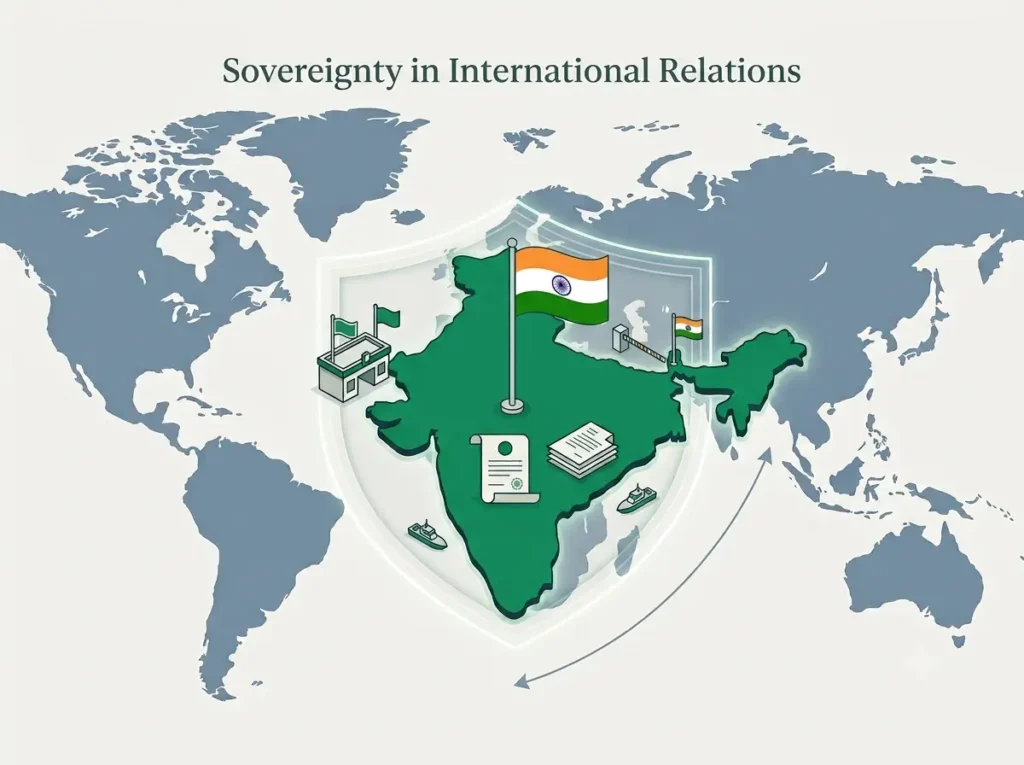
Key ideas in International Relations (IR) are essential for understanding how countries interact and share power. Here are the main ideas:
Sovereignty in international relations: This means that countries have control over their own territory and are not subject to outside interference. It is a foundational part of the international system, resting on a state’s right to govern itself without external control.
Power in international relations: This is a state’s ability to influence others. Power can be “hard” — military and economic strength — or “soft,” such as cultural influence and diplomacy (a distinction developed by Joseph Nye). Power shapes how states relate to one another.
Anarchy in international relations: In IR, anarchy does not mean chaos — it means there is no central world government above sovereign states. This absence of an overarching authority is what leads realists to argue that states must rely on self-help, producing both competition and cooperation.
National interest in international relations: This refers to what a country wants to achieve — security, economic growth, protecting its territory, or promoting its values. National interest shapes how states act internationally.
Security dilemma in international relations: This occurs when one state’s efforts to become more secure (for example, by building up its military) make other states feel less secure, prompting them to respond in kind. This dynamic can create tension or arms races even when neither side wants conflict.
Balance of power in international relations: This is a mechanism by which states try to prevent any single state from becoming dominant — typically through alliances or military build-up — to keep the international system stable.
Globalisation in international relations: The growing interconnection of economies, societies and cultures, driven by technology and trade. Globalisation changes how goods, ideas and people move across borders and is one reason IR now studies far more than just state-to-state diplomacy.
Interdependence: When states rely on each other, especially for trade and resources. Robert Keohane and Joseph Nye’s idea of “complex interdependence” argues that this can reduce (though not eliminate) the likelihood of conflict.
Diplomacy: The process of dialogue and negotiation between states to manage relationships and resolve disputes — a core tool of foreign policy.
International law and international relations: The body of rules — treaties, conventions and customary practice — that governs how states and other international actors interact, aiming for a degree of predictable, peaceful conduct.
Human rights in international relations: Rights that belong to all people regardless of nationality, race or religion, often protected through international agreements such as the Universal Declaration of Human Rights. Human rights are now a recurring element of foreign policy debates.
Non-state actors in international relations: Actors other than states that influence world politics — international organisations (UN, WTO), NGOs, multinational corporations, and, more controversially, armed non-state groups.
Realism and liberalism: The two oldest and still most influential traditions in IR. Realism emphasises conflict, power and the pursuit of security in an anarchic system; liberalism emphasises the possibility of cooperation through institutions, trade and shared norms.
Constructivism in international relations: This approach argues that ideas, norms and identities — not just material power — shape how states behave, and that many features of the international system (like “sovereignty” itself) are socially constructed rather than fixed.
International institutions: Organisations such as the United Nations, WTO and World Bank that help states cooperate, set standards, and manage shared problems such as security, trade and public health.
These concepts are interconnected, and understanding them helps explain why states and other actors behave the way they do in world politics.
Scope and Subject Matter of IR
International Relations (IR) covers a wide and continuously expanding range of topics. Here is a structured breakdown, drawing on the “5 A’s” framework (Aim, Actors, Agenda, Arena, Actions) often used to summarise the field’s scope:
Scope of International Relations
Actors in international relations: IR used to focus mainly on states, but today it also studies non-state actors — international organisations (like the United Nations), multinational corporations, and advocacy/civil-society groups.
International relations levels of analysis: IR studies world politics at different levels — the individual (leaders, decision-makers), the state, and the international system as a whole. Each level offers a different lens on the same event; for instance, the outbreak of a war can be explained by a leader’s personality, a state’s domestic politics, or the structure of the international system, and IR scholars debate which level explains the most.
Interdisciplinary character: IR draws on history, political science, economics, sociology, law and psychology to understand global events and trends. This is one reason “is IR a distinct discipline or a sub-field of political science” remains an open, debated question in the literature (the “autonomy debate”).
Globalisation: IR examines how globalisation affects politics, economies and societies — including how states have become more interdependent in trade, technology, migration and the environment.
Theory and practice: IR includes both theory (realism, liberalism, constructivism, and others) and real-world practice (diplomacy, treaty-making, conflict resolution) that shape policy decisions.
Subject Matter of International Relations
International security: War, peace and conflict resolution — from traditional interstate war to newer threats like cyberattacks and terrorism.
International political economy: The relationship between politics and economics globally — trade policy, financial systems, and how economic power translates into political influence.
Foreign policy and diplomacy: How states formulate and carry out foreign policy, balancing national interest with domestic politics; diplomacy is the primary tool for managing relations peacefully.
International law and organisations: The rules governing states — treaties, customary law — and the role of bodies like the UN and WTO in facilitating cooperation.
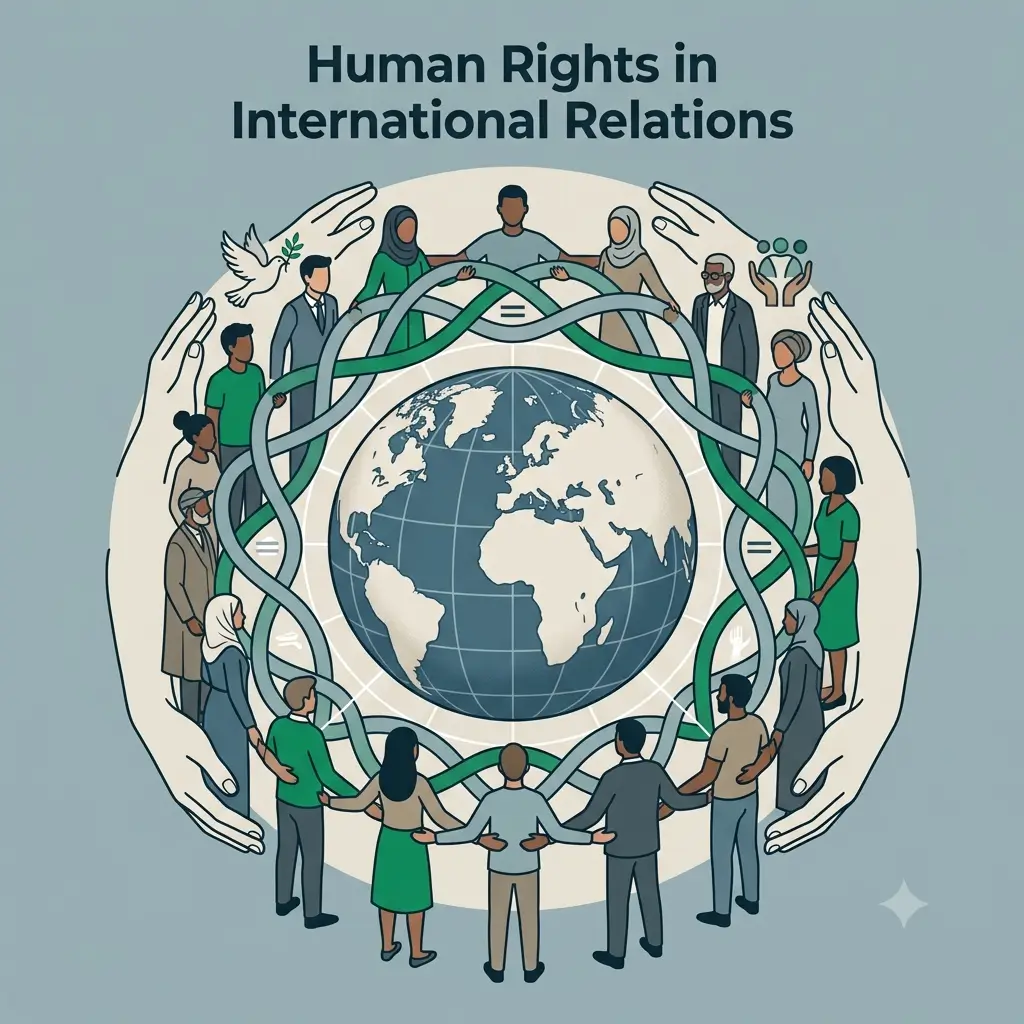
Human rights: IR studies the promotion and protection of human rights globally, including refugee crises and international responses to mass atrocities.
Environmental issues: Climate change and the need for coordinated, multilateral action have become central to contemporary IR.
Global health: Pandemics and health crises (most visibly COVID-19) have shown why international cooperation on health is now treated as a core IR concern, not a peripheral one.
International development: What drives economic and social growth — particularly in developing countries — including poverty, aid and debt.
Cultural interactions: Religion, nationalism and identity shape how states and societies behave internationally.
Conflict and peace studies: Why conflicts occur and how they can be resolved, with a focus on peacebuilding and reconciliation.
Expanding Horizons
IR keeps adapting to new issues and trends — technology, artificial intelligence, climate change, pandemics — to address both long-standing and emerging global problems. This constant expansion is also why scholars like Stanley Hoffmann have noted that IR’s scope is famously difficult to pin down: “How could one agree once and for all upon the definition of a field whose scope is in constant flux?”
Theoretical Approaches of International Relations
International Relations (IR) theories help explain why conflicts happen, how cooperation works, and what the international system looks like. Here are the major theories relevant for the DU syllabus:
1. Theory of realism in international relations
- Main idea: Realism sees the international system as anarchic — with no central authority — so states prioritise their own security and interests above all else.
- Key ideas: Power, national interest, balance of power, security dilemma.
- Key thinkers: Thomas Hobbes (philosophical roots), Hans Morgenthau (classical realism), Kenneth Waltz (neorealism).
- Types: Classical realism locates the cause of conflict in human nature and the flawed pursuit of power (Morgenthau). Neorealism/structural realism (Waltz) instead locates the cause in the anarchic structure of the international system itself, not human nature.
2. Liberalism and neoliberalism in international relations
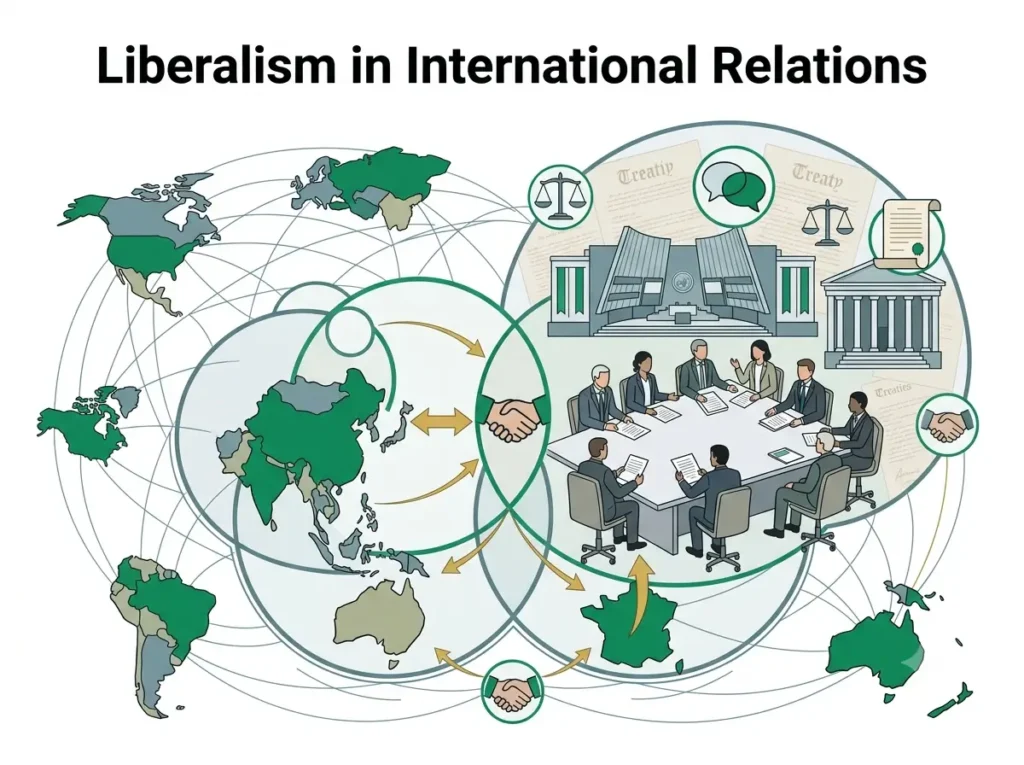
- Main idea: Liberalism holds that cooperation is possible even without a world government, through trade, shared norms and international institutions.
- Key ideas: Cooperation, democracy, collective security, interdependence.
- Key thinkers: Immanuel Kant (philosophical roots — “perpetual peace”), Robert Keohane and Joseph Nye (complex interdependence, neoliberal institutionalism).
- Type: Neoliberalism studies how institutions and rules help states overcome collective-action problems and cooperate even while pursuing self-interest.
3. Theory of constructivism in international relations
- Main idea: Constructivism argues that ideas, norms and identities shape state behaviour — international structures are socially constructed, not just given by material power.
- Key ideas: Identity, norms, social construction (“anarchy is what states make of it”).
- Key thinker: Alexander Wendt.
4. Marxist approach to international relations
- Main idea: Marxist IR sees the international system as shaped by capitalist economic structures, in which wealthier states and classes benefit at the expense of poorer ones.
- Key ideas: Economic inequality, imperialism, class struggle.
- Key thinker: Karl Marx (foundational ideas later developed by IR scholars).
- Types: Dependency theory studies how developing countries remain economically dependent on developed ones; World-systems theory (Immanuel Wallerstein) divides the world into core, semi-periphery and periphery states based on their position in the global economy.
5. Feminist perspective in international relations
- Main idea: Feminist IR argues that mainstream theories have overlooked gender, and that gender shapes security, war and diplomacy in ways traditional IR ignores.
- Key ideas: Gender, security, patriarchy.
- Key thinker: Cynthia Enloe; J. Ann Tickner is another central figure often included on DU reading lists.
- Type: Liberal feminism pushes for equal representation of women in political and diplomatic institutions.
6. Postcolonialism
- Main idea: Postcolonial theory examines how the legacy of colonialism continues to shape international relations, and critiques how mainstream IR has centred European and American experience.
- Key ideas: Colonial legacy, cultural hegemony, the “subaltern.”
- Key thinker: Edward Said (Orientalism, 1978) is the foundational reference, though he is a literary/cultural theorist rather than an IR scholar by training.
7. English School of international relations
- Main idea: The English School views international relations as an “international society” of states that share certain norms and rules, balancing conflict with a degree of order.
- Key ideas: International society, order, justice.
- Key thinker: Hedley Bull (The Anarchical Society, 1977).
8. Critical theory in international relations
- Main idea: Critical theory challenges existing power structures in IR and pushes for emancipation and social justice rather than simply explaining the world as it is.
- Key ideas: Emancipation, ideology, hegemony.
- Key thinker: Jürgen Habermas (Frankfurt School roots); Robert Cox’s distinction between “problem-solving theory” and “critical theory” is the reference most DU reading lists use.
9. Game theory in international relations
- Main idea: Game theory uses formal, mathematical models to analyse strategic decision-making between states during conflict and negotiation (for example, the Prisoner’s Dilemma as a model of the security dilemma).
- Key ideas: Strategic choice, equilibrium, rational actors.
- Key thinker: John Nash.
Summary Table of IR Theories
| Theory | Focus | Key Concepts | Key Thinker(s) |
|---|---|---|---|
| Realism | Power and state interests | Power, national interest, security dilemma | Morgenthau, Waltz |
| Liberalism | Cooperation and institutions | Interdependence, democracy, institutions | Kant, Keohane & Nye |
| Constructivism | Ideas, norms and identity | Social construction, norms, identity | Wendt |
| Marxism | Economic structures and class | Capitalism, exploitation, imperialism | Marx, Wallerstein |
| Feminism | Gender in IR | Gender, patriarchy, human security | Enloe, Tickner |
| Postcolonialism | Legacies of colonialism | Colonialism, cultural hegemony, subalternity | Said |
| English School | International society | International law, order, justice | Bull |
| Critical Theory | Emancipation and social justice | Hegemony, ideology, emancipation | Habermas, Cox |
| Game Theory | Strategic interaction | Rational choice, equilibrium | Nash |
Criticism across theories: No single theory is treated as settled truth in the discipline, and each has well-known limitations that DU exams often ask students to discuss. Realism is criticised for being unable to explain sustained cooperation and for treating states as unified, rational actors when domestic politics often drives foreign policy. Liberalism is criticised for underestimating how power imbalances persist even inside institutions. Constructivism is criticised for being better at describing change than predicting it. Marxist and dependency approaches are criticised for economic determinism — reducing politics to economics. Feminist and postcolonial approaches are sometimes dismissed by mainstream scholars as “normative” rather than “explanatory,” a charge those traditions directly contest by arguing that all theory carries normative assumptions, including realism’s. Scholars often combine insights from more than one theory rather than adopting a single framework wholesale.
Reading the Big Bangs: The Contested Origins of IR
This section is one of the most exam-important parts of Unit 1, and it is worth understanding clearly: DU’s own syllabus title for this part is literally “Reading the Big Bangs,” and the assigned reading — Benjamin de Carvalho, Halvard Leira and John M. Hobson’s 2011 article “The Big Bangs of IR: The Myths That Your Teachers Still Tell You about 1648 and 1919” (published in Millennium: Journal of International Studies) — argues that the two standard “origin stories” of IR are myths that historical scholarship has already debunked, even though textbooks keep repeating them. Understanding both the conventional story and the critique of it is what this part of the unit is actually testing.
The Two “Big Bang” Myths
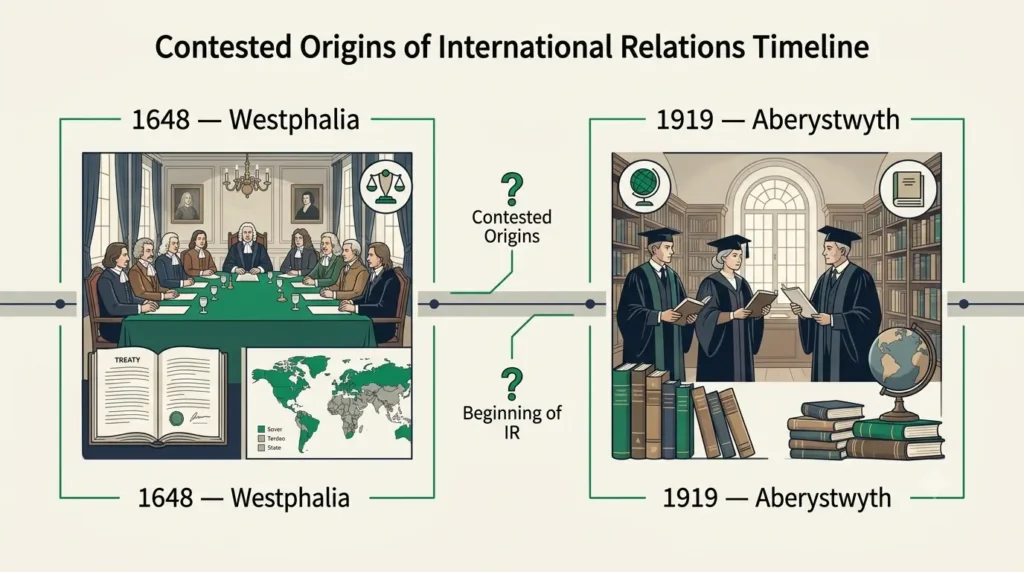
Myth 1 — 1648 and the Peace of Westphalia: The conventional story holds that the Peace of Westphalia (1648), which ended the Thirty Years’ War, created the modern system of sovereign, territorial states and ended the overlapping, hierarchical authority of the Holy Roman Empire and the Catholic Church — the beginning of “international relations” as relations between sovereign equals.
De Carvalho, Leira and Hobson (building on earlier revisionist work by Stephen Krasner and Andreas Osiander) argue this is largely a myth. The Westphalian treaties did not establish the modern idea of sovereignty in any clean sense: the principle of a ruler’s right to determine their state’s religion (cuius regio, eius religio) actually predates Westphalia, going back to the 1555 Peace of Augsburg. The treaties applied specifically to the polities of the Holy Roman Empire, not to Europe as a whole, and neither the modern territorial state nor a fully anarchic states-system emerged in 1648 — both took shape gradually over the following centuries.
Myth 2 — 1919 and the birth of IR as an academic discipline: The conventional story holds that IR became a formal, independent field of study after the trauma of World War I, when the University of Wales, Aberystwyth, created the Woodrow Wilson Chair of International Politics in 1919 — the world’s first academic post in International Relations — and that the discipline then developed through a “First Great Debate” between idealists (who believed war could be prevented through law and international institutions like the League of Nations) and realists (who argued that power, not law, ultimately governs relations between states).
The Aberystwyth chair in 1919 is a verifiable historical fact. What de Carvalho, Leira and Hobson dispute is the surrounding narrative built on top of that fact — that IR sprang into existence as a clean, unified discipline at that single moment, and that its early history is accurately captured by a simple “idealism vs realism” story. They show that this narrative was constructed and popularised later, and that it obscures more complicated and geographically wider histories of how the study of international politics actually developed (including work outside Britain and the United States).
A separate strand of recent scholarship — for instance Vineet Thakur, Alexander Davis and Peter Vale’s work on the discipline’s links to South African racial politics — pushes the critique further, arguing that some of IR’s earliest institutional roots were entangled with colonial and racial thinking, not simply with the idealist search for peace that the standard story emphasises.
Why This Matters for Indian and Global-South Students
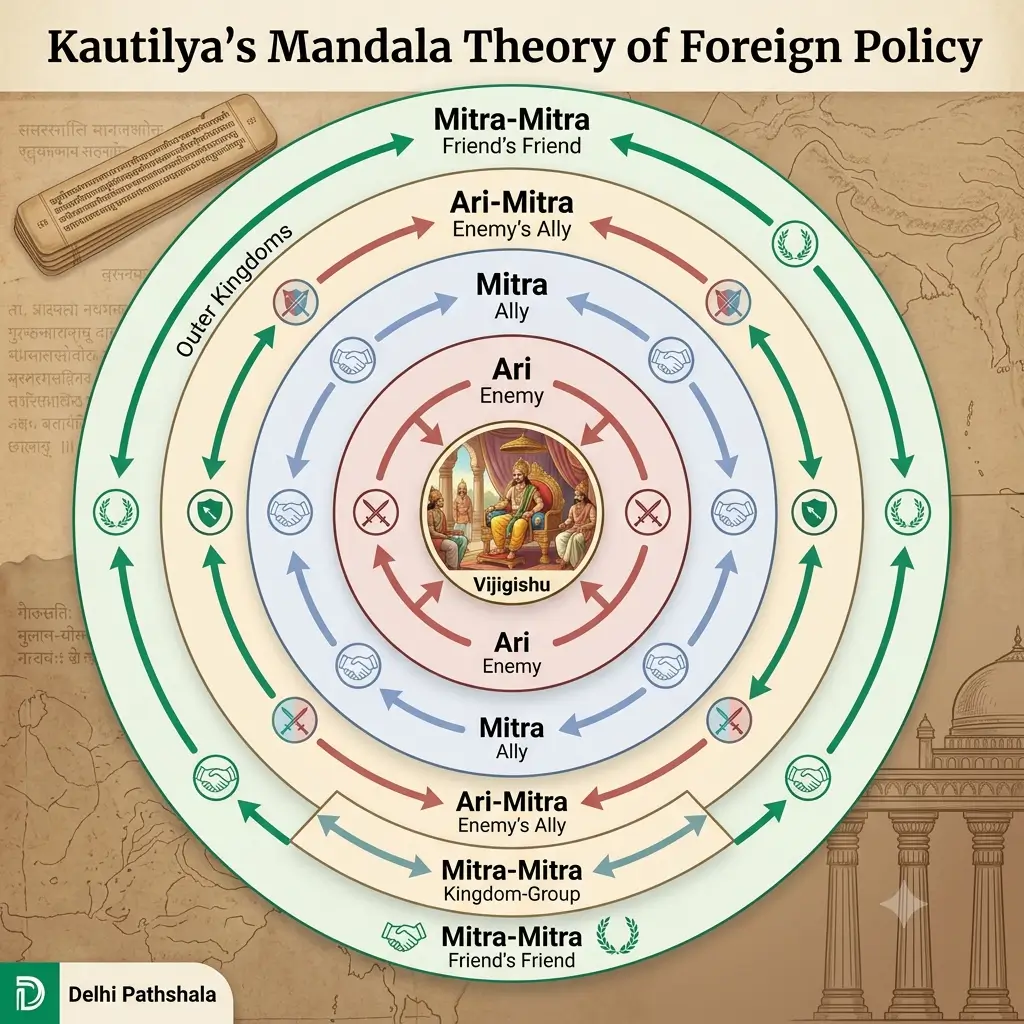
Both myths share a common feature the syllabus wants students to notice: they are Eurocentric. They treat European events (Westphalia, WWI) as the universal starting point of “international relations” everywhere, sidelining the political orders, diplomatic practices and inter-state relations that existed in Asia, Africa and the Americas well before 1648 or 1919 (for example, the Arthashastra‘s “Mandala theory” of interstate relations, discussed later in this article, describes strategic relations between kingdoms in ancient India centuries before Westphalia). This is precisely the bridge to the next part of the unit — de-colonial accounts of IR — because contesting the “Big Bangs” is itself an early step in decolonising the discipline’s self-image.
Exam tip: If a question asks you to “critically examine” or “discuss the contestation over” the origins of IR, do not simply narrate 1648 and 1919 as settled facts — that answers the wrong question. Present both the conventional narrative and the myth-busting critique, and explain why the critique matters (Eurocentrism, selective history, obscuring non-Western political orders).
Major Historical Events and Their Impact on IR (Post-1919 Development)
Once IR was institutionalised as a field (whatever the real story behind its founding), several major twentieth-century events did visibly shape how the discipline developed:
- World War I and early idealism: The scale of WWI’s destruction pushed early IR scholars toward idealism — the belief that war could be prevented through international law, cooperation and institutions like the League of Nations.
- World War II and the shift to realism: The League of Nations’ failure to prevent WWII discredited idealism in the eyes of many scholars and policymakers, and realism — emphasising power and national interest — became the dominant approach. The United Nations was created afterward to better support collective security.
- The Cold War: The US–Soviet rivalry reinforced realism, with concepts like the security dilemma and balance of power becoming central to how scholars explained the era.
- Post-Cold War and globalisation: The Soviet Union’s dissolution in 1991 accelerated globalisation and renewed interest in liberal theories emphasising interdependence and the spread of democracy.
- 9/11 and the “war on terror”: The 2001 attacks expanded IR’s agenda to include non-state terrorism and, later, cybersecurity as core security concerns.
- Climate change and global health: Recent decades have widened IR’s focus further, to include environmental cooperation and pandemic response as central, not marginal, subjects.
Key Figures in the Discipline’s Development
- E.H. Carr: A founding critic of idealism; his book The Twenty Years’ Crisis, 1919–1939 (1939) argued that power, not morality, drives international politics — a foundational realist text.
- Hans Morgenthau: Politics Among Nations (1948) systematised classical realism around the concept of national interest defined in terms of power.
- Kenneth Waltz: Theory of International Politics (1979) founded neorealism, arguing that the anarchic structure of the international system — not human nature — drives state behaviour.
- Immanuel Kant: His essay on “perpetual peace” (1795), long before IR existed as a discipline, laid philosophical groundwork for liberal IR theory.
- Alexander Wendt: Social Theory of International Politics (1999) is the key constructivist text, arguing that international structures are built from shared ideas as much as material power.
- Robert Keohane and Joseph Nye: Their work on “complex interdependence” (from the 1970s onward) showed how economic and institutional ties can reduce — without eliminating — the likelihood of conflict.
Evolution of IR Thinking — A Brief Timeline
| Period | Dominant Thinking | Key Shift |
|---|---|---|
| Post-WWI (1919 onward) | Idealism | Belief that law and institutions (League of Nations) can prevent war |
| Post-WWII | Classical Realism | Carr and Morgenthau: power, not morality, drives states |
| Cold War | Neorealism / Structural Realism | Waltz: anarchic system structure, not human nature, explains behaviour |
| 1970s–80s | Neoliberalism | Keohane & Nye: interdependence and institutions enable cooperation |
| Late 20th century | Constructivism & Critical Theories | Wendt and others: norms and ideas, not just power, shape the system |
| 2000s–present | Decolonial / Global IR | Growing challenge to Eurocentric origin stories and theory-building |
Bringing in De-colonial Accounts
Decolonial theory in IR examines how the legacy of colonialism continues to shape global relationships today, and challenges the assumption that Western perspectives are the neutral or universal starting point for understanding world politics. It helps students understand international politics more fully by taking seriously the histories and experiences of non-Western states and societies.
Introduction to Decolonial Theory
Decolonial theory argues that colonialism continues to influence knowledge production and politics long after formal colonial rule ended. It challenges the dominance of Western frameworks in IR and calls for approaches that take non-Western histories and experiences seriously on their own terms.
Difference from postcolonialism: Both traditions examine the effects of colonialism, but decolonial theory pushes further — it argues for moving away from Western epistemological frameworks altogether, rather than only critiquing them from within.
Important scholars: Aníbal Quijano introduced the idea of the “coloniality of power” — the argument that colonial hierarchies of race and knowledge persist structurally even after political independence. Walter Mignolo builds on this to argue for “epistemic disobedience” — actively questioning Western ways of producing knowledge. María Lugones extended decolonial theory by adding a gender dimension, arguing that colonialism also imposed a particular (Western, binary) gender order on colonised societies.
Critique of Eurocentrism in IR
Traditional IR theories are criticised for centring European and American historical experience — for example, classical realism’s emphasis on interstate power politics reflects a specifically European historical trajectory, generalised into a “universal” theory of all international politics. Decolonial theorists describe this as a “coloniality of knowledge” — the treatment of Western concepts and categories as neutral and universally applicable, when they in fact reflect a particular history. Eurocentric theories claim general validity, but decolonial scholars argue IR needs to account for the different histories and political orders of other regions instead of assuming one framework fits everywhere.
Incorporating Non-Western Perspectives
Decolonial approaches call for rethinking core IR concepts — like sovereignty and security — in light of non-Western experience. For example, many Indigenous traditions understand land in terms of collective stewardship and relationship rather than exclusive ownership, which sits uneasily with the Westphalian idea of territorial sovereignty. Recognising this diversity, and the voices that colonial systems historically silenced, allows for a fuller and more accurate picture of how international politics actually works across different societies.
Case Studies of Decolonial IR
- The Non-Aligned Movement (NAM): Formed in the 1950s by states — led by figures like Jawaharlal Nehru, Josip Broz Tito and Gamal Abdel Nasser — that chose not to align formally with either the US or the Soviet bloc during the Cold War, asserting sovereignty and resisting continued great-power domination on their own terms.
- Indigenous movements: Movements such as Standing Rock in the United States challenge the treatment of land purely as an economic commodity and foreground traditional ecological knowledge as a legitimate basis for policy, not just a cultural curiosity.
- BRICS and the Global South: The BRICS grouping (Brazil, Russia, India, China, South Africa) illustrates how emerging economies push for reform of Western-dominated international financial institutions.
- Pan-Africanism and the African Union (AU): Pan-Africanism promotes unity among African states to resist neocolonial influence, and the AU works toward cooperative security and development combining modern and traditional governance structures.
Decolonial accounts in IR push the discipline away from Western-centred theory toward a more inclusive understanding that takes colonial histories and non-Western experience seriously — not as an addendum to mainstream IR, but as a correction to it.
Understanding the Genealogy of IR in India
The fourth part of Unit 1 asks students to trace how the study of IR developed specifically in India — from thinkers who predate the discipline entirely, through the post-independence institutionalisation of IR, to India’s more recent, more theoretically confident contributions.
Early Indian Thinkers and Their Contributions
Kautilya (Chanakya) and ancient strategic thought: Kautilya, a scholar-strategist traditionally dated to around the 4th century BCE, is treated in Indian IR as an indigenous precursor to realist thought. His work, the Arthashastra, develops the Mandala theory of foreign policy — the idea that a state’s immediate neighbour is a natural rival, while “the neighbour’s neighbour” is a natural ally, encouraging strategic alliance-building to balance power. The Arthashastra also discusses diplomacy, espionage and the practical use of power in ways scholars compare directly to Western realism, making it a useful example of a non-Western IR tradition existing independently of — and centuries before — the European “Big Bang” narratives discussed above.
Mahatma Gandhi and anti-colonial ideas: Gandhi’s commitment to non-violence (ahimsa) and truth (satya) shaped a distinctly moral approach to both domestic and international conduct. His model of non-violent resistance influenced anti-colonial movements globally and later leaders such as Martin Luther King Jr., and it fed into India’s post-independence emphasis on peaceful coexistence.
Jawaharlal Nehru and the Non-Aligned Movement: As India’s first Prime Minister, Nehru shaped India’s foreign policy of non-alignment during the Cold War, co-founding NAM alongside leaders like Tito and Nasser. His Panchsheel — five principles of mutual respect, non-aggression, non-interference, equality and peaceful coexistence, first formalised in the 1954 Sino-Indian agreement on Tibet — remain a reference point in Indian foreign policy discourse today.
B.R. Ambedkar and social justice in international relations: Though not primarily an IR thinker, Ambedkar’s lifelong focus on social justice, human rights and economic self-reliance shaped India’s international positioning on questions of equality and anti-discrimination, and influenced India’s engagement with human-rights issues at the UN.
Rabindranath Tagore and cultural internationalism: Tagore argued that aggressive nationalism could become a source of conflict, and instead promoted a universal humanism grounded in cultural exchange. His critique appears in his 1917 lectures published as Nationalism, and his institution, Visva-Bharati, was founded to promote cross-cultural understanding — an early template for what is now called India’s cultural diplomacy and soft power.
Summary of Early Indian Contributions to IR
| Thinker | Contribution | Key Concepts | Impact on IR |
|---|---|---|---|
| Kautilya | Ancient strategic thought | Power, Mandala theory, alliances | Indigenous precursor to realism |
| Mahatma Gandhi | Anti-colonial internationalism | Non-violence, moral diplomacy | Shaped India’s peace-oriented foreign policy |
| Jawaharlal Nehru | Non-alignment | Panchsheel, non-alignment, self-reliance | Founded NAM; established India as a Global South leader |
| B.R. Ambedkar | Social justice in IR | Human rights, economic independence | Advocacy for social justice at global forums |
| Rabindranath Tagore | Cultural internationalism | Universal humanism, cultural diplomacy | Shaped India’s soft-power and cultural diplomacy |
These early Indian thinkers together show a genealogy of IR in India that runs independently of — and, in Kautilya’s case, long predates — the European narratives covered in the “Big Bangs” section, offering an alternative reference point for the discipline that decolonial and Global IR scholars increasingly draw on.
Development of IR Studies in India
The academic study of IR in India developed in four broad, overlapping phases.
Phase 1 — Foundational period (pre-independence to 1950s): Before independence, there was limited standalone study of IR; diplomacy and colonial politics were studied mainly within general political science and history. Post-independence, India built dedicated institutions — the Indian Council of World Affairs (ICWA) and the School of International Studies (SIS, later merged into JNU) — to train diplomats and analysts, reflecting the new state’s urgent need for foreign-policy expertise.
Phase 2 — The Cold War era (1950s–1980s): India’s policy of non-alignment shaped the questions Indian IR scholars asked, with a strong focus on India’s position between the US and Soviet blocs. Universities such as JNU and the University of Calcutta became key centres, area studies (South Asia, Africa) expanded, and Indian scholarship relied relatively less on imported Western theory, staying closer to practical foreign-policy analysis.
Phase 3 — Post-Cold War and globalisation (1990s–2000s): India’s 1991 economic liberalisation deepened its integration into the global economy, prompting greater engagement with Western IR theory and new subjects like economic interdependence and non-state actors. India’s 1998 nuclear tests pushed security studies (nuclear deterrence, regional security) to the forefront, and more IR-focused think tanks were established.
Phase 4 — Contemporary period (2010s–present): Indian scholars increasingly critique Western biases in IR theory and call for incorporating Indigenous frameworks. Current scholarship engages climate change, global health and technology diplomacy, alongside a growing number of think tanks, more international academic collaboration, and analysis of India’s role in an increasingly multipolar world.
Summary of the Development of IR Studies in India
| Phase | Characteristics | Focus Areas | Key Developments |
|---|---|---|---|
| Foundational Period | Pre-independence and early independence | Nationalism, diplomacy, colonial critique | ICWA and SIS established |
| Cold War Era (1950s–80s) | Non-alignment, area studies, regional focus | NAM, growth of academic programmes | JNU and Calcutta University emerge as key centres |
| Post-Cold War (1990s–2000s) | Globalisation, security studies, theoretical engagement | Nuclear deterrence, expansion of think tanks | Increased Western-theory engagement post-liberalisation |
| Contemporary (2010s–present) | Decolonial theory, multipolarity, non-traditional issues | Climate, health, technology diplomacy | Rise of Global IR debate, more international collaboration |
Key Indian IR Theorists and Their Works
Indian IR scholarship today includes several influential thinkers who bring India’s history, politics and strategic experience into direct conversation with — and sometimes direct challenge to — mainstream Western IR theory.
1. K. Subrahmanyam — Defence and Security Studies: Widely called the “father of Indian strategic studies,” Subrahmanyam shaped India’s Cold War-era defence and nuclear thinking, including India’s commitment to a No-First-Use nuclear posture. His extensive writing on nuclear strategy and independent defence policy continues to influence Indian strategic doctrine.
2. C. Raja Mohan — Realism and India’s Foreign Policy: A leading contemporary foreign-policy commentator focused especially on the Indo-Pacific, arguing for closer Indian engagement with Western powers to balance China. His books Crossing the Rubicon and Samudra Manthan trace India’s shift from strict non-alignment toward a more actively engaged foreign policy.
3. Amitav Acharya — Constructivism and Global IR: Acharya promotes non-Western perspectives in IR and is the leading voice behind the “Global IR” project, which pushes the discipline to incorporate diverse regional and local contexts rather than treating Western theory as universal. His books include The Making of Southeast Asia and Constructing a Security Community in Southeast Asia. “Global IR” is directly relevant to Unit 4 of this DSC-6 course (Exploring the Future Trajectories), which students will encounter later in the syllabus.
4. B.S. Chimni — Critical Theory and Postcolonialism: Chimni’s work on international law and Third World Approaches to International Law (TWAIL) critiques how mainstream international law and IR theory have historically ignored the interests and historical injustices experienced by the Global South. His key writing includes International Law and World Order.
5. Shashi Tharoor — Soft Power and India’s Global Image: A former diplomat and politician, Tharoor argues that India’s culture and democratic institutions give it substantial soft-power potential. His book Pax Indica discusses India’s foreign policy and its capacity for global leadership through non-coercive means.
6. Kanti Bajpai — India–Pakistan Relations and Strategic Studies: Bajpai specialises in South Asian security, particularly India’s relations with Pakistan and China, including works such as India Versus China.
7. Srinath Raghavan — Historical Analysis of IR: Raghavan uses rigorous historical method to explain Indian foreign policy, notably in 1971: A Global History of the Creation of Bangladesh, showing how specific historical episodes shape long-run strategic thinking.
8. Sanjaya Baru — Political Economy and Globalisation: Baru examines the intersection of economics, foreign policy and globalisation, including in The Accidental Prime Minister, which discusses foreign-policy decision-making under Prime Minister Manmohan Singh.
Summary of Key Indian IR Thinkers
| Thinker | Focus Areas | Key Works | Contribution to IR |
|---|---|---|---|
| K. Subrahmanyam | Defence, nuclear policy | Writings on deterrence and strategy | Basis for India’s independent defence strategy |
| C. Raja Mohan | Realism, Indo-Pacific | Crossing the Rubicon, Samudra Manthan | Strategy for Indo-Pacific engagement |
| Amitav Acharya | Constructivism, Global IR | The Making of Southeast Asia | Champion of non-Western, “Global IR” perspectives |
| B.S. Chimni | Postcolonial theory, international law | International Law and World Order | Critique of Western-centred international law |
| Shashi Tharoor | Soft power, diplomacy | Pax Indica | Framework for using India’s soft power |
| Kanti Bajpai | India–Pakistan relations, security studies | India Versus China | Insight into regional security dynamics |
| Srinath Raghavan | Historical analysis, foreign policy | 1971: A Global History | Historical grounding for foreign-policy analysis |
| Sanjaya Baru | Political economy, globalisation | The Accidental Prime Minister | Economic lens on foreign-policy decisions |
Contemporary Issues in Indian IR
While this goes slightly beyond Unit 1’s core syllabus focus, understanding current issues helps connect the theoretical material above to how Indian IR scholarship is actually applied today, and several of these recur in exam “contemporary relevance” questions.
India–China competition and the Indo-Pacific strategy: Border tensions, economic competition and China’s expanding footprint in South Asia and the Indian Ocean have pushed India toward a more active Indo-Pacific strategy, including deepening ties with the US, Japan and Australia through the Quad grouping, aimed at a “free, open and inclusive Indo-Pacific.”
Relations with the United States and the Quad: The India–US relationship has strengthened around shared concerns over China and cooperation on defence, technology and trade. India’s participation in the Quad marks a departure from strict non-alignment, though India continues to balance this against its long-standing ties with Russia.
Managing relations with Pakistan: Relations remain shaped by the Kashmir dispute, cross-border terrorism (including after major attacks like the 2001 Parliament attack and 2008 Mumbai attacks) and nuclear deterrence dynamics, with India pursuing a mix of diplomatic pressure and counterterrorism measures.
Engagement in multilateral institutions: India is active in BRICS, the G20 and the Shanghai Cooperation Organisation, and continues to press for a permanent seat on the UN Security Council as part of a broader push to reform global governance structures for emerging economies.
Energy security and climate change: India has committed to installing 500 GW of non-fossil-fuel electricity capacity by 2030 and meeting 50% of its energy requirements from renewable sources by 2030 — targets announced by Prime Minister Narendra Modi at the COP26 summit in Glasgow (2021), which raised India’s earlier domestic target of 450 GW. India is also part of the Paris Agreement and co-founded the International Solar Alliance (ISA).
Economic diplomacy and trade partnerships: India is negotiating free trade agreements with major economies including the EU and UK, while remaining outside the Regional Comprehensive Economic Partnership (RCEP) over concerns about competition from China.
Technology and cybersecurity: As India digitises rapidly, cybersecurity, data protection and “digital sovereignty” — including scrutiny of Chinese technology firms — have become significant foreign- and security-policy concerns.
Diaspora diplomacy: According to the Ministry of External Affairs, the total population of Overseas Indians (Non-Resident Indians and Persons of Indian Origin combined) stood at roughly 35.4 million as of November 2024 — the largest diaspora of any country in the world. India engages this diaspora through initiatives like Pravasi Bharatiya Divas and the OCI card scheme, both for remittances and for soft-power influence.
Internal security and its foreign-policy links: Domestic insurgencies and separatist movements sometimes intersect with foreign policy where external support is alleged, requiring India to coordinate internal-security and diplomatic responses.
Public health diplomacy: India’s role as a major vaccine producer became a foreign-policy asset during COVID-19, most visibly through the “Vaccine Maitri” programme, which supplied vaccines to numerous countries and is now cited as a case study in Indian soft power and health diplomacy.
Summary of Current Issues in Indian IR
| Issue Area | Key Focus | Strategic Impact |
|---|---|---|
| India–China Rivalry | Border security, Indo-Pacific, Quad | Shapes India’s defence and maritime strategy |
| Relations with the US | Defence cooperation, technology partnerships | Deepens global alignment while balancing strategic autonomy |
| Pakistan Relations | Border tensions, terrorism, Kashmir | Shapes domestic and regional security policy |
| Multilateral Institutions | UNSC reform, BRICS, G20 | Expands India’s role in global governance |
| Energy Security & Climate | Renewable energy (500 GW by 2030), Paris Agreement | Balances growth with climate commitments |
| Economic Diplomacy | FTAs, staying out of RCEP | Secures growth while managing trade-openness trade-offs |
| Cybersecurity | Digital sovereignty, technology partnerships | Protects national security in the digital domain |
| Diaspora Diplomacy | ~35.4 million overseas Indians (MEA, 2024) | Strengthens remittances, soft power and global image |
| Public Health Diplomacy | Vaccine Maitri, pandemic response | Positions India as a global-health contributor |
Conclusion
International Relations is best understood not as a single settled body of knowledge but as a field defined by genuine, ongoing contestation — over its very definition, over the myths surrounding its own origins, over whose historical experience counts as the discipline’s starting point, and over which theory best explains state behaviour. For DU students, Unit 1 specifically asks you to hold two things together: the conventional account of IR’s development (its key concepts, its major theories, its post-1919 institutional history) and a critical awareness that this conventional account is Eurocentric and has been directly challenged by both the “Big Bangs” myth-busting literature and by decolonial scholarship. India’s own intellectual tradition — from Kautilya’s ancient strategic thought to Nehru’s non-alignment to contemporary scholars like Amitav Acharya’s “Global IR” — offers one of the clearest illustrations of why that critical awareness matters, and it is exactly this combination of foundational concepts and critical perspective that DU examiners look for in Unit 1 answers.
Continue Reading
(Related notes for DSC-6: Introduction to International Relations, Semester 2, BA (Hons.) Political Science)
University of Delhi Previous Year Questions
University of Delhi Previous Year Questions
Section A — Short Answer Questions
1 Define International Relations. How does Quincy Wright’s definition differ from Morgenthau’s? +
Hint: Compare power-centred and broader definitions of International Relations.
Suggested Answer Focus: Contrast the state-and-power focus with Wright’s broader emphasis on groups of major importance. Probable
2 What is meant by the “security dilemma” in International Relations? +
Hint: Use an arms-race example to illustrate the concept.
Suggested Answer Focus: Define the security dilemma and explain how one state’s defensive measures can increase insecurity and trigger reciprocal actions. Probable
3 Explain the Mandala theory of Kautilya. +
Hint: Refer to the Arthashastra.
Suggested Answer Focus: Explain the neighbour-as-rival and neighbour’s-neighbour-as-ally logic within Kautilya’s strategic framework. Probable
4 What is the “First Great Debate” said to be about, and why is that label contested? +
Hint: Link the discussion to the “Big Bangs” reading.
Suggested Answer Focus: Explain the conventional idealism-versus-realism narrative and discuss why de Carvalho, Leira, and Hobson challenge this disciplinary history. Probable
5 Distinguish between hard power and soft power with one example of each. +
Hint: Use military and cultural examples.
Suggested Answer Focus: Define hard power and soft power and illustrate the distinction with relevant contemporary examples. Probable
Section B — Long Answer Questions
1 “The origins of International Relations as a discipline are more myth than history.” Critically examine this statement with reference to 1648 and 1919. +
Hint: Treat this as a central “Big Bangs” question for the unit.
Suggested Answer Focus: Present the conventional 1648 and 1919 narratives, followed by the critiques offered by de Carvalho, Leira, and Hobson and the reasoning behind their challenge to these disciplinary origin stories. Probable
2 Discuss the decolonial critique of mainstream International Relations theory. +
Hint: Use Quijano, Mignolo, and relevant case studies such as NAM and BRICS.
Suggested Answer Focus: Explain coloniality of knowledge, Eurocentrism, and the ways in which decolonial approaches challenge conventional foundations of IR theory. Probable
3 Trace the genealogy of the International Relations discipline in India, from Kautilya to contemporary scholars. +
Hint: Cover ancient, colonial-era, and post-independence phases.
Suggested Answer Focus: Structure the answer chronologically: Kautilya → Gandhi and Nehru → post-independence institutions → contemporary scholars contributing to Global IR. Probable
4 Compare and contrast realism and liberalism as approaches to understanding International Relations. +
Hint: Compare their assumptions about anarchy, self-help, cooperation, and institutions.
Suggested Answer Focus: Explain the differences between realist and liberal approaches using major thinkers and their respective views of international cooperation and institutions. Probable
5 “Global IR calls for a discipline built on plural, not singular, foundations.” Discuss with reference to Amitav Acharya’s work. +
Hint: Connect the genealogy discussion in Unit 1 with the “Global IR” theme in Unit 4.
Suggested Answer Focus: Explain the core claims of Global IR and connect its emphasis on plural foundations with the broader decolonial critique of mainstream IR. Probable
FAQs
What is the simplest definition of International Relations (IR)?
IR is the study of how states, international organisations and other global actors interact — covering diplomacy, conflict, trade, cooperation and shared global challenges. There is no single agreed definition; scholars differ on how narrowly (“relations between states”) or broadly (“relations between groups of major importance”) to define it.
What is the difference between International Relations and International Politics?
The terms are often used interchangeably, but “International Politics” traditionally emphasises power and conflict between states, while “International Relations” is broader, covering economic, cultural and social interactions as well as political ones, and includes non-state actors.
Why is 1648 (the Peace of Westphalia) considered important — and why is it also controversial?
It is conventionally treated as the birth of the modern sovereign-state system. It is controversial because historians have shown the treaties did not actually establish modern sovereignty in any clean sense, and the story is considered a partly mythologised, Eurocentric simplification — one of the “Big Bangs” myths this unit specifically asks students to critique.
Why is 1919 significant in the history of IR?
1919 is when the University of Wales, Aberystwyth, created the world’s first academic chair in International Politics, conventionally marking IR’s birth as a distinct academic discipline. As with 1648, scholars now argue that the surrounding “idealism vs realism” origin story oversimplifies a more complicated and geographically wider history.
What is the “First Great Debate” in IR?
It refers to the supposed early clash between idealists (who believed international law and institutions could prevent war) and realists (who argued power determines international outcomes) after World War I. Its accuracy as a historical account of the discipline’s actual early development is itself contested by revisionist scholarship.
What is decolonial theory in IR, and how is it different from postcolonialism?
Decolonial theory examines how colonial hierarchies of knowledge and power persist even after formal independence, and calls for moving beyond Western frameworks altogether. Postcolonialism, in contrast, critiques colonialism’s effects from within existing (often Western) theoretical traditions rather than seeking to replace them entirely.
What is Kautilya’s Mandala theory, and why does it matter for IR?
The Mandala theory, from Kautilya’s Arthashastra, holds that a state’s immediate neighbour is a natural rival while the neighbour’s neighbour is a natural ally, guiding alliance formation to balance power. It matters because it shows a fully developed, realism-like tradition of strategic thought existing in ancient India, independent of and long before the European “Big Bang” narratives.
What are the main theories of International Relations DU students need to know for DSC-6?
Realism, liberalism/neoliberalism, constructivism, Marxism, feminism, postcolonialism, the English School, critical theory and game theory — with realism, liberalism, Marxism, feminism and constructivism receiving the most direct emphasis on the DSC-6 syllabus (they recur again in Unit 2).
How is India’s approach to IR different from Western IR theory?
Indian IR draws on distinct intellectual roots — Kautilya’s realism-like strategic thought, Gandhi’s non-violence, Nehru’s non-alignment — and, through scholars like Amitav Acharya’s “Global IR” project, actively challenges the assumption that Western theory is universally applicable, instead pushing for a discipline built on diverse regional experiences.
What is the Non-Aligned Movement (NAM) and why is it discussed under decolonial IR?
NAM was a Cold War-era grouping of states, including India under Nehru, that refused formal alignment with either the US or Soviet bloc. It is discussed under decolonial IR because it represents newly-independent, formerly-colonised states asserting sovereignty and shaping global politics on their own terms, rather than being passive subjects of great-power rivalry.
Is this unit only about theory, or does it also cover practical/contemporary issues?
Unit 1 itself is primarily theoretical and historiographical (what is IR, its contested origins, decolonial accounts, and India’s genealogy in the discipline). Contemporary issues in Indian foreign policy are covered here for context and because they often appear in “critically discuss” exam questions, but they are drawn from later parts of the wider DSC-6 syllabus and related papers (like DSC-18, India’s Foreign Policy).
What should a good DU exam answer on the “contested origins of IR” actually include?
It should present the conventional 1648/1919 narrative, then explicitly engage with the myth-busting critique (de Carvalho, Leira and Hobson), explain why the conventional story is considered Eurocentric, and connect this to the decolonial and Indian-genealogy material covered in the rest of Unit 1 — rather than treating 1648/1919 as uncontested historical fact.
Subscribe to keep reading
You've used your free notes for now. Get Delhi Pathshala Premium for unlimited access.
Subscribe — ₹29/30 days