
Contents
- Concept of Power in Political Science
- 1. Definition and Types of Power
- Types of Power in International Relations
- 1. Hard Power
- 2. Soft Power
- 3. Smart Power
- 2. Sources of Power
- 1. Military Power
- 2. Economic Power
- 3. Political Power
- 4. Cultural Power
- 5. Technological Power
- 6. Geopolitical Power
- 7. Ideological Power
- Key Takeaways: Sources of Power
- 3. Theories of Power
- 1. Realism
- Realism’s View on Power
- 2. Liberalism
- Liberalism’s View on Power
- 3. Constructivism
- Constructivism’s View on Power
- Comparison of Theories of Power
- Key Takeaways: Theories of Power
- 4. Power Dynamics
- What It Means
- Power Balances in International Relations
- Patterns of Power Dynamics Today
- Key Takeaways: Power Dynamics
- 5. Case Studies
- Historical Examples
- 1. The Cold War (1947–1991): Two Major Powers
- 2. European Colonization (16th–20th Century)
- 3. The Concert of Europe (1815–1914): Many Powers
- Modern Examples
- 1. The Rise of China
- 2. U.S. Dominance after the Cold War
- 3. European Union (EU)
- 4. Russia’s War on Ukraine (2022–Present)
- 5. Climate Change: Working Together
- Key Takeaways: Case Studies on Power
- Concept of Sovereignty
- 1. What is Sovereignty
- 2. History of Sovereignty
- Key Takeaways: History of Sovereignty
- 3. Legal and Political Aspects
- Key Takeaways: Legal and Political Sovereignty
- 4. Challenges to Sovereignty
- Key Takeaways: Challenges to Sovereignty
- 5. Theories of Sovereignty
- Key Takeaways: Theories of Sovereignty
- 6. Case Studies
- 1. Kosovo (2008)
- 2. South China Sea Dispute
- 3. The Crisis in Syria (2011–Present)
- 4. Brexit and the European Union
- 5. Taiwan’s Sovereignty Issue
- Key Takeaways: Case Studies on Sovereignty
- Concept of Empire
- 1. What is an Empire?
- History of Empires
- 2. Theories of Empire
- 1. Colonialism
- 2. Postcolonialism
- 3. Neoimperialism
- Key Takeaways: Theories of Empire
- 3. Characteristics of Empires
- Key Takeaways: Characteristics of Empires
- 4. Case Studies
- 1. The Roman Empire (27 BCE – 476 CE)
- 2. The British Empire (16th Century – Mid-20th Century)
- Key Takeaways: Roman and British Empires
- 5. Contemporary Issues
- Key Takeaways: Contemporary Issues in Empire
- International Order
- 1. Definition and Components
- Main Parts of International Order
- Key Takeaways: Components of International Order
- 2. Theories of International Order
- Key Takeaways: Theories of International Order
- 3. Historical Evolution
- Key Takeaways: Historical Evolution of International Order
- 4. Case Studies
- Previous Year Questions (DSC-6, Unit 3)
- FAQs
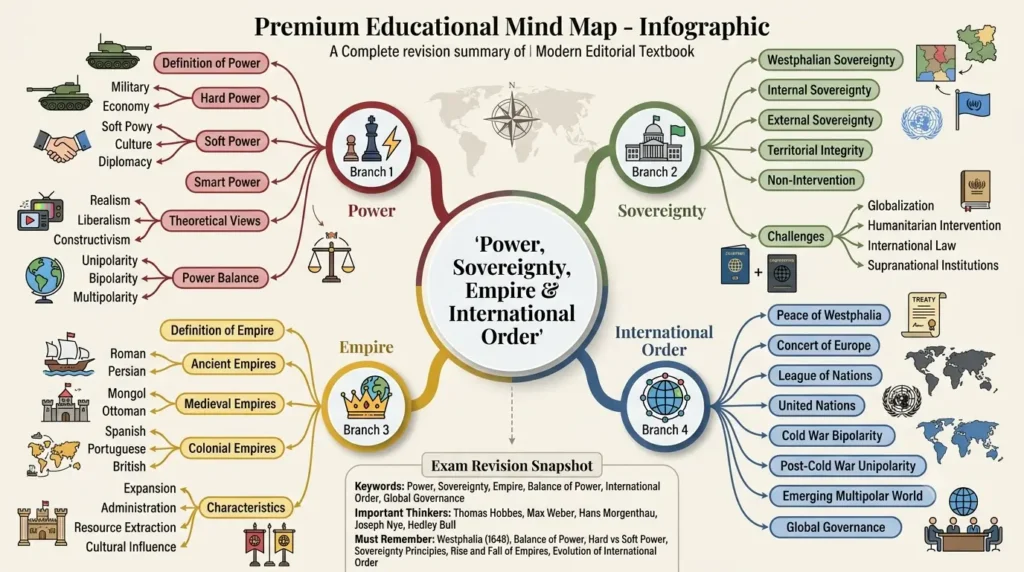
Power, sovereignty, empire aur international order — ye chaar concepts hi poore International Relations discipline ki neev hain. Agar aapko samajh aa jaaye ki states apni power kaise use karte hain, sovereignty ka matlab kya hai, empires kaise bante-bikharte hain, aur global order kis principle par chalta hai — to DSC-6 ka Unit 3 aapke liye kabhi mushkil nahi lagega.
Is post mein “Unit 3: Concepts of Power, Sovereignty, Empire, International Order” ke complete notes diye gaye hain, jo DSC – 6: Introduction to International Relations: Theories, Concepts and Debates course ka hissa hain — DU BA (Hons.) Political Science, Semester 2 ke students ke liye specially taiyaar kiye gaye. Agar aapne abhi tak Unit 1: What is IR and its Contested Origins aur Unit 2: IR Theories nahi padhe, to unhe pehle cover kar lena helpful rahega, kyunki Unit 3 unhi theories (realism, liberalism, constructivism) ko power, sovereignty, empire aur international order par apply karta hai.
Concept of Power in Political Science
1. Definition and Types of Power
Power is one of the most fundamental ideas in politics — the ability to influence or control what others do in order to achieve certain goals. Power can take different forms depending on how it is exercised.
Power can be simply defined as the ability to make others act in a certain way, even if they would not otherwise choose to.
– Max Weber described power as the chance that a person can realise their own will even against the resistance of others. – Joseph Nye defined power as the ability to affect the behaviour of others to get the outcomes you want, through coercion, payment, or attraction.
Types of Power in International Relations
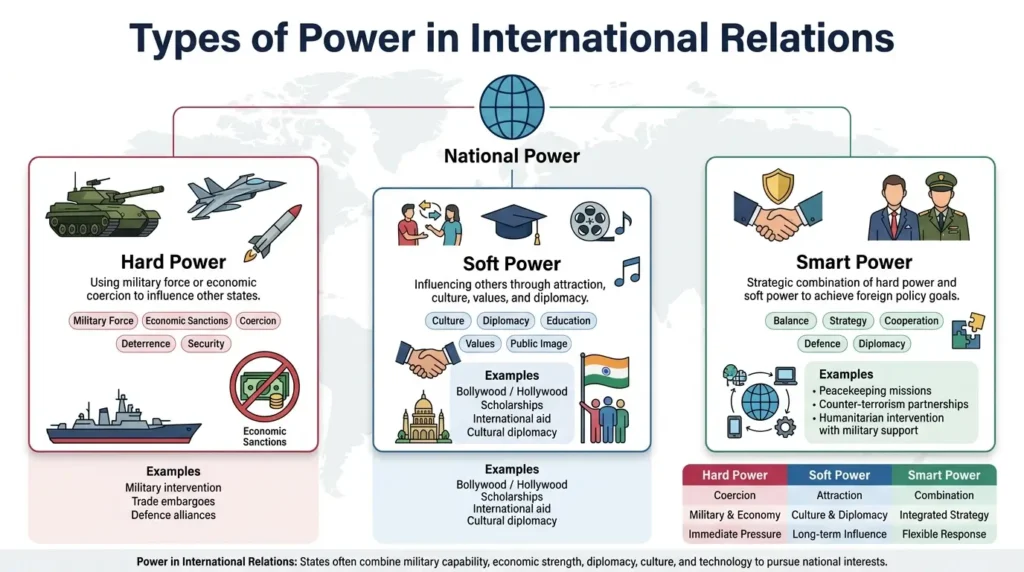
Power in IR is broadly divided into three types, based on how it is exercised: hard power, soft power, and smart power.
1. Hard Power
- Hard power means using force or pressure to influence others.
- It relies on tangible resources like military strength or money.
- Examples: military action, economic sanctions, or coercive threats.
2. Soft Power
- Soft power works through attraction and persuasion rather than force.
- It stems from a country’s culture, values, and diplomacy — a concept developed extensively by Joseph Nye at Harvard’s Belfer Center.
- Examples: the global reach of a nation’s cinema and music, promotion of democratic values, or cultural diplomacy programs like China’s Confucius Institutes.
3. Smart Power
- Smart power blends hard and soft power to achieve specific goals.
- It is about knowing when to coerce and when to persuade.
- Examples: NATO combining security cooperation with economic partnerships, or counterterrorism strategies that pair military force with cultural diplomacy.
2. Sources of Power
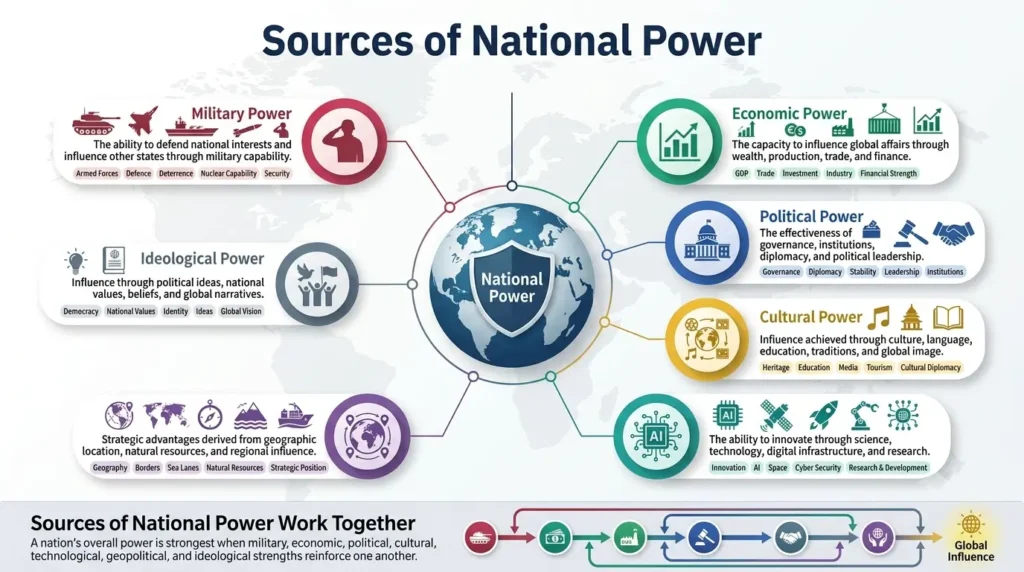
1. Military Power
What it is: The ability to use or threaten military force to achieve goals.
Key Parts: Size and strength of armed forces; modern weapons and defence systems; strategic alliances such as NATO.
Importance: Deters attacks, enables intervention in conflicts, and strengthens negotiating leverage.
Examples: The U.S. military’s global footprint; Russia’s military actions in Ukraine.
2. Economic Power
What it is: The ability to influence others through money, trade, and economic rules.
Key Parts: Economic growth and GDP; natural resources; trade relationships; aid and loans.
Importance: Shapes global trade rules, provides leverage through sanctions, and builds influence through foreign aid.
Examples: China’s Belt and Road Initiative; the U.S. dollar’s dominance in global finance.
3. Political Power
What it is: The ability to govern effectively and shape political systems abroad.
Key Parts: Government stability; influence in bodies like the United Nations; diplomatic networks.
Importance: Ensures legitimacy in global decision-making and shapes international norms.
Examples: The EU’s regulatory influence; the U.S. forming coalitions like the G7.
4. Cultural Power
What it is: The ability to shape preferences and values through culture.
Key Parts: Popular culture; educational exchange; promotion of language and traditions.
Importance: Builds cross-border trust and enhances a country’s global image.
Examples: South Korea’s Hallyu (Korean Wave); the global spread of English due to British and American cultural influence.
5. Technological Power
What it is: The ability to create and control critical technologies.
Key Parts: R&D capacity; leadership in emerging tech like AI; cyber and space capabilities.
Importance: Sets global technology standards and strengthens both military and economic power.
Examples: U.S.–China competition in AI; NASA and SpaceX space programmes.
6. Geopolitical Power
What it is: Influence derived from geographic advantage.
Key Parts: Control over trade routes and resources; proximity to conflict zones or allies; natural defences.
Importance: Determines strategic value, energy security, and regional influence.
Examples: The Middle East’s importance for oil; Turkey’s position between Europe and Asia.
7. Ideological Power
What it is: Influence gained through promoting beliefs and values.
Key Parts: Political ideologies (like democracy); religious influence; advocacy for universal values such as human rights.
Importance: Shapes global movements and builds value-based alliances.
Examples: U.S. promotion of democracy abroad; the Vatican’s influence on global moral debates.
Key Takeaways: Sources of Power
Power in international relations flows from multiple sources — military, economic, political, cultural, technological, geopolitical, and ideological. States combine these sources differently to expand their influence, and understanding them helps explain both cooperation and competition in world politics.
3. Theories of Power
1. Realism
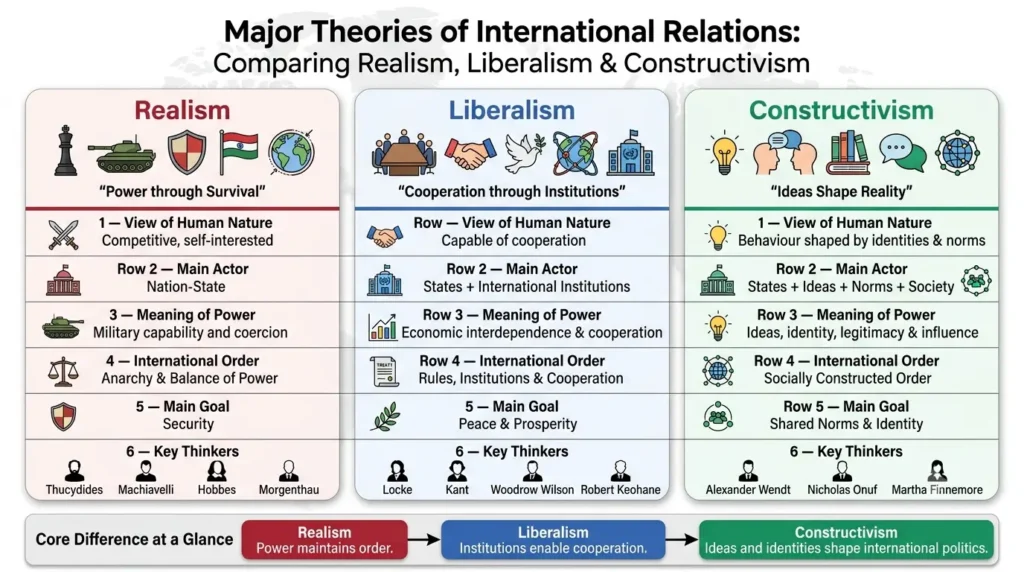
Main Ideas: Power is essential for a state’s survival in an anarchic world; states act rationally to maximise power for security; power is primarily military and economic.
Key Points: The international system is anarchic (no central authority); states are the primary actors; competition for power drives conflict.
Realism’s View on Power
- Relative Power: States care about power relative to others — one state’s gain is often another’s loss.
- Zero-Sum View: Power gained by one state often means power lost by another.
- Strong focus on military capability and strategy.
Notable Thinkers
– Hans Morgenthau argued the desire for power is rooted in human nature. – Kenneth Waltz located the drive for power in the structural absence of central authority in the international system.
Examples: The Cold War arms race; competition for control in the South China Sea.
2. Liberalism
Main Ideas: Power involves cooperation and mutual benefit, not just coercion; international institutions reduce conflict; economic interdependence and democracy lower the likelihood of war.
Key Points: Both states and international organisations matter; absolute gains matter more than relative gains; human progress makes cooperation possible.
Liberalism’s View on Power
- Power includes both hard (military) and soft (cultural, legal) dimensions.
- Shared values help distribute power more fairly among states.
- Strong emphasis on diplomacy and institutional cooperation.
Notable Thinkers
– Immanuel Kant advocated peace through cooperation and democratic governance. – Robert Keohane highlighted how international institutions encourage state cooperation.
Examples: The European Union as a cooperative political-economic bloc; the United Nations’ role in maintaining peace and dialogue.
3. Constructivism
Main Ideas: Power is shaped by ideas, identities, and social norms rather than physical resources alone; state interaction constructs the international system itself; power is deeply contextual and relational.
Key Points: State identities and goals evolve through interaction; norms and beliefs shape how power is perceived and exercised; ideas can reshape power dynamics over time.
Constructivism’s View on Power
- Power can come from norms and shared values, such as human rights.
- Soft power and persuasive influence carry significant weight.
- Power operates through persuasion as much as through force.
Notable Thinkers
– Alexander Wendt argued that international anarchy is “what states make of it.” – Nicholas Onuf introduced constructivism as a framework for explaining how social interaction shapes international relations.
Examples: The global anti-apartheid movement; the spread of democratic norms through organisations like the OECD or NATO.
Comparison of Theories of Power
| Aspect | Realism | Liberalism | Constructivism |
|---|---|---|---|
| Nature of Power | Focus on hard power | Mix of hard and soft power | Power based on social ideas |
| Primary Actors | Primarily states | States and international organisations | States, organisations, and ideas |
| Focus | Security and survival | Cooperation and mutual benefit | Norms and identities |
| Key Mechanisms | Conflict and competition | Institutions and interdependence | Social interaction and shared norms |
| View on Anarchy | Inherent, leads to conflict | Manageable through cooperation | Defined by shared ideas and practices |
(For a deeper comparative treatment of these three schools, see our full Introduction to International Relations Theories notes.)
Key Takeaways: Theories of Power
Realism, liberalism, and constructivism each explain power from a different angle: realism through competition and hard power, liberalism through cooperation and institutions, and constructivism through ideas and identity. Together, they capture the full complexity of how power actually operates in world politics.
4. Power Dynamics
What It Means
Power dynamics refer to shifts in how power is distributed globally — often triggered by the rise of new powers or the decline of existing ones. This can reshape leadership, alliances, and the international system itself.
Key Points: Shifts in economic, military, and political strength drive change; rising powers challenging dominant ones often create tension; the result may be a more multipolar order.
Theory: Power transition theory holds that global stability is most at risk when a rising power approaches parity with a dominant power, since the challenger often seeks to revise existing rules.
Examples
- Historical shifts: The transfer of global leadership from Britain to the United States after World War II; the decline of European colonial powers relative to the U.S. and Soviet Union in the 20th century.
- Current shifts: China’s rise as a global power challenging U.S. primacy; India’s growing influence in the Indo-Pacific.
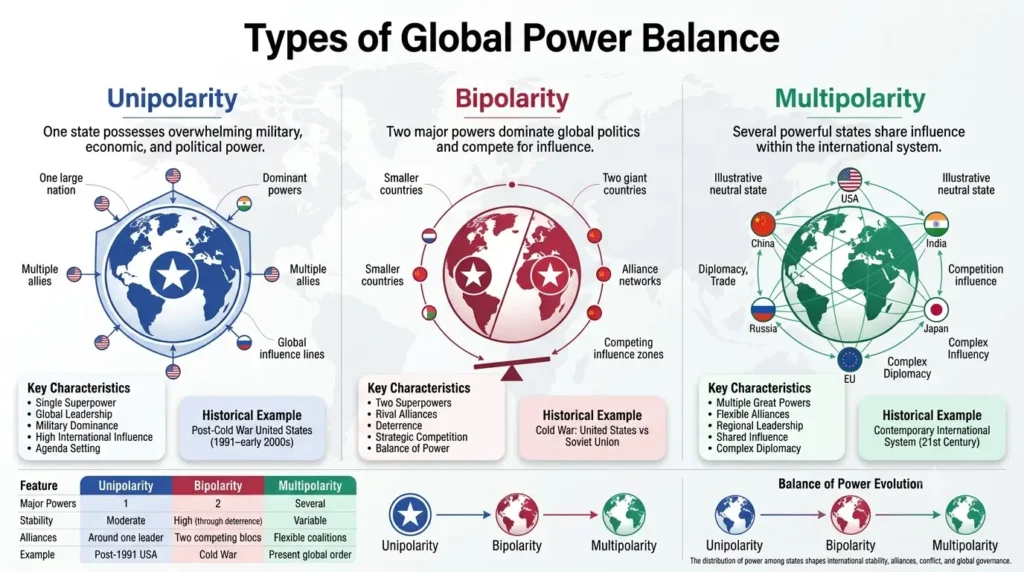
Power Balances in International Relations
Power balances describe how power is distributed among states to prevent any one actor from dominating — a core idea in realist theory, which holds that stability comes from balance.
Types of Power Balances
- Bipolarity — power concentrated in two major states or blocs. Example: the Cold War rivalry between the U.S. and Soviet Union.
- Multipolarity — power spread across several states. Example: the 19th-century European balance of power.
- Unipolarity — power concentrated in a single dominant state. Example: U.S. dominance after the Cold War.
Ways to Maintain Balance: alliances (e.g. NATO); arms build-up as deterrence; balancing (states cooperating against a strong power) versus bandwagoning (states aligning with the strong power for safety or benefit).
Examples: The balance of power in Napoleonic-era Europe; contemporary alliances like AUKUS and the Quad, which counterbalance China’s influence in the Indo-Pacific.
Patterns of Power Dynamics Today
- Hegemony — a dominant state sets the rules of the system. Example: U.S. leadership after WWII through institutions like the UN and IMF.
- Emerging Multipolarity — multiple powers share significant influence, as seen today among the U.S., China, the EU, and India.
- Regional Power Dynamics — states dominate specific regions: Brazil in South America, South Africa in Africa, Saudi Arabia in the Middle East.
- Shift from Hard to Smart Power — states increasingly combine economic leverage, cultural diplomacy, and technology (e.g. China’s Belt and Road Initiative).
- Great Power Competition — renewed rivalry among the U.S., China, and Russia, especially in space, cyberspace, and technology.
- Role of Non-State Actors — corporations, NGOs, and international bodies increasingly shape global power dynamics; tech companies like Google and Apple influence digital policy worldwide.
- Shared Power for Global Challenges — issues like climate change and pandemics require multilateral cooperation, as seen through bodies like the World Health Organization.
Key Takeaways: Power Dynamics
Power dynamics in international relations are constantly evolving due to shifts in economic strength, military capability, and global influence. Concepts like power transition and balance of power help explain how stability, conflict, and cooperation unfold — and as the global order grows more interconnected, understanding these dynamics is essential for making sense of contemporary geopolitics.
5. Case Studies
Case studies illustrate how power actually operates between states, revealing shifts, balances, and the use of different types of power in practice.
Historical Examples
1. The Cold War (1947–1991): Two Major Powers
The U.S. and the Soviet Union were the two dominant powers of this era. Hard power manifested through the arms race, nuclear brinkmanship, and proxy wars in Vietnam and Afghanistan; soft power through the ideological contest between capitalism/democracy and communism; alliances like NATO and the Warsaw Pact formalised the balance. The Soviet collapse in 1991 left the U.S. as the sole superpower.
2. European Colonization (16th–20th Century)
European powers like Britain and France expanded through military conquest (hard power), resource extraction and trade control (economic power), and cultural/religious diffusion (soft power). Decolonisation accelerated after World War II as colonial powers weakened.
3. The Concert of Europe (1815–1914): Many Powers
Following the Napoleonic Wars, European states cooperated through regular diplomatic meetings to prevent any one power from dominating, with Britain often playing a stabilising role. This multipolar arrangement held until World War I.
Modern Examples
1. The Rise of China
China’s rapid growth is changing global power equations. Economic power via the Belt and Road Initiative, expanding military capability in the South China Sea, and growing soft power through cultural diplomacy are reshaping global influence — alongside rising tension with the U.S. over technology and trade.
2. U.S. Dominance after the Cold War
Hard power projected through military interventions in Iraq and Afghanistan; soft power exercised via democracy promotion and multilateral cooperation through the UN. The U.S. remains influential but faces growing competition.
3. European Union (EU)
The EU wields significant economic power through trade agreements and soft power through its promotion of human rights globally — even as it grapples with challenges like Brexit and external security threats.
4. Russia’s War on Ukraine (2022–Present)
Russia’s use of hard power to alter borders has met sustained resistance, with NATO and allied states countering through economic sanctions and military aid, while Ukraine has built significant soft power through its narrative of resistance.
5. Climate Change: Working Together
Climate change highlights the limits of unilateral power: leadership in environmental agreements (soft power) and investment in clean energy (economic power) matter more than military strength, even as disagreements persist between developed and developing nations over responsibility.
Key Takeaways: Case Studies on Power
These examples show that power shifts through both conflict and cooperation. Different combinations of hard, soft, and smart power shape international relations, and adapting to new power configurations is essential for understanding global politics today.
Concept of Sovereignty
Sovereignty means a state’s supreme authority to govern itself without external interference — an idea that has evolved considerably as the world has changed.
1. What is Sovereignty
Basic Definition: Sovereignty is the highest authority within a defined territory. It includes:
- Internal Sovereignty: A state’s control over its own territory and population without outside interference.
- External Sovereignty: Recognition of a state as independent and equal by other states.
Modern Views:
- Westphalian Sovereignty: Non-interference in other states’ internal affairs.
- Popular Sovereignty: The idea that ultimate authority rests with the people, typical of democracies.
- Shared Sovereignty: States pooling some control with organisations like the European Union.
2. History of Sovereignty
A. Early Ideas: In antiquity, sovereignty was linked to rulers seen as divinely appointed. In medieval Europe, authority was fragmented among kings, nobles, and the Church.
B. The Treaty of Westphalia (1648): Ended the Thirty Years’ War and is widely treated as a milestone in the emergence of modern sovereignty. Its principles: non-interference, equality of states, and territorial integrity. It is worth noting — and worth mentioning in your answers for extra credit — that scholars like Andreas Osiander have challenged the idea that Westphalia single-handedly invented the modern state system, arguing it was one milestone among several rather than a clean starting point (a useful critical angle discussed in Osiander’s Sovereignty, International Relations, and the Westphalian Myth).
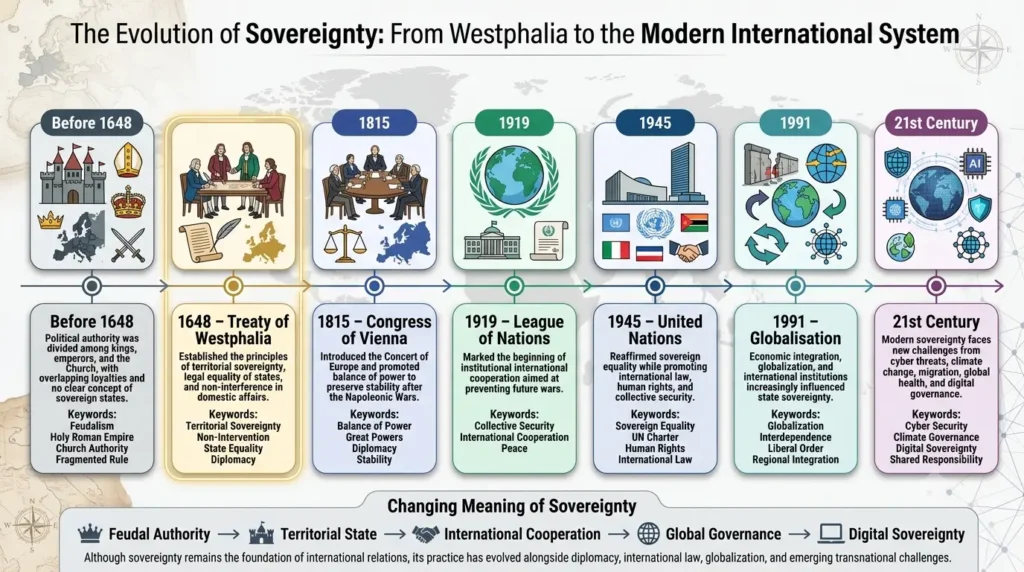
C. Enlightenment and Popular Power (17th–18th Century): Thinkers like John Locke and Rousseau argued sovereignty derives from the people, not from kings. The American and French Revolutions demonstrated sovereignty rooted in popular consent.
D. 19th Century — National Identity and Sovereignty: Nationalism linked sovereignty to national identity and self-rule. The Congress of Vienna (1815) balanced power in Europe while affirming state equality, and anti-colonial movements later borrowed these ideas in their own struggles for independence.
E. 20th Century — New Challenges:
- Decolonization: Post-WWII, many new independent states emerged across Asia, Africa, and the Middle East, with the United Nations (1945) affirming the equality of member states.
- Globalization: Economic interdependence and bodies like the WTO and EU began to challenge traditional sovereignty.
- Humanitarian Interventions: The idea of Responsibility to Protect (R2P) questioned absolute sovereignty by permitting outside intervention to prevent mass atrocities.
F. 21st Century — Sovereignty Today:
- Weakened Sovereignty: Climate change, terrorism, and cybersecurity increasingly require cross-border cooperation, limiting unilateral state action.
- Non-State Actors: Corporations, NGOs, and international bodies now shape government decisions.
- Sovereignty vs. Shared Power: The EU exemplifies how states voluntarily share sovereignty for mutual benefit.
- Struggles for Independence: Movements such as those in Catalonia or Scotland continue to test the limits of state authority.
Key Points About Sovereignty Today
| Aspect | Old Sovereignty | Current Challenges |
|---|---|---|
| State Power | Complete control over local issues | Limited by globalisation and international organisations |
| Borders | Fixed and unchangeable | Contested by migration and trade flows |
| Recognition | Bilateral, state-to-state | Increasingly collective, via bodies like the UN |
| Intervention | Not permitted | Permitted under specific conditions (e.g. R2P) |
Key Takeaways: History of Sovereignty
Sovereignty has evolved from divine kingship to popular, democratic legitimacy. While still central to statehood, it continues to adapt under pressure from globalisation, technology, and non-state actors — the core challenge being how to balance state autonomy with the need for global cooperation.
3. Legal and Political Aspects
Sovereignty has both legal and political dimensions that shape how it operates domestically and internationally.
1. Legal Sovereignty
A. Key Legal Rules
- Territorial Sovereignty: States hold exclusive legal authority over their land, resources, and people, recognised in the UN Charter, Article 2(1), which affirms the sovereign equality of all member states.
- Non-Intervention: No state may interfere in another’s internal affairs — codified in UN Charter Article 2(7), subject to limited exceptions.
- Equality of States: All states are formally equal under international law, underpinning institutions like the International Court of Justice.
- Right to Self-Determination: Peoples have the right to determine their own political status, enshrined in the UN Charter and the International Covenant on Civil and Political Rights (1966).
B. Limits and Issues
- Responsibility to Protect (R2P): Allows intervention with UN approval when a state fails to protect its own population from mass atrocities.
- International Law and Treaties: States voluntarily limit their sovereignty by joining bodies like the WTO or ICC.
- Human Rights Norms: Sovereignty is constrained by obligations under the Universal Declaration of Human Rights (1948).
2. Political Sovereignty
A. Internal Political Sovereignty: Rests on a state’s authority and legitimacy. Challenged by secessionist movements (Catalonia, Scotland), civil wars (Syria, Yemen), and weak governance.
B. External Political Sovereignty: Depends on recognition by other states — Taiwan and Palestine illustrate the limits of partial recognition. Globalisation and the influence of large corporations (e.g. over data and trade) further complicate traditional sovereignty.
C. Shared Sovereignty: The EU and ICC both represent voluntary pooling of sovereignty for collective benefit.
Conflicts Between Legal and Political Sovereignty
| Aspect | Legal Sovereignty | Political Sovereignty |
|---|---|---|
| Focus | Adherence to international law | Actual exercise of power and autonomy |
| Scope | Fixed rules (territorial rights) | Fluid, shaped by shifting power dynamics |
| Challenges | Balancing global norms with state rights | Globalisation, internal instability, external pressure |
| Example of Conflict | R2P intervention vs. state sovereignty | Sanctions undermining political independence |
Current Issues in Sovereignty: cyber sovereignty (e.g. China’s “Great Firewall”); climate sovereignty (the Paris Agreement, 2015); health sovereignty (COVID-19 cooperation via the WHO); and sovereignty tensions from transnational terrorism (e.g. drone strikes raising questions about territorial respect).
Key Takeaways: Legal and Political Sovereignty
Legal sovereignty establishes the formal equality and independence of states, while political sovereignty reflects the real-world exercise of power and governance. Globalisation, technology, and transnational challenges continue to reshape how the two interact.
4. Challenges to Sovereignty
1. Globalization
- Economic: Trade agreements often force domestic policy changes; large corporations can outweigh state authority; reliance on global supply chains creates vulnerability.
- Cultural: Global media and brands can erode local identity.
- Technological: Cross-border platforms and digital currencies like Bitcoin challenge state control over money and information.
2. Transnational Terrorism: Terrorist networks exploit weak states, and counterterrorism often requires cross-border military or intelligence action that bypasses formal consent.
3. Cybersecurity Threats: Cyberattacks target critical infrastructure; election interference undermines political sovereignty; states like China and the EU are asserting “digital sovereignty” to regain control of data flows.
4. Climate Change: Cross-border environmental problems require collective action, limiting unilateral decision-making — as seen in binding international climate agreements.
5. Supranational Organisations: The EU restricts member-state autonomy in exchange for shared economic benefit — a tension made visible by Brexit.
6. Humanitarian Interventions (R2P): Interventions in Kosovo and Libya illustrate how sovereignty can be overridden during mass atrocities, though critics argue R2P is sometimes applied selectively for political ends.
7. Migration and Refugee Crises: Large population movements strain border control and resource allocation, as seen in the European debate over the Syrian refugee crisis.
8. Rise of Non-State Actors: Multinational corporations, NGOs like Amnesty International, and organised crime networks all operate partly outside state control.
9. Internal Challenges: Secessionist movements (Scotland, Catalonia) and civil conflicts weaken central authority.
10. Public Health Crises: COVID-19 forced states to close borders unilaterally while also requiring global cooperation on vaccines.
11. Space and Arctic Sovereignty: Rising commercial and military activity in space, and melting Arctic ice opening new trade routes, are creating new sovereignty disputes.
12. Hybrid Warfare: Russia’s annexation of Crimea combined military force with propaganda and cyber operations, blurring the line between conventional and unconventional threats to sovereignty.
Key Takeaways: Challenges to Sovereignty
State sovereignty faces mounting pressure from globalisation, terrorism, technology, and climate change. While sovereignty remains central to international relations, its practical meaning keeps evolving — and balancing national authority with global cooperation is likely to remain the defining challenge of this century.
5. Theories of Sovereignty
1. Traditional Theories
- Divine Right Theory: Kings rule by divine mandate — exemplified by Louis XIV’s claim, “I am the state.” Discredited by Enlightenment rationalism.
- Social Contract Theory: Sovereignty arises from an agreement between rulers and the governed.
– Thomas Hobbes favoured strong central authority to maintain order. – John Locke advocated limited government accountable to the people. – Jean-Jacques Rousseau argued sovereignty must reflect the general will.
2. Westphalian Sovereignty: Emerged from the 1648 Treaty of Westphalia — non-interference, equality of states, territorial control. Forms the basis of the modern nation-state system, though increasingly questioned amid globalisation.
3. Post-Westphalian Theories
- Globalization and Interdependence: Sovereignty is no longer absolute; states pool authority through bodies like the EU or WTO.
- Responsibility to Protect (R2P): States must protect their citizens; failure can justify outside intervention (e.g. NATO in Kosovo, 1999; UN action in Libya, 2011).
4. Popular Sovereignty: Authority rests with the people, rooted in Enlightenment thought and revolutions like the American (1776) and French (1789).
5. Legal Sovereignty: Austin’s theory frames sovereignty as the command of a supreme authority backed by law, though it is criticised for ignoring the role of public opinion and culture.
6. Internal vs. External Sovereignty: Internal sovereignty concerns control over territory and people (challenged by civil war, corruption); external sovereignty concerns recognition by other states (challenged by cases like Taiwan or Crimea).
7. Constructivist Theory of Sovereignty: Sovereignty is shaped by evolving social norms rather than fixed rules — e.g. the shift from absolute sovereignty toward humanitarian intervention.
8. Critical Theories
- Marxist Theory: Sovereignty as a tool for powerful states to control weaker ones economically.
- Feminist Perspectives: Traditional sovereignty discourse often overlooks women and marginalised groups.
- Post-Colonial Theory: Former colonies continue to face structural disadvantages rooted in past domination.
9. Cyber and Digital Sovereignty: States increasingly seek control over online spaces and data — China’s “Great Firewall” and the EU’s GDPR data protection framework are prominent examples.
Key Takeaways: Theories of Sovereignty
From divine right to popular sovereignty, theories of sovereignty trace how the concept has adapted across centuries. Understanding these frameworks helps explain how states balance independence with growing interdependence.
6. Case Studies
1. Kosovo (2008)
Kosovo declared independence from Serbia in 2008 after the Kosovo War (1998–99). Serbia, backed by Russia, rejected the declaration; the U.S. and many EU states recognised Kosovo, while Russia and China did not. The case highlights the tension between territorial integrity and the right to self-determination, and Kosovo remains only partially recognised today.
2. South China Sea Dispute
China claims most of the South China Sea on historical grounds, contested by the Philippines, Vietnam, Malaysia, and Brunei. A 2016 international tribunal ruled against China’s claims, which China has not accepted — an ongoing test of how international law interacts with territorial sovereignty and power politics.
3. The Crisis in Syria (2011–Present)
Syria’s civil war drew in multiple foreign powers, each backing different factions, severely weakening the Assad government’s control over its own territory and raising enduring questions about humanitarian intervention versus state sovereignty.
4. Brexit and the European Union
The UK’s 2016 vote to leave the EU was driven substantially by concerns over sovereignty — particularly control over immigration and lawmaking. The UK formally left the EU in January 2020, though questions over the balance between shared and national sovereignty persist.
5. Taiwan’s Sovereignty Issue
Taiwan has functioned independently since 1949 but is not recognised by the UN due to China’s “One-China” policy. Its case illustrates how non-recognition can constrain a state’s ability to participate in global institutions, even where de facto sovereignty exists.
Key Takeaways: Case Studies on Sovereignty
These cases show sovereignty is rarely absolute in practice — it is constantly negotiated through territorial disputes, international law, and the politics of recognition.
Concept of Empire
1. What is an Empire?
An empire is a large political entity — typically a state — that controls multiple territories, peoples, and resources, usually through military conquest, settlement, or political domination. Empires are organised around a central authority (an emperor or ruling elite) exercising power over diverse regions and cultures.
History of Empires
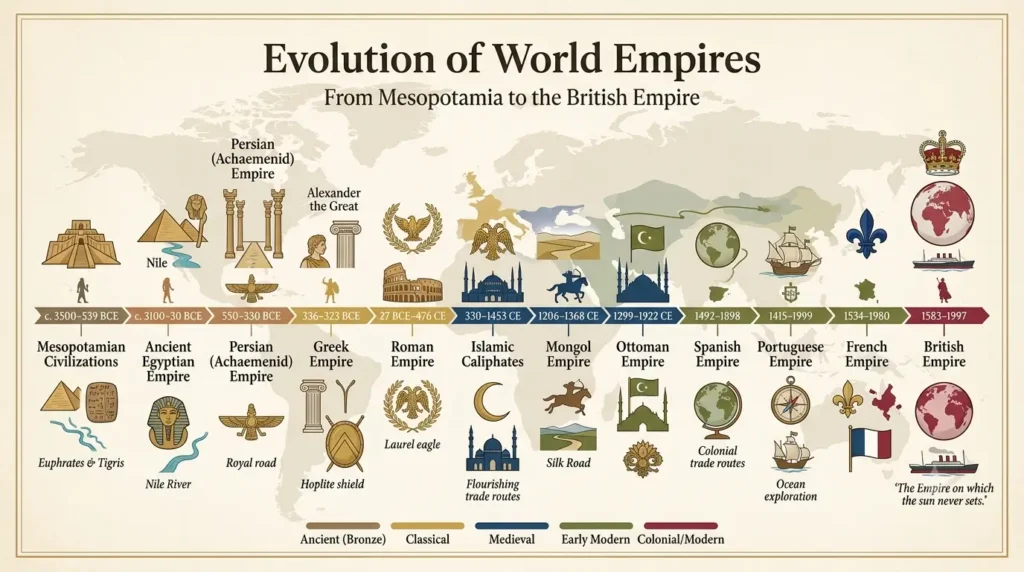
1. Ancient Empires: The Akkadian Empire (~2300 BCE); the Egyptian Empire (New Kingdom, 1550–1077 BCE); the Persian Empire under Cyrus the Great; the Roman Empire (27 BCE–476 CE in the West, continuing as the Byzantine Empire until 1453 CE).
2. Medieval Empires: The Byzantine Empire; the Islamic Caliphates (Umayyad, Abbasid) spreading from Arabia across North Africa, Spain, and Asia; the Mongol Empire, founded by Genghis Khan in the 13th century — the largest contiguous land empire in history.
3. Modern Empires: European colonial empires (Spain, Portugal, Britain, France, the Netherlands) from the 15th to 20th centuries — the British Empire, “on which the sun never set,” being the largest; the Ottoman Empire, controlling parts of Southeast Europe, West Asia, and North Africa until the early 20th century.
Decline of Empires: Internal problems (revolts, economic decline) and external pressures (military defeat, resistance movements) typically drive imperial collapse. The fall of the Ottoman Empire after WWI and the dissolution of the British Empire after WWII mark two defining 20th-century turning points.
Ideas about Empires
- Imperialism: A state’s policy of extending power by acquiring or dominating other territories, often through economic exploitation and cultural control.
- Post-Colonial Theory: Scholars like Edward Said and Frantz Fanon examine how empires shaped colonised cultures and identities, and how these effects persist today.
- Empire as Global Power: Theorists Michael Hardt and Antonio Negri argue that today’s global power operates not as a single empire, but as a decentralised network of economic and military forces.
2. Theories of Empire
1. Colonialism
Colonialism is the practice of acquiring and maintaining colonies for economic, political, and strategic gain, typically through military force, economic control, and settlement — including settler colonialism, exploitation colonialism, and internal colonialism.
Key Aspects:
- Economic Exploitation: Extraction of resources, labour, and land from colonies to enrich the colonising power.
- Cultural Imposition: Colonial powers imposed their language, religion, and institutions, disrupting indigenous social structures.
- Racism and the “Civilizing Mission”: Colonial powers justified domination through racist ideology framing colonised peoples as inferior.
Key Theorists
– Karl Marx viewed colonialism as an extension of capitalist imperialism, extracting cheap labour and resources. – Antonio Gramsci‘s concept of cultural hegemony explains how colonisers maintained dominance through ideology, not just force.
2. Postcolonialism
Postcolonialism examines the enduring legacies of colonial rule after formal independence, especially from the mid-20th century onward.
Key Themes: hybridity and cultural exchange between coloniser and colonised; the psychological and social legacy of colonialism on identity; resistance movements and the challenges of post-independence nation-building.
Key Theorists
– Frantz Fanon, in works like The Wretched of the Earth, examined the psychological effects of colonialism on both coloniser and colonised. – Edward Said, in Orientalism, argued the West constructed a distorted view of the “Orient” to justify colonial domination. – Homi Bhabha developed the concept of “hybridity” and the “third space,” where colonial identities are negotiated and transformed.
3. Neoimperialism
Neoimperialism (or neocolonialism) refers to the continued dominance of former colonial or new global powers over other nations after formal decolonisation — operating through economic, political, and cultural means rather than direct conquest.
Key Aspects: economic control via multinational corporations, the IMF and World Bank; cultural imperialism through the export of Western media and consumer culture; military interventions often framed as humanitarian but criticised as modern imperial control.
Key Theorists
– Kwame Nkrumah, Ghana’s first president, coined the term “neocolonialism” to describe ongoing external control after formal independence. – Immanuel Wallerstein‘s World-Systems Theory divides the world into core, semi-periphery, and periphery nations, with core nations exploiting the periphery. – Noam Chomsky has extensively critiqued U.S. foreign policy and its role in global dominance.
Key Takeaways: Theories of Empire
Colonialism explains the methods and motives of empire-building; postcolonialism examines its lasting cultural and psychological legacy; and neoimperialism critiques how imperial structures persist in today’s globalised world. Together, these frameworks shape ongoing debates about power, inequality, and justice.
3. Characteristics of Empires
1. Expansion and Territorial Conquest — via military conquest (e.g. Rome), colonisation (e.g. British, Spanish, French empires), or strategic alliances and diplomacy.
2. Centralized Control and Hierarchical Structure — a central authority (emperor, ruling elite, or bureaucracy) governs through a hierarchy of local administrators, backed by legal and administrative systems such as Roman law and its road network.
3. Economic Exploitation and Resource Extraction — empires extract resources (e.g. British extraction of Indian cotton and tea), build trade networks (Portuguese and Spanish maritime empires), and often rely on exploited or enslaved labour, as in the Atlantic slave trade.
4. Cultural Influence and Assimilation — language and religion spread through empire (Latin and Christianity under Rome; English and Christianity under Britain); cultural hybridity can also emerge, as in Mughal Indo-Islamic culture; education systems are often used to reinforce imperial ideology.
5. Military Power and Control — large standing armies (Roman legions, the Mongol cavalry, the Royal Navy), military infrastructure (roads, forts), and suppression of internal rebellion sustain imperial control.
6. Legacy of Empire — political boundaries (many African and Middle Eastern borders trace to colonial partition), economic disparities, and cultural imprints (language, religion, legal systems) all persist long after empires collapse.
Key Takeaways: Characteristics of Empires
Empires share six defining traits — expansion, centralised control, economic exploitation, cultural influence, military power, and lasting legacy. These traits help explain both the rise and fall of empires and their continuing imprint on global politics.
4. Case Studies
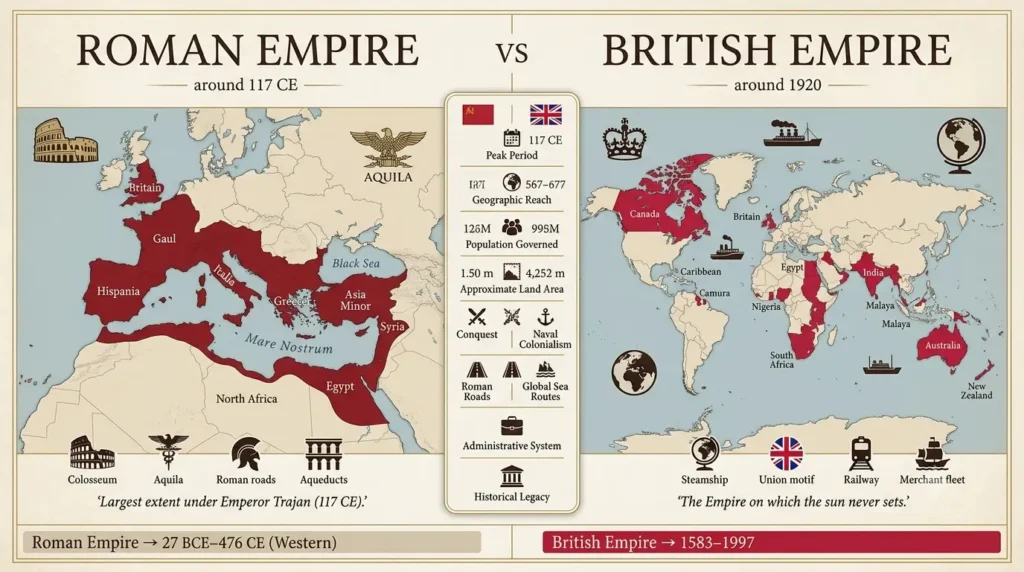
1. The Roman Empire (27 BCE – 476 CE)
Expansion: Grew through conquest — the Punic Wars against Carthage, and annexation of Greece, Egypt, Gaul, and parts of Britain — driven by both resource acquisition and strategic security.
Governance: Became an empire under Augustus in 27 BCE, governed via a complex legal system and provincial administration under proconsuls.
Culture: Latin spread across the empire, laying the foundation for the Romance languages; Roman engineering (aqueducts, roads, amphitheatres) left a lasting infrastructural legacy.
Economy: Relied heavily on resource extraction and slave labour from conquered territories.
Military: The Roman legions and extensive road network (e.g. the Appian Way) secured Mediterranean dominance for centuries.
Decline: Economic trouble, political instability, and invasions by the Huns and Goths led to the empire’s split; the Western Roman Empire fell in 476 CE, while the Byzantine Empire endured until 1453 CE.
Legacy: Roman law, governance structures, and infrastructure continue to influence the modern world, alongside the spread of Christianity across Europe.
2. The British Empire (16th Century – Mid-20th Century)
Expansion: Grew via colonisation, military conquest, and trade — the East India Company playing a central role in establishing British control over India.
Governance: Ruled through the British monarchy and Parliament, with colonial governments varying from self-governing dominions (Canada, Australia) to more directly controlled territories (India, parts of Africa).
Economy: Built global trade routes, extracted raw materials (cotton, rubber, minerals), exploited enslaved labour in the Caribbean and Americas via the Triangular Trade, and fuelled Britain’s Industrial Revolution.
Culture: Spread the English language and the ideology of the “civilizing mission,” while also introducing education and legal systems that shaped the later Commonwealth of Nations.
Military: The Royal Navy protected trade routes and enforced control, while suppressing uprisings such as the Indian Rebellion of 1857 and the Mau Mau Uprising in Kenya.
Decline: Weakened by two world wars and rising independence movements; the Indian Independence Act of 1947 marked a pivotal turning point, followed by decolonisation across Africa, Asia, and the Caribbean.
Legacy: English remains a global lingua franca; British legal and political institutions continue to shape former colonies; the Commonwealth of Nations survives as an institutional remnant of empire.
Key Takeaways: Roman and British Empires
Both empires demonstrate the shared logic of empire — expansion, centralised governance, economic exploitation, and cultural influence — while also showing how imperial legacies (law, language, infrastructure) persist long after formal collapse.
5. Contemporary Issues
1. Neo-imperialism and Global Power Dynamics: Economic dependency through debt and trade practices (China’s Belt and Road Initiative is often cited in this context); continued military interventions by major powers (e.g. the 2003 Iraq War, NATO’s role in Libya in 2011) echo older imperial patterns of influence.
2. Postcolonial Struggles and National Identity: Tension between colonial-era languages and national identity; ongoing cultural imperialism through Western media dominance; persistent economic inequality tied to colonial-era exploitation; disputes over land and resource rights affecting Indigenous communities.
3. Neocolonialism in Africa and Latin America: Continued economic dependency on raw-material exports; foreign military bases (e.g. U.S. AFRICOM) framed as security cooperation but sometimes criticised as neocolonial influence; “debt trap diplomacy” as a mechanism of leverage.
4. Reparations and Historical Justice: Growing calls for reparations from descendants of enslaved peoples and Indigenous communities; ongoing debates over cultural restitution — for instance, the return of artefacts like the Benin Bronzes.
Key Takeaways: Contemporary Issues in Empire
While classical empires have formally ended, their legacies — economic inequality, cultural influence, and contested identities — continue to shape global politics through neo-imperialism, postcolonial struggle, and demands for historical justice.
International Order
1. Definition and Components
International order is the system of rules and practices that governs how states, organisations, and other actors interact globally — managing cooperation, competition, and conflict across security, trade, human rights, environment, and diplomacy. It is not static; it evolves with shifts in power, technology, and prevailing ideas about fairness and justice.
Main Parts of International Order
1. International Institutions: the United Nations (peace, security, human rights, with agencies like UNESCO and WHO); the World Trade Organization (trade rules); the IMF and World Bank (global economic management); regional bodies like the EU and African Union.
2. International Laws and Norms: International Humanitarian Law; International Human Rights Law; environmental law; the principle of sovereignty and non-intervention; customary international law (e.g. freedom of navigation).
3. Power and Security Structures: distribution of power among states; security arrangements like NATO; arms control treaties; the regulation of military force under international law.
4. Global Trade and Economic Systems: global trade regimes; interdependent supply chains; economic sanctions; development aid.
5. Diplomacy and International Cooperation: diplomatic norms; multilateralism; informal “Track II” diplomacy; crisis and humanitarian diplomacy.
6. Norms of Justice, Human Rights, and Equality: the Universal Declaration of Human Rights; accountability mechanisms like the International Criminal Court; efforts to reduce global inequality.
Key Takeaways: Components of International Order
International order is a layered system of institutions, laws, power structures, trade regimes, diplomacy, and human rights norms — one that keeps evolving in response to global events and shifting ideas about legitimacy and justice.
2. Theories of International Order
1. Realism: Power and Security
Realists see international politics as anarchic, with power and security as the central drivers of state behaviour. Key ideas: anarchy; state-centrism; self-help; the security dilemma (one state’s military build-up can make others feel less secure); a competitive view of human nature.
Realism on Order: Order depends on how power is distributed — unipolar systems tend to be more stable, while multipolar or bipolar systems are seen as more conflict-prone. Cooperation is limited by states’ pursuit of self-interest, and a stable order requires a roughly even balance of power.
2. Liberalism: Cooperation and Institutions
Liberals emphasise cooperation, interdependence, and the role of institutions in sustaining peace. Key ideas: international institutions and norms (like the UN) enable cooperation; economic interdependence discourages war; the Democratic Peace Theory holds that democracies rarely fight each other; human progress and rational cooperation can manage global problems.
Liberalism on Order: Global institutions like the UN and NATO can prevent conflict, resolve disputes, and achieve shared goals — global governance is central to sustaining a peaceful order.
3. Constructivism: Ideas, Norms, and Identities
Constructivists argue international order is built through shared understandings and social interaction, not power or institutions alone. Key ideas: the social construction of international reality; the role of state identity in shaping foreign policy; evolving norms (e.g. changing views on sovereignty and humanitarian intervention); socialisation of states through repeated interaction.
Constructivism on Order: International order reflects prevailing norms and ideas, which shift as global understandings change — explaining why the “rules of the game” evolve even without major shifts in material power.
Key Takeaways: Theories of International Order
Realism explains order through power and security, liberalism through cooperation and institutions, and constructivism through evolving norms and identities. Each offers a distinct lens for understanding why international order holds together — or breaks down.
3. Historical Evolution
1. Ancient and Medieval International Orders (Pre-1500): Early international relations were regional rather than global — shaped by Mesopotamian, Egyptian, and Greek city-state diplomacy; Roman law as a precursor to modern international law; the Dar al-Islam framework governing relations under the Islamic Caliphates; and decentralised feudal diplomacy in medieval Europe.
2. The Peace of Westphalia (1648): Marked a foundational (if contested) milestone for the modern state system, establishing sovereignty, territorial integrity, limited religious tolerance, and the framework for modern diplomacy.
3. The Rise of Colonial Empires (1500–1914): European imperial expansion created a hierarchical global order dominated by Western powers; the Concert of Europe (1815) managed great-power balance within Europe but did little to check colonial expansion elsewhere; global trade and the Atlantic economy linked Europe to its colonies through exploitation.
4. The World Wars and the Creation of the Modern International Order (1914–1945): WWI dismantled the Ottoman, Austro-Hungarian, and Russian empires and produced the (ultimately ineffective) League of Nations. WWII led to the founding of the United Nations in 1945, alongside the beginning of large-scale decolonisation.
5. The Cold War Era and the Bipolar International Order (1945–1991): Defined by U.S.–Soviet rivalry, the nuclear arms race and the logic of mutually assured destruction, and numerous proxy wars fought through the UN’s structural limitations.
6. The Post-Cold War Era and the Unipolar World (1991–present): Marked by accelerating globalisation, U.S. hegemony, and — more recently — growing multipolar competition from China, Russia, and regional powers, alongside ongoing debate over the effectiveness of institutions like the UN, IMF, and World Bank.
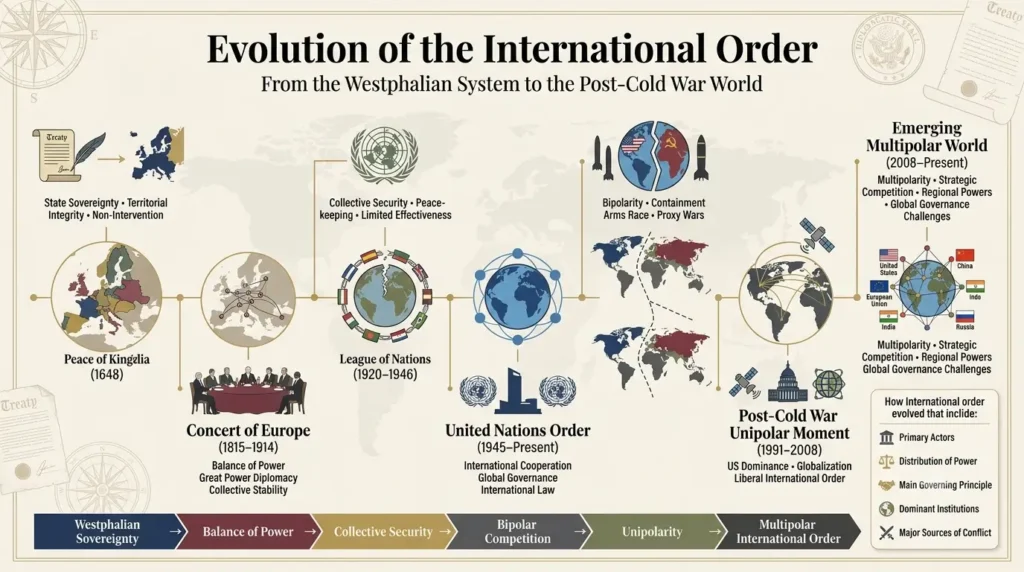
Key Takeaways: Historical Evolution of International Order
From ancient regional diplomacy through Westphalian sovereignty, colonial hierarchy, the World Wars, the Cold War, and today’s contested multipolarity, international order has continually adapted to shifting power, ideology, and technology.
4. Case Studies
1. The Cold War and the Bipolar International Order (1945–1991): The defining case study for bipolar order — U.S.–Soviet rivalry shaped military alliances, economic systems, and global governance structures for nearly half a century, illustrating both the stability and the risks bipolarity can produce.
(Continue exploring related units and case studies in our DU Political Science notes archive.)
Previous Year Questions (DSC-6, Unit 3)
Yeh questions actual DU B.A. (Prog./Hons.) Political Science DSC-6 examination papers ke recurring patterns par based hain. Inhe practice karke aap apni answer-writing strategy strong bana sakte hain.
- “Sovereignty is considered as the hallmark of modern nation-state system.” Explain. (Asked in DU DSC-6 semester examination, Unique Paper Code 1361.)
- Discuss the different types of power — hard, soft, and smart power — with suitable examples.
- What is meant by power transition and balance of power? Explain with examples.
- Explain the Westphalian conception of sovereignty and its relevance in the contemporary world.
- Critically examine the challenges to state sovereignty posed by globalisation.
- What is an empire? Discuss the key characteristics of empire with reference to the Roman and British Empires.
- Distinguish between colonialism, postcolonialism, and neoimperialism.
- What is international order? Discuss its main components.
- Compare realist, liberal, and constructivist perspectives on international order.
- Trace the historical evolution of international order from the Peace of Westphalia to the present.
- Write a short note on the Responsibility to Protect (R2P) and its implications for sovereignty.
- Discuss any one contemporary case study (Kosovo, South China Sea, Brexit, or Taiwan) that illustrates the tension between sovereignty and international politics.
FAQs
What are the four main concepts covered in DSC-6 Unit 3?
Unit 3 of DSC-6 covers four core concepts in International Relations: power, sovereignty, empire, and international order — each explored through multiple theoretical lenses (realism, liberalism, and constructivism).
What is the difference between hard power and soft power?
Hard power relies on coercion — military force, economic sanctions, or threats — to influence others. Soft power relies on attraction and persuasion, drawing on a country’s culture, values, and diplomacy, as conceptualised by Joseph Nye.
What is Westphalian sovereignty?
Westphalian sovereignty is the principle, associated with the 1648 Peace of Westphalia, that each state has exclusive authority over its own territory and that other states should not interfere in its internal affairs. It remains foundational to the modern international system, though it is increasingly challenged by globalisation.
How is an empire different from a nation-state?
An empire is a large political entity controlling multiple territories, peoples, and cultures under a single central authority, often acquired through conquest. A nation-state, by contrast, is typically a single sovereign territory associated with one dominant national identity.
What is the Responsibility to Protect (R2P)?
R2P is a global political commitment holding that states must protect their populations from genocide, war crimes, ethnic cleansing, and crimes against humanity — and that the international community may intervene, with UN approval, when a state fails to do so.
Why is Taiwan’s sovereignty considered a sensitive issue?
Taiwan has functioned as a self-governing entity since 1949, but it is not recognised by the UN due to China’s One-China Policy, which claims Taiwan as part of Chinese territory. This makes Taiwan’s international status a persistent flashpoint in global politics.
What is the realist view of international order?
Realists argue international order depends primarily on the distribution of power among states. A stable order requires a roughly even balance of power, since unchecked dominance by one state can provoke conflict from rising challengers.
Subscribe to keep reading
You've used your free notes for now. Get Delhi Pathshala Premium for unlimited access.
Subscribe — ₹29/30 days