
Contents
- Introduction
- About Hayleigh Barclay
- About Disability Horizons
- Disability Literature in Scotland
- Publication Context
- Importance of Short Stories in Disability Literature
- Summary of “Happy Birth-day”
- Setting and Characters
- Plot Overview
- Key Events
- Symbolism in “Happy Birth-day”
- The Sterile Room
- The Carnation Poster
- The Purple Door
- The Cupcake
- “Deal with It!”
- Significance of the Title
- An Unhappy Fairy Tale: Subverting Cinderella
- Analysis of Themes
- Identity and the Imposition of Disability
- Society’s Perception of Disability
- Institutional Indifference and Satire of Bureaucracy
- Isolation Within a System, Not Just Within a Family
- The Role of Humour in Serious Topics
- Medical Model vs Social Model of Disability
- Dr LuLu as a Caregiver Figure
- Genre: Satire and Dark Humour
- Literary Devices and Techniques
- Irony and Wit
- Character Development and Dialogue
- Narrative Style and Structure
- Understanding the Context
- Historical and Cultural Background of Disability in Literature
- Disability’s Influence on the Story
- The Importance of Disabled Writers Today
- Scholarly Views and Critiques
- The Importance of Barclay’s Work in Literature
- Key Takeaways
- Continue Reading
- University of Delhi Previous Year Questions
- Frequently Asked Questions (FAQs)
- Conclusion
- External Sources Referenced
In this post, updated and fact-checked notes on “Unit 3C: Happy Birth-day” by Hayleigh Barclay, from DSC-17: Literature and Disability, are given — covering an accurate plot summary, symbolism, satire, themes, and exam-oriented material for DU students.
Introduction
About Hayleigh Barclay
Hayleigh Barclay is a Scottish writer and disability advocate who lives with Spinal Muscular Atrophy (SMA) Type 2, a condition that affects muscle strength and movement. Her lived experience directly shapes both her advocacy work and her writing, which combines personal narrative with creative fiction to challenge disability stereotypes and push for greater inclusion. She also holds a Doctorate of Fine Arts in Creative Writing (2019), making her one of relatively few disabled women in the UK to hold this qualification.
In 2010, Barclay founded the ‘Plane Fair’ campaign, an initiative pressing the aviation industry to adopt technology that would let wheelchair users remain in their own chairs during flights — highlighting problems like inaccessible seating, inadequate toilet facilities, and wheelchair damage during air travel. Her advocacy work connects to broader disability-rights frameworks such as Scotland’s ‘A Fairer Scotland for Disabled People’ Strategy (2016), and she is also involved with UK Trailblazers, a network of young disability advocates.
As a writer, Barclay’s short fiction for Disability Horizons includes “Happy Birth-day” (2018), which explores self-perception and social expectation; Designer Genes (2018), on the ethics of genetic engineering; Office Politics (2019); Rolling In It (2020); and Cinderella Reimagined (2021), which reworks the fairy tale into a story of disabled empowerment. Her debut novel, Girl of the Ashes (2020, Indie Authors Press), is a historical fantasy set in 19th-century Scotland, following an 18-year-old wheelchair-using protagonist navigating social expectation and personal identity. In 2023, she also wrote and released a short film, The Ghost of Me, exploring mental health, identity, and self-acceptance, produced by Disability Horizons’ media branch.
(Sources: Hayleigh Barclay’s author profile on Disability Horizons; DU SOL Study Material, DSC-17: Literature and Disability, Unit III(5))
About Disability Horizons
Disability Horizons is a UK-based online magazine, founded in 2011 by Martyn Sibley and Srin Madipalli — both of whom also live with Spinal Muscular Atrophy — that shares the experiences, opinions, and creative work of disabled people. The platform publishes articles, personal stories, lifestyle content, and reviews written from a disabled perspective, and has also run creative initiatives — such as the short-story series that produced “Happy Birth-day” — specifically to put disabled characters at the centre of fiction rather than treating disability as a side issue or a source of pity.
Disability Literature in Scotland
Barclay’s work belongs to a wider tradition of Scottish disability literature and activism. The disability rights movement in Scotland gained real momentum through the 1970s–80s alongside other social justice movements, with institutional visibility growing through bodies like the Scottish Disability Equality Forum (established 2001) and Disability Scotland (founded 1991). In literature specifically, writers such as Leela Soma (The Slow Disappearance of Dale R., 2001) and poet-essayist David R. Brown (The Silence of the Wheelchair, 2003, which critiques the medical model of disability) had already begun exploring disability from the inside. Barclay’s “Happy Birth-day” (2018) is a continuation of this wave — using satire and speculative fiction rather than realism to make its case.
Publication Context
“Happy Birth-day” was written by Hayleigh Barclay, with an accompanying illustration by disabled illustrator Philip Hoare, and was first published on Disability Horizons on 14 May 2018. It was the first entry in a planned series of short stories and illustrations built around a single premise: what would fiction look like if disabled characters were written as the hero or heroine of their own story, instead of being reduced to a symbol of suffering or inspiration? This editorial context matters for exam purposes — it explains why the story is structured as a compact, single-scene, almost fable-like narrative rather than a longer realist story.
Importance of Short Stories in Disability Literature
Short stories are important in disability literature because they can express complex feelings and experiences in a brief, concentrated format. Rather than building an entire fictional world, a short story like “Happy Birth-day” can compress an entire argument about disability, identity, and social attitudes into a single scene and a handful of pages. This makes the form especially useful for direct, focused critique — as seen in Barclay’s story, which uses one continuous conversation to interrogate how society assigns meaning to disability before a person is even born. With contributions from writers like Hayleigh Barclay, this genre continues to grow, offering both representation and sharp social commentary within a short, teachable text.
Summary of “Happy Birth-day”
Setting and Characters
The story is set entirely in an imagined bureaucratic afterlife — specifically, a “Reincarnation Department” where souls are processed and assigned their next life. The two central figures are:
- The woman (protagonist): an unnamed soul undergoing her fifth attempt at the reincarnation process, whose memory has been wiped after each of her four previous deaths.
- Dr LuLu: a brisk, clinically detached official who conducts the woman’s “pre-birth consultation” and delivers the news of her next incarnation.
Minor figures — a smiling young male attendant, and “Penelope,” a colleague Dr LuLu calls on the phone — appear briefly to reinforce the story’s picture of reincarnation as a cold, understaffed bureaucratic system rather than anything mystical or sacred.
Plot Overview
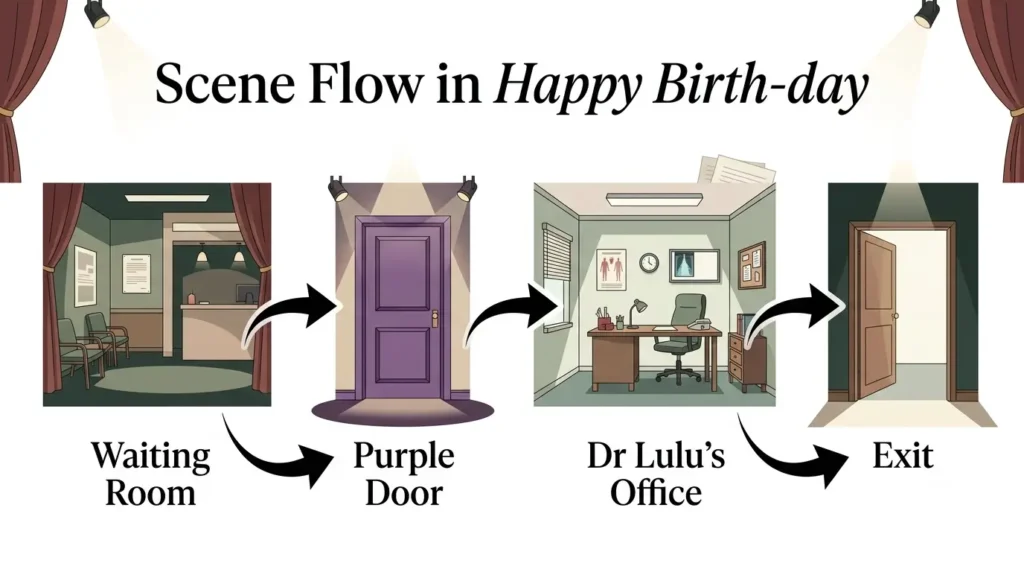
The story opens in a waiting room with beige walls, flickering neon lights, and oversized pink armchairs, where several souls sit in tense silence before being called forward. The protagonist notices a garish poster of a white carnation with the word “REIN” printed on it in gold letters — an unsubtle branding exercise for the Reincarnation Department. A young attendant leads the group away, but stops the woman and directs her instead through a purple door on the other side of the room.
Passing through the door, she falls into darkness and lands in a different office, facing Dr LuLu, who welcomes her to her “pre-birth consultation.” Dr LuLu reviews the woman’s “life plan” — her future parents, appearance, destiny, and date of death — but interrupts herself to deliver what she frames as a dramatic announcement: the woman is going to be born disabled in her next life.
The woman reacts with shock, fear, and confusion, initially wondering whether this is a punishment for something done in a past life. Dr LuLu dismisses this as superstition, and the two enter a long, increasingly candid exchange: the woman asks whether she gets to choose her disability (she does not), whether people will treat her badly because of it (Dr LuLu bluntly says some people are “assholes” who ask invasive questions), and whether one disability is “better” than another (Dr LuLu insists disabilities are simply different, not better or worse — and that this is not for anyone to judge).
As the conversation continues, Dr LuLu admits she may have oversold the situation as a dramatic “mission” and clarifies that it is closer to a matter of free will mixed with fate. Before the woman can ask any of her remaining questions — about her parents, her appearance, how she will die — the young attendant returns to collect her. Dr LuLu ends the session abruptly, telling the woman to “deal with it” and sending her through the door with the sardonic parting line that gives the story its title.
Key Events
- The waiting room and the purple door: the woman is separated from the group and led to an individual “pre-birth consultation,” setting up the story’s central premise.
- The announcement: Dr LuLu tells the woman she will be born disabled — delivered with theatrical timing that immediately falls flat.
- The interrogation of fear and prejudice: the woman voices exactly the fears and questions a real newly-disabled person (or their family) might have — punishment, pity, mistreatment, hierarchy of disabilities — and Dr LuLu answers each one directly, deflating the myths one by one.
- The abrupt, unresolved ending: the woman is pushed out the door mid-question, with no manual, no full explanation, and no comfort — only Dr LuLu’s blunt “deal with it.”
Symbolism in “Happy Birth-day”
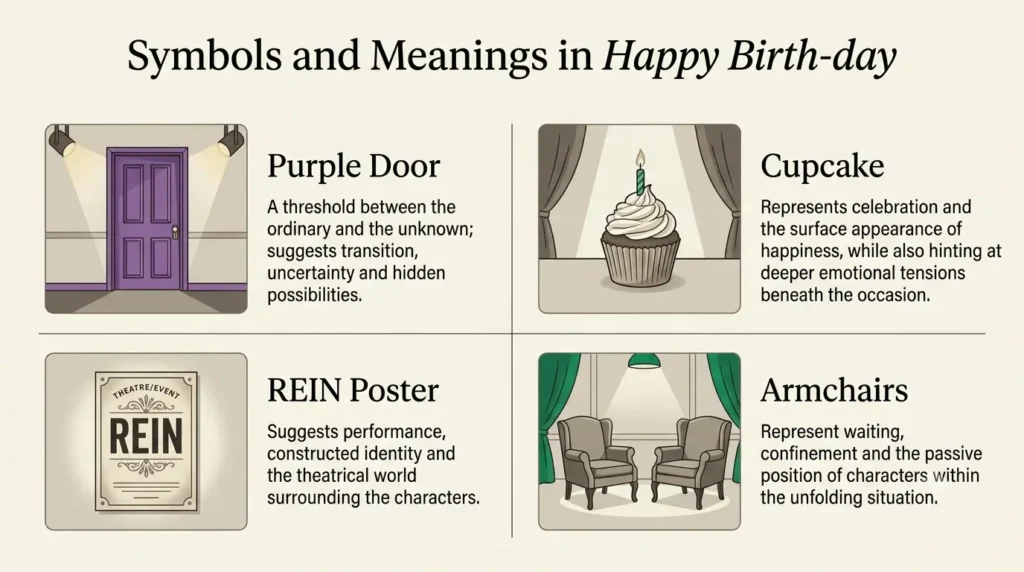
Barclay uses a small set of concrete, almost absurd objects to carry the story’s larger argument about how bureaucracies and institutions handle something as significant as disability. Quick-reference table first, followed by exam-ready short notes on each symbol.
| Symbol | What it represents |
|---|---|
| The sterile room (beige walls, flickering neon lights, Aztec rug) | Discomfort, tension, and liminality — a “blank,” unstable waiting space mirroring the fragility of the woman’s situation. |
| The “REIN” carnation poster | Corporate branding applied to something as profound as reincarnation — critiques how large systems package deeply personal experiences (including disability) as generic, sanitised products. |
| The purple door | A threshold or point of transition — between the woman’s old identity and the new life (and disability) she is about to be assigned. |
| The oversized armchairs (pink, then yellow with orange stripes) | Discomfort disguised as comfort — the furniture looks welcoming but leaves the woman feeling out of place, mirroring how accommodation is often offered in appearance only. |
| The cupcake offered in the waiting room | A superficial, token gesture of comfort offered before life-altering news — critiqued in the DU SOL material via a direct comparison to Aldous Huxley’s Brave New World (see Genre section below). |
| “Deal with it!” | The story’s closing line and its own symbol of emotional detachment and systemic indifference — see dedicated section below. |
The Sterile Room
The room’s beige walls, flickering neon lights, and Aztec rug are built to evoke discomfort and a sense of liminality — a blank, unstable space that mirrors the fragility of the woman’s own situation. The Aztec rug specifically gestures toward Aztec beliefs about cyclical death and rebirth, tying the room’s décor to the reincarnation premise itself. The oversized pink armchairs look comfortable but only heighten the woman’s sense of being out of place — physical comfort paired with emotional unease, reflecting a place that offers the appearance of care without addressing the real problem at hand.
The Carnation Poster
The white carnation and gold “REIN” lettering nominally signal purity and new beginnings, but the poster’s garish, commercial design reduces the profound concept of reincarnation to something decorative and marketable — much as the woman’s identity, fate, and agency are reduced to impersonal decisions made in the sterile room. The wordplay in “REIN” (suggesting both control and cyclical recurrence) also raises a bigger question the story leaves open: is life an orderly, controlled process, or an arbitrary one? This tension between order and chaos echoes concerns raised in Albert Camus’s The Myth of Sisyphus (1942).
The Purple Door
The purple door is a symbol of transition — the threshold between the known and the unknown, using purple’s traditional association with spirituality and transformation. Passing through it, the woman experiences a flash of blue light before falling into darkness and landing in a garishly-coloured yellow-and-orange armchair — a sequence that dramatizes the disorientation and lack of control that accompanies enforced change, while the jarring colour contrast underlines how “new beginnings” can be both vibrant and destabilising at once.
The Cupcake
The cupcake offered in the waiting room stands for a superficial, consumable “fix” offered in place of genuine emotional or psychological support — a small, trivial gesture set against a moment of real crisis. This is comparable, as the DU SOL material for this unit points out, to Aldous Huxley’s Brave New World (1932), where the drug soma offers citizens shallow contentment in place of real emotional or intellectual engagement; both texts critique institutions that trade genuine depth for surface-level appeasement.
“Deal with It!”
The story’s closing line is treated as a symbol in its own right in the official DU course material: it captures the emotional detachment with which the protagonist’s very real fears are dismissed, and the lack of guidance or empathy she is offered as she is sent into an unknown future. Read alongside disability theorist Lennard J. Davis‘s argument (in The Disability Studies Reader, 1997) that society tends to treat disability as something to be “fixed” rather than accepted, the phrase becomes a compressed statement of exactly that dismissive, fix-it-or-ignore-it attitude — leaving the protagonist to navigate an unaccommodating world with no manual and no real support.
Significance of the Title
The title “Happy Birth-day” is a deliberate pun and a piece of dramatic irony. On the surface, it echoes the innocuous, celebratory phrase “Happy Birthday” — but Barclay hyphenates it (“Birth-day”) to draw attention to its literal meaning: the day the protagonist is assigned the specifics of her next birth, including her disability. The phrase is also the story’s closing line, delivered by Dr LuLu with clinical indifference as she pushes the woman through the door: “Deal with it! … Happy Birth-day.” Used this way, the “happy” in the title becomes deeply ironic: it is not a warm wish but a dismissive sign-off, underscoring the story’s critique of how casually institutions can deliver life-changing news without genuine care.
An Unhappy Fairy Tale: Subverting Cinderella
The DU course material frames “Happy Birth-day” as a deliberate inversion of the traditional fairy-tale structure, using Cinderella (1697) as its reference point. In a classic fairy tale, a powerless protagonist’s problems are resolved through external, often magical, intervention. Barclay’s protagonist is similarly powerless — but no magical transformation arrives. She must simply accept a condition she never chose, and her life becomes more complex, not less, once the “assignment” is made.
This framing connects to Rosemarie Garland-Thomson‘s observation (Extraordinary Bodies, 1997) that disabled characters in literature are rarely written as heroes — often appearing instead as tragic figures in need of rescue, as with Quasimodo in The Hunchback of Notre-Dame (1831). By denying its protagonist any magical fix, “Happy Birth-day” resists this rescue narrative altogether, instead mirroring the real, unresolved, ongoing nature of disabled life without pretending a story-book ending is coming.
Analysis of Themes
Identity and the Imposition of Disability
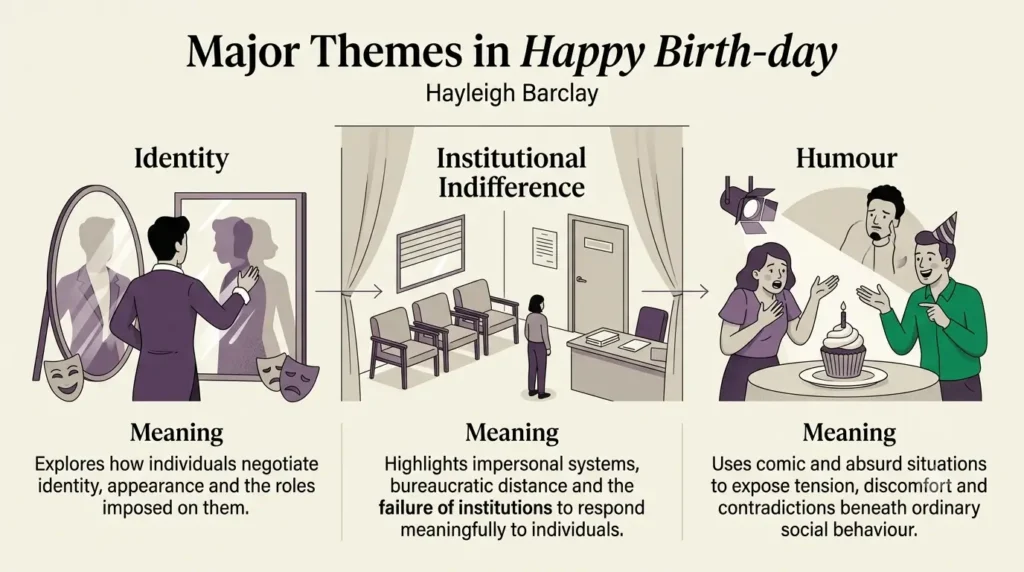
Unlike stories where a character is born with or develops a disability over time, “Happy Birth-day” restructures the entire premise: disability is presented as something assigned from outside, before the character even exists in the world. This lets Barclay dramatize a question many real disabled people face indirectly — why me? — without needing a realist setting. The woman’s initial reaction (fear, a sense of punishment, resistance) mirrors the process of coming to terms with an unchosen identity marker, while Dr LuLu’s blunt responses (“Why not you?”) reject the idea that disability requires justification or blame.
Society’s Perception of Disability
Much of the story’s critique is delivered indirectly, through Dr LuLu’s warnings about how humans will treat the woman once she is born: intrusive questions about her body, her sex life, how her disability happened, and offers of unsolicited prayer. This preemptive warning — delivered before the woman has even been born — is Barclay’s way of showing that ableism is not an occasional lapse in manners but a predictable, almost programmed pattern of behaviour that disabled people are told to expect and prepare for.
Institutional Indifference and Satire of Bureaucracy
The reincarnation department is staffed by officials who treat an enormous, life-altering decision with the same tone as a routine paperwork process. Dr LuLu is unprepared for the woman’s emotional reaction (she has no tissues, only a post-it note), attempts a phone call mid-session, and eventually cuts the consultation short simply because the next appointment has arrived. This satirical framing critiques how large systems — whether cosmic, institutional, or bureaucratic — often process deeply personal human (or, here, pre-human) experiences with detached efficiency rather than genuine care.
Isolation Within a System, Not Just Within a Family
Earlier readings of this story sometimes assume the isolation in “Happy Birth-day” comes from family or social gatherings; in the actual text, the isolation is structural. The woman is quite literally singled out from a group, led alone through a door, and left to process life-altering news with no support system, no manual, and no time to prepare. This reframes “isolation” as a failure of institutional support rather than a failure of interpersonal relationships — an important distinction for exam answers.
The Role of Humour in Serious Topics
“Happy Birth-day” is fundamentally a comic story, but its humour is used to deliver serious social critique rather than to soften or avoid it. Dr LuLu’s sarcastic asides (mocking people who reduce others to a single label — “Oooh, she has a disability… Oooh, she is a lesbian… Oooh, she has green hair”) and her generally unbothered tone in the face of the woman’s distress generate dark comedy that exposes, rather than excuses, institutional carelessness. The humour gives the story its satirical edge: readers laugh at the absurdity of the system, and in doing so are made to notice how normalised that absurdity actually is.
Medical Model vs Social Model of Disability
The DU course material reads the protagonist’s frustration through the lens of two competing frameworks in disability studies: the medical model (as discussed by Lennard J. Davis in Enforcing Normalcy, 1995), which treats disability as an individual deficiency needing correction, and the social model (as developed by Mike Oliver in The Politics of Disablement, 1990), which locates the “problem” in social barriers rather than in the disabled person. The protagonist’s anger is directed less at the disability itself and more at having it imposed by an impersonal system that treats her purely as a medical case — pushing the story closer to a social-model reading, even though it is Dr LuLu, an institutional figure, who insists (not entirely convincingly) that no disability is “better or worse” than another.
Dr LuLu as a Caregiver Figure
Beyond functioning as comic relief, Dr LuLu can also be read as a study in the ethics of caregiving under institutional constraint. Her choice to call the disability a “mission” rather than a “problem” or “defect” is a small but deliberate act of reframing — an attempt, however imperfect, to offer the protagonist a sense of purpose. Read against Carol Gilligan‘s work on the ethical dilemmas caregivers face when institutional demands collide with the emotional needs of those in their care (In a Different Voice, 1982), Dr LuLu emerges as someone caught between procedural duty and a flicker of genuine consideration — which is part of why the story avoids painting her as a simple villain.
Genre: Satire and Dark Humour
“Happy Birth-day” is best read as a work of satire, using an absurd, exaggerated premise — reincarnation run like a government office — to comment on real social attitudes toward disability. The DU course material draws two specific comparisons here. First, to Jonathan Swift‘s Gulliver’s Travels, where absurd or grotesque fictional societies (the Lilliputians, the detached governance of Brobdingnag) expose real institutional follies — Barclay’s cupcake, offered as a “solution” to a life-altering crisis, works the same way, as an exaggerated symbol of institutional inadequacy. Second, to Aldous Huxley‘s Brave New World (1932), where the drug soma keeps citizens docile through shallow, engineered contentment; the cupcake performs an equivalent function in miniature, trading real depth and care for a token, consumable gesture.
The story’s clinical, detached tone — most visible in Dr LuLu’s matter-of-fact delivery of life-altering news, and in Barclay’s reference to “Soup Can Culture” (an allusion to Andy Warhol‘s Campbell’s Soup Cans, 1962, which flattens uniqueness into mass-produced, marketable labels) — heightens this satirical effect throughout. This distinguishes “Happy Birth-day” from more solemn or tragic disability narratives, positioning it instead alongside satirical and darkly comic writing traditions.
Literary Devices and Techniques
Irony and Wit
The central irony of the story lies in the mismatch between the momentousness of the announcement (a soul is about to be born disabled) and the offhand, almost bored way Dr LuLu delivers it — including her disappointment that the woman doesn’t react with enough “dramatic” flair. The woman’s own wit emerges through her sharp, persistent questioning (Can I choose? Is it a punishment? Can it at least be a “better” disability?) — questions that expose the absurdity of trying to rank or bargain over disability, while also giving the character agency rather than passive victimhood.
Character Development and Dialogue
The entire story is carried through a single extended dialogue between the woman and Dr LuLu. The woman’s dialogue shifts across the conversation — from disoriented and frightened, to indignant, to assertively questioning — charting a compressed arc of emotional processing within just a few pages. Dr LuLu, meanwhile, functions less as a fully-realised individual and more as a mouthpiece for institutional indifference, though Barclay gives her enough personality (her irritation at the lack of tissues, her attempt at dramatic timing, her casual profanity) to keep the exchange lively rather than didactic.
Narrative Style and Structure
Important note for exam purposes: the originally published version of “Happy Birth-day” (Disability Horizons, 2018) is narrated in the third person, closely following the woman’s perspective and reactions (“the woman stared…”, “she wondered…”). However, the official DU SOL Study Material for this unit describes the story as first-person narration, using Gérard Genette’s concept of focalisation (Narrative Discourse, 1980) to argue that the protagonist functions as both narrator and focalizer, and further describes the narrative as disrupting linear time through flashbacks. Since DU examiners will grade against the SOL framework, answer according to the SOL Study Material’s first-person/focalizer reading in your exam, while noting — if the question allows for critical nuance — that the story as originally published is written in the third person with no flashbacks, structured instead as a single, uninterrupted scene from the waiting room to the final “Deal with it.”
Regardless of which framing is used, the point both readings agree on is this: the narrative style keeps the reader tightly bound to the protagonist’s emotional experience, and the story’s structure denies both the protagonist and the reader any resolution — mirroring her own lack of control over the outcome.
Understanding the Context
Historical and Cultural Background of Disability in Literature
For much of literary history, disabled characters were often relegated to the margins of fiction — used as symbols of pity, tragedy, villainy, or inspiration, rather than being written as complete individuals with interiority and agency. From the late twentieth century onward, disability literature and disability studies have increasingly pushed back against these patterns, arguing for representations of disabled characters as complex protagonists rather than plot devices. “Happy Birth-day” is a direct product of this shift: it was commissioned specifically to place a disabled character at the centre of a story, and it uses satire — rather than sentimentality — to make its argument about disability and identity.
Culturally, this kind of representation intersects with the broader disability rights movement’s demand for visibility, self-representation, and control over narrative — disabled writers telling disabled stories, rather than having their experiences interpreted or filtered by non-disabled authors.
Disability’s Influence on the Story
In “Happy Birth-day,” disability is not something the protagonist discovers about herself gradually — it is announced to her, externally and suddenly, before she is even born. This structural choice allows Barclay to explore disability as a social and institutional fact as much as a personal one: much of the story’s tension comes not from the disability itself, but from how the woman is told about it, and from her anticipation of how other people will react to it. The narrative resists framing disability as a tragedy to be mourned; instead, through Dr LuLu’s matter-of-fact insistence that no disability is “better or worse” than another, the story pushes toward a more neutral, dignity-based framing of disability as difference rather than deficiency.
The Importance of Disabled Writers Today
Disabled writers occupy an increasingly important place in contemporary literature, challenging older stereotypes and pushing for a more inclusive literary landscape. For a long time, disabled characters were largely written by non-disabled authors, often relying on secondhand assumptions or stereotypes. Writers like Hayleigh Barclay — who draws on her own lived experience with Spinal Muscular Atrophy — bring authenticity and specificity that externally-written characters often lack. Barclay’s broader body of work, which spans both disability-focused writing and mainstream fantasy fiction, also demonstrates that disabled writers need not be limited to writing “about” disability; their disabled identity can inform work across genres, expanding what disability representation in literature can look like.
Scholarly Views and Critiques
The DU course material situates “Happy Birth-day” within an established body of disability-studies scholarship, rather than leaving its themes as generalised observations. Four theoretical frames recur:
- Rosemarie Garland-Thomson (Extraordinary Bodies: Figuring Physical Disability in American Culture and Literature, 1997) argues that disability is a cultural and historical construction rather than a purely biological given, and that its “meaning” is shaped through representation — a lens the course material applies directly to how the protagonist’s identity is defined for her, externally, before birth.
- Simi Linton (Claiming Disability: Knowledge and Identity, 1998) frames disability identity as historically treated as something to be hidden or overcome; “claiming disability” is an act of self-definition against dominant medical and social framings — echoed in the protagonist’s persistent, if unsuccessful, attempts to assert control over how her disability is decided and discussed.
- Tom Shakespeare (Disability Rights and Wrongs, 2006) advocates integrating the social and medical models rather than treating either as complete on its own — a balanced position the story dramatizes through Dr LuLu, who is neither purely a villain of institutional apathy nor a straightforward advocate.
- Lennard J. Davis (Enforcing Normalcy, 1995) and Mike Oliver (The Politics of Disablement, 1990) supply the medical-model/social-model distinction discussed above (see “Medical Model vs Social Model of Disability”).
On tone, the comic, satirical register can be read as a deliberate strategy to make a difficult topic accessible without slipping into either despair or the kind of saccharine “inspiration” narrative disability studies scholars often push back against. A fair critique, though, is that by confining the entire story to a single satirical conversation, the piece risks under-exploring the protagonist’s deeper emotional interiority in favour of wit and critique.
On scope, because “Happy Birth-day” is set entirely within a fantastical bureaucratic afterlife, it engages with disability primarily at the level of anticipated social attitudes (what people will say, how they will react) rather than depicting the lived, material realities of disability — accessibility barriers, healthcare systems, workplace discrimination, and so on. This is a reasonable limitation to note in an exam answer: the story is a sharp, compact satire of attitudes and institutional framing, not a comprehensive social exploration of disabled life.
The Importance of Barclay’s Work in Literature
Hayleigh Barclay’s “Happy Birth-day” is a notable contribution to contemporary disability literature precisely because of its unusual approach: rather than presenting disability through realism or memoir, it uses speculative, satirical fiction to interrogate how disability is perceived before it is even experienced. This positions Barclay’s work alongside writers who use genre fiction (in her case, both fantasy and satire) as a vehicle for serious social commentary, expanding the range of forms available to disability literature beyond realist narrative and memoir.
Key Takeaways
“Happy Birth-day” uses a satirical, bureaucratic-afterlife premise to dramatize how disability is assigned, discussed, and anticipated by institutions and, by extension, by society — using dark humour, pointed dialogue, and concrete symbols (the purple door, the cupcake, the “REIN” poster) to critique institutional indifference rather than to mourn disability itself. The story’s central irony — captured in its title — is that a life-altering, deeply personal moment is delivered with the same detachment as a routine office appointment.
The story’s greatest strength for DU exam purposes is its compactness: a single scene carries a full argument about identity, imposition, institutional attitudes, and the use of humour as both coping mechanism and critique — making it an efficient text for short-answer, symbolism, and satire-based questions alike.
Continue Reading
Continue your DSC-17 (Literature and Disability) preparation with the other units in this course:
Continue Reading — DSC-17: Literature and Disability
University of Delhi Previous Year Questions
DU Previous Year Questions
Source Note — VERIFIED: DSC-17 was introduced under NEP 2022, so an independently-searchable past-exam-paper bank does not yet exist for this specific unit. The questions below are based on DU SOL Study Material for Literature and Disability, Unit III(5): “Happy Birth-Day” by Hayleigh Barclay, prepared by Shriya Pandey, pp. 72–83. Questions 1–8 are directly cross-checked against the “Check Your Progress” questions in the study material; Questions 9–12 are additional thematic questions derived from named discussion sections in the same material and are not verbatim “Check Your Progress” questions.
Section A: Short Answer Questions — 5 Marks / ~150 Words
SOL “Check Your Progress” — VERIFIED, pp. 74, 78 & 82
1 How does Hayleigh Barclay’s personal experience with Spinal Muscular Atrophy (SMA) Type 2 influence her writing and advocacy work? +
2 What is the significance of Barclay’s short-story work in the context of disability rights? +
3 Discuss how the story moves away from the stereotypical, pity-driven depiction of disability. +
4 Discuss the irony of the title and how the absence of a magical resolution mirrors the real-life struggles of disabled individuals. +
5 How does Dr LuLu’s character portray the role of a caregiver/authority figure? +
Section B: Long Answer Questions — 10/15 Marks
SOL “Check Your Progress” — VERIFIED, p. 82
6 Discuss the symbolism behind the room’s details, such as the beige walls, flickering neon lights, and Aztec rug. +
7 What role does the white carnation poster play in the story? +
8 Discuss the significance of the first-person narrative in “Happy Birth-day.” How does it foster empathy and present the protagonist’s experience with disability? +
Section C: Additional Thematic Questions
Based on named discussion sections in the SOL material — Not Verbatim “Check Your Progress” Questions
9 Explain “Happy Birth-day” as “An Unhappy Fairy Tale” — a subversion of Cinderella. +
10 Critically comment on “Deal with It!” as a symbol of systemic indifference. +
11 How does Barclay use dark humour, drawing on the traditions of Jonathan Swift and Aldous Huxley? +
12 Discuss the representation of disability in “Happy Birth-day” through the Medical Model versus Social Model of disability. +
How this may be examined: DU’s Semester 6 pattern generally asks students to attempt a limited number of questions from a larger set, often combining full-length discussion questions with short-note questions. For this text, prepare a full-length answer on the story as a critique of exclusion or reincarnation as a metaphor for imposed/forced identity. Also prepare short notes on individual symbols such as the sterile room, purple door, cupcake, carnation poster, and “Deal with it!”.
Exam Note: The general DU exam-format observation above is a probable pattern, not a confirmed format for this specific DSC-17 unit.
Frequently Asked Questions (FAQs)
What is “Happy Birth-day” by Hayleigh Barclay about?
It is a short story about a woman undergoing a “pre-birth consultation” in an imagined reincarnation bureaucracy, where she is told — with clinical indifference by an official called Dr LuLu — that she will be born disabled in her next life. The story uses this premise to satirise institutional attitudes toward disability.
Who is Hayleigh Barclay?
Hayleigh Barclay is a Scottish writer and disability advocate who lives with Spinal Muscular Atrophy (SMA) Type 2. She holds a Doctorate of Fine Arts in Creative Writing, founded the ‘Plane Fair’ accessible-air-travel campaign in 2010, and has written both fantasy fiction (including the novel Girl of the Ashes) and disability-focused short fiction and film for Disability Horizons.
Where and when was “Happy Birth-day” first published?
It was first published on the Disability Horizons website on 14 May 2018, with illustrations by Philip Hoare. Disability Horizons itself was founded in 2011 by Martyn Sibley and Srin Madipalli, both of whom live with SMA.
What other works has Hayleigh Barclay written?
Her other short stories for Disability Horizons include Designer Genes (2018), Office Politics (2019), Rolling In It (2020), and Cinderella Reimagined (2021). Her debut novel, Girl of the Ashes (2020), is a historical fantasy following an 18-year-old wheelchair-using protagonist in 19th-century Scotland. In 2023 she also released a short film, The Ghost of Me.
What are the main symbols in “Happy Birth-day”?
Key symbols include the purple door (transition/transformation), the “REIN” carnation poster (commercialisation of a profound event), the cupcake (token, surface-level comfort), and the mismatched oversized armchairs (discomfort disguised as accommodation).
Is “Happy Birth-day” a tragic or a comic story?
It is primarily comic and satirical in tone, using dark humour and irony rather than sentimentality to explore its themes — though the underlying subject matter (how disability is imposed and anticipated) is treated seriously beneath the humour.
What genre does “Happy Birth-day” belong to?
It is best classified as satire, drawing on a speculative/fantastical premise (a bureaucratic afterlife) to critique real institutional and social attitudes, in a tradition comparable to satirists like Jonathan Swift.
What is the significance of the title?
“Happy Birth-day” is a pun on “Happy Birthday” that becomes ironic by the story’s end, when Dr LuLu uses it as a dismissive parting line while pushing the protagonist out the door — undercutting the warmth typically associated with the phrase.
Why does the story never explain who the protagonist will become?
The consultation is cut short before the woman can ask about her future parents, appearance, or life details — a deliberate structural choice that mirrors her lack of control over the process and leaves the story’s ending unresolved and abrupt.
Conclusion
Hayleigh Barclay’s “Happy Birth-day” is a compact but pointed satire that uses an imagined bureaucratic afterlife to interrogate how disability is assigned, discussed, and anticipated — not by the disabled individual, but by the institutions and social attitudes that surround her before she is even born. Through sharp dialogue, deliberate symbolism (the purple door, the cupcake, the “REIN” poster), and a tone that oscillates between dark comedy and genuine unease, Barclay critiques institutional indifference while giving her protagonist enough wit and persistence to resist being reduced to a passive recipient of her own story. For DU students, the story rewards close attention to its irony, symbolism, and genre — satire, rather than tragedy or memoir — as the key to unlocking both its humour and its social critique.
External Sources Referenced
External References — “Happy Birth-Day”
Subscribe to keep reading
You've used your free notes for now. Get Delhi Pathshala Premium for unlimited access.
Subscribe — ₹29/30 days