
Contents
- Nationalism: Meaning, Nation, State and the Idea of a Nation
- What is nationalism?
- Nation, state, nation-state and ethnic group
- Why a shared identity is “constructed”
- Nation as an Imagined Community: Benedict Anderson
- Anderson’s definition
- How were nations imagined? Print capitalism and its consequences
- Criticisms of Anderson
- How Scholars Explain Nationalism: Primordialists, Modernists and Others
- Civic and Ethnic Nationalism
- Civic nationalism
- Ethnic nationalism
- Civic versus ethnic: a comparison
- Is the civic–ethnic divide real?
- Civic Nationalism in Practice
- From Enlightenment to democratic revolutions
- Examples of civic unity
- Strengths and weaknesses
- Ethnic Nationalism in Practice
- Language, religion and shared memory
- Germany, the Balkans and Rwanda
- Exclusion and its costs
- Did ethnic nationalism ever help liberation?
- Anti-Colonial Nationalism: Why It Needs Its Own Theory
- Colonization and the rise of nationalist movements
- How colonial history shapes nationalism after independence
- Is anti-colonial nationalism a “derivative discourse”?
- Four ideological roads
- What anti-colonial nationalism aimed at
- Mahatma Gandhi: Swaraj, Satyagraha and Inclusive Nationalism
- Life and context
- Core ideas
- Gandhi’s nationalism: civic, cultural or both?
- Impact and limits
- Mao Zedong: Peasants, People’s War and Revolutionary Nationalism
- Background
- Main ideas
- Impact
- Frantz Fanon: Violence, National Culture and the Pitfalls of National Consciousness
- Background
- Main ideas
- Impact and criticism
- Amílcar Cabral: Culture, Class and National Liberation
- Background
- Main ideas
- Impact
- Comparing Gandhi, Mao, Fanon and Cabral
- Shared themes
- Comparison table
- Key differences
- Challenges in practice
- Criticisms and Limitations of These Approaches
- Why These Debates Still Matter
- Key Terms at a Glance
- Timeline
- How to Write This Unit in a DU Exam
- Conclusion
- Continue Reading
- University of Delhi Previous Year Questions
- FAQs
- Further Reading and Sources
Every political map you have used since school rests on one idea: that humanity is divided into nations, and that each nation should govern itself. That idea is nationalism. It built the United States and France, it tore apart Yugoslavia, it ended European empires in Asia and Africa, and it is still argued over in parliaments and on television today.
Unit 2 of DSC-11: Concepts in Comparative Political Analysis (BA (Hons.) Political Science, Semester 4) asks you to look at nationalism from three directions. First, what is a nation, and in what sense is it an “imagined community” (Benedict Anderson)? Second, how do nationalisms differ, especially as civic and ethnic forms? Third, what were the ideas behind anti-colonial nationalism, as seen in the thought of Mahatma Gandhi, Mao Zedong, Frantz Fanon and Amílcar Cabral?
These notes follow that order. They are written for exam use: definitions first, then debates, then tables for quick revision, followed by answer-writing hints, DU previous year questions and FAQs. The unit is conceptual and comparative. It is not a history of the Indian national movement; for that, read our DSC-3 notes on colonialism and nationalism in India. For the full list of papers and units, see the DU BA (Hons.) Political Science syllabus, and always check the latest syllabus PDF issued by the University of Delhi in case of revisions.
Unit 2 at a glance
| Part of the unit | Central question | Key names to remember |
|---|---|---|
| Nation as an imagined community | How do millions of strangers come to feel like one people? | Benedict Anderson; Ernest Gellner; Eric Hobsbawm; Anthony D. Smith; Partha Chatterjee |
| Civic and ethnic nationalism | Is the nation defined by shared citizenship or by shared descent and culture? | Hans Kohn; Ernest Renan; Rogers Brubaker; Will Kymlicka |
| Anti-colonial nationalism: Gandhi | Can freedom be won through non-violent moral power? | Gandhi (Hind Swaraj, 1909) |
| Anti-colonial nationalism: Mao | Can a peasant army lead a national and social revolution? | Mao Zedong (On Protracted War, On New Democracy) |
| Anti-colonial nationalism: Fanon | What does colonialism do to the mind, and what does decolonization demand? | Frantz Fanon (The Wretched of the Earth, 1961) |
| Anti-colonial nationalism: Cabral | What is the relationship between culture, class and liberation? | Amílcar Cabral (The Weapon of Theory, National Liberation and Culture) |
Nationalism: Meaning, Nation, State and the Idea of a Nation
What is nationalism?
Nationalism is the political belief that a people who share a sense of common identity, built on language, culture, history, territory or citizenship, form a nation, and that this nation has the right to self-determination, usually through a state of its own. It is at once an ideology (a set of ideas about how politics should be organized), a movement (people mobilizing for a cause) and a sentiment (the feeling of belonging).
Ernest Gellner, in Nations and Nationalism (1983), gave a short and influential formulation: nationalism is the principle that the political unit (the state) and the national unit (the culture or people) should match. Eric Hobsbawm used a similar definition. The difficulty, as you will see throughout this unit, is deciding who counts as the “nation” in the first place.
Nation, state, nation-state and ethnic group
Students often lose marks by treating these as synonyms. They are not.
| Term | Meaning | Example |
|---|---|---|
| Nation | A community that believes it shares an identity (language, culture, history, citizenship, or a mix) and often claims political self-rule | The Kurds; the Quebecois; the Scots |
| State | A political-legal institution with sovereignty over a territory, a government and a population, recognized by other states | India; Canada; Japan |
| Nation-state | A state whose boundaries are meant to coincide with one nation | France and Japan are usually given as close approximations; in practice almost no state is perfectly homogeneous |
| Ethnic group (ethnie) | A group with a myth of common ancestry, shared memories and cultural markers, which may or may not seek a state | Many Naga, Zulu or Roma communities |
Some states contain several nations (Canada, Belgium, and, in the view of some scholars, India), while some nations have no state of their own or a contested one (the Kurds; the Palestinians, whose statehood is recognized by many countries but disputed). Stepan, Linz and Yadav, in Crafting State-Nations (2011), argue that India is better described as a state-nation, a democracy that protects several cultural identities within one political community, than as a classic nation-state. If you want to revise the state side of this distinction, see our notes on States, Nations and Markets (GE-4, Unit 2).
Why a shared identity is “constructed”
Nationalism creates a shared identity that unites people who may never meet. Most scholars in this unit’s reading list treat that identity as socially constructed rather than natural or fixed. National anthems, flags, school textbooks, maps, museums and historical narratives all help people feel part of a larger whole. For the wider link between identity and nationalism, see our note on identity and nationalism.
Nation as an Imagined Community: Benedict Anderson
Anderson’s definition
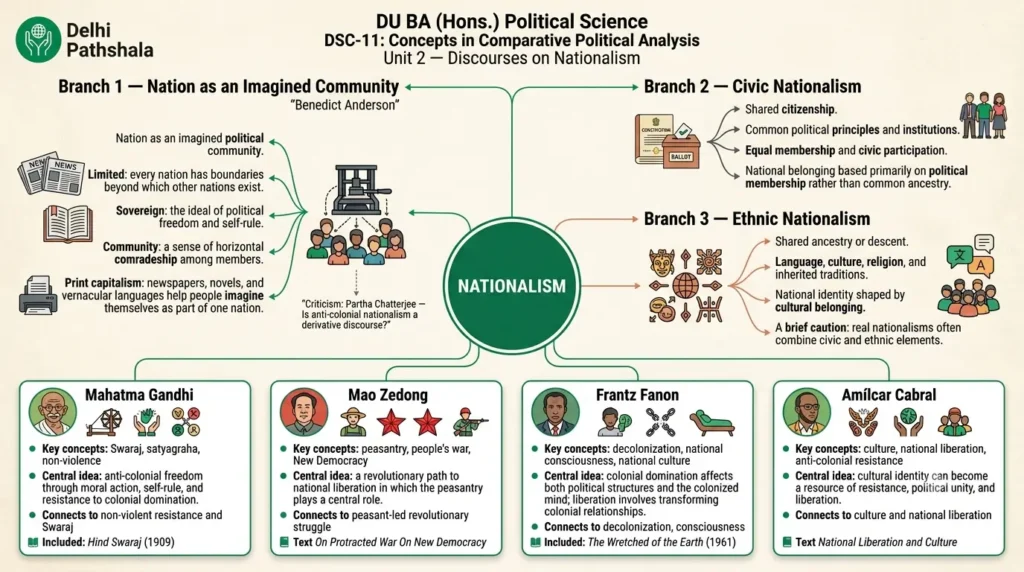
In Imagined Communities: Reflections on the Origin and Spread of Nationalism (first published 1983; revised editions 1991 and 2006), Benedict Anderson defined the nation as an imagined political community, imagined as both inherently limited and sovereign. Each word matters:
- Imagined: even in the smallest nation, most members will never meet one another, yet each carries in their mind an image of the community. Anderson was clear that “imagined” does not mean “fake”; communities are to be distinguished by the style in which they are imagined, not by their falseness.
- Limited: no nation imagines itself to be coextensive with all of humankind. Every nation has boundaries beyond which other nations lie.
- Sovereign: the concept was born in the age of the Enlightenment and revolutions, when dynastic and divinely ordained hierarchies were losing legitimacy. The nation dreams of being free, and the sovereign state is the emblem of that freedom.
- Community: whatever the actual inequality and exploitation within it, the nation is conceived as a deep, horizontal comradeship, which is why millions have been willing to die for it.
How were nations imagined? Print capitalism and its consequences
Anderson’s historical explanation centres on print capitalism. When publishers in early modern Europe discovered that there was money in printing books and newspapers in everyday languages (vernaculars) rather than Latin alone, they created reading publics. People who spoke many local dialects could now understand one another on the printed page and became aware of the many thousands who read the same language. Newspapers and novels also gave readers a sense of moving together through the same “homogeneous, empty time”, reading about events that others were reading about at the same moment.
Anderson traced several waves of nationalism:
- Creole nationalisms in the Americas (late 18th and early 19th centuries), led by colonial-born elites who were excluded from top imperial posts.
- Linguistic nationalisms in Europe (19th century), built around vernacular print-languages.
- “Official nationalism”, in which dynasties and states adopted the national idea from above to protect themselves.
- Anti-colonial nationalisms in Asia and Africa (20th century), where schooling, the colonial census, map and museum (the title of a chapter added in the 1991 edition) shaped how colonized people came to see their territory and themselves, and where a bilingual, Western-educated intelligentsia played a central role.
Criticisms of Anderson
- Partha Chatterjee asked what was left for the colonized to imagine if the nation was a “modular” form that Europe and the Americas had already supplied (see “Is anti-colonial nationalism a derivative discourse?” below).
- Critics note that print capitalism cannot explain nationalism in societies with low literacy or strong oral cultures.
- Ethno-symbolists such as Anthony D. Smith argue that Anderson underplays older ethnic myths and memories on which modern nations draw.
- Anderson himself rejected Gellner’s view that nationalism “invents” nations, because to him that treated imagination as fabrication.
How Scholars Explain Nationalism: Primordialists, Modernists and Others
Scholars usually sort explanations of nationalism into a few broad families. Knowing which family a thinker belongs to is one of the quickest ways to score in a theory question.
| Approach | Core claim | Key thinkers | Main criticism |
|---|---|---|---|
| Primordialism | Ethnic and national attachments (kinship, language, religion, territory) are deep, given and emotionally binding | Clifford Geertz (on “primordial sentiments” in new states, 1963); Edward Shils | Treats identities as natural and fixed; cannot explain how they change |
| Perennialism | Nations existed in earlier periods, not only in modern times | Adrian Hastings | Risks reading the modern nation backwards into history |
| Modernism | Nations and nationalism are products of modernity: industrialization, capitalism, print, mass education, the modern state | Ernest Gellner; Benedict Anderson; Eric Hobsbawm | May undervalue older ethnic ties and memories |
| Ethno-symbolism | Modern nations are built on older ethnic myths, symbols and memories | Anthony D. Smith; John Hutchinson | Hard to test; can overstate continuity |
| Postcolonial approaches | Western theories misread nationalism in colonized societies, where the struggle was against empire | Partha Chatterjee; Frantz Fanon; Amílcar Cabral | Sometimes treats “the West” and “the colonized” as too uniform |
Gellner’s argument in brief: agrarian societies were culturally fragmented. Industrial society needs mobile, literate workers who share a standardized “high culture”, taught through mass education and protected by the state. Nationalism, on this view, produces nations, not the other way round.
Hobsbawm’s contribution: nations are “dual phenomena”, constructed from above by states and elites but understood only by studying how ordinary people experience them. He also showed, with Terence Ranger (The Invention of Tradition, 1983), how supposedly ancient national traditions are often recent.
Methods of study. Scholars compare nationalism across cases because it develops differently across societies. French nationalism grew out of the revolution of 1789 and the idea of citizens making a nation, whereas German nationalism developed in the 19th century around language and culture. Postcolonial writers add that nationalism in colonized countries was a tool of liberation first, and only then a political ideology.
Civic and Ethnic Nationalism
Civic nationalism
Civic nationalism defines the nation by citizenship and shared political values, not by ancestry. Anyone who accepts the constitution and its principles can, in principle, belong. Its key features:
- Inclusion: membership is open through legal citizenship.
- Political participation: the emphasis is on democracy, rights and common institutions.
- Voluntarism: the French thinker Ernest Renan (1882) described the nation as a “daily plebiscite”, a shared will to live together resting on common memories and shared forgetting. In the same spirit, the Abbé Sieyès in 1789 described the nation as a body of citizens living under one law with one representation.
- Examples usually cited: France (in its republican self-image), the United States, Canada.
Ethnic nationalism
Ethnic nationalism defines the nation by common ancestry, language, religion and cultural heritage. Membership depends largely on birth and descent. Its key features:
- Exclusivity: outsiders may find it difficult or impossible to become full members.
- Tradition and memory: emphasis on heritage, myths of origin and a historical homeland.
- Roots in Romanticism: German thinkers such as Johann Gottfried Herder stressed the unique spirit of each Volk expressed in its language, and Fichte’s Addresses to the German Nation (1807–08) used cultural unity to call for national revival.
- Examples usually cited: German nationalism before 1945, Serbian nationalism in the Balkans, and (with scholarly disagreement) some forms of Zionism, which also contain civic and liberal strands.
Civic versus ethnic: a comparison
| Basis of comparison | Civic nationalism | Ethnic nationalism |
|---|---|---|
| Definition of the nation | Citizens sharing political values and institutions | People sharing descent, language, religion or culture |
| How one joins | By citizenship, naturalization and commitment | Largely by birth |
| Typical concept of citizenship | Jus soli (right of the soil) tendencies | Jus sanguinis (right of blood) tendencies |
| Intellectual roots | Enlightenment, French and American revolutions, Renan | Romanticism, Herder, Fichte |
| Strength | Inclusive, rights-based, compatible with diversity | Strong emotional unity; can mobilize the oppressed |
| Risk | May ignore cultural differences (“neutral citizenship” can favour the majority culture) | Exclusion, discrimination, ethnic cleansing, genocide |
| Examples (contested) | USA, France, Canada | Germany before 1945, Serbia in the 1990s |
Is the civic–ethnic divide real?
Hans Kohn, in The Idea of Nationalism (1944), contrasted a “Western” nationalism (rational, political, liberal: England, France, the USA) with an “Eastern” one (organic, cultural, often authoritarian: Germany, Eastern Europe). Many scholars have since challenged this neat split:
- Rogers Brubaker (Citizenship and Nationhood in France and Germany, 1992) showed that French and German conceptions of the nation produced different citizenship regimes, with France leaning to territorial birthright citizenship and Germany’s 1913 law resting on descent, which was substantially reformed in 2000. But he also warned against treating this as a simple good-versus-bad contrast.
- Will Kymlicka argued that the “good Western, bad Eastern” picture is too simple, because Western nation-building also involved cultural standardization of languages and symbols.
- Bernard Yack (1996) called the idea of a purely civic nation a myth: even “civic” nations rely on shared culture, language and memory.
The practical lesson for your answer: treat civic and ethnic nationalism as ideal types. Real nationalisms, including those of India and the United States, mix both.
Civic Nationalism in Practice
From Enlightenment to democratic revolutions
Civic nationalism grew out of Enlightenment ideas of liberty, equality and popular sovereignty. Three moments are commonly used as markers:
- The American Revolution (1776): the Declaration of Independence founded a political community on rights and consent, though slavery and the dispossession of Native Americans contradicted those ideals for generations.
- The French Revolution (1789): the Declaration of the Rights of Man and of the Citizen made the nation the source of sovereignty, so that citizenship, not birth into a privileged order, defined belonging.
- Post-1945 democratic constitutions: many new and reformed states, including India, Canada and South Africa, adopted civic principles to hold diverse populations together.
Examples of civic unity
India. The Constituent Assembly adopted the Constitution on 26 November 1949, and it came into force on 26 January 1950. It built national identity on equal citizenship, fundamental rights and democratic institutions, and, as in Jawaharlal Nehru’s The Discovery of India (1946), on the idea of “unity in diversity”. Yet communal violence, caste inequality and language politics have repeatedly tested that ideal. In his final speech to the Constituent Assembly, B. R. Ambedkar warned that political equality would be hollow without social and economic equality.
United States. Citizenship is open to people of every background through law, but the civil rights movement of the 1950s and 1960s exposed the gap between civic ideals and racial exclusion.
South Africa. After the first democratic elections of 1994, Nelson Mandela’s government promoted a multiracial, rights-based nation under the 1996 Constitution, often called the “rainbow nation”. Yet the country remains among the most unequal in the world by commonly used measures, which shows how hard it is to turn legal equality into social equality.
Strengths and weaknesses
Strengths
- Encourages inclusion, political participation and equal rights.
- Allows multicultural living, and can unite diverse post-colonial societies.
- Supports ideas such as constitutional patriotism (Jürgen Habermas), which ties loyalty to constitutional principles instead of ethnic origin.
Weaknesses
- The idea of “neutral citizenship” can overlook cultural difference, so the dominant group’s language and customs quietly become the national norm.
- It is vulnerable to challenge from ethnic and majoritarian movements, especially in deeply divided societies.
- Critics in several democracies, including India and the United States, argue that majoritarian politics strains civic equality. Defenders of those movements reply that they express a legitimate cultural or civilizational identity. A good answer presents both positions with attribution and avoids taking a partisan side.
Ethnic Nationalism in Practice
Language, religion and shared memory
Ethnic nationalism rests on shared ancestry, language, cultural traditions and historical memory:
- Language marked identity in 19th-century German, Italian and Hungarian nationalisms.
- Religion has defined national identity in cases such as Catholic Poland; in Pakistan, where the two-nation idea (formalized by the Muslim League’s 1940 Lahore Resolution) held that Muslims were a nation; and in Hindutva, which V. D. Savarkar defined in Essentials of Hindutva (1923) through ideas of a shared homeland and culture.
- Historical myths of origin and homeland play a central role in Serbian nationalism in the Balkans and in Zionism.
Germany, the Balkans and Rwanda
- Germany (19th–20th century). Romantic ideas of the Volk and language contributed to the movement that led to the creation of the German Empire in 1871. Under the Nazis, a cultural nationalism was twisted into a racial ideology that excluded and exterminated Jews and others. Strictly, Nazi doctrine went beyond ethnic nationalism into biological racism.
- The Balkans. As Ottoman power declined, Serbian, Greek, Bulgarian and other national movements emerged. In the 1990s, the break-up of Yugoslavia led to wars marked by ethnic cleansing, including the 1995 Srebrenica massacre, which the International Criminal Tribunal for the former Yugoslavia and the International Court of Justice described as genocide.
- Rwanda. Belgian colonial rule hardened the distinction between Hutu and Tutsi, for example through identity cards introduced in the 1930s. In 1994, Hutu extremists carried out a genocide against Tutsi and moderate Hutu in which, by common estimates, roughly 800,000 people were killed.
Exclusion and its costs
Ethnic nationalism can:
- Exclude minorities. UN bodies have documented the persecution of the Rohingya in Myanmar, which they have described as ethnic cleansing; the Myanmar authorities dispute this characterization. In August 2022 the UN human rights office said that serious violations against Uyghurs and other Muslim minorities in Xinjiang may amount to international crimes, possibly crimes against humanity; the Chinese government rejects the findings.
- Fuel violence and separatism. The Holocaust and the Bosnian war are the standard examples.
- Support authoritarian politics by presenting a leader as the sole voice of the ethnic nation.
Did ethnic nationalism ever help liberation?
It is sometimes said that ethnic identity united people against colonial rule in places like Ghana and Algeria. The picture is more complicated. Most anti-colonial movements built territorial nationalisms within borders drawn by the colonizers, often at the Berlin Conference (1884–85) and similar settlements, and tried to overcome local ethnic divisions rather than build on them. Kwame Nkrumah’s movement in Ghana, for example, stressed national and pan-African unity. Algeria’s liberation front drew on Arab-Islamic cultural symbols, but it too sought a single Algerian nation. Cultural and linguistic revival movements, such as Māori campaigns to protect language and land rights under the 1840 Treaty of Waitangi, are better described as cultural revival and indigenous rights movements, whose label as “nationalism” is itself debated.
In short: civic nationalism is more inclusive and democratic, but struggles to hold deeply diverse societies together. Ethnic nationalism can be a strong rallying force but risks exclusion and conflict. Most states today, including India and the United States, show a mix of both, which keeps debates on national identity alive.
Anti-Colonial Nationalism: Why It Needs Its Own Theory
Colonization and the rise of nationalist movements
From the 15th century onwards, European powers took control of large parts of Africa, Asia and the Americas. Colonial rule meant political control by a foreign government, economic exploitation (in India, Dadabhai Naoroji’s “drain of wealth” analysis is the classic example) and cultural control through European languages, religions and schooling. To go deeper into colonialism as a socio-economic structure, read our Unit 1 notes on capitalism, socialism, colonialism and neo-liberalism.
Colonial rule produced its own opponents. Colonial schools created educated elites who learned the language of rights and self-determination and then turned it against the empire. Early movements asked for reform and representation; by the mid-20th century most demanded complete independence, through protest, armed struggle or non-violent resistance. Colonial borders became the frames of the new nations, and in 1964 the Organization of African Unity accepted the inherited colonial frontiers, despite the ethnic mixes and splits they contained.
How colonial history shapes nationalism after independence
Even after independence, colonial rule left its mark: parliamentary and constitutional models borrowed from the West, economic dependence on former rulers (what Nkrumah called neo-colonialism in 1965), and ethnic or religious divisions hardened under colonial policies. Many post-colonial leaders therefore blended nationalism with socialism, pan-Africanism or pan-Asianism.
Is anti-colonial nationalism a “derivative discourse”?
This is one of the most important debates for the unit, and it directly answers a common student search: what does “derivative discourse” mean?
- Anderson argued that the nation became a “modular” form, first appearing in the Americas and Europe and then copied and adapted elsewhere with the help of print and education.
- Partha Chatterjee, in Nationalist Thought and the Colonial World: A Derivative Discourse? (1986), asked what was left for colonized peoples to imagine if their nationalisms were simply copies of European models. His answer: anti-colonial nationalism both borrows from and rebels against Western thought. It accepted Western science, the state and the economy as the “outer”, material domain, where the West was ahead, but it declared sovereignty over the “inner”, spiritual domain of language, religion, family and culture well before it won political power (Whose Imagined Community?, 1991; The Nation and Its Fragments, 1993).
- Chatterjee traces three “moments” in Indian nationalism: departure (Bankimchandra), manoeuvre (Gandhi) and arrival (Nehru).
IGNOU’s study material on anti-colonial nationalism summarizes this debate in a student-friendly way: Nation and Nationalism, Unit 2: Anti-Colonial Nationalism (eGyanKosh).
Four ideological roads
Anti-colonial nationalism drew on several ideas, and the four thinkers in your syllabus show how different they were:
- Gandhi: a moral and civilizational critique of colonial rule, resisted through non-violent mass action.
- Mao: Marxism-Leninism adapted to a semi-colonial, peasant society, fought through people’s war.
- Fanon: a psychiatrist’s analysis of how colonialism damages minds as well as economies, with a theory of decolonization as total and violent change.
- Cabral: an agronomist’s analysis that tied culture, class and armed struggle together in a theory of national liberation.
What anti-colonial nationalism aimed at
- Political control: self-rule and the end of colonial laws and institutions (India in 1947; African independence from the late 1950s to the 1970s).
- Cultural revival: recovering languages, histories and dignity, as in the Négritude movement of Aimé Césaire, Léopold Senghor and Léon Damas, which celebrated Black identity and which Fanon and Cabral later criticized.
- Economic independence: reducing dependence on former rulers, as in Nkrumah’s Ghana, which linked national independence with African unity and socialist development.
In short: anti-colonial nationalism was not only about getting rid of foreign rulers. It was about reshaping identity, self-rule and justice, by very different routes.
Mahatma Gandhi: Swaraj, Satyagraha and Inclusive Nationalism
Life and context
Mohandas Karamchand Gandhi was born on 2 October 1869 in Porbandar. He studied law in London, practised in South Africa from 1893, and developed his method of resistance there, returning to India in 1915. By then the Indian National Congress (founded in 1885) was a major nationalist platform. Gandhi’s early campaigns in India, such as Champaran (1917), brought peasants into nationalist politics, and by 1919–20 he was the central figure of the movement. He was assassinated on 30 January 1948.
Core ideas
1. Hind Swaraj and the critique of modern civilization. In Hind Swaraj (1909), Gandhi argued that true independence meant more than replacing British rulers with Indian ones. He saw the problem partly in modern industrial civilization itself, with its reliance on machinery, railways and the pursuit of material gain, and warned that India would remain unfree if it simply took over the colonial state’s institutions. (You can read the text in Anthony Parel’s edition, which appears among DU’s recommended readings for related papers.)
2. Swaraj as self-rule at several levels. For Gandhi, swaraj was political freedom, but also self-control, moral and social reform, and the self-government of villages. Real freedom needed both political and moral change.
3. Non-violence and truth: ahimsa and satyagraha. Satyagraha, a method he developed in South Africa, means holding firmly to truth through non-violent resistance. It rests on refusing to obey unjust laws while accepting the penalties without hatred, so that the moral power of the resister challenges the oppressor. It was used in major movements:
- Non-Cooperation Movement (1920–22), called off after violence at Chauri Chaura in 1922.
- Salt March and Civil Disobedience (1930), begun from Sabarmati to Dandi.
- Quit India Movement (1942).
4. Swadeshi, khadi and the constructive programme. Gandhi promoted self-reliance through handspun cloth (khadi) and the boycott of British goods, together with the removal of untouchability, Hindu–Muslim unity and rural improvement.
Gandhi’s nationalism: civic, cultural or both?
Textbooks often call Gandhi’s nationalism inclusive, since he treated Hindus, Muslims, Sikhs and others as equal members of one Indian nation. That is broadly accurate, but scholars debate it:
- Supporters point to his backing of Hindu–Muslim unity, including support for the Khilafat movement (1919–22), and his campaigns against untouchability.
- Critics argue that his use of religious language (Ram Rajya, bhajans, fasting) made it harder for many Muslims to see themselves in the national movement. B. R. Ambedkar argued that Gandhi’s approach did not take the caste question seriously enough, a dispute that came to a head in the Poona Pact of 1932.
- Partha Chatterjee reads Gandhi as the “moment of manoeuvre”: a leader who spoke to the peasantry in its own idiom and in doing so turned a narrow elite movement into a mass one, even while leaving some questions unresolved.
Impact and limits
- Gandhi’s methods influenced Martin Luther King Jr. in the US civil rights movement and Nelson Mandela in South Africa, though Mandela and his colleagues also turned to armed struggle in 1961 when they felt non-violence had been closed off. That example is useful in an exam when you compare Gandhi with Fanon.
- The IGNOU material cited above calls India’s largely non-violent mass movement an exception among anti-colonial struggles.
- His vision of non-violent unity was strained by communal violence and the Partition of 1947, which is the standard criticism of its limits.
Conclusion. Gandhi combined moral ideas, non-violent resistance and a plural idea of the Indian nation. His thought is still discussed in debates about peaceful protest, democracy and social justice.
Mao Zedong: Peasants, People’s War and Revolutionary Nationalism
Background
Mao Zedong was born on 26 December 1893 in Shaoshan, Hunan, into a peasant family that was comparatively well-off by village standards. The Qing dynasty fell in the revolution of 1911, and the last emperor abdicated in 1912, leaving a weak republic dominated by warlords and pressured by foreign powers. Since the Opium Wars, China had lost sovereignty piece by piece through unequal treaties and foreign concessions, a situation Mao called semi-colonial and semi-feudal. China was not colonized as a whole by any single power, which is why it makes an interesting case for this unit.
Key events in his rise:
- 1919: the May Fourth Movement, a burst of nationalist and intellectual activity after the Versailles settlement; Mao became a Marxist in this period.
- 1921: the Chinese Communist Party (CCP) was founded.
- 1927: the Nationalist (Kuomintang) alliance with the communists collapsed in violence; Mao’s Report on an Investigation of the Peasant Movement in Hunan argued that the peasantry would be the main revolutionary force.
- 1934–35: the Long March; Mao’s leadership was consolidated at the Zunyi Conference (January 1935).
- 1937–45: war with Japan, with a second CCP–KMT alliance; 1946–49: civil war ending in the proclamation of the People’s Republic of China on 1 October 1949.
Main ideas
1. Marxism-Leninism with a Chinese face. Classical Marxism looked to the urban industrial working class. In a country that was overwhelmingly agrarian, Mao made the peasantry the main force of revolution, led by the Communist Party. This adaptation is often called the “Sinification of Marxism”.
2. Nationalism and revolution fused. Mao presented the communist cause as both a social revolution and a struggle against imperialism. In On New Democracy (1940), he argued that China’s revolution must first be a national, democratic revolution led by the CCP in alliance with the peasantry, the petty bourgeoisie and the “national bourgeoisie”, and only afterwards move toward socialism. He described the new culture as national, scientific and mass-based.
3. People’s war. In On Protracted War (1938), Mao set out a strategy of long guerrilla war in three stages, from strategic defence, to stalemate, to counter-offensive, built on the support of the rural population. Land reform, in which land was taken from landlords and given to peasants, was both a social goal and a method for winning popular backing.
Impact
- Mao changed the form of revolutionary nationalism, making it a mass movement that combined class politics with a struggle against foreign domination.
- After 1949, campaigns such as the Great Leap Forward (1958–62, with some historians ending it in 1961) aimed at rapid industrialization and collectivization but ended in a catastrophic famine, whose death toll is estimated at many millions. The Cultural Revolution (1966–76) aimed to remove “bourgeois” elements and caused widespread violence and disorder.
- His strategies were studied by Vietnamese communists and others, and Maoist movements emerged later in Nepal, Peru and India (the Naxalite movement, named after Naxalbari in 1967).
Conclusion. Mao’s nationalism cannot be separated from his socialist revolution, peasant mobilization and resistance to imperialism. It transformed China and inspired movements elsewhere, though his policies had devastating human costs.
Frantz Fanon: Violence, National Culture and the Pitfalls of National Consciousness
Background
Frantz Fanon was born in 1925 in Martinique, then a French colony. He served with the Free French forces in the Second World War, where he met racism within the army, and went on to study medicine and psychiatry in France. In 1953 he took up a post at the psychiatric hospital in Blida, Algeria, where he treated both Algerians and French soldiers and saw how colonial violence damaged people on both sides. He resigned in 1956 and worked openly with the National Liberation Front (FLN) during the Algerian war (1954–62). He died of leukaemia in December 1961, shortly after finishing The Wretched of the Earth.
Main ideas
1. Colonialism as a psychological as well as political system. In Black Skin, White Masks (1952), Fanon explored how racism in a colonial world pushes Black people to see themselves through the eyes of whites, producing feelings of inferiority and a desire to become “white”. Colonialism, he argued, reaches into the mind.
2. A divided, “Manichean” world. In The Wretched of the Earth (1961), Fanon described the colonial world as split into two compartments, settler and native, held in place by force. Because the order rests on violence, he argued, ending it means more than a transfer of power. Decolonization is a total transformation that creates new people and new relations.
3. Violence. Fanon argued that, in settler colonies like Algeria, where colonial rule itself relied on violence, the colonized could not win dignity without a violent break. He saw violence as political (a means of ending the system) and also psychological (a way for the colonized to regain self-respect). He was not naive about its costs: the book also describes the mental disorders produced by colonial war. His view is controversial and is best presented as an argument that responded to a specific setting, not a universal law (Hannah Arendt, for one, criticized it).
4. The pitfalls of national consciousness. This is the part that most directly links Fanon to the theme of nationalism and the part exams reward. Fanon distinguished national consciousness from narrow nationalism. He warned that when independence is led by a national bourgeoisie, a small educated elite that simply takes over the colonizer’s position and economy, the nation risks “becoming a replica” of the old order: a one-party state, ethnic or racial chauvinism and continued economic dependence. He argued that national consciousness must grow into social and political consciousness, in which the masses have real power.
5. Peasants and the lumpenproletariat. Writing about colonial societies in which the urban working class was small and sometimes relatively privileged, Fanon looked to the peasantry and the marginalized urban poor as the main revolutionary force.
6. National culture. In “On National Culture”, Fanon described three phases of the native intellectual: assimilation of the colonizer’s culture; immersion in and nostalgia for a precolonial past; and a fighting phase, in which writers and artists take part in the struggle and help create a culture oriented to the future. He criticized forms of cultural nativism, such as the Négritude movement, for relying on a mythical past.
Impact and criticism
- Fanon became central to postcolonial studies, influencing thinkers such as Edward Said and Homi Bhabha. Said, for one, described Fanon’s position as a form of “critical nationalism”, one that is aware that precolonial societies were not simple or uniform.
- His ideas on armed struggle and racial identity influenced groups such as the Black Panther Party in the US and anti-apartheid activists.
- Criticisms: that he romanticized violence; that his picture of the peasantry as a revolutionary class was too general; and that his treatment of gender is limited. Whether post-independence authoritarian regimes confirm his warnings or show the difficulty of his solutions remains a matter of debate, and it would be too simple to say that his ideas “led to” dictatorships.
Amílcar Cabral: Culture, Class and National Liberation
Background
Amílcar Cabral was born on 12 September 1924 in Bafatá, Portuguese Guinea (now Guinea-Bissau), to Cape Verdean parents. He trained as an agronomist in Lisbon, and his fieldwork on land and agriculture in Guinea gave him detailed knowledge of its social structure. In September 1956 he helped found the African Party for the Independence of Guinea and Cape Verde (PAIGC). After the Pidjiguiti dockworkers’ strike of August 1959 was suppressed by the colonial authorities, the movement moved toward armed struggle, and the guerrilla war began in January 1963. Portugal, a poor colonial power that refused to negotiate, fought wars in Angola, Mozambique and Guinea. Cabral was assassinated in Conakry on 20 January 1973 by dissidents within his own party; historians continue to discuss the role of Portuguese intelligence. Guinea-Bissau declared independence unilaterally in September 1973, and Portugal recognized it in 1974 after the Carnation Revolution.
Main ideas
1. “Theory” without dogma. In The Weapon of Theory (an address at the Tricontinental Conference in Havana, 1966), Cabral argued that a liberation struggle needs theory, but not copied formulas. Each society’s own class structure and history must be studied. He used Marxist concepts selectively and avoided claiming that his own movement fitted a ready-made model.
2. Culture as the foundation of resistance. In National Liberation and Culture (the Eduardo Mondlane Memorial Lecture at Syracuse University, 1970), Cabral argued that colonial domination tries to deny a people’s history and culture, so liberation is itself an act of culture. Culture, to him, is not a fixed museum but a living, changing force that holds a people’s identity together under foreign rule. His phrase “return to the source” is often misunderstood as nostalgia. Cabral applied it mainly to the colonial petty-bourgeois intelligentsia, who must reconnect with the people’s struggle and culture, and he was also critical of aspects of tradition.
3. Class analysis and “class suicide”. Cabral examined the social classes of colonial Guinea (peasants, workers, the small educated petty bourgeoisie and others) and concluded that the petty bourgeoisie was the group best placed to lead, but also prone to compromise with the colonial order. For a revolution to succeed, he said, this group must commit “class suicide”: give up its own interests and identify with the working people.
4. Unity against colonial divisions. Colonial rule had played on ethnic and regional divisions. Cabral stressed unity across ethnic lines, and the PAIGC aimed at a joint Guinea–Cape Verde political community (a project that ended in 1980).
5. Armed and political struggle, plus social work. The PAIGC combined guerrilla war with political education, schools, health care and people’s stores in the areas it liberated. Freedom, for Cabral, was about material benefits and better lives for ordinary people, not only flags.
6. Warning against neo-colonialism. He cautioned that independence led by a weak and imitative elite could keep the economic structure of colonialism in place.
Impact
Cabral worked with the liberation movements of Angola (MPLA) and Mozambique (FRELIMO) within the alliance of Portuguese colonies’ nationalist organizations (CONCP), and his writings are widely used in African and postcolonial studies. He is often placed beside Mao, Fanon, Che Guevara and Fidel Castro as one of the leading theorists of liberation. Critics point to the difficulties of the PAIGC’s post-independence period, including the end of the Guinea–Cape Verde union in 1980.
Conclusion. Cabral’s vision linked nationalism, class analysis and cultural revival into a single strategy of liberation. He did not live to see independence, but his ideas have shaped African nationalist and revolutionary thought.
Comparing Gandhi, Mao, Fanon and Cabral
Shared themes
- Self-determination: all aimed at ending foreign rule.
- Mass participation: all believed that ordinary people, not only elites, must take part, whether through satyagraha (Gandhi) or armed struggle (Mao, Fanon, Cabral).
- Rejecting the colonial order’s culture: each asked what kind of culture and identity would replace it.
- Post-colonial problems: each worried about what would come after independence, whether the replacement of one ruling group by another (Gandhi, Fanon, Cabral) or the shape of the new state (Mao).
Comparison table
| Basis | Mahatma Gandhi | Mao Zedong | Frantz Fanon | Amílcar Cabral |
|---|---|---|---|---|
| Context | British India | Semi-colonial, semi-feudal China | French settler colonialism in Algeria; the Caribbean | Portuguese colonialism in Guinea and Cape Verde |
| Main target | British rule and “modern civilization” | Imperialism, feudalism and the Nationalist government | Colonial racism and violence; later the national bourgeoisie | Portuguese colonialism and neo-colonialism |
| Agent of change | The masses, through moral transformation | Peasantry led by the Communist Party | Peasantry and the marginalized urban poor | Peasantry, led by a petty bourgeoisie that commits “class suicide” |
| Method | Satyagraha; non-cooperation; constructive programme | Protracted people’s war; land reform | Violence as a response to colonial violence, plus political education | Guerrilla war combined with political education and social services |
| Role of culture | Moral and religious reform; swadeshi and khadi | “New democratic” culture: national, scientific, mass | National culture is forged in the struggle; critique of Négritude | Culture as the basis of resistance; “return to the source” |
| Idea of the nation | Plural and inclusive, though debated for its religious idiom | United “people” led by the party, defined against “enemies” | National consciousness becoming social and political consciousness | Unity across ethnic lines; Guinea–Cape Verde union |
| Vision after colonialism | Self-governing communities, rural economy | Centralized communist state, industrialization | Real power for the masses; no new elite | Political, economic and cultural freedom; socialist-leaning economy |
Key differences
- Gandhi and Fanon on violence: Gandhi treated non-violence as both ethics and strategy and believed in moral persuasion. Fanon argued that, against a regime based on violence, non-violence was inadequate. Remember Mandela’s turn to armed struggle in 1961 as an example of this debate, and the observation in IGNOU’s material that Gandhi’s mass non-violent movement was exceptional.
- Mao and Cabral: Both used armed struggle, but Mao organized it around class struggle and Party leadership, while Cabral put culture and a nuanced study of each society’s class structure at the centre.
- Fanon and Cabral on culture: the editors of the Williams and Chrisman Colonial Discourse and Post-Colonial Theory reader note that, for Fanon, national culture cannot truly exist under colonial domination, whereas for Cabral culture is in a dialectical relationship with history and continues to operate under colonial rule. Cabral also links cultural processes to the economic base more explicitly than Fanon does.
| Fanon | Cabral |
|---|---|
| Colonized people are psychologically damaged; the cure is the struggle itself | Colonialism suppresses culture, but culture survives and becomes a source of resistance |
| Warns of the national bourgeoisie | Warns of the petty bourgeoisie’s weakness and calls for its “class suicide” |
| National culture is created through the fighting phase | National culture already exists in the people’s culture and must be strengthened critically |
| Violence has a cleansing, regenerative role | Armed struggle is a means to liberation, combined with social reconstruction |
Challenges in practice
- Gandhi’s non-violent movement faced the Partition and communal violence.
- Mao’s Great Leap Forward and Cultural Revolution caused immense suffering.
- Fanon’s warnings about post-independence elites have been taken up by scholars to analyse several African and Asian states, while others argue that the difficulties of new states had many causes.
- Cabral’s life was cut short, and his project of unity with Cape Verde did not last.
Criticisms and Limitations of These Approaches
- Modernist theories (Gellner, Anderson) are criticized for underestimating older ethnic ties and for being Eurocentric; primordialism is criticized for treating identities as natural.
- The civic–ethnic distinction is useful but, as Brubaker, Kymlicka and Yack show, too neat. Real nationalisms combine civic and cultural elements.
- Anti-colonial nationalisms often glossed over internal divisions of caste, gender, religion and region in the name of unity. Women’s roles in liberation struggles were frequently praised and then sidelined.
- The four thinkers have particular blind spots: Gandhi’s treatment of caste and the religious idiom of his politics; the human cost of Mao’s campaigns; the justification of violence in Fanon; and the difficulty of translating Cabral’s theory into stable government.
Why These Debates Still Matter
- Nation-building after empire. Many states still struggle to balance national unity and ethnic or religious diversity. The question of how to build a shared citizenship without suppressing difference runs from India to South Sudan.
- Neo-colonialism and economic dependence. The worries of Fanon, Cabral and Nkrumah about economic dependence still shape debates in the Global South about aid, debt and trade.
- Populism and nationalism. Scholars use the term populist nationalism for movements in many countries that claim to speak for “the real people”, for example the 2016 UK referendum on leaving the EU and the “America First” slogan in US politics. Supporters see a legitimate defence of national sovereignty and culture; critics see a risk of exclusion. Likewise, scholars debate whether Hindutva is best seen as cultural nationalism rooted in civilization or, as Christophe Jaffrelot has argued, as a form of “ethnic democracy” in tension with the Constitution’s civic equality. Present such debates with attributions in the exam, and avoid taking sides.
- Competing nationalisms. The Russia–Ukraine war and the Israel–Palestine conflict are often discussed as cases of competing national claims over territory and identity.
- Globalization and nationalism. Some argue that globalization weakens national identity; others point to a revival of nationalism in response. Michael Billig’s idea of “banal nationalism” reminds us that nations are reproduced daily, in flags on public buildings and in news bulletins, not only in crises.
- The influence of the four thinkers. Gandhi’s methods continue to shape peaceful protest; Fanon’s writings are used in discussions of race and identity; Cabral’s ideas on culture inform debates on cultural imperialism; Mao’s strategies remain a point of reference for revolutionary movements, and a warning for critics.
Key Terms at a Glance
| Term | One-line meaning |
|---|---|
| Imagined community | A community whose members never all meet but picture themselves as one (Anderson) |
| Print capitalism | The commercial printing of books and newspapers in vernaculars, which helped create national reading publics |
| Modernism | The view that nations and nationalism are products of modern conditions |
| Primordialism | The view that ethnic and national bonds are deep, given attachments |
| Ethno-symbolism | The view that modern nations draw on older ethnic myths and symbols (A. D. Smith) |
| Civic nationalism | Nation defined by citizenship and shared political values |
| Ethnic nationalism | Nation defined by descent, language, religion and culture |
| Derivative discourse | Chatterjee’s phrase, questioning whether Asian and African nationalisms merely copied European models |
| Swaraj | Self-rule: political, moral and social (Gandhi) |
| Satyagraha | Non-violent resistance rooted in truth (Gandhi) |
| New Democracy | Mao’s stage of anti-imperialist, anti-feudal revolution led by the CCP before socialism |
| People’s war | Mao’s protracted guerrilla strategy based on rural mass support |
| Manichean world | Fanon’s term for the sharply divided colonial order |
| National consciousness | In Fanon, the stage that must grow into social and political consciousness to avoid narrow nationalism |
| National bourgeoisie | The elite class that Fanon feared would replace the colonizer without changing the system |
| Return to the source | Cabral’s call for the colonized intelligentsia to reconnect with the people’s culture and struggle |
| Class suicide | Cabral’s demand that the revolutionary petty bourgeoisie give up its own class interests |
| Neo-colonialism | Continued economic and political control of formally independent states (Nkrumah, 1965) |
Timeline
| Year | Event |
|---|---|
| 1776 | American Declaration of Independence |
| 1789 | French Revolution; Declaration of the Rights of Man and of the Citizen |
| 1882 | Renan’s lecture “What is a Nation?” |
| 1909 | Gandhi writes Hind Swaraj |
| 1921 | Founding of the Chinese Communist Party |
| 1930 | Gandhi’s Salt March |
| 1938 | Mao’s On Protracted War |
| 1940 | Mao’s On New Democracy |
| 1949 | PRC proclaimed; Indian Constitution adopted (in force 1950) |
| 1952 | Fanon’s Black Skin, White Masks |
| 1956 | PAIGC founded |
| 1961 | Fanon’s The Wretched of the Earth; Fanon dies in December |
| 1965 | Nkrumah’s Neo-Colonialism |
| 1970 | Cabral’s lecture National Liberation and Culture |
| 1973 | Cabral assassinated (20 January) |
| 1983 | Anderson’s Imagined Communities; Gellner’s Nations and Nationalism |
| 1986 | Chatterjee’s Nationalist Thought and the Colonial World |
How to Write This Unit in a DU Exam
Questions in this unit tend to be of two kinds: conceptual (what is a nation; imagined communities; civic versus ethnic) and thinker-based (Fanon on nationalism; compare Gandhi and Mao). A DU Semester 4 paper reported for this course asks you to attempt any five questions in three hours, so check your own paper’s instructions and plan your time accordingly.
For a long answer (around 800–1,000 words):
- Start with a precise definition (2–3 lines).
- Present the main theories or thinkers, with attribution.
- Add a debate or criticism (Chatterjee on Anderson; Brubaker on civic and ethnic).
- Use one or two examples, ideally a mix of Indian and non-Indian.
- End with a short, balanced conclusion that answers the exact question asked.
For a short note (around 200–250 words), e.g. “Fanon on nationalism”: one line on who Fanon was; his critique of colonialism; national consciousness versus nationalism; the national bourgeoisie; the role of violence and national culture; one line of assessment.
Common mistakes to avoid: using “nation” and “state” as synonyms; calling Anderson’s “imagined” “imaginary”; saying Gandhi was simply “against violence” without mentioning his idea of swaraj; and presenting Fanon as only a theorist of violence.
Conclusion
Nationalism can unite and it can divide. In this unit you have seen the nation as an imagined community, a construct of print, institutions and shared memory (Anderson, Gellner, Hobsbawm), and you have examined the civic and ethnic models, along with the argument that real nations are mixtures. You have also studied four answers to colonial rule: Gandhi’s moral politics of swaraj and satyagraha; Mao’s peasant-based people’s war; Fanon’s analysis of colonial psychology and his warning about the national bourgeoisie; and Cabral’s union of culture and class analysis.
For political studies, the point of all this is not to rank the thinkers but to see why nationalist movements take different forms in different places, why independence rarely ends the argument about who the nation is, and how to analyse modern nationalist and populist movements with care and evidence. The next unit moves from the nation to the structure of the state: see What is Constitutionalism? (DSC-11, Unit 3).
Continue Reading
Continue reading (DSC-11 and related notes)
- Socio-Economic Structures (DSC-11, Unit 1): capitalism, socialism, colonialism and neo-liberalism, the background to this unit.
- What is Constitutionalism? (DSC-11, Unit 3): the next unit in the paper.
- Colonialism and Nationalism in India (DSC-3): the history of colonial rule and Indian nationalism.
- States, Nations and Markets (GE-4, Unit 2): the state and nation distinction in another DU paper.
University of Delhi Previous Year Questions
DU Previous Year Questions
Questions reported from DU examination papers and related solved-paper sets for DSC-11: Concepts in Comparative Political Analysis (Paper Code 2322102402), Unit 2: Discourses on Nationalism. Tap a question to view a quick-answer guide.
1 Analyse Fanon’s conception of the role of violence and national consciousness in the liberation struggle and formation of post-colonial identities. +
2 Critically evaluate the idea of ethnic nationalism. In what ways does it differ from civic nationalism? +
3 What is nation and nationalism? Discuss Gandhi’s conceptualisation of nationalism. +
4 What is nation and nationalism? Discuss the conceptualisation of nationalism. +
5 Write a short note on Fanon on nationalism. +
6 Write a short note on decolonization. +
7 Distinguish between civic and ethnic nationalism. Illustrate with examples from Europe and post-colonial societies. +
8 Explain the ideological basis of anti-colonial nationalism with reference to Mao Zedong. +
9 Discuss Amilcar Cabral’s contribution to anti-colonial nationalism and the role of culture in nation-building. +
10 Examine Gandhi’s idea of Swaraj and Satyagraha as a basis for anti-colonial nationalism. How does it differ from Western nationalism? +
11 What do you understand by anti-colonial nationalism? How did Fanon link decolonization to psychological liberation? +
FAQs
Is Unit 2 of DSC-11 about the Indian national movement?
No. It is a conceptual and comparative unit on nationalism. Gandhi appears as one of four anti-colonial thinkers. For the Indian national movement as history, use DSC-3.
Which thinkers should I prepare for this unit?
Anderson (imagined communities), plus Gellner, Hobsbawm, Smith and Chatterjee for debates, and Gandhi, Mao, Fanon and Cabral for anti-colonial nationalism. Check the latest DU syllabus for the readings your teachers prescribe.
Does “imagined” mean that a nation is fake?
No. Anderson says communities differ in the style in which they are imagined, not in whether they are genuine. National feeling is real enough that people live and die for it.
Is civic nationalism always good and ethnic nationalism always bad?
Not necessarily. Civic nationalism can also hide the dominance of a majority culture, while ethnic or cultural movements have sometimes protected threatened languages and communities. The key question is how a nationalism treats minorities.
Was Gandhi’s nationalism civic or ethnic?
He argued for an inclusive Indian nation, so it is usually called civic in aim. But scholars note his religious idiom and the criticisms by Ambedkar and others. A balanced answer mentions both.
Did Fanon say that violence is the only way to end colonialism?
He argued that in settler colonies where colonial rule rested on violence, decolonization would require a violent break, but he also described its psychological costs and stressed political education. Present it as his argument for a particular context.
Mao’s China was not formally a colony. Why is he in this unit?
Mao described China as semi-colonial and semi-feudal because foreign powers controlled much of its economy and territory through unequal treaties. His revolution combined anti-imperialist nationalism with social revolution.
What is the difference between Fanon and Cabral on culture?
Fanon says national culture is created in the struggle and warns against nostalgia. Cabral treats culture as a living source of resistance that already exists under colonial rule and links it to economic and class structures.
What does “derivative discourse” mean?
It is Partha Chatterjee’s phrase from the title of his 1986 book. He asks whether Asian and African nationalisms merely copied European ideas, and argues that they borrowed Western models in the material sphere while claiming sovereignty in the spiritual and cultural sphere.
How many theories and examples do I need in an 18-mark answer?
There is no fixed number, but aim for a clear definition, two or three theories or thinkers with attribution, one debate and two or three examples. Depth and relevance count for more than a long list of names.
Further Reading and Sources
Readings listed for this unit in a copy of the DU syllabus (confirm against the official PDF): Benedict Anderson, Imagined Communities (Verso, 2006); Umut Özkırımlı, Theories of Nationalism: A Critical Introduction (Palgrave Macmillan, 2010); and a chapter on Fanon, Cabral and the African liberation struggle from a 1978 Monthly Review Press book on a Marxist theory of nationalism.
Other works cited in these notes: Ernest Gellner, Nations and Nationalism (1983); Eric Hobsbawm, Nations and Nationalism since 1780 (1990); Anthony D. Smith, The Ethnic Origins of Nations (1986); Partha Chatterjee, Nationalist Thought and the Colonial World (1986) and The Nation and Its Fragments (1993); Rogers Brubaker, Citizenship and Nationhood in France and Germany (1992); Stepan, Linz and Yadav, Crafting State-Nations (2011); M. K. Gandhi, Hind Swaraj (1909); Mao Zedong, On Protracted War (1938) and On New Democracy (1940); Frantz Fanon, Black Skin, White Masks (1952) and The Wretched of the Earth (1961); Amílcar Cabral, The Weapon of Theory (1966) and National Liberation and Culture (1970); Kwame Nkrumah, Neo-Colonialism: The Last Stage of Imperialism (1965).
Free online resources:
- IGNOU, Nation and Nationalism, Unit 2: Anti-Colonial Nationalism (eGyanKosh), for a student-level account of anti-colonial nationalism and Chatterjee’s critique.
- MIT OpenCourseWare, Nationalism (17.524) reading list, for a sense of how the civic/ethnic and modernist debates are taught.
- Cambridge Core, review essay on recent scholarship on Cabral.
Subscribe to keep reading
You've used your free notes for now. Get Delhi Pathshala Premium for unlimited access.
Subscribe — ₹29/30 days