

Contents
- Introduction to Constitutionalism
- Definition and Importance
- Importance
- Key Concepts in Constitutionalism
- 1. Rule of Law
- 2. Separation of Powers
- 3. Protection of Individual Rights
- Summary: Why Constitutionalism Matters
- Evolution of Constitutionalism
- Ancient Beginnings
- 1. The Code of Hammurabi (around 1754 BCE)
- 2. Athenian Constitution (around 508 BCE)
- Medieval and Renaissance Changes
- 1. Magna Carta (1215)
- 2. Model Parliament (1295)
- 3. Thinkers: Machiavelli and Locke
- Enlightenment and Social Contract Ideas
- 1. Montesquieu’s Separation of Powers (1748)
- 2. Locke’s Social Contract Theory
- 3. Rousseau’s General Will and Popular Sovereignty
- Modern Constitutionalism Development
- 1. 19th Century Europe
- 2. Latin American Constitutions
- 3. Meiji Constitution in Japan (1889)
- 4. Post-World War II Constitutions
- Summary: The Historical Arc
- Post-Colonial Constitutionalism
- Definition and Characteristics
- Case Studies
- 1. India
- 2. African Nations
- 3. Latin American Nations
- Challenges and Adaptations
- Summary: Post-Colonial Constitutionalism in Brief
- Modern Challenges to Constitutionalism
- Terrorism and Surveillance
- Globalization and Governance
- Role of Technology
- Environmental Concerns
- Key Principles of Constitutionalism
- Rule of Law
- Separation of Powers
- Protection of Individual Rights
- Constitutional Interpretation
- Federalist Dynamics
- Summary: The Pillars Holding It Together
- Comparison Table: Constitutionalism Across Eras
- Previous Year Questions (PYQs)
- FAQs on Constitutionalism
If you’re studying DSC-11: Concepts in Comparative Political Analysis in Semester 4 of your B.A. (Hons.) Political Science course, Unit 3: Constitutionalism is one of the most exam-heavy topics — it regularly shows up as a long-answer question in the DU end-semester paper. This post covers the complete unit: meaning and importance, the historical evolution from Hammurabi’s Code to post-colonial constitutions, modern-day challenges, key principles, solved previous year questions, and an FAQ section for quick revision.
Introduction to Constitutionalism
Definition and Importance
Constitutionalism means having a set of laws, known as a constitution, that organizes and limits government power to ensure fairness, justice, and protection of personal freedoms. It is based on the idea that the government’s power comes from these laws and must follow them.
In simple terms, constitutionalism is about having rules that guide how the government works, how power is shared, and how the government is held responsible. As the Wikipedia entry on constitutionalism puts it, political organizations are constitutional only to the extent that they contain institutional mechanisms that control power and protect the liberties of citizens — including minorities.
Importance
- Limits Government Power: Makes sure no one person or group has too much power, which helps prevent abuse.
- Protects Individual Rights: Establishes rights and freedoms to protect people from unfair actions by the government.
- Promotes Rule of Law: Creates a clear legal system that helps avoid confusion and unfair treatment.
- Ensures Accountability: Governments must follow the constitution and laws, promoting fairness and openness.
- Stability and Order: A constitution helps maintain political stability and reduces conflict.
Key Concepts in Constitutionalism
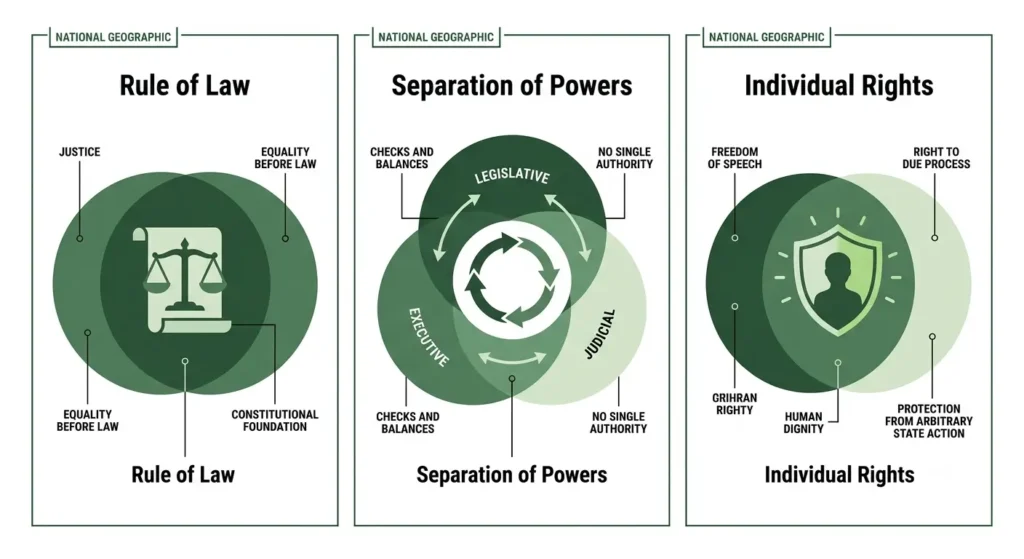
1. Rule of Law
The Rule of Law means that everyone, including government officials, must follow the law. No one is above the law, and all government actions must be legal.
- Equality Before the Law: Everyone must be treated equally, no matter their position.
- Legal Certainty: Laws should be clear, known, and applied fairly.
- Accountability: Officials must follow the law, and illegal actions can be challenged.
(For a deeper dive into how this plays out in India’s federal structure, see our notes on Good Governance — DSC-1.)
2. Separation of Powers
The Separation of Powers divides government responsibilities into different branches: the Executive, Legislature, and Judiciary.
- Checks and Balances: Prevents any branch from becoming too powerful, as each can check the others.
- Prevents Tyranny: Helps stop power from being concentrated in one place.
For example: Legislature makes laws (e.g., Parliament), Executive carries out laws (e.g., the Prime Minister), Judiciary interprets laws (e.g., courts).
3. Protection of Individual Rights
A key goal of constitutionalism is to protect people’s rights from government violations, usually through a Bill of Rights or similar provisions.
- Fundamental Rights: Basic rights everyone has, like life and freedom.
- Civil Liberties: Free speech, religion, assembly.
- Rights to Fair Process: Fair trial, protection from unfair detention.
(This connects directly with the idea of Rights discussed in Rights — DSC-7, if you want to revise that unit alongside this one.)
Summary: Why Constitutionalism Matters
Constitutionalism is important because it provides a legal system that keeps government power in check, ensures fairness, and protects individual rights. The main ideas — Rule of Law, Separation of Powers, and Protection of Individual Rights — work together to stop abuse of power, promote justice, and maintain stability in society.
Evolution of Constitutionalism
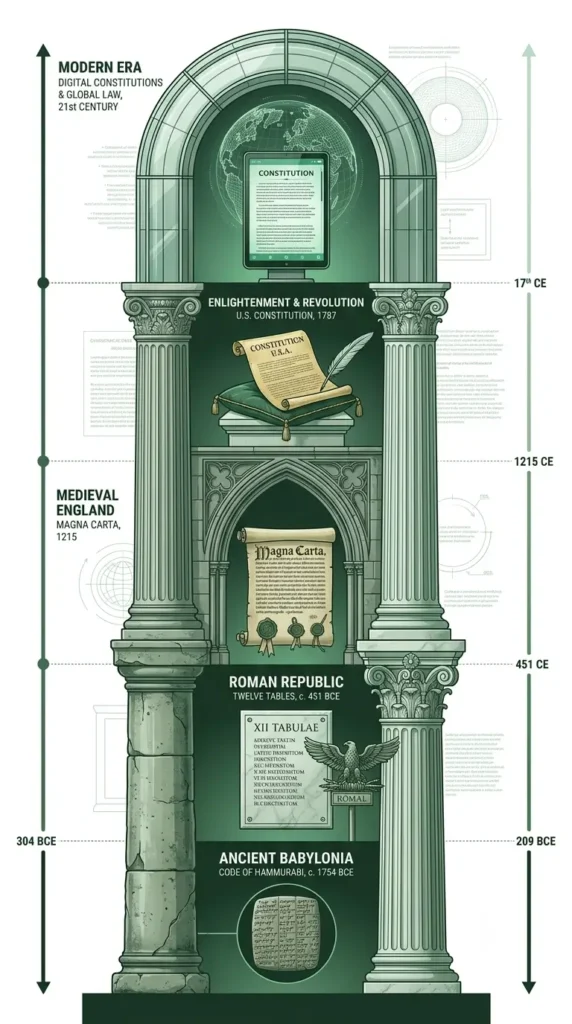
Constitutionalism has changed over many years due to historical events, laws, and political ideas. Here’s how it developed from ancient times to today.
Ancient Beginnings
1. The Code of Hammurabi (around 1754 BCE)
The Code of Hammurabi is one of the first written sets of laws, created by King Hammurabi of Babylon, covering family matters, property rights, and crime.
- It showed that everyone, even the king, must follow the law.
- The code was made public, highlighting the need for clear and fair laws.
2. Athenian Constitution (around 508 BCE)
Ancient Athens is often seen as the start of democracy. The Athenian Constitution, created by Cleisthenes, set up a system where citizens could participate in government.
- Introduced direct democracy, allowing citizens to influence decisions.
- Separated powers among elected officials and the people’s assembly.
Medieval and Renaissance Changes
1. Magna Carta (1215)
The Magna Carta is a key document forced on King John of England by his nobles, aimed at limiting the king’s power.
- Established that the king must obey the law, starting the move towards constitutional monarchy.
- Included rights like fair trials and protection from wrongful imprisonment.
2. Model Parliament (1295)
Called by King Edward I, this included clergy, nobles, and common people — later becoming the House of Commons and House of Lords.
- Introduced the idea of representation, limiting the king’s power.
3. Thinkers: Machiavelli and Locke
- Niccolò Machiavelli (1469–1527): The Prince discussed power and the role of rulers, stressing the need for stability and laws.
- John Locke (1632–1704): Two Treatises of Government argued governments exist to protect natural rights (life, liberty, property) through a social contract.
Enlightenment and Social Contract Ideas
1. Montesquieu’s Separation of Powers (1748)
Montesquieu, in The Spirit of the Laws, argued that dividing power into three branches prevents abuse — directly influencing the U.S. Constitution (1787) and the modern idea of checks and balances.
2. Locke’s Social Contract Theory
Locke’s idea of popular sovereignty and limited government helped define modern democratic constitutionalism.
3. Rousseau’s General Will and Popular Sovereignty
Jean-Jacques Rousseau, in The Social Contract (1762), argued that political power comes from the people’s general will — an idea that fed directly into the French Revolution.
Modern Constitutionalism Development
1. 19th Century Europe
The French Revolution (1789) established popular sovereignty and universal rights; constitutional monarchies appeared; the Revolutions of 1848 pushed for rights-guaranteeing constitutions.
2. Latin American Constitutions
The Constitution of Cádiz (1812) and the Mexican Constitution (1824) were important early examples in the region.
3. Meiji Constitution in Japan (1889)
Created a constitutional monarchy with a legislature and guaranteed civil rights — one of the first written constitutions in Asia.
4. Post-World War II Constitutions
Germany’s Basic Law (1949), the Indian Constitution (1950), and post-independence African constitutions all promoted democracy and human rights after 1945.
Summary: The Historical Arc
The journey of constitutionalism goes from early laws and Athenian democracy to modern constitutions that support democracy, human rights, and the rule of law — shaped by thinkers like Locke and Montesquieu and events like the French Revolution.
Post-Colonial Constitutionalism
Post-colonial constitutionalism is about creating constitutions in countries that became independent from colonial powers, mostly in the 20th century — aiming to set up democratic governments, protect human rights, and modernize societies affected by colonialism.

Definition and Characteristics
- Democratic Principles: Popular sovereignty, universal suffrage, civil liberties.
- Ethnic and Cultural Diversity: Accommodating varied populations in the new system.
- Secularism or State Religion: Balancing separation of religion and state with existing religious identities.
- Economic Justice: Correcting inequalities left by colonial rule.
- Internationalism: Alignment with UN, human rights, self-determination.
Case Studies
1. India
- Parliamentary system inspired by the British model but tailored to Indian needs.
- Secularism and Pluralism guaranteed constitutionally.
- Social Justice through affirmative action for historically disadvantaged groups.
- Challenges: communalism, caste discrimination, economic inequality remain significant.
(For the deeper Indian angle, see our notes on Aggannasutta — DSC-8 which touches on early ideas of governance and social order relevant to this discussion.)
2. African Nations
- Ethnic Diversity meant constitutions often tried to share power to avoid conflict.
- Pan-Africanism and, in cases like Tanzania under Julius Nyerere, socialist nationalisation.
- Nigeria (1960): struggled with ethnic divisions, leading to instability.
- Kenya (1963): presidential system, but ethnic tensions caused instability.
- South Africa (1994): new democratic constitution post-apartheid, focused on reconciliation.
3. Latin American Nations
- Republicanism, mixed presidential-parliamentary systems.
- Mexico (1917): land reform, workers’ rights.
- Brazil (1988): wide civil, political, and social rights post-dictatorship.
(You may also want to revisit our notes on Brazil — DSC-17 for the comparative-politics angle on this same constitution.)
Challenges and Adaptations
- Balancing Tradition and Modernity — e.g., integrating tribal/traditional councils in Africa, or the caste system in India, without undermining democratic values.
- Addressing Social and Economic Inequalities — affirmative action in India; land reform attempts in Africa, often resisted by existing elites.
- Ensuring Democratic Governance — frequent military coups in post-colonial Africa and Latin America; South Africa’s Truth and Reconciliation Commission as a notable exception.
Summary: Post-Colonial Constitutionalism in Brief
Post-colonial constitutionalism emerged as a way for newly independent nations to build governance reflecting democratic values, human rights, and social justice — with India, Africa, and Latin America each showing different paths through the same colonial legacy.
Modern Challenges to Constitutionalism
Constitutionalism today faces challenges from terrorism, globalization, technology, and the environment — each testing its core commitment to democracy, rule of law, and human rights.

Terrorism and Surveillance
- Security vs. Freedoms: The USA Patriot Act (2001) increased surveillance and limited freedoms post-9/11, raising overreach concerns.
- Surveillance State: Edward Snowden’s NSA revelations exposed the tension between state security and personal privacy.
Globalization and Governance
- International Organizations like the UN and EU can influence domestic law, creating tension with national sovereignty.
- Human Rights Norms sometimes clash with local customs.
- Economic Policies: Global trade agreements can restrict a nation’s constitutional freedom to legislate on labor or environmental protection.
Role of Technology
- Privacy and Data Protection: The EU’s GDPR addresses this, though many countries lack similar laws.
- Freedom of Expression: Social media raises questions on how much governments should regulate misinformation without limiting free speech.
- AI and Automation: Algorithms in governance may unintentionally reinforce bias or violate due process.
Environmental Concerns
- Some countries have added the right to a healthy environment to their constitutions.
- Climate change raises new questions of state responsibility and international cooperation that can conflict with national sovereignty.
Key Principles of Constitutionalism
Rule of Law
Everyone, including officials, follows the law — equality before the law, legal certainty, accountability.
Separation of Powers
Executive, Legislature, and Judiciary check each other to prevent concentration of power.
Protection of Individual Rights
Civil, political, economic, and social rights, plus due process and equal protection.
Constitutional Interpretation
- Originalism: Interprets the constitution based on framers’ intent.
- Living Constitution: Sees the constitution as evolving with society.
- Judicial Review: Courts check laws against the constitution.
Federalist Dynamics
Power shared between central and regional governments, balancing local autonomy with national unity.
(Compare this with our detailed notes on Local Governance — GE-2 for the decentralization angle.)
Summary: The Pillars Holding It Together
Modern constitutionalism rests on the Rule of Law, Separation of Powers, and Protection of Individual Rights — constantly tested by terrorism, globalization, technology, and environmental crises, but still the framework through which democracy, justice, and human rights are upheld.
Comparison Table: Constitutionalism Across Eras
| Era | Key Feature | Example | Associated Thinker/Event |
|---|---|---|---|
| Ancient (1754 BCE–508 BCE) | First written laws; early citizen participation | Code of Hammurabi, Athenian Constitution | King Hammurabi, Cleisthenes |
| Medieval/Renaissance (1215–1500s) | Limiting monarchical power; representation | Magna Carta, Model Parliament | King John, Machiavelli, Locke |
| Enlightenment (1700s) | Separation of powers; social contract | U.S. Constitution (1787) | Montesquieu, Locke, Rousseau |
| Modern (1800s–1945) | Popular sovereignty; constitutional monarchies | French Revolution, Meiji Constitution | 1848 Revolutions |
| Post-Colonial (1947–present) | Decolonization; rights-based nation-building | Indian Constitution (1950), South Africa (1994) | Constituent Assembly, Nelson Mandela |
Previous Year Questions (PYQs)
Q1. Discuss the evolution of constitutionalism from colonial to post-colonial contexts. Approach: Contrast colonial constitutions (designed to protect colonial economic interests, limited indigenous participation, dual legal systems) with post-colonial constitutions (popular sovereignty, rights-based, nation-building focus). Use India, Ghana, or South Africa as case studies.
Q2. What is post-colonial constitutionalism? Discuss with suitable case studies. Approach: Define the term, then pick two contrasting case studies (e.g., India’s parliamentary-secular model vs. an African example like Nigeria’s ethnic power-sharing challenges).
Q3. Explain the key principles of constitutionalism with suitable examples. Approach: Structure around Rule of Law, Separation of Powers, Protection of Individual Rights — one real-world example for each (India’s judicial review, U.S. checks and balances, EU’s GDPR for rights in the digital age).
Q4. Critically examine the challenges to constitutionalism in the contemporary world. Approach: Cover terrorism/surveillance (Patriot Act), globalization (UN/EU influence on sovereignty), and technology (AI, social media) — conclude with how constitutions are adapting rather than collapsing.
Q5. Trace the historical development of constitutionalism from ancient to modern times. Approach: Chronological answer — Hammurabi → Magna Carta → Montesquieu/Locke/Rousseau → French Revolution → post-WWII constitutions. Use the comparison table above as your answer skeleton.
FAQs on Constitutionalism
What is the simplest definition of constitutionalism?
Constitutionalism is the idea that a government’s power must come from, and be limited by, a constitution — a set of fundamental laws that everyone, including the government itself, must follow.
What is the difference between a constitution and constitutionalism?
A constitution is a written or unwritten document/set of rules that establishes a government. Constitutionalism is the broader political philosophy that government power should actually be limited and accountable under that constitution — a country can have a constitution without genuine constitutionalism if the rules aren’t followed in practice.
Is India a good example of constitutionalism?
Yes — India’s 1950 Constitution establishes rule of law, separation of powers, judicial review, and fundamental rights. However, challenges like caste discrimination and communalism show that constitutionalism is an ongoing practice, not just a document.
Who is considered the father of modern constitutionalism?
There’s no single “father,” but Montesquieu (separation of powers), John Locke (social contract, natural rights), and Rousseau (popular sovereignty) are the Enlightenment thinkers most credited with shaping modern constitutionalism.
What is post-colonial constitutionalism in simple terms?
It refers to how newly independent countries (mostly after 1945) designed their constitutions to move away from colonial control and build democratic, rights-based systems — often while balancing traditional social structures with modern governance.
Related reading: What is Federalism · Discourses on Nationalism · Concepts in Comparative Political Analysis — Semester 4
Subscribe to keep reading
You've used your free notes for now. Get Delhi Pathshala Premium for unlimited access.
Subscribe — ₹29/30 days