
Contents
- 1. American Occupation of Japan (1945–1952)
- Background and Goals
- Japan’s Surrender
- Occupation Goals
- Leadership and Administration
- General Douglas MacArthur
- SCAP’s Structure
- Disarmament and Democratic Changes
- Military Disbandment
- War Crimes Trials
- The 1947 Constitution
- Creation and Principles
- Article 9: Renunciation of War
- Changes in Government
- Economic Reforms
- Land Redistribution
- Dismantling Zaibatsu
- Labour Reform
- Social and Cultural Changes
- Education and Women’s Rights
- American Cultural Influence
- Key Takeaways
- 2. The Reverse Course: The Cold War Shift in Occupation Policy
- What Triggered the Reverse Course?
- Key Policy Reversals
- Why This Matters for Your Exam
- 3. Historiographical Perspectives
- 4. Economic Recovery and Growth (Post-War Japan)
- Initial Challenges and Recovery Plans
- Postwar Challenges
- Recovery Plans
- Role of the Dodge Plan and Economic Stabilization
- Dodge Plan (1949)
- Industrial Development and Innovation
- Reconstruction of Infrastructure and Industry
- Rise of Key Sectors: Electronics, Automobiles, and Technology
- Social Changes and Urbanization
- Population Movement and Urban Growth
- Changes in Family Structure and Lifestyle
- Political Developments
- Emergence of Political Parties and Democratic Institutions
- US-Japan Security Treaty and Its Implications
- Japan’s Role in the International Community
- Entry into International Organizations
- Foreign Policy and Diplomatic Relations
- Cultural Renaissance
- Influence of Western Culture and Preservation of Japanese Traditions
- Development of Modern Art, Literature, and Cinema
- 5. End of Occupation: The San Francisco Peace Treaty
- Key Takeaways
- 6. Quick Reference Tables
- SCAP’s Major Reforms: Intended Goal vs. Actual Outcome
- Zaibatsu vs. Keiretsu
- 7. Continue Reading
- 8. External References
- 9. University of Delhi Previous Year Questions
- 10. Frequently Asked Questions (FAQs)
- Conclusion
In this post, notes on “Unit 4: American Occupation of Japan | Post-War Reconstruction of Japan” from DSC-3: History of Modern Japan (c. 1868–1950s) are given, covering the full arc from Japan’s surrender in 1945 to the restoration of its sovereignty in 1952 — the demilitarization and democratization reforms under SCAP, the 1947 Constitution, economic recovery under the Dodge Plan, the Cold War-driven “reverse course,” and the San Francisco Peace Treaty. This post is structured for DU BA (Hons.) History exam preparation, with short/long PYQ-pattern questions and FAQs at the end.
1. American Occupation of Japan (1945–1952)
Background and Goals
Japan’s Surrender
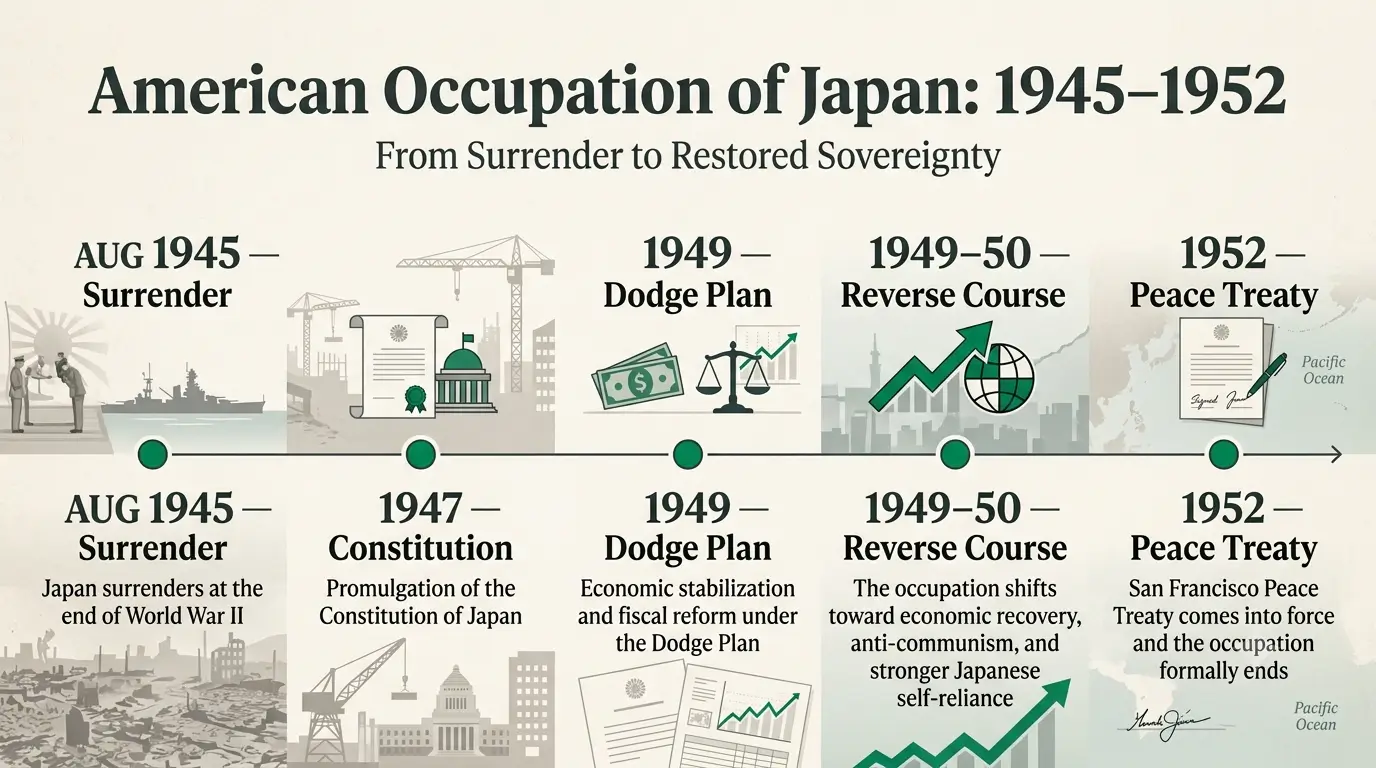
Japan surrendered on August 15, 1945, after the atomic bombings of Hiroshima (August 6) and Nagasaki (August 9), bringing the Second World War to an end. The formal instrument of surrender was signed aboard the USS Missouri in Tokyo Bay on September 2, 1945 — the date usually treated as the formal end of the war in the Pacific and the start of the occupation.
The legal and policy framework for the occupation rested on two founding documents:
- The Potsdam Declaration (July 26, 1945), issued by the U.S., U.K., and China (the Soviet Union added its endorsement when it entered the war against Japan), which demanded Japan’s unconditional surrender and set out the broad terms for eliminating militarism and establishing “a peacefully inclined and responsible government.”
- The U.S. Initial Post-Surrender Policy for Japan (SWNCC 150/4), approved by President Truman on September 6, 1945, and released publicly on September 22, 1945. This became SCAP’s operating charter and translated the Potsdam Declaration’s broad demands into concrete policy: disarm Japan, democratize its institutions, and prevent it from ever again threatening regional peace.
Occupation Goals
The occupation had a dual mandate, commonly summarized as demilitarization and democratization:
- Demilitarization — dismantle Japan’s armed forces and war-making capacity, and remove militarist influence from public life.
- Democratization — replace authoritarian imperial rule with a constitutional, parliamentary system built on popular sovereignty, civil liberties, and human rights.
Beyond these twin pillars, the occupation also pursued economic and social reform — land redistribution, the weakening of concentrated industrial power (the zaibatsu), labour rights, and education reform — on the theory that militarism had been sustained not just by the army but by economic monopoly, social inequality, and an authoritarian education system. The underlying goal was to build a peaceful, pro-Western, non-threatening Japan.
Leadership and Administration
General Douglas MacArthur
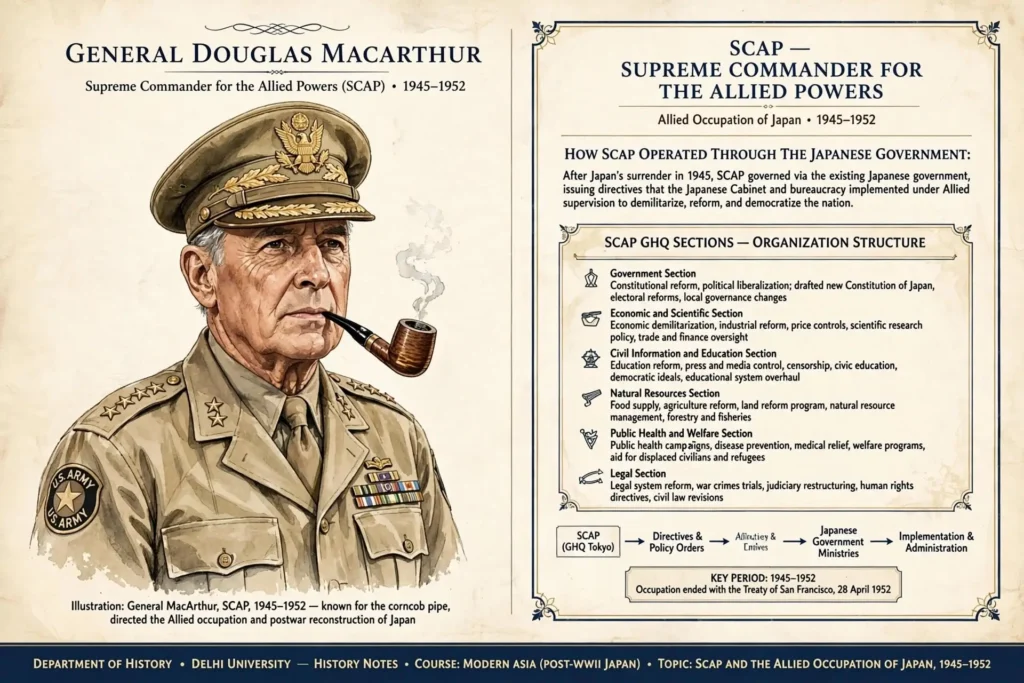
General Douglas MacArthur was appointed Supreme Commander for the Allied Powers (SCAP) — a title that, confusingly, referred both to MacArthur personally and to the entire administrative organization he headed. He arrived in Japan on August 30, 1945, and effectively governed the country as an unelected but immensely powerful figure until his replacement by General Matthew Ridgway in April 1951. Japanese popular culture at the time referred to him, half in awe, as the “Caesar of the Pacific.”
Although the occupation was nominally a collective Allied endeavour — with an Allied Council for Japan (Tokyo) and an eleven-nation Far Eastern Commission (Washington) formally overseeing policy — in practice the occupation was an almost entirely American affair. The Soviet Union, notably, was excluded from any real administrative role in Japan, unlike in occupied Germany, because it refused to place its troops under MacArthur’s command. The Far Eastern Commission set broad policy and the Allied Council was consultative, but MacArthur and his staff took orders principally from Washington and paid limited attention to either body.
SCAP’s Structure
SCAP combined military and civilian staff who administered nearly every domain of Japanese life — government, military affairs, the economy, and education. Rather than direct military rule (as in occupied Germany), SCAP governed through indirect rule: the existing Japanese government, bureaucracy, and even the emperor were retained as instruments through which SCAP’s directives were issued and implemented. This was a deliberate and pragmatic choice — it preserved administrative continuity, reduced the cost and manpower needed for direct rule, and lent indigenous legitimacy to reforms that were, in substance, externally imposed.
Disarmament and Democratic Changes
Military Disbandment
One of SCAP’s first actions was the complete disbandment of Japan’s armed forces, which had numbered over six million men at the war’s end. This involved dismantling military installations, arsenals, and munitions factories, and destroying or converting military aircraft and naval vessels. A closely linked and logistically enormous task was repatriation — bringing home roughly six million Japanese soldiers and civilians from former colonies and occupied territories across East and Southeast Asia (with the notable exception of around 400,000 people who remained prisoners in the Soviet Union). Demobilization and repatriation were substantially completed by the end of 1948.
Japan was constitutionally barred from maintaining a military for the duration of the occupation — a prohibition that would only be partially reversed once Cold War pressures intensified (see “The Reverse Course,” below).
War Crimes Trials
The most prominent mechanism of retribution was the International Military Tribunal for the Far East (IMTFE) — commonly called the Tokyo Trials — which ran from May 1946 to November 1948. It prosecuted 28 “Class A” defendants (charged with crimes against peace, in addition to conventional war crimes), including former Prime Minister Tojo Hideki. All 28 were found guilty on some charges; Tojo and six others were executed, while sixteen others received life sentences.
Alongside the Tokyo Trials, a network of national and local courts in Japan and other Asian countries tried roughly 5,700 “Class B” and “Class C” defendants for conventional war crimes and crimes against humanity — of whom over 900 were executed.
Beyond the courtroom, SCAP also conducted a broader purge of Japanese public life: between 1945 and 1948, roughly 200,000 people — military officers, ultranationalist politicians, bureaucrats associated with the war ministries, and business leaders tied to militarist associations — were removed from their positions and had their political rights suspended. This purge, however, was applied unevenly and largely spared the financial and industrial elites whose wartime activity had sustained the imperial war effort — a point of ongoing scholarly criticism (see Section 3, “Historiographical Perspectives,” below).
The 1947 Constitution
Creation and Principles
The Constitution of Japan, promulgated in November 1946 and effective from May 3, 1947, is sometimes called the “MacArthur Constitution” because of the central role American officials played in drafting it. The process itself is instructive: an initial Japanese-government draft, prepared under diplomat Kijūrō Shidehara, struck MacArthur and his staff as far too conservative and insufficiently democratic. MacArthur therefore had his own Government Section at GHQ produce an alternative draft — the one that, after negotiation with Japanese leaders, ultimately became the new constitution.
The Constitution marked a fundamental break from the Meiji Constitution of 1889 (compare with the Meiji Constitution, which had vested sovereignty in the emperor). Under the new charter:
- Sovereignty shifted from the emperor to the people.
- The emperor became a purely symbolic “symbol of the State and of the unity of the people,” stripped of political authority and formally required to renounce his claim to divinity.
- The document guaranteed fundamental human rights, social-welfare rights, and — most distinctively — Article 9, discussed separately below.
Article 9: Renunciation of War
Article 9 is the constitution’s single most internationally significant clause. It states that Japan “forever renounces war as a sovereign right of the nation” and the threat or use of force as a means of settling international disputes, and further declares that land, sea, and air forces, as well as other war potential, will never be maintained. This made Japan’s post-war constitution globally unusual in explicitly renouncing not just aggressive war but the maintenance of any military force at all — a provision that would come under strain within just a few years, once the Korean War forced a partial and controversial re-interpretation (see “The Reverse Course”).
Changes in Government
The new constitution set up a parliamentary democracy with a bicameral National Diet as the supreme organ of state power. The old, appointed House of Peers was replaced by an elected House of Councillors, while primary legislative authority rested with the lower House of Representatives. The Cabinet was made collectively responsible to the Diet, and the first post-war general election — held in April 1946, even before the constitution’s formal promulgation — confirmed broad popular acceptance of the new democratic order, although no single party won a clear majority and Yoshida Shigeru, who became prime minister, initially headed an unstable coalition government. The constitution also enshrined universal adult suffrage, extending the vote to women for the first time, and wrote the principle of local autonomy into law.
Economic Reforms
Land Redistribution
Land reform is widely regarded as the most successful and least controversial of all occupation policies. Initially proposed by the Japanese government itself in 1945, it was substantially strengthened by SCAP directives from 1946 onward. Under the Special Measures to Create Independent Farmers Act and the Revised Farmland Adjustment Act (1946), the state compulsorily purchased tenant-farmed land above a modest threshold (roughly two to three hectares, depending on region) from absentee and large landlords and resold it on highly favourable terms to the tenant farmers who actually worked it.
The results were dramatic: approximately 80% of tenanted farmland — affecting roughly four million acres and two million tenant households — was redistributed within about two years, and the proportion of Japanese farm households classified as tenants fell from close to 50% before the war to under 10% within a decade. This reform eliminated the economic base of the old landlord class, created a large class of independent smallholders with a direct stake in the new democratic order, and contributed significantly to Japan’s post-war rural political stability.
Dismantling Zaibatsu
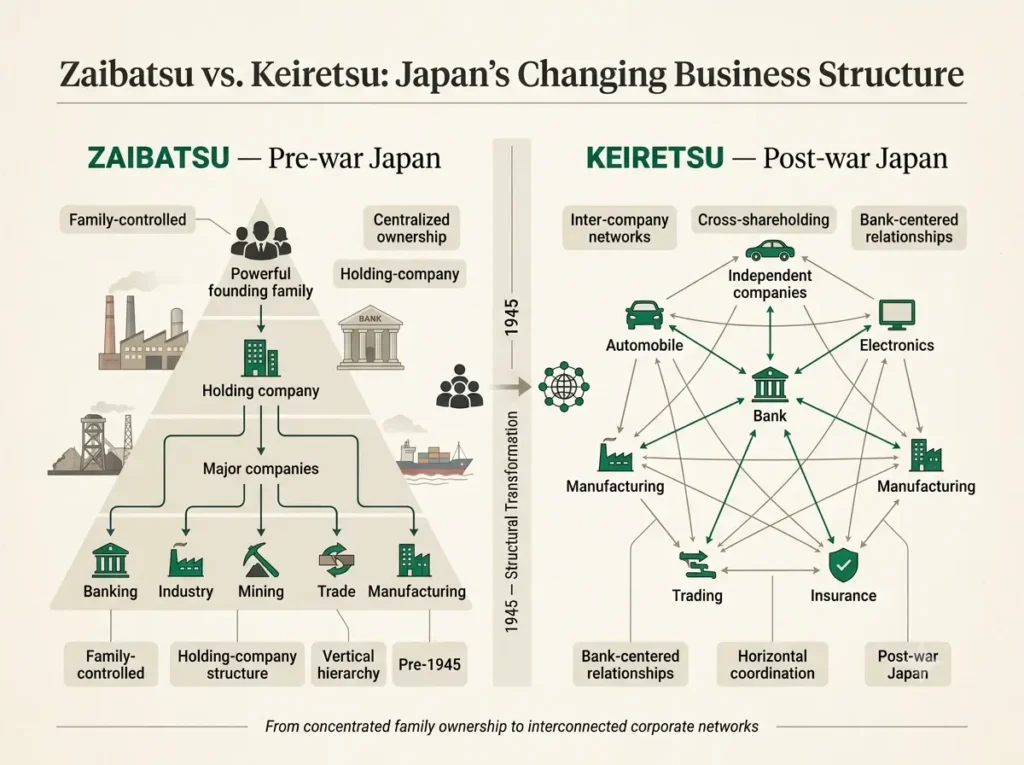
SCAP also targeted the zaibatsu — massive, family-controlled industrial conglomerates such as Mitsui, Mitsubishi, Sumitomo, and Yasuda — which had dominated the pre-war and wartime economy and were seen as having underwritten Japanese militarism. SCAP initially identified 83 zaibatsu holding companies for dissolution, seizing their shares and releasing them onto the open market; the Deconcentration Law of 1947 subsequently targeted over 300 additional companies for breakup.
This effort, however, was significantly reversed once Cold War priorities took hold: the number of companies actually subject to breakup was whittled down from over 300 to just 18, and ultimately only 11 were divided. Banks, notably, were left largely untouched, which had a lasting effect on the structure of the post-war Japanese economy. In place of the family-owned zaibatsu, a new form of corporate organization emerged — the keiretsu — a network of formally independent companies linked through cross-shareholding and a central bank, rather than a single controlling family. The keiretsu preserved many of the zaibatsu’s organizational features while nominally complying with post-war anti-monopoly law, and became a defining feature of the “Japanese corporate capitalism” that underpinned Japan’s later high-growth era.
Labour Reform
Labour reform was the third major pillar of SCAP’s economic democratization agenda, guided by three landmark statutes often referred to together as the “Three Labour Laws“: the Trade Union Law (1945), the Labor Relations Adjustment Law (1946), and the Labor Standards Act (1947). These guaranteed workers the right to organize, bargain collectively, and strike, and established a Ministry of Labour — Japan’s first — to oversee compliance.
The effect on union membership was extraordinary: in a country facing roughly 13 million potentially unemployed people after demobilization, the rate of union organization rose from about 3% in 1945 to 55% within three years, reaching close to five million members by 1949. This rapid unionization also produced a wave of militant labour activism, including major strikes — activism that, as Cold War anxieties grew, SCAP itself moved to restrain (it banned strikes by public servants in 1948 and later revised the Trade Union Law to limit union power).
Social and Cultural Changes
Education and Women’s Rights
Education reform, formalized through the Fundamental Law of Education and the School Education Law, both enacted in 1947, replaced Japan’s prewar multi-track, highly centralized education system with a single-track 6-3-3-4 structure modeled on the American system. Compulsory education was extended from six to nine years, co-education was introduced at all levels, and the highly centralized Ministry of Education’s authority was reduced through the creation of locally elected school boards. Textbooks were revised to strip out militaristic content, and roughly 120,000 teachers judged insufficiently committed to democratic values were purged (with many later reinstated). Women gained the right to vote, to own property, to pursue higher education, and to enter government and police service for the first time.
American Cultural Influence
American culture — movies, music, consumer goods, and ideals of individualism and democracy — had a significant impact on Japanese society during the occupation, contributing to a gradual shift toward Western-style consumerism and lifestyles even as Japan continued to preserve many of its own traditional arts and customs.
Key Takeaways
The American occupation of Japan (1945–52) pursued a dual mandate of demilitarization and democratization, formalized through the Potsdam Declaration and the Initial Post-Surrender Policy. Under General MacArthur’s SCAP, Japan underwent sweeping constitutional, economic, and social reform — the 1947 Constitution (with its unique Article 9), land redistribution, the dismantling of the zaibatsu, and labour and education reform. These reforms were genuinely transformative, but — as the next section shows — they were substantially reshaped by the onset of the Cold War.
2. The Reverse Course: The Cold War Shift in Occupation Policy
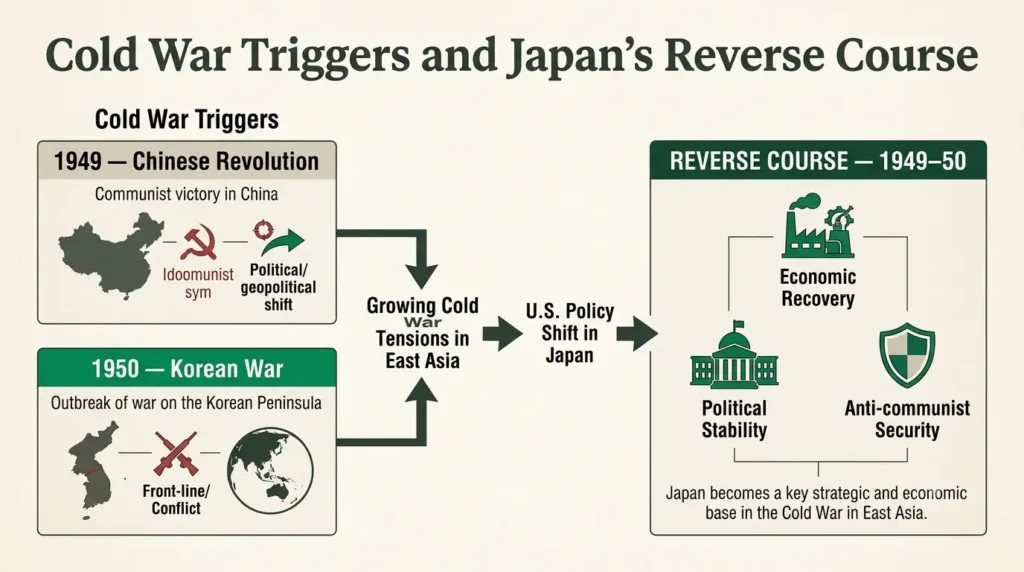
By 1948–49, American strategic priorities in Asia changed dramatically, producing a set of policy reversals that historians collectively call the gyaku kōsu, or “reverse course.” This is one of the most important — and most frequently examined — themes in the study of the occupation, and it fundamentally qualifies any simple narrative of the occupation as a smooth march toward liberal democracy.
What Triggered the Reverse Course?
Two events reoriented American policy:
- The Chinese Communist victory in the Chinese Civil War (1949), which raised the alarming prospect (from Washington’s perspective) of a communist bloc dominating mainland Asia.
- The outbreak of the Korean War in June 1950, which turned Japan overnight into an indispensable American military staging ground and logistical base.
Together, these events shifted American priorities away from punishing and reforming a former enemy, and toward building Japan into a stable, prosperous, reliably anti-communist ally.
Key Policy Reversals
- Purge reversed, not intensified: The purge of wartime militarist leaders was halted, and many previously purged officials — including future Prime Minister Nobusuke Kishi, who had served as a minister in Tojo’s wartime cabinet — returned to positions of political and economic power.
- New purge target — the political left: Attention shifted instead toward suppressing the Japan Communist Party and its sympathizers within labour unions, academia, and the media (the so-called “Red Purge“).
- Zaibatsu dissolution abandoned: As noted above, the ambitious plan to break up over 300 zaibatsu-linked companies was scaled back to just 11 actual breakups, and the government was encouraged to support, rather than dismantle, large industrial combines.
- Rearmament begins: In 1950, at the outbreak of the Korean War, GHQ ordered the creation of the National Police Reserve — a 75,000-strong paramilitary force that represented the first, cautious step back toward a Japanese military, notwithstanding Article 9. This force was reorganized into the Self-Defense Forces in 1954, after the occupation had ended.
- Economic policy reoriented toward growth: Instead of continued reform and reparations, the emphasis shifted decisively toward rebuilding Japan’s industrial capacity — a shift closely tied to the Dodge Plan (covered in Part 2 of this unit, below) and to American wartime procurement spending during the Korean War, which gave Japanese industry a major boost.
Why This Matters for Your Exam
The reverse course is frequently tested precisely because it complicates the “successful democratization” narrative that the earlier sections of this unit might otherwise suggest. It shows that the occupation’s outcomes were shaped as much by external Cold War geopolitics as by American democratic idealism — a distinction examiners often expect students to draw explicitly.
3. Historiographical Perspectives
Historians remain divided on how to characterize the occupation’s overall legacy. Sympathetic or “success” narratives emphasize the genuinely transformative achievements in constitutional government, land reform, and civil rights, and note the striking contrast with the difficulties later faced during the American occupation of Iraq (2003 onward) — a comparison some scholars have drawn explicitly.
Critical accounts, often informed by post-colonial and left-leaning Japanese historiography, emphasize:
- The undemocratic methods used to build democracy — including systematic press censorship and the suppression of dissenting publications during the occupation itself.
- The fact that the 1947 Constitution was never put to a popular referendum, and that substantive Japanese input into its drafting was limited.
- The protection of Emperor Hirohito and other senior wartime figures from accountability, seen by critics as a case of political expediency overriding the occupation’s stated commitment to justice.
- The way the reverse course truncated the reform agenda, preserving conservative political and economic elites — a continuity of power that, critics argue, still shapes Japanese politics and Japan’s engagement with its own wartime history (including unresolved controversies such as the treatment of “comfort women” in Japanese textbooks and official memory).
A balanced answer for DU exams should acknowledge both dimensions: genuine, lasting democratic and economic transformation, alongside real limits, contradictions, and continuities with the pre-war order.
4. Economic Recovery and Growth (Post-War Japan)
Initial Challenges and Recovery Plans
Postwar Challenges
After the war, Japan faced severe economic distress: destroyed factories and infrastructure, acute food shortages, runaway prices, a weak currency, and high unemployment, compounded by the strain of absorbing millions of returning soldiers and repatriated civilians.
Recovery Plans
Initial U.S. efforts to stabilize the economy centred on the structural reforms already discussed — land reform, the (partial) breakup of the zaibatsu, and labour rights — on the theory that a more equitable economic structure would itself support recovery and prevent a relapse into instability that could feed extremism.
Role of the Dodge Plan and Economic Stabilization
Dodge Plan (1949)
By 1948–49, however, U.S. policy shifted toward direct macroeconomic stabilization. The Dodge Plan, designed by U.S. banker and presidential advisor Joseph Dodge in 1949, aimed to break the cycle of chronic inflation by imposing a balanced national budget, cutting government spending, and tightly controlling the money supply — essentially, an early and quite severe form of fiscal austerity (“the Dodge Line”). The plan required the Japanese government to limit money creation and reduce reliance on government borrowing, and it fixed the yen at a single exchange rate of ¥360 to the U.S. dollar, which remained in place for over two decades and gave Japanese exporters a stable, competitive footing.
The Dodge Plan caused real short-term pain — rising unemployment and falling wages — but it succeeded in curbing inflation and laid the fiscal groundwork for sustained long-term growth, particularly once Korean War procurement spending began flowing into the Japanese economy from 1950 onward.
Industrial Development and Innovation
Reconstruction of Infrastructure and Industry
The U.S. provided financial assistance and technical expertise that helped boost Japan’s industrial output through the 1950s, with early emphasis on rebuilding heavy industries — steel, coal, and shipbuilding — that were considered essential to broader recovery.
Rise of Key Sectors: Electronics, Automobiles, and Technology
- Electronics and Technology: Japan emerged as a global leader in electronics, with companies such as Sony, Panasonic, and Sharp driving innovation in televisions, semiconductors, and audio equipment through an emphasis on high-quality manufacturing.
- Automobiles: The automobile industry expanded rapidly, with Toyota, Nissan, and Honda becoming global competitors, supported by government industrial policy that emphasized quality and export competitiveness.
Social Changes and Urbanization
Population Movement and Urban Growth
Large numbers of people migrated from rural areas to cities such as Tokyo, Osaka, and Yokohama in search of employment, driving rapid urban growth. Governments launched large public housing and infrastructure projects — including modern transport systems such as the Shinkansen bullet train (which opened in 1964, just after this unit’s period, but whose planning and early groundwork date to the 1950s) — to cope with the strain.
Changes in Family Structure and Lifestyle
Urban migration accelerated the shift from extended to nuclear family structures, while growing numbers of women entered the workforce, gradually reshaping traditional gender roles. Rising incomes fuelled a new consumer culture, with expanding demand for televisions, cars, and household goods, and the growth of shopping and entertainment districts.
Political Developments
Emergence of Political Parties and Democratic Institutions
Japan’s new constitutional order gave rise to a competitive party system, though it was the Liberal Democratic Party (LDP) — formed in 1955, just after this unit’s period, through the merger of Japan’s main conservative parties — that would go on to dominate Japanese politics for decades.
US-Japan Security Treaty and Its Implications
Signed alongside the San Francisco Peace Treaty in 1951, the US-Japan Security Treaty allowed the United States to retain military bases in Japan for its defence, even as Article 9 formally barred Japan from maintaining offensive military forces of its own. This arrangement let Japan concentrate its resources on economic growth while adopting an officially pacifist foreign policy — an arrangement sometimes called the “Yoshida Doctrine,” after Prime Minister Yoshida Shigeru.
Japan’s Role in the International Community
Entry into International Organizations
Japan’s admission to the United Nations in 1956 marked its formal return to the community of nations as a peaceful state, and it subsequently became involved in a widening range of international organizations, reinforcing its re-integration into the global economy.
Foreign Policy and Diplomatic Relations
Japan maintained a close alliance with the United States through the Cold War while also working to rebuild diplomatic and economic relations with neighbouring countries such as South Korea and China — relations complicated by the legacy of Japan’s own earlier imperial expansion in the region.
Cultural Renaissance
Influence of Western Culture and Preservation of Japanese Traditions
Post-war Japan experienced a strong current of Western cultural influence — American films and music prominent among them — even as considerable effort went into preserving traditional Japanese arts and customs alongside this new Western influence.
Development of Modern Art, Literature, and Cinema
Japan’s cultural life underwent a genuine revival in this period. In literature, writers such as Yukio Mishima achieved international recognition, blending traditional and modern sensibilities. In cinema, directors such as Akira Kurosawa achieved lasting global influence, with his 1950 film Rashomon often credited with introducing Japanese cinema to Western audiences.
5. End of Occupation: The San Francisco Peace Treaty
The occupation formally ended with the Treaty of Peace with Japan, signed in San Francisco on September 8, 1951, by Japan and 48 Allied nations (notably, the Soviet Union declined to sign). The treaty came into force on April 28, 1952, restoring full Japanese sovereignty.
Key features of the settlement:
- Japan formally renounced claims to Korea, Taiwan, and other former colonial territories.
- Japan agreed to pay reparations to countries it had occupied during the war, though these were kept deliberately modest to support Japan’s own economic recovery — reflecting the same Cold War logic that shaped the reverse course.
- The treaty was signed on the same day as the US-Japan Security Treaty, formally linking Japan’s regained sovereignty to a continuing American military presence — a linkage that has remained a subject of political debate in Japan to this day.
With the treaty’s entry into force in April 1952, the American occupation of Japan — one of the most sustained and consequential exercises of externally directed nation-building in modern history — came to a formal close after almost seven years.
Key Takeaways
Japan’s post-war recovery combined the Dodge Plan’s fiscal stabilization, Korean War-driven industrial growth, and steady political institutionalization around the LDP and the US-Japan security alliance. The occupation ended with the San Francisco Peace Treaty (September 1951, effective April 28, 1952), restoring Japanese sovereignty while cementing a long-term US-Japan security relationship that endures today.
6. Quick Reference Tables
SCAP’s Major Reforms: Intended Goal vs. Actual Outcome
| Reform | Intended Goal | Actual Outcome / Limitation |
|---|---|---|
| Military disbandment | Permanently eliminate Japan’s war-making capacity | Complete by 1948, but partially reversed in 1950 with the National Police Reserve |
| 1947 Constitution | Popular sovereignty, civil rights, permanent renunciation of war (Article 9) | Adopted and enduring, but drafted largely by Americans without a popular referendum |
| Land reform | Break the power of the landlord class, create independent farmers | Highly successful — ~80% of tenanted land redistributed; tenancy fell from ~50% to under 10% |
| Zaibatsu dissolution | Break up 300+ monopolistic conglomerates | Scaled back to just 11 actual breakups; zaibatsu succeeded by keiretsu networks |
| Labour reform | Guarantee union rights, prevent “social dumping” | Union membership rose from 3% to 55% in three years, but later restrained after 1948 strikes |
| Purge of militarists | Permanently remove ~200,000 wartime leaders from public life | Purge substantially reversed after 1949–50; many officials returned to power |
Zaibatsu vs. Keiretsu
| Feature | Zaibatsu (pre-war) | Keiretsu (post-war) |
|---|---|---|
| Ownership | Controlled by a single founding family | No single family owner; linked through cross-shareholding |
| Structure | Centralized holding company at the top | Decentralized network around a core bank |
| Examples | Mitsui, Mitsubishi, Sumitomo, Yasuda | Mitsubishi Group, Sumitomo Group (as post-war networks) |
| Legal status | Dissolved/targeted for breakup by SCAP (1945–47) | Formally compliant with post-war anti-monopoly law |
| Relationship to state/military | Closely tied to wartime military-industrial policy | Oriented toward post-war export-led industrial growth |
7. Continue Reading
Continue Reading — DSC-3: History of Modern Japan and Korea
8. External References
For further reading and verification, students may consult:
External References — American Occupation of Japan
9. University of Delhi Previous Year Questions
DU Previous Year Questions
Compiled from actual University of Delhi previous year papers — Paper Code 12317612 (History of Modern Japan and Korea) — across Shivaji College, Shri Guru Nanak Dev Khalsa (SGND Khalsa) College, Loreto College, and Hemchandra (Herambachandra) College. These questions cover Unit 4 of DSC-3 and are grouped according to marks weightage.
Section A: Long Answer Questions — 15–25 Marks
1 Discuss the main objectives of the American Occupation of Japan (1945–1952). What steps did SCAP take toward demilitarization and democratization? +
2 Discuss the salient features of the 1947 Japanese Constitution. What is the significance of Article 9? Was it imposed by American officials? +
3 What is meant by the “Reverse Course” (1947–1950)? Why did American policy shift so abruptly? +
4 Critically evaluate SCAP’s economic reforms — land redistribution and the dissolution of the zaibatsu. +
5 What role did the Dodge Plan (1949) and the Shoup Mission play in Japan’s economic stabilization? How did the Korean War help recovery? +
6 Discuss the social reforms undertaken during the American Occupation — education reforms, women’s suffrage, and labour unions. +
Section B: Medium Questions — 10 Marks
7 What was the purpose of the War Crimes Trials / Tokyo Trials? What were the “purges”? +
8 What were the implications of the San Francisco Peace Treaty (1951) and the US-Japan Security Treaty? +
9 What was the structure of SCAP? What was General Douglas MacArthur’s role? +
10 How was American cultural influence reflected in post-war reconstruction? Comment on the “Americanization” of Japan. +
Section C: Short Notes — 5 Marks
11 Potsdam Declaration +
12 Red Purge of 1950 / National Police Reserve +
13 Zaibatsu vs. Keiretsu +
DU Exam Pattern Tip:
The paper is worth 75 marks, and students must attempt any three questions. Unit 4 almost always appears as one of the options.
For long answers, use a three-phase structure:
1. Early Reforms (1945–47) — Demilitarization and democratization
2. Reverse Course (1948–50) — Shift toward economic rehabilitation and anti-Communist priorities
3. Peace Treaty & Legacy (1951–52) — San Francisco Peace Treaty and its aftermath
10. Frequently Asked Questions (FAQs)
What were the two main goals of the American occupation of Japan?
The occupation’s core mandate was demilitarization (dismantling Japan’s armed forces and war-making capacity) and democratization (building a constitutional, parliamentary government based on popular sovereignty and civil rights).
Who was in charge of the occupation of Japan?
General Douglas MacArthur, as Supreme Commander for the Allied Powers (SCAP), headed the occupation from 1945 until he was replaced by General Matthew Ridgway in April 1951.
What was the Dodge Plan?
The Dodge Plan (1949), designed by U.S. advisor Joseph Dodge, was an austerity programme to stabilize Japan’s economy by balancing the national budget, cutting government spending, and fixing the yen at ¥360 to the U.S. dollar to control inflation.
What is the “reverse course” in the context of Japan’s occupation?
The “reverse course” (gyaku kōsu) refers to the policy reversals that followed the 1949 Chinese Communist revolution and the 1950 Korean War, when U.S. priorities shifted from reforming and punishing Japan to rebuilding it as a stable, anti-communist ally — leading to a halted purge, abandoned zaibatsu dissolution, and early rearmament.
What is the difference between zaibatsu and keiretsu?
Zaibatsu were pre-war family-owned industrial conglomerates (e.g., Mitsui, Mitsubishi) dissolved by SCAP. Keiretsu were their post-war successor networks — companies linked through cross-shareholding around a central bank, rather than a single controlling family.
When did the American occupation of Japan officially end?
The occupation ended on April 28, 1952, when the San Francisco Peace Treaty (signed September 8, 1951) came into force, restoring Japan’s full sovereignty.
What was Article 9 of the 1947 Japanese Constitution?
Article 9 states that Japan “forever renounces war as a sovereign right of the nation” and declares that it will never maintain land, sea, or air forces — a globally distinctive renunciation clause that came under strain once the Korean War prompted the creation of the National Police Reserve in 1950.
How successful was Japan’s land reform under the occupation?
It is generally considered the occupation’s most successful reform: roughly 80% of tenanted farmland was redistributed within about two years, and farm tenancy fell from close to 50% to under 10% within a decade.
Conclusion
The American occupation of Japan (1945–1952) stands as one of the most consequential episodes of externally directed nation-building in modern history. Under General MacArthur’s SCAP, Japan was disarmed, given a new democratic constitution built around popular sovereignty and the unprecedented renunciation of war in Article 9, and subjected to sweeping land, economic, and labour reforms. Yet this reform agenda was neither linear nor purely idealistic: the Cold War’s onset — first the Chinese Communist revolution of 1949, then the Korean War of 1950 — triggered the “reverse course,” scaling back the purge of wartime leaders, abandoning much of the zaibatsu-dissolution programme, and setting Japan on the path toward limited rearmament even under Article 9. The occupation formally ended with the San Francisco Peace Treaty in 1952, but its dual legacy — genuine democratic and economic transformation alongside unresolved continuities with the pre-war order — continues to shape Japan’s politics, its constitutional debates, and its alliance with the United States to this day.
Subscribe to keep reading
You've used your free notes for now. Get Delhi Pathshala Premium for unlimited access.
Subscribe — ₹29/30 days