
Contents
- Korea – Historical Relations and Colonial Experience with Japan
- 1. Early Relations and Conflicts (Common Era to 1598)
- 2. Treaty of Ganghwa (1876)
- 3. Annexation of Korea (1910)
- 4. Colonial Administration and Policies
- 5. Impact on Korean Society and Culture
- Manchuria – Japanese Expansion and Control
- 1. Importance of Manchuria
- 2. Mukden Incident (1931)
- 3. Creation of Manchukuo (1932)
- 4. Economic Exploitation
- 5. Impact on Local People
- China – The Japanese Invasion and Occupation
- 1. Early Relations and Conflicts with China
- 2. Twenty-One Demands (1915)
- 3. Second Sino-Japanese War (1937–1945)
- 4. Occupation and Administration
- 5. International Reaction and Consequences
- Comparison: Japan’s Colonial Methods in Korea, Manchuria & China
- Timeline of Japanese Expansion (1876–1945)
- Key Takeaways
- Previous Year Questions (DSC-3, Unit 3)
- FAQs
In this post, notes of “Unit 3: Imperialistic Expansion: Korea, Manchuria, China” from “DSC-3: History of Modern Japan (c. 1868 – 1950s)” are given, which is helpful for students appearing in this year’s exams. Agar aap Meiji-era ke political background se pehle refresh karna chahte ho, hamare Meiji Constitution notes pehle padh sakte ho.
Korea – Historical Relations and Colonial Experience with Japan
1. Early Relations and Conflicts (Common Era to 1598)
- Initial Contact: Japan and Korea have interacted for centuries, starting in the early Common Era. They were separate kingdoms that traded and exchanged culture. Japan often sent envoys to Korea to learn about China. While there were peaceful exchanges, conflicts arose over land and cultural differences.
- Japanese Invasions (1592–1598): Known as the Imjin War, these invasions were led by Toyotomi Hideyoshi, who wanted to conquer Korea as a step toward invading China. The invasions caused massive destruction and loss of life. With help from China, Korea successfully resisted the invasions, but this period left lasting scars and changed their relationship.
2. Treaty of Ganghwa (1876)
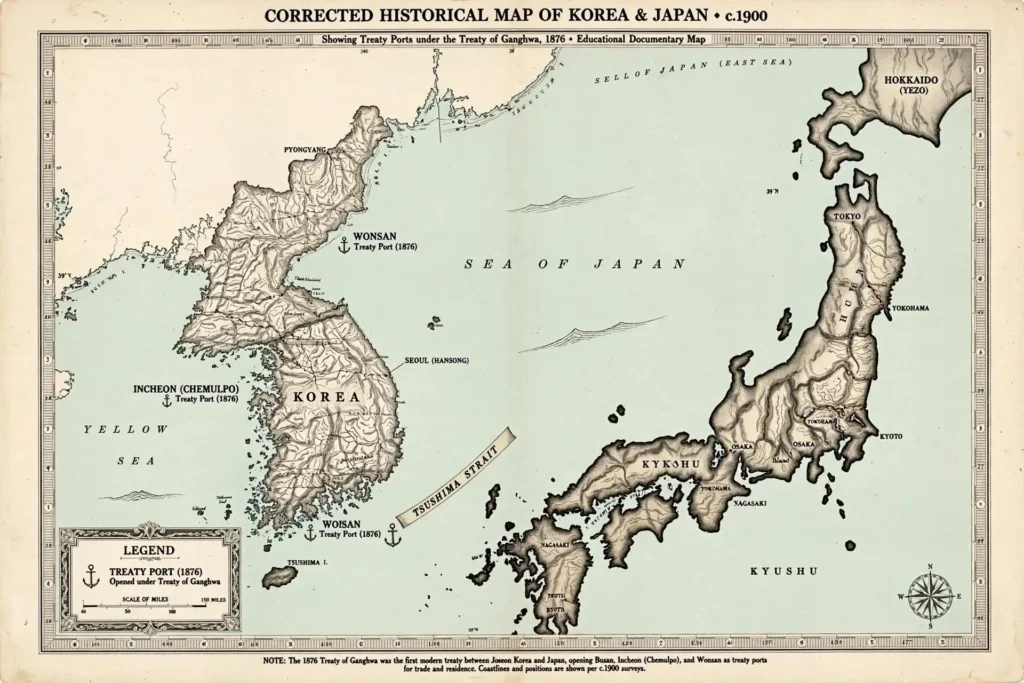
- Background: The Treaty of Ganghwa marked the start of Japan’s control over Korea. After Japan opened its ports to Western powers, it aimed to expand its influence in Korea. The treaty was signed under pressure, as Japan threatened to attack Seoul, forcing Korea to allow Japanese trade.
- Significance: The treaty was considered ‘unequal‘ because it made Korea recognize Japan as a sovereign state, opened ports to Japanese trade, and granted special rights to Japanese citizens in Korea. This started Korea’s semi-colonization and pushed it away from traditional Confucian values.
3. Annexation of Korea (1910)
- Strategies: The annexation in 1910 was the result of Japan’s long-term efforts to control Korea. Japan used military force, political manipulation, and economic incentives. After the Russo-Japanese War, Japan gained more control, leading to the formal annexation.
- Key Figures: Important figures like Ito Hirobumi helped orchestrate the annexation. He manipulated the Korean royal family to accept Japanese rule. After his assassination in 1909 by Korean nationalist An Chung-Gŭn, Japan moved quickly to finalize the annexation.
For a full account of what followed, see Korea Under Japanese Rule.
4. Colonial Administration and Policies
- Governance Changes: The annexation ended the Korean monarchy and replaced it with a Japanese colonial government. Japan established a centralized system to control Korea, replacing many local officials with Japanese administrators, effectively ending Korean sovereignty.
- Economic Exploitation: Japan exploited Korea’s resources for its own benefit, focusing on extracting materials like rice and coal. Infrastructure in Korea was developed mainly to serve Japan’s needs, and Korean workers faced harsh conditions.
5. Impact on Korean Society and Culture
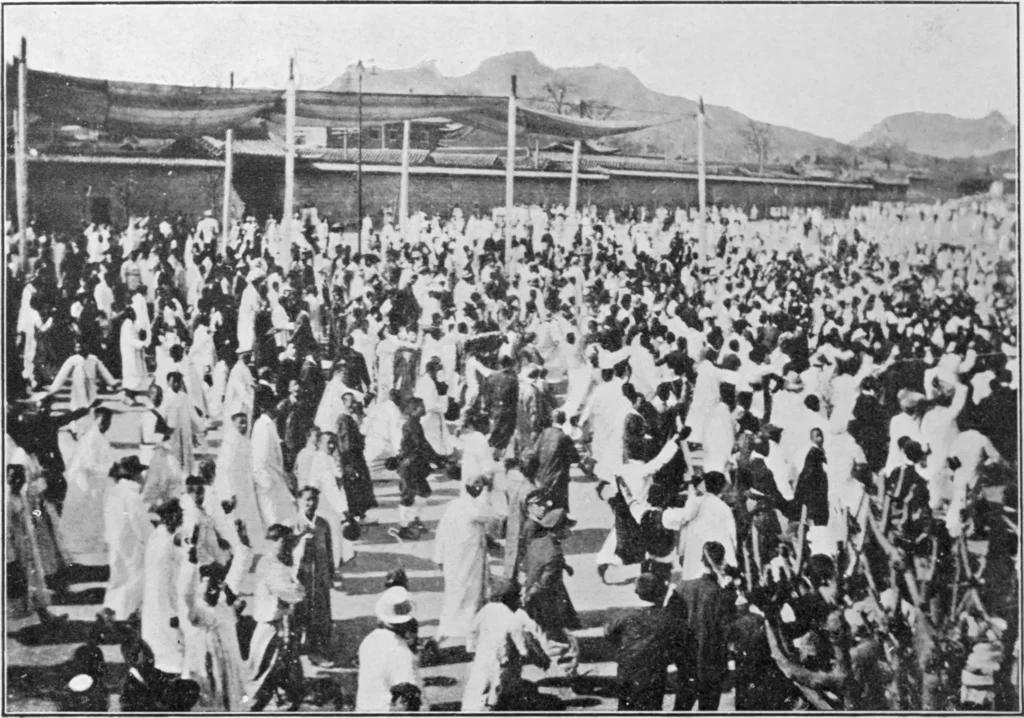
- Cultural Assimilation: Japan aimed to erase Korean culture by suppressing the language and customs. Koreans were forced to adopt Japanese names, and schools promoted Japanese history. Despite this, many Koreans resisted, notably during the March 1st Movement in 1919, which called for independence.
- Social and Economic Effects: The colonial period caused severe hardships for Koreans, including forced labor and poverty. Many lost their lands, leading to increased poverty while wealth concentrated among Japanese colonizers and local collaborators. Traditional family structures were disrupted, fueling nationalistic movements that eventually led to Korea’s independence in 1945.
This summary outlines the early interactions between Japan and Korea, the rise of Japanese control, the colonial period, and its significant effects on Korean society and culture.
Manchuria – Japanese Expansion and Control
1. Importance of Manchuria
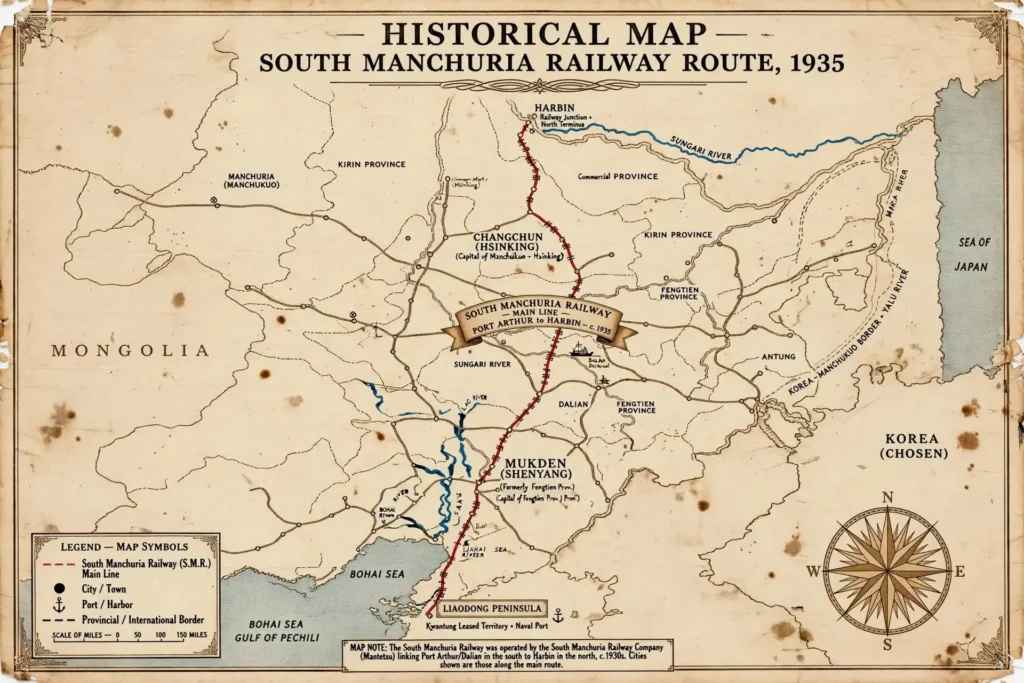
- Economic and Military Value: Manchuria, in Northeast China, was very important for Japan because it had many natural resources like coal and iron. This area was crucial for Japan’s industrial growth and military strategy, especially because it was close to Korea and Russia. Japan wanted to control Manchuria to become more self-sufficient and strengthen its military in East Asia.
- Japanese Involvement: Japan first got involved in Manchuria in the late 1800s after winning the First Sino-Japanese War (1894–1895). This victory allowed Japan to increase its influence in the area. By 1905, Japan took control of the South Manchuria Railway and established several settlements, which set the stage for more Japanese economic and military involvement. For deeper regional context, see Manchuria since c. 1900.
2. Mukden Incident (1931)
- What Happened: The Mukden Incident occurred on September 18, 1931, when a part of the South Manchuria Railway was sabotaged. Japan staged this event to justify invading Manchuria. Although it was likely planned by the Japanese military (the Kwantung Army), they blamed Chinese rebels for the attack, using this as an excuse to launch a full invasion. Full details: Mukden Incident — Britannica.
- Aftermath: Following the Mukden Incident, Japanese forces quickly occupied Manchuria. The League of Nations condemned Japan’s actions, but Japan withdrew from the League in 1933 when pressured to leave Manchuria. This invasion marked the start of Japan’s aggressive expansion in China, leading to the Second Sino-Japanese War (1937–1945).
3. Creation of Manchukuo (1932)
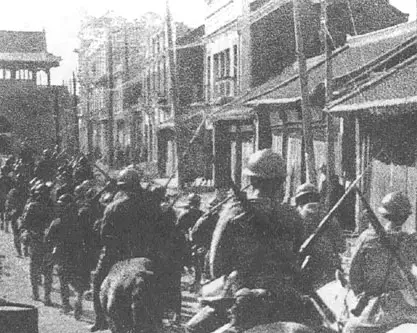
- Establishment: In 1932, Japan created a puppet state called Manchukuo in the areas it occupied in Manchuria. The last emperor of China, Puyi, was made the nominal ruler, but Japan controlled everything through its military and administration. Read more: Manchukuo — Wikipedia.
- Control and Governance: Although Manchukuo was presented as an independent state, Japan ran all military, economic, and political affairs. Japanese officials managed the government, and the local Manchu people had to follow Japanese policies. The Japanese military kept order and suppressed any resistance, using Manchukuo as a buffer against Soviet expansion and for resource access.
4. Economic Exploitation
- Resource Use and Development: Under Japanese rule, Manchukuo was heavily exploited for its resources. Japan extracted coal, iron, and other materials to support its military and industrial growth. They built railroads, factories, and mines mainly for Japan’s war economy, making Manchukuo a vital part of Japan’s industrial system.
- Role of Japanese Businesses: Large Japanese companies, known as zaibatsu, played a significant role in Manchukuo’s economy. Companies like Mitsubishi and Mitsui developed industries in the region and profited from resource extraction, furthering Japan’s imperial economic goals.
5. Impact on Local People
- Displacement and Labor: The local population, including ethnic Chinese and Manchus, faced severe hardships under Japanese rule. Many were forced off their land for Japanese settlers and projects. Local workers often had to work under harsh conditions in mines and factories, and many were conscripted into the Japanese military.
- Cultural Suppression and Resistance: Japan tried to suppress local cultures and make the population adopt Japanese customs. They enforced Japanese language and education, diminishing traditional Chinese and Manchu practices. This cultural repression led to resistance movements, including secret societies and guerrilla groups, notably by Chinese communists and nationalists fighting against Japanese occupation.
Japan’s control over Manchuria and the establishment of Manchukuo had a lasting impact on the local population, leading to economic exploitation and cultural suppression. The legacy of this occupation continues to affect relations between Japan, China, and Korea today.
China – The Japanese Invasion and Occupation
1. Early Relations and Conflicts with China
- Initial Contact and Trade: Japan and China have a long history of trade and cultural exchange. Japan learned a lot from China, adopting ideas like Confucianism, Buddhism, and writing. However, tensions grew in the 19th century as Japan modernized and Western powers began to influence China. This led to the weakening of China’s imperial power and the opening of its ports for foreign trade with the Treaty of Tientsin in 1858.
- First Sino-Japanese War (1894–1895): This war was fought mainly over Korea, which China had controlled. Japan won decisively, revealing the weaknesses of the Qing Dynasty. The Treaty of Shimonoseki forced China to give Taiwan, the Pescadores Islands, and parts of Manchuria to Japan and recognize Korea’s independence, which Japan later controlled. This victory marked Japan’s rise as a significant imperial power in East Asia.
2. Twenty-One Demands (1915)
- Background and Goals: In 1915, during World War I, Japan made the Twenty-One Demands to China, aiming to increase its control over the country while China was unstable due to the war in Europe. These demands sought to establish Japanese political and economic dominance, including control over territories and privileges for Japanese businesses. Full text of the demands: Twenty-one Demands — Britannica.
- Chinese Reaction: The Chinese government, led by Yuan Shikai, accepted many of Japan’s demands due to Japan’s military strength. However, these demands were unpopular among the Chinese people and sparked protests, particularly during the May Fourth Movement in 1919. This situation weakened China’s sovereignty and increased resentment towards Japan.
3. Second Sino-Japanese War (1937–1945)
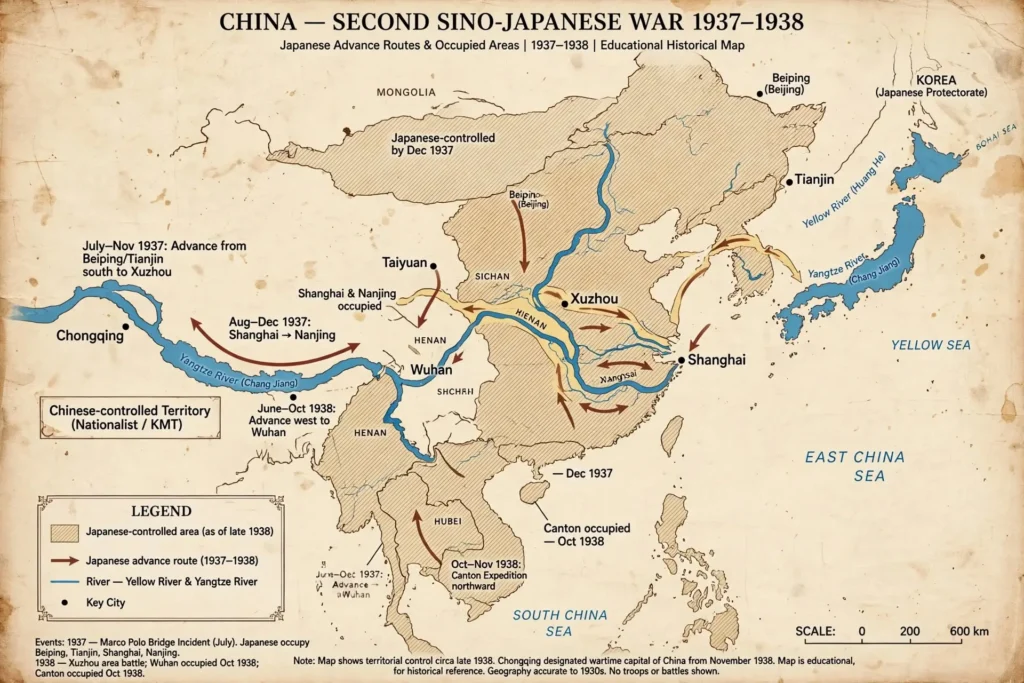
- Causes and Key Battles: The Second Sino-Japanese War began in 1937 after a clash between Japanese and Chinese troops near Beijing. Japan aimed to expand its empire by conquering China. Early in the war, Japan captured major cities like Shanghai and Nanjing, committing atrocities such as the Nanjing Massacre, where many Chinese civilians were killed. Background: Second Sino-Japanese War — Wikipedia.
- Military Leaders and Strategies: The Chinese forces were led by Chiang Kai-shek, while communist forces under Mao Zedong were also involved. Despite Japan’s military advantages, the war became long and drawn out, with China receiving support from the United States and the Soviet Union. Important battles included those in Shanghai, Wuhan, and Changsha. Chinese forces used guerrilla tactics, while Japan faced challenges with supply lines and difficult terrain. The war ended in 1945 in a stalemate, merging into Japan’s broader defeat in World War II.
4. Occupation and Administration
- Japanese Control and Policies: During the war, Japan occupied many parts of China, including major cities and rural areas, enforcing strict martial law and treating local populations harshly. The Japanese military exploited these regions for war resources and used forced labor, particularly in industries. The occupation was marked by severe violence, especially in Nanjing.
- Impact on Society and Economy: The occupation devastated China’s economy as the Japanese military seized food and resources. Infrastructure was destroyed, and many people were displaced. Millions of civilians suffered, and widespread resistance efforts emerged to fight against the occupiers.
5. International Reaction and Consequences
- Global Response: The League of Nations condemned Japan’s actions but was ineffective in stopping its aggression. Although the international community criticized Japan, there was no significant military response. China sought help from Western powers like the United States, which provided support to the Nationalist government.
- Long-Term Effects on Relations: The war deeply affected Sino-Japanese relations. The atrocities, especially the Nanjing Massacre, left lasting scars in China’s memory. After Japan’s defeat in 1945, it had to give up its territorial claims. Relations between the two countries remained strained, with China seeking reparations and an apology for war crimes. Although diplomatic ties were restored in 1972, the legacy of the war still influences their relationship today.
The Second Sino-Japanese War is a significant and painful chapter in China’s history, shaping the future of both China and Japan in the 20th century. For how Japan’s political system unraveled leading into this era, see our Meiji Constitution and failure of parliamentary democracy notes, and for what happened after 1945, read American Occupation of Japan.
Comparison: Japan’s Colonial Methods in Korea, Manchuria & China
| Aspect | Korea | Manchuria | China |
|---|---|---|---|
| Method of Control | Direct annexation (1910) | Puppet state — Manchukuo (1932) | Military invasion & occupation (no annexation) |
| Legal Status | Formal Japanese colony | Nominally independent, Japan-controlled | Occupied territory, sovereignty disputed |
| Nominal Ruler | None — direct Japanese governor-general | Puyi (last Qing emperor) | None — local collaborationist regimes used |
| Primary Motive | Strategic buffer + cultural assimilation | Resources (coal, iron) + military buffer vs. USSR | Territorial expansion + resource extraction |
| Resistance | March 1st Movement (1919) | Guerrilla groups, secret societies | Nationalist (KMT) + Communist resistance |
| Duration | 1910–1945 (35 years) | 1932–1945 (13 years) | 1937–1945 (8 years, full-scale) |
Timeline of Japanese Expansion (1876–1945)
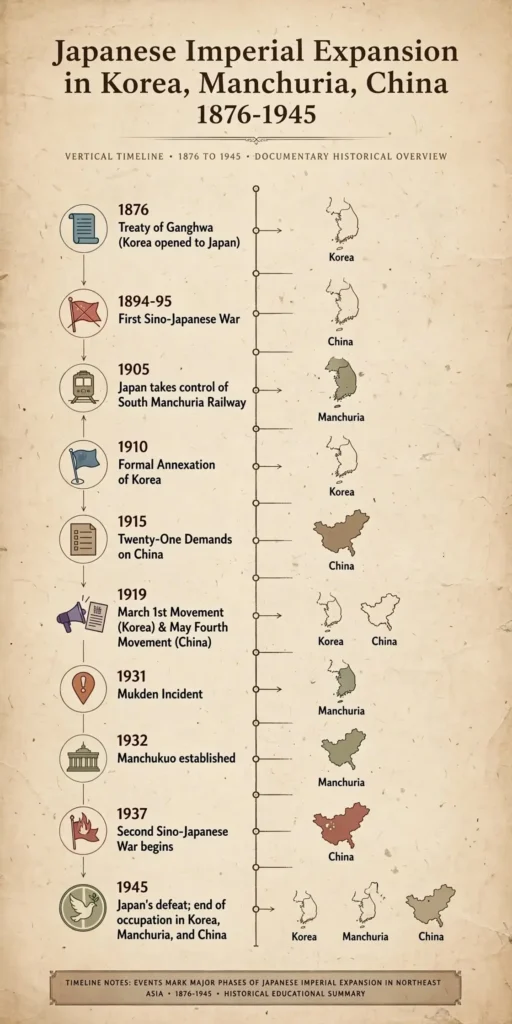
- 1876 — Treaty of Ganghwa (Korea opened to Japan)
- 1894–95 — First Sino-Japanese War
- 1905 — Japan takes control of South Manchuria Railway
- 1910 — Formal Annexation of Korea
- 1915 — Twenty-One Demands on China
- 1919 — March 1st Movement (Korea) & May Fourth Movement (China)
- 1931 — Mukden Incident
- 1932 — Manchukuo established
- 1937 — Second Sino-Japanese War begins
- 1945 — Japan’s defeat; end of occupation in Korea, Manchuria, and China
Key Takeaways
- Japan’s expansion followed three distinct models: direct annexation (Korea), puppet statehood (Manchuria), and military occupation (China).
- Economic motives (resources, markets) and military strategy (buffer zones against Russia/USSR) consistently drove Japanese policy across all three regions.
- Each region developed its own resistance movement — March 1st Movement, Manchurian guerrilla groups, and the KMT-CCP united front — that shaped 20th-century nationalism in East Asia.
- The legacy of this expansion still shapes Japan’s diplomatic relations with Korea and China today.
Previous Year Questions (DSC-3, Unit 3)
Previous Year Questions — Japanese Imperialism in Asia
Important questions from previous year exam patterns on this topic. Tap a question to view a quick-answer guide.
1 Trace the evolution of Japanese imperialism with regard to its policies in Korea. +
2 Examine the circumstances that led to Japan’s war with Russia in 1904–05. What was the impact of this war on the imperialist ambitions of Japan? +
3 Why did Japan invade Manchuria? Explain the Manchurian Crisis of 1931. +
4 Examine the stages of Japanese imperialism with special reference to its policies in Korea and Manchuria between 1894 and 1945. +
5 Discuss Japan’s policy towards China from 1894 to 1937. What was the significance of the Twenty-One Demands (1915)? +
6 How did Japan establish its economic domination in Manchuria and Korea? Discuss the role of the South Manchuria Railway Company. +
7 Write a note on the ‘Twenty-One Demands’ proposed by Japan to China in 1915. +
8 Discuss the annexation of Korea in 1910. What were its consequences for the Korean people? +
9 What was the March First Movement (1919) in Korea? Why is it considered a major turning point? +
10 What was the Greater East Asia Co-Prosperity Sphere? How was it used to justify Japanese imperialism in China? +
11 Briefly discuss the Nanjing Massacre (1937–38) and its impact on Sino-Japanese relations. +
12 What was the Sino-Japanese War of 1894–95? What did Japan gain from the Treaty of Shimonoseki? +
13 What is the Mukden Incident? +
14 What was Manchukuo? Who was made its puppet ruler? +
15 What was the role of the Kwantung Army in Manchuria? +
FAQs
Why did Japan annex Korea in 1910?
Japan wanted a strategic buffer against Russian influence and access to Korea’s resources and labor. The annexation followed decades of political manipulation, forced treaties, and military pressure, culminating in formal control after the Russo-Japanese War weakened rival powers in the region.
What was the Mukden Incident and why is it significant?
The Mukden Incident (September 18, 1931) was a staged sabotage of the South Manchuria Railway, blamed on Chinese forces to justify Japan’s invasion of Manchuria. It’s significant because it marked the beginning of Japan’s decade-long military expansion in China and led to Japan’s withdrawal from the League of Nations.
What was Manchukuo and who really controlled it?
Manchukuo was a nominally independent puppet state created by Japan in 1932, with the last Qing emperor Puyi as its figurehead ruler. In reality, Japan’s military and administrators controlled every aspect of governance, economy, and policy.
How did the Twenty-One Demands affect China?
The Twenty-One Demands (1915) sought to expand Japan’s political and economic control over China during World War I. While China was forced to accept most demands, the humiliation fueled the May Fourth Movement of 1919 and long-term anti-Japanese nationalism.
What triggered the Second Sino-Japanese War?
A clash between Japanese and Chinese troops near Beijing in 1937 escalated into full-scale war, as Japan sought to expand its empire deeper into China, eventually merging with the broader conflict of World War II.
How did Japan’s approach differ across Korea, Manchuria, and China?
Japan used direct annexation in Korea, a puppet-state model in Manchuria, and military occupation without formal annexation in China — each shaped by different strategic and diplomatic considerations (see comparison table above).
Subscribe to keep reading
You've used your free notes for now. Get Delhi Pathshala Premium for unlimited access.
Subscribe — ₹29/30 days