
Contents
- Quick Overview – DU Syllabus Mapping
- Introduction – What is The Rover and Why is it Important?
- About Aphra Behn – First Professional Woman Playwright
- Early Life and Education
- Pioneering Role as a Female Playwright in the Restoration Period
- Literary Contributions and Significance
- Historical and Theatrical Context
- What are the Main Features of Restoration Comedy?
- Title Significance: Why The Rover or The Banish’d Cavaliers?
- Source Text: Thomaso or The Wanderer
- Publication History and Context
- Plot Summary – The Rover Summary Act Wise
- Act I
- Act II
- Act III
- Act IV
- Act V
- Setting and its Importance
- Character Analysis – Detailed Map for DU
- The Role of Masks and Disguises
- Major Themes and Motifs – With Textual Evidence
- 1. Gender and Power Dynamics
- 2. Love, Lust, and Relationships
- 3. Social Satire and Critique of Patriarchy
- 4. Freedom vs Constraint
- 5. The Role of Carnival and Festivity, Deceit and Disguise
- 6. Class and Money, Violence and Rape Culture
- Literary Devices and Techniques
- Wit and Comedy
- Symbolism and Metaphors
- Dialogue and Banter
- Satirical Elements, Irony
- Critical Essays and Perspectives
- Feminist Readings
- Historical Criticism and Socio-Political Context
- Essays by Notable Scholars – With Arguments
- Performance History and Adaptations
- Early Performances and Reception
- Modern Adaptations and Interpretations
- Influence on Restoration Comedy
- Contemporary Relevance
- Conclusion
- Continue Reading – Related DSC-5 Notes
- University of Delhi Previous Year Questions
- Frequently Asked Questions (FAQs)
Quick Overview – DU Syllabus Mapping
Paper: DSC-5: 16th and 17th Century English Drama (B.A. Hons English, B.A. Programme DSC-3 Minor) – Semester II
Unit: Unit 3 – Aphra Behn: The Rover
Course Credits: 4 | As per: UGCF 2022 and NEP 2020
Official Source: DU SOL DSC-5 Study Material – Unit 3 The Rover by Nalini Prabhakar | DU Syllabus PDF
Learning Objectives from DU SLM: Understand the main features of Restoration drama and theatre, understand importance of play’s title and setting, analyze gender and power dynamics, evaluate female agency.
What this article covers: Complete The Rover summary act wise, detailed character analysis (9+ characters), major themes, literary devices, feminist and historical criticism, important quotes with act-scene, DU previous year questions with hints, and FAQs.
Introduction – What is The Rover and Why is it Important?
The Rover by Aphra Behn (1677) is a Restoration comedy set in Naples during carnival season and is the most frequently performed and read of Aphra Behn’s plays. The full title, The Rover; or, The Banish’d Cavaliers, signals its political subtext: the “banished cavaliers” are Royalist Englishmen exiled in Europe during the Interregnum after the execution of Charles I.
For DU students, The Rover is crucial because it is the first play by a professional female playwright in English theatre to enter the canon. It challenges 17th-century notions of marriage while asking timeless questions of sexual politics, female agency, and commodification. This article provides complete DU-oriented notes for The Rover summary by Aphra Behn designed for long-answer (10/15 marks) and short-answer (5 marks) questions.
Quick Answer: The Rover (1677) is a Restoration comedy by Aphra Behn set in Naples during carnival. It follows two Spanish sisters Hellena and Florinda seeking love and autonomy, and a group of exiled English cavaliers led by Willmore the libertine rover. Through masks, mistaken identities, and wit, Behn critiques patriarchy, forced marriage, and the commodification of women.
About Aphra Behn – First Professional Woman Playwright
Early Life and Education
Aphra Behn (1640-1689) was born in Harbledown, near Canterbury, Kent, likely to Bartholomew Johnson, a barber, and Elizabeth Denham. Details of her early life remain uncertain and debated. She claimed to have spent time in Surinam (then an English colony), an experience that later informed her novel Oroonoko (1688). She worked as a spy for Charles II in Antwerp under the codename Astrea during the Second Anglo-Dutch War, but was left unpaid and even spent time in debtor’s prison. She was not from a wealthy family, but her forced financial independence shaped her career.
She was one of the few women to become fully literate and to pursue professional authorship at a time when women had limited educational opportunities, making her pioneering role even more significant.
Pioneering Role as a Female Playwright in the Restoration Period
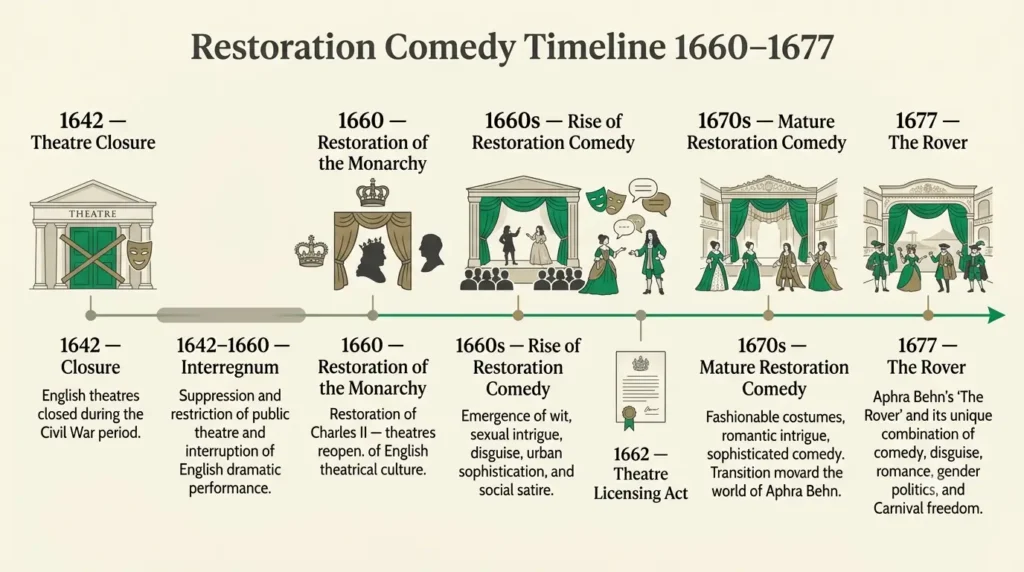
Aphra Behn is considered one of the first professional female playwrights in English history. Her career flourished during the Restoration period (1660 onwards), when the monarchy was restored under King Charles II and theatres reopened after 18 years of Puritan closure (1642-1660).
This era allowed women to act on stage for the first time, which encouraged more female playwrights. Behn took advantage of this, writing bold and sometimes controversial works. Her prologue to The Rover famously defends the playwright’s hard wit and mocks audiences expecting mere debauchery.
Her most famous play, The Rover (1677), mixes comedy, romance, and themes of sexuality, breaking new ground in how women were portrayed. By tackling issues of gender, sexuality, and power, Behn became a central figure in English drama.
Literary Contributions and Significance
Behn was a versatile writer, producing plays, novels, poetry, and short stories. Her work examined love, gender roles, and social norms.
- Plays: The Rover (1677), The Feigned Courtesans, The Lucky Chance
- Novels: Oroonoko (1688) — considered one of the first anti-slavery works in English literature, critiquing slavery and colonialism.
- Significance: She achieved financial independence through writing, groundbreaking for her era, and opened doors for future women writers like Susanna Centlivre. Her importance lies in challenging societal norms about gender and authorship.
Historical and Theatrical Context
What are the Main Features of Restoration Comedy?
This is a direct DU question. Restoration comedy (1660-1710) has these features, all present in The Rover:
- Reopening of theatres: After Puritan ban, Charles II reopened theatres. Dorset Garden Theatre staged The Rover.
- Comedy of Manners: Focus on wit, sexual intrigue, and manners of aristocracy.
- The Rake/Libertine Hero: Charming, promiscuous, witty male – Willmore is classic example.
- Strong-willed Heroines: Women who manipulate wit to gain agency – Hellena.
- Use of Prose, Wit, Double Entendre: Quick banter, sexual puns.
- Foreign, Liminal Setting: Naples, carnival – allows loosening of English norms.
- Actresses on Stage: First time women performed, making courtesan roles like Angellica more complex.
For detailed background, see our notes on The English Revolution (1603-1688): Major Issues and Implications and Aristotle Poetics and Concept of Tragedy.
Title Significance: Why The Rover or The Banish’d Cavaliers?
The Rover refers to Willmore – not just because he travels, but because of his “roving eye” – a classic rake who roves from woman to woman.
The Banish’d Cavaliers is the political key. As noted in The Cambridge Companion to Aphra Behn – The Cavalier myth in The Rover, the cavaliers are English Royalists exiled during the Interregnum (1649-1660) after Charles I’s execution. Behn, a staunch Royalist, portrays them sympathetically. The title thus links personal sexual roving with political exile. DU examiners frequently ask this.
Source Text: Thomaso or The Wanderer
The Rover is Behn’s reworking of Thomaso, or, The Wanderer (1664) by Thomas Killigrew. The plot, characters, and many lines are similar. Behn changed the setting from Madrid during Spanish Inquisition to Naples during Carnival, which allows more freedom for women and critique of Puritan values.
Publication History and Context
The Rover was first performed in March 1677 at Dorset Garden Theatre, London, by the Duke’s Company. It was well-received and performed almost every year from 1703 to 1750. It was published in 1677. The play’s bold approach to female sexuality was provocative, but its clever dialogue secured its place.
Plot Summary – The Rover Summary Act Wise
Below is the DU-oriented act-wise summary, Sourced from LitCharts Plot Summary and GradeSaver Act Summaries.
Act I
The play opens in Naples. Sisters Florinda and Hellena, daughters of a Spanish nobleman, discuss love. Florinda loves the noble but impoverished English Colonel Belvile, who saved her during the siege of Pamplona. Hellena, younger and witty, is destined by her father and brother Don Pedro for a convent, but longs to experience love before.
Don Pedro enters and announces Florinda must marry his friend Don Antonio (son of a Viceroy) tomorrow to avoid marrying the elderly Don Vincentio chosen by their father. Hellena defends her sister. The sisters decide to go to carnival that night masked as gypsies with cousin Valeria and governess Callis.
On a street, Belvile is melancholy for Florinda. His friends – Frederick, Ned Blunt (a naive country squire), and newly arrived Willmore, the Rover – tease him. Florinda, Hellena, Valeria in gypsy disguise enter with Callis and Stephano, plus prostitute Lucetta and her pimp Sancho. Florinda recognizes Belvile. Hellena tells Willmore’s fortune, flirting. Lucetta plots to rob Blunt. Florinda cannot reveal herself due to Callis but slips Belvile a letter to meet at garden gate. Blunt leaves with Lucetta.
Act II
Blunt brags about a “woman of quality” in love with him (actually Lucetta). The Englishmen take his common purse, knowing she is a whore who will fleece him. They encounter the house of famous courtesan Angellica Bianca, who advertises with three portraits outside for 1000 crowns a month. Willmore, penniless, pulls down a portrait, falling in love with image.
Don Pedro and Don Antonio arrive masked, vying to buy Angellica. Antonio betrays Florinda, showing no shame. Pedro challenges him to a duel at the Molo (public square), but Pedro makes Antonio think challenger is Belvile. After they leave, Willmore enters Angellica’s house, scolds her for pricing love, and they admit feelings. Angellica agrees to give herself for love, not money – a fatal mistake for a courtesan. Her servant Moretta warns: “this is the fate of all whores.”
Act III
Hellena, Florinda, Valeria learn Willmore is with Angellica. Willmore navigates between Hellena and Angellica, professing undying love to each. Angellica becomes jealous of gypsy Hellena. Hellena takes betrayal in stride – she shares his inconstant heart. Meanwhile Florinda tests Belvile’s fidelity in mask; he passes, so she gives him a jewel with her picture.
Elsewhere, Lucetta tricks Blunt: she leads him to bedroom, makes him undress and remove valuables, then slips out via trapdoor with lover Philippo and Sancho, stealing everything. Blunt falls through “common shore” (sewer), emerges dirty in undergarments, cursing all women.
Night: Florinda waits in garden for Belvile in nightgown. Drunk, masked Willmore enters, mistakes her for a wench, and attempts to rape her. Belvile and Frederick arrive just in time to save her. Don Pedro enters with guards, Florinda flees, Englishmen are forced out. Don Antonio has paid Angellica 1000 crowns; drunk Willmore fights him, wounds him, leaves him for dead. Antonio’s soldiers arrest Belvile, mistaking him for Willmore and for Pedro.
Act IV
Belvile, imprisoned in Antonio’s house, is freed on condition he fights Antonio’s rival (actually Don Pedro) masked in Antonio’s clothes. He assumes rival is himself for Florinda, but duel is for Angellica.
Florinda watches duel at Molo, cheering wrong man. Pedro yields to “Antonio” (Belvile) and gives him his sister. Florinda gasps until Belvile reveals himself. Pedro realizes mistake, takes sister away. Meanwhile Angellica has servant fetch Willmore, still jealous. Hellena appears dressed as a boy page, pleading for her “master” who loves Willmore. Willmore loves idea of wealthy patroness, recognizes gypsy under disguise. He tells Angellica he will marry only someone with “wit enough to manage an intrigue of love.” Hellena’s challenge thrown, she departs. Willmore insults Angellica, she vows revenge.
Florinda and Valeria escape Pedro. Florinda, fleeing, accidentally enters English lodgings where Blunt nurses wounded pride waiting for new clothes. Blunt, enraged against women, attempts to rape Florinda to avenge humiliation by Lucetta, with Frederick’s help, until Florinda mentions Belvile’s name. They lock her up to verify.
Act V
Englishmen return mocking Blunt. Blunt announces he holds a woman hostage. Don Pedro offers to judge if she is “of quality or for our diversion.” Willmore proposes longest sword takes her – Pedro’s Toledo blade wins, about to unveil his own sister. Belvile recognizes her ring in Blunt’s possession but cannot reveal identity fearing Pedro’s wrath. At eleventh hour, Valeria distracts Pedro saying Florinda has escaped. Belvile and Florinda hastily marry with a convenient priest, Valeria marries Frederick same ceremony. Willmore remains to guard house.
Angellica arrives masked, pistol in hand, threatening to kill Willmore for betraying all womankind. He charms her out of resolve. Antonio offers to kill Willmore for Angellica. Pedro returns, questions Antonio’s loyalty to Florinda. Antonio exits. Willmore informs Pedro deed is done, threatens to kidnap him if he doesn’t bless marriage.
Belvile and Pedro reconcile. Hellena enters again as boy. Willmore finally agrees to marry her when she still refuses to sleep with him without marriage; they exchange names. Pedro is dismayed but resigned – nunnery not for Hellena. Blunt enters in ridiculous Spanish costume made by local tailor – “the mode of a nation he abominates.” Final couples dance, admitting fear of marriage but resolving to it. Play ends with carnival revelers.
Setting and its Importance
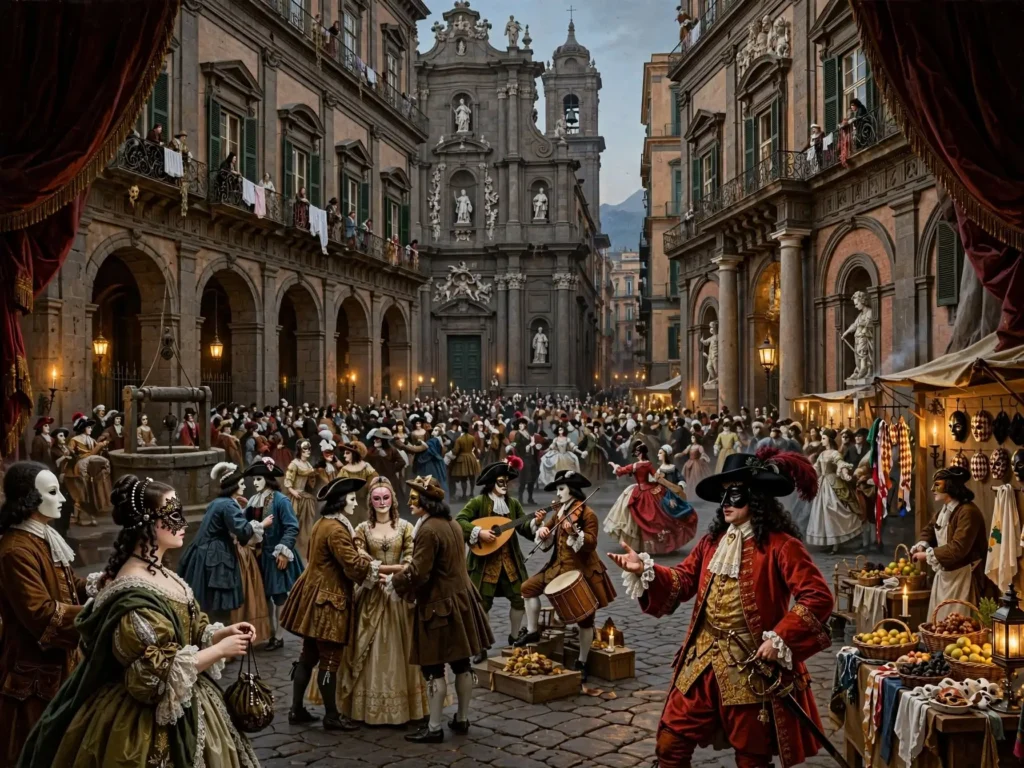
The play takes place in Naples during Carnival, a time when social rules are relaxed. This is crucial:
- Liminal Space: Carnival allows temporary suspension of rank, privilege, prohibitions – women from convent girls to courtesans take initiative.
- Contrast with England: For 1670s English audience, Naples evokes Catholic, exotic, sexually permissive space versus Puritan Interregnum memory.
- Masks: Literal masks allow exploration of desires and shifting identities, but also reflect how women must hide true selves to fit patriarchal society.
- Political: Naples as site for exiled cavaliers to enact loyalty and excess.
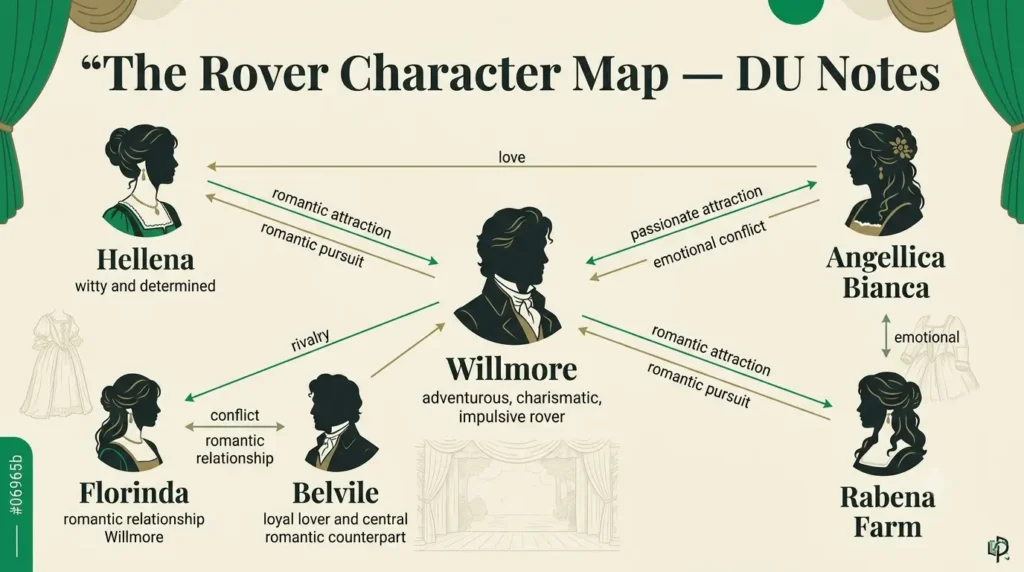
Character Analysis – Detailed Map for DU
| Character | Role & Type | Key Traits | DU Focus |
|---|---|---|---|
| Willmore: The Rover | Libertine rake, protagonist, banished cavalier | Charismatic, reckless, witty, sexually free, inconstant, good-natured but selfish | Embodies Restoration libertine; struggle freedom vs responsibility |
| Hellena | Enlightened heroine, Florinda’s sister | Witty, independent, clever, progressive, sexually frank, strategist | Rejects convent, pursues Willmore on own terms, manages intrigue |
| Florinda | Traditional vs independence | Virtuous, dutiful, vulnerable, romantic | Represents conflict duty vs desire, nearly raped twice, shows patriarchal threat |
| Belvile (Colonel) | Honorable cavalier, Florinda’s lover | Noble, sincere, melancholic, honorable foil to Willmore | True love vs lust contrast |
| Angellica Bianca | Famous courtesan | Beautiful, wealthy (1000 crowns), emotionally vulnerable, commodified | Shows economics of sex; love ruins her business; power and vulnerability |
| Don Pedro | Florinda & Hellena’s brother | Patriarchal, controlling, honorable but hypocritical | Enforces forced marriage |
| Don Antonio | Viceroy’s son, betrothed to Florinda | Wealthy, lustful, betrays Florinda for Angellica | Represents aristocratic hypocrisy |
| Ned Blunt | Country squire | Naive, crude, braggart, vengeful, butt of farce | Country vs town wit, farcical humor, attempted rape shows misogyny |
| Lucetta | Prostitute | Cunning, deceitful, economically motivated | Deception, survival, critique of male gullibility |
| Moretta | Angellica’s maid | Cynical, pragmatic | Voice of experience: warns about whores falling in love |
| Valeria & Callis | Cousin & governess | Valeria: supportive, flirts with Frederick; Callis: watchful | Female solidarity |
| Frederick | English gentleman, friend | Loyal, witty | Foil, helper |
The Role of Masks and Disguises
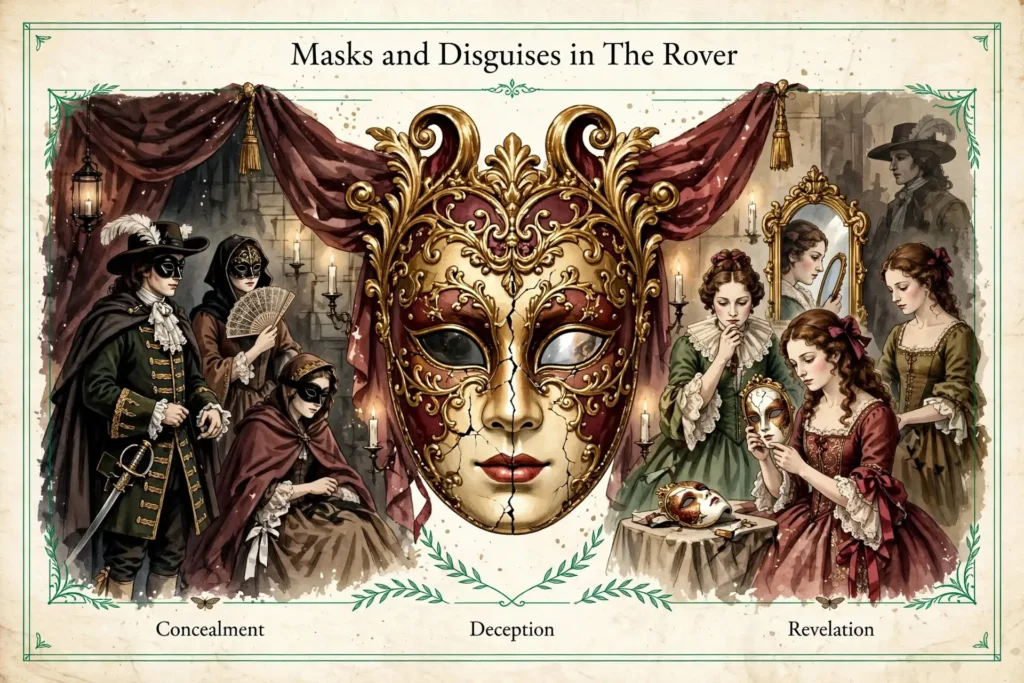
Masks and disguises are central. During carnival, characters wear masks to hide identities, allowing exploration of different roles. This reflects how individuals, especially women, hide true selves to fit expectations. The play does not take moral stance – both moral and immoral characters use disguise, showing deceit as universal tool. Florinda’s gypsy disguise, Hellena’s page boy disguise, and Willmore’s masked attempted rapes show both liberation and danger.
Major Themes and Motifs – With Textual Evidence
1. Gender and Power Dynamics
The Rover examines power struggle between men and women. While Willmore represents male dominance, Hellena and Florinda challenge dynamics. Key line: Hellena refuses nunnery: “I am resolved to provide myself this Carnival.”
2. Love, Lust, and Relationships
Difference between love and lust explored in Willmore’s relationships. At time of writing, marriage seen as social/business transaction between aristocratic families. Both women achieve marriages assuring financial independence without excessive emotional commitment.
3. Social Satire and Critique of Patriarchy
Through sharp dialogue, Behn critiques restrictive patriarchy. Women treated as objects, particularly through Angellica’s character, and mocks hypocrisy of upper class and religious institutions. Male libertine lifestyle both mocked and celebrated.
4. Freedom vs Constraint
Tension between personal freedom and societal constraints. Carnival symbolizes freedom, while plot shows characters navigating familial expectations. Reflects era’s focus on individualism and personal autonomy.
5. The Role of Carnival and Festivity, Deceit and Disguise
Carnival setting essential – allows breaking free from roles, self-discovery, fluidity of identity. As LitCharts notes, play brims with masks from gypsy costumes to comedy of mistaken identities.
6. Class and Money, Violence and Rape Culture
Money runs throughout: Angellica’s 1000 crowns, Blunt’s robbery, Hellena’s wealth. Blunt’s line “adsheartlikins” marks him as bumpkin. Two near-rape scenes (Willmore on Florinda, Blunt on Florinda) show patriarchal violence threat – key feminist reading. Contemporary criticism focuses on this.
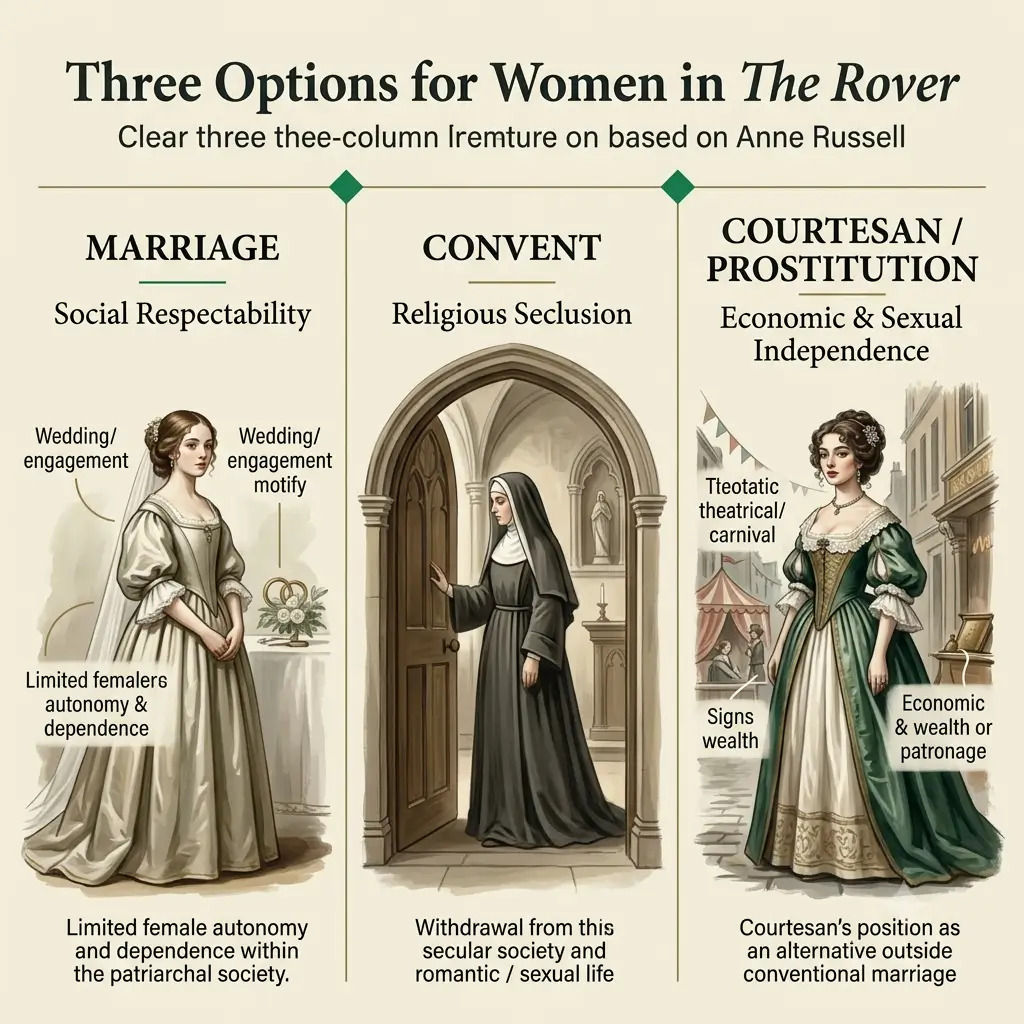
Comparison Table – Three Options for Women in Restoration Society
| Option | Character | Cost | Agency |
|---|---|---|---|
| Forced Marriage | Florinda (to Vincentio/Antonio) | Loss of autonomy, business transaction | Low, must trick to escape |
| Convent | Hellena (destined) | Sexual repression, confinement | None |
| Prostitution/Courtesan | Angellica, Lucetta | Sacrifice honor/virginity, economic survival | Economic independence but commodified |
As Anne Russell points out, these are three options for women in society represented in The Rover.
Literary Devices and Techniques
Wit and Comedy
Famous for clever humor, wordplay, puns, double meanings typical of Restoration comedies. Quick conversations showcase fast-paced wit. Comedic situations like mistaken identities and disguises enhance humor.
Symbolism and Metaphors
- Carnival: Symbolizes freedom and rebellion against societal rules, allowing hidden desires.
- Masks: Difference between appearance and true selves. Willmore seems charming but complicated.
- Rover: Symbolizes free spirit valuing physical freedom over emotional connections.
- Sword/Toledo Blade: Phallic power, patriarchal longest-sword contest for woman.
Dialogue and Banter
Key feature, much comedy from quick exchanges. Witty banter between Willmore and Hellena/Angellica reveals desires and intelligence, allows characters to assert independence.
Satirical Elements, Irony
Rich in satire regarding social and gender roles. Critiques hypocrisy of upper class. Irony: audience sees trap when character thinks in control, making play more satirical.
Critical Essays and Perspectives
Feminist Readings
Feminist critics focus on women as active agents. Hellena rejects passive role, pursues Willmore on own terms. Florinda navigates constraints, chooses Belvile. Angellica represents darker side of commodification, yet emotional depth complicates her. Readings highlight Behn critiques gender inequalities and emphasizes women’s active roles. However, near-rape scenes show limits of carnival freedom.
Historical Criticism and Socio-Political Context
Places play in Restoration context: political change, cultural transformation after Charles II return 1660 shifted from strict Puritan values to hedonistic culture. Carnival reflects rise of “new woman” who could assert more independence. Critics argue Behn’s exploration mirrors broader historical changes.
Essays by Notable Scholars – With Arguments
- Janet Todd: Studies Behn’s life, highlights success as female playwright in male-dominated field and ability to write about women’s desires and independence. Book: The Secret Life of Aphra Behn.
- Elaine Hobby: Examines female characters as complex and active, challenging contemporary views on gender and power. Virtue of Necessity.
- Derek Hughes: Explores Behn’s role in Restoration theatre, noting how plays both follow and challenge genre norms.
- Jacqueline Pearson: Emphasizes women’s roles in Restoration comedy, focus on witty dialogue and playful take on sexual politics.
Performance History and Adaptations
Early Performances and Reception
First performed in 1677 at Dorset Garden Theatre, London, well-received, reflecting popularity of Restoration comedy. Bold approach to female sexuality provocative but clever dialogue secured place.
Modern Adaptations and Interpretations
Modern adaptations highlight themes of gender, power, sexual politics, updating setting to resonate today. Many portray Hellena and Florinda as empowered figures rather than objects of desire, reinterpreting social critiques in light of current discussions about women’s autonomy.
Influence on Restoration Comedy
Key example of Restoration comedy, known for lively satire and complex views on love and relationships. Expands genre by featuring strong female characters who challenge social norms.
Contemporary Relevance
Behn’s questions remain relevant: Can financial independence coexist with love? How do masks (social media personas) allow identity play? The near-rape scenes now read as commentary on consent, making play important for modern feminist theatre. Modern productions often stage Angellica’s pistol scene as moment of female rage against patriarchal betrayal.
Conclusion
The Rover is a rich and layered play that uses characters, setting, and themes to challenge societal norms, particularly regarding gender and power. Behn’s work remains relevant for exploration of freedom, identity, and complexities of human relationships. For DU students, understanding The Rover as both Restoration comedy and early feminist text, with its act-wise intrigue, character contrasts (Willmore vs Belvile, Hellena vs Florinda vs Angellica), and carnival as political space, is key to scoring well. Remember its source in Killigrew’s Thomaso and its title’s Cavalier myth.
Continue Reading – Related DSC-5 Notes
Enhance your DSC-5 preparation with these verified notes from Delhi Pathshala:
Continue Reading — DSC-5: 16th & 17th Century English Drama
University of Delhi Previous Year Questions
DU Previous Year Questions — The Rover
Important DU PYQs and DU-pattern questions on Aphra Behn’s The Rover. Tap a question to view a quick-answer guide.
1 What are the main features of Restoration Comedy as seen in The Rover? +
2 Why is The Rover called The Banish’d Cavaliers? Explain the significance of the title. +
3 What are the three options available to women in The Rover? +
4 Analyze the role of masks and disguises in The Rover. +
5 Who is Angellica Bianca? Discuss her significance in The Rover. +
6 Discuss The Rover as a Restoration Comedy. How does Behn both follow and subvert the conventions? +
7 Critically analyze the character of Hellena as an enlightened heroine. How does she challenge patriarchal norms? +
8 Examine the theme of gender and power dynamics in The Rover with special reference to the attempted rape scenes. +
9 Discuss the significance of carnival and the Naples setting in The Rover. +
10 The Rover is a reworking of Killigrew’s Thomaso. Discuss Behn’s adaptation and its feminist implications. +
11 Analyze Willmore as a Restoration libertine/rake. Is he a hero or an anti-hero? +
Frequently Asked Questions (FAQs)
What is the full summary of The Rover by Aphra Behn?
The Rover (1677) is a Restoration comedy by Aphra Behn. Two Spanish sisters Hellena and Florinda seek to escape forced convent and forced marriage during Naples carnival. They meet exiled English cavaliers led by Willmore the libertine rover. Through masks, disguises, and wit, Hellena tames Willmore into marriage, Florinda marries faithful Belvile, while courtesan Angellica is ruined by love and naive Blunt is robbed by prostitute Lucetta. It critiques patriarchy and celebrates female wit.
What is the act-wise summary of The Rover?
Act I introduces sisters and cavaliers at carnival; Act II shows Angellica’s house and Blunt’s deception; Act III has Lucetta robbing Blunt and Willmore’s attempted rape of Florinda; Act IV includes Molo duel and Florinda trapped by Blunt; Act V resolves with double weddings and Angellica threatening Willmore with pistol.
Who are the main characters in The Rover?
Main characters: Willmore (rover), Hellena (witty heroine), Florinda (virtuous sister), Belvile (honorable colonel), Angellica Bianca (courtesan, 1000 crowns), Don Pedro (brother), Don Antonio (Viceroy’s son), Ned Blunt (naive squire), Lucetta (prostitute), Moretta, Valeria, Callis.
Why is The Rover called The Banish’d Cavaliers?
The Rover refers to Willmore’s roving sexual and geographical nature. Banish’d Cavaliers refers to exiled English Royalists (Cavaliers) during Interregnum after Charles I execution, living in Europe. Title links personal roving with political exile, as discussed in Cambridge Companion’s Cavalier myth chapter.
What are the major themes in The Rover?
Major themes: Gender and power dynamics, love vs lust and marriage as business transaction, social satire and critique of patriarchy, freedom vs constraint, carnival and festivity as liminal space, class and money, deceit and disguise, and threat of patriarchal violence.
What are the three options for women in The Rover?
As critic Anne Russell notes, women have three options: forced marriage (Florinda to Vincentio/Antonio), convent (Hellena destined), or prostitution/courtesan (Angellica, Lucetta). Each costs autonomy; play shows women negotiating within these limited options using wit.
Is The Rover a Restoration Comedy?
Yes, The Rover is a key example of Restoration comedy featuring rake hero, witty dialogue, comedy of manners, foreign setting, sexual intrigue, and first use of actresses. However Behn subverts it by making women active agents of their desires rather than passive objects, and critiquing libertine excess.
What is the role of Angellica Bianca in The Rover?
Angellica is famous courtesan charging 1000 crowns/month. She represents commodification of women – economically independent but must sacrifice honor. She falls in love with Willmore for free, ruining her business, showing vulnerability behind power. Her pistol scene is key feminist moment.
What is DU syllabus for The Rover?
As per UGCF 2022, The Rover is Unit 3 of DSC-5: 16th and 17th Century English Drama, BA Hons English Semester II, also DSC-3 Minor for BA Programme. Learning objectives: Understand Restoration drama features, importance of title and setting, gender dynamics. Source: DU SOL SLM Unit 3 by Nalini Prabhakar.
What is the source of The Rover?
The Rover is a reworking of Thomaso, or, The Wanderer (1664) by Thomas Killigrew. Behn kept plot and characters but changed setting from Madrid during Spanish Inquisition to Naples during Carnival, allowing greater female agency and critique of English Puritan values.
Disclaimer: This article is for educational purposes for DU students. PYQs marked DU-pattern are probable questions based on syllabus trends, not verbatim official papers. Always cross-check with official DU SOL material.
Subscribe to keep reading
You've used your free notes for now. Get Delhi Pathshala Premium for unlimited access.
Subscribe — ₹29/30 days