

Contents
- Quick Snapshot
- Introduction of John Donne
- Biography of John Donne
- John Donne’s Contribution to English Literature
- Famous Works of John Donne
- Historical and Cultural Context
- John Donne’s Renaissance Period
- John Donne as a Metaphysical Poet
- Religious and Political Climate
- Glossary of Difficult Words in The Good-Morrow
- Summary of The Good-Morrow by John Donne
- Analysis of the Poem The Good-Morrow
- Themes
- Love and Unity
- Exploration and Discovery
- Spiritual Awakening
- Structure and Form
- Metaphysical Conceits
- Poetic Form and Meter
- Imagery and Symbolism
- Imagery of Exploration
- Symbolism of Awakening
- Language and Style
- Use of Paradox
- Tone and Diction
- Critical Interpretations
- Major Critical Perspectives
- Feminist Readings
- Psychoanalytic Readings
- Comparative Analysis
- Comparison with Other Poems by Donne
- Comparison with Contemporary Poets
- Frequently Asked Questions (FAQs)
- Conclusion
- Summary of Key Points
- Donne’s Legacy in English Literature
Reading time: ~18 minutes
In this post, notes of Unit 2 (John Donne: Good-Morrow) from DSC – 4 (14th to 17th Century English Poetry) are given which is helpful for the students doing graduation this year.
Quick Snapshot
| Poet | John Donne (1572–1631) |
| Composed | Early 1600s (possibly 1590s) |
| Published | 1633, posthumously, in Songs and Sonnets |
| Genre | Aubade (a morning love poem) |
| Form | 3 stanzas of 7 lines each |
| Rhyme Scheme | ABABCCC |
| Meter | Iambic pentameter |
| Central Theme | Love as spiritual awakening, unity, and transcendence |
What is an aubade? The Good-Morrow belongs to a poetic tradition called the aubade — a morning love poem, usually spoken by one lover to another at daybreak. Unlike the typical aubade, which laments the coming of dawn because it forces the lovers to separate, Donne flips the convention: dawn here is a moment of celebration, marking the lovers’ spiritual “waking” into true love. Recognising this genre is important because DU exam questions often ask students to identify and justify the poem’s form.
Introduction of John Donne
Biography of John Donne
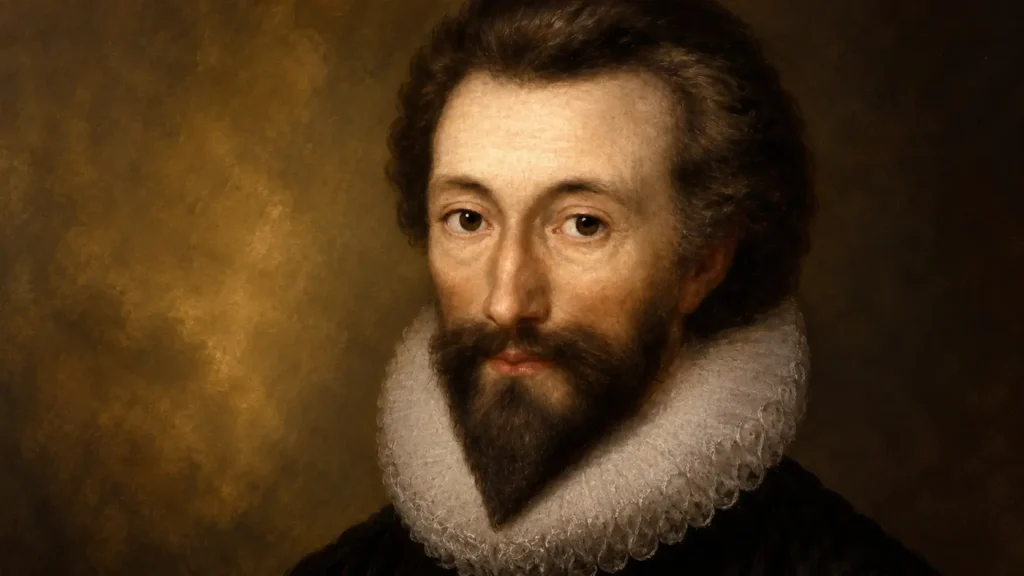
John Donne (1572–1631) was an English poet, priest, and lawyer.
He is known as one of the best metaphysical poets of the 17th century.
He was born in London and studied at Oxford and Cambridge but did not get degrees because he was Catholic, which was a problem in the Anglican schools.
Donne faced money problems in his early life and had a complicated personal life, including a secret marriage to Anne More, which caused him professional issues.
Later, he became Anglican and worked his way up in the Church of England, eventually becoming the Dean of St. Paul’s Cathedral.
His life experiences — growing up Catholic, his secret marriage, and his change in faith — greatly influenced his poetry, which mixes spiritual and physical themes.
John Donne’s Contribution to English Literature
John Donne is a key figure in the Metaphysical Poetry movement.
Metaphysical poets were known for their clever and thoughtful style, using complex metaphors and deep ideas about love, death, faith, and life.
Donne’s poetry is known for its strong emotions, deep thoughts, and surprising connections between different ideas.
His poetry was written during a time of major political and religious change in England, moving from the Elizabethan era to the Jacobean era.
While his work is very personal, it also looks at larger ideas about life, faith, and the relationship between body and soul, reflecting the uncertainties of his time.
Famous Works of John Donne
John Donne wrote poems, sermons, and religious writings. Some of his most important works include:
- Songs and Sonnets: A collection of love poems that talk about romantic love, loyalty, and betrayal, mixing spiritual and physical ideas.
- The Flea: A clever love poem that uses a flea as a metaphor to downplay physical intimacy.
- The Good-Morrow: A poem about the deep connection between two lovers, showing Donne’s thoughtful view on relationships.
- Holy Sonnets: A series of religious poems that express Donne’s worries about death, sin, and redemption.
- Death, Be Not Proud (Holy Sonnet X): A reflection on how death is not powerful compared to eternal life.
- Batter My Heart (Holy Sonnet XIV): A passionate request for help with his spiritual struggles.
- Devotions upon Emergent Occasions: A prose work that talks about illness, death, and God’s grace. It contains the famous line, “No man is an island,” which highlights how people are connected.
- Sermons: As a well-known Anglican preacher, Donne gave many impactful sermons that combined his religious insights with his poetic style.
Donne’s work is still admired for its deep thoughts, strong emotions, and creative language. His poetry remains important for exploring the complexities of human life, especially the connections between love, faith, and death.
Historical and Cultural Context
John Donne’s Renaissance Period
John Donne wrote during the English Renaissance, a time when people were interested in classical learning, arts, and human experiences.
This period started in Italy in the 14th century and moved to England by the late 15th century. It was a time of exploration and new ideas, peaking under Queen Elizabeth I and continuing into the early 1600s when James I was king, which is when Donne did much of his writing.
Key points about the Renaissance:
- Humanism: This idea focused on the value of individuals and encouraged thinking, self-expression, and exploring human feelings, which is evident in Donne’s work.
- Scientific Curiosity: The Renaissance saw growth in knowledge about science, and Donne’s poetry often includes scientific ideas and metaphors.
- New Literary Styles: Poets experimented with different styles, and Donne’s unique approach set him apart from previous poets like Edmund Spenser.
The Age of Discovery connection: The Good-Morrow was written during the Age of Discovery (roughly the 15th to 17th centuries), the period of intense European sea exploration when navigators were mapping “new worlds.” This is exactly why stanza 2 is packed with words like “sea-discoverers,” “new worlds,” “maps,” and “hemispheres.” Donne takes the biggest cultural obsession of his time — exploring unknown lands — and argues that the discovery of love is a bigger, more fulfilling adventure than any physical voyage. Knowing this context makes the stanza 2 imagery much easier to explain in an exam answer.
John Donne as a Metaphysical Poet
John Donne is known as a key figure in Metaphysical Poetry, which started in the early 1600s. The term “metaphysical” was used later to describe poets who explored deep themes in an abstract way.
Key features of Metaphysical Poetry:
- Metaphysical Conceit: Surprising connections between unlike things, such as comparing lovers to compass legs in Donne’s poem A Valediction: Forbidding Mourning.
- Deep Themes: Metaphysical poetry often deals with love, death, the soul, and existence. Donne explores the connection between the body and soul, and earthly and divine love.
- Complex Ideas: Donne’s poetry is known for its challenging ideas and contradictions that explore emotional and philosophical questions.
- Everyday Language: Donne uses language that sounds more like everyday speech, making his poems feel personal.
- Religious Thoughts: In his later works, Donne reflects on religious themes, life, and death, blending these with everyday concerns.
Religious and Political Climate
The religious and political situation during Donne’s life greatly influenced his writing. In the late 1500s and early 1600s, England faced significant religious changes and political shifts.
- Religious Tension: Donne was born into a Catholic family when England was mainly Protestant. He faced challenges due to his faith and later converted to Anglicanism, which is reflected in his poetry, especially in his Holy Sonnets about sin and salvation.
- Religious Changes: The Protestant Reformation created conflicts in England, and Donne’s work often reflects the spiritual struggles of his time.
- Political Changes: Donne lived through a time of political change, including the transition from Queen Elizabeth I to James I.
In summary, John Donne’s writings are shaped by his life experiences and the wider religious, political, and intellectual changes of his time. His ability to connect personal feelings with universal themes continues to engage readers today.
Explore the notes on the other poets covered in this unit: Prologue & Pardoner’s Tale (Chaucer), Astrophil and Stella 1 (Philip Sidney), The Passionate Man’s Pilgrimage (Walter Raleigh), and Paradise Lost Book 1 (Milton).
Glossary of Difficult Words in The Good-Morrow
| Word/Phrase | Meaning |
|---|---|
| Troth | An old word for “faith” or “truth” (used here as “by my troth” = “I swear”) |
| Weaned | Moved from breast milk to solid/other food — used as a metaphor for growing out of childishness |
| Country pleasures | Simple, rustic, and somewhat crude pleasures; also carries a mild sexual undertone |
| Seven Sleepers’ den | A reference to a Christian legend of seven youths who slept in a cave for centuries — symbolises a long, unaware sleep |
| Fancies | Illusions or imaginary things, not real substance |
| Sea-discoverers | Explorers and navigators of the Age of Discovery |
| Hemispheres | Literally, halves of the globe; used here as a metaphor for the two lovers forming one perfect whole |
| Sharp north / declining west | Geographical/astronomical terms symbolising imperfection, decay, and cold — the lovers’ world has none of this |
| Mixed equally | Balanced in the right proportion (alchemical idea — unequal mixtures decay, equal ones are stable/eternal) |
Summary of The Good-Morrow by John Donne
Stanza 1 “I wonder, by my troth, what thou and I Did, till we loved? Were we not weaned till then, But sucked on country pleasures, childishly? Or snorted we in the Seven Sleepers’ den? ‘Twas so; but this, all pleasures fancies be. If ever any beauty I did see, Which I desired, and got, ’twas but a dream of thee.”
Line-by-line explanation: The speaker opens with a rhetorical question — what did he and his beloved even do before they fell in love? He asks, almost teasingly, if they were “not weaned,” still feeding on childish, simple pleasures, or asleep like the legendary Seven Sleepers, unaware of real life. He answers his own question: yes, that’s exactly how it was. Every pleasure he experienced before was just a “fancy,” an illusion. Even if he ever admired another woman’s beauty, that was, in hindsight, only a dim dream of the woman he loves now.
Rhetorical questions used: Notice how Donne builds the entire stanza on a chain of questions — “what thou and I did,” “were we not weaned,” “did we suck on country pleasures,” “did we snort in the Seven Sleepers’ den.” This questioning structure creates a conversational, almost confessional tone, and dramatizes the speaker’s realization in real time rather than simply stating it.
Poetic devices: Metaphysical conceit (comparing pre-love life to infancy and sleep), allusion (Seven Sleepers of Ephesus), rhetorical question, colloquialism (“by my troth”).
Stanza 2 “And now good-morrow to our waking souls, Which watch not one another out of fear; For love, all love of other sights controls, And makes one little room an everywhere. Let sea-discoverers to new worlds have gone, Let maps to others, worlds on worlds have shown; Let us possess our world; each hath one, and is one.”
Line-by-line explanation: The speaker greets their “waking souls” with a good morning — a spiritual awakening triggered by love, not just the literal morning. Their love is free of fear or suspicion. Because of this love, all other sights and desires lose their pull; their one small room becomes an entire world. He then dismisses the great sea-explorers and mapmakers of his era — let them go discover new lands, he says, the lovers already possess their own complete world in each other.
Historical link: This stanza is the clearest example of the poem’s Age of Discovery context — it directly references the sea voyages and cartography that defined Donne’s era, only to argue that inner, emotional discovery outweighs outer, geographical discovery.
Poetic devices: Hyperbole (“one little room an everywhere”), symbolism (waking souls = spiritual rebirth), contrast (exploration vs. intimacy).
Stanza 3 “My face in thine eye, thine in mine appears, And true plain hearts do in the faces rest; Where can we find two better hemispheres, Without sharp north, without declining west? Whatever dies was not mixed equally; If our two loves be one, or thou and I Love so alike that none do slacken, none can die.”
Line-by-line explanation: The speaker notices his own reflection in his beloved’s eyes, and hers in his — a literal and symbolic image of two people mirrored perfectly in each other. He asks where else in the world you could find two better “hemispheres” — halves that, unlike the real globe, have no harsh north or declining west, i.e., no flaw or decay. He closes with a logical/alchemical argument: anything that dies was never perfectly balanced to begin with. Since their two loves are equally matched, their love cannot weaken or die.
Poetic devices: Metaphor (hemispheres = two perfectly matched halves), paradox (perfect union defeats death), imagery (mutual reflection in the eyes), philosophical/scientific reasoning (alchemical balance).
Analysis of the Poem The Good-Morrow
The Good-Morrow is a famous poem by John Donne from his book Songs and Sonnets. It talks about love, unity, and spiritual growth using creative comparisons and deep ideas. Here’s a simple look at the poem, covering its main points, structure, images, and style.
Themes
Love and Unity
The main idea of The Good-Morrow is the deep connection in true love. Donne shows how the lovers’ past experiences were shallow compared to the strong bond they have now.
The speaker suggests that their small space feels like the whole world because of their love:
“For love all love of other sights controls, And makes one little room an everywhere.”
This means their love makes everything else seem less important, highlighting how they are two parts of one whole.
Exploration and Discovery
Donne compares love to exploring new places. While others search the world, the lovers find new things within their relationship:
“Let sea-discoverers to new worlds have gone, Let maps to others, worlds on worlds have shown.”
Their love is an adventure that reveals more about them, making outside adventures unnecessary.
Spiritual Awakening
The title, The Good-Morrow, suggests a new beginning for the lovers, moving from a state of ignorance to awareness. The first line hints that their lives before meeting were like being asleep.
This awakening is not just about love but also about a deeper, spiritual connection. Their love lifts them to a higher level of understanding, where they feel eternal together.
Structure and Form
Metaphysical Conceits
One key part of The Good-Morrow is Donne’s use of creative comparisons, which connect different ideas in surprising ways. For example, he describes their room as a small world:
“And makes one little room an everywhere.”
This shows that their love makes even a small space feel vast and full of life. Another comparison is when he says they are like two halves of a whole:
“Where can we find two better hemispheres, Without sharp north, without declining west?”
This suggests that their love is perfect and lasts forever, unlike the outside world.
Poetic Form and Meter
The Good-Morrow has three stanzas with seven lines each. The rhyme pattern is ABABCCC, which gives the poem a nice balance, reflecting the lovers’ unity.
The poem mainly uses iambic pentameter, a rhythm that feels natural and conversational, adding to its personal and thoughtful mood.
Imagery and Symbolism
Imagery of Exploration
Donne uses exploration images to show the difference between worldly pursuits and the lovers’ journey together. Mentions of “sea-discoverers” and “maps” suggest physical journeys, but the speaker believes true discovery is found in their love.
Symbolism of Awakening
Awakening is important in the poem. The lovers have “woken” to a new reality where love is more meaningful. The title, The Good-Morrow, represents moving from darkness (ignorance) to light (awareness and love).
Language and Style
Use of Paradox
Donne’s poetry often uses paradox, and The Good-Morrow does too. One paradox is that the lovers feel complete while being in a small space:
“And makes one little room an everywhere.”
Another paradox is that if their souls are so united, they cannot die:
“If our two loves be one, or thou and I Love so alike, that none do slacken, none can die.”
Tone and Diction
The tone of The Good-Morrow feels intimate, thoughtful, and philosophical. Donne uses straightforward language but also includes creative comparisons, making the poem feel both personal and profound. The poem starts with wonder in the first stanza and builds to a strong affirmation of the lovers’ unity by the third stanza, mirroring their emotional and spiritual growth.
In short: The Good-Morrow is a deep poem that looks at love, unity, and spiritual awakening through John Donne’s unique style. His creative comparisons, paradoxes, and exploration images raise the relationship to a cosmic level, while the personal tone keeps it relatable.
Critical Interpretations
John Donne’s poem The Good-Morrow has been looked at in many ways to understand its themes, style, and ideas about love and relationships. Critics have studied the poem from different angles, including feminist views and psychological interpretations.
Major Critical Perspectives
Love and Thought: Critics like T. S. Eliot and Helen Gardner praise how Donne combines deep thinking with strong feelings. Eliot noted that Donne connects emotions and thoughts well, which is clear in how he describes love as both a spiritual and physical connection.
Unity in Love: Many critics also talk about the theme of unity and completeness in The Good-Morrow. Critics like C. A. Patrides note that this unity reflects the Renaissance belief in harmony, where individuals and the universe connect.
Feminist Readings
Feminist interpretations of The Good-Morrow often look at how gender and power are shown in the poem. Donne has faced criticism for how he shows women in his other works, but in this poem, scholars see a more equal view of love.
Equality in Love: Feminist critics highlight the metaphor of the two hemispheres as a sign of equality between the speaker and the beloved:
“My face in thine eye, thine in mine appears, And true plain hearts do in the faces rest.”
Possible Criticisms: Some feminist critics argue that the poem focuses too much on the speaker’s thoughts; the beloved does not speak in the poem, which could reinforce traditional views where the man’s perspective dominates.
Psychoanalytic Readings
From a psychological perspective, The Good-Morrow can be seen as a reflection of the speaker’s personal growth through love. Critics use ideas from Freud and Lacan to explore how the speaker’s relationship represents a development of the self.
From Selfishness to Mature Love: In the first stanza, the speaker describes his past as a time of shallow, self-focused pleasure: “But sucked on country pleasures, childishly?” As the poem goes on, he moves to a deeper form of love, marked by mutual understanding.
Recognition and Identity: Lacan’s idea of the mirror stage is relevant here — the reflection imagery (“My face in thine eye, thine in mine appears”) symbolises the speaker and beloved recognising themselves through each other, forming a shared identity.
Comparative Analysis
Comparison with Other Poems by Donne
vs. The Flea: While The Good-Morrow shows love as deep and spiritual, The Flea is more playful and focuses on physical attraction, using a flea that bit both lovers to argue they should be together physically.
vs. A Valediction: Forbidding Mourning: Both poems show love as lasting, but A Valediction focuses on love surviving physical separation (comparing lovers to a compass), while The Good-Morrow celebrates the moment of realising love.
vs. The Sun Rising: Both poems claim the lovers’ room is their whole world, but The Sun Rising is bold and playful, challenging the sun itself, while The Good-Morrow stays more serious and reflective.
vs. The Canonization: Both poems celebrate love as a complete and self-sufficient world, but The Canonization presents love as something so extraordinary that it transforms the lovers into legendary, almost saint-like figures worthy of admiration. In contrast, The Good-Morrow focuses on the personal and spiritual awakening of two lovers, emphasizing mutual trust, unity, and emotional maturity rather than public recognition or immortality.
Comparison with Contemporary Poets
Donne vs. Andrew Marvell: Marvell’s To His Coy Mistress urges the lover to seize the moment before time runs out; Donne’s The Good-Morrow is less about time running out and more about love lasting forever.
Donne vs. George Herbert: Herbert’s Love (III) explores a personal relationship with God; Donne’s poem is about the bond between two people, not divine love.
Donne vs. Shakespeare: Shakespeare’s Sonnet 116 also sees love as unchanging, but Shakespeare talks about love in general terms while Donne focuses on the specific, intimate connection between two people, using a more flowing, conversational form.
Frequently Asked Questions (FAQs)
What type of poem is The Good-Morrow?
The Good-Morrow is an aubade — a morning love poem — and is also classified as a metaphysical poem because of its use of conceits, paradox, and intellectual argument about love.
What is the rhyme scheme of The Good-Morrow?
The poem follows an ABABCCC rhyme scheme across all three stanzas, each with seven lines, mainly written in iambic pentameter.
What is the central theme of The Good-Morrow?
The central theme is love as a spiritual awakening — the idea that true love transforms two people into a complete, self-sufficient, and eternal world of their own.
What does “one little room an everywhere” mean?
This is a hyperbole/paradox suggesting that the lovers’ shared space feels as vast and complete as the entire world, because their love makes everything outside it unnecessary.
Why does Donne mention sea-discoverers and maps in the poem?
This refers to the Age of Discovery, the era of sea exploration Donne lived in. He uses it as a contrast: while explorers search the physical world for new lands, the lovers have already found everything they need in each other.
What are “two better hemispheres” in the poem?
It’s a metaphor comparing the lovers to the two halves of a globe, but a perfect version — without the “sharp north” or “declining west” that represent imperfection, cold, and decay in the real world.
Why is the poem called The Good-Morrow?
“Good-morrow” is an old greeting meaning “good morning.” The title signals both a literal morning after the lovers have spent the night together, and a metaphorical “waking up” of their souls into true, mature love.
Is The Good-Morrow part of Donne’s Songs and Sonnets?
Yes, it was published posthumously in 1633 as part of Donne’s collection Songs and Sonnets, and is generally considered one of the earliest poems in that collection.
Conclusion
Summary of Key Points
John Donne’s poem The Good-Morrow deeply explores love as a powerful and changing experience for the mind and spirit. It shows love as a force that connects not just bodies, but also minds and souls, going beyond time and space. Important themes like love, unity, exploration, and spiritual growth are woven into the poem’s unique form, highlighting Donne’s skill in metaphysical poetry.
When compared to his earlier, more playful poems like The Flea, The Good-Morrow shows a different side of Donne’s work. It shares some similarities with A Valediction: Forbidding Mourning in how it thinks about love. Unlike other poets of his time, such as Andrew Marvell, George Herbert, and William Shakespeare, Donne’s take on love is more about deep thoughts and emotional connections, making his style special and lasting.
Different interpretations, including feminist and psychological views, give more understanding of the poem’s themes around gender roles, personal growth, and the equal relationship between the speaker and the loved one.
Donne’s Legacy in English Literature
John Donne’s impact on English literature, especially through his metaphysical poetry, is significant and lasting. The Good-Morrow shows Donne’s mix of smart ideas, strong emotions, and deep thinking, which makes him stand out from many poets of his time.
His use of clever comparisons and surprising ideas challenged old ways of writing poetry, opening doors for future poets to explore deeper feelings and thoughts. Donne’s influence goes beyond the Renaissance, inspiring modern poets like T. S. Eliot, who admired Donne for blending thought and emotion in his work.
The Good-Morrow shows his lasting importance, capturing the complexities of love and human experiences in ways that still connect with today’s audiences.
Notes prepared for DSC – 4 (14th to 17th Century English Poetry), Unit 2, BA (Hons) English, Delhi University.
Subscribe to keep reading
You've used your free notes for now. Get Delhi Pathshala Premium for unlimited access.
Subscribe — ₹29/30 days