
Contents
‘Light, Oh Where is the Light?’ is Poem XXVII from Rabindranath Tagore’s Nobel Prize-winning collection Gitanjali (1912). Prescribed under DSC-12: Indian Writing in English Translation (Unit 2B), this poem captures the poet’s restless search for spiritual clarity amid inner darkness.
Part of: DSC-12 Unit 2B — Gitanjali Complete Notes
Key Facts
| Aspect | Detail |
|---|---|
| Poem number | XXVII (27) |
| Form | Prose poem |
| Collection | Gitanjali (Song Offerings) |
| Central symbol | Light |
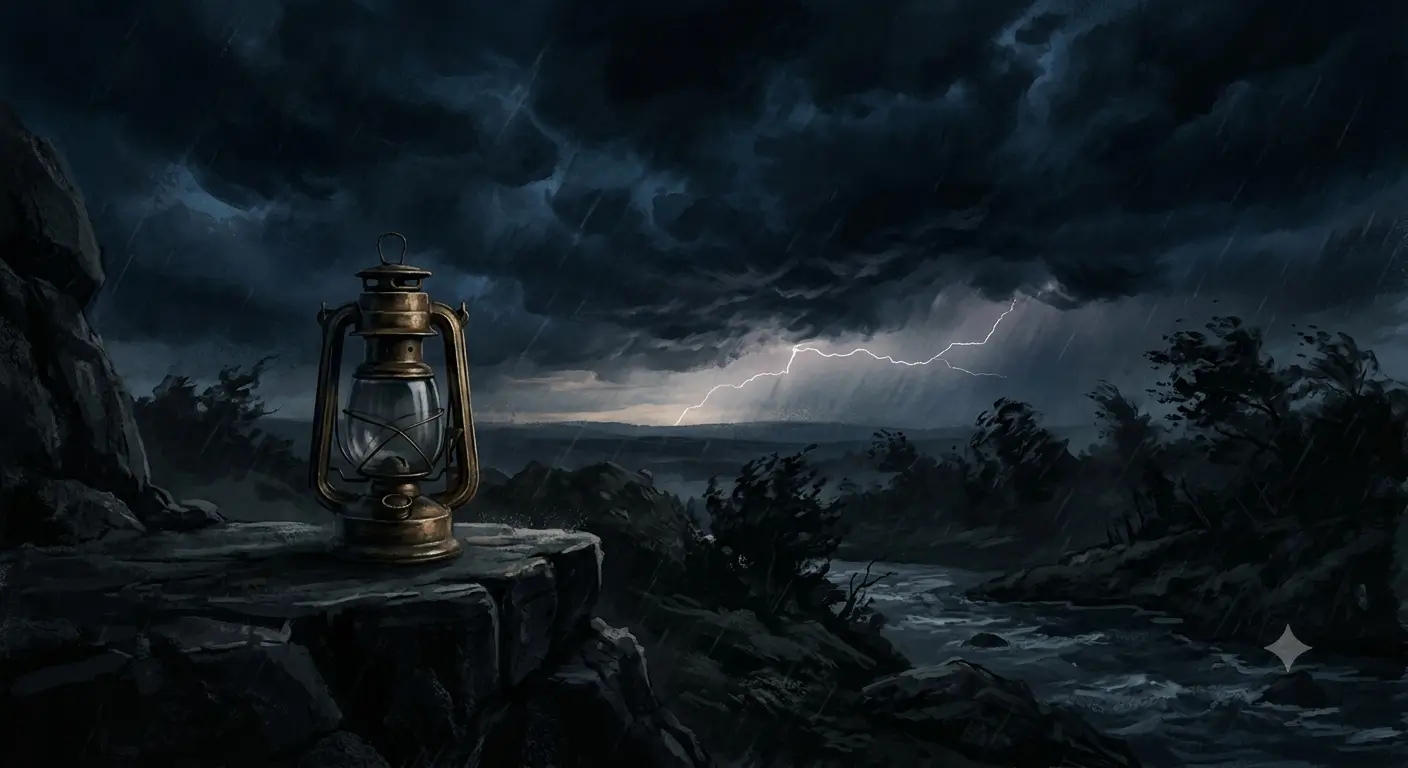
| Setting | A stormy, dark night |
| Tone | Restless, urgent, searching |
Summary
The poet is engulfed by darkness — both literal and spiritual — and cries out for the “light” that would guide him toward truth and inner peace. Despite having a lamp, there is no flame; his heart feels abandoned and directionless. A storm rages outside — thunder, ceaseless rain, and a sudden flash of lightning that only deepens the surrounding gloom rather than illuminating his path. Amid this chaos, he senses that the divine calls to him through the darkness, urging him toward a “love-tryst,” yet he cannot find the way. The poem closes with a resolve: rather than waiting passively, the poet must kindle the lamp with his own life — spiritual illumination must come from within, not from outside.
Line-by-Line Explanation
Light, oh where is the light? Kindle it with the burning fire of desire!
Opening cry — “kindle it with the burning fire of desire” The poet demands light, but the poem immediately signals that this light won’t come from outside — it must be kindled by his own desire. This is the poem’s first hint that spiritual awakening requires internal effort, not a passively received gift.
There is the lamp but never a flicker of a flame,-is such thy fate, my heart! Ah, death were better by far for thee!
The lamp with no flame The poet possesses the lamp (the capacity, the potential) but no flame (living faith or devotion). This is spiritual stagnation — the heart is ready for devotion but hasn’t yet been kindled. The poet finds this state so painful that he says death would be preferable, underlining the intensity of his spiritual desperation.
Misery knocks at thy door, and her message is that thy lord is wakeful, and he calls thee to the love-tryst through the darkness of night.
Misery knocking, the lord calling through the darkness A turning point: the misery knocking at his door actually carries a message — that the divine is awake and calling the poet toward a love-tryst even through the night’s darkness. Suffering itself becomes a summons toward union, not merely a punishment.
The sky is overcast with clouds and the rain is ceaseless. I know not what this is that stirs in me,-I know not its meaning.
Overcast sky, ceaseless rain — “I know not its meaning” The storm outside mirrors the poet’s inner confusion. He cannot explain what is stirring within him — a limitation of self-awareness: the spiritual experience is happening, but its rational meaning still escapes him.
A moment’s flash of lightning drags down a deeper gloom on my sight, and my heart gropes for the path to where the music of the night calls me.
The lightning flash that “drags down a deeper gloom” This is the poem’s central paradox. Lightning offers a moment of illumination, but once it fades, the darkness feels even more absolute than before. This captures how a fleeting spiritual insight can make the doubt that follows feel more intense — a flash of clarity followed by renewed confusion. In this chaos, the poet’s heart “gropes” for the path toward the divine call carried on the “music of the night.”
Light, oh where is the light! Kindle it with the burning fire of desire! It thunders and the wind rushes screaming through the void. The night is black as a black stone.
Thunder, screaming wind, “black as a black stone” The chaos peaks — thunder and screaming wind, and a simile that renders the night’s darkness as solid and impenetrable as stone. The darkness stops being a mere absence of light and becomes an almost physical, crushing presence.
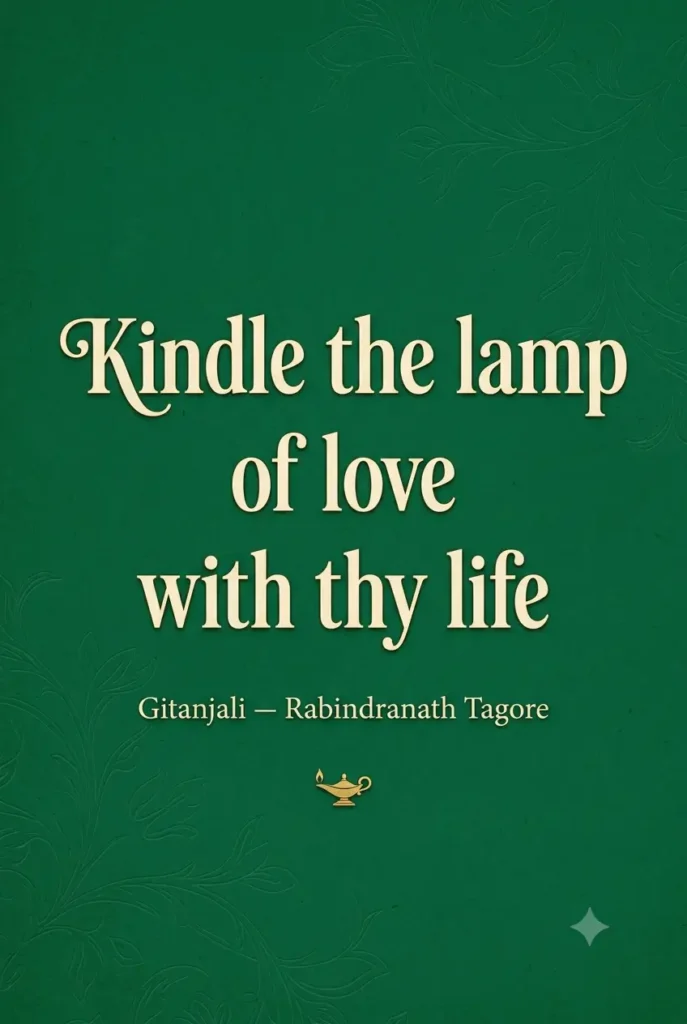
Let not the hours pass by in the dark. Kindle the lamp of love with thy life.
The final resolve — “let not the hours pass by in the dark. Kindle the lamp of love with thy life.” The poem’s climax and resolution: the poet will no longer wait passively. He resolves to kindle the lamp of love with his own life — through his own actions and devotion. This is Gitanjali‘s central spiritual teaching: self-agency — divine light isn’t received from outside; it must be kindled from within, through how one lives.
Themes
1. Spiritual Longing and Confusion
The poem captures the universal human experience of searching for meaning while feeling lost — a soul aware that truth exists but unable to locate it.
2. Divine Presence Amid Darkness
Even in confusion, the poet senses that the divine is near, calling him through the storm — suggesting that spiritual darkness is not abandonment but a test of faith.
3. Self-Reliance in Spiritual Awakening
The final line reframes enlightenment as an active, internal act — the poet must “kindle the lamp” himself rather than wait for an external light.
Symbols
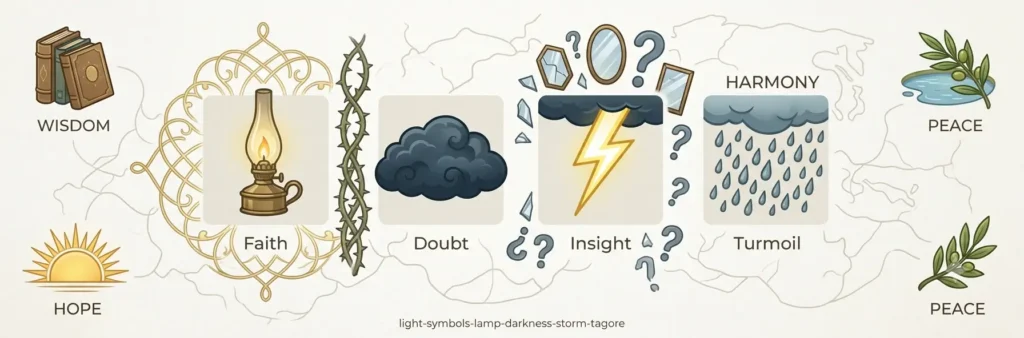
| Symbol | Meaning |
|---|---|
| Light | Divine truth, spiritual clarity, self-realization |
| Darkness | Doubt, confusion, spiritual ignorance |
| Storm (rain, thunder, lightning) | Inner turmoil and the trials of the spiritual quest |
| The unlit lamp | Dormant faith / potential for devotion not yet realized |
Literary Devices
- Symbolism — light/darkness as the poem’s central device
- Personification — misery “knocks” at the door
- Imagery — vivid sensory description of the storm mirrors emotional chaos
- Paradox — lightning brings a “deeper gloom,” not clarity
Critical Analysis
The poem’s power lies in its refusal to resolve the poet’s darkness with an easy epiphany. Instead, Tagore locates the resolution in agency — the poet’s own will to kindle the lamp of love with his life. This positions Gitanjali‘s spirituality as something lived and enacted, not passively received, which is part of why Western critics and the Nobel committee responded to it as more universal and humanistic than conventionally devotional.
Important Questions (PYQ-Style)
- Discuss the symbolism of light and darkness in ‘Light, Oh Where is the Light?’
- How does Tagore use the storm as a metaphor for spiritual confusion?
- “Kindle the lamp of love with thy life” — explain this line with reference to the poem’s central theme.
- Comment on the significance of the title in relation to the poem’s content.
- Explain with reference to context: the lines describing the lightning and “deeper gloom.”
Frequently Asked Questions
What does “light” symbolize in this poem?
Light symbolizes divine truth, spiritual clarity, and self-realization — the understanding the poet desperately seeks.
What is the poem number of ‘Light, Oh Where is the Light?’ in Gitanjali?
It is Poem XXVII (27) in the English edition of Gitanjali.
What is the tone of the poem?
The tone is restless and urgent, shifting toward a quiet, resolved determination by the end.
How does this poem connect to the next prescribed poem, ‘When My Play was with Thee’?
Both poems explore the soul’s relationship with the divine — this one through searching and darkness, the other through nostalgic, innocent closeness. Read the comparison →
Continue reading:
Subscribe to keep reading
You've used your free notes for now. Get Delhi Pathshala Premium for unlimited access.
Subscribe — ₹29/30 days