
Contents
- Welcome, Future Sociologists!
- Course Information – At a Glance
- Why Does This Course Even Matter?
- Complete Syllabus – Unit-Wise Breakdown
- UNIT I: The Promise of Sociological Research (8 Hours)
- UNIT II: The Link Between Theory and Research (8 Hours)
- UNIT III: Concepts and Hypotheses (8 Hours)
- UNIT IV: The Process of Social Research (8 Hours)
- UNIT V: Plagiarism and Ethics in Social Research (4 Hours)
- UNIT VI: Primary and Secondary Sources of Data (12 Hours)
- 6.1 Types of Primary Data: Qualitative and Quantitative Data
- 6.2 Introduction to Big Data at National Level: Census and NSS Data
- 6.3 Introduction to Digital Research
- UNIT VII: Basic Data Analysis (12 Hours)
- Suggestive Readings – Beyond the Syllabus (Delhi Pathshala Recommends)
- Exam Strategy – Delhi Pathshala’s Proven Tips
- Frequently Asked Questions (FAQs)
- Final Word from Delhi Pathshala
Welcome, Future Sociologists!
If you’ve just stepped into BA (Hons.) Sociology at Delhi University, you’re probably excited about learning sociology – but have you ever wondered how sociologists study society? How do they collect data? How do they know if their findings are reliable? How do they turn ideas into research?
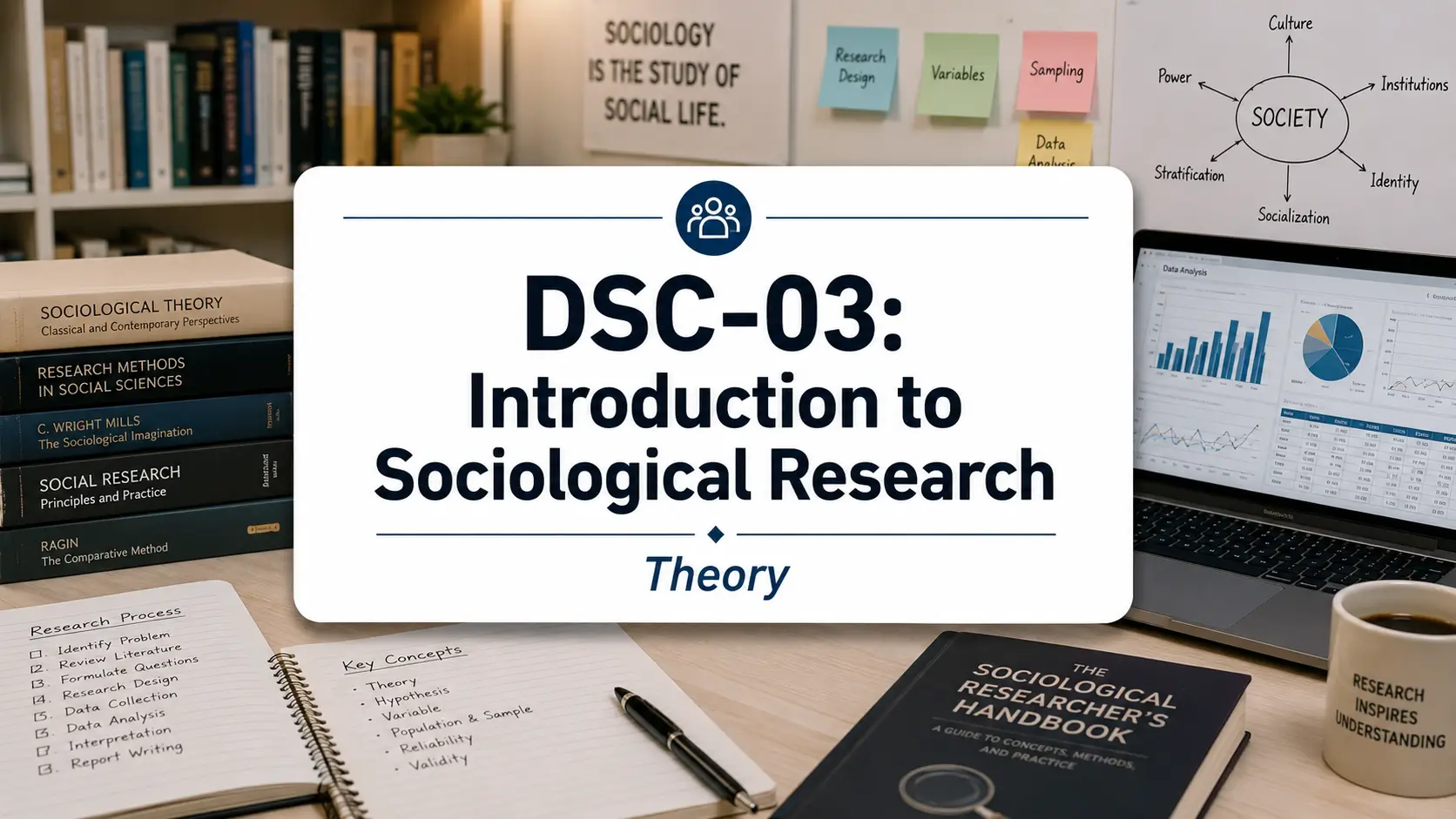
That’s exactly what DSC-03: Introduction to Sociological Research is all about. And trust us – this is not just another theory of paper. This is where you learn the tools of trade – the methods and techniques that sociologists use to understand the social world.
Under the latest NEP (National Education Policy) 2020 framework, DU has designed this course to introduce you to sociological research both from a theoretical and methodological perspective. Whether you want to pursue a career in academia, policymaking, market research, or social work – the skills you learn in this course will stay with you forever.
This 4-credit course (3 lectures + 1 tutorial) is your foundation for understanding how research works – from formulating a research question to analyzing data and writing up findings. It covers everything from theory and research linkage to ethics, plagiarism, primary/secondary data, and basic data analysis.
We at Delhi Pathshala have gone through the official DU Sociology syllabus (2022 revision, applicable for 2026-27) and created this complete guide for you. No fluff – just what you need to know to score well and actually understand research!
Course Information – At a Glance
| What? | Details |
| Course Code | DSC-03 |
| Course Title | Introduction to Sociological Research |
| Programme | BA (Hons.) Sociology – Semester I |
| Credits | 4 (3 Lectures + 1 Tutorial per week) |
| Eligibility | No specific requirement |
| Pre-requisite | NIL |
| Exam Body | Examination Branch, University of Delhi |
| Curriculum Framework | NEP 2020 (revised 2022, effective 2026-27) |
Why Does This Course Even Matter?
Let’s be honest – sociology isn’t just about reading books and memorizing theories. Sociology is about understanding the real world – and to do that, you need research skills. Under the new NEP-aligned syllabus, the focus has shifted from rote memorization to critical thinking, application, and practical skills.
Here’s what this course does:
- It introduces you to sociological research – both theory and practice.
- It teaches you to read and critically evaluate research – a skill that will help you in every course.
- It helps you understand the difference between quantitative and qualitative methods – the two main approaches to social research.
- It covers ethical issues and plagiarism – essential for academic integrity.
- It introduces you to big data, census, NSS data, and digital research – connecting you to contemporary research trends.
- It builds your foundation for designing your own research project – something you’ll do in later semesters.
💡 Delhi Pathshala says: Yeh paper sirf rattne ka nahi hai. Isko samjho, research ki practical side ko understand karo – future mein bahut kaam aayega. NEP ka core philosophy hai – learning should be applied, not just theoretical.
Complete Syllabus – Unit-Wise Breakdown
The syllabus is divided into 7 units – each building upon the previous one. Total teaching hours: 60 hours (spread across the semester).
UNIT I: The Promise of Sociological Research (8 Hours)
This unit sets the foundation. It introduces you to the power of sociological research – how it helps us understand the social world.
| Author | Chapter / Reading | Book Details | Key Focus |
| C.W. Mills | “The Promise” (Chapter 1) | The Sociological Imagination. London: OUP (1959) pp. 3–24 | Understanding the sociological imagination – connecting personal troubles to public issues through research. |
Exam Tip: You’ve already read Mills in DSC-01! But here, focus on how Mills uses research to connect personal troubles to public issues. Research is a tool that makes sociological imagination possible.
UNIT II: The Link Between Theory and Research (8 Hours)
This unit explores the relationship between theory and research. How do they inform each other? This is a classic question in sociology.
| Author | Chapter / Reading | Book Details | Key Focus |
| R.K. Merton | “The Bearing of Sociological Theory on Empirical Research” & “The Bearing of Empirical Research on Sociological Theory” (Chapters 4 & 5) | Social Theory and Social Structure. Delhi: Arvind Publishing House (1972) pp. 139–171 | How theory guides research AND how research shapes theory – the two-way relationship. |
Exam Tip: Merton is a classic – this is one of the most important readings in this course. Understand the two-way relationship: theory tells us what to look for, and research helps us refine theory. Yeh bahut important hai – examiner ko impress karta hai.
UNIT III: Concepts and Hypotheses (8 Hours)
This unit covers the building blocks of research: concepts and hypotheses. How do we define what we’re studying? How do we formulate testable statements?
| Author | Chapter / Reading | Book Details | Key Focus |
| Goode & Hatt | Chapters 5 and 6 | Methods in Social Research. New York: McGraw Hill (1952) pp. 41–73 | Concept formation, operationalization, and hypothesis formulation in social research. |
Exam Tip: This is very practical – learn the difference between concepts (abstract ideas) and hypotheses (testable statements). Examples dena mat bhoolna.
UNIT IV: The Process of Social Research (8 Hours)
This unit walks you through the step-by-step process of conducting social research – from start to finish.
| Author | Chapter / Reading | Book Details | Key Focus |
| Kenneth Bailey | “The Research Process” (Chapter 1) | Methods of Social Research. New York: Simon and Schuster, The Free Press, 4th edition (1994) pp. 3–19 | Step-by-step guide to the research process – from identifying a problem to writing a report. |
Exam Tip: Memorize the steps of the research process – this is a very common exam question. Steps: identify problem → review literature → formulate hypothesis → design research → collect data → analyze data → write report.
UNIT V: Plagiarism and Ethics in Social Research (4 Hours)
This is a small but important unit. It covers the ethical principles that guide social research and the importance of avoiding plagiarism.
| Author | Chapter / Reading | Book Details | Key Focus |
| Association of Social Anthropologists (ASA) | “Ethical Guidelines for Good Research Practice” | ASA Ethical Guidelines pp. 1–10 | Ethical principles in social research – informed consent, confidentiality, avoiding harm. |
| John W. Creswell | “Research Design: Qualitative, Quantitative and Mixed Methods Approaches” (Chapter on Ethics) | Research Design: Qualitative, Quantitative and Mixed Methods Approaches. Sage Publications, 3rd edition (2009) pp. 87–93 | Ethical considerations in research design – protecting participants and maintaining integrity. |
Exam Tip: Yeh unit easy marks hai – ethics aur plagiarism ke principles yaad rakhna. Informed consent, confidentiality, anonymity, avoiding harm – yeh keywords use karo.
UNIT VI: Primary and Secondary Sources of Data (12 Hours)
This is the biggest unit – covering different types of data and their sources. It has 3 sub-topics.
6.1 Types of Primary Data: Qualitative and Quantitative Data
| Author | Chapter / Reading | Book Details | Key Focus |
| Nicholas Walliman | “The Nature of Data” (Chapter 4) | Research Methods: The Basics. London: Routledge (2010) pp. 65–77 | Understanding what data is – different types and their characteristics. |
| Yeunchul Kim | “New Opportunities for Sociological Research” | Journal of Asian Sociology, Vol. 48, No. 3 (2019) pp. 343–358 | Contemporary opportunities and challenges in sociological research. |
6.2 Introduction to Big Data at National Level: Census and NSS Data
| Author | Chapter / Reading | Book Details | Key Focus |
| Government of India | “History of the Census of India” & “Drop-in Article No. 5: Census of India 2011” | Census of India Official Documents pp. 1–10 | Historical background and importance of the Census in understanding Indian society. |
| Satish Deshpande | “Contemporary India: A Sociological View” | Contemporary India: A Sociological View. New Delhi: Penguin Books (2003) pp. 125–150 | Sociological analysis of Indian society using Census and NSS data. |
Exam Tip: Census and NSS data are India-specific – DU loves this! Know the importance of Census, its history, and how it helps sociologists understand India. Deshpande is a contemporary Indian sociologist – examiner impressed.
6.3 Introduction to Digital Research
| Author | Chapter / Reading | Book Details | Key Focus |
| Sarah Pink et al. | “Digital Ethnography: Principles and Practice” (Chapter 1) | Digital Ethnography: Principles and Practice. SAGE Publications (2016) pp. 1–18 | Introduction to digital research methods – ethnography in the digital age. |
Exam Tip: Yeh contemporary aur relevant hai – Digital research is the future. Understand how ethnography has evolved in the digital age (social media, online communities, etc.).
UNIT VII: Basic Data Analysis (12 Hours)
This unit introduces you to basic data analysis – how to organize and analyze quantitative data.
| Author | Chapter / Reading | Book Details | Key Focus |
| S.P. Gupta | “Classification and Tabulation” (Chapter 7) | Elementary Statistical Methods. Sultan Chand & Sons Publishers pp. 65–100 | How to classify and tabulate data – organizing raw data for analysis. |
Exam Tip: This is practical – learn how to classify and tabulate data. This is the foundation for understanding more advanced statistics later.
Suggestive Readings – Beyond the Syllabus (Delhi Pathshala Recommends)
These aren’t mandatory, but they’ll deepen your understanding and help you write better answers:
| Book | Author | Why Read? |
| Research Methodology: Methods and Techniques | C.R. Kothari | Comprehensive guide to research methods – great for understanding the Indian context. |
| The Practice of Social Research | Earl Babbie | Classic textbook – excellent for beginners. |
| Social Research Methods: Qualitative and Quantitative Approaches | W. Lawrence Neuman | Balanced coverage of both approaches – very well-written. |
| Doing Social Research | Therese L. Baker | Practical guide – good for understanding the actual process of research. |
Exam Strategy – Delhi Pathshala’s Proven Tips
Since the examination scheme is prescribed by the DU Examination Branch, here are 5 strategies to score 70+ (out of 75):
- Merton ko acche se padho – Theory vs Research ka relationship sabse important concept hai. Yeh reading har exam mein aati hai.
- Research process ko step-by-step yaad karo – Bailey ka chapter (Unit IV) bahut important hai. Steps ko examples ke saath samjhao.
- Ethics aur plagiarism ko seriously lo – Yeh unit short hai but easy marks hai. Informed consent, confidentiality, anonymity – yeh keywords use karo.
- Census aur NSS data ka importance samjho – India-specific content hai – DU mein yeh bahut appreciated hai. Deshpande ka reading yaad rakho.
- Quantitative vs. Qualitative ka difference clear karo – Yeh bahut common exam question hai. Definitions + examples dono do.
Frequently Asked Questions (FAQs)
Q1. Is this syllabus applicable for the 2026-27 academic session?
✅ Yes. The DSC-03 syllabus was revised in 2022 under the NEP framework and remains the official DU syllabus for 2026-27.
Q2. Which semester is this course for?
✅ This is a Semester I paper for BA (Hons.) Sociology students.
Q3. How many credits does this course carry?
✅ 4 credits – 3 for lectures and 1 for tutorials.
Q4. Is there any practical component?
✅ No. There is no practical/practice component for DSC-03.
Q5. What is the most important unit in this course?
✅ Unit II (Theory and Research) and Unit VI (Primary and Secondary Sources of Data) – both are heavily tested.
Q6. What is the most important reading in this course?
✅ R.K. Merton – “Social Theory and Social Structure” (Chapters 4 & 5). This is the most frequently asked concept in DSC-03.
Q7. Where can I find the official exam pattern?
✅ The examination scheme is prescribed by the Examination Branch, University of Delhi. Keep checking the official DU website or stay tuned to Delhi Pathshala for updates.
Final Word from Delhi Pathshala
Doston – research sociology ki jaan hai. Yeh paper sirf syllabus nahi – yeh sochne aur samajhne ka naya tareeqa hai. Research skills will stay with you forever – whether in academia, policy, or your career.
Under the new NEP curriculum, DU has made this course more practical, contemporary, and skill based. DSC-03: Introduction to Sociological Research is your first step into becoming a researcher – embrace it!
Delhi Pathshala par hum regularly DU ke latest syllabus, notes, aur exam guides update karte hain. Is page ko bookmark karo aur apne doston ke saath share karo.
Koi doubt ho? Comment karo – hum reply karenge. 😊
Disclaimer: Yeh post academic guidance ke liye hai. Official exam scheme aur latest updates ke liye hamesha Examination Branch, University of Delhi ko refer karein.
Curated by the Delhi Pathshala Academics Team – your trusted partner for DU Sociology, English, Political Science, History, and more. 100% accurate, exam-oriented content as per University of Delhi norms.
Subscribe to keep reading
You've used your free notes for now. Get Delhi Pathshala Premium for unlimited access.
Subscribe — ₹29/30 days