
Contents
- Welcome, Future Sociologists!
- Course Information – At a Glance
- Why Does This Course Even Matter?
- Complete Syllabus – Unit-Wise Breakdown with Page Numbers
- UNIT I: Formations of Indian Society (24 Hours)
- UNIT II: Indian Society – Configurations and Dynamics (36 Hours)
- a. Caste, Class and Tribe
- b. Gender, Family and Religion
- c. Village, Cities and Urbanization
- Suggested Readings – Beyond the Syllabus (Delhi Pathshala Recommends)
- Exam Strategy – Delhi Pathshala’s Proven Tips
- Frequently Asked Questions (FAQs)
- Final Word from Delhi Pathshala
Welcome, Future Sociologists!
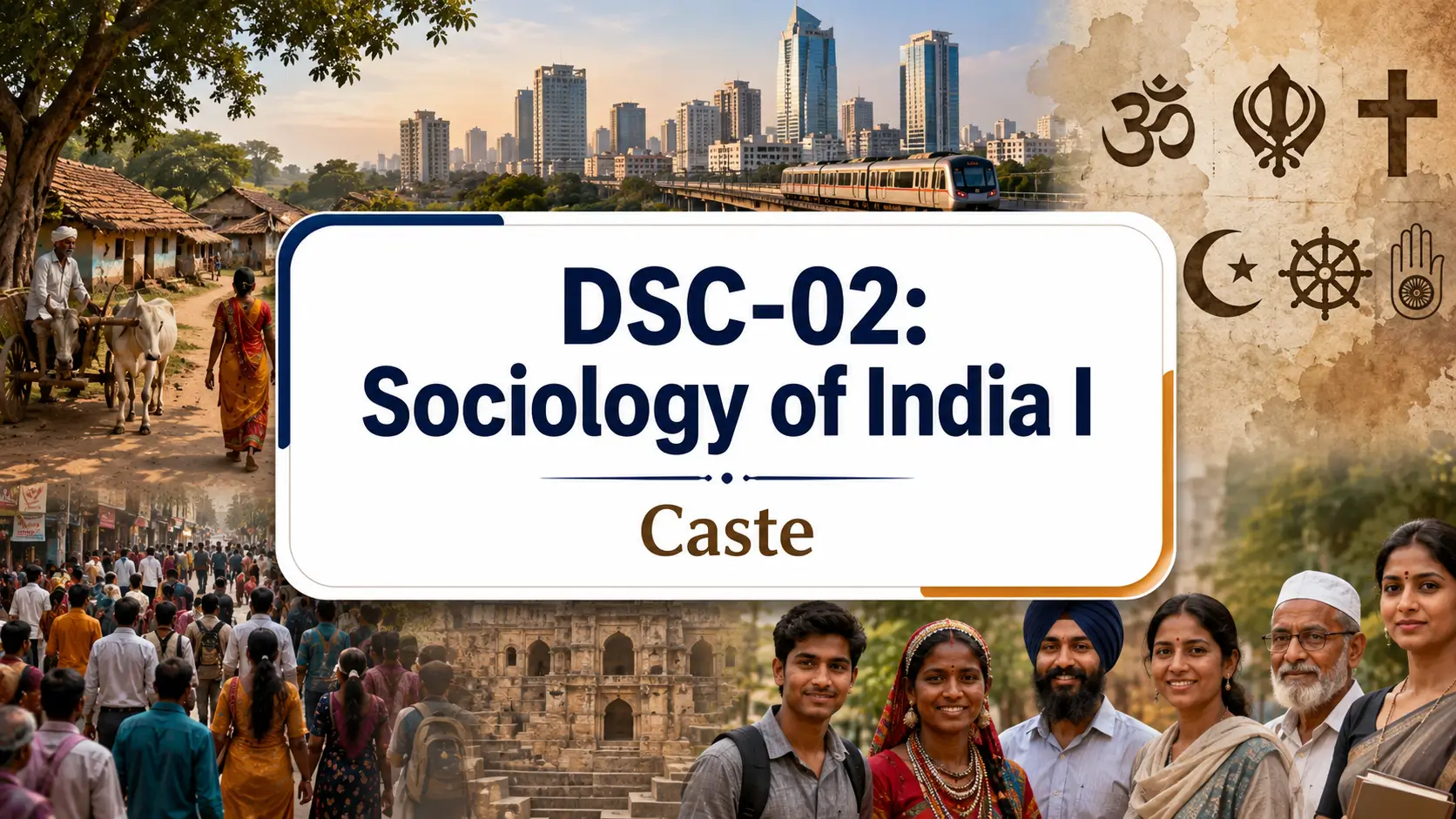
If you’ve successfully completed DSC-01: Introduction to Sociology in your first semester, get ready for the next exciting journey – DSC-02: Sociology of India I. And trust us – this is not just another theory paper. This is where you apply your sociological imagination to understand the layered, complex, and ever-transforming reality of Indian society.
Under the latest NEP (National Education Policy) 2020 framework, DU has designed this course to make you see India differently – not through stereotypes or common sense, but through a critical sociological lens. Whether it’s caste dynamics, village life, gender relations, or urban transformations – this paper covers it all.
This 4-credit course is your foundation for understanding Indian society. It’s designed to help you grasp the interlinkages between various elements – caste, class, tribe, gender, family, religion, village, and cities – and see them as relational and dynamic features, not isolated boxes.
We at Delhi Pathshala have gone through the official DU Sociology syllabus (2022 revision, applicable for 2026-27) and created this complete guide for you. No fluff – just what you need to know to score well.
Course Information – At a Glance
| What? | Details |
| Course Code | DSC-02 |
| Course Title | Sociology of India I |
| Programme | BA (Hons.) Sociology – Semester I |
| Credits | 4 (3 Lectures + 1 Tutorial per week) |
| Eligibility | No specific requirement |
| Pre-requisite | NIL |
| Exam Body | Examination Branch, University of Delhi |
| Curriculum Framework | NEP 2020 (revised 2022, effective 2026-27) |
Why Does This Course Even Matter?
Let’s be honest – we all grow up with some “common sense” ideas about India. But this course shatters those myths. Under the new NEP-aligned syllabus, the focus is on critical thinking, application, and reflexivity – not rote memorization.
Here’s what this course does:
- It introduces you to Indian society through a sociological lens – not just as a tourist, but as a critical observer.
- It shows you how caste, class, tribe, gender, family, religion, village, and cities are all interlinked – you can’t understand one without the others.
- It helps you understand that Indian society is dynamic and ever-changing – not static or traditional.
- It builds your foundation for all future sociology papers – from Sociology of India II to Gender Studies, Political Sociology, and more.
- It develops your ability to critically examine shared social reality – a skill that will serve you beyond college.
💡 Delhi Pathshala says: Yeh paper sirf rattne ka nahi hai. Isko samjho, everyday life mein apply karo – marks apne aap aa jayenge. Yeh NEP ka core philosophy hai – learning should be applied, not just theoretical.
Complete Syllabus – Unit-Wise Breakdown with Page Numbers
The syllabus is divided into 2 units – each building upon the previous one. Total teaching hours: 60 hours (spread across the semester).
UNIT I: Formations of Indian Society (24 Hours)
This unit sets up the historical and structural foundation. It helps you understand how Indian society was formed – the historical processes, ideological shifts, and institutional changes that shaped it.
| Author | Chapter / Reading | Book Details | Page Numbers | Key Focus |
| Robert W. Stern | “Changing India” (Chapter) | Changing India. Cambridge: Cambridge University Press (2003) pp. 16–31 | pp. 16–31 | Historical formations of Indian society – how India evolved over time. |
| André Beteille | “Antinomies of Society: Essays on Ideologies and Institutions” | Antinomies of Society: Essays on Ideologies and Institutions. Delhi: OUP (2000) pp. 198–207 | pp. 198–207 | Ideological contradictions and institutional complexities in Indian society. |
Exam Tip: Beteille is a must-read for understanding the ideological tensions in Indian society – the “antinomies” or contradictions that make India unique.
UNIT II: Indian Society – Configurations and Dynamics (36 Hours)
This is the biggest unit – and it’s your toolkit for understanding the key elements of Indian society. It covers 3 sub-topics, each focusing on interconnected features.
a. Caste, Class and Tribe
| Author | Chapter / Reading | Book Details | Key Focus |
| Eleanor Zelliot | “Caste in Contemporary India” | In Robin Rinehart ed. Contemporary Hinduism: Ritual, Culture, and Practice. Santa Barbara: ABC-Clio (2004) pp. 243–268 | Caste in modern India – how it has changed and continues to shape society. |
| Adrian C. Mayer | “Caste in an Indian Village: Change and Continuity 1954-1992” | In C.J. Fuller ed. Caste Today. Delhi: OUP (1996) pp. 32–63 | Village-level study of caste – change vs continuity over 40 years. |
| Hamza Alavi & John Harriss | “Sociology of ‘Developing Societies’: South Asia” | Sociology of “Developing Societies”: South Asia. London: Macmillan (1989) pp. 134–147 & 268–275 | Class dynamics and social structures in South Asian societies. |
| Leela Fernandes | “India’s Middle Classes in Contemporary India” | In Knut A. Jacobsen ed. Routledge Handbook of Contemporary India. London: Routledge (2016) pp. 332–340 | Rise and role of India’s middle classes – their impact on politics and society. |
| Virginius Xaxa | “Politics of Language, Religion and Identity: Tribes in India” | Economic and Political Weekly, Vol. 40, No. 13 (2005) pp. 1363–1370 | Tribal identities – politics of language, religion, and identity formation. |
Exam Tip: Xaxa and Fernandes are current and relatable – they connect historical structures to contemporary India. Leela Fernandes is especially important for understanding today’s India.
b. Gender, Family and Religion
| Author | Chapter / Reading | Book Details | Key Focus |
| Leela Dube | “Caste and Women” | Anthropological Explorations in Gender: Intersecting Fields. Delhi: Sage (2001) pp. 154–173 | How caste and gender intersect – the unique position of women in caste society. |
| Diane P. Mines & Sarah Lamb | “Everyday Life in South Asia” (Introduction) | Everyday Life in South Asia. Indianapolis: Indiana University Press, 2nd edition (2002) pp. 9–22 | Everyday experiences in South Asia – focusing on gender, family, and daily life. |
| Lina M. Fruzzetti | “Muslim Rituals: Household Rites vs. Public Festivals in Rural India” | In Imtiaz Ahmad. Ritual and Religion among Muslims in India. Delhi: Manohar (1981) pp. 91–112 | Muslim religious practices – household vs public rituals in rural India. |
Exam Tip: Leela Dube is a must-read for understanding the intersection of caste and gender. Fruzzetti is important for understanding minority religious practices in India.
c. Village, Cities and Urbanization
| Author | Chapter / Reading | Book Details | Key Focus |
| M.N. Srinivas | “The Changing Village” | Indian Society through Personal Writings. Delhi: OUP (1998) pp. 138–162 | How Indian villages are changing – rural transformation and continuity. |
| Sandeep Pendse | “Toil, Sweat and the City” | In Sujata Patel and Alice Thorner (eds.) Bombay: Metaphor for Modern India. Delhi: OUP (2007) pp. 2–25 | Labor, migration, and life in the city – the experience of urban workers. |
| Nandini Gooptu | “Divided We Stand: Indian City after Economic Liberalization” | In Knut A. Jacobsen ed. Routledge Handbook of Contemporary India. London: Routledge (2016) pp. 216–225 | Urban divides in post-liberalization India – inequality and fragmentation. |
Exam Tip: Srinivas is classic – you can’t study Indian villages without him. Pendse and Gooptu are contemporary – they connect to today’s urban realities.
Suggested Readings – Beyond the Syllabus (Delhi Pathshala Recommends)
These aren’t mandatory, but they’ll deepen your understanding and help you write better answers:
| Book | Author | Chapters / Pages | Why Read? |
| The Cambridge Companion to Modern Indian Culture | Vasudha Dalmia & Rashmi Sadana (eds.) | “The Formation of Tribal Identities” – Stuart Blackburn (pp. 30–48) | Understanding tribal identity formation in India. |
| India Today | Stuart Corbridge, John Harriss & Craig Jeffrey | Chapter 1 – “Making Sense of India Today” (pp. 1–19) | Contemporary India – a comprehensive overview. |
| The Cambridge Companion to Modern Indian Culture | Vasudha Dalmia & Rashmi Sadana (eds.) | “The Politics of Caste Identities” – Christoph Jaffrelot (pp. 80–98) | Caste as a political identity – essential for understanding modern India. |
| Keywords for Modern India | Craig Jeffrey & John Harriss | Full book | Key concepts for understanding contemporary India – very useful for exams. |
| Success of Indian Democracy | Atul Kohli (ed.) | “Social Movement Politics in India” – Smitu Kothari et al. (pp. 242–269) | Social movements and democracy in India. |
| Social Ecology | Ramachandra Guha (ed.) | “Ecology and Social Structure” – Joan P. Mencher (pp. 42–76) | Ecology, environment, and social structures in India. |
| Caste in India | Diane Mines | Chapter 3 – “Personhood and Rank” (pp. 27–35) & Chapter 7 – “Some Other Things to Know about Caste” (pp. 67–73) | Accessible introduction to caste – great for beginners. |
| A History of India | Peter Robb | Chapter 1 – “Introduction: Region and Civilization” (pp. 1–26) | Historical context for understanding Indian society. |
| Local Politics: The Law of the Fishes | Marguerite Robinson | Chapter 2 – “Caste, Politics and the Agrarian System” (pp. 19–46) | Caste, politics, and agrarian relations in rural India. |
| The Sociological Review | Mary Searle-Chatterjee | “Caste, Religion and other Identities” (pp. 147–166) | Intersection of caste, religion, and identity. |
| Economic and Political Weekly | K.S. Singh | “Transformation of Tribal Society: Integration vs Assimilation” Vol. 17, No. 33 & 34 (pp. 1318–1325, 1376–1384) | Tribal society – integration vs assimilation debates. |
| The Remembered Village | M.N. Srinivas | Full book | Classic ethnography of an Indian village – a must-read for sociology students. |
| Economic and Political Weekly | Malcolm Voyce | “Shopping Malls in India: New Social ‘Dividing Practices'” Vol. 42, No. 22 (pp. 2055–2062) | Contemporary urban India – malls and social divisions. |
Exam Strategy – Delhi Pathshala’s Proven Tips
Since the examination scheme is prescribed by the DU Examination Branch, here are 5 strategies to score 70+ (out of 75):
- Interlink everything – Yeh paper interconnections ke baare mein hai. Show how caste is linked to class, how gender is linked to religion, and how villages are linked to cities. Isme relation building sabse important hai.
- Use contemporary examples – Beteille aur Zelliot ko padho, lekin examples today’s India se lo – like OBC movements, middle-class aspirations, urban migration, etc.
- Compare and contrast – Caste vs class, village vs city, household rites vs public festivals – yeh comparisons easy marks hain.
- Indian sociologists ko seriously lo – Beteille, Dube, Xaxa, Fernandes, Srinivas – yeh Indian sociologists examiner ko impress karte hain.
- Tutorials miss mat karo – wahan practice hoti hai. Mock answers likho, feedback lo. Tutorial ka 1 credit bhi overall grade mein count hota hai.
Frequently Asked Questions (FAQs)
Q1. Is this syllabus applicable for the 2026-27 academic session?
✅ Yes. The DSC-02 syllabus was revised in 2022 under the NEP framework and remains the official DU syllabus for 2026-27.
Q2. Which semester is this course for?
✅ This is a Semester I paper for BA (Hons.) Sociology students.
Q3. How many credits does this course carry?
✅ 4 credits – 3 for lectures and 1 for tutorials.
Q4. Are there any practical components?
✅ No. There is no practical/practice component for DSC-02.
Q5. What is the most important unit in this course?
✅ Unit II – it’s the biggest (36 hours) and covers the most important concepts. Pay special attention to the interconnections between caste, class, tribe, gender, family, religion, village, and cities.
Q6. What is the most important reading in this course?
✅ André Beteille (for foundational understanding), Eleanor Zelliot (for contemporary caste), and M.N. Srinivas (for villages). But all readings are important – don’t skip any!
Q7. Where can I find the official exam pattern?
✅ The examination scheme is prescribed by the Examination Branch, University of Delhi. Keep checking the official DU website or stay tuned to Delhi Pathshala for updates.
Final Word from Delhi Pathshala
Doston – India ko samajhna matlab apni identity ko samajhna. Yeh paper sirf syllabus nahi – yeh India ko ek sociological lens se dekhne ka mauka hai.
Under the new NEP curriculum, DU has made this course more contemporary, applied, and interconnected. DSC-02: Sociology of India I is your second step into this exciting journey – and it’s a big one!
Delhi Pathshala par hum regularly DU ke latest syllabus, notes, aur exam guides update karte hain. Is page ko bookmark karo aur apne doston ke saath share karo.
Koi doubt ho? Comment karo – hum reply karenge. 😊
Disclaimer: This post is for informational and academic guidance purposes only. For the official examination scheme and latest updates, refer to the Examination Branch, University of Delhi.
Curated by the Delhi Pathshala Academics Team – your trusted partner for DU Sociology, English, Political Science, History, and more. 100% accurate, exam-oriented content as per University of Delhi norms.
Subscribe to keep reading
You've used your free notes for now. Get Delhi Pathshala Premium for unlimited access.
Subscribe — ₹29/30 days