
Contents
- Background: How the Idea of Governance Entered Political Science
- Difference between Government and Governance:
- Government vs Governance: Quick Comparison Table
- Stoker’s Five Propositions: What Is Distinctive about Governance
- An Example from Delhi
- The Debate: Is Governance Replacing Government?
- Importance of Studying Governance:
- Role of the State in the Era of Globalisation
- Pressures on the State
- The Debate: Is the State in Retreat?
- From “Rowing” to “Steering”
- India’s Experience
- Role of State: Core Functions That Remain
- State, Market and Civil Society
- State, Market and Civil Society Compared
- Key Ideas and Thinkers
- Criticisms and Limits of the Triad
- Main Features and Dimensions of Governance:
- Indicators and Criteria of Governance:
- Good Governance: The UNESCAP Eight Characteristics
- Measuring Governance: The Worldwide Governance Indicators
- Good Governance: Two Strands
- Criticism and Limitations of the Governance Concept
- Main Challenges and Issues of Governance in India:
- Main Initiatives and Reforms of Governance in India:
- Quick Revision Table: Initiatives and the Governance Dimension They Serve
- Important Comparisons
- Contemporary Relevance
- Conclusion
- Continue Reading
- University of Delhi Previous Year Questions
- FAQs
Students usually meet the words government and governance on the same page and assume they are two spellings of one idea. They are not. In Unit 1 of this Generic Elective you are asked to understand why political scientists, the World Bank and the United Nations started using “governance” in the late twentieth century, and what that change of vocabulary says about the modern state, the market and society.
These notes cover the whole unit in the order you will need it in an exam: how the idea of governance arose, the difference between government and governance, why governance is worth studying, the role of the state in an era of globalisation, the relationship between state, market and civil society, the features and dimensions of governance, the criticisms of the concept, and then India: its governance challenges and the main reforms and initiatives. Questions and FAQs at the end help with revision.
Syllabus note: Unit 1 is listed as Government and Governance: Concepts, with two parts: (a) Role of the State in the Era of Globalisation and (b) State, Market and Civil Society. This is based on copies of the DU syllabus circulating online; please check the exact wording against the official University of Delhi syllabus PDF for your admission year.
Background: How the Idea of Governance Entered Political Science
The word is old. It comes from the Greek kybernan and kybernetes, meaning “to steer” and the “pilot” or “helmsman” of a ship. That steering image is still the best way to remember the concept: governance is about direction and coordination, not only about who sits in the captain’s chair.
The modern, technical use of the term grew out of the 1980s and 1990s:
- World Bank (1989 and 1992): The 1989 report Sub-Saharan Africa: From Crisis to Sustainable Growth linked weak development outcomes to weak public institutions. In 1992 the Bank published Governance and Development, which treated the way power is exercised in managing a country’s economic and social resources as a development issue in itself. This is the root of the “good governance” agenda.
- James Rosenau and Ernst-Otto Czempiel (1992): Their edited book Governance without Government: Order and Change in World Politics argued that order in world politics is produced by many actors, not only by governments.
- R. A. W. Rhodes (1996): In “The New Governance: Governing without Government” (Political Studies, 44), Rhodes noted that the term is popular but imprecise and listed at least six uses: the minimal state, corporate governance, the new public management, good governance, socio-cybernetic systems, and self-organising networks. He himself defined governance as self-organising, inter-organisational networks.
- Gerry Stoker (1998): In “Governance as Theory: Five Propositions” (International Social Science Journal, 50), Stoker set out what is distinctive about the governance perspective, which we use below.
- India: Economic liberalisation after 1991 changed what Indians expected of the state, and the 1990s and 2000s added citizen-centred tools such as the Citizen’s Charter, the Right to Information Act and e-governance. These are covered later in these notes.
Difference between Government and Governance:
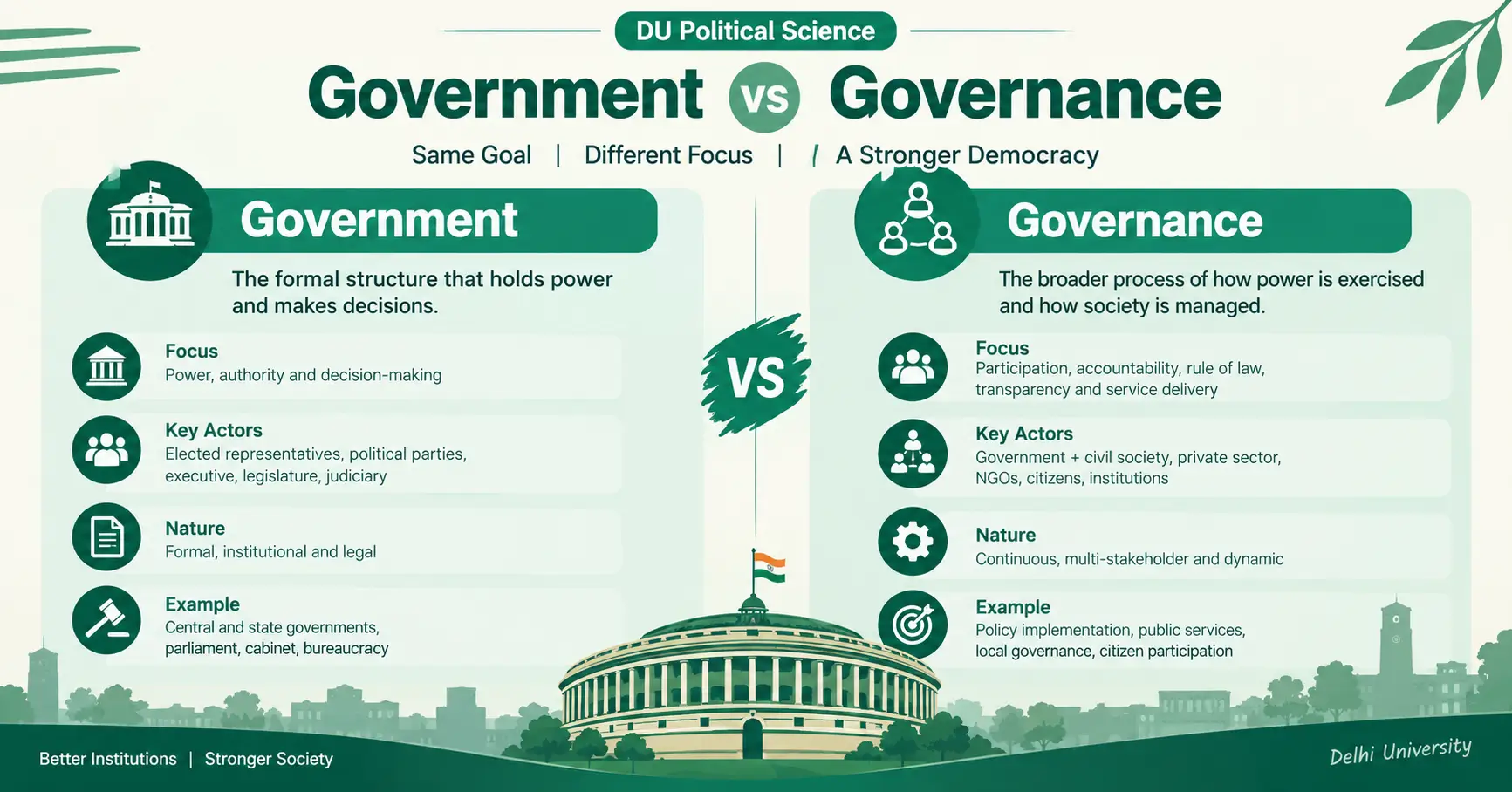
Government is the formal machinery of the state: the people and institutions that make, apply and enforce binding rules within a territory. Governance is the wider process by which a society is steered. It includes government but also reaches the market, civil society, communities and, increasingly, international bodies.
1. Definition:
– Government: “Government” refers to the formal structure and institutions through which a state exercises its authority and control over its citizens. It includes elected officials, bureaucratic agencies, and other entities responsible for making and implementing laws and policies.
– Governance: “Governance,” on the other hand, is a broader concept that encompasses the entire process and system by which a society is directed and controlled. It includes not only formal institutions but also informal structures, networks, and mechanisms that influence decision-making and policy implementation.
2. Scope:
– Government: The term “government” typically refers to the formal and institutional aspects of the state, including the executive, legislative, and judicial branches.
– Governance: “Governance” extends beyond the formal state structures to include interactions between government institutions, non-governmental organizations, businesses, communities, and other stakeholders.
3. Nature:
– Government: Government is a specific set of institutions and officials responsible for making and enforcing laws. It is a more specific and delimited concept.
– Governance: Governance is a broader and more inclusive term that looks at the entire system of decision-making and implementation, recognizing the influence of various actors both within and outside formal government structures.
4. Focus:
– Government: Focuses on the formal authority and power vested in elected representatives and state institutions.
– Governance: Focuses on the overall management and coordination of societal affairs, considering both formal and informal mechanisms.
5. Hierarchy:
– Government: Implies a hierarchical structure with clearly defined roles and responsibilities.
– Governance: Recognizes that decision-making may involve multiple actors, and authority is often dispersed across different levels and entities.
Government vs Governance: Quick Comparison Table
| Basis | Government | Governance |
|---|---|---|
| Meaning | Formal institutions and officeholders of the state | Process of steering society through many actors and rules |
| Source of authority | Legal authority of the state | Legal authority plus negotiation, trust, networks, markets and shared goals |
| Actors | Legislature, executive, judiciary, bureaucracy | State, private sector, civil society, communities, international bodies |
| Mode of working | Mostly command, rules, hierarchy | Coordination, partnership, bargaining, steering |
| Accountability | Elections, legislatures, courts, audit | Same, plus transparency, social audit, stakeholder feedback, which is harder to pin down in networks |
| Question it answers | Who rules and through which institutions? | How are collective decisions actually made and carried out? |
| Example | Parliament passes a law; a ministry issues rules | Government, industry, researchers and residents jointly work out how to reduce urban air pollution |
Stoker’s Five Propositions: What Is Distinctive about Governance
Gerry Stoker (1998) summarised the governance perspective in five propositions, here in plain words:
- Governance involves institutions and actors drawn from, but also beyond, government.
- The boundaries and responsibilities for tackling social and economic problems are blurred; the line between public and private is no longer sharp.
- Institutions engaged in collective action depend on one another for power and resources.
- Governance is about autonomous, self-governing networks of actors.
- The capacity to get things done does not rest only on government’s power to command or use its authority. Government can use new tools and techniques to steer and guide.
An Example from Delhi
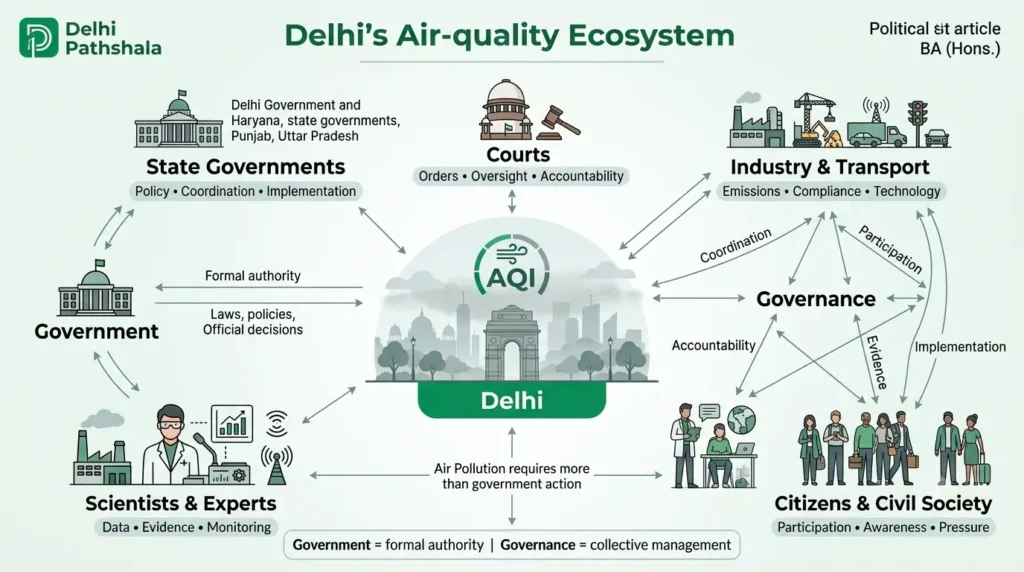
Air pollution in Delhi and the National Capital Region cannot be handled by the Delhi government alone. Neighbouring state governments, the Commission for Air Quality Management in NCR and Adjoining Areas, courts, farmers, transporters, industry, scientists, resident welfare associations and individual citizens all shape the outcome. Government supplies the legal authority; governance is the whole web of actors and bargains through which the problem is (or is not) solved. A smaller example is Bhagidari, an initiative of the Delhi government at the turn of the century that brought resident welfare associations into local decision-making; the word itself means “partnership”.
The Debate: Is Governance Replacing Government?
Students often write as if governance has simply replaced government. Scholars do not agree on that.
– The “hollowing out” view: Rhodes and others argued that globalisation, privatisation and networks had reduced the state’s direct control, so governments increasingly steer through others.
– The “state still matters” view: Jon Pierre and B. Guy Peters (Governance, Politics and the State, 2000) and, earlier, Theda Skocpol and colleagues (Bringing the State Back In, 1985) stressed that the state keeps unique powers: legitimate coercion, taxation, law-making and the ability to set the rules under which every other actor operates. On this view, governance describes a change in how the state works, not its disappearance.
A balanced exam answer says that governance is broader than government, that government remains one of the most important actors within governance, and that “governance without government” is better treated as a limiting case than as a description of most countries.
Importance of Studying Governance:
1. Complexity of Modern Societies:
– Modern societies are characterized by complexity, interdependence, and rapid change. Studying governance helps understand the intricate web of relationships among various actors and institutions involved in decision-making and policy implementation. A school-education policy, for example, touches the Union and state governments, regulators, private schools, teachers’ bodies, parents and courts.
2. Globalization:
– In an era of globalization, governance extends beyond national borders. Global issues such as climate change, trade, and security require coordinated efforts and effective governance mechanisms at an international level.
3. Multilevel Governance:
– Many decisions and policies are made at various levels of government, from local to global. Studying governance helps analyze how different levels of government interact and influence one another. The term multilevel governance is associated with Liesbet Hooghe and Gary Marks, who developed it while studying the European Union.
4. Participation and Inclusivity:
– Governance emphasizes the importance of inclusivity and citizen participation in decision-making processes. Studying governance helps explore mechanisms to ensure a more participatory and accountable system.
5. Adaptability to Change:
– Governance frameworks are more adaptable to societal changes compared to rigid government structures. Understanding governance allows for the exploration of flexible and responsive approaches to societal challenges. (This is a tendency, not a rule: networks can also be slow, and formal institutions can adapt when reformed.)
6. Non-state Actors:
– Governance involves the interaction of a wide range of actors, including non-state entities like NGOs, businesses, and community groups. Studying governance acknowledges the significance of these actors in shaping policies and outcomes.
7. Ethics and Accountability:
– Governance emphasizes ethical considerations and accountability mechanisms. By studying governance, one can explore ways to ensure transparency, accountability, and ethical conduct in decision-making processes.
8. Efficiency and Effectiveness:
– Governance mechanisms strive for efficiency and effectiveness in the use of resources and the achievement of desired outcomes. Studying governance helps identify best practices and improve the overall performance of systems.
In conclusion, while government focuses on formal structures and institutions, governance provides a more comprehensive understanding of the broader processes and interactions that shape the direction and control of societies. Studying governance is crucial in navigating the complexities of modern governance systems and ensuring effective, inclusive, and ethical decision-making.
Role of the State in the Era of Globalisation
(Syllabus Unit 1, part a)
Globalisation here means the growing cross-border flow of goods, capital, technology, information and people, together with the rules and institutions that manage those flows. It changes what states can do and what citizens expect them to do.
Pressures on the State
– Economic: Capital can move quickly, so governments compete to attract investment. International trade rules and financial markets limit some policy choices.
– Political and legal: Organisations such as the WTO, IMF and World Bank, and a growing body of international law, shape domestic policy. Climate change, pandemics and cyber-security cannot be solved by one state.
– Technological: Digital platforms and communication technologies change how citizens organise and how governments deliver services.
– Social: Migration, global media and transnational movements widen the circle of actors who claim a say in public affairs.
The Debate: Is the State in Retreat?
| Position | Main argument | Associated scholars |
|---|---|---|
| State in retreat | Global markets and institutions have weakened national governments | Kenichi Ohmae, The End of the Nation State (1995); Susan Strange, The Retreat of the State (1996) |
| State adapts and remains central | States still tax, regulate and negotiate; the extent of “powerlessness” is exaggerated, and strong states manage openness better | Linda Weiss, The Myth of the Powerless State (1998); Dani Rodrik, “Has Globalization Gone Too Far?” (1997) |
From “Rowing” to “Steering”
The shift in the state’s role is often summarised through the phrase steering rather than rowing, popularised by David Osborne and Ted Gaebler in Reinventing Government (1992). The state concentrates on setting direction, rules and standards, and leaves more of the actual delivery to markets, civil society and local bodies. Rhodes’s list of uses of governance above (minimal state, new public management) captures the same drift.
India’s Experience
India’s balance changed after the economic reforms of 1991, when licensing was relaxed and the economy opened up. The state moved away from controlling most economic activity, but it did not become irrelevant: it still runs large welfare programmes, regulates markets through bodies such as SEBI, and acts as the main guarantor of rights. Later sections on RTI, GST, Jan Dhan and Digital India show the Indian state using new tools to steer rather than only to command.
Role of State: Core Functions That Remain
– Regulatory Function: The state plays a crucial role in governance by establishing and enforcing rules and regulations that govern various aspects of society.
– Service Delivery: Governments are responsible for providing essential services to citizens, such as education, healthcare, infrastructure, and public safety.
– Protection of rights and security: Only the state holds legitimate authority to enforce laws and protect rights across a territory.
– Redistribution and social justice: Taxation and welfare spending correct inequalities that markets leave untouched.
State, Market and Civil Society
(Syllabus Unit 1, part b)
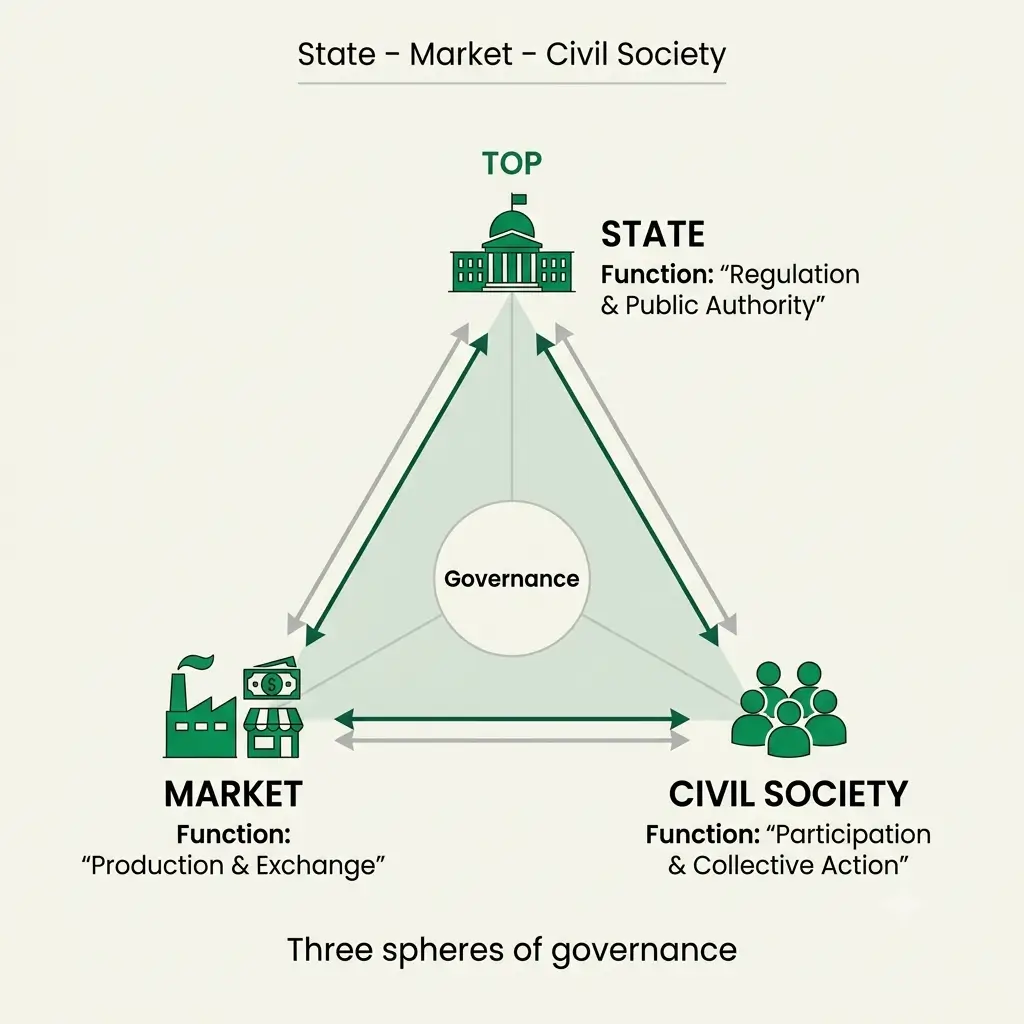
Governance is often described as the interaction of three sectors. Each has strengths and weaknesses, and no one sector can manage a complex society alone.
Role of State:
– Regulatory Function: The state plays a crucial role in governance by establishing and enforcing rules and regulations that govern various aspects of society.
– Service Delivery: Governments are responsible for providing essential services to citizens, such as education, healthcare, infrastructure, and public safety.
Role of Market:
– Economic Coordination: The market serves as a mechanism for economic coordination, allocating resources through supply and demand forces.
– Innovation and Efficiency: Markets encourage innovation and efficiency by fostering competition among businesses.
Role of Civil Society:
– Advocacy and Activism: Civil society organizations (CSOs) play a vital role in advocating for the rights and interests of citizens and marginalized groups.
– Checks and Balances: Civil society acts as a check on both the state and the market, ensuring accountability and transparency.
State, Market and Civil Society Compared
| Basis | State | Market | Civil society |
|---|---|---|---|
| Logic | Authority and law | Exchange and competition | Voluntary association and shared purpose |
| Strength | Can compel, tax, redistribute, protect rights | Efficient allocation, innovation | Voice for the marginalised, watchdog role, local knowledge |
| Typical failure | Red tape, corruption, capture by interest groups | Inequality, monopolies, neglect of public goods and the environment | Uneven representation, limited resources, accountability of NGOs themselves |
| Accountability to | Voters, courts, legislature | Shareholders and consumers | Members, donors, the public |
| Indian example | Public distribution system, NHM | Private industry, banks, start-ups | RTI activism, community organisations, NGOs |
Key Ideas and Thinkers
– Civil society: Alexis de Tocqueville, in Democracy in America, saw voluntary associations as a school of democracy. G. W. F. Hegel treated civil society as the sphere between family and state. Antonio Gramsci studied it as a space where cultural leadership is won. Robert Putnam’s Making Democracy Work (1993) connected civic associations and trust (social capital) to the performance of democratic institutions.
– State and market: Classical liberals favour a minimal state and wide market freedom; welfare-state and Keynesian approaches give the state a larger role in managing demand and protecting citizens; neoliberal policy since the 1980s again favoured privatisation and deregulation. Chalmers Johnson’s study of Japan, MITI and the Japanese Miracle (1982), supports the idea of a “developmental state” that guides the market.
Criticisms and Limits of the Triad
– Civil society is not automatically virtuous. Organisations differ in resources, representativeness and transparency, and some serve narrow interests.
– In India, the regulation of foreign funding of NGOs under the Foreign Contribution (Regulation) Act, 2010 (amended in 2020) is debated: supporters cite national security and transparency, critics argue it constrains civil-society work. A fair answer presents both sides.
– The three sectors overlap in practice: public-private partnerships, state-funded NGOs and corporate foundations blur the boundaries.
Main Features and Dimensions of Governance:
Types of Governance:
– Corporate Governance: Focuses on the internal structures and processes of corporations, ensuring accountability to shareholders and ethical business practices. (In Britain, the Cadbury Report of 1992 was an influential early statement on corporate governance.)
– Global Governance: Addresses issues that transcend national borders, such as climate change, human rights, and global trade.
– Local Governance: Involves the administration and decision-making processes at the local level, often focusing on community development and service delivery. See our notes on local governance.
Levels of Governance:
– Macro-level Governance: Involves national and international governance structures, addressing overarching issues that affect entire populations or regions.
– Meso-level Governance: Takes place at the intermediate level, involving sub-national entities like states or provinces.
– Micro-level Governance: Refers to governance at the local or community level, dealing with issues specific to smaller populations.
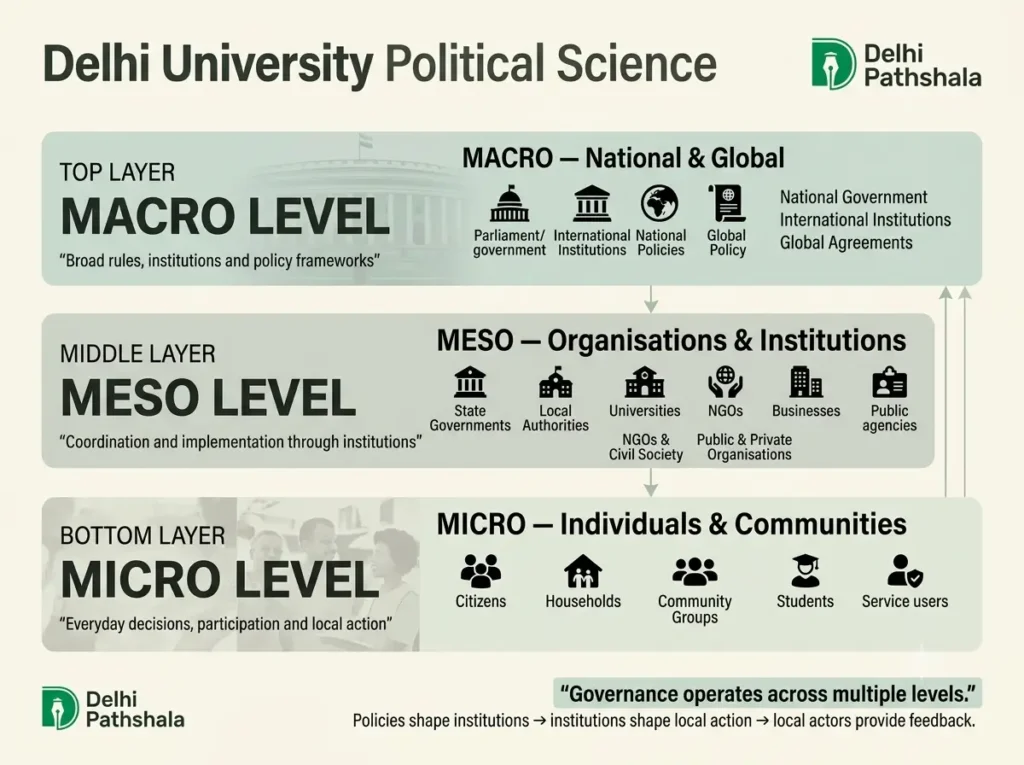
(The macro, meso and micro division is an analytical convenience used in teaching; different authors draw the lines differently, and in practice the levels constantly interact.)
Indicators and Criteria of Governance:
– Transparency: The extent to which information and decision-making processes are accessible and understandable to the public.
– Accountability: The mechanisms in place to ensure that individuals and institutions are answerable for their actions and decisions.
– Rule of Law: The adherence to established laws and legal frameworks by both state and non-state actors.
– Participation: The inclusion of diverse voices and perspectives in decision-making processes.
– Efficiency and Effectiveness: The ability of governance structures to achieve desired outcomes in a timely and resource-efficient manner.
– Equity and Inclusivity: Ensuring fair and inclusive participation and distribution of resources, benefits, and burdens.
– Legitimacy: The perceived or actual authority of governance institutions and processes in the eyes of the public.
– Adaptability: The capacity of governance systems to respond and adapt to changing circumstances and emerging challenges.
– Human Rights: The protection and promotion of fundamental human rights as a core element of governance.
– Sustainability: The consideration of long-term environmental, social, and economic impacts in decision-making.
Good Governance: The UNESCAP Eight Characteristics
The United Nations Economic and Social Commission for Asia and the Pacific (UNESCAP) defines governance as the process of decision-making and the process by which decisions are implemented (or not implemented), and says that good governance has eight major characteristics. These are the characteristics students most often quote, and they overlap with the indicator list above.
| Characteristic | What it means in practice | Link to the indicators above |
|---|---|---|
| Participation | Men and women have a voice, directly or through legitimate representatives | Participation |
| Rule of law | Fair legal frameworks enforced impartially | Rule of Law, Human Rights |
| Transparency | Decisions and their enforcement follow rules; information is accessible | Transparency |
| Responsiveness | Institutions serve stakeholders within a reasonable time | Adaptability |
| Consensus oriented | Mediation of different interests towards a broad consensus | Legitimacy |
| Equity and inclusiveness | All groups feel they have a stake and are not excluded | Equity and Inclusivity |
| Effectiveness and efficiency | Results that meet needs while making the best use of resources, including sustainable use of natural resources | Efficiency and Effectiveness, Sustainability |
| Accountability | Decision-makers are answerable to the public and to institutional stakeholders | Accountability |
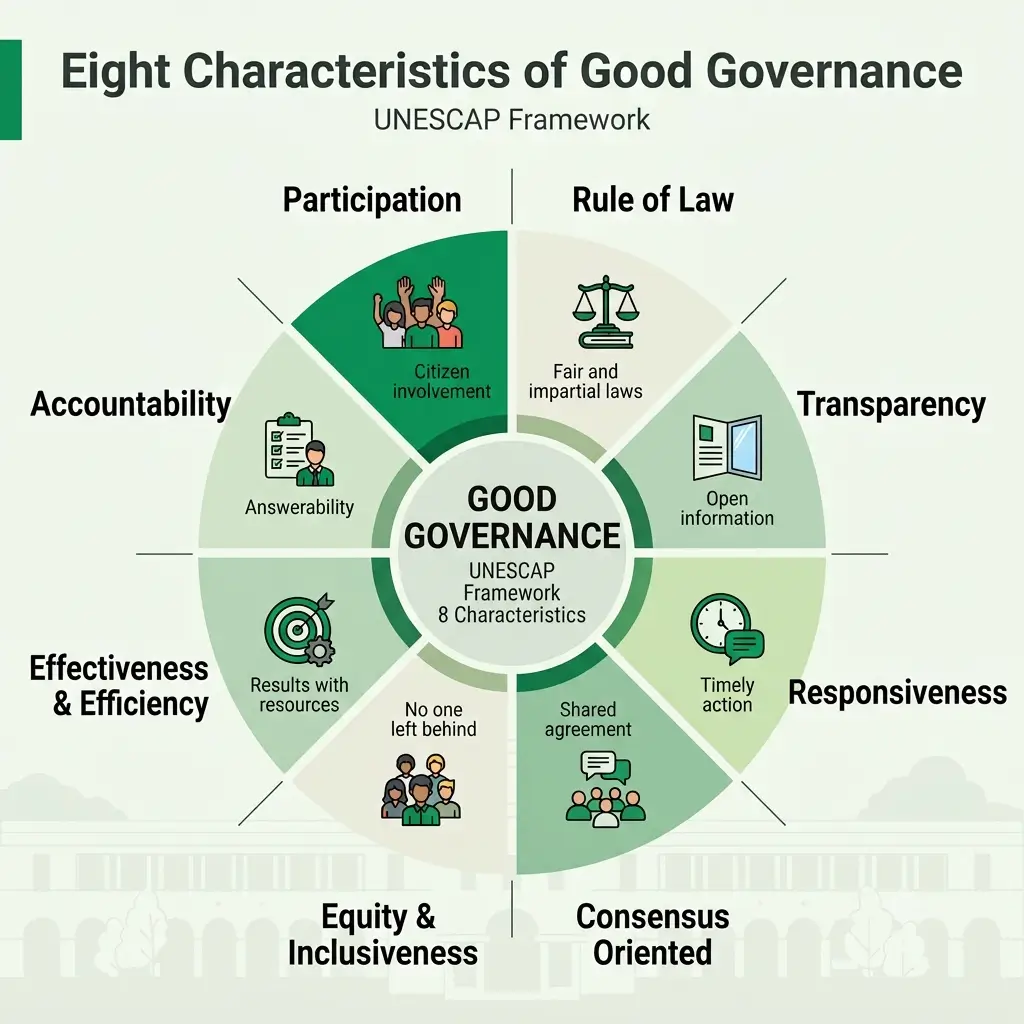
UNESCAP adds that corruption is minimised and the voices of the most vulnerable are heard under good governance, and that no society achieves all eight perfectly: it is an ideal to move towards.
Measuring Governance: The Worldwide Governance Indicators
The World Bank’s Worldwide Governance Indicators (associated with Daniel Kaufmann, Aart Kraay and Massimo Mastruzzi) summarise perceptions of governance in six dimensions: voice and accountability, political stability and absence of violence, government effectiveness, regulatory quality, rule of law, and control of corruption. They are widely used, but they measure perceptions, and critics question whether a single index can capture such different realities.
Good Governance: Two Strands
– Development-agency strand (World Bank): Stresses sound public management, accountability, transparency and a legal framework for development, and has sometimes been tied to aid conditions.
– Democratic strand (UN agencies including UNDP and UNESCAP): Stresses participation, human rights, equity and sustainable human development.
Collaborative Governance:
– Emphasizes partnerships and collaborations among state, market, and civil society actors to address complex issues.
– Involves shared decision-making, joint problem-solving, and collective action to achieve common goals.
Responsive Governance:
– Focuses on the ability of governance structures to be responsive to the needs, concerns, and aspirations of the people they serve.
– Encourages ongoing dialogue and feedback mechanisms between citizens and decision-makers.
E-Governance and Digital Governance:
– Involves the use of information and communication technologies to enhance the efficiency, accessibility, and transparency of governance processes.
– Includes online service delivery, digital communication, and data-driven decision-making.
– In India, the National e-Governance Plan (2006) and later Digital India (2015) are the main reference points; see the initiatives section below. The same cluster of ideas (good, collaborative, network and digital governance) is explained in more detail in our notes on multiple perspectives on governance in public administration.
Network Governance:
– Recognizes the interconnectedness of various actors and institutions involved in governance.
– Emphasizes the importance of networks, alliances, and collaborations in addressing complex challenges.
Understanding the features and dimensions of governance provides a comprehensive framework for analyzing and evaluating the effectiveness of systems in addressing societal needs, fostering economic development, and ensuring social justice and environmental sustainability.
Criticism and Limitations of the Governance Concept
A good answer does not only describe governance; it also tests it.
– Vagueness: Rhodes himself called the term popular but imprecise. When one word covers the minimal state, corporate management, networks and good governance, it can mean everything and therefore explain little.
– Accountability gap: When many actors share decisions, it becomes harder for a citizen to know who is responsible. Stoker lists this among the dilemmas of governance. Elections hold governments accountable; no equivalent mechanism automatically holds a network accountable.
– Depoliticisation: Presenting governance as technical management of “stakeholders” can hide questions of power, class and conflict.
– Donor agenda: Critics argue that “good governance” has sometimes been a list of conditions pushed on poorer countries. Merilee Grindle’s “Good Enough Governance” (Governance, 2004) argued for realistic, prioritised reform rather than an unachievable full list.
– Western bias and one-size-fits-all: Institutions that work in one country may not transfer easily to another.
– Risk of weakening the state: If service delivery is passed to private bodies without regulation, the poor may be left behind.
Main Challenges and Issues of Governance in India:
Quality and Accountability of Public Services:
– Inadequate Service Delivery: Many parts of India face challenges in providing basic public services such as education, healthcare, and sanitation. Quality remains a concern in both rural and urban areas.
– Bureaucratic Inefficiency: Bureaucratic delays and inefficiencies can hinder the timely delivery of services and responses to citizens’ needs.
Participation and Representation of Citizens:
– Political Participation: Despite being a vibrant democracy, there are concerns about the depth and breadth of citizens’ political engagement. Voter turnout varies, and marginalized groups may face obstacles in participating effectively.
– Women’s Representation: Gender disparities persist in political representation, with women underrepresented at various levels of governance. The 73rd and 74th Constitution Amendments (1992) reserved one-third of seats for women in panchayats and municipalities, and the Constitution (106th Amendment) Act, 2023, known as the Nari Shakti Vandan Adhiniyam, provides for one-third reservation in the Lok Sabha and state assemblies; its operation is linked to later steps (a census and delimitation), so check its current status before quoting dates.
Responsiveness and Transparency of Institutions:
– Lack of Transparency: Transparency in decision-making processes, particularly in matters of public interest, remains a concern. There is a need for greater openness and accessibility to information.
Corruption and Ethics:
– Corruption at Various Levels: Corruption is a pervasive issue at both central and state levels, impacting governance across sectors. It erodes public trust and diverts resources from intended beneficiaries. Bureaucratic red tape and bribery can impede citizens’ access to their entitled services.
– Ethical Conduct: Ensuring ethical conduct in public service is crucial. Unethical practices and lack of accountability can undermine the effectiveness of governance institutions.
– Institutional responses: The Prevention of Corruption Act, 1988, the Lokpal and Lokayuktas Act, 2013 and the Whistle Blowers Protection Act, 2014 are the main statutory tools; students should be ready to discuss how effective they have been.
Money Power and Criminalisation of Politics:
– Concerns about the role of money in elections and the presence of candidates with criminal cases have repeatedly reached the Supreme Court. In 2002 and 2003 the Court’s decisions on candidate disclosure (the ADR and PUCL cases) strengthened voters’ right to know about candidates, and in February 2024 the Court struck down the electoral bonds scheme. These examples show courts acting as a governance actor.
Inequality and Social Justice:
– Economic Disparities: Income and wealth disparities persist, contributing to social inequality. Policies may not always effectively address the needs of marginalized and vulnerable communities.
– Caste-Based Discrimination: Despite constitutional provisions, caste-based discrimination and social hierarchies continue to pose challenges to social justice.
Infrastructure and Urbanization Challenges:
– Urban-Rural Disparities: Rapid urbanization has led to challenges in providing basic infrastructure and services in urban areas. Rural regions often lag behind in terms of development.
– Environmental Concerns: Urbanization and industrialization contribute to environmental degradation, posing challenges for sustainable governance.
– Transportation and Connectivity: Improving transportation infrastructure and connectivity, especially in remote areas, is crucial for economic development and social inclusion.
– Energy Access: Ensuring reliable and sustainable energy sources for all citizens is a pressing issue.
Education and Skill Development:
– Quality of Education: Ensuring a high standard of education across the country remains a challenge. Disparities in educational infrastructure and outcomes persist.
– Skill Mismatch: There is a gap between the skills possessed by the workforce and the skills demanded by the job market.
Healthcare Challenges:
– Healthcare Infrastructure: Access to quality healthcare services is a challenge, particularly in rural areas. Adequate healthcare infrastructure and trained personnel are essential.
– Pandemic Preparedness: The COVID-19 pandemic highlighted the need for robust healthcare systems and emergency response mechanisms.
Security Concerns:
– Internal Conflicts: Some regions face internal conflicts and security challenges. Ensuring peace and security within the country is essential for stable governance.
– Border Issues: Addressing border disputes and maintaining peaceful relations with neighboring countries is crucial for geopolitical stability.
Digital Divide:
– Technological Disparities: The digital divide remains a challenge, with disparities in access to technology and the internet. Bridging this gap is essential for inclusive governance. It matters especially because many services are now delivered online: those without access risk exclusion from the very systems meant to include them.
Disaster Management:
– Natural Disasters: India is prone to natural disasters such as floods, earthquakes, and cyclones. Effective disaster management and response mechanisms are crucial. The Disaster Management Act, 2005 created the National Disaster Management Authority and a three-tier structure of authorities.
Judicial Backlog and Legal Reforms:
– Judicial Delays: The legal system faces challenges of backlog and delays in delivering justice. Legal reforms are essential for an efficient and responsive judiciary. (Case-pendency figures change constantly; quote current numbers from the National Judicial Data Grid, not from older notes.)
Federalism and Centre-State Relations:
– Coordination Challenges: Ensuring effective coordination between the central and state governments is critical for seamless governance. Striking a balance between federalism and national priorities is an ongoing challenge. The GST Council, in which the Union and the states jointly decide tax matters, and the replacement of the Planning Commission by NITI Aayog in 2015 are frequently cited in debates on cooperative federalism. See also what is federalism.
Addressing these challenges requires a multi-faceted approach involving effective policies, institutional reforms, citizen engagement, and sustained efforts to promote transparency, accountability, and inclusivity in governance.
Main Initiatives and Reforms of Governance in India:
Right to Information Act (RTI), 2005:
– Objective: The RTI Act aims to promote transparency and accountability in the functioning of government institutions by empowering citizens to access information.
– Key Features:
– Citizens can request information from public authorities, and the authorities are obligated to provide the requested information within a stipulated time (generally 30 days, and 48 hours where life or liberty is involved).
– The Act covers central and state government offices, as well as public authorities at various levels.
– Information disclosure promotes public scrutiny, reducing corruption and enhancing governance efficiency.
– Public authorities must also disclose certain information proactively (Section 4), and Section 8 lists exemptions. The Central and State Information Commissions hear appeals. The Act was passed in June 2005 and came fully into force in October 2005; the 2019 amendment, which changed the terms and conditions of service of Information Commissioners, remains debated.
Public Service Guarantee Acts (state laws; first enacted 2010):
– Objective: These laws focus on providing time-bound services to citizens and enhancing service delivery in government offices.
– Key Features:
– There is no single central “Public Service Guarantee Act, 2010”. Madhya Pradesh became the first state to enact such a law, in 2010, and many other states followed in 2011 and after, including Delhi (the Delhi (Right of Citizen to Time Bound Delivery of Services) Act, 2011), Rajasthan, Bihar and Himachal Pradesh. A central Bill of 2011 on time-bound delivery of goods and services and redressal of grievances lapsed with the dissolution of the 15th Lok Sabha.
– Specifies a list of services that government departments must provide within a predetermined timeframe.
– Non-compliance with service delivery timelines can lead to penalties for officials, promoting accountability. For example, Rajasthan’s law provided for fines for undue delay.
– Aims to reduce bureaucratic delays, corruption, and enhance the overall quality of public services.
Citizen’s Charter:
– Objective: The Citizen’s Charter is a commitment by government departments to provide transparent and accountable services to citizens.
– Key Features:
– Outlines the standards of service delivery, grievance redressal mechanisms, and the rights and responsibilities of both citizens and officials.
– Empowers citizens by setting expectations for service quality and timelines.
– Encourages public participation in the monitoring and evaluation of services.
– The idea was taken up in India in the late 1990s, following a 1997 conference of Chief Ministers on responsive administration. A Citizen’s Charter is a commitment, not a law, so citizens cannot ordinarily go to court to enforce it; this limitation is why the later right-to-service laws were seen as a step forward. The “Sevottam” framework of the Department of Administrative Reforms and Public Grievances was designed to improve the quality of charters and grievance redressal.
Corporate Social Responsibility (CSR):
– Objective: CSR initiatives encourage businesses to contribute to social and environmental causes, fostering a sense of responsibility beyond profit-making.
– Key Features:
– The Companies Act, 2013, mandates certain companies to spend a portion of their profits on CSR activities. Section 135 applies to companies meeting thresholds of net worth, turnover or net profit, and requires them to spend at least 2 per cent of their average net profit of the preceding three financial years; the provisions took effect from 1 April 2014.
– CSR activities often focus on education, healthcare, environmental sustainability, and community development, drawn from the activities listed in Schedule VII.
– Aims to align business activities with societal well-being and sustainable development.
– Critics say CSR spending is concentrated in a few states and sectors, which is why it is better seen as a supplement to, not a substitute for, public spending.
Goods and Services Tax (GST), 2017:
– Objective: GST is a comprehensive indirect tax reform aimed at simplifying the taxation system and promoting a unified market.
– Key Features:
– Replaced multiple indirect taxes with a single, nationwide tax, reducing tax cascading and improving efficiency.
– Promotes a common market by providing a uniform tax structure across states.
– Enhances transparency and compliance through digital processes and a unified tax filing system.
– It followed the 101st Constitution Amendment Act, 2016 and came into effect on 1 July 2017. The GST Council, with representatives of the Union and the states, is a clear example of joint decision-making in governance.
Jan Dhan Yojana:
– Objective: Launched in 2014, Jan Dhan Yojana (Pradhan Mantri Jan Dhan Yojana) aims to provide financial inclusion by ensuring access to banking services for all citizens.
– Key Features:
– Facilitates the opening of bank accounts with minimal documentation.
– Provides financial services such as insurance, credit, and pension to marginalized sections of society.
– Aims to reduce economic disparities and promote financial literacy.
Swachh Bharat Abhiyan:
– Objective: Launched on 2 October 2014, Swachh Bharat Abhiyan focuses on achieving cleanliness and sanitation across the country.
– Key Features:
– Aims to eliminate open defecation, improve waste management, and promote cleanliness in public spaces.
– Involves behavioral change campaigns, construction of toilets, and waste management initiatives.
– Aims to enhance public health, environmental sustainability, and overall quality of life.
Digital India Initiative:
– Objective: Launched in 2015, Digital India aims to transform India into a digitally empowered society and knowledge economy.
– Key Features:
– Promotes digital literacy, electronic governance, and online service delivery.
– Aims to bridge the digital divide by providing broadband connectivity to rural areas.
– Encourages the use of technology for economic growth, innovation, and inclusive development.
Rural Employment Guarantee: from NREGA (2005) to VB-G RAM G (2025):
– Objective: The National Rural Employment Guarantee Act, 2005 (renamed the Mahatma Gandhi National Rural Employment Guarantee Act, MGNREGA, in 2009) guaranteed rural households a minimum of 100 days of wage employment annually, promoting livelihood security.
– Key Features:
– Provides employment opportunities for rural households through public works programs.
– Aims to address poverty, enhance rural infrastructure, and prevent distress migration.
– Involves decentralized planning and social audits to ensure transparency and accountability.
– Important update for exams: In December 2025 the President gave assent to the Viksit Bharat, Guarantee for Rozgar and Ajeevika Mission (Gramin) Act, 2025, known as the VB-G RAM G Act, which replaces MGNREGA.
The new law raises the statutory guarantee to at least 125 days of wage employment per rural household per year, lets states notify a pause of up to 60 days in peak sowing and harvesting seasons, and requires weekly wage payment or payment within fifteen days.
Reports on the notification say the Act comes into force on 1 July 2026, with MGNREGA repealed from that date, and that states share the cost (the Centre earlier met the entire wage bill). The Bill was passed amid opposition protests, so describe it as a contested reform. Always check the latest official notification, because implementation details may change.
Pradhan Mantri Jan Arogya Yojana (PM-JAY):
– Objective: Launched in 2018, PM-JAY aims to provide financial protection against healthcare expenses and improve access to quality healthcare.
– Key Features:
– Offers health insurance coverage to economically vulnerable families.
– Includes cashless treatment at empaneled hospitals for a range of medical conditions.
– Aims to reduce the financial burden of medical expenses on poor households.
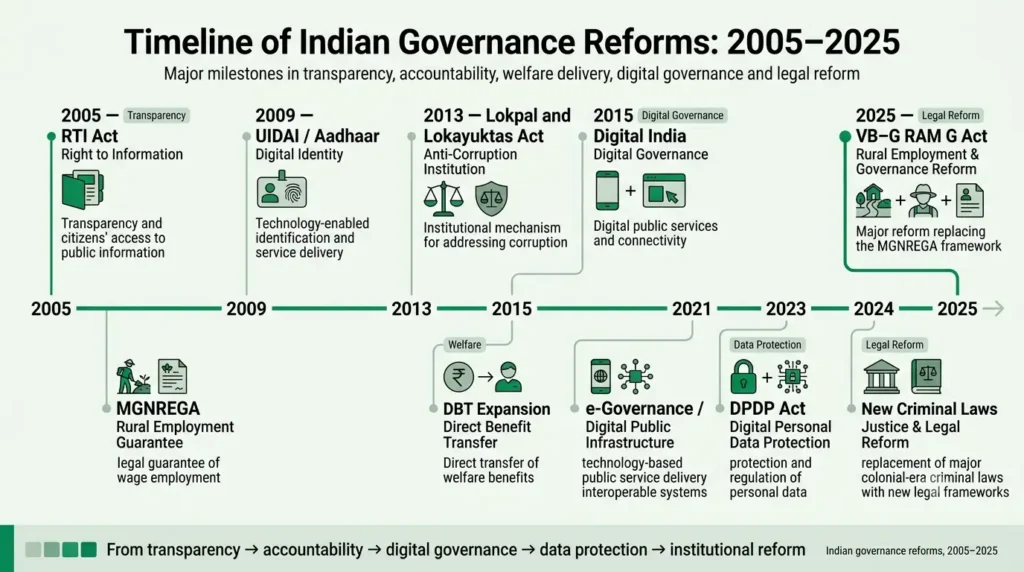
Quick Revision Table: Initiatives and the Governance Dimension They Serve
| Initiative | Year | Main governance dimension |
|---|---|---|
| Right to Information Act | 2005 | Transparency and accountability |
| NREGA, later MGNREGA; now VB-G RAM G Act | 2005; 2025 | Inclusion, livelihood security, social audit |
| Public service guarantee (right-to-service) laws, first in Madhya Pradesh | 2010 onwards | Responsiveness, time-bound delivery |
| Citizen’s Charter | Late 1990s onwards | Responsiveness, citizen participation |
| Companies Act (CSR, Section 135) | 2013; effective 2014 | Role of the market in social development |
| Jan Dhan Yojana | 2014 | Financial inclusion |
| Swachh Bharat Abhiyan | 2014 | Public health, behavioural change |
| Digital India | 2015 | E-governance, digital inclusion |
| GST | 2017 | Cooperative federalism, market integration |
| PM-JAY | 2018 | Equity in healthcare |
These initiatives and reforms reflect India’s ongoing efforts to address various aspects of governance, including transparency, service delivery, financial inclusion, environmental sustainability, and social development. They contribute to building a more efficient, inclusive, and accountable governance framework.
Important Comparisons
| Concept pair | Key difference |
|---|---|
| Government vs governance | Institutions and officeholders vs the wider process of steering society (see the table above) |
| Governance vs good governance | Governance is descriptive and can be good or bad; good governance is normative, measured against criteria such as participation, rule of law and accountability |
| Good governance vs e-governance | Good governance is the goal; e-governance is one tool (use of ICT) to help reach it |
| Corporate vs global vs local governance | Firms and shareholders; issues beyond national borders; community and municipal level |
| Citizen’s Charter vs right-to-service law | A charter is a commitment without a legal remedy; a right-to-service law gives a legal entitlement with penalties and appeals |
Contemporary Relevance
– Welfare delivery: The move from MGNREGA to the VB-G RAM G Act shows governance in action: a change in who pays (Union and states), how work is monitored (digital tools and social audit) and how rights are framed.
– Environment: Questions like air quality or river cleaning need inter-state, judicial, scientific and citizen cooperation.
– Digital state: Online services make government faster for some and harder to reach for others, which is why the digital divide is a governance issue and not only a technology issue.
– Federal bargaining: GST and debates over Centre-State finances show how governance is negotiated across levels.
Conclusion
Government is the formal machinery of the state; governance is the wider process by which a society is steered, in which the state, the market and civil society all play a part. The best answers do three things: define both terms precisely, show with examples why the second is broader than the first, and then test the idea by presenting the criticisms and the scholarly debate. For India, learn the challenges and the reforms side by side, because an examiner will usually expect you to link an initiative such as RTI, GST or Digital India to the dimension of governance it is meant to improve, and to say honestly where its limits lie.
Continue Reading
- Local Governance: the next unit of this paper, covering local government and people’s participation.
- Multiple Perspectives on Governance in Public Administration: good, collaborative, network and digital governance explained in more detail.
- What Is Federalism: background for the Centre-State coordination issues discussed above.
- Organs of Constitutional Governance: Legislature, Executive and Judiciary: the formal institutions that make up “government”.
- BA Political Science Notes (all semesters): full list of Political Science notes.
University of Delhi Previous Year Questions
University of Delhi Previous Year Questions | दिल्ली विश्वविद्यालय पिछले वर्ष के प्रश्न
Section A – Most Repeated Questions | Government, Governance & Good Governance
1. Differentiate between governance and government. Explain the characteristics of good governance as described by the World Bank. +
Unit: Unit I – Government and Governance: Concepts
Suggested Answer Focus: Define government and governance, establish their conceptual differences, and explain the major attributes of good governance associated with the World Bank framework.
Direct PYQ Repeated
2. Differentiate between the concepts of Government and Governance. +
Unit: Unit I – Government and Governance: Concepts
Suggested Answer Focus: Explain government as the formal institutional machinery of the state and governance as a broader process involving multiple actors, institutions and mechanisms of collective decision-making. Conclude with the changing nature of governance in contemporary politics.
Direct PYQ Repeated
3. Discuss the conceptual understanding and attributes of governance and make a comparative analysis of governance and government. +
Unit: Unit I – Government and Governance: Concepts
Suggested Answer Focus: Begin with the meaning of governance, discuss its major attributes, and then compare governance and government in terms of actors, institutional boundaries, decision-making, participation and mechanisms of coordination.
Direct PYQ Repeated
4. How does ‘governance’ differ from government? Illustrate. +
Unit: Unit I – Government and Governance: Concepts
Suggested Answer Focus: Clearly distinguish the institutional concept of government from the wider, process-oriented concept of governance. Use suitable illustrations to show the involvement of state and non-state actors.
Direct PYQ Repeated
Section B – State, Market and Civil Society
5. Discuss the interrelationship between state, market, and civil society in governance. +
Unit: Unit I – State, Market and Civil Society
Suggested Answer Focus: Explain the distinctive role of the state, market and civil society and examine their interaction in contemporary governance. Discuss cooperation, competition and changing boundaries between the three spheres.
Direct PYQ Repeated
6. Explain the interlinkages between state, market and civil society in governance discourse. +
Unit: Unit I – State, Market and Civil Society
Suggested Answer Focus: Define all three concepts and explain their interdependence in governance. Emphasise how governance increasingly involves interaction among public institutions, economic actors and civil-society organisations.
Direct PYQ Repeated
7. Explain the concept of governance while discussing the role of state, market, and civil society in the era of globalization. +
Unit: Unit I – Government and Governance: Concepts
Suggested Answer Focus: Link the concept of governance with globalisation and explain the changing roles of state institutions, market forces and civil-society actors. Discuss why governance cannot be understood only through formal government institutions.
Direct PYQ Repeated
8. Discuss the concept of ‘Good Governance’ and its relation with State, Market and Civil Society. +
Unit: Unit I – Government and Governance: Concepts
Suggested Answer Focus: Define good governance and connect its major characteristics with the roles of the state, market and civil society. Discuss participation, accountability, responsiveness, transparency and institutional effectiveness where relevant.
Direct PYQ Repeated
Section C – Globalisation and the Role of the State
9. Discuss the challenges posed by globalisation to the concept of state sovereignty. +
Unit: Unit I – Role of State in the Era of Globalisation
Suggested Answer Focus: Examine how globalisation affects the autonomy and sovereignty of the state. Discuss the influence of global markets, international institutions and transnational processes while assessing whether globalisation has transformed rather than simply eliminated state power.
Direct PYQ Repeated
10. Give a brief outline of state-market relationship in the era of globalization. +
Unit: Unit I – Role of State in the Era of Globalisation
Suggested Answer Focus: Explain the changing relationship between state institutions and market forces under globalisation, including the changing role of the state and the increasing significance of market mechanisms.
Direct PYQ Repeated
Section D – Short Answer / Internal Assessment Questions
11. Write a short note on the interconnection between development and governance. +
Suggested Answer Focus: Explain how governance affects development outcomes and how development goals require effective, accountable and responsive institutions.
Question Bank Practice
12. How can democratic institutions strengthen good governance? +
Suggested Answer Focus: Discuss participation, representation, accountability, transparency, responsiveness and institutional checks as mechanisms through which democratic institutions can strengthen governance.
Question Bank Practice
13. Should Sustainable Development be the sole responsibility of the state? Argue. +
Suggested Answer Focus: Examine the responsibilities of the state while considering the role of markets, civil society and citizens in achieving sustainable development.
Question Bank Practice
Section E – 2 Marks | Definitions
14. Define free market. +
Paper: PLSGGEC02T – Political Science (GE2)
Suggested Answer Focus: Give a concise definition of a free market and identify the role of market forces in determining economic exchange.
Direct PYQ
15. Define state. +
Paper: PLSGGEC02T – Political Science (GE2)
Suggested Answer Focus: Provide a concise political-science definition of the state and identify its essential institutional and territorial dimensions.
Direct PYQ
16. What do you mean by civil society? +
Paper: PLSGGEC02T – Political Science (GE2)
Suggested Answer Focus: Define civil society as the sphere of voluntary associations and organised social activity located between the state, market and individual/family spheres, as appropriate to the course framework.
Direct PYQ
Section F – Highest-Probability Unit 1 Questions
17. Differentiate between Government and Governance with reference to World Bank / UNDP definitions and explain the significance of good governance. +
Unit: Unit I – Government and Governance: Concepts
Suggested Answer Focus: Prepare government versus governance as the highest-priority conceptual question. Cover definitions, major differences, characteristics of good governance and the role of different actors.
Probable Repeated Theme
18. Explain the interrelationship between State, Market and Civil Society in the era of globalisation. +
Unit: Unit I – State, Market and Civil Society
Suggested Answer Focus: Prepare the three-way relationship as a core Unit I theme. Explain the distinct roles of state, market and civil society and how their interaction shapes contemporary governance under globalisation.
Probable Repeated Theme
19. Discuss the Role of State in the Era of Globalisation. Has globalisation reduced state sovereignty? +
Unit: Unit I – Role of State in the Era of Globalisation
Suggested Answer Focus: Explain the changing role of the state under globalisation and critically examine the claim that globalisation has reduced state sovereignty. Address both constraints on state autonomy and the continuing importance of the state.
Probable Repeated Theme
20. Explain the official examination pattern relevant to Unit I of Governance: Issues and Challenges. +
Paper: BA (H) Political Science GE – Governance: Issues and Challenges
Unique Paper Code: 12325906
Suggested Answer Focus: In the cited official paper (Paper 4487), students were instructed to attempt any four questions, with all questions carrying equal marks. Unit I is commonly represented through an early question, particularly Q1 or Q2. Prepare all three major Unit I themes: Government vs Governance; State, Market and Civil Society; and the Role of State in the Era of Globalisation.
Exam Pattern Answer Focus
FAQs
What is the simplest way to remember the difference between government and governance?
Government is who holds formal power and through which institutions. Governance is how a society is steered, involving the state and many others.
Can there be governance without government?
In theory, writers such as Rosenau and Rhodes explored it, especially in world politics and network settings. Critics such as Pierre and Peters argue the state remains central. For exams, present it as a debate.
Is good governance the same as good government?
No. Good government concentrates on how well the institutions of the state perform. Good governance asks whether the whole process, including non-state actors, meets criteria such as participation, accountability and rule of law.
What are the main characteristics of good governance according to UNESCAP?
Participation, rule of law, transparency, responsiveness, consensus orientation, equity and inclusiveness, effectiveness and efficiency, and accountability.
Which thinkers should I quote in a governance answer?
Rhodes (1996) for the many uses of governance, Stoker (1998) for the five propositions, Rosenau and Czempiel (1992) for governance without government, and, for criticism, Pierre and Peters or Grindle. Quote only what you are sure of and name the work.
Why does the syllabus include the role of the state in the era of globalisation?
Because globalisation is one of the main reasons the concept of governance became popular: no state can handle trade, climate, finance or security alone, so shared governance becomes necessary.
Is there one central Public Service Guarantee Act in India?
No. Right-to-service laws are state laws, beginning with Madhya Pradesh in 2010. A central Bill of 2011 lapsed.
Has MGNREGA been replaced?
The VB-G RAM G Act, 2025 replaces MGNREGA, with a guarantee of at least 125 days. Reports say it came into force on 1 July 2026. Always verify the latest official notification before writing a date in an exam.
How much of the Indian challenges and reforms section should I learn?
Learn the logic first (service delivery, participation, accountability, inequality, federalism), then two or three examples per heading. The tables help you revise quickly.
What is the difference between a Citizen’s Charter and a right-to-service law?
A Citizen’s Charter is a commitment by an agency and is not legally enforceable. A right-to-service law makes timely delivery a legal entitlement, with penalties and appeals.
Why is the digital divide counted as a governance problem?
Because services are increasingly online. If some people cannot access them, a tool meant to include citizens can end up excluding them.
What is the best structure for a 10–15 mark answer on this unit?
A short definition, a table or comparison, one or two theories or thinkers, an Indian example, a criticism, and a conclusion. Avoid only listing points.
Subscribe to keep reading
You've used your free notes for now. Get Delhi Pathshala Premium for unlimited access.
Subscribe — ₹29/30 days