
Contents
- What is Local Governance?
- Concept of Decentralisation
- Evolution of Local Governance in India
- Key Committees on Local Governance
- 73rd Constitutional Amendment Act, 1992 — Panchayati Raj
- Key Features of the 73rd Amendment
- 74th Constitutional Amendment Act, 1993 — Urban Local Bodies
- Key Features of the 74th Amendment
- Democratic Decentralisation: Core Principles
- People’s Participation in Governance
- Challenges in Local Governance
- Rural (PRI) Challenges
- Urban (ULB) Challenges
- Rural vs Urban Local Governance: Comparison
- DU Previous Year Questions
- FAQs
Local governance is the third and closest tier of government to the citizen — it is where roads, water supply, sanitation, and local schools are actually managed. For DU Political Science (GE-2, Unit 4) students, this topic is the foundation for understanding how India practices democratic decentralisation through Panchayati Raj Institutions (PRIs) in rural areas and Urban Local Bodies (ULBs) in cities.
This note covers the constitutional basis, structure, key committees, challenges, and people’s participation — everything needed for both semester exams and conceptual clarity.
<!– IMAGE 1 SPEC BELOW –>
What is Local Governance?
Local governance refers to the system of government that operates at the community level — within a village, town, or city — and is responsible for addressing the immediate needs of residents. In India, local governance operates through two parallel structures:
- Rural: Panchayati Raj Institutions (PRIs) — Gram Panchayat, Panchayat Samiti, Zilla Parishad
- Urban: Urban Local Bodies (ULBs) — Municipal Corporation, Municipal Council, Nagar Panchayat
Both systems derive constitutional status from the 73rd and 74th Constitutional Amendment Acts respectively, making local governance a mandatory, elected third tier of government rather than a mere administrative convenience.
Concept of Decentralisation
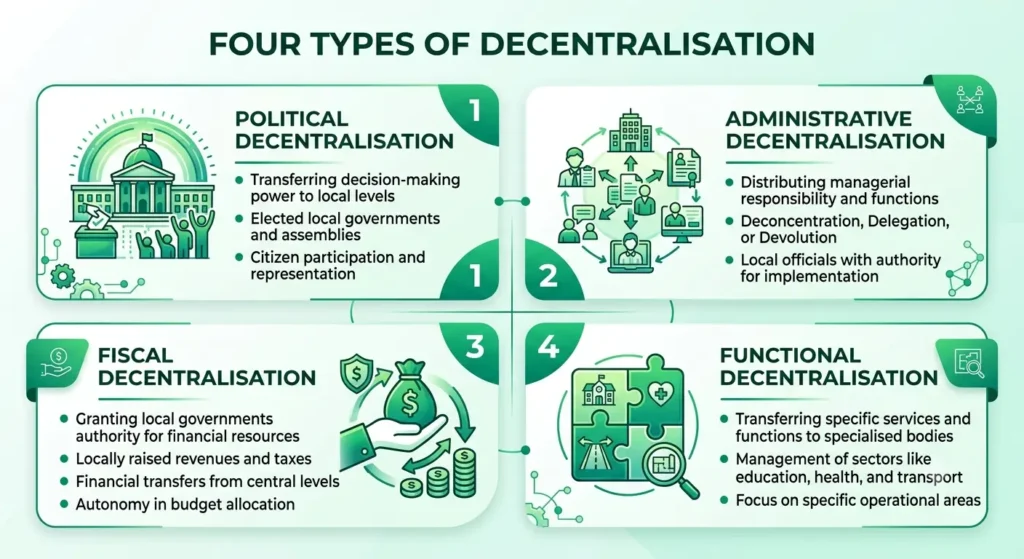
Decentralisation is the transfer of authority, responsibility, and resources from central or state governments to local units. Political theorists distinguish between three forms:
1. Deconcentration: Shifting administrative responsibility to regional field offices, while decision-making authority stays with the central government.
2. Devolution: Granting genuine authority, responsibility, and resources to local governments to formulate and implement their own policies. This is the strongest form of decentralisation and is what India’s 73rd/74th Amendments aim for.
3. Delegation: Transferring management authority for specific functions to semi-autonomous bodies (e.g., parastatal agencies), without full political accountability to local citizens.
Types of decentralisation commonly asked in exams:
- Political Decentralisation — transfer of political power through elections and representative local bodies
- Administrative Decentralisation — delegation of administrative functions to local units
- Fiscal Decentralisation — transfer of financial resources and taxation authority
- Functional Decentralisation — transfer of specific sector-based responsibilities (health, education, sanitation)
Evolution of Local Governance in India
- Ancient India: Evidence of self-governing village assemblies (sabhas) shows local governance has deep historical roots in the subcontinent.
- Colonial Era: The British introduced municipal boards and district boards mainly for administrative control and revenue collection, not democratic participation.
- Post-Independence: Community Development Programme (1952) attempted grassroots development but lacked people’s participation and accountability — this failure directly led to the Balwant Rai Mehta Committee.
Key Committees on Local Governance
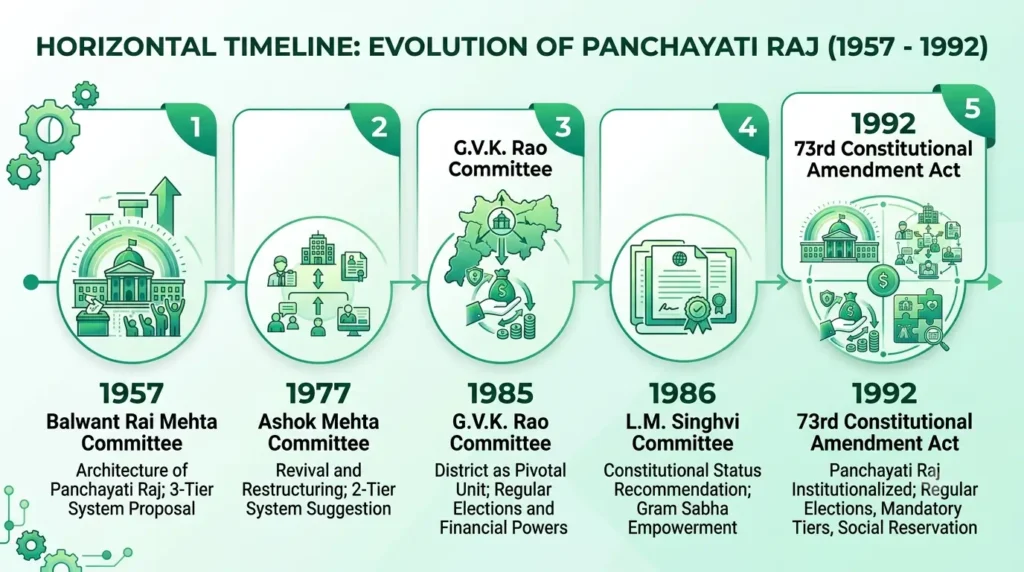
| Committee | Year | Key Recommendation |
|---|---|---|
| Balwant Rai Mehta Committee | 1957 | Recommended a three-tier Panchayati Raj system: Gram Panchayat, Panchayat Samiti, Zilla Parishad |
| Ashok Mehta Committee | 1977–78 | Proposed a two-tier system with greater powers concentrated at the Mandal/District level |
| G.V.K. Rao Committee | 1985 | Called Panchayati Raj institutions “grass without roots”; emphasised Zilla Parishad as the pivotal body |
| L.M. Singhvi Committee | 1986 | First to recommend constitutional status for PRIs, and creation of Gram Sabhas as the foundation of democracy |
These committee recommendations, especially Singhvi’s, directly paved the way for the 73rd and 74th Amendment Acts in 1992–93.
73rd Constitutional Amendment Act, 1992 — Panchayati Raj
The 73rd Amendment gave constitutional status to rural local self-government, adding Part IX and the Eleventh Schedule (29 subjects) to the Constitution.
Key Features of the 73rd Amendment
- Three-tier structure: Gram Panchayat (village) → Panchayat Samiti (block) → Zilla Parishad (district)
- Gram Sabha: Mandatory village assembly of all registered voters — the foundation of direct democracy at the grassroots
- Reservation: Seats reserved for SCs, STs (in proportion to population), and not less than one-third for women, including chairperson posts
- Regular elections: Every 5 years, conducted by an independent State Election Commission
- State Finance Commission: Reviews financial position of Panchayats every 5 years
- Devolution of 29 subjects listed in the Eleventh Schedule, including agriculture, education, health, and rural housing
74th Constitutional Amendment Act, 1993 — Urban Local Bodies
The 74th Amendment gave constitutional recognition to urban local self-government, adding Part IX-A and the Twelfth Schedule (18 subjects).
Key Features of the 74th Amendment
- Three types of ULBs based on population and urbanisation:
- Municipal Corporation — large urban areas
- Municipal Council — smaller urban areas
- Nagar Panchayat — transitional areas (rural-to-urban)
- Wards Committees: Mandatory in cities with population above 3 lakh, for citizen-level participation
- Reservation: Same pattern as PRIs — SC/ST proportional, one-third for women
- Functions: 18 subjects under the Twelfth Schedule, including urban planning, water supply, slum improvement, and fire services
Democratic Decentralisation: Core Principles
Democratic decentralisation combines devolution (real transfer of authority) with democracy (elected, accountable local bodies). Its core components:
1. Devolution of Powers — political authority transferred to elected local representatives; administrative powers delegated to implement schemes such as those linked to New Public Management and New Public Service.
2. Financial Decentralisation — local revenue generation (property tax, local cess) combined with intergovernmental transfers from state/central governments via Finance Commissions.
3. Accountability & Transparency — local audits, Gram Sabha oversight, and the Right to Information (RTI) Act strengthen citizen oversight of local bodies.
4. Capacity Building — training programmes for elected local representatives, especially newly-elected women and first-time PRI members.
People’s Participation in Governance
People’s participation is the active involvement of citizens in decisions that affect their lives, and is considered essential to both democracy and effective local governance.
Key mechanisms:
- Gram Sabha meetings and Ward Committee consultations — direct citizen input
- Right to Information (RTI): Statutory right to access government records, strengthening transparency
- Participatory budgeting: Citizens directly influence how local funds are allocated (piloted in cities like Pune and Bengaluru)
- Civil Society Organisations (CSOs) and CBOs: NGOs and community groups acting as intermediaries between citizens and the state — relevant also to broader debates on obligations of the state and duties of citizens
- E-Governance: Digital platforms (e.g., e-Panchayat, Swachh Bharat Mission dashboards) enabling remote citizen interaction with local bodies
Challenges in Local Governance
Rural (PRI) Challenges
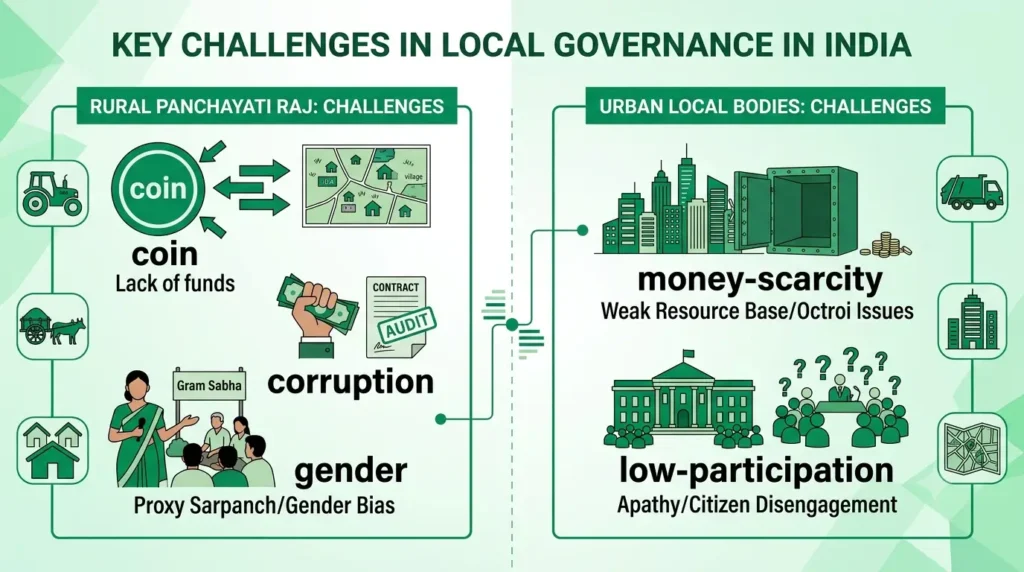
- Over-politicisation hindering effective, consensus-based decision-making
- Centralising tendency — state governments often retain control over key functions and funds meant for Panchayats
- Gender and caste barriers — women and marginalised groups elected on paper (sarpanch pati phenomenon) but denied real decision-making power
- Financial constraints — limited own-revenue sources, heavy dependence on state transfers
- Corruption — undermines the effectiveness and public trust in PRIs
Urban (ULB) Challenges
- Financial scarcity limiting service delivery capacity
- Limited citizen participation — Ward Committees often exist only on paper
- State control — ULBs frequently lack real autonomy from state governments
- Functional overlap — unclear division of responsibility between ULBs, state parastatals, and central schemes
Rural vs Urban Local Governance: Comparison
| Feature | Rural (PRI) | Urban (ULB) |
|---|---|---|
| Constitutional Basis | 73rd Amendment, 1992 | 74th Amendment, 1993 |
| Constitution Part | Part IX | Part IX-A |
| Schedule | Eleventh Schedule (29 subjects) | Twelfth Schedule (18 subjects) |
| Structure | Gram Panchayat → Panchayat Samiti → Zilla Parishad | Nagar Panchayat / Municipal Council / Municipal Corporation |
| Grassroots Unit | Gram Sabha | Ward Committee |
| Key Challenge | Centralising tendency, gender barriers | Financial scarcity, low participation |
DU Previous Year Questions
Q1. Discuss the main provisions of the 73rd Constitutional Amendment Act. (GE-2, frequently repeated)
Focus on Part IX, Eleventh Schedule, three-tier structure, Gram Sabha, and reservation provisions.
Q2. What is democratic decentralisation? Discuss its significance in the Indian context.
Link devolution + democracy; cite Panchayati Raj as the applied example.
Q3. Examine the role of Gram Sabha in strengthening grassroots democracy.
Emphasise direct democracy angle and RTI/social audit linkage.
Q4. Critically analyse the challenges faced by Panchayati Raj Institutions in India.
Use the challenges section above — over-politicisation, financial dependence, gender barriers.
Q5. Compare the 73rd and 74th Constitutional Amendment Acts.
Use the comparison table above directly.
FAQs
When was the 73rd Constitutional Amendment Act passed?
A: It was passed in 1992 and came into force on 24 April 1993, giving constitutional status to Panchayati Raj Institutions.
How many tiers does the Panchayati Raj system have?
A: Three tiers — Gram Panchayat (village), Panchayat Samiti (block), and Zilla Parishad (district).
What is the difference between local governance and local self-government?
A: Local governance is the broader system of managing local affairs (which can include appointed officials), while local self-government specifically refers to elected, constitutionally-empowered bodies like PRIs and ULBs.
Which committee first recommended constitutional status for Panchayati Raj?
A: The L.M. Singhvi Committee (1986) first recommended constitutional recognition, which was later implemented through the 73rd Amendment in 1992.
What percentage of seats are reserved for women in PRIs and ULBs?
A: Not less than one-third (33%) of total seats, including chairperson positions, are reserved for women, in addition to SC/ST reservations proportional to population.
What subjects are covered under the Eleventh and Twelfth Schedules?
A: The Eleventh Schedule (73rd Amendment) covers 29 subjects like agriculture and rural health for Panchayats; the Twelfth Schedule (74th Amendment) covers 18 subjects like urban planning and water supply for ULBs.
Related notes: Obligations of State and Duties of Citizens (GE-2, Unit 4), Good Governance Initiatives in India (DSC-1, Unit 5), New Public Management vs New Public Service
External references: 73rd & 74th Amendment Acts — PRS Legislative Research, Ministry of Panchayati Raj, Government of India
Subscribe to keep reading
You've used your free notes for now. Get Delhi Pathshala Premium for unlimited access.
Subscribe — ₹29/30 days