
Contents
- Quick Summary (TL;DR)
- What is Equality of Opportunity
- What is Equality of Outcome
- Difference Between Equality of Opportunity and Equality of Outcome
- Theoretical Foundations
- Philosophical Theories Supporting Equality of Opportunity
- Philosophical Theories Supporting Equality of Outcome
- Influential Thinkers
- Practical Implications
- Implementing Equality of Opportunity
- Challenges in Achieving Equality of Outcome
- Case Studies
- Critiques and Debates
- Critiques of Equality of Opportunity
- Critiques of Equality of Outcome
- Ongoing Debates
- Conclusion
- Previous Year & Likely Exam Questions (DSC-7, Unit 2a)
- Frequently Asked Questions (FAQs)
- Further Reading (External)
- Continue Reading (Internal)
These notes cover Unit 2(a): Equality — Equality of Opportunity and Equality of Outcome, from DSC – 7: Political Theory: Concepts and Debates. Continue with Unit 2(b) here: Egalitarianism: Background Inequalities and Differential Treatment.
Quick Summary (TL;DR)
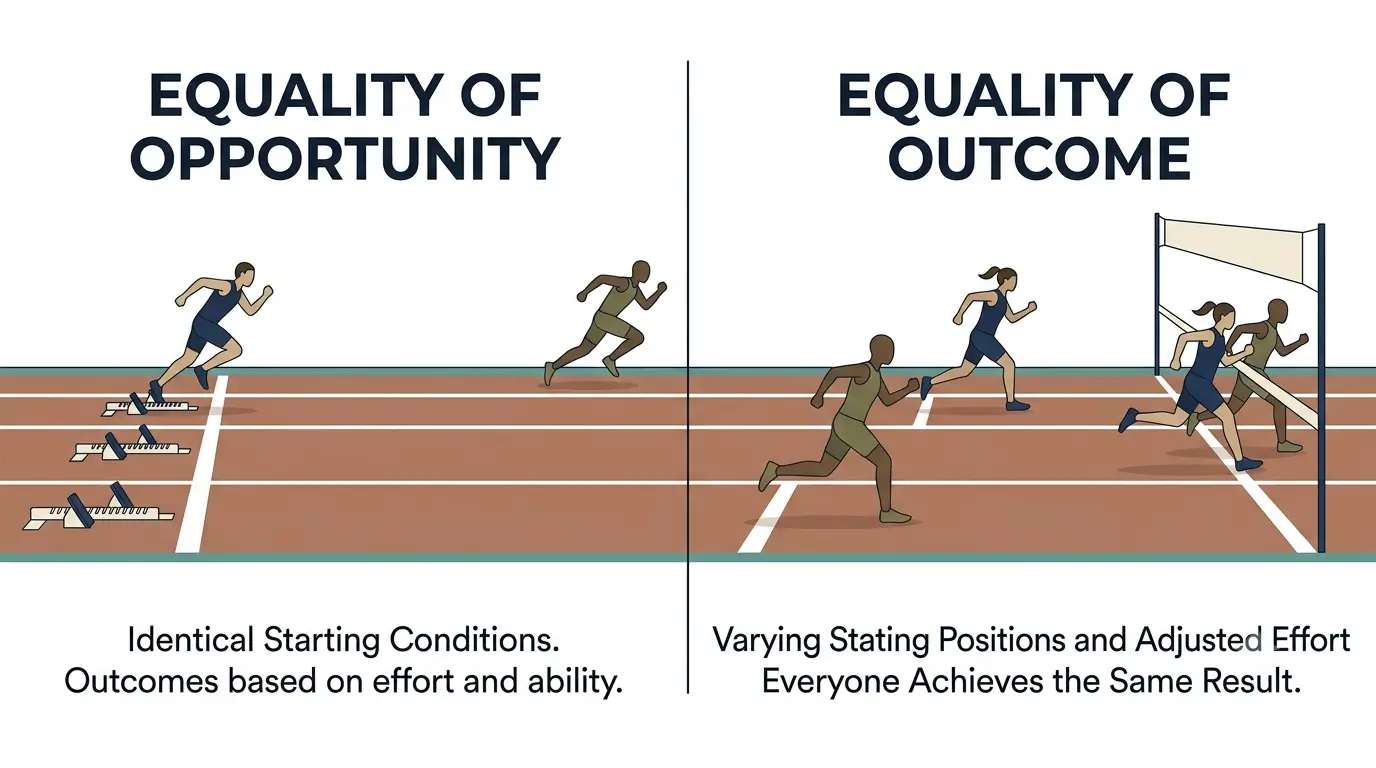
Equality of opportunity means everyone gets the same fair starting point and chance to compete — success then depends on effort, skill, and choice. Equality of outcome means society actively works to reduce the gap in final results — income, education, health — even if people started differently. In short: opportunity equality is about a fair race; outcome equality is about a fair finish.
What is Equality of Opportunity
Equality of opportunity means everyone should start in the same place in life and have the same chances to succeed, no matter their background, race, gender, or social class. It supports the idea that people should be able to pursue their goals without facing unfair barriers.
It promotes fair competition, where success depends on a person’s skills, effort, and choices — not on inherited advantage.
What is Equality of Outcome
Equality of outcome is about ensuring that people end up in a broadly similar economic or social position. The goal is to narrow gaps in wealth, health, and education so that no one is held back by circumstances beyond their control.
It aims for a fairer distribution of resources and results — often through wealth redistribution, social support schemes, or targeted policy interventions. For more on how this connects to background disadvantage, see Egalitarianism: Background Inequalities and Differential Treatment.
Difference Between Equality of Opportunity and Equality of Outcome
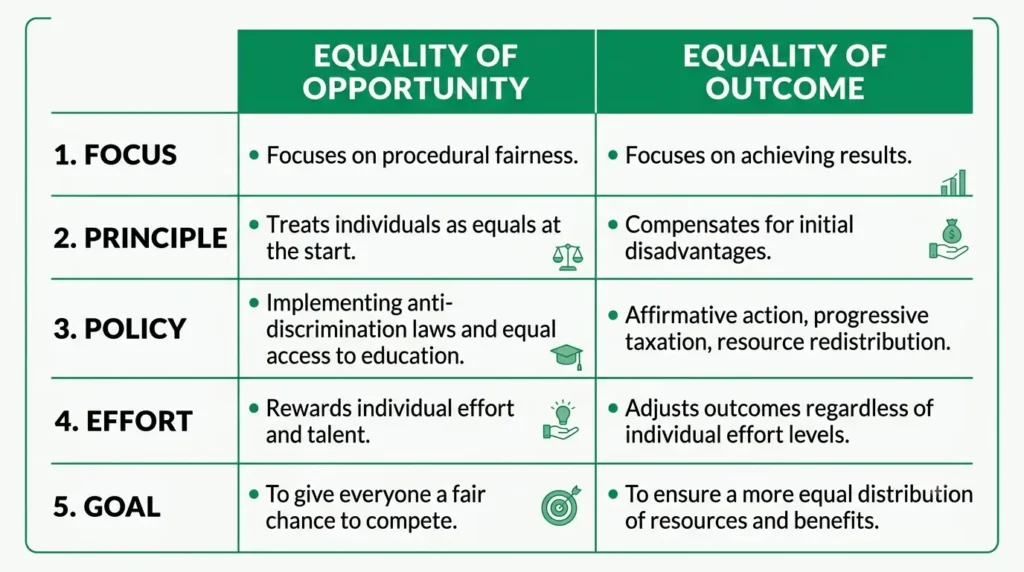
| Aspect | Equality of Opportunity | Equality of Outcome |
|---|---|---|
| Focus | Same chances and starting point for everyone | Similar end results, like income or education |
| Principle | Fairness in how people compete, based on skills and effort | Fairness in results, reducing gaps in living conditions or wealth |
| Policy Implications | Access to education and jobs — not guaranteed results | Redistribution of wealth or resources to equalise results |
| View on Individual Effort | Outcome differences reflect individual choice and ability; rewards merit | Outcomes are shaped by class, race, and social structure; needs systemic change |
| Goal | A fair environment for competition | Reducing disparities in final positions through resource equalisation |
In short: equality of opportunity is about giving everyone the same chances, while equality of outcome is about making sure everyone ends up with broadly similar results.
Theoretical Foundations
Philosophical Theories Supporting Equality of Opportunity
1. Liberal Egalitarianism This view holds that everyone should have the same chances in life regardless of background, while still valuing personal freedom and fair competition. John Rawls is its most influential voice — in A Theory of Justice, he argues a fair society must give everyone an equal chance to pursue their goals.
2. Rawls’ Fair Equality of Opportunity Rawls holds that differences in wealth or status are acceptable only if they benefit those who are worse off (the Difference Principle). Outcomes may differ, but everyone must start from a genuinely equal position — not merely a formally equal one. Read the full breakdown in our John Rawls’ Theory of Justice notes.
3. Meritocracy Meritocracy holds that people should succeed based on ability rather than wealth or family background. Critics such as Michael Young argue this ignores the fact that people don’t start on equal footing because of pre-existing social inequalities — a point worth remembering for exam critique-based questions.
Philosophical Theories Supporting Equality of Outcome
1. Utilitarianism (Redistribution for Maximum Welfare) Thinkers like John Stuart Mill argue policy should maximise overall happiness, which can justify redistributing wealth. Some inequality may be acceptable if it benefits most people, but extreme inequality is treated as harmful.
2. Socialism and Communism Karl Marx envisioned a classless society where wealth is shared according to need, not inherited advantage. Socialists argue government intervention is necessary to reduce economic gaps in access to housing, healthcare, and education.
3. Amartya Sen — Capability Approach Amartya Sen shifts the focus from resources to capabilities — what people can actually do and become with what they have. Equality, for Sen, means removing the barriers that stop people from living a life they have reason to value.
Influential Thinkers
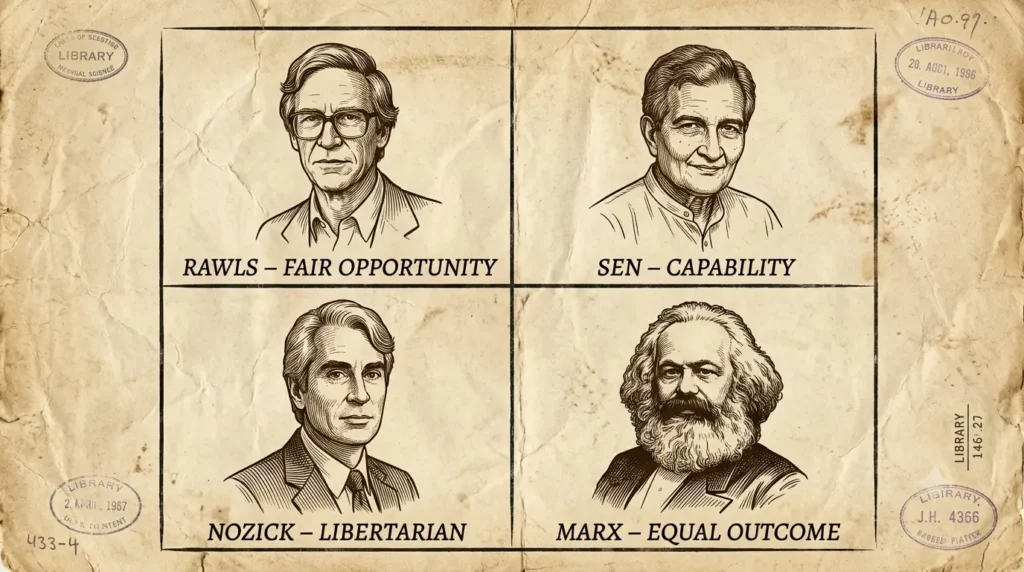
John Rawls (1921–2002) — Central to debates on equality of opportunity; argues justice is fairness, and that everyone deserves equal chances through education and social support. (Full notes: John Rawls’ Theory of Justice)
Amartya Sen (1933–present) — His capability approach reframes inequality around what people can actually achieve, not just what resources or outcomes they’re handed; his work has directly shaped Indian and global poverty-reduction policy.
Robert Nozick (1938–2002) — A libertarian critic of redistribution; argues the state’s role is to protect rights, not engineer outcomes.
Karl Marx (1818–1883) — Foundational to socialist and communist thought on equal outcomes; critiques capitalism as structurally unequal and calls for shared ownership of resources.
Practical Implications
Implementing Equality of Opportunity
a) Education and Access to Quality Schools — Public education systems and affirmative-action admissions try to level the playing field for historically disadvantaged groups.
b) Healthcare Access — Universal healthcare (the NHS in the UK, the Affordable Care Act in the US) tries to ensure health doesn’t determine who can compete fairly.
c) Anti-Discrimination Laws — Equal pay laws and bodies like the US Equal Employment Opportunity Commission (EEOC) aim to ensure people are judged on skill, not identity.
d) Social Mobility Programmes — Scholarships, skill training, and early-childhood programmes (e.g., the US Head Start Program) try to break the poverty cycle at the source.
e) The Indian Context — India’s approach blends both ideals: the Right to Education (RTE) Act, 2009 pursues equality of opportunity by guaranteeing free schooling, while reservation policy under Articles 15(4) and 16(4) leans toward equality of outcome by directly correcting historical caste- and community-based disadvantage. This dual approach is a favourite exam angle — expect questions asking you to place Indian policy within this opportunity–outcome framework.
Challenges in Achieving Equality of Outcome
- Resistance to redistribution — wealthier groups often oppose taxation aimed at funding welfare programmes.
- Structural inequality — long-standing gaps in wealth, race, or region make equal outcomes hard to reach even with policy support.
- Cultural and social barriers — informal norms (e.g., gender pay gaps) persist even where formal laws promote equality.
- Unintended consequences — critics argue schemes like Universal Basic Income (UBI) may reduce the incentive to work.
- Measurement problems — should “equal outcome” be measured by income, health, education, or happiness? Different metrics yield different conclusions.
Case Studies
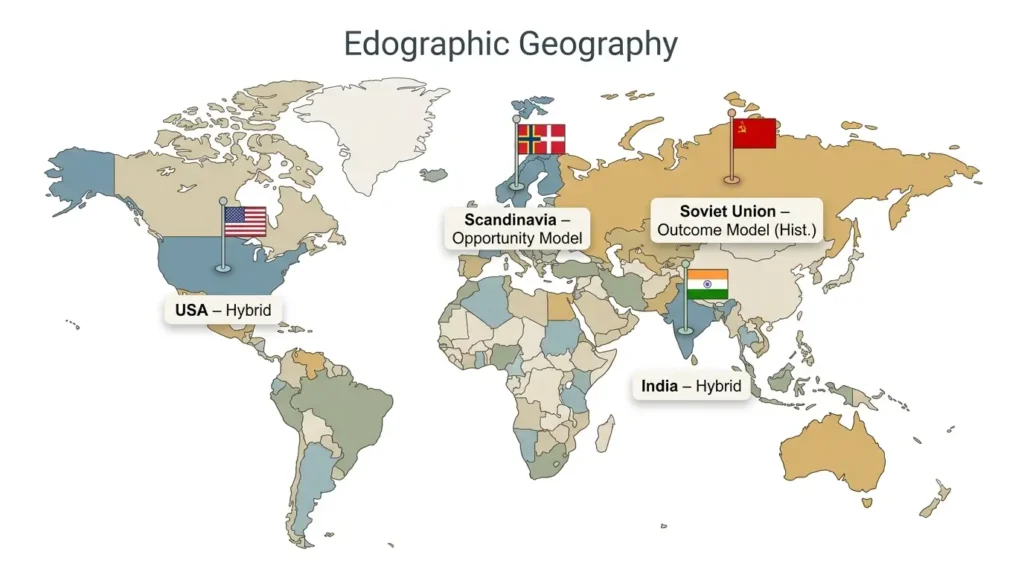
1. Equality of Opportunity — The Scandinavian Model Norway, Sweden, Denmark, and Finland prioritise universal access to education and healthcare alongside strong anti-discrimination protections. They rank high on social mobility, though income inequality hasn’t disappeared entirely.
2. Equality of Outcome — The Soviet Union (1917–1991) Central planning and wealth redistribution reduced extreme poverty and raised literacy, but came at the cost of personal freedoms, innovation, and — eventually — economic efficiency.
3. Hybrid Approach — India India constitutionally guarantees formal equality (Article 14) alongside outcome-oriented tools like reservation and targeted welfare schemes (e.g., MGNREGA). This makes India a useful real-world example of a state actively balancing both models — more relevant for DU answers than the often-cited US/Scandinavia pair alone.
4. Hybrid Approach — United States The US emphasises equality of opportunity through anti-discrimination law and education access, but does comparatively less on equality of outcome — leaving significant racial and economic gaps in place.
Critiques and Debates
Critiques of Equality of Opportunity
- Unequal starting points — background and class advantage undercut the fairness of the “race” before it even begins.
- The myth of meritocracy — hard work alone doesn’t explain success when private schooling and connections give some a head start.
- Structural barriers — discrimination in hiring or admissions persists even where formal equality exists on paper.
Critiques of Equality of Outcome
- Incentive and productivity concerns — critics argue equal results reduce the motivation to work hard or innovate.
- Cost of redistribution — heavy taxation to fund equalisation can discourage investment.
- Risk of state overreach — pursuing equal outcomes can require the state to intervene deeply in economic and personal life, as seen in the Soviet case above.
Ongoing Debates
Most contemporary political theorists — including Rawls himself — argue a just society needs both: equal starting chances and a safety net that limits how far outcomes can diverge. The Nordic welfare-state model is often cited as this middle path. For a deeper look at how “fairness” is theorised more broadly, see our notes on Justice: Procedural and Substantive Justice (DSC-7, Unit 3).
Conclusion
Equality of opportunity and equality of outcome answer the same underlying question — what does a fair society owe its members — in two different ways. Opportunity-based equality focuses on removing barriers before the competition begins; outcome-based equality focuses on correcting imbalances after it ends. Real-world systems, including India’s own constitutional framework, rarely pick one exclusively — they combine elements of both, and understanding that blend is exactly what DU exam answers on this topic should demonstrate.
Previous Year & Likely Exam Questions (DSC-7, Unit 2a)
- Distinguish between equality of opportunity and equality of outcome with suitable examples. (Long answer, 10 marks)
- “Equality of opportunity is meaningless without equality of outcome.” Critically examine this statement. (Long answer, 10 marks)
- Explain Rawls’ concept of “fair equality of opportunity” and the Difference Principle. (Medium, 5–6 marks)
- What are the main critiques of meritocracy as a basis for equality of opportunity? (Short answer, 5 marks)
- How does Amartya Sen’s capability approach differ from a purely resource-based or outcome-based view of equality? (Medium, 5–6 marks)
- Discuss any two case studies that illustrate equality of opportunity and equality of outcome in practice. (Long answer, 10 marks)
Frequently Asked Questions (FAQs)
What is the main difference between equality of opportunity and equality of outcome?
Equality of opportunity ensures everyone has a fair starting point and chance to compete; equality of outcome ensures people end up with broadly similar results, regardless of where they started.
Is equality of opportunity better than equality of outcome?
Neither is inherently “better” — they solve different problems. Most modern welfare states, including the Nordic model, combine elements of both rather than choosing one exclusively.
What did John Rawls say about equality?
Rawls argued for “fair equality of opportunity” combined with the Difference Principle — inequalities are acceptable only if they benefit society’s least advantaged members.
What is the difference between equality and equity?
Equality means treating everyone the same; equity means giving people what they specifically need to reach a similar outcome — equity is closely linked to the idea of equality of outcome.
How is equality of outcome relevant to India’s reservation policy?
India’s reservation system is a real-world example of equality-of-outcome thinking — it corrects historical, structural disadvantage directly, rather than relying only on formally equal access.
Which DU paper does this topic come under?
This topic is covered under DSC-7: Political Theory: Concepts and Debates, Unit 2(a) – Equality, for B.A. (Hons.) Political Science, Semester 3, University of Delhi.
Further Reading (External)
- Equality of Opportunity — Stanford Encyclopedia-linked overview, EDEQ Stanford
- Equality of Outcome — Wikipedia
- Amartya Sen — Wikipedia
Continue Reading (Internal)
Subscribe to keep reading
You've used your free notes for now. Get Delhi Pathshala Premium for unlimited access.
Subscribe — ₹29/30 days