
Contents
- Quick Facts
- Background of the Poem
- Composition and publication history
- Where does the title come from?
- Historical and personal context
- Full Text of the Poem
- The Hollow Men Summary
- The two epigraphs
- Part I: the hollow men introduce themselves
- Part II: the eyes they cannot face
- Part III: the dead land
- Part IV: the meeting place
- Part V: the breakdown
- Part-wise revision table
- Themes in The Hollow Men
- Spiritual emptiness
- Failure of communication
- Paralysis: the gap between idea and act
- Fear of judgement and of a “final meeting”
- Fragmented modern life
- Failed ritual and false worship
- A glimmer of hope
- Symbols and Imagery
- Literary Devices
- Structure, Form and Language
- Sources and Allusions
- Important Comparisons
- Three kingdoms of death
- Prufrock, The Hollow Men and The Waste Land
- Bang and whimper: Yeats and Eliot
- Critical Perspectives
- Modernist elements
- Reception and impact
- The debate: what is the poem about?
- Contemporary Relevance
- Key Lines to Remember
- Conclusion
- Continue Reading
- University of Delhi Previous Year Questions
- Frequently Asked Questions
These are notes on Unit 1A (ii): The Hollow Men by T.S. Eliot, from DSC-13: Twentieth Century Poetry & Drama, B.A. (Hons.) English, Semester 5, University of Delhi. The Department of English syllabus lists Eliot’s The Love Song of J. Alfred Prufrock and The Hollow Men together in Unit I, so it makes sense to read the two poems side by side.
The Hollow Men is a five-part free-verse poem, first published as a complete poem on 23 November 1925 in Eliot’s Poems 1909–1925. Its speakers are “stuffed” scarecrow-like figures who stand in a dry, dead landscape between life and death. They cannot speak with meaning, cannot pray, and cannot act. The poem is best known for its last four lines, which say the world ends “not with a bang but a whimper”.
Quick Facts
| Point | Detail |
|---|---|
| Poet | T.S. Eliot (1888–1965) |
| Form | Free verse in five numbered parts, about 98 lines (the count differs slightly between editions) |
| Complete poem first published | 23 November 1925, in Poems 1909–1925 (Faber & Gwyer, the firm later known as Faber & Faber) |
| Earlier appearances | Parts I–IV appeared in The Chapbook, Commerce, The Criterion and The Dial in 1924–25 |
| Epigraphs | A line from Conrad’s Heart of Darkness (Kurtz’s death) and the Guy Fawkes Night cry “A penny for the Old Guy” |
| Comes after | The Waste Land (1922) |
| Followed by | Eliot’s baptism into the Church of England (June 1927) and Ash-Wednesday (1930) |
| Voice | A collective “we”, with a single “I” in Part II |
| Famous ending | “This is the way the world ends / Not with a bang but a whimper” |
Background of the Poem
Composition and publication history
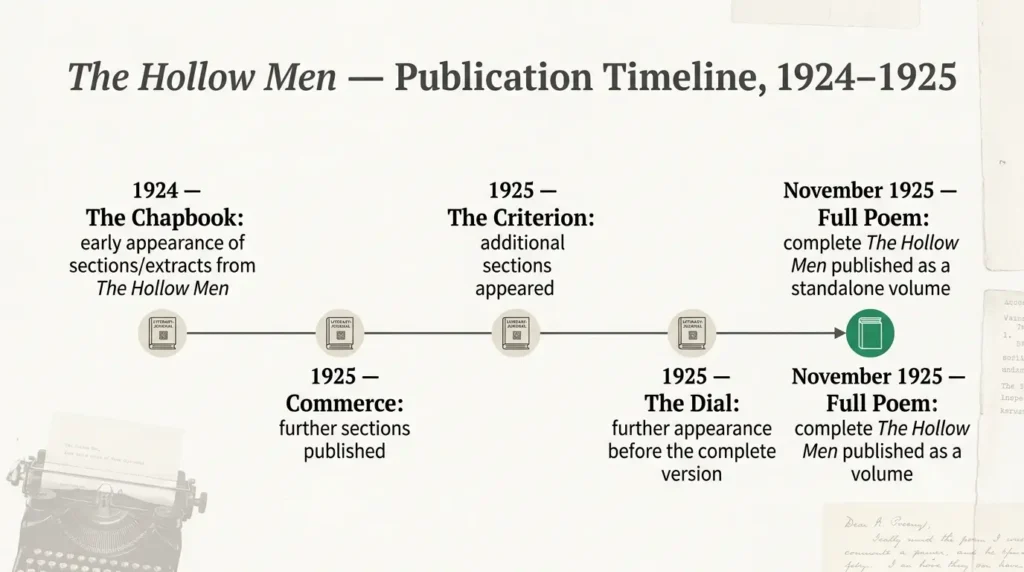
Most students think The Hollow Men was written in one go in 1925. It wasn’t. Eliot built it up in stages out of separate poems. In an interview he said it grew out of separate poems that he later saw could be “focused together” into a whole (quoted by Kermode and Hollander, via the Academy of American Poets). The T. S. Eliot Foundation’s centenary article traces the stages:
| When | Where | What appeared |
|---|---|---|
| November 1924 | The Chapbook (Harold Monro) | “Doris’s Dream Songs”, three short poems. One of them became Part III (“This is the dead land”) |
| Late 1924 | Commerce (a French journal) | The text that became Part I |
| January 1925 | The Criterion (edited by Eliot) | “Three Poems”, including the pieces that became Part II and Part IV |
| March 1925 | The Dial (New York) | “The Hollow Men I–III”, which correspond to the final Parts I, II and IV |
| 23 November 1925 | Poems 1909–1925 | The finished five-part poem, with Part V newly added and the earlier parts revised |
Eliot told the editor of The Dial in January 1925 that at least one more poem in the series was still unwritten. That tells us he was already thinking of a sequence, even though the final shape came later.
Exam point: The “fragments joined into a whole” method is typically modernist. It also explains why the poem feels like a chain of scenes rather than a story. Ash-Wednesday was composed in the same way.
Where does the title come from?
Eliot’s own explanation is that he combined the title of William Morris’s romance The Hollow Land with Rudyard Kipling’s poem “The Broken Men”. The Eliot Foundation reports that Eliot noted these two sources on a draft of Part III, and a letter of 1935 to the Times Literary Supplement is the usual citation for the same claim.
Some critics suggest a further link. In Conrad’s Heart of Darkness, Marlow describes Kurtz as “hollow at the core”, and Kurtz appears in the first epigraph. Eliot’s own account and the Conrad connection do not contradict each other, but you should treat the Conrad link as a critical suggestion, not as something Eliot stated.
Historical and personal context
The poem comes out of the post-First World War world of The Waste Land (1922): a Europe disillusioned with its old certainties. Eliot had recovered from a “nervous breakdown” in 1921 and was by 1925 editing The Criterion and joining the board of the publishers Faber & Gwyer. He was not yet a member of the Church of England; that came in June 1927, only two years after the poem. Many readers therefore see The Hollow Men as a poem written on the edge of belief. For the competing readings (war, marriage, religion), see the section on critical perspectives below.
Full Text of the Poem
Mistah Kurtz-he dead
A penny for the Old GuyI
We are the hollow men
We are the stuffed men
Leaning together
Headpiece filled with straw. Alas!
Our dried voices, when
We whisper together
Are quiet and meaningless
As wind in dry grass
Or rats’ feet over broken glass
In our dry cellar
Shape without form, shade without colour,
Paralysed force, gesture without motion;
Those who have crossed
With direct eyes, to death’s other Kingdom
Remember us-if at all-not as lost
Violent souls, but only
As the hollow men
The stuffed men.II
Eyes I dare not meet in dreams
In death’s dream kingdom
These do not appear:
There, the eyes are
Sunlight on a broken column
There, is a tree swinging
And voices are
In the wind’s singing
More distant and more solemn
Than a fading star.
Let me be no nearer
In death’s dream kingdom
Let me also wear
Such deliberate disguises
Rat’s coat, crowskin, crossed staves
In a field
Behaving as the wind behaves
No nearer-
Not that final meeting
In the twilight kingdomIII
This is the dead land
This is cactus land
Here the stone images
Are raised, here they receive
The supplication of a dead man’s hand
Under the twinkle of a fading star.
Is it like this
In death’s other kingdom
Waking alone
At the hour when we are
Trembling with tenderness
Lips that would kiss
Form prayers to broken stone.IV
The eyes are not here
There are no eyes here
In this valley of dying stars
In this hollow valley
This broken jaw of our lost kingdoms
In this last of meeting places
We grope together
And avoid speech
Gathered on this beach of the tumid river
Sightless, unless
The eyes reappear
As the perpetual star
Multifoliate rose
Of death’s twilight kingdom
The hope only
Of empty men.V
Here we go round the prickly pear
Prickly pear prickly pear
Here we go round the prickly pear
At five o’clock in the morning.
Between the idea
And the reality
Between the motion
And the act
Falls the Shadow
For Thine is the Kingdom
Between the conception
And the creation
Between the emotion
And the response
Falls the Shadow
Life is very long
Between the desire
And the spasm
Between the potency
And the existence
Between the essence
And the descent
Falls the Shadow
For Thine is the Kingdom
For Thine is
Life is
For Thine is the
This is the way the world ends
This is the way the world ends
This is the way the world ends
Not with a bang but a whimper.
(Source: All Poetry – The Hollow Men)
The Hollow Men Summary
The Hollow Men is a poem about people who have lost spiritual and moral purpose, and who know it. The speakers call themselves “hollow” and “stuffed”, like scarecrows or the straw effigy of Guy Fawkes. They live in a landscape of dry cellars, cactus and broken stone, and they exist in a kind of waiting-room between life and death. They fear the “direct eyes” of those who have faced death with conviction. They cannot pray properly, and in the final part even the Lord’s Prayer breaks off mid-line. The world, the poem predicts, will end quietly.
The poem is usually divided into five parts. Eliot used Roman numerals; many guides call them “sections” or “cantos”.
The two epigraphs
The poem opens with two borrowed lines.
- “Mistah Kurtz—he dead” is a line about the death of Kurtz, the ivory-station agent in Joseph Conrad’s Heart of Darkness (published in Blackwood’s Magazine in 1899 and as a book in 1902). Kurtz is a complicated figure. Marlow calls him “hollow at the core”, yet also credits his dying cry with a kind of conviction. That double status matters here: Kurtz is hollow, but he is more committed than the hollow men of the poem.
- “A penny for the Old Guy” is what English children say on 5 November, Guy Fawkes Night, when they carry a straw-stuffed effigy and ask for pennies. Guy Fawkes was involved in the Gunpowder Plot of 1605, an attempt to blow up Parliament. The effigy is stuffed with straw (compare “headpiece filled with straw”) and the plot was a violent act, a “bang” that failed. Eliot, writing to a schoolmaster who asked about the poem, noted that “Guy” is the English, not the American, sense of the word.
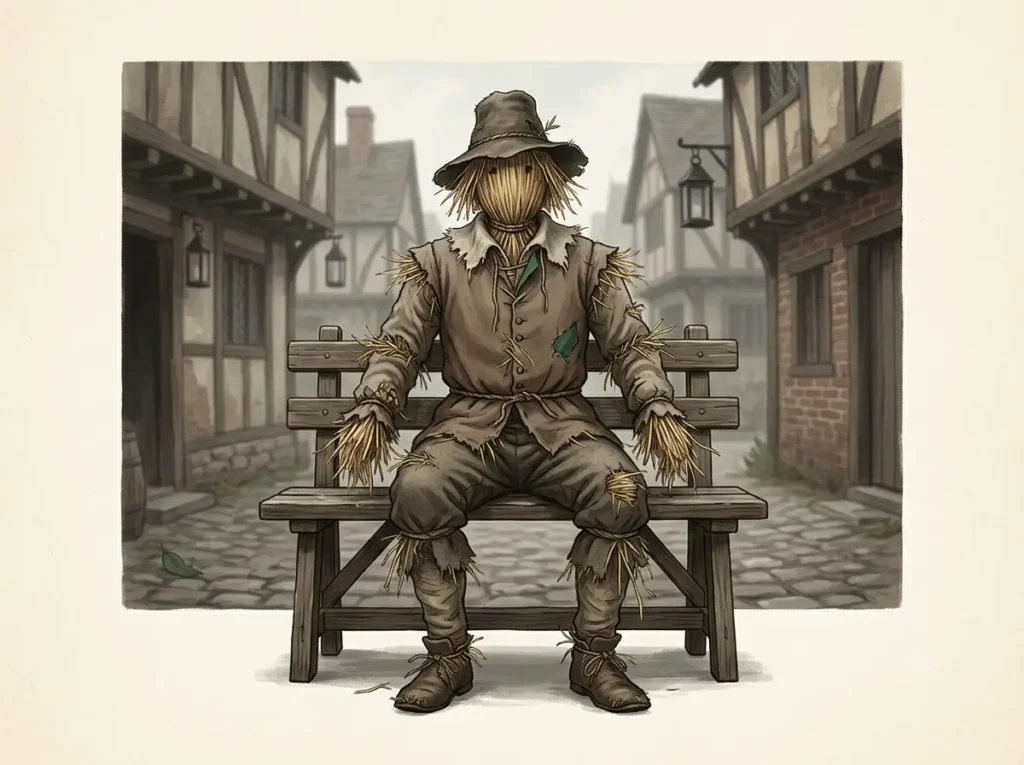
Note that most printed texts carry both epigraphs, but some online reproductions (for example the Academy of American Poets page) print only the second.
Part I: the hollow men introduce themselves
The speakers name themselves “the hollow men” and “the stuffed men”, leaning on one another with straw in their heads. Their dried voices, when they whisper together, are as quiet and meaningless as wind in dry grass or rats’ feet over broken glass in a dry cellar. They are “shape without form, shade without colour”, “paralysed force”, “gesture without motion”: outlines of life with nothing inside. The part ends by contrasting them with those who “have crossed with direct eyes” to “death’s other Kingdom”. Those people, if they remember the hollow men at all, remember them “not as lost violent souls”, but only as hollow, stuffed men. In other words, even the damned of the violent kind would at least have been something.
Part II: the eyes they cannot face
A speaker confesses that there are eyes he “dare not meet in dreams”. In “death’s dream kingdom” these eyes do not appear. In that kingdom the eyes are replaced by softer images: sunlight on a broken column, a swinging tree, voices in the wind’s singing, more distant and solemn than a fading star. He asks not to be brought any nearer. Instead he wants to wear “deliberate disguises”: a rat’s coat, crowskin, crossed staves in a field, which are the standard equipment of a scarecrow. He wants to “behave as the wind behaves”, and he shrinks from “that final meeting in the twilight kingdom”.
Part III: the dead land
The setting becomes explicit: “the dead land”, “cactus land”, where stone images are raised and receive “the supplication of a dead man’s hand” under a fading star. The speaker wonders whether it is like this “in death’s other kingdom”: waking alone, at the hour of “trembling with tenderness”, when lips that would kiss “form prayers to broken stone”. Love and prayer have both gone wrong: the longing is real, but it gets turned into worship of dead images.
Part IV: the meeting place
“The eyes are not here.” In this “valley of dying stars”, this “hollow valley”, this “broken jaw of our lost kingdoms”, the speakers “grope together and avoid speech”, gathered on the beach of a swollen (“tumid”) river. They are sightless, unless the eyes reappear as “the perpetual star”, the “multifoliate rose” of death’s twilight kingdom. That rose is “the hope only of empty men”. It is the only glimpse of redemption in the poem, and it is conditional and distant.
Part V: the breakdown
The final part begins with a children’s game, “Here we go round the prickly pear”, a twisted version of “Here we go round the mulberry bush”, set at five o’clock in the morning. Then comes the repeated pattern in which something is said to lie between two things (the idea and the reality, the motion and the act, the conception and the creation, the emotion and the response, the desire and the spasm), and each time “Falls the Shadow”. Between these blocks come broken fragments of the Lord’s Prayer (“For Thine is the Kingdom”) and the line “Life is very long”. The prayer is never completed: “For Thine is / Life is / For Thine is the”. The poem ends with the famous four lines: three repetitions of “This is the way the world ends”, then “Not with a bang but a whimper”.
Eliot gave a useful hint on how this part should sound. Replying to the actor Michael Redgrave, he said the first and last quatrains should be spoken quickly in a flat monotone, like children chanting a counting-out game, and the middle section slowly, like a litany (reported by the Eliot Foundation).
Part-wise revision table
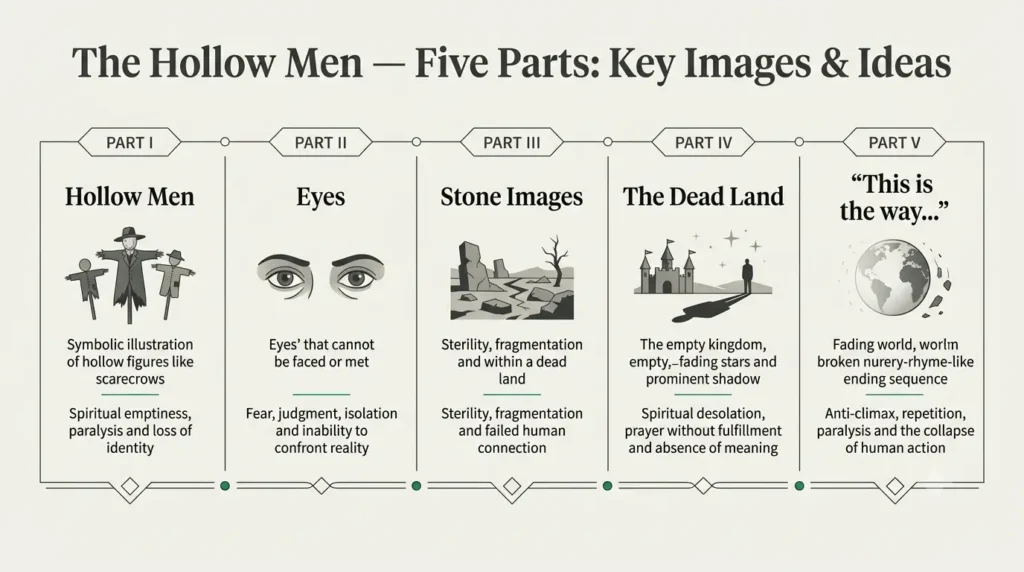
| Part | Main image(s) | Core idea | Main source / allusion |
|---|---|---|---|
| Epigraphs | Kurtz, the Old Guy | Hollowness, failed violence, effigies | Heart of Darkness; Guy Fawkes Night |
| I | Scarecrows, dry voices, broken glass | Paralysis; contrast with those who cross with “direct eyes” | Dante’s souls “without infamy or praise” (Inferno III; see sources table) |
| II | Eyes, dream kingdom, disguises | Fear of being seen and judged | Scarecrow imagery |
| III | Dead land, cactus, stone images | Prayer without a living God | Waste-land landscape |
| IV | Valley of dying stars, tumid river, rose | Failed communication; a conditional hope | Dante (river, celestial rose) |
| V | Prickly pear, Shadow, broken prayer | Gap between intention and act; collapse of language | Nursery rhyme; the Lord’s Prayer |
Themes in The Hollow Men
Spiritual emptiness
The main theme is the absence of spiritual fulfilment. The hollow men are disconnected from any larger purpose. Their “prayers” go to broken stone, and the Lord’s Prayer fails in Part V. This is not atheism. It is closer to wanting belief and being unable to reach it, which is why many critics read the poem as a stage on Eliot’s road towards Christianity.
Failure of communication
The hollow men whisper rather than speak, and in Part IV they “avoid speech”. Even their “voices” are compared to wind in grass and rats’ feet. This is a world where language no longer carries meaning, and the breakdown of language in Part V is the end point of that process.
Paralysis: the gap between idea and act
This is probably the most important theme in the exam. Part V sets out a series of gaps: between idea and reality, motion and act, conception and creation, desire and spasm. The “Shadow” falls in every gap. The hollow men can think and wish, but nothing passes into action. (For the existing page’s “Failure to Achieve”, this is the same point stated more sharply.)
Fear of judgement and of a “final meeting”
The existing note on “fear of death” needs a small correction. The hollow men are less afraid of dying than of being seen: the eyes of the committed dead in Part II, and the “final meeting” in the twilight kingdom. They want disguises, and they would rather stay in the dream kingdom. Their problem is that they have no commitment to be judged for.
Fragmented modern life
The broken column, broken glass, broken stone and broken jaw all point to a civilisation in pieces. The poem’s own form, a set of fragments with shifting scenes and voices, mirrors that condition.
Failed ritual and false worship
Stone images receive prayers, children’s games stand in for liturgy, and the real liturgy breaks down. Ritual survives as a hollow shell.
A glimmer of hope
The “perpetual star” and “multifoliate rose” in Part IV are the poem’s one positive image. The rose is hope “only of empty men”, and the verb is conditional (“unless the eyes reappear”). Whether this is real hope or a last bitter irony is one of the poem’s open questions.
Symbols and Imagery
| Image | What it suggests |
|---|---|
| The hollow / stuffed men, straw, scarecrows | Loss of inner life and identity; the Guy Fawkes effigy; people who are shapes rather than selves |
| Dry voices; wind in dry grass; rats’ feet on broken glass | Speech without meaning; barrenness; decay |
| Eyes | Vision, judgement, moral directness; what the hollow men cannot face |
| Sunlight on a broken column; swinging tree; wind’s singing | Fragments of order glimpsed in the dream kingdom, beautiful but distant |
| Disguises: rat’s coat, crowskin, crossed staves | Evasion; the scarecrow as a figure that looks like a man but is not |
| Dead land / cactus land | The waste-land landscape; spiritual drought |
| Stone images, broken stone | Dead objects of worship; faith with no living centre |
| Tumid river | The boundary between life and death (Dante’s river; Eliot’s reply to a reader mentions the Styx) |
| Dying stars vs perpetual star | The contrast between fading hope and lasting redemption |
| Multifoliate rose | Dante’s rose of paradise; a Christian symbol of grace; the one image of redemption |
| Prickly pear | The nursery-rhyme mulberry bush turned into desert vegetation |
| The Shadow | Whatever stands between intention and action; Eliot left it undefined |
| Bang / whimper | Violent commitment (Guy Fawkes’s gunpowder) against a quiet fading-out |
Literary Devices
- Repetition and refrain. “We are the hollow men”, the recurring “death’s … kingdom” phrases and the repeated “Falls the Shadow” create a ritual, chant-like quality and a feeling of being stuck.
- Allusion. Conrad, Guy Fawkes Night, Dante, the Lord’s Prayer and a nursery rhyme all appear. Together they show that the poem’s world has inherited religious and literary traditions but cannot use them. See the section below.
- Paradox and oxymoron. “Shape without form, shade without colour, paralysed force, gesture without motion” are the clearest examples; each pairs something with its own absence.
- Parallelism. The “Between the … / And the …” structure of Part V is a controlled repetition that makes the gaps feel inescapable.
- Parody. Eliot twists a children’s rhyme and a prayer. The high and the low are both emptied out.
- Symbolism and imagery. Scarecrows, cactus, stone and broken things carry most of the meaning (see table above).
- Anticlimax. The expected “bang” of an apocalypse is replaced by a “whimper”.
- Sound. The poem is mostly unrhymed, but there are echoes of rhyme and rhythm, for example “grass” and “glass” in Part I and the singsong of the Part V quatrains. These echoes make the breakdown of pattern more noticeable.
Structure, Form and Language
The poem has five parts of unequal length and shifting tone. It is written in free verse: there is no regular metre and no fixed rhyme scheme, with the scattered rhyme and nursery-rhyme rhythm noted above. The earlier note on this page said the poem has “no rhyme and meter” at all; the better statement is that it is unmetered free verse with occasional rhyme and strong refrains.
The parts do not tell a story. Instead, they move through moods: self-description (I), fear (II), failed prayer (III), a barren meeting place with a flicker of hope (IV), and breakdown (V). Part V is the most abstract section and the one in which the language visibly falls apart. Martin Scofield, in his chapter on the poem in the Cambridge series on Eliot’s poems, describes the poem as both a continuation of The Waste Land and a tentative new beginning, in which the older mood finally wins, ending in “shrill and desperate frivolity” (the abstract on Cambridge Core).
Sources and Allusions
| Source | How it is used |
|---|---|
| Conrad, Heart of Darkness | First epigraph; Kurtz as the “hollow” man with a kind of conviction |
| Guy Fawkes and the Gunpowder Plot (1605) | Second epigraph; straw effigy; the failed “bang” |
| Dante, Inferno (Canto III) | Souls who lived “without infamy or praise” gather by a river and are not ferried across; the river and the “meeting place” in Part IV echo this. Eliot, replying to a reader, accepted the Styx as an association, “perhaps with a rather more antique than Dantesque association” |
| Dante, Paradiso | The “multifoliate rose” echoes the rose of paradise |
| The Lord’s Prayer | The line “For Thine is the Kingdom” breaks off in Part V |
| “Here we go round the mulberry bush” | Becomes “Here we go round the prickly pear” |
| William Morris, The Hollow Land; Kipling, “The Broken Men” | Eliot’s own account of the title |
| The Waste Land (1922) | A sister poem: the five-part form, the dry landscape, the nursery-rhyme fragments, the liturgical echoes |
The Dante reading is the standard critical frame. Kermode and Hollander (quoted by the Academy of American Poets) note that the first references are Dantean and that the hollow men’s “direct eyes” contrast with the blessed.
Important Comparisons
Three kingdoms of death
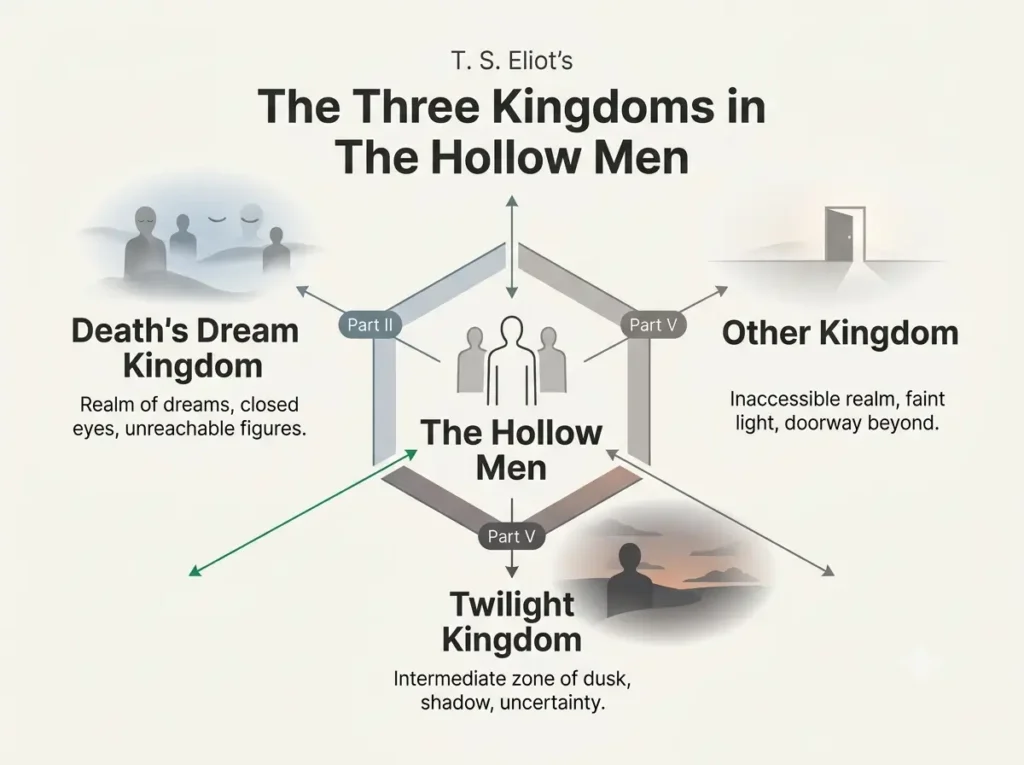
The poem uses three similar-sounding phrases. They are never defined, so this is the usual reading in study guides, not a fixed fact; critics differ on the details.
| Phrase | Where | Usual reading |
|---|---|---|
| Death’s dream kingdom | Part II | An imagined, half-protected zone in which the dreaded eyes do not appear |
| Death’s other Kingdom | Parts I, III | The realm of those who “crossed with direct eyes”: souls who met death with some conviction |
| Death’s twilight kingdom | Parts II, IV | The threshold of the “final meeting”; the place the rose belongs to |
Prufrock, The Hollow Men and The Waste Land
| The Love Song of J. Alfred Prufrock (1915) | The Waste Land (1922) | The Hollow Men (1925) | |
|---|---|---|---|
| Speaker | One self-conscious individual | Many voices | Collective “we” with one “I” |
| Setting | Drawing rooms, city streets | Wasteland, London, myth | A dry, dead, borderland landscape |
| Problem | Social and romantic indecision | Cultural and spiritual collapse | Total paralysis, failed prayer |
| Tone | Ironic, anxious | Fragmented, urgent | Sparse, ritualised, bleak |
| Hope | Almost none | Hints of renewal | One conditional image (the rose) |
| Length | Long dramatic monologue | Long, multi-part | Short, five parts |
Prufrock, too, cannot decide or act, but he is a particular man with a particular fear. The hollow men are a group, and their paralysis has become a condition of existence. Read the Prufrock notes on Delhi Pathshala alongside this poem. For another modernist poem about an ending world, compare Yeats’s The Second Coming, in which the centre “cannot hold” and a rough beast waits, with Eliot’s whimper.
Bang and whimper: Yeats and Eliot
Yeats’s apocalypse arrives with violence and a monstrous birth. Eliot’s does not. If you are asked to compare the two in DSC-13, this contrast of loud and quiet endings is a strong starting point.
Critical Perspectives
Modernist elements
- Fragmentation. The poem is a collage of scenes, voices and borrowed lines.
- Allusion and the literary tradition. This matches Eliot’s own argument, in “Tradition and the Individual Talent” (1919), that a poet writes in dialogue with the past.
- Impersonality and the collective voice. The poem speaks for a group, not a single confessing “I”.
- Free verse and experimental form, with rhythm created by repetition rather than metre.
- Collision of high and low. Liturgy and nursery rhyme sit side by side.
- Loss of certainty. Often described as “existential” in later criticism, though that is a modern label, not Eliot’s.
Reception and impact
The first major reviews responded to the poem as the newest and bleakest part of Poems 1909–1925, which contained no other new poem. Edmund Wilson, reviewing the volume in 1925, saw it as a more advanced stage of the demoralisation already expressed in The Waste Land, and he praised Eliot’s sense of the post-war condition of Europe.
Other early critics were struck by the poem’s musical quality: Babette Deutsch heard “a new music”, and I. A. Richards called it Eliot’s most beautiful poem and spoke of a “music of ideas” (all reported by the Eliot Foundation). The poem’s closing lines were described in Eliot’s 1965 New York Times obituary as probably the most quoted lines of any twentieth-century poet writing in English (as cited on Wikipedia; not checked against the original).
The debate: what is the poem about?
Critics do not agree on a single reading, and Eliot himself declined to explain it. In 1963 his secretary replied to a class of A-level students that he did not believe in giving interpretations of his poetry. The main positions are:
- A post-war cultural diagnosis. This is the reading most study guides give, and it goes back to early reviewers such as Wilson: the hollow men are the generation of post-war Europe. It is a valid reading, and examiners expect you to know it.
- A personal poem. The Eliot Foundation’s centenary article argues that the war reading, popular as it is, does not capture the poem’s roots. It cites a letter of 1 January 1936 in which Eliot called the poem “blasphemous” because it was despair, and said it stood for the lowest point he ever reached in his “sordid domestic affairs”. Some critics link this to Eliot’s failing marriage to Vivienne. The letter is solid evidence; how far it should override the cultural reading is a matter for debate.
- A religious reading. The poem was written two years before Eliot’s baptism. The broken prayers, the stone images, the rose and the Dantean frame suggest a struggle with belief. Compare the later Ash-Wednesday (1930).
- A psychological reading. In a reply to a schoolmaster, Eliot said he would not contest a point about the influence of recent advances in psychology, but that if it were true the connection was unconscious, not deliberate.
- A political reading. In the same reply Eliot said he was not making “political criticism” but saw no reason why a reader should not apply the poem in that way.
A good exam answer presents at least two of these, attributes them, and avoids saying that any one of them is the “true” meaning.
Contemporary Relevance
The poem’s last lines have gone far beyond literature. In Francis Ford Coppola’s Apocalypse Now (1979), Colonel Kurtz, played by Marlon Brando, recites from the poem, which neatly reconnects it to its Conrad epigraph. The Eliot Foundation also records that lines from the poem were used in a 1934 Hollywood film set in 1918, which drew a wry comment from Eliot that real fame comes when quotations appear in billboard advertisements.
The poem has also inspired composers, including Vincent Persichetti’s The Hollow Men (1944) and Kaija Saariaho’s Study for Life. Eliot himself said in 1956 that the poem never seemed to him suitable for a musical setting (Eliot Foundation). Speaking in 1958, as reported by Henry Hewes in the Saturday Review (cited on Wikipedia; not checked against the original), Eliot said he would not write the ending again, because the association with the H-bomb had become too obvious.
Key Lines to Remember
| Line (short extract) | Part | Why it matters |
|---|---|---|
| “Headpiece filled with straw” | I | The scarecrow / Guy Fawkes effigy image |
| “Shape without form, shade without colour” | I | Paradox of presence without substance |
| “Eyes I dare not meet in dreams” | II | Fear of judgement |
| “This is the dead land” | III | The waste-land setting |
| “Between the idea and the reality … Falls the Shadow” | V | The gap between thought and act |
| “Not with a bang but a whimper” | V | The anticlimactic end of the world |
Conclusion
The Hollow Men is a short poem that rewards slow reading. It takes the despair of The Waste Land and compresses it into five parts of dry, ritual language. Its speakers are not villains and not tragic heroes. They are people who never committed to good or evil, and so have nothing to be remembered for. The poem is full of borrowed voices (Conrad, Dante, the Lord’s Prayer, a children’s game) and every one of them fails to hold. Only the “perpetual star” and the rose offer a glimpse of something else.
For DU exams, remember four things: the poem’s composition in stages; the two epigraphs and what they add; the central theme of the gap between idea and act; and the ending’s contrast between “bang” and “whimper”. Whenever you state a reading, name who holds it, and be careful to quote only what is actually in the poem.
Continue Reading
More notes from DSC-13: Twentieth Century Poetry & Drama
- The Love Song of J. Alfred Prufrock by T.S. Eliot: the other Eliot poem in Unit 1A
- The Second Coming by W.B. Yeats: another modernist poem about an ending world
- Still Falls the Rain by Edith Sitwell: twentieth-century poetry shaped by war
- Heart of Darkness: short summary: the source of the Kurtz epigraph
- Waiting for Godot by Samuel Beckett: inaction and waiting in twentieth-century drama
Full course list: Twentieth Century Poetry & Drama notes
University of Delhi Previous Year Questions
University of Delhi Previous Year Questions
Section A — Source-Attributed DU Questions
1 Identify, contextualize and comment on the lines: “We are the hollow men / We are the stuffed men / Leaning together / Headpiece filled with straw. Alas!” +
Year / Paper: University of Delhi, DSC-13 / Twentieth Century Poetry & Drama — Part A format; exact paper/session should be checked against the source paper.
Hint: Identify the speaker, context, title image, and the significance of “hollow” and “stuffed.”
Suggested Answer Focus: Explain the collective modern speakers, the contrast between “hollow” and “stuffed,” the scarecrow image, spiritual and intellectual emptiness, and Eliot’s representation of modern paralysis. Source-Attributed
2 Identify, contextualize and comment on: “Mistah Kurtz – he dead / A penny for the Old Guy.” +
Year / Paper: University of Delhi, DSC-13 / Twentieth Century Poetry & Drama — Part A question format.
Hint: Explain both epigraphs and their literary sources.
Suggested Answer Focus: Discuss Kurtz from Conrad’s Heart of Darkness, Guy Fawkes and the failed Gunpowder Plot, and how the epigraphs introduce the poem’s themes of emptiness, failed action, death, and anticlimax. Source-Attributed
3 Identify, contextualize and comment on: “This is the way the world ends / Not with a bang but a whimper.” +
Year / Paper: University of Delhi, DSC-13 / Twentieth Century Poetry & Drama — Part A question format.
Hint: Link the ending with the Guy Fawkes epigraph and the poem’s central idea of paralysis.
Suggested Answer Focus: Discuss anticlimax, failed action, spiritual exhaustion, the contrast between “bang” and “whimper,” and Eliot’s portrayal of a civilization unable to achieve decisive action. Source-Attributed
4 Identify, contextualize and comment on: “Between the idea / And the reality / Falls the Shadow.” +
Year / Paper: University of Delhi, DSC-13 / Twentieth Century Poetry & Drama — Part A question format.
Hint: Explain the Shadow and its relationship to the poem’s idea of failed action.
Suggested Answer Focus: Discuss the gap between intention and action, thought and realization, desire and fulfilment, and the Shadow as a symbol of spiritual and existential paralysis. Source-Attributed
5 “Genuine poetry can communicate before it is understood.” Discuss your views with reference to T. S. Eliot’s poems in the syllabus. +
Year / Paper: DU 2015–16 paper, Code 2032103501 — Twentieth Century Poetry & Drama.
Hint: Discuss Eliot’s poetry with reference to both The Love Song of J. Alfred Prufrock and The Hollow Men.
Suggested Answer Focus: Explain Eliot’s use of fragmentation, imagery, allusion, rhythm, symbolism, dramatic voice, and suggestive rather than purely explanatory language. Relate these techniques to the experience of modern alienation and crisis. Source-Attributed
6 Discuss The Hollow Men as a poem of spiritual emptiness and paralysis. How do the hollow men symbolize post-World War I disillusionment? +
Year / Paper: Recurring theme associated with DU evaluation material for The Hollow Men.
Hint: Focus on spiritual emptiness, paralysis, fragmentation, and the historical context of post-World War I disillusionment.
Suggested Answer Focus: Explain how the hollow men embody spiritual exhaustion, inability to act, loss of faith, fragmented consciousness, and the wider crisis of modern humanity. DU Theme
Section B — Recurring / DU-Pattern Questions
7 What is the significance of the title The Hollow Men? +
Year / Paper: Question-bank / internal assessment material
Hint: Explain both “hollow” and “men.”
Suggested Answer Focus: Discuss the title as a representation of spiritual emptiness, lack of purpose, failed action, and the collective condition of modern humanity. Probable
8 What does the phrase “stuffed men” signify? +
Year / Paper: Question-bank / internal assessment material
Hint: Connect the phrase with the scarecrow image.
Suggested Answer Focus: Explain the contrast between outward appearance and inner emptiness, emphasizing the absence of genuine spiritual or intellectual substance. Probable
9 Critically analyse Eliot’s use of allusion, symbolism and imagery in The Hollow Men, with reference to Guy Fawkes, Heart of Darkness, the Lord’s Prayer and nursery rhymes. +
Year / Paper: Question Bank — Paper VII: Twentieth Century Poetry and Drama, DU-affiliated college material
Hint: Treat each allusion as part of Eliot’s fragmented modernist method.
Suggested Answer Focus: Analyse the Kurtz and Guy Fawkes epigraphs, religious allusions, nursery-rhyme fragments, symbolism of straw, eyes, dryness and shadow, and the way these references reinforce spiritual fragmentation. Probable
10 Compare The Love Song of J. Alfred Prufrock and The Hollow Men as two phases of modernist crisis. +
Year / Paper: Question Bank — Paper VII: Twentieth Century Poetry and Drama, DU-affiliated college material
Hint: Compare personal anxiety in Prufrock with collective spiritual paralysis in The Hollow Men.
Suggested Answer Focus: Discuss individual versus collective crisis, social anxiety versus metaphysical paralysis, fragmentation, failed communication, imagery, and the changing scale of Eliot’s modernist vision. Probable
11 Critically examine the theme of spiritual emptiness and emotional void in The Hollow Men. +
Year / Paper: Recurring thematic formulation
Hint: Use the hollow men, stuffed men, Shadow, eyes, dryness, and the ending.
Suggested Answer Focus: Explain the emotional and spiritual void through Eliot’s imagery of emptiness, failed prayer, inability to act, fragmented language, and the absence of meaningful transcendence. Probable
Paper & Syllabus Reference
Unit I: T. S. Eliot — The Love Song of J. Alfred Prufrock and The Hollow Men
NEP-UGCF Paper Code: 12031502 / 2032103501
Old CBCS Paper Code: 2032103501 — Twentieth Century Poetry & Drama
Paper Pattern: Part A and Part B; Part A requires all questions and Part B requires any three questions. Part A questions carry 10 marks each and Part B questions carry 20 marks each in the cited paper pattern.
Publication Detail: The Hollow Men was published in 1925.
Frequently Asked Questions
When was The Hollow Men written and published?
It was composed in stages in 1924–25. Parts were printed in four journals before the complete five-part poem appeared on 23 November 1925 in Poems 1909–1925.
Who are the hollow men?
They are the collective speakers of the poem: scarecrow-like, “stuffed” figures who have lost spiritual and moral purpose. Eliot did not tie them to one group, and critics read them as post-war Europeans, as modern people in general, and, in the biographical reading, as a mirror of Eliot’s own despair.
Where does the title come from?
Eliot said he combined William Morris’s The Hollow Land with Kipling’s “The Broken Men”. Some critics also see a link to Conrad’s description of Kurtz as “hollow at the core”.
What do the two epigraphs mean?
The first refers to the death of Kurtz in Conrad’s Heart of Darkness. The second recalls Guy Fawkes Night and the straw effigy. Both involve a “hollow” or stuffed figure, and both point to the contrast between conviction (even violent conviction) and complete emptiness.
What is the “multifoliate rose”?
It is an image from Dante’s Paradiso, where paradise is described as a rose of many petals. In Part IV it appears as the one possible hope for the hollow men, but only if the eyes “reappear”.
What does “Between the idea and the reality … Falls the Shadow” mean?
It describes the gap between thinking or wishing and doing. Eliot does not say what the Shadow is, and readers have interpreted it as failure of will, spiritual paralysis, or the presence of death. Any one reading should be presented as an interpretation.
Is the poem about the First World War?
Many readers, from early reviewers onward, take it as a response to post-war Europe, but Eliot’s 1936 letter points to the personal despair of his domestic life. A fair answer says the war context is important and that the poem is not limited to it.
How are “death’s dream kingdom”, “death’s other kingdom” and “twilight kingdom” different?
The poem never defines them. The usual reading is that the dream kingdom is a half-protected imagined zone, the other kingdom belongs to those who crossed with “direct eyes”, and the twilight kingdom is the threshold of the final meeting. Critics vary on the details.
Why does the poem end with “bang” and “whimper”?
The “bang” recalls Guy Fawkes’s gunpowder, a violent act of conviction. The “whimper” is the quiet fading-out of people with no conviction. Eliot said in 1958, as reported, that he would not write the lines again because of their later association with nuclear weapons.
How is the poem related to The Waste Land and Prufrock?
It shares the dry landscape, the five-part form and the nursery-rhyme and liturgical fragments of The Waste Land, and the inability to act of Prufrock. Kermode and Hollander note that some of its material was originally in The Waste Land.
Is The Hollow Men in the DU syllabus?
Yes. The Department of English syllabus for the Twentieth Century Poetry & Drama course (DSC-13) lists it together with Prufrock under Eliot in Unit I. Check your own college’s current syllabus for the exact edition and semester.
Subscribe to keep reading
You've used your free notes for now. Get Delhi Pathshala Premium for unlimited access.
Subscribe — ₹29/30 days