

Contents
- Overview of the 17th Century European Crisis
- Historical Context and Importance
- 2. Economic Dimensions
- Economic Decline and Crisis
- Causes of Economic Decline
- Impact on Agriculture and Industry
- The Transition from Feudalism to Capitalism
- E. J. Hobsbawm’s Perspective
- Accumulated Capital and Division of Labor
- Colonial System and Market Dynamics
- 3. Social Dimensions
- Social Unrest and Civil Resistance
- Revolts and Rebellions
- Population Growth and Demographic Changes
- Social Structures and Inequality
- Impact on Peasants and Wage Earners
- Changes in Social Hierarchies
- 4. Political Dimensions
- Political Instability and Wars
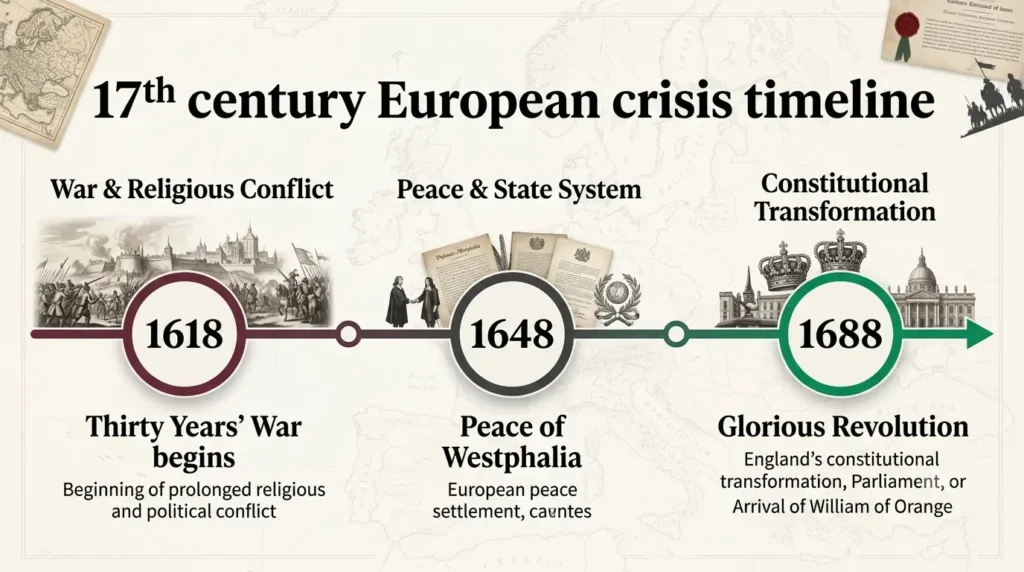
- The Thirty Years’ War (1618–1648)
- The English Civil War (1642–1651) and the French Fronde (1648–1653)
- Rise of Absolutism
- Role of Monarchs and Centralized Power
- Political Conflicts and Power Struggles
- 5. Climate and Population Changes
- Effects of Climate
- Population Changes
- 6. Spain’s Decline
- Reasons for Spain’s Decline
- A Contested Decline: Was Spain Ever a “Rising” Power?
- Consequences of Decline
- 7. Historiographical Debate: Was There Really a “General Crisis”?
- Hobsbawm: An Economic Crisis of Transition
- Trevor-Roper: A Crisis of State and Society
- Mousnier, Elliott, and the Regional Rebuttals
- Was It a “General” Crisis at All?
- Comparative Table: Major Positions in the General Crisis Debate
- 8. Timeline: Key Events of the 17th Century Crisis
- 9. Conclusion
- Key Points Summary
- Transition to Stability
- Cultural Impact
- Continue Reading
- University of Delhi Previous Year Questions
- Further Reading
- Frequently Asked Questions (FAQs)
Notes for “Unit 1: The 17th Century European Crisis: Economic, Social, and Political Dimensions,” DSC-2: Rise of the Modern West – II, B.A. (Hons.) History, Semester 4, University of Delhi.
Overview of the 17th Century European Crisis
Historians often describe the 17th century in Europe as a period of “General Crisis” — a phrase coined by Marxist historian Eric Hobsbawm in 1954 to describe the simultaneous economic, social, and political breakdowns that struck much of the continent between roughly the 1590s and the 1680s. The period includes the Thirty Years’ War (1618–1648), the English Civil War (1642–1651), the French Fronde (1648–1653), the decline of Spain, and widespread peasant revolts across Catalonia, Naples, Portugal, and beyond. Religious tensions from the Protestant Reformation and the Catholic Counter-Reformation deepened these conflicts, while the cooling climate of the so-called Little Ice Age brought poor harvests and famine. Whether all of this truly added up to a single, continent-wide “crisis,” or whether it is more accurate to speak of several distinct regional crises, remains one of the most debated questions in early modern European historiography — a debate this unit examines in detail below.
Historical Context and Importance
The 17th century is a hinge point between the medieval world and the modern era. Many parts of Europe moved away from feudalism toward early capitalism and stronger centralized states during this period. It set the stage for the Enlightenment of the 18th century and the rise of modern Western civilization, marking both the decline of feudal structures and the growth of the nation-state, alongside major advances in science (the Scientific Revolution) that reshaped how contemporaries understood the natural and political world.
2. Economic Dimensions
Economic Decline and Crisis
Causes of Economic Decline
The economy of 17th-century Europe faced several interlinked pressures:
- Wars and Military Spending: Sustained warfare, especially the Thirty Years’ War, drained state treasuries and pushed monarchies into debt. Historian Niels Steensgaard has argued that it was precisely this growth in state military spending — rather than a crisis of production — that squeezed European economies, as governments diverted resources from private markets into taxation to fund larger standing armies.
- Agricultural Decline: The Little Ice Age cooled the climate across Europe, shortening growing seasons and causing repeated poor harvests. Farming methods remained largely unchanged from the medieval period and could not keep pace with population pressure in good years, let alone bad ones.
- Inflation: A large influx of American silver into Spain in the 16th century had already caused a long “Price Revolution.” By the 17th century this inflation was disrupting trade and hollowing out the Spanish economy in particular, since silver flowed through Spain to pay off crown debts rather than being reinvested domestically.
Impact on Agriculture and Industry
- Agriculture: Bad weather and an outdated feudal landholding system left many rural areas in poverty, worsened by high and often unevenly distributed taxation — the tax burden usually fell hardest on peasants, since nobility and clergy were commonly exempt.
- Industry: With the Industrial Revolution still more than a century away, textile and mining industries struggled where they depended on urban, guild-based production. However, early rural (proto-industrial) manufacturing and small-scale trade networks began expanding precisely because they escaped the cost structures and taxation of the cities — a shift historians studying proto-industrialization consider central to understanding the period’s uneven industrial geography.
The Transition from Feudalism to Capitalism
E. J. Hobsbawm’s Perspective
Historian E. J. Hobsbawm argued that the move from feudalism to capitalism was a slow, uneven process rather than a single clean break. In his account, capitalist elements had already appeared within European society by the 16th century, but they remained trapped inside a feudal social framework too rigid to let them fully develop. For Hobsbawm, the 17th-century crisis was the mechanism by which this feudal framework was finally broken, clearing the way for capitalism to become the dominant mode of production by the 18th century. He identified four specific obstacles that had to be overcome before capitalism could take hold: insufficient accumulated capital, an inadequate division of labour, a narrow domestic market of subsistence-level buyers, and an unreformed colonial trading system focused on luxury goods rather than mass-producible commodities.
Accumulated Capital and Division of Labor
Wealth accumulation was central to this transition. As trade routes expanded and colonies grew, European nations reinvested colonial profits into production, encouraging the rise of a merchant class oriented around trade profits rather than land rents. Improvements in the division of labor, particularly in textiles and mining, gradually raised efficiency and helped early capitalist enterprises take shape — though, as historian Alexandra Lublinskaya has pointed out in her critique of Hobsbawm, large-scale manufacturing using divided labour already existed in France, Spain, and Germany well before the 17th century, complicating any claim that the crisis alone unlocked this development.
Colonial System and Market Dynamics
The growth of European colonies in the Americas, Africa, and Asia reshaped the European economy. Goods such as sugar, tobacco, and silver flowed into Europe, altering established trade patterns, while colonies simultaneously supplied raw materials and absorbed European manufactured goods — an early global trade network built on mercantilism and the triangular trade. This system gradually made wealth less dependent on land ownership and more dependent on control of international trade and resource extraction.
Key Takeaways — Economic Dimensions: The 17th century combined agricultural decline, warfare, and inflation to accelerate a slow shift from feudal to early capitalist economic structures, though historians disagree sharply on how far this shift had actually progressed by 1700 (see the Historiographical Debate below).
3. Social Dimensions
Social Unrest and Civil Resistance
Revolts and Rebellions
The 17th century saw significant social unrest driven by economic hardship, political oppression, and a widening gap between rich and poor. Key revolts included:
- The Fronde (1648–1653): A series of civil wars in France in which nobles and the Parlement of Paris resisted royal centralization under the young Louis XIV, reacting against Cardinal Mazarin’s fiscal and administrative policies.
- The English Civil War (1642–1651): A conflict between King Charles I and Parliament over taxation, royal authority, and religion, ending in the king’s execution and the establishment of the Commonwealth under Oliver Cromwell.
- The Thirty Years’ War (1618–1648): Primarily a religious conflict that triggered widespread uprisings, especially in Bohemia and Germany, as war devastated the countryside and strained state finances.
- Peasant and Regional Revolts: High taxes, famine, and oppressive landlords drove revolts such as the Catalan Revolt (1640) and the Portuguese Restoration (also 1640) in the Spanish monarchy, alongside continuing unrest tied to the earlier German Peasants’ War.
According to Geoffrey Parker’s global survey of 17th-century revolts, the mid-century decades saw an unusually dense clustering of state breakdowns worldwide — not just in Europe but also in Ming China and the Ottoman Empire — a pattern some historians treat as evidence of a genuinely global crisis rather than a purely European one.
Population Growth and Demographic Changes
- Population Growth: Despite famine and war, Europe’s population gradually increased toward the end of the century, though unevenly — growth continued steadily in England and the Netherlands while parts of Central and Eastern Europe (especially areas devastated by the Thirty Years’ War) saw sustained decline.
- Urbanization: Migration toward cities in search of economic opportunity fed the rise of early capitalism, as towns became centers of trade and manufacturing. London, for instance, grew from roughly 25,000 to over 500,000 residents across the early modern period.
- Aftermath of the Black Death: Long-term labor shortages dating back to the 14th-century plague still shaped wage bargaining power for some workers, even as many peasants continued to face poverty and instability.
Social Structures and Inequality
Impact on Peasants and Wage Earners
- Peasants: Most Europeans remained peasants, especially in rural areas, often bound by feudal obligations. While some regions shifted toward capitalist land arrangements, many peasants remained impoverished, heavily taxed, and exploited by landowners, with high mortality from poor conditions, epidemics, and famine.
- Wage Earners and the Proletariat: Early industrialization created a growing class of wage earners — artisans and factory-style workers — who faced poor conditions and low pay, laying groundwork for later labor movements.
Changes in Social Hierarchies
- Nobility and Aristocracy: The nobility remained powerful, but royal centralization began shifting the balance of power. Louis XIV, for example, required nobles to live at his court in Versailles, limiting their independent political base.
- Rise of the Bourgeoisie: A new wealthy merchant and banking class emerged, gaining influence through trade and finance and challenging traditional aristocratic dominance of the market economy.
- Religious Hierarchies: Religious conflict shaped social structure throughout, with the Catholic Church often aligned with the aristocracy, while Protestant movements challenged established hierarchies.
- Women and Social Inequality: Women, especially in lower social classes, faced limited rights and were largely confined to domestic roles, with significant barriers to education and economic independence, though some women in merchant or noble households gained informal influence over family business and estate matters.
Key Takeaways — Social Dimensions: Social change in this century was defined by revolt against economic hardship, gradual demographic recovery after the Black Death, and the slow rise of a bourgeois merchant class alongside — not yet replacing — the traditional aristocracy.
4. Political Dimensions
Political Instability and Wars
The Thirty Years’ War (1618–1648)
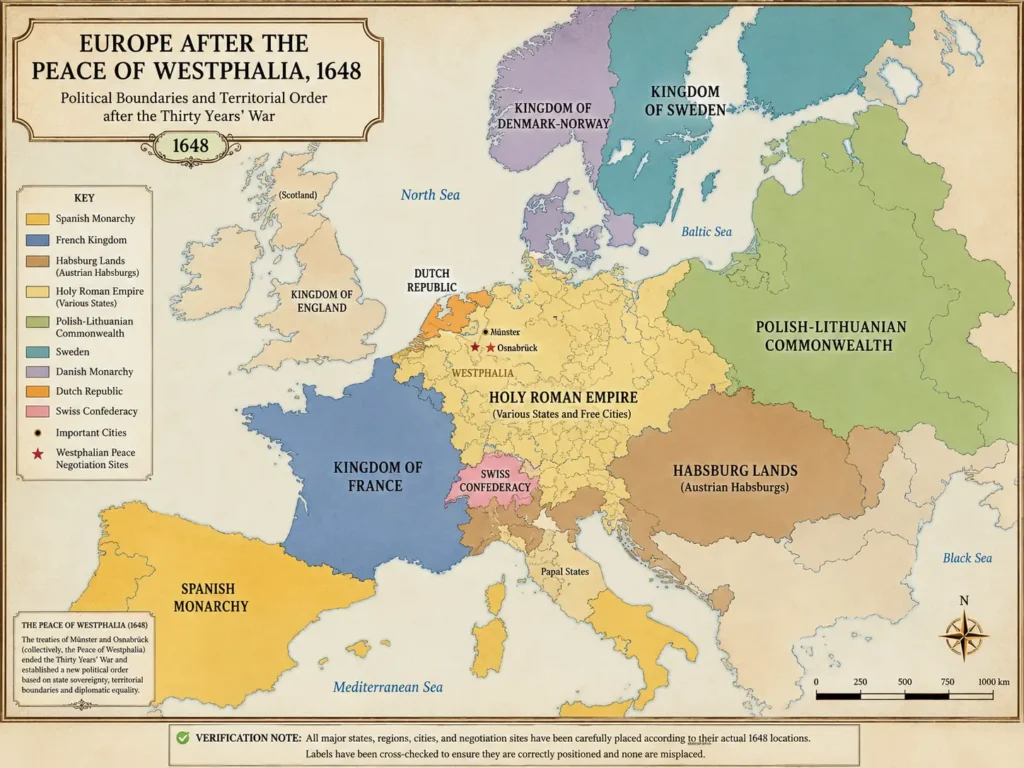
The Thirty Years’ War began as a religious conflict between Protestant and Catholic states within the Holy Roman Empire and grew into a broader struggle for political power and territory across Central Europe.
- Causes of the War: Religious tension following the Protestant Reformation escalated after the “Defenestration of Prague” in 1618, when Protestant nobles threw Catholic officials from a window. Power struggles between the Catholic Habsburg dynasty and Protestant states — Denmark, Sweden, and eventually France — turned a regional dispute into a continental war. France, though Catholic, allied with Protestant powers specifically to weaken Habsburg dominance, while Spain backed its Austrian Habsburg relatives.
- Consequences of the War: The Peace of Westphalia (1648) redrew borders, expanded religious toleration, and weakened both the Holy Roman Empire and the Catholic Church’s political authority. The war left the Habsburgs significantly weakened while France emerged as Europe’s strongest power. Westphalia is widely regarded as foundational to the modern concept of state sovereignty — the principle that states govern their own internal affairs without outside interference.
Reference: Thirty Years’ War (background reference only)
The English Civil War (1642–1651) and the French Fronde (1648–1653)
- The English Civil War pitted King Charles I against Parliament over taxation, royal authority, and religion. It led to Charles I’s execution and a temporary end to the monarchy under Cromwell’s Commonwealth — a pivotal moment for the later development of England’s constitutional monarchy. The Battle of Naseby was decisive in defeating royalist forces, and the eventual Glorious Revolution of 1688 further cemented parliamentary sovereignty.
- The French Fronde arose from Cardinal Mazarin’s centralizing fiscal policies during Louis XIV’s minority. Though nobles and the Parlement resisted royal authority through several rounds of revolt and negotiation, the Fronde ultimately failed to check the monarchy — its defeat cleared the path for Louis XIV to build one of history’s most complete absolutist states.
Rise of Absolutism
Role of Monarchs and Centralized Power
Absolutism describes a political system in which a monarch holds centralized power with minimal institutional checks from parliaments or the nobility. Several rulers pursued this model in the 17th century:
- Louis XIV of France: Often considered the archetypal absolute monarch, Louis XIV is famously (if perhaps apocryphally) associated with the phrase “L’État, c’est moi” (“I am the state”). He reduced noble independence by drawing the aristocracy into court life at Versailles, reorganized the military, and expanded French territory while consolidating administrative power in royal hands.
- The Habsburgs in Spain and Austria: Philip IV of Spain attempted to tighten royal control over Spain and its colonies, while the Austrian Habsburgs sought to centralize their diverse, multi-ethnic empire — an effort complicated by the resources drained during the Thirty Years’ War.
- The English Monarchy: Unlike France, England moved toward constitutional monarchy. James I and Charles I both attempted more absolute rule but met sustained resistance from Parliament, a conflict that produced the English Civil War and, later, the Glorious Revolution’s more durable settlement between crown and Parliament.
Political Conflicts and Power Struggles
The rise of absolutism did not go uncontested. Nobility, the church, and an emerging middle class all resisted centralizing monarchs to different degrees:
- The Role of the Nobility: Louis XIV successfully curtailed noble power in France; nobles retained more influence in England and Spain. In Russia, Tsar Peter the Great later worked to reduce the power of the boyars (Russian nobility) as part of broader modernization efforts.
- Religious Conflicts: In France, Protestant Huguenots challenged Catholic royal authority; suppressing them (culminating in the Revocation of the Edict of Nantes in 1685) helped the crown consolidate religious as well as political control.
- The Rise of Bureaucratic States: Monarchs increasingly relied on professional royal administrators to manage state affairs, improving governance capacity while also making rulers dependent on the loyalty and competence of these growing bureaucracies.
- The Decline of Feudal Power: Absolutism accelerated the decline of localized feudal authority, as monarchs used military force, legal reform, and court patronage to weaken independent feudal lords.
Key Takeaways — Political Dimensions: Political instability in the 17th century arose from the collapse of older feudal power structures and the contested rise of absolutism — a rise that succeeded almost completely in France, only partially in Spain and Austria, and ultimately failed in England, where it instead produced constitutional monarchy.
5. Climate and Population Changes
Effects of Climate
Europe experienced significant cooling during the 17th century as part of the broader Little Ice Age, a period of lower average temperatures lasting from roughly the 14th to the mid-19th century. This affected agriculture and society in several ways:
- Agricultural Challenges: Shorter growing seasons caused repeated crop failures, especially in northern Europe, driving famine and food shortages in France, Germany, and England.
- Famine and Health Issues: Malnutrition increased vulnerability to disease, contributing to epidemics such as the plague of 1629–1631 in Italy and France, and worsening social unrest through elevated death rates. Scientific studies of sunspot activity during the so-called “Maunder Minimum” (roughly 1645–1715), along with tree-ring and glacier evidence, are among the strongest supporting evidence historians and climate scientists cite for this cooling trend.
Population Changes
- Population Decline: Following the 14th-century Black Death, Europe’s population recovery in the 17th century was repeatedly slowed by war, famine, and disease, particularly in regions affected by the Thirty Years’ War and English Civil War.
- Urban Growth: Cities in England and the Netherlands expanded despite these pressures, driven by trade and emerging industry, fueling the rise of a distinct urban working class.
- Migration Patterns: Regions less affected by war, such as parts of Eastern Europe, saw relatively stable or growing populations, while migration and trade reshaped Europe’s demographic and economic geography more broadly.
6. Spain’s Decline
Reasons for Spain’s Decline
Spain’s fall from its position as Europe’s leading power during the 17th century resulted from intertwined economic, military, and political problems:
- Economic Problems: An influx of silver from Spanish American colonies initially boosted royal finances but fed sustained inflation and instability. Spain neglected domestic industry and agriculture in favor of relying on colonial wealth, while inefficient tax collection and dependence on foreign loans deepened fiscal weakness. Competition from rival European powers steadily eroded Spain’s Mediterranean trade dominance.
- Military Strain: Continuous involvement in the Thirty Years’ War and conflicts with France and England drained Spanish resources. Maintaining an overseas empire became an increasingly unsustainable financial burden as rival powers modernized their militaries faster.
- Political Issues: Weak leadership under Philip IV and the mentally and physically frail Charles II struggled to manage a sprawling, diverse empire. Internal revolts in Catalonia and Naples, alongside Portugal’s successful bid for independence in 1640, further fractured Spanish authority.
A Contested Decline: Was Spain Ever a “Rising” Power?
Not all historians accept the standard “decline” narrative uncritically. Historian Henry Kamen has argued that talk of Spanish “decline” is somewhat misleading, for three reasons: first, Spain’s 16th-century “golden age” depended heavily on the wealth and administrative capacity of its Italian, Genoese, and Flemish partners rather than purely Castilian strength — so Castile arguably never “rose” independently in the first place. Second, Kamen points to signs of genuine economic recovery after 1650 in sectors such as the Segovian wool industry, alongside rising birth rates after 1660, complicating a picture of uninterrupted decline. Third, he notes that Spain’s underlying vulnerabilities — currency devaluations, crown bankruptcies, military setbacks against England and the Dutch — were already visible in the late 16th century, before the 17th-century “crisis” is conventionally said to begin. Historians such as J.H. Elliott and Jonathan Israel broadly maintain the traditional decline thesis while acknowledging these regional and chronological complications, arguing that Spain’s real internal economic weaknesses were made far harder to manage by the sheer scale of its imperial commitments.
Consequences of Decline
- Loss of Power: Spain’s weakening position allowed the Dutch Republic, France, and England to rise in relative prominence.
- Economic Weakness: Declining trade routes, stagnating industry, and reduced tax revenues undermined confidence in the Spanish monarchy for the remainder of the century.
7. Historiographical Debate: Was There Really a “General Crisis”?
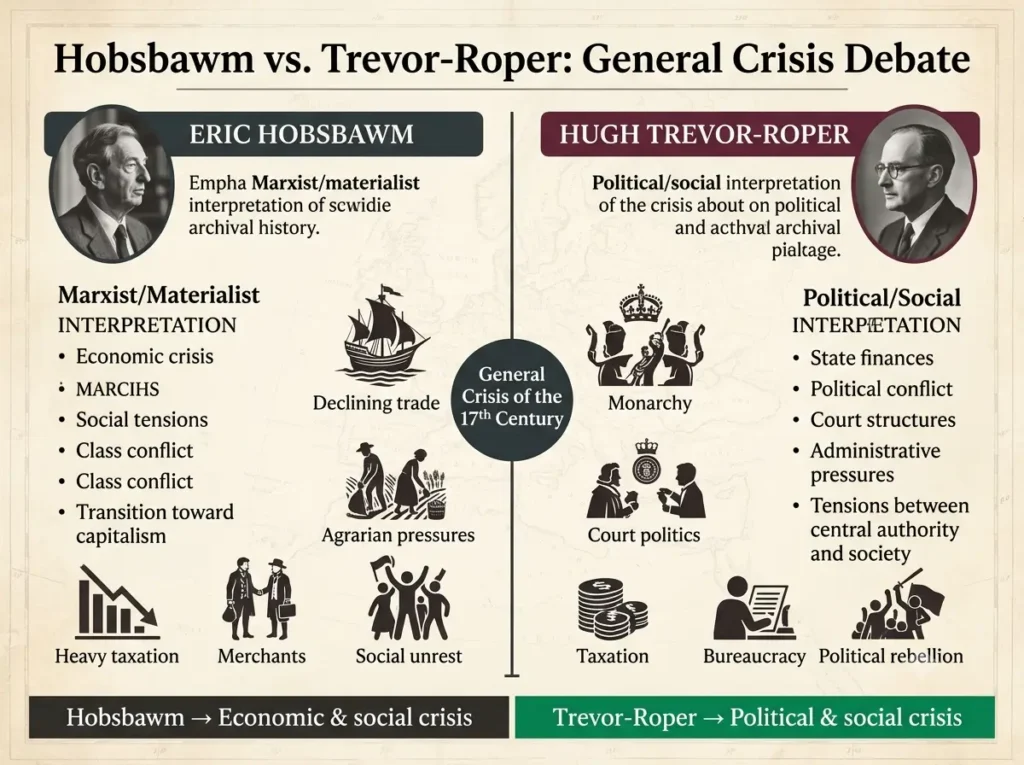
This is the single most examined aspect of this unit, and the section where DU examiners most often expect depth. The debate began in 1954, when both E. J. Hobsbawm and French historian Roland Mousnier independently proposed that the 17th century represented a decisive “crisis” moment in European history — though the two scholars meant quite different things by the term.
(deeply understand this topic: the historiographical debate on the General Crisis)
Hobsbawm: An Economic Crisis of Transition
As outlined in Section 3 above, Hobsbawm framed the crisis primarily in economic terms: a necessary, painful transition from a feudal economy that could no longer expand within its existing social framework, to the capitalist economy that would eventually power the Industrial Revolution. For Hobsbawm, the crisis unfolded across three phases — contraction from roughly 1600–1640, an acute socio-revolutionary phase from 1640–1660, and a slow recovery into the 1680s — and it was ultimately productive, since it forced the reorganization of production and capital that made later industrialization possible.
Trevor-Roper: A Crisis of State and Society
In 1959, English historian Hugh Trevor-Roper published a direct challenge to Hobsbawm in the same journal, Past & Present. Trevor-Roper argued there was little solid evidence for a purely economic crisis, and reframed the debate around a crisis in the relationship between state and society. In his account, 16th-century monarchies had built increasingly bloated, parasitic court bureaucracies that survived on informal extraction from the population rather than official salaries. This arrangement was tolerable as long as the economy was expanding, but became unsustainable once growth slowed in the 1620s, producing a widening rift between the royal “Court” and the “Country” gentry and townspeople who bore the resulting fiscal burden. Trevor-Roper narrowed his focus to the intense revolts of 1640–1660 specifically, treating them as symptoms of this state-society rupture rather than as evidence of a deeper economic transformation.
Mousnier, Elliott, and the Regional Rebuttals
Trevor-Roper’s thesis provoked its own set of rebuttals. Roland Mousnier, examining France specifically, argued that Trevor-Roper’s “Court vs. Country” framework did not fit the French case well — the Fronde saw nobility and commoners participate together, and Mousnier saw the deeper rupture in the previous century’s Wars of Religion, not the mid-1600s. J.H. Elliott, examining Spain, similarly complicated a single unifying model, pointing to how regional revolts in Catalonia and Naples grew out of specific local grievances against Habsburg fiscal centralization rather than a generalized “Court-Country” split. Steensgaard’s later intervention emphasized a fiscal-military explanation — that rising state spending on warfare, not any single social rupture, was the common thread linking otherwise very different regional crises.
Was It a “General” Crisis at All?
A significant strand of the debate simply questions the word “general.” Regions did not experience crisis uniformly: England’s economy weathered the century with comparatively little disruption even as its politics were convulsed by civil war; the Dutch Republic entered its economic “Golden Age” during precisely the same decades that Spain and the Mediterranean economies were declining. Some historians therefore argue for divergence rather than convergence as the true defining feature of the century — Western Europe’s free-labour agrarian economies diverging sharply from Eastern Europe’s expanding serfdom, and northern Atlantic trade diverging from Mediterranean stagnation. This has led later historians, including Geoffrey Parker in his global-scale study Global Crisis (2013), to broaden the debate beyond Europe entirely, linking the mid-century clustering of revolts in China, the Ottoman Empire, and Mughal India to the same climatic pressures of the Little Ice Age.
Comparative Table: Major Positions in the General Crisis Debate
| Historian | Core Argument | Type of Crisis | Main Criticism Raised Against It |
|---|---|---|---|
| E. J. Hobsbawm (1954) | Feudal economy structurally blocked capitalist expansion; crisis forced the transition | Economic | Underestimates pre-existing capital accumulation and division of labour (Lublinskaya) |
| Roland Mousnier (1954) | Crisis reflects conflict between old feudal order and emerging modern government | Social/Political | Seen as less precise than Trevor-Roper’s framework |
| Hugh Trevor-Roper (1959) | Crisis in the relationship between an overgrown court bureaucracy and society (“Court vs. Country”) | Political/Institutional | Doesn’t fit France (Mousnier) or Spain’s regional revolts (Elliott) well |
| Niels Steensgaard (1970) | Rising state military spending, not economic production failure, drove the crisis | Fiscal-military | Debated whether this explains social unrest fully |
| Henry Kamen | Spain’s “decline” is overstated; Castile never independently “rose” | Revisionist/Regional | Downplays real fiscal and military weaknesses (Elliott, Israel) |
| Geoffrey Parker (2013) | Crisis was global, driven by Little Ice Age climate shocks affecting Europe, China, and the Islamic world simultaneously | Global/Climatic | Broadens scope so far that “crisis” risks losing analytical precision |
Key Takeaways — Historiographical Debate: There is no single agreed answer to “was there a General Crisis?” — the strongest DU exam answers acknowledge the debate itself as the real subject matter, presenting Hobsbawm’s economic thesis, Trevor-Roper’s state-society thesis, and the regional/global rebuttals as competing but individually incomplete explanations.
8. Timeline: Key Events of the 17th Century Crisis
| Year | Event |
|---|---|
| 1598 | Death of Philip II of Spain; Edict of Nantes ends French Wars of Religion |
| 1618 | Defenestration of Prague triggers the Thirty Years’ War |
| 1629–1631 | Plague epidemic strikes Italy and France |
| 1640 | Catalan Revolt and Portuguese Restoration against Spanish rule |
| 1642–1651 | English Civil War |
| 1645–1715 | Maunder Minimum (low sunspot activity linked to the Little Ice Age) |
| 1647 | Revolt of Naples (Masaniello uprising) |
| 1648 | Peace of Westphalia ends the Thirty Years’ War; the Fronde begins in France |
| 1648–1653 | The Fronde |
| 1649 | Execution of Charles I; England becomes a republic |
| 1653 | Cromwell becomes Lord Protector of England |
| 1660 | Restoration of the English monarchy under Charles II |
| 1685 | Revocation of the Edict of Nantes by Louis XIV |
| 1688 | The Glorious Revolution in England |
9. Conclusion
Key Points Summary
The 17th century in Europe was a period of overlapping political, economic, and social crises, driven by prolonged warfare, climatic disruption, and demographic pressure. Spain’s decline helped clear the way for the rise of France and England as leading powers, while the century’s political conflicts — the Thirty Years’ War, the English Civil War, and the Fronde — produced sharply divergent outcomes: near-total absolutism in France, contested but ultimately limited absolutism in Spain and Austria, and constitutional monarchy in England.
Transition to Stability
By the century’s end, European states had begun to stabilize, whether through the consolidated absolutism of Louis XIV’s France or the constitutional settlement following England’s Glorious Revolution.
Cultural Impact
The crises of this century also shaped culture, feeding the tension and drama of Baroque art, while literature and philosophy increasingly reflected the era’s uncertainties — intellectual currents that fed directly into the 18th-century Enlightenment.
Continue Reading
Continue Reading — DSC-2: Rise of the Modern West – II
University of Delhi Previous Year Questions
DU Previous Year Questions
Important DU PYQs and DU-pattern questions on DSC-2: Rise of the Modern West – II, Unit 1. Tap a question to view a quick-answer guide.
1 Critically examine the nature and impact of the 17th century crisis in Europe. यूरोप में 17वीं शताब्दी संकट के स्वरूप एवं प्रभाव का आलोचनात्मक परीक्षण कीजिए। +
Hint: Structure your answer around the nature of the crisis (economic, social, and political dimensions), followed by its impact on the transition from feudalism, the rise of absolutism and constitutionalism, and Spain’s decline. Conclude by evaluating how far the crisis can genuinely be described as a “general” European crisis. High Priority
2 Assess the economic and political dimensions of the 17th century crisis in Europe. 17वीं शताब्दी के संकट के आर्थिक और राजनीतिक आयामों का मूल्यांकन कीजिए। +
Hint: Keep the two dimensions clearly separated. Discuss the economic crisis through agrarian problems, monetary instability, demographic decline, and trade contraction, including Hobsbawm’s transition thesis. Then examine the political crisis through absolutism and parliamentary struggles before offering a concluding assessment. High Priority
3 Examine the nature and causes of the Seventeenth Century Crisis in Europe. +
Hint: Begin with the historiographical origin of the term, particularly Eric Hobsbawm’s formulation in 1954. Then distinguish between the nature and causes of the crisis so that the answer does not become merely a list of causes. High Priority
4 To what extent do demographic and climatic reasons account for the 17th century General Crisis in Europe? +
Hint: Frame the answer through the Hobsbawm-versus-Parker debate. Weigh evidence concerning the Little Ice Age and Maunder Minimum against economic, demographic, and political explanations rather than presenting climate as the sole cause. High Priority
5 Was the 17th century crisis a ‘General Crisis’? Discuss the historiographical debate between Eric Hobsbawm and Hugh Trevor-Roper. +
6 Discuss the economic dimensions of the 17th century crisis — agrarian crisis, demographic crisis, monetary crisis and trade contraction. +
7 Explain the social dimensions of the 17th century crisis — peasant revolts, social tensions and population decline. +
8 Analyze the political dimensions of the 17th century crisis — state breakdown, absolutism vs. parliamentary struggles. +
9 Examine the impact of the 17th century crisis on Mediterranean economies, with special reference to the decline of Spain and Italy. +
10 To what extent was the Thirty Years’ War (1618–48) both a cause and a consequence of the 17th century crisis? +
11 Do you agree that the 17th century crisis marked the transition from feudalism to capitalism? Critically evaluate Hobsbawm’s thesis. +
12 How did different regions of Europe experience and recover from the 17th century crisis? Compare Western and Eastern Europe / England, France, Spain. +
Exam Pattern: DU has asked a direct Unit 1 question as Q1 in both the 2020 and 2022 papers, indicating that this unit regularly carries a 15-mark question. Prioritize Eric Hobsbawm (1954), Hugh Trevor-Roper (1959), and Geoffrey Parker’s climatic/global-crisis thesis, as these perspectives anchor many versions of the question.
Further Reading
University of Delhi’s own study module on this unit
Frequently Asked Questions (FAQs)
What is meant by the “General Crisis” of the 17th century?
It is a historiographical term, first used by E. J. Hobsbawm in 1954, describing the cluster of economic, social, and political breakdowns that affected much of Europe (and, in later global interpretations, parts of Asia) roughly between 1600 and 1680. It is a scholarly interpretation, not a term contemporaries themselves used.
Who started the “General Crisis” debate?
E. J. Hobsbawm and Roland Mousnier both proposed crisis theories in 1954. Hugh Trevor-Roper’s 1959 rebuttal, offering a rival “state vs. society” explanation, is what turned this into a sustained historiographical debate.
Was the 17th century crisis the same everywhere in Europe?
No. England’s economy stayed comparatively stable even during its civil war, and the Dutch Republic experienced its economic Golden Age during the same decades that Spain and much of the Mediterranean were declining — a key reason some historians reject the word “general” altogether.
What caused the decline of Spain in the 17th century?
A combination of inflation from American silver, neglect of domestic industry, costly and continuous wars, weak royal leadership under Philip IV and Charles II, and internal revolts in Catalonia and Naples, plus Portugal’s successful bid for independence in 1640.
What was the difference between the English Civil War and the French Fronde?
Both arose from conflicts between monarchs and elites over centralizing power, but the English Civil War produced a lasting shift toward constitutional monarchy, while the Fronde’s failure allowed Louis XIV to build one of Europe’s most complete absolutist states.
How did the Little Ice Age contribute to the crisis?
Cooling temperatures shortened growing seasons and caused repeated crop failures, contributing to famine, disease, and social unrest — though most historians treat climate as one contributing factor among several, not a sole cause.
Is Henry Kamen’s view on Spain’s decline widely accepted?
It remains a minority/revisionist position. Most historians, including J.H. Elliott, still broadly accept that Spain suffered real economic and military decline in the 17th century, while acknowledging Kamen’s point that Spain’s earlier “rise” depended heavily on non-Castilian partners.
What is the significance of the Peace of Westphalia (1648) beyond ending the Thirty Years’ War?
It is widely treated as the founding moment of the modern international system of sovereign states, establishing the principle that states have exclusive authority over their own internal and religious affairs.
Subscribe to keep reading
You've used your free notes for now. Get Delhi Pathshala Premium for unlimited access.
Subscribe — ₹29/30 days