

Contents
- 1. Introduction to European State Systems
- Definition and Characteristics
- Overview of state formation and governance in early modern Europe
- Key features of European state systems
- Evolution and Development
- Historical context and factors leading to the development of modern states
- Role of political, economic, and social changes
- Conclusion
- 🔑 France vs England at a Glance — Comparison Table
- 2. Case Study: France
- Historical Background
- Key events leading to the formation of the French state
- Role of monarchy and nobility
- Centralization of Power
- Development of absolute monarchy
- Key monarchs and their contributions
- Administrative and bureaucratic reforms
- Conclusion
- Economic Policies and Trade
- Development of mercantilism
- Impact on domestic and international trade
- Role of colonial expansion
- Social and Cultural Impact
- Influence of the state on society and culture
- Role of religion and the Catholic Church
- Cultural achievements and contributions
- Conclusion
- 3. Case Study: England
- Historical Background
- Key events leading to the formation of the English state
- Role of monarchy and parliament
- Political Developments
- Evolution of constitutional monarchy
- Key events and documents
- Development of parliamentary democracy
- Conclusion
- Economic Policies and Trade
- Development of commercial and industrial economy
- Impact on domestic and international trade
- Role of colonial expansion
- Social and Cultural Impact
- Influence of the state on society and culture
- Role of religion and the Anglican Church
- Cultural achievements and contributions
- Conclusion
- 📝 Previous Year Questions (DU History — Rise of the Modern West-I, Semester III)
- ❓ Frequently Asked Questions
- Important Links
In this post, you’ll find complete notes on “Unit VI: European State Systems” from DSC-2: Rise of the Modern West-I — covering how France became Europe’s model of absolute monarchy while England evolved into a constitutional monarchy. These notes include a side-by-side comparison table, previous year questions from actual DU papers, and answers to the questions students ask most before exams.
Quick take: Both France and England moved away from feudal, decentralised rule in the early modern period — but they arrived at opposite endpoints. France concentrated power in one king (Louis XIV: “L’État, c’est moi”), while England distributed power between the Crown and Parliament through the Magna Carta, the Civil War, and the Glorious Revolution.
1. Introduction to European State Systems
Definition and Characteristics
The early modern period, from the 16th to the 18th centuries, was a time when political power and governance changed a lot in Europe. During this time, the modern state started to develop, with more centralized power, control over land, and organized systems for administration, law, and military.
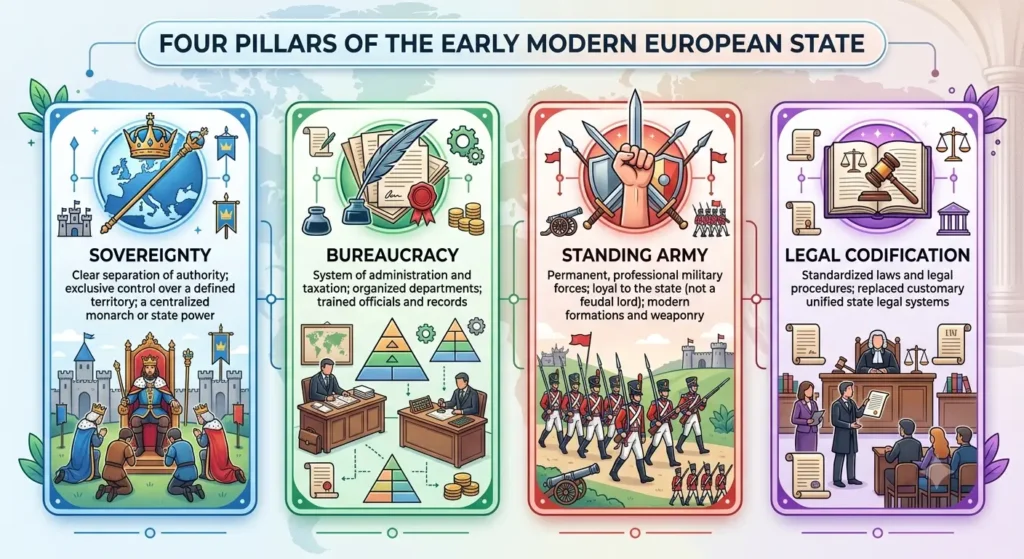
Overview of state formation and governance in early modern Europe
- Centralization of Power: Rulers worked to concentrate power in their hands, reducing the influence of nobles and local leaders — linked to the end of feudalism and the rise of nation-states.
- Sovereignty: The idea of sovereignty became more important, meaning a state had full control over its territory without outside interference.
- Bureaucratic Administration: States relied more on civil servants and tax collectors to implement policy, moving away from informal medieval systems.
- Standing Armies: Permanent military forces controlled directly by kings became a key tool for holding power.
For a formal definition of the concept, see Britannica’s entry on absolutism — useful for citing a standard academic definition in your answers.
Key features of European state systems
- Monarchy and Absolutism: Kings like Louis XIV of France held absolute power, seen as chosen by God.
- Legal Systems and Codification: Standardised legal systems emerged — the Code Napoléon later became a model for other countries.
- Religious Control and the Church: Monarchs tried to control religious institutions; the Catholic Church was central to conflicts like the Reformation.
- The Rise of Capitalist Economies: Growth of trade and capitalism influenced how states organised themselves economically.
Evolution and Development
Historical context and factors leading to the development of modern states
- Decline of Feudalism — the feudal system that organised power in medieval Europe weakened as kings gained more power.
- Religious Reformation and Wars — the Protestant Reformation, the Catholic Counter-Reformation, and the Thirty Years’ War pushed rulers toward the idea of state sovereignty, recognised in the Treaty of Westphalia (1648).
- Wars and Conflict — frequent wars required stronger military and tax systems.
- Rise of Trade and Capitalism — the rise of mercantilism gave monarchs new wealth to build state systems.
- The Enlightenment — thinkers like John Locke and Montesquieu argued for limited government and the consent of the governed.
Role of political, economic, and social changes
- Political: Absolute monarchies (France under Louis XIV) vs. constitutionalism and parliamentary power (England, especially after the English Civil War and Glorious Revolution).
- Economic: Rise of capitalist economies and global trade funded armies and state-building.
- Social: Weakening feudal structures, growing towns, and Enlightenment ideas eventually fed into revolutions like the French Revolution.
Conclusion
The development of modern states in Europe was shaped by a mix of political, economic, and social change. Centralization of power, bureaucracies, capitalism, and Enlightenment ideas together produced modern nation-states — some absolutist, some constitutional. These changes set the stage for the revolutions of the 18th and 19th centuries.
🔑 France vs England at a Glance — Comparison Table
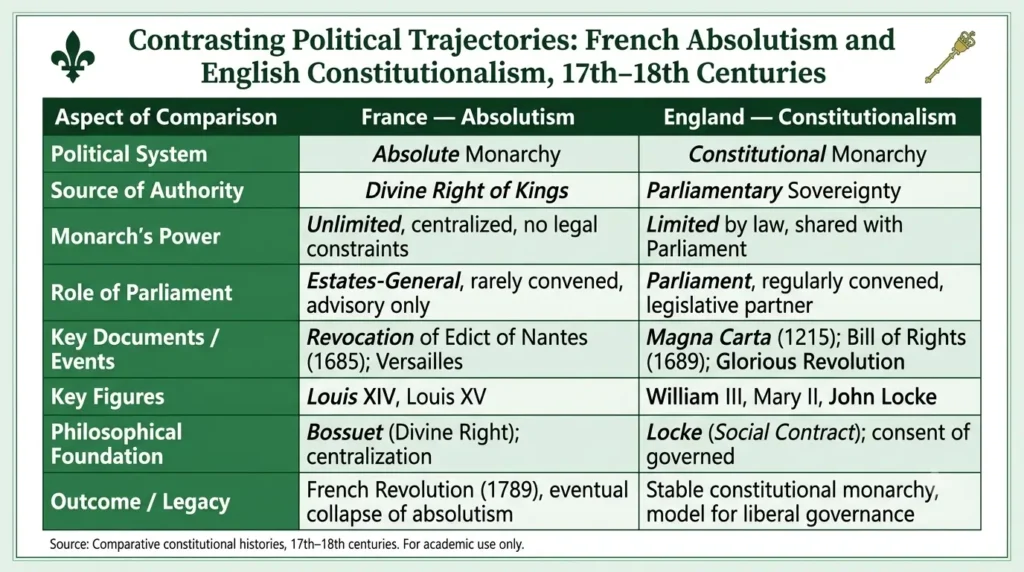
| Aspect | France | England |
|---|---|---|
| End State | Absolute Monarchy | Constitutional Monarchy |
| Key Ruler(s) | Louis XIV (“Sun King”), Henry IV, Louis XIII | Charles I, James II, William III & Mary II |
| Turning-Point Event | The Fronde (1648–53) | Glorious Revolution (1688) |
| Key Document | None (royal will = law) | Magna Carta (1215), Bill of Rights (1689) |
| Nobility’s Role | Reduced to ceremonial court life at Versailles | Retained power via the House of Lords |
| Religious Institution | Catholic Church (Edict of Nantes revoked, 1685) | Church of England / Anglican Church |
| Economic Policy | Mercantilism under Colbert | Commercial capitalism, Navigation Acts |
| Legislative Power | Concentrated in the king | Shared with Parliament (Commons + Lords) |
| Long-Term Outcome | Absolutism → French Revolution (1789) | Constitutionalism → Parliamentary democracy |
2. Case Study: France
Historical Background
Key events leading to the formation of the French state
- The Hundred Years’ War (1337–1453) — long conflict with England that centralised power under Charles VII after the Treaty of Picquigny (1475).
- The Wars of Religion (1562–1598) — civil wars between Catholics and Huguenots; ended with the Edict of Nantes (1598) under Henry IV.
- The Rise of the Bourbon Dynasty (1589) — Henry IV unified the country and strengthened the monarchy through financial reform.
- The Fronde (1648–1653) — noble uprisings against centralising power under Cardinal Mazarin; its failure made the monarchy stronger than ever.
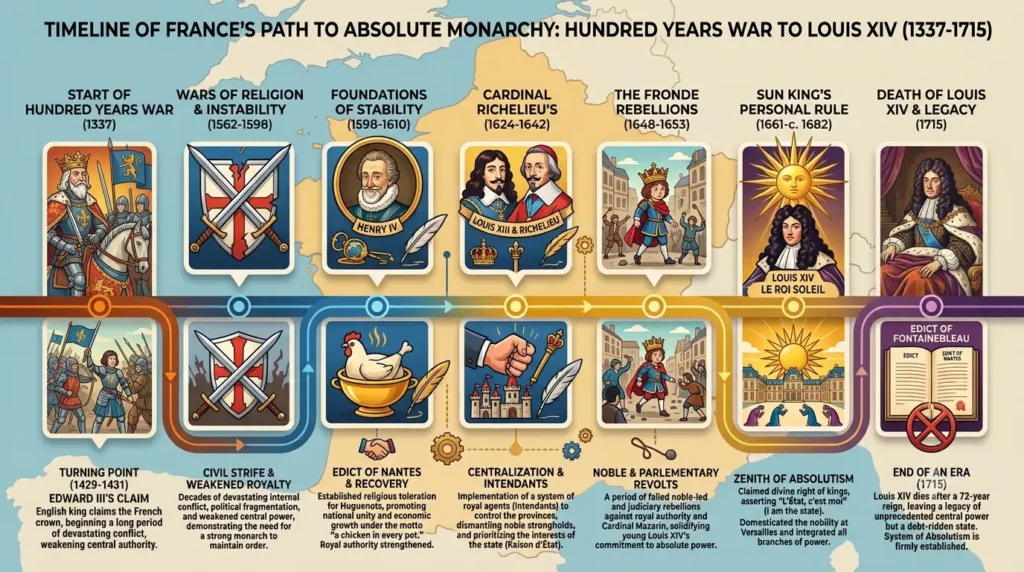
Role of monarchy and nobility
Medieval French kings relied heavily on local nobles under feudalism. The Bourbon monarchy reversed this — Henry IV and Louis XIII centralised power, and by Louis XIV‘s reign nobles were reduced to ceremonial roles at Versailles.
Centralization of Power
Development of absolute monarchy
- Divine Right of Kings — the belief that royal power came directly from God, making royal rule unquestionable.
- Louis XIV’s Reign (1643–1715) — after the Fronde, Louis XIV vowed never to share power again, famously declaring “L’État, c’est moi.” Read a full academic profile on Britannica: Louis XIV for further reference.
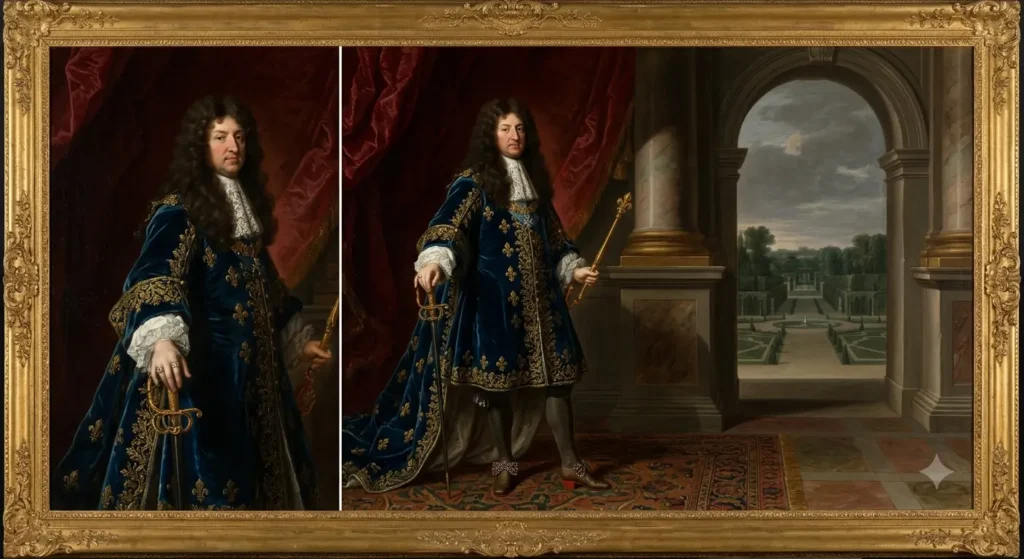
Key monarchs and their contributions
- Henry IV (1589–1610) — issued the Edict of Nantes; focused on economic recovery.
- Louis XIII (1610–1643) — relied on Cardinal Richelieu, who weakened noble power and Huguenot strongholds.
- Louis XIV (1643–1715) — the peak of absolutism; built Versailles, expanded French territory, created a professional army, and governed through royal intendants.
Administrative and bureaucratic reforms
- Intendants — royal officials who enforced policy and collected taxes, bypassing noble authority.
- Jean-Baptiste Colbert — implemented mercantilist economic control, state-run industries, and import tariffs.
- Royal Court at Versailles — kept nobles dependent on royal favour.
- Standing Army — placed under direct royal command.
Conclusion
The growth of centralized power in France peaked under Louis XIV, who combined administrative reform, military control, and cultural patronage to build one of Europe’s most powerful states.
Economic Policies and Trade
Development of mercantilism
Mercantilism guided France’s economy under Louis XIV. Colbert supported local industries, controlled trade, and invested in infrastructure like canals and roads.
Impact on domestic and international trade
Domestic policy cut imports and boosted local production (helping textiles, but burdening peasants with heavy taxes). Internationally, France built the French East India Company and French West India Company to manage colonial trade.
Role of colonial expansion
French colonies in the Caribbean (Saint-Domingue, Martinique) produced sugar, coffee, and tobacco; French traders also competed with the British and Dutch in the Indian Ocean.
Social and Cultural Impact
Influence of the state on society and culture
Louis XIV centralised both political and social power — nobles were drawn into court rituals at Versailles that kept them loyal and dependent.

Role of religion and the Catholic Church
The Revocation of the Edict of Nantes (1685) aimed for religious unity but led to the persecution of Huguenots and loss of skilled workers.
Cultural achievements and contributions
France became the centre of Baroque art and architecture. Louis XIV supported Molière, Racine, French opera, and founded the Royal Academy of Sciences (1666).
Conclusion
Louis XIV’s mercantilist economy, centralised monarchy, and Baroque cultural patronage together made France the model of absolute power and cultural dominance in 17th-century Europe.
3. Case Study: England
Historical Background
Key events leading to the formation of the English state
- Norman Conquest (1066) — William the Conqueror established a unified feudal state.
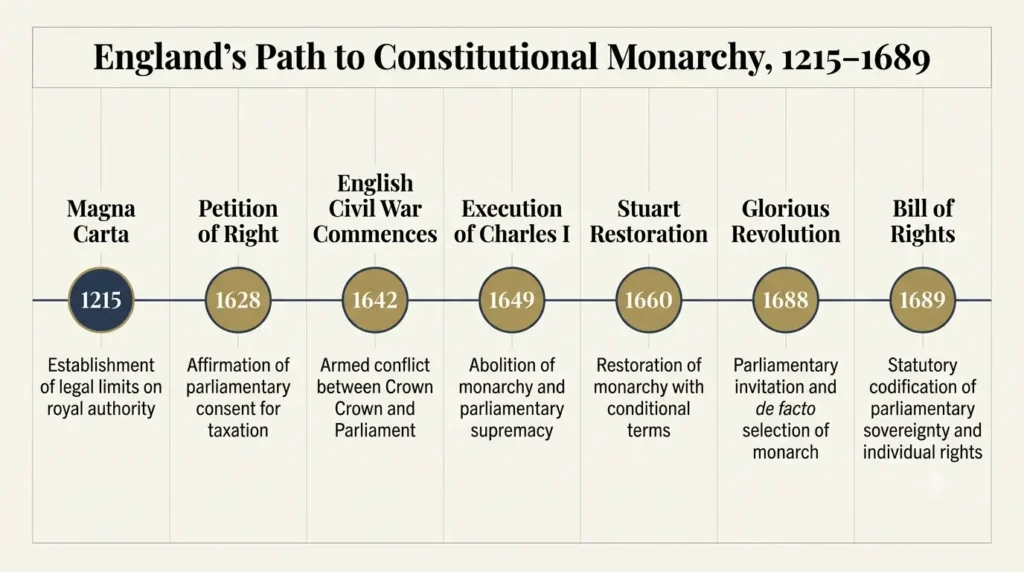
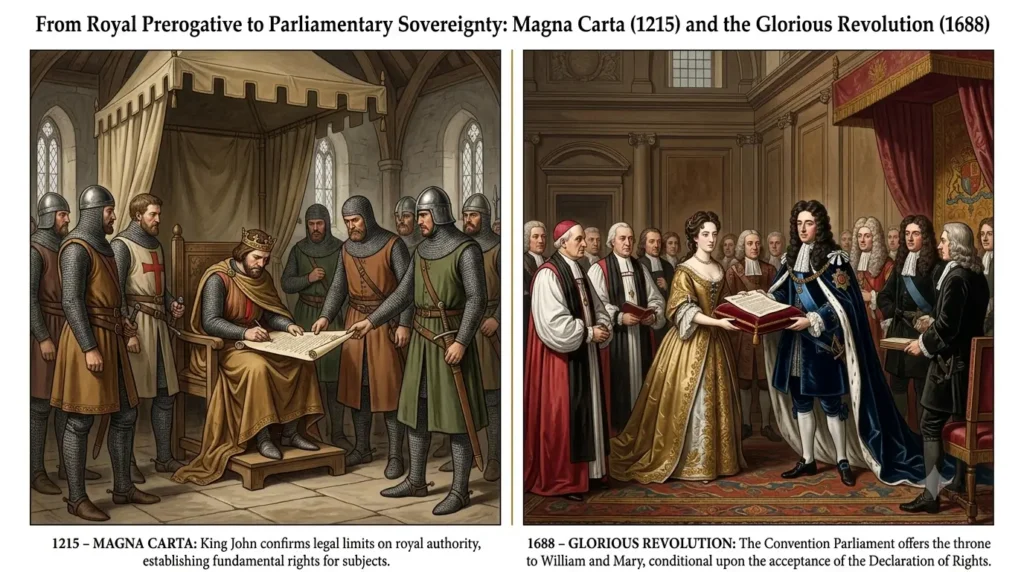
- Magna Carta (1215) — King John was forced to limit royal power, beginning England’s path toward constitutional law. See the official record via the UK Parliament: Magna Carta overview.
- The English Civil War (1642–1651) — conflict between Charles I and Parliament ended with the king’s execution and the Commonwealth under Oliver Cromwell.
- Restoration and Glorious Revolution (1660–1688) — the monarchy returned in 1660; James II‘s removal in 1688 marked the start of constitutional monarchy. Read more via Britannica: Glorious Revolution.
Role of monarchy and parliament
Royal power after the Norman Conquest was strong but was gradually shared with nobles (Magna Carta) and then with Parliament, especially after the Civil War and the Bill of Rights.
Political Developments
Evolution of constitutional monarchy
England’s shift toward constitutional monarchy happened gradually, through a chain of documents and crises rather than a single event.
Key events and documents
- Magna Carta (1215) — limited royal taxation power and granted legal rights to free men.
- Petition of Right (1628) — barred taxation without Parliament’s consent.
- The English Civil War (1642–1651) — Parliament’s victory over the Royalists.
- The Glorious Revolution (1688) — peaceful removal of James II; William and Mary took the throne.
- Bill of Rights (1689) — monarchy could not rule without Parliament’s consent.
Development of parliamentary democracy
The House of Lords and House of Commons gained growing control over taxation and law. The 18th century saw the rise of the Whigs and Tories, the Acts of Union (1707), and the office of Prime Minister.
Conclusion
England’s constitutional monarchy developed through the Magna Carta, the Petition of Right, the Civil War, and the Bill of Rights — shifting power steadily from the Crown to Parliament.
Economic Policies and Trade
Development of commercial and industrial economy
Between the 16th and 17th centuries, England moved from a feudal to a commercial and industrial economy, driven by global trade and better farming methods under the Tudors and Stuarts.
Impact on domestic and international trade
Cities like London, Liverpool, and Bristol grew as trading hubs. The Navigation Acts required colonial goods to travel on English ships, cementing England’s control of colonial trade.
Role of colonial expansion
Colonies in North America, the Caribbean, and India supplied raw materials; trade monopolies were granted to companies like the East India Company. This wealth helped establish the Bank of England (1694).
Social and Cultural Impact
Influence of the state on society and culture
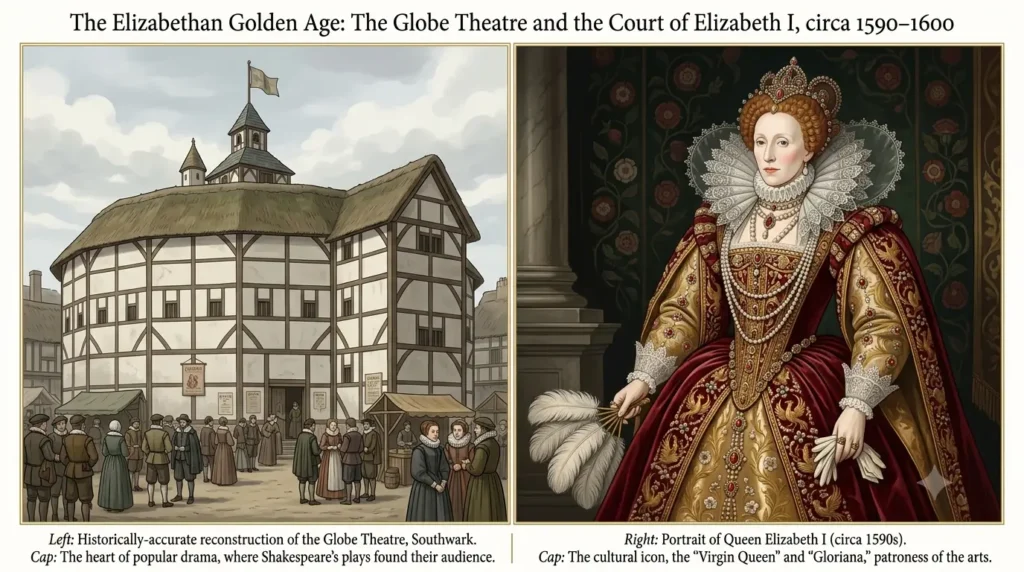
Monarchs like Henry VIII and Elizabeth I shaped English society; the Elizabethan era saw a boom in theatre, literature, and art.
Role of religion and the Anglican Church
The English Reformation under Henry VIII split England from Rome, forming the Church of England. Elizabeth I later established Protestantism as the social foundation, while Puritans later fuelled tensions leading to the Civil War.
Cultural achievements and contributions
The Elizabethan era produced William Shakespeare and the Globe Theatre; the Scientific Revolution brought Isaac Newton and Francis Bacon to prominence.
Conclusion
England’s shift from a farming economy to a commercial and industrial power, alongside Anglican religious influence and a literary golden age, laid the foundation for the modern British state.
📝 Previous Year Questions (DU History — Rise of the Modern West-I, Semester III)
Based on actual DU CBCS and IGNOU-equivalent question papers on this unit, expect questions in these formats:
- “The emergence of the European state system represented a paradox between feudal and capitalist forces.” Explain with reference to England, France, Russia, or Spain. (DU Semester III, CORE paper)
- Discuss the nature of state and politics in England and France in the 18th century.
- Compare the process of state formation in France and England during the early modern period.
- What were the main features of Absolutism? Discuss with reference to France under Louis XIV.
- Trace the evolution of constitutional monarchy in England from the Magna Carta to the Bill of Rights.
- Write short notes on: (a) The Fronde (b) The Glorious Revolution (c) Mercantilism under Colbert (d) The Petition of Right
💡 Exam tip: Most DU questions on this unit ask you to compare France and England rather than describe them separately — use the comparison table above directly in your answer structure for full marks.
❓ Frequently Asked Questions
What is the difference between absolute monarchy and constitutional monarchy?
In an absolute monarchy (like France under Louis XIV), the king holds total power with no legal limits. In a constitutional monarchy (like England after 1689), royal power is limited by law and shared with an elected Parliament.
Why did France become an absolute monarchy while England became a constitutional monarchy?
France’s monarchy successfully suppressed noble resistance (the Fronde) and centralised power through bureaucracy and a standing army. England’s monarchy, by contrast, faced sustained resistance from Parliament — through the Magna Carta, Civil War, and Glorious Revolution — that permanently limited royal authority.
What was the significance of the Fronde in French history?
The Fronde (1648–1653) was a noble rebellion against royal centralisation. Its failure convinced Louis XIV to never share power again, directly leading to the height of French absolutism.
What was the Glorious Revolution and why does it matter?
The Glorious Revolution (1688) was the peaceful removal of King James II and the installation of William III and Mary II, who accepted the Bill of Rights (1689). It marked the permanent shift of England toward constitutional, Parliament-limited monarchy.
Who was Jean-Baptiste Colbert?
Colbert was Louis XIV’s finance minister who implemented mercantilist policies — protecting French industries, controlling trade, and building infrastructure to make France economically self-sufficient.
What are the most important PYQs from this unit for DU exams?
The most repeated question type asks you to compare France and England’s state formation directly, or to discuss absolutism using France as the primary example. See the Previous Year Questions section above for exact past paper phrasing.
Important Links
Subscribe to keep reading
You've used your free notes for now. Get Delhi Pathshala Premium for unlimited access.
Subscribe — ₹29/30 days