

Contents
- Key Terms You Must Know
- Introduction
- 1. Shift of Economic Balance from the Mediterranean to the Atlantic
- Overview of the Economic Changes
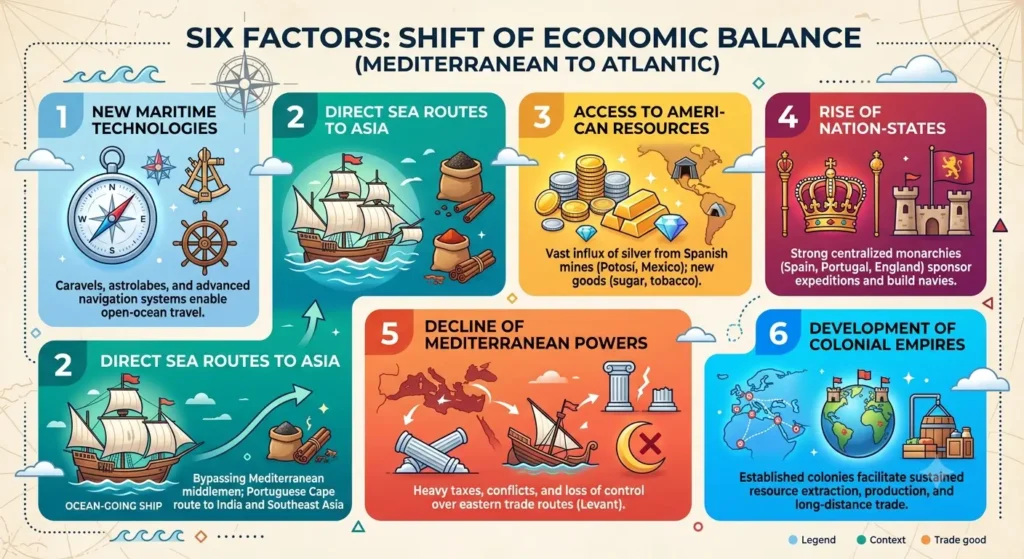
- Factors Contributing to the Shift
- 2. Decline of Mediterranean Trade Dominance
- Impact of the Ottoman Empire on Mediterranean Trade Routes
- Decline of Italian City-States (Venice, Genoa)
- Effects on Mediterranean Economies
- 3. Rise of Atlantic Trade
- Exploration and Discovery of the New World
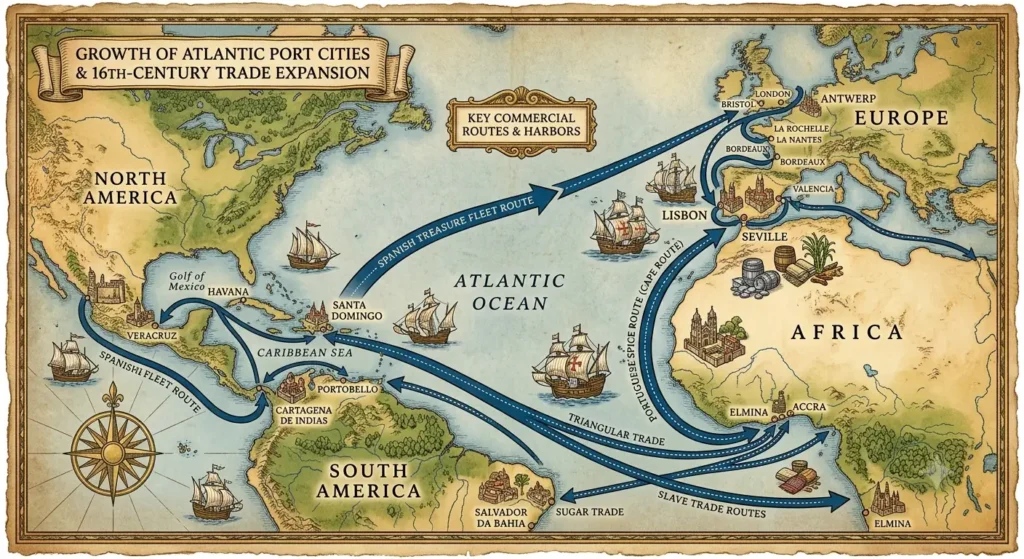
- Key Maritime Powers
- The Triangular Trade
- 4. Impact on European Economies
- Growth of Port Cities
- Commercial Innovations
- Shifts in Power Dynamics
- Mediterranean Economy vs Atlantic Economy — Quick Comparison
- 5. The Price Revolution
- Causes of the Price Revolution
- Economic Consequences
- Long-Term Implications
- Important Exam-Oriented Questions (DU Pattern)
- ❓ Frequently Asked Questions (FAQ)
Unit V Notes | DSC-2: Rise of the Modern West – I | B.A. (Hons.) History, Semester 3
📌 Quick Summary (TL;DR): During the sixteenth century, Europe’s economic centre shifted from the Mediterranean (Venice, Genoa, Constantinople) to the Atlantic (Lisbon, Seville, Antwerp, Amsterdam). This happened due to the discovery of the Americas, Ottoman control over Mediterranean trade routes, and new navigation technology. The same period also saw the Price Revolution — a long inflationary cycle caused mainly by the influx of American silver — which reshaped European economies, social classes, and eventually laid groundwork for modern capitalism.
Key Terms You Must Know
| Term | Meaning |
|---|---|
| Commercial Revolution | The wave of financial/trade innovations (banking, joint-stock companies, credit) that supported large-scale Atlantic trade |
| Price Revolution | Sustained inflation in 16th-century Europe, mainly driven by the influx of American silver and gold |
| Triangular Trade | The trade cycle connecting Europe (goods) → Africa (enslaved people) → the Americas (raw materials) |
| Debasement of Currency | Reducing the precious metal content in coins to stretch limited silver supply |
| Mercantilism | An economic policy focused on maximising exports and state wealth through trade control |
Introduction
During the sixteenth century, Europe experienced significant changes in its economic landscape. The centre of economic power, which had traditionally revolved around the Mediterranean — particularly Italy, Spain, and the eastern Mediterranean — began shifting towards the Atlantic. This transformation followed closely on the heels of the European Reformation and the broader intellectual churn of the Renaissance, and it marked the beginning of a new economic era that would come to define the modern West.
The Mediterranean world had been the heart of European commerce for centuries, with cities like Venice, Genoa, and Constantinople acting as vital trade hubs. But as new maritime routes opened and global exploration expanded horizons, the Atlantic Ocean became the new centre of European economic activity — driven by geographical discoveries, technological advancement, and shifting political dynamics. According to the Encyclopaedia Britannica’s overview of the Age of Discovery, this reorientation of trade routes was one of the defining economic transitions of early modern Europe.
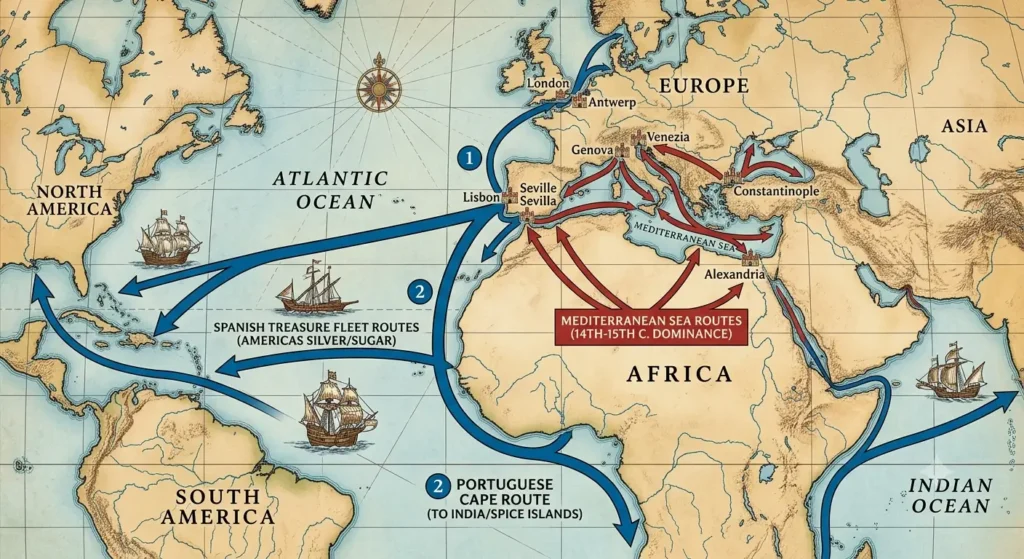
1. Shift of Economic Balance from the Mediterranean to the Atlantic
Overview of the Economic Changes
The sixteenth century, often called the Age of Exploration, was characterised by:
- Expansion of Global Trade – European explorers, particularly from Spain and Portugal, opened new sea routes to Africa, the Americas, and Asia, enabling exchange of spices, gold, silver, and other commodities.
- The Rise of the Atlantic Economy – The 1492 discovery of the Americas by Christopher Columbus and subsequent colonisation led to a massive influx of precious metals into Europe.
- Commercial Revolution – New banking practices, joint-stock companies, and expanded credit systems supported large-scale commercial ventures.
- Shift in Power and Wealth – Spain and Portugal became dominant early on, but the Netherlands, England, and France gradually rose to prominence.
Factors Contributing to the Shift
- Geographical Discoveries and Exploration – Voyages by Columbus, Vasco da Gama, and Ferdinand Magellan opened Atlantic and Asian trade routes, bypassing Ottoman-controlled Mediterranean paths.
- Discovery of the Americas – Silver and gold extracted from the Americas flowed into Europe through Seville, Lisbon, and later Amsterdam.
- Technological Advancements in Navigation – The compass, astrolabe, and caravel ship design enabled longer, safer ocean voyages.
- Decline of Mediterranean Dominance – Ottoman control over Constantinople and the Levant pushed European traders to seek alternative routes.
- Changes in the European Political Landscape – Competition for colonies drove Spain, Portugal, England, France, and the Netherlands into the race for maritime empire.
- Rise of Capitalism and Commercial Practices – Growth of the merchant class and joint-stock companies financed voyages, colonies, and trade routes.
Conclusion: The shift of economic balance from the Mediterranean to the Atlantic was the combined result of exploration, technological advancement, changing commercial practices, and the decline of Mediterranean dominance — laying the foundation for the modern global economy.
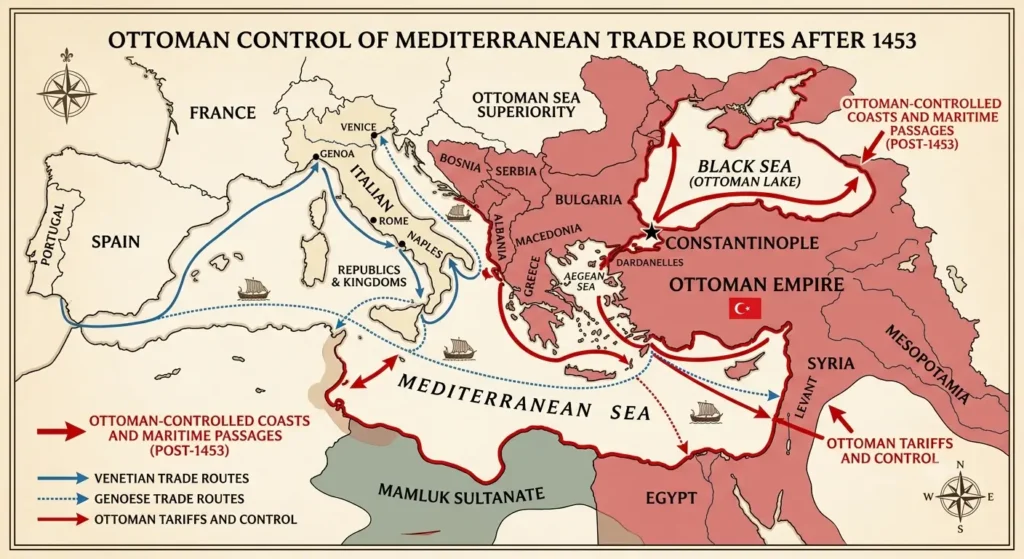
2. Decline of Mediterranean Trade Dominance
Impact of the Ottoman Empire on Mediterranean Trade Routes
The Ottoman Empire’s conquest of Constantinople in 1453 gave it control over critical land routes and ports essential to Europe–Asia trade.
- Control of Strategic Routes – Ottomans controlled the eastern Mediterranean, forcing European merchants to rely on Ottoman-regulated routes for spices, silk, and luxury goods.
- Taxation and Tariffs – Heavy taxes on goods passing through Ottoman territory made Mediterranean trade less profitable.
- Blocking of Alternative Routes – Ottoman monopolisation of key ports pushed Europeans to seek new routes altogether.
Decline of Italian City-States (Venice, Genoa)
- Rise of the Ottoman Empire weakened Venice’s and Genoa’s grip on eastern trade.
- Competition from the Atlantic diverted trade and investment westward.
- Internal Struggles — costly wars and political fragmentation drained resources.
- Shift in Financial Practices — banks and joint-stock companies in Antwerp and Amsterdam began attracting European investors.
Effects on Mediterranean Economies
- Economic Stagnation in Venice, Genoa, and Barcelona
- Declining Maritime Power of Italian merchant fleets
- Loss of Strategic Trade Routes as intermediaries between Europe and Asia
- Shift in Wealth toward Seville, Lisbon, Antwerp, and Amsterdam
- Decline in Cultural and Artistic Patronage, affecting the later Italian Renaissance
3. Rise of Atlantic Trade
Exploration and Discovery of the New World
Columbus’s 1492 voyage (sponsored by Spain) aimed to find a westward route to Asia but instead led to the European “discovery” of the Americas, triggering colonisation and sustained transatlantic contact.
- Spanish and Portuguese colonies became major sources of gold and silver, especially from mines in present-day Bolivia and Mexico.
- Technological advances — compass, astrolabe, caravel — made reliable transatlantic voyages possible.
Key Maritime Powers
| Power | Contribution |
|---|---|
| Portugal | Opened sea route to India (Vasco da Gama, 1498); secured Brazil via the Treaty of Tordesillas (1494) |
| Spain | Controlled vast silver mines at Potosí and Zacatecas; ran the Spanish treasure fleet system |
| England | Colonised Jamestown (1607) and Plymouth (1620); exported tobacco, cotton, sugar |
| France | Explored Canada (Jacques Cartier); established Caribbean colonies like Saint-Domingue |
The Triangular Trade
A trade cycle connecting three continents:
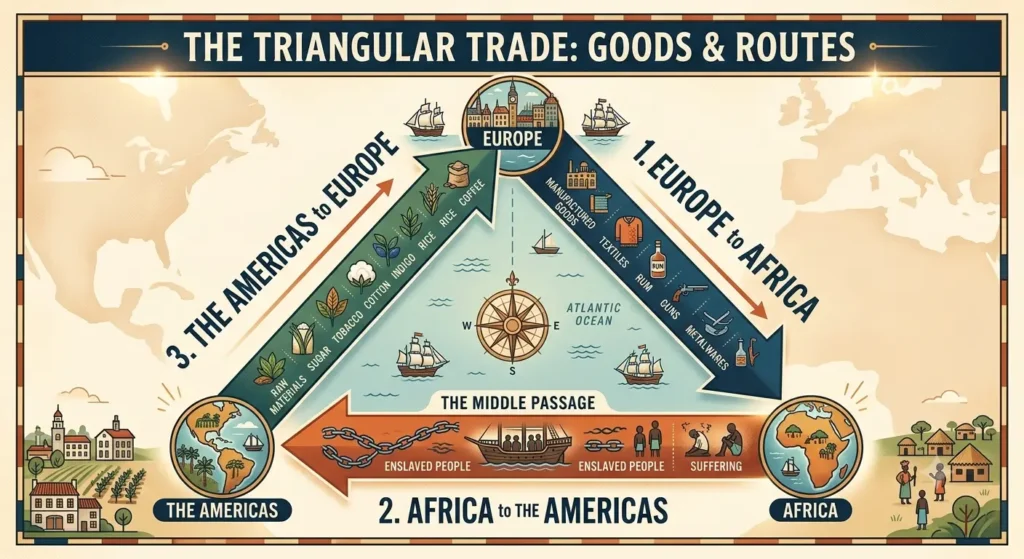
- Europe → Africa: manufactured goods (textiles, guns, liquor)
- Africa → Americas: forced transportation of enslaved Africans
- Americas → Europe: raw materials (sugar, tobacco, cotton) produced through slave labour
This system, along with the growth of joint-stock companies like the Dutch and British East India Companies, pooled capital for long-distance trade ventures and directly shaped the trajectory of European colonialism in Asia.
4. Impact on European Economies
Growth of Port Cities
| City | Role |
|---|---|
| Lisbon | Commercial hub for wealth from Brazil, Africa, Asia |
| Seville | Primary port for Spanish treasure fleets |
| Amsterdam | Financial capital of Europe; home to the Amsterdam Stock Exchange (1602) |
| London | Centre for trade in tobacco, sugar, cotton from the colonies |
| Bordeaux | Hub for wine trade and Caribbean commerce |
Commercial Innovations
- Joint-Stock Companies – Dutch East India Company (1602), British East India Company (1600)
- Stock Exchanges – Amsterdam Stock Exchange enabled trading of shares and bonds
- Expansion of Credit – The Medici Bank and later the Bank of England financed maritime ventures
Shifts in Power Dynamics
The decline of Mediterranean cities like Venice, Genoa, and Milan coincided with the rise of Spain, Portugal, the Netherlands, and England as new economic powerhouses — though Spain’s wealth from silver also fed into the inflation discussed in the next section. As explored further in European State Systems: France and England, this economic shift went hand-in-hand with the rise of centralised nation-states.
Mediterranean Economy vs Atlantic Economy — Quick Comparison
| Aspect | Mediterranean Economy (Pre-16th century) | Atlantic Economy (16th century onward) |
|---|---|---|
| Key Cities | Venice, Genoa, Constantinople | Lisbon, Seville, Antwerp, Amsterdam, London |
| Controlling Powers | Italian city-states, Ottoman Empire | Spain, Portugal, later Netherlands, England, France |
| Main Trade Goods | Spices, silk, luxury goods via land/sea routes to Asia | Silver, gold, sugar, tobacco, cotton, enslaved labour |
| Trade Routes | Overland + Mediterranean sea routes, Ottoman-controlled | Transatlantic sea routes, Triangular Trade |
| Financial Centre | Venice, Genoa (early banking) | Antwerp → Amsterdam (stock exchange, joint-stock companies) |
| Decline Trigger | Ottoman conquest of Constantinople (1453) | — (rose to dominance) |
| Long-term Outcome | Economic stagnation, reduced cultural patronage | Foundation for modern capitalism and global trade networks |
5. The Price Revolution
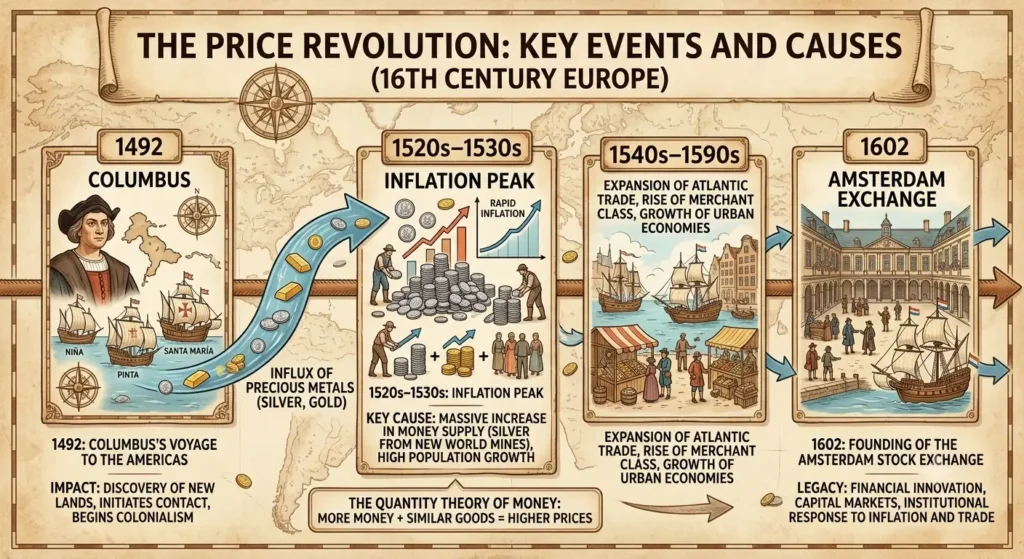
The Price Revolution refers to a period of sustained inflation in Europe roughly between the 1500s and 1650s, marked by a sharp rise in the price of food, land, and wages.
Causes of the Price Revolution
- Influx of Precious Metals – Massive silver imports from Potosí (Bolivia) and Zacatecas (Mexico) increased Europe’s money supply, devaluing currency.
- Population Growth – Rising population increased demand for food and goods faster than supply could keep pace.
- Agricultural Shifts – The shift toward cash crops (like wool) reduced staple food output, pushing grain prices higher.
- Expansion of Trade Networks – Growing demand for New World and Asian commodities added further inflationary pressure.
Economic Consequences
- Landlords/Aristocracy – Generally benefited from rising land values and rents.
- Peasants and Urban Poor – Hit hardest; wages failed to keep pace with rising costs, fuelling unrest such as the German Peasants’ War (1524–25).
- Merchants/Bourgeoisie – Profited by selling at inflated prices and repaying debts in devalued currency.
- Governments – Responded through currency debasement, price controls, and (largely ineffective) wage regulation.
Long-Term Implications
- Accelerated the decline of feudalism and rise of a cash-based economy.
- Encouraged development of new financial instruments — bills of exchange, letters of credit, banking institutions.
- Fed directly into the rise of mercantilism and, eventually, modern capitalism — a theme carried forward in Mercantilism and European Economies: Trade and Empire.
- Intensified social stratification, deepening the gap between landowners and the urban/rural poor.
For a deeper economic-history treatment of this inflationary cycle, see the Economic History Society’s overview of European price trends (Economic History Review, referenced by leading historians such as E. J. Hamilton).
Important Exam-Oriented Questions (DU Pattern)
These are the most frequently repeated/expected question types for this unit in DU semester exams — use them for quick revision and answer-writing practice.
1. Price Revolution (causes/factors + impact)
- Critically examine the monetary and non-monetary factors which caused the Price Revolution and assess its varied impact on sixteenth century Europe. (Paper 1722, Q7)
- Assess the causes and impact of the Price Revolution. (Paper 12311347-OC, Q5)
- Outline the causative factors that led to the Price Revolution. What was its impact on the European economy? (Paper 4499, Q7)
- What were the causes and consequences of the Price Revolution in sixteenth century Europe? (Paper 573, Q7)
- Discuss the main features of the Spanish and Italian economies in the 16th century. What was the impact of Price Revolution on these regions? (Paper 12311347-New, Q5 — combined question)
2. Economic trends/developments in Italy & Spain (16th century) — 4 baar
- Outline the main economic trends in Italy and Spain in the sixteenth century. (Paper 1722, Q6)
- Discuss the major economic developments associated with either 16th century Italy & Spain or England & Netherlands. (Paper 573, Q6)
- Analyze the main economic developments of 16th century Western Europe. (Paper 4499, Q6)
- Discuss the main features of the Spanish and Italian economies in the 16th century… (Paper 12311347-New, Q5 — same as above overlap)
3. Shift of economic balance: Mediterranean → Atlantic
- Give a brief account of the shift of economic balance from the Mediterranean to the Atlantic in the 16th century Europe. (Paper 5303, Q6)
4. Commercial Revolution
- Assess the significance of the Commercial Revolution in 16th century Europe. (Paper 5303, Q7)
Sample Questions:
- Discuss the shift of economic balance from the Mediterranean to the Atlantic during the sixteenth century.
- What role did the Ottoman Empire play in the decline of Mediterranean trade dominance?
- Examine the causes and consequences of the Price Revolution in sixteenth-century Europe.
- How did the discovery of the Americas affect the European economy?
- Write a note on the growth of Atlantic port cities during the sixteenth century.
- Explain the Triangular Trade and its significance in the Atlantic economy.
- “The Price Revolution was a major catalyst for the rise of capitalism in Europe.” Discuss.
- Analyse the impact of the Price Revolution on different social classes in Europe.
❓ Frequently Asked Questions (FAQ)
Why did the economic balance shift from the Mediterranean to the Atlantic in the 16th century?
Mainly due to the discovery of the Americas, Ottoman control over Mediterranean trade routes after 1453, and advances in navigation technology that made transatlantic voyages possible.
What was the Price Revolution?
A prolonged period of inflation in Europe (roughly 1500–1650) driven largely by the massive influx of American silver and gold, along with population growth and agricultural shifts.
Which cities benefited most from the rise of Atlantic trade?
Lisbon, Seville, Antwerp, Amsterdam, and London emerged as the new commercial and financial centres of Europe.
How did the Price Revolution affect peasants and the urban poor?
Wages failed to keep pace with rising prices, leading to declining living standards and contributing to unrest such as the German Peasants’ War (1524–25).
What is the Triangular Trade?
A three-way trade system connecting Europe (manufactured goods), Africa (enslaved people), and the Americas (raw materials like sugar, tobacco, and cotton).
How is this unit relevant to DSC-2 exams?
This unit (Unit V of Rise of the Modern West – I) is frequently tested through long-answer questions on the shift of economic balance and the Price Revolution — both covered in detail above with DU-pattern practice questions.
Related Unit Notes: ← Origins, Course, and Results of the European Reformation | European State Systems: France, England →
Explore More: DSC-2: Rise of the Modern West – I (All Units) | BA History Hons DU Notes | DU Syllabus 2024
Subscribe to keep reading
You've used your free notes for now. Get Delhi Pathshala Premium for unlimited access.
Subscribe — ₹29/30 days