
Contents
- 1. Issues and Debates
- Nature of Feudalism
- Definition and characteristics of feudalism
- Main features of feudalism
- Economic and social structures
- Economic structure
- Social structure
- Key terms at a glance
- Factors Leading to the Decline of Feudalism
- Economic changes and crises
- A. Growth of trade and towns
- B. The Black Death (1347–1351)
- C. Rise of money and banking
- Social and political upheavals
- A. Rise of monarchies
- B. The Hundred Years’ War (1337–1453)
- C. Peasant uprisings and social unrest
- Timeline for revision
- Emergence of Capitalism
- Key features and principles of capitalism
- A. Private ownership
- B. Market economy
- C. Profit motive
- D. Wage labour
- Role of trade and commerce
- A. Growth of trade routes
- B. Rise of mercantilism
- C. Banking and credit
- D. Commercial Revolution
- Impact of technological innovations
- A. Agricultural innovations
- B. The Industrial Revolution
- C. Innovations in transportation
- D. Communication advances
- Debates on Feudalism and Capitalism
- Historical interpretations and perspectives
- Marx’s starting point
- Pirenne and the commercial model
- The Dobb–Sweezy debate
- The demographic model: Postan, Habakkuk, Le Roy Ladurie
- The Brenner debate
- Wallerstein and the world-system
- Weber and the cultural argument
- Braudel and layered capitalism
- Other readings for depth
- Comparison of the main positions
- Controversies and differing viewpoints
- A. Was there a single, coherent “feudalism”?
- B. The role of the bourgeoisie
- C. When did the transition happen?
- D. One road or many?
- E. How should capitalism itself be defined?
- 2. Question of Eurocentrism
- Definition and Concept of Eurocentrism
- Explanation of Eurocentrism in historical studies
- A. Where it comes from
- B. Europe as the focus of world history
- C. Eurocentric views in specific historical events
- Critiques and limitations
- A. Ignoring non-European histories
- B. Bias in knowledge creation
- C. Simplified and inaccurate history
- D. Need for inclusive knowledge
- Eurocentric Views on Feudalism and Capitalism
- Traditional Eurocentric narratives
- A. Feudalism as a European norm
- B. Capitalism as a European evolution
- Examples of Eurocentric interpretations
- A. Feudalism as necessary for European development
- B. Capitalism as a product of European exceptionalism
- C. The Industrial Revolution as Europe’s defining moment
- How Eurocentrism Shapes the Transition Debate
- Challenges to Eurocentrism
- Alternative perspectives and approaches
- A. Postcolonialism and changing history
- B. World-systems theory
- C. Subaltern studies
- Contributions of non-European scholars and historians
- A. African historiography
- B. Asian and Middle Eastern historians
- C. Latin American perspectives
- Impact on understanding global history
- A. Recognition of multiple histories and contributions
- B. More inclusive historical narratives
- C. Global interconnectedness
- D. Rethinking capitalism and development
- Contemporary Relevance
- Conclusion
- Continue Reading
- University of Delhi Previous Year Questions
- Long Answer Questions
- Short Answer Questions
- FAQs
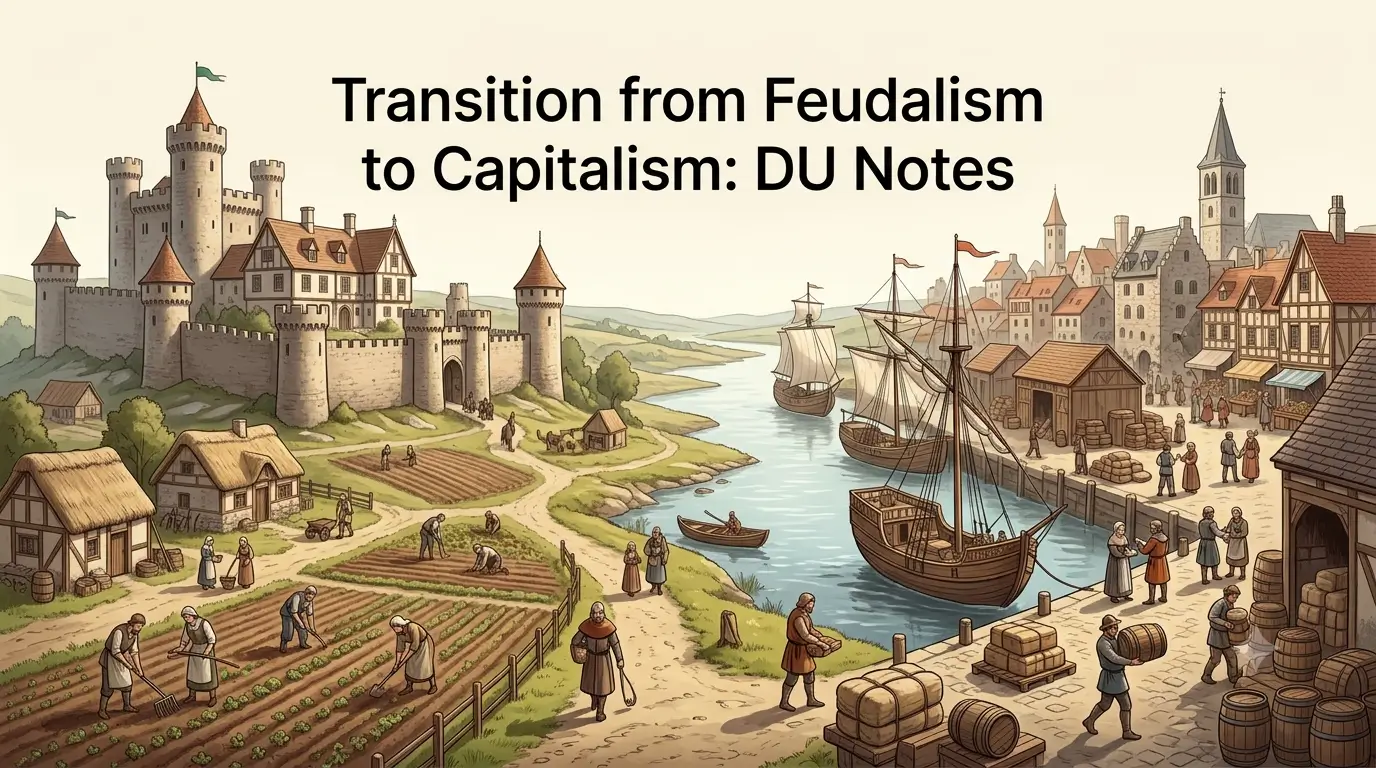
Unit 1 of DSC-2: Rise of the Modern West – I asks two linked questions. Why did the feudal order of medieval Europe give way to capitalism? And how far does our answer depend on telling that story from a European vantage point alone? College teaching plans for the paper at the University of Delhi describe the unit in exactly these terms: first “issues and debates” on the transition, then the “question of Eurocentrism.”
These notes first build the factual ground (what feudalism was, why it weakened, how capitalist practices emerged) and then spend more time on what examiners usually reward: the historians’ debate over what drove the change, and the critique of Eurocentrism. Wherever scholars disagree, the notes name them and state their positions instead of presenting one version as settled.
Quick answer: what is the transition from feudalism to capitalism? It is the long, uneven process in Western Europe (broadly the 12th to the 18th century, with large regional differences) by which an economy built on lord-held land, peasant labour services and customary dues was replaced by one built on private property, market competition, wage labour and profit-making. Historians disagree about the “prime mover”: internal class conflict (Dobb, Brenner), expanding trade (Pirenne, Sweezy), population cycles (Postan) or a wider world-system (Wallerstein).
How to use these notes: read Section 1 for the argument, use the comparison table in Section 1 for revision, then read Section 2 so that you can link Eurocentrism back to the transition debate in a single answer. The Previous Year Questions and FAQs at the end show how the unit has been asked.
1. Issues and Debates
Nature of Feudalism
Feudalism was a system of landholding, loyalty and military service that organised power in much of medieval Europe. Historians usually trace its characteristic relationships from about the 9th and 10th centuries (after the break-up of the Carolingian order) to the late Middle Ages. It did not end everywhere at once: in parts of Eastern Europe, serfdom survived long after it had faded in the west, and in Russia it was abolished only in 1861.
Definition and characteristics of feudalism
Feudalism is the way power, wealth and land were distributed in much of medieval Europe. Land was granted in return for military help, labour or loyalty. Two quite different definitions are used by historians, and it helps to know both because the transition debate often turns on which one is meant.
| Approach | What “feudalism” means | Associated with |
|---|---|---|
| Legal–military (narrow) | A set of lord–vassal ties: a vassal swears homage and fealty and receives a fief in return for military service and counsel | F. L. Ganshof and the older constitutional tradition |
| Socio-economic (broad) | A whole society in which lords live off the surplus of a dependent peasantry, extracted through rents, labour services and other dues backed by legal and political power (“extra-economic coercion”) | Marc Bloch (as a total social structure) and Marxist historians such as Maurice Dobb and Rodney Hilton |
The older textbook picture of feudalism has also been challenged. Elizabeth A. R. Brown (1974) and Susan Reynolds (1994) argued that “feudalism” is a later construct that historians imposed on a much messier medieval reality. This is a separate question from the transition debate, but it explains why modern historians are careful with the word.
Main features of feudalism
Decentralised power
- Shared power: Unlike a strong central government, feudalism had many lords who shared control of the land. Kings had limited power in practice and depended on these lords for armies and administration.
- Fiefs: Land was the main source of wealth and was granted to vassals (lesser lords) in return for service. The grant, called a fief, could in time become hereditary.
Social levels
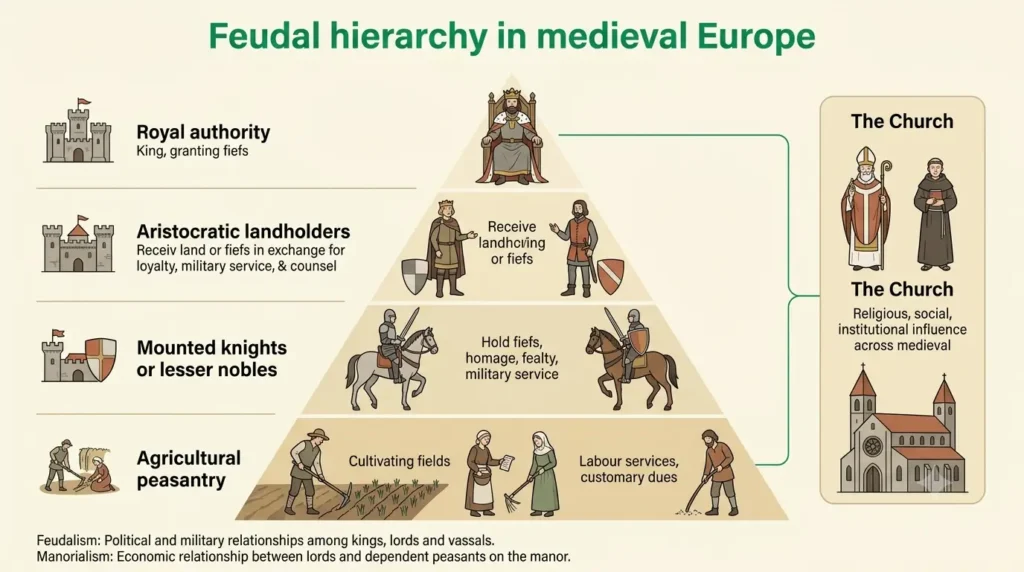
- The king was at the top, followed by great nobles, then lesser lords and vassals (knights among them), and at the bottom the peasantry, free and unfree.
- Each level owed duties to those above and below. Medieval writers summed this up as the “three orders”: those who pray (clergy), those who fight (nobility) and those who work (peasants).
Loyalty and service
- A vassal promised loyalty and military service to a lord in return for land.
- The bond was sealed through ceremonies of homage and an oath of fealty. Personal obligation, not impersonal law, held the system together.
Manorialism
- Feudalism was closely linked to manorialism, in which the manor, a large estate, was the basic unit of agrarian production. Feudalism describes the political and military ties among the elite; manorialism describes the economic relationship between lord and peasant. The two overlapped but were not identical.
- A typical manor had a demesne (land farmed directly for the lord) and holdings worked by peasants. Peasants worked the lord’s land for part of the week (labour services), paid dues in kind or in money, and in return received protection and access to land.
Economic and social structures
Economic structure
Land as wealth
- Land was the main source of wealth and power. Kings granted large territories to great nobles, who granted smaller portions to vassals. Most people lived and worked on the land.
Farming and the limits of self-sufficiency
- The economy was overwhelmingly agrarian. Manors produced most of the food and basic goods their people needed, usually in an open-field system with a rotation of crops and fallow.
- Self-sufficiency was never complete. Salt, iron, millstones and luxuries had to be bought, and markets and fairs (the Champagne fairs of the 12th and 13th centuries are the best-known example) linked regions.
Money and exchange
- It is misleading to say that medieval Europe ran on pure barter. Coins circulated, and from the 12th century many labour services and payments in kind were commuted into money rents. The point is that money did not yet organise production the way it later would, and a great deal of exchange still took place in kind or through customary obligation.
Crafts and trade
- Long-distance trade was limited in the early centuries, but towns held local markets and supported crafts such as weaving, metalworking and building. Trade expanded sharply from the 11th century, which is one reason the economy of the later feudal period looks very different from that of the early one.
Social structure
The king
- The king stood at the top and was, in theory, the ultimate lord of the realm. In England the Norman kings held that all land was ultimately held of the Crown, but in much of Europe royal authority over land was weak and the claim that “the king owned all the land” is a simplification.
Nobles and lords
- Lords held large estates and controlled the peasants who worked them. They received land (directly or indirectly) from the king in return for loyalty and military help.
Vassals and knights
- Vassals held land from a lord and provided military service. Knights, mounted warriors, formed the core of feudal armies.
Serfs and peasants
- At the bottom were peasants. Serfs were legally tied to the manor and could not leave without the lord’s permission. They owed labour services and customary dues, and typically paid charges on events such as marriage or inheritance. Their position varied sharply from region to region: England, France, Germany and Russia each had different forms of dependence. Free peasants also existed and paid rent but were not bound in the same way.
The Church
- The Catholic Church was a major landowner and an independent power. It collected the tithe, ran schools and charity, applied canon law and shaped the moral world of the period.
In brief. Feudalism mixed social, economic and political elements. Its core was the exchange of land for service, which created a hierarchy based on landholding and dependence. Land ownership determined wealth and power, the economy rested on agriculture and local trade (later developments in trade are taken up in the notes on mercantilism and European economies), and mobility between ranks was limited. The transition debate asks what happened to this order and why.
Key terms at a glance
| Term | Meaning (in this unit) |
|---|---|
| Fief | Land granted by a lord to a vassal in return for service |
| Vassal | Person who swears loyalty and service to a lord in return for a fief |
| Manor / manorialism | Estate and the lord–peasant economic system built around it |
| Demesne | Part of the manor farmed directly for the lord |
| Serf | Peasant legally tied to the manor, owing labour and dues |
| Commutation | Replacement of labour services or payments in kind by money rent |
| Bourgeoisie | Originally “town-dwellers” (burghers); later, the property-owning commercial class |
| Mode of production | In Marxist usage, the way a society organises production and the extraction of surplus (e.g. feudal, capitalist) |
| Extra-economic coercion | Surplus extracted by force, law or custom rather than through market exchange, typical of feudal rent |
| Merchant capital | Capital invested in buying and selling goods, without necessarily controlling production |
| Primitive (original) accumulation | Marx’s term for the historical process that separated producers from the means of production and created capital and a wage-labour force |
| Agrarian capitalism | A system of capitalist tenant farmers, landlords and wage labourers in agriculture, central to Brenner’s argument |
Factors Leading to the Decline of Feudalism
Feudalism weakened in Western Europe from the late Middle Ages because of economic, social and political changes that reinforced one another. Historians differ on which mattered most, and that disagreement is the heart of the debate set out later in this unit. The 14th century is often treated as a crisis point: a great famine in 1315–17 (a run of bad harvests and hunger), the Black Death from 1347, a long war between England and France, and widespread revolt.
Economic changes and crises
A. Growth of trade and towns
- Increase in trade:
- As trade expanded from the 11th and 12th centuries, a market-based economy developed around new routes, fairs and towns. Italian cities such as Venice, Genoa and Florence, the Flemish cloth towns and the Hanseatic towns of the Baltic and North Sea were important nodes.
- A merchant class emerged and the economy came to rely more on buying and selling than on dues in kind.
- Rise of towns:
- Towns created a new social group, the bourgeoisie (“town people”), not tied to the land like peasants. Many towns won charters of self-government, and the old saying that town air makes one free reflects the idea that a serf who lived in a town long enough could escape bondage.
- Town dwellers dealt in money, which gradually eroded the rigid framework of obligation on which feudal society depended.
Historians disagree sharply about how much weight to give this factor. For Henri Pirenne and, later, Paul Sweezy, the revival of trade and towns was the decisive solvent of feudalism. Maurice Dobb argued that towns and merchants did not by themselves dissolve the feudal order and that the roots of change lay in the countryside. See the debate below.
B. The Black Death (1347–1351)
- Shortage of workers:
- The Black Death, a devastating plague that reached Europe in 1347, killed a very large part of the population. Estimates differ by region and source, and figures between roughly one-third and one-half of the population in many areas are commonly cited, so precise numbers should be treated as estimates.
- With fewer workers, surviving peasants and wage labourers could demand better terms. Authorities tried to hold wages down by law, as in England’s Ordinance of Labourers (1349) and Statute of Labourers (1351), and such attempts increased tension.
- Decrease in farming output and rents:
- Lords faced falling rents and labour shortages. Many converted labour services into money rents or leased out their demesne lands, which weakened the old bonds between lord and dependent peasant.
- Financial strain also made it harder for nobles to maintain their military role.
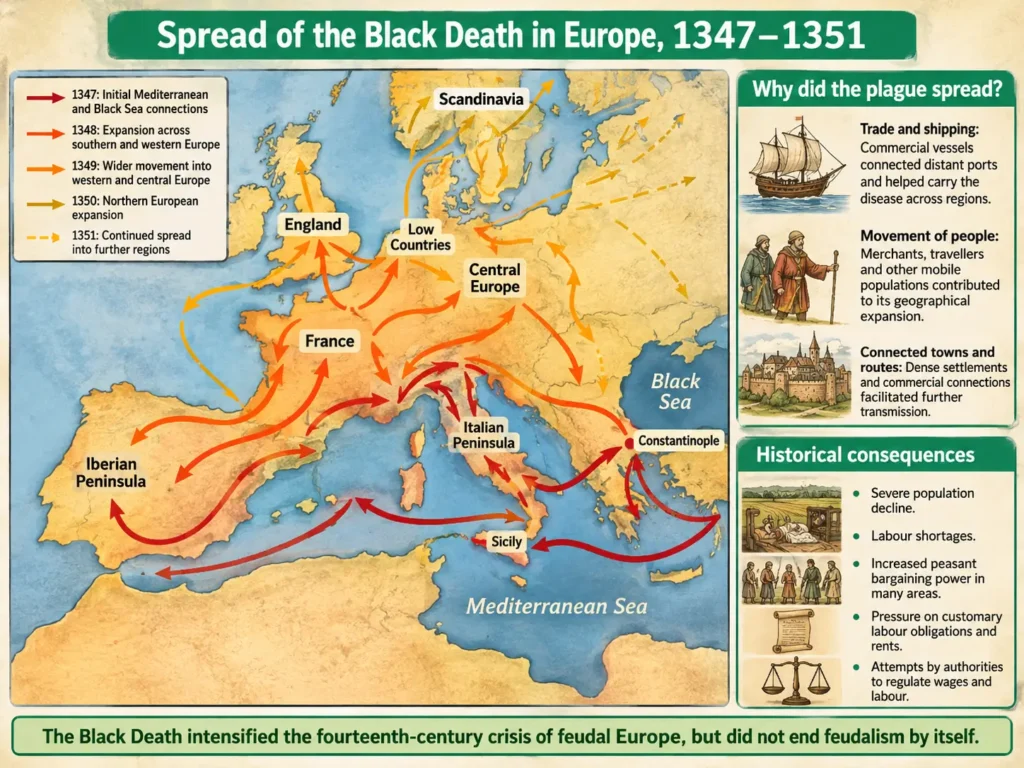
A caution for exam answers: the Black Death accelerated trends already under way (the pressure of population on land before 1348, the famine of 1315–17, the commutation of services). Historians such as M. M. Postan stress the demographic shock; critics such as Robert Brenner argue that the same shock produced very different outcomes in England, France and Eastern Europe, so it cannot be the whole explanation.
C. Rise of money and banking
- Shift to a money economy:
- Greater use of money allowed banking, credit and more complex financial instruments. Italian merchant banks used bills of exchange to move funds across Europe and avoid carrying coin, and they developed techniques such as double-entry bookkeeping.
- Credit was also a risk: the bankruptcy of the great Florentine banking houses in the 1340s followed English royal defaults on loans, showing how war finance and banking were intertwined.
- Nobles who needed cash often borrowed against or sold land, which reduced their control over resources.
Social and political upheavals
A. Rise of monarchies
- Power of kings:
- Stronger monarchs gradually reduced the independent power of the nobility. Rulers such as Louis XI of France (r. 1461–83) and Henry VII of England (r. 1485–1509) strengthened royal authority through taxation, royal justice and control over armed forces.
- In France, Charles VII’s ordinance companies (1445) are an early example of a permanent royal army, which reduced dependence on feudal levies.
- Formation of early nation-states:
- Strong monarchies built administrations that could tax directly, raise armies and enforce law without relying only on feudal ties.
- Whether this meant the end of feudalism or its transformation is itself debated. Perry Anderson (Lineages of the Absolutist State) argued that absolutist monarchy was a reorganised form of feudal domination: it protected noble property while centralising power. This reading appears in DU reading lists for the paper.
B. The Hundred Years’ War (1337–1453)
- Changes in warfare:
- The Hundred Years’ War between England and France weakened the old feudal military system. Paid professional soldiers and mercenary companies became more important than feudal levies.
- New military technology, notably the English longbow (Crécy 1346, Agincourt 1415) and later gunpowder artillery, undermined the supremacy of the mounted knight.
- Economic and social strain:
- Financing the war led monarchs to seek revenue outside traditional feudal dues, including new taxes. The burden fell heavily on ordinary people.
- Heavy taxation helped provoke revolts such as the Jacquerie in France (1358) and the English Peasants’ Revolt of 1381.
C. Peasant uprisings and social unrest
- Peasant revolts:
- The aftermath of the Black Death, attempts to freeze wages and high taxes produced popular risings. The Jacquerie (1358) occurred during the Hundred Years’ War, after the French defeat at Poitiers. The Peasants’ Revolt of 1381 in England, also known through the name of its leader Wat Tyler, was triggered by poll taxes and drew on wider grievances about serfdom and labour laws.
- These were two separate events in two countries. Most revolts were suppressed, but historians such as Rodney Hilton argue that sustained peasant resistance helped erode serfdom in western Europe in the longer run.
- Changing position of the Church:
- The Church’s authority was shaken by the Avignon papacy (1309–77), the Great Schism (1378–1417) and later the Reformation (from 1517). The rise of secular monarchies and criticism of church wealth reduced its role as an unquestioned moral arbiter.
In brief. Feudalism declined over several centuries. Economic changes (trade, towns, money), demographic shocks (famine and plague), political change (stronger monarchies, new warfare) and social conflict (peasant resistance) all contributed. Which of these was fundamental is the question around which the historical debate is organised.
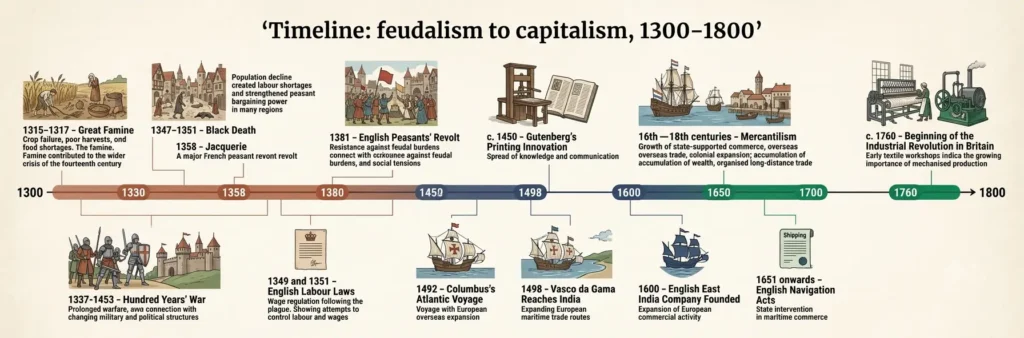
Timeline for revision
| Date | Event | Why it matters for the transition |
|---|---|---|
| c. 9th–10th century | Characteristic lord–vassal and manorial relations spread | The “classic” feudal order |
| 11th–13th century | Revival of trade, growth of towns and fairs | Commercial expansion (Pirenne, Sweezy) |
| 1315–1317 | Great Famine | Sign of pressure of population on land (Postan) |
| 1337–1453 | Hundred Years’ War | Changes in warfare and taxation |
| 1347–1351 | Black Death reaches and sweeps Europe | Labour shortage, falling rents |
| 1349, 1351 | English labour legislation | Lords’ attempt to hold wages down |
| 1358 | Jacquerie | Peasant revolt in France |
| 1381 | English Peasants’ Revolt | Revolt against poll taxes and serfdom |
| c. 1450 | Gutenberg’s printing press | Faster circulation of knowledge and commercial information |
| 1492, 1498 | Columbus’s voyage; Vasco da Gama reaches India | Expansion of oceanic trade and colonialism |
| 1602 | Dutch East India Company (VOC) founded | Early joint-stock company with tradable shares |
| c. 1760 onwards | Industrial Revolution in Britain | Rise of industrial capitalism |
| 1861 | Serfdom abolished in Russia | Feudal-type bondage persisted in the east |
Emergence of Capitalism
Capitalism marks a shift from the feudal system to an economy built around private ownership, market exchange and the pursuit of profit. The change unfolded across the late Middle Ages, the Renaissance and the early modern period, and historians still disagree about when “real” capitalism begins: with the commercial expansion of the later Middle Ages, with agrarian change in 16th-century England, with the Atlantic and merchant economy of the 16th and 17th centuries, or with the Industrial Revolution.
Key features and principles of capitalism
Capitalism is an economic system in which the means of production are mainly privately owned and operated for profit, with goods and labour exchanged through markets. Its main features are as follows.
A. Private ownership
- Ownership: Individuals or private groups own businesses, land and other resources, and can buy, sell and manage them according to market conditions. Under feudalism, land was held through a chain of obligations and could not be freely bought and sold in the same way.
- Building wealth: The aim is to invest in land, labour or machinery in order to earn a return.
B. Market economy
- Supply and demand: Prices are shaped by the balance of how much is available and how much people want.
- Competition: Producers compete on price and quality, which pushes them to cut costs and innovate. Several historians (notably Ellen Meiksins Wood, following Brenner) stress that what is distinctive about capitalism is not the existence of markets, which are very old, but dependence on the market: producers and appropriators alike must compete to survive.
C. Profit motive
- Earning money: Business owners invest in order to earn more than they put in.
- Reinvesting profits: Profits are ploughed back into production, which drives continuous accumulation and expansion. This reinvestment, rather than simple trading, is what separates capitalism from earlier forms of commerce.
D. Wage labour
- Labour market: Workers sell their labour for wages instead of being tied to land and lord.
- “Free” labour: Marx used the word “free” in a double sense: workers are free to sell their labour, and also “free” of any ownership of the means of production, so that they must sell it to live. Voluntary contract, not legal bondage, is the form of the relationship, though the choice is constrained by necessity.
Role of trade and commerce
Trade and commerce were central to the expansion of capitalism, though historians disagree about whether they were its cause or its consequence.
A. Growth of trade routes
- Global trade: The Age of Exploration (15th to 17th centuries) widened trade horizons. Portuguese, Spanish, Dutch, English and French ventures built routes linking Europe with Africa, Asia and the Americas. Key moments include Columbus’s voyage in 1492 and Vasco da Gama’s arrival in India in 1498.
- Colonies and resources: Colonies supplied gold, silver, spices, sugar and cotton and created new markets. The scale and meaning of this contribution to European capitalism is a major theme in the critique of Eurocentrism (Section 2). Unit 2 of the paper takes up the process in detail in the notes on early colonial expansion of the modern West.
B. Rise of mercantilism
- Mercantilism: In the 16th–18th centuries mercantilism was the dominant economic outlook of European states. It treated national wealth as a stock of bullion and favoured exporting more than importing, supported by tariffs, monopolies and regulation. England’s Navigation Acts (from 1651) are a standard example. Mercantilism is not the same as capitalism, but it shaped the commercial environment in which capitalist practices grew.
- Trade centres: Venice and Genoa, and later Antwerp, Amsterdam and London, became hubs of trade, finance and shipping. The shift of economic weight from the Mediterranean towards the Atlantic is a key theme in Unit 5 of the course.
C. Banking and credit
- Banking system: Long-distance trade required credit and secure ways to move money. Banks and merchant houses provided loans, and instruments such as bills of exchange made trade easier. Later public institutions such as the Bank of Amsterdam (1609) and the Bank of England (1694) strengthened financial systems.
- Joint-stock companies and share markets: Companies such as the English East India Company (1600) and the Dutch East India Company, or VOC (1602), pooled capital from many investors. The VOC’s shares were traded in Amsterdam, an important step in the history of stock markets.
D. Commercial Revolution
- Market growth: The “Commercial Revolution” is a label historians use for the expansion of trade, credit and commercial techniques in Europe. The period it covers varies by author (some focus on the 11th–14th centuries, others extend it to the 18th), so it is safest in an answer to name the process rather than fix a single date range.
- Bourgeoisie: The growth of trade enlarged the merchant and financier class who played a central part in commercial capitalism.
Impact of technological innovations
Technological change increased productive capacity and shaped the form capitalism took, though technology alone does not explain the transition.
A. Agricultural innovations
- Agricultural change: Better rotations, improved tools and more intensive farming raised output and made it possible for fewer farmers to feed more people. Marx singled out the separation of peasants from the land as the foundation of capitalist production.
- Enclosure movement: In England, enclosure converted open fields and commons into privately controlled holdings. It happened in waves, from the Tudor period (when sheep-farming was a major motive) to the parliamentary enclosures of the 18th and 19th centuries. It displaced many small cultivators and contributed to a labour force available for wage work. The scale and timing of its effects remain debated, and critics of simple “enclosure created the proletariat” accounts point to other sources of wage labour too.
B. The Industrial Revolution
- Factories and machines: The Industrial Revolution (in Britain, from about the 1760s) is associated with inventions such as the spinning jenny (1760s) and improved steam engines (James Watt’s innovations from the late 1760s), which transformed textiles and, later, many other industries. Factories concentrated workers and machines under single ownership.
- Shift to industrial capitalism: The centre of gravity moved from commerce and agriculture to manufacturing, giving rise to factory owners and a large industrial working class. Marxist historians see the Industrial Revolution as the culmination of the long transition. The next stage of the story is covered in Industrial Revolution and Social Transformation of Europe in the 19th Century.
- Urban growth: Industrial work drew people to cities and expanded urban populations.
C. Innovations in transportation
- Better transport: Canals, railways (the Stockton–Darlington line in 1825 and Liverpool–Manchester line in 1830 are early examples) and steamships lowered transport costs and widened markets.
- Global trade: Faster, cheaper transport integrated regional markets into national and international ones.
D. Communication advances
- Printing press: Gutenberg’s printing press (Mainz, about 1450) spread information, including commercial handbooks, accounting methods and news of prices.
- Telegraph and telephone: The electric telegraph (from the 1830s–40s) and the telephone (1870s) later made business communication nearly instantaneous.
In brief. Capitalism emerged through a combination of economic, technological and social changes. Its core elements are private property, market competition, the profit motive and wage labour. Trade, finance and technology expanded markets and productivity, but the explanation of how and why these elements came together in Europe is exactly what the historians in the next section disagree about.
Debates on Feudalism and Capitalism
Two questions drive the historiography. First, what dissolved feudalism? Second, why did capitalism then emerge, and first in particular places such as England and the Netherlands? Historians have grouped the answers into a few broad families of explanation, and a good exam answer names each family with its main thinkers rather than listing scholars randomly.
| Family of explanation | Prime mover | Main proponents |
|---|---|---|
| Internal / class-relations | Struggles between lords and peasants and the changing structure of property relations within feudalism | Maurice Dobb, Rodney Hilton, Robert Brenner, Ellen Meiksins Wood |
| External / commercial | Expansion of trade and towns acting on a static feudal economy | Henri Pirenne, Paul Sweezy |
| Demographic | Long cycles of population growth and decline | M. M. Postan, E. Le Roy Ladurie, J. H. Habakkuk and others in the same tradition |
| World-system | The structure of a capitalist world-economy with a core and periphery from the 16th century | Immanuel Wallerstein |
| Cultural / ideational | Religious and cultural values favouring rational, disciplined accumulation | Max Weber |
| Merchant-capital and long-run market | A layered system in which large merchants stood above ordinary markets | Fernand Braudel |
Historical interpretations and perspectives
Marx’s starting point
Karl Marx (1818–1883) treated the transition as part of a historical movement from one mode of production to another, driven by tensions between productive forces and social relations. In Capital (Volume 1) he described the historical process by which producers were separated from the land and the means of production as “primitive accumulation” and noted that capitalist relations developed within feudal society before overthrowing it. He also distinguished two roads: one in which the producer himself becomes a capitalist and one in which the merchant takes control of production. That distinction was developed by later Marxists, including Lenin, who contrasted a transition led from below by petty producers with one led by merchants or landowners from above. Most of the debate that followed is, in one way or another, a quarrel over how to read these ideas.
Pirenne and the commercial model
The Belgian historian Henri Pirenne argued that the revival of long-distance trade and of towns challenged the closed agrarian economy of feudalism from outside. Merchants and towns, in this view, were the solvent. This “commercialisation” model is the background to Paul Sweezy’s position in the Dobb–Sweezy exchange.
The Dobb–Sweezy debate
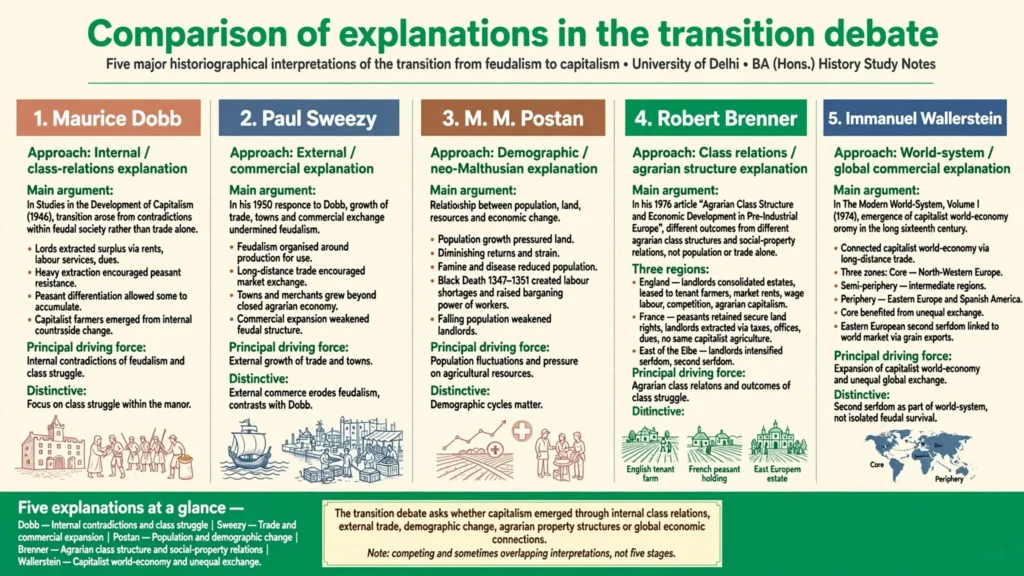
In 1946 the British Marxist economist Maurice Dobb published Studies in the Development of Capitalism (the US edition appeared in 1947). He argued that the decline of feudalism had internal causes. Feudal lords, he held, tried to extract ever more from the peasantry, partly to support their own consumption and wars, and this pushed the system into crisis. Peasant resistance and differentiation within the peasantry created new groups of small commodity producers and capitalist farmers. Dobb did not think that the growth of towns and trade by itself caused feudalism’s decline.
In 1950 the American Marxist economist Paul Sweezy published a critique in the journal Science & Society. He defined feudalism essentially as a system of production for use, which he regarded as resistant to internal change. In his view, the force that undermined it had to come from outside: the growth of trade and towns. (A short working paper summarises the exchange.) The disagreement is therefore often summed up as “internal” versus “external” prime mover, or class struggle versus commerce.
The exchange drew in other historians, among them Kohachiro Takahashi, Christopher Hill and Rodney Hilton, and the contributions were later collected by Hilton as The Transition from Feudalism to Capitalism (London, 1976). DU college teaching plans list Hilton’s collection among the central readings. Hilton himself favoured the class-struggle emphasis, and his work on peasant society (such as the essay “A Crisis of Feudalism,” 1978) was influential.
Why it matters in exams: Dobb is usually presented as the champion of internal contradictions and class struggle; Sweezy as the champion of trade and markets. A strong answer also notes that both worked within Marxism and that later critics found fault with both (Brenner, in particular, called Sweezy’s approach “neo-Smithian”).
The demographic model: Postan, Habakkuk, Le Roy Ladurie
A different explanation came from historians who stressed population. M. M. Postan, working on medieval England, argued that population growth up to the early 14th century pressed on land and resources, lowering productivity and living standards; famine and plague then reduced numbers, raised the value of labour and weakened lords. Emmanuel Le Roy Ladurie applied a similar long-cycle approach to Languedoc in France. John Hatcher and J. H. Habakkuk are also associated with the debate in college teaching plans. This is sometimes called the neo-Malthusian model, because it echoes Malthus’s idea that population presses against resources.
The Brenner debate
In 1976 the American historian Robert Brenner (born 1943) published “Agrarian Class Structure and Economic Development in Pre-Industrial Europe” in the journal Past & Present. He attacked both main earlier models. Against the demographic model he argued that the same population trends led to quite different outcomes in different regions. Against the commercialisation model he argued that growing trade did not automatically transform agrarian relations in a capitalist direction. What mattered, he said, was the structure of class relations, which he called “social-property relations,” and the outcomes of class struggle.
Brenner’s comparative argument runs roughly as follows:
- England: Lords were unable to re-impose serfdom after the Black Death, but peasants also failed to secure firm ownership of the land they worked. Landlords gradually consolidated large estates and leased them to tenant farmers, who paid market-determined rents and hired wage labour. Competition among farmers pushed them to raise productivity and so created “agrarian capitalism.”
- France: Peasants largely held secure rights to their land, so lords were pushed to extract surplus through taxes, offices and seigneurial dues rather than through market leases. Brenner treats this as a pre-capitalist route that did not produce capitalist agriculture.
- Eastern Europe (east of the Elbe): Lords took advantage of weak peasant resistance and imposed or intensified serfdom, again blocking a capitalist development in the countryside.
The debate that followed (see this overview and bibliography) included contributions from Postan and Hatcher, Le Roy Ladurie, Guy Bois, Hilton, Patricia Croot and David Parker, and others; the papers were collected as The Brenner Debate (ed. T. H. Aston and C. H. E. Philpin, Cambridge University Press, 1985). Ellen Meiksins Wood built on Brenner in The Origin of Capitalism (see her own summary of the argument), arguing that capitalism’s defining feature is market dependence arising from particular property relations, not simply the existence of trade, and that England’s early political centralisation was an important background.
The Marxist historian T. J. Byres (summarised here) used these ideas to compare routes: England, where capitalism developed “from below” under landlord leadership; Prussia, an example of the “from above” route associated with Lenin; and France, a case of delayed capitalist development. Byres also warned that using England as the only model leads to poor analysis of other countries, including India.
Wallerstein and the world-system
Immanuel Wallerstein, in The Modern World-System, Volume I (1974, subtitled Capitalist Agriculture and the Origins of the European World-Economy in the Sixteenth Century), shifted the unit of analysis from the nation to the world-economy. He argued that a capitalist world-economy took shape in Europe in the “long sixteenth century,” organised into a core (north-west Europe), a semi-periphery and a periphery (for example, Eastern Europe and Spanish America), with unequal exchange between them. Eastern European “second serfdom” was, for him, part of the capitalist system because it produced grain for the world market. Wallerstein’s work is on DU reading lists for the paper.
Two points about Wallerstein are easy to confuse. First, he is often grouped with Sweezy as a “commercial” explanation, and Brenner criticised him on exactly this ground. Second, although he widened the view beyond Europe, critics such as Andre Gunder Frank argued that his account still treats Europe as the origin and driver of the system (see Section 2). The idea that Wallerstein showed Asia and Africa as equal centres of the global economy does not describe his argument.
Weber and the cultural argument
Max Weber (1864–1920) asked why a distinctive, rationally organised capitalism appeared in the West. In The Protestant Ethic and the Spirit of Capitalism (1904–05) he argued that Protestant, especially Calvinist, ideas about calling, discipline and thrift encouraged systematic accumulation. He also stressed rational law, bureaucracy and accounting. Critics respond that important capitalist centres existed in Catholic Italy and Flanders before the Reformation, and that the thesis may confuse a correlation with a cause. Later critics, including Frank, also argue that Weber’s approach assumes a European uniqueness that needs to be proved, not assumed.
Braudel and layered capitalism
Fernand Braudel (1902–1985), in Civilization and Capitalism, 15th–18th Century, distinguished layers of economic life: everyday material life, ordinary markets, and above them a narrow top level of large-scale, long-distance merchants and financiers whom he called “capitalism.” For Braudel, capitalism was more closely tied to concentrated commercial power than to wage labour or factories. His approach is not a simple Marxist one, and he did not accept Wallerstein’s emphasis on the sixteenth century as the beginning of the modern world-system.
Other readings for depth
Perry Anderson (Passages from Antiquity to Feudalism and Lineages of the Absolutist State) examines how feudal states and absolutist monarchies were structured and how class power was reorganised. Both works appear in DU reading lists for the paper.
Comparison of the main positions
| Scholar / school | Key work | Prime mover of the transition | Main criticism |
|---|---|---|---|
| Karl Marx | Capital, Vol. 1 | Class relations and primitive accumulation; internal contradictions | Different readings of his “two roads” and of how far capitalism’s origins were purely European |
| Henri Pirenne | Studies of medieval towns and trade | Revival of trade and towns | Dobb and others argue merchants and towns did not by themselves dissolve feudal relations |
| Maurice Dobb | Studies in the Development of Capitalism (1946) | Internal class struggle and crisis of feudal surplus extraction | Sweezy and Brenner questioned his treatment of trade and of the roots of the crisis |
| Paul Sweezy | Critique in Science & Society (1950) | External: expansion of trade and towns | Brenner called it “neo-Smithian”: assumes markets automatically dissolve old relations |
| M. M. Postan, Le Roy Ladurie | Work on medieval England and Languedoc | Population cycles | Brenner: same demographic trend, different outcomes; neglects class power |
| Robert Brenner | “Agrarian Class Structure…” (1976) | Social-property relations and outcome of class struggle | Critics question his evidence and his focus on England; the role of trade and empire is played down |
| E. M. Wood | The Origin of Capitalism | Market dependence arising in English agrarian relations | Seen as too England-centred; weak on the wider world |
| Immanuel Wallerstein | The Modern World-System, Vol. I (1974) | World-economy of core and periphery from the long 16th century | Brenner: too market-centred; Frank and others: still Eurocentric |
| Max Weber | The Protestant Ethic and the Spirit of Capitalism | Religion and rationality | Early capitalism in Catholic regions; European uniqueness assumed |
| Fernand Braudel | Civilization and Capitalism, 15th–18th Century | Layered economy dominated by large merchants | Less precise on class relations and on the point where capitalism begins |
Controversies and differing viewpoints
A. Was there a single, coherent “feudalism”?
Some historians treat feudalism as a real, identifiable system; others, such as Brown and Reynolds, treat it as a modern construct. Marxists use a broad concept (a feudal mode of production) that is not the same as the narrower legal definition. The question reaches beyond Europe: historians of India such as D. D. Kosambi and R. S. Sharma debated whether and how an “Indian feudalism” existed, and the debate has repeatedly asked whether a European concept can travel.
B. The role of the bourgeoisie
Marx and Engels cast the bourgeoisie as the revolutionary class that overthrew feudalism. Dobb saw merchants as often allied to the existing order and treated change from the producers themselves as more transformative; Brenner and Wood stressed landlords, tenants and agrarian producers rather than merchants. Others argue that merchants, financiers and towns were more important than these accounts allow.
C. When did the transition happen?
The answers range widely: the commercial expansion from the 11th century; the crisis of the 14th; the long 16th century (Wallerstein); the English Revolution of the 17th, which Christopher Hill and other Marxists read as a “bourgeois revolution” while revisionist historians contest that reading; and the Industrial Revolution of the late 18th century. These are not necessarily incompatible if the argument is that different aspects of capitalism developed at different times.
D. One road or many?
Byres and others show that the transition took different forms (England, Prussia, France). A single model drawn from England risks flattening real differences.
E. How should capitalism itself be defined?
If capitalism means trade, markets and merchants, then it is very old and the transition becomes gradual and widespread. If it means market-dependent production, wage labour and competitive accumulation, as Brenner and Wood argue, it starts later and in fewer places. Much of the debate between the “commercial” and “class” camps is, at bottom, a disagreement about this definition.
In brief. The debate has produced several competing frameworks: internal class struggle (Dobb, Hilton, Brenner), external trade (Pirenne, Sweezy), demography (Postan, Le Roy Ladurie), world-system (Wallerstein), culture (Weber) and layered merchant capitalism (Braudel). No single account is accepted by all; most historians now treat the transition as the result of several interacting processes, while still disagreeing about which came first.
2. Question of Eurocentrism
Definition and Concept of Eurocentrism
Eurocentrism is a way of understanding the world that puts European history, culture and values at the centre and treats European experience as the standard against which other societies are measured. It often ignores or minimises the histories of non-European peoples, or describes them only in relation to Europe. It has strongly influenced how history has been written and taught, particularly since the colonial period. The syllabus for this paper introduces the concept explicitly in the context of the rise of the modern West.
A useful distinction: Eurocentrism is not simply “studying Europe.” Studying European history is legitimate. The problem arises when Europe’s path is assumed to be the universal, natural or superior one, and when other regions are seen as backward, static or merely recipients of European influence.
Explanation of Eurocentrism in historical studies
A. Where it comes from
The roots of Eurocentric thinking lie in several overlapping sources: early modern European expansion and conquest, Enlightenment philosophies of progress, and, above all, the 19th-century colonial order, when European powers controlled much of the world and justified rule as a “civilising mission.”
- Colonial context: European states such as Britain and France took control of large parts of Asia, Africa and the Americas and described their rule as bringing civilisation to “backward” peoples, which made non-European cultures appear less important.
- Historiography: In many standard accounts, events such as the Renaissance, the Scientific Revolution and the Industrial Revolution were treated as the decisive moments of world history, while developments elsewhere were overlooked or presented as marginal.
- Social theory: Critics such as Andre Gunder Frank argue that even major Western social theorists, from Marx and Weber to Wallerstein, built Eurocentric assumptions into their models. For example, Frank notes that Marx took over earlier European ideas of Asian “despotism” and stagnation. These are Frank’s arguments, and defenders of these thinkers contest them.
B. Europe as the focus of world history
Eurocentric accounts often treat Europe as the key to understanding global progress. This can involve:
- Highlighting Europe’s rise as self-generated: The idea of a “European miracle” (the phrase is the title of a 1981 book by Eric L. Jones) holds that Europe rose because of some distinctive internal quality such as its environment, culture, institutions or religion. J. M. Blaut (The Colonizer’s Model of the World, 1993) called the underlying assumption “Eurocentric diffusionism”: Europe as the permanent “inside” from which progress radiates outward to a passive “outside.”
- Civilisation and progress: Civilisations such as ancient Greece and Rome are often presented as the starting point of modern ideas, while other civilisations are described as less significant.
- Lasting impact after colonialism: Even after formal empire ended, many histories, textbooks and syllabi continued to centre Europe.
C. Eurocentric views in specific historical events
- Exploration and “discovery”: Accounts of the Age of Exploration often celebrate European navigators such as Columbus while overlooking the existing societies and the destruction that followed.
- Slavery and colonialism: The role of slavery and colonial extraction in European prosperity is sometimes minimised. Eric Williams’s Capitalism and Slavery (1944) was an early challenge on this point.
- Global economy: Eurocentric views often claim that Europe created world trade, ignoring the long-established networks of the Indian Ocean, the Silk Roads, China and the Islamic world.
Critiques and limitations
Eurocentrism has been criticised by scholars from many traditions. The main criticisms are as follows.
A. Ignoring non-European histories
- Neglecting other cultures: Critics argue that Eurocentrism leaves out the histories and contributions of non-European societies such as the Aztecs, the Incas, Africa’s kingdoms, India, China and the Islamic world.
- Overlooking the effects of colonialism: The destructive effects of colonialism on indigenous peoples and economies are often skipped or softened.
B. Bias in knowledge creation
- Preference for Western ideas: Western concepts are often treated as universal, and non-Western knowledge systems as less important.
- Assumed superiority: The assumption that European ideas and ways of life are the best undervalues other cultures.
C. Simplified and inaccurate history
- Skewed global history: Eurocentric history may suggest that societies outside Europe were static until Europeans arrived. Historians of Asia, such as K. N. Chaudhuri and Janet Abu-Lughod, have shown dynamic trading systems in the Indian Ocean and across Eurasia long before European dominance.
- Misunderstanding the Middle Ages: The label “Dark Ages” applied to medieval Europe ignores the achievements of other regions during the same time, and also oversimplifies Europe’s own medieval history.
D. Need for inclusive knowledge
- Challenging Eurocentrism: Scholars such as Edward Said (Orientalism, 1978) argue that Western knowledge about the “East” was shaped by, and helped sustain, imperial power, and call for rethinking how history is written.
- Global history approaches: Many historians now focus on connections among regions, which lets them describe how exchanges of goods, ideas, technologies and people shaped history.
In brief. Eurocentrism has shaped how history is told and taught. It has helped organise the story of Europe’s past, but its limitations (neglect of non-European histories, assumption of superiority, a simplified picture of the world) have become clearer. Critiques encourage an inclusive history that recognises contributions from all regions.
Eurocentric Views on Feudalism and Capitalism
Eurocentric views of feudalism and capitalism strongly influenced how historians told the story of Western Europe. These views focus on European experience and downplay the contributions of other regions and the connections among them.
Traditional Eurocentric narratives
A. Feudalism as a European norm
In traditional accounts, feudalism is described as a system specific to Europe that shaped the Middle Ages. Key points include:
- Feudalism as a European creation: Many accounts suggest feudalism was a European response to the collapse of Roman authority and the lack of strong central government.
- The Middle Ages as isolated and “backward”: Some narratives picture medieval Europe as cut off and primitive compared with the classical world, overlooking the achievements of the Islamic world, China, India and Mesoamerica in the same period.
- Feudalism as a step towards modernity: Some accounts present feudalism as a necessary stage leading to stronger monarchies and eventually to capitalism, as if Europe’s path were the model for the world.
B. Capitalism as a European evolution
Traditional accounts of capitalism emphasise:
- Capitalism as a European achievement: Many accounts credit Western Europe with creating modern capitalism as the result of internal economic and social growth beginning in the feudal period.
- Renaissance and Reformation: These events are often seen as key to the rise of capitalism, promoting individualism and rational approaches to business.
- The Industrial Revolution and European exceptionalism: The Industrial Revolution is placed at the heart of capitalism’s growth, suggesting that European innovation was decisive.
Examples of Eurocentric interpretations
A. Feudalism as necessary for European development
- Marc Bloch (Feudal Society, 1939–40) is the classic structural account of European feudalism as a total social order. His book is Europe-centred in subject, though Bloch himself made comparisons beyond Europe, including with Japan. The Eurocentrism critique is aimed less at studying feudal Europe than at the claim that Europe’s feudal stage was the necessary road to modernity for everybody.
- Feudalism as a precursor to modernity: Interpretations in which feudal fragmentation produced the conditions for modern states and markets can ignore non-European forms of political organisation and exchange.
B. Capitalism as a product of European exceptionalism
- Weber’s Protestant Ethic thesis: Weber’s argument that Protestant values shaped the “spirit” of capitalism centres a European cultural cause and, in the eyes of critics, makes capitalism seem uniquely European.
- European exceptionalism in economic development: Accounts that explain Europe’s lead entirely through internal European qualities downplay contributions from other regions and the effect of global connections.
- Colonialism and capitalism: Critics argue that explanations focused on European achievement overlook how colonial extraction, slavery and plantation economies fed European capitalism. Historians such as Eric Williams, Walter Rodney (How Europe Underdeveloped Africa, 1972) and, in a different way, Immanuel Wallerstein have brought these links into the picture.
C. The Industrial Revolution as Europe’s defining moment
- Technological superiority: Eurocentric accounts tend to see the Industrial Revolution as proof of Europe’s inherent creativity. Revisionists argue that the global context mattered: trade, colonial markets and raw materials, and, in Kenneth Pomeranz’s The Great Divergence (2000), access to coal and to resources from the Americas that eased Europe’s ecological limits. Pomeranz’s argument is itself debated.
- Capitalism as a “natural” outcome: These narratives often present the shift from feudalism to capitalism as a smooth progression, hiding the conflict, dispossession and coercion involved.
In brief. Eurocentric accounts of feudalism and capitalism portray Europe as the main actor in world history. They present feudalism as Europe’s solution to a historical problem and capitalism as the outcome of European growth. These readings neglect non-European societies and the interconnected character of global history, as postcolonial and global historians argue.
How Eurocentrism Shapes the Transition Debate
DU’s question on this unit has asked students to connect the two halves of the topic (see the Previous Year Questions below), so it helps to be able to make the link explicitly. There are at least four ways in which Eurocentrism affects the transition debate, according to its critics:
- The “internal explanation” bias: Dobb, Brenner and many others locate the causes of capitalism inside Europe, often inside a single country (England). Critics such as Blaut argue that this ignores the contribution of overseas expansion, colonial wealth, slavery and trade with Asia.
- A universal stage model: The idea that every society passes from feudalism to capitalism makes European history the template for others. Debates on “feudalism” in India, China and elsewhere have asked whether this is true or whether the label distorts local realities.
- Neglect of other centres of commerce: The Indian Ocean, China and the Islamic world had sophisticated trading and financial systems. Historians such as Chaudhuri, Abu-Lughod and Frank argue that Europe joined an existing world economy more than it created one.
- Periodisation and labels: Terms such as “medieval,” “Dark Ages,” “early modern” and “rise of the West” carry European assumptions and are applied to other regions without much justification.
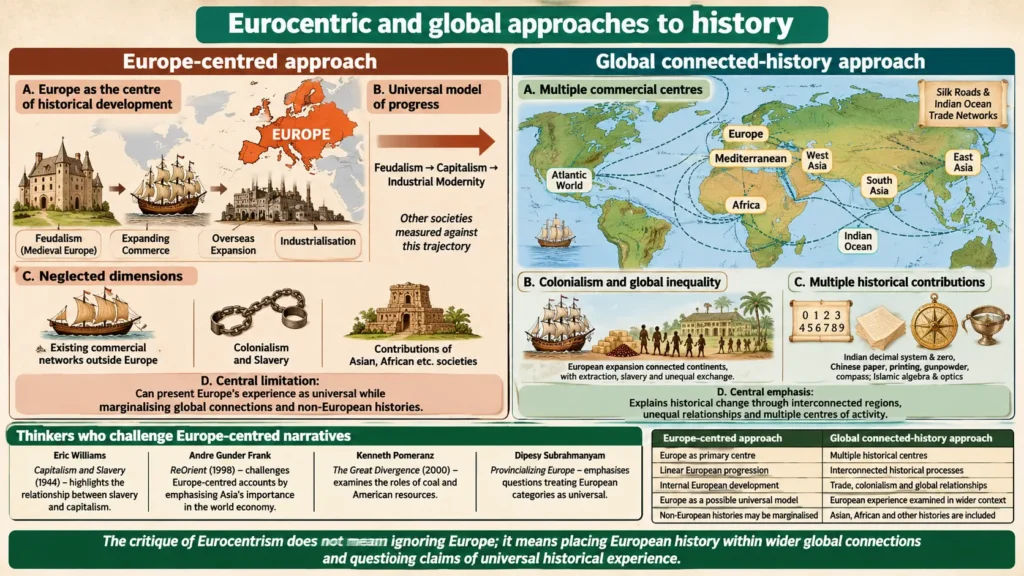
A balanced answer should also note the counter-argument: defenders of Brenner and Wood say that capitalism’s specific social relations (market-dependent producers) emerged first in English agriculture, and that this is an argument about social relations, not about European superiority. The debate is therefore also about what capitalism is.
Challenges to Eurocentrism
Eurocentrism was long the dominant frame for telling the story of feudalism, capitalism and the modern world. In recent decades, many scholars have challenged it, trying to include a wider range of voices and to recognise the contributions of non-European societies and scholars.
Alternative perspectives and approaches
A. Postcolonialism and changing history
Postcolonial scholars question Eurocentric views and argue that history should acknowledge the harm caused by colonialism. Important points include:
- Decolonising knowledge: Edward Said’s Orientalism (1978) argued that Western representations of the “Orient” served power. Later writers called for the inclusion of African, Asian and indigenous American experience in history.
- Provincialising Europe: Dipesh Chakrabarty’s Provincializing Europe (2000) argued that European categories of history cannot simply be treated as universal.
- Global and transnational views: Many historians now take a global perspective, recognising that events in one region affect others. Sanjay Subrahmanyam’s idea of “connected histories” is a prominent example.
B. World-systems theory
Immanuel Wallerstein‘s world-systems theory treats the world economy rather than individual nations as the unit of analysis. It changed how historians think about development, because it links Europe’s prosperity to the exploitation of peripheral regions. But its relation to Eurocentrism is contested:
- Its contribution: It highlights the role of colonial and peripheral regions in European capitalism and the unequal structure of the world economy.
- Its critics: Andre Gunder Frank argues in ReOrient (1998; read his introduction) that Wallerstein’s system still puts Europe at the origin of the modern world-economy and gives Asia too little part before 1800. Frank argues for an Asia-centred world economy up to about 1800, in which Europe held a relatively marginal position. Other scholars dispute parts of Frank’s account too.
C. Subaltern studies
The Subaltern Studies collective, associated with Ranajit Guha and historians of South Asia, studied the experiences of groups left out of elite and nationalist histories, such as peasants and workers in colonial India. Gayatri Chakravorty Spivak‘s essay “Can the Subaltern Speak?” (1988) engaged with the group’s project and critiqued the problem of representing the subaltern.
- Colonial subjects as historical agents: The project aimed to show these groups as actors with their own politics, not merely victims or followers.
- History from below: It sought to tell the past from the standpoint of marginalised groups rather than only that of leaders and states.
Contributions of non-European scholars and historians
Non-European scholars have contributed important critiques of and alternatives to Eurocentric history.
A. African historiography
- Cheikh Anta Diop (Senegal) argued for the African roots of ancient Egyptian civilisation and for Africa’s role in world history. His arguments are important in the history of African historiography and also contested by other scholars.
- Walter Rodney (Guyana, who taught in Tanzania) argued in How Europe Underdeveloped Africa (1972) that European contact and the slave trade had undermined African economies.
- Kwame Nkrumah, Ghana’s first leader, was a political thinker and pan-Africanist rather than a professional historian. His writings argued for telling African history on African terms.
B. Asian and Middle Eastern historians
- Sanjay Subrahmanyam (India-born historian) has studied connections across the Indian Ocean and early modern Eurasia and argues for “connected histories” in place of Europe-centred accounts.
- K. N. Chaudhuri (Asia Before Europe, 1990) studied the economy and civilisation of the Indian Ocean before European dominance, and Irfan Habib analysed the Mughal agrarian economy and asked about the possibilities of capitalist development in India.
- The Lebanese-French writer Amin Maalouf is a novelist and essayist rather than an academic historian. His popular book The Crusades Through Arab Eyes offers an Arab perspective on medieval events and is useful as a reading, but it should not be cited as scholarly historiography.
C. Latin American perspectives
- Eduardo Galeano (Uruguay), in Open Veins of Latin America (1971), wrote a polemical account of how the region’s resources were extracted for European and later American profit.
- Aníbal Quijano (Peru) developed the idea of the “coloniality of power,” arguing that structures of racial and economic hierarchy created under colonialism persist.
Impact on understanding global history
Challenges to Eurocentrism have changed how historians look at the global past. Key effects include:
A. Recognition of multiple histories and contributions
By including non-European perspectives, historians now recognise the role of civilisations outside Europe in shaping the modern world, for example:
- The Islamic world‘s role in the translation and development of knowledge in mathematics, medicine and optics (for instance al-Khwarizmi in algebra and Ibn al-Haytham in optics), not only in “preserving” classical learning.
- The contributions of China (paper, printing, gunpowder, the compass), India (the decimal place-value system with zero) and Mesoamerica (maize cultivation and sophisticated calendars) long before European expansion.
B. More inclusive historical narratives
Moving away from Eurocentrism has led to narratives that recognise the contributions of marginalised groups, including indigenous peoples, enslaved people and women.
C. Global interconnectedness
Global history stresses the connections among societies. Instead of Europe as the unique centre, historians emphasise the exchange of goods, ideas, technologies, diseases and people across regions.
D. Rethinking capitalism and development
The new understanding also changes how we see capitalism: as shaped by global trade, colonial extraction and slavery as well as by European developments. Whether these external factors were decisive or supporting is still a live argument, which links Section 2 back to the Dobb–Sweezy–Brenner–Wallerstein debate in Section 1.
In brief. Challenges to Eurocentrism have produced a richer, more complex account of the past, drawing on postcolonial, world-systems, subaltern and non-European scholarship. They have not produced a single agreed replacement: scholars debate how much weight to give global connections as against internal European change.
Contemporary Relevance
The transition debate is not only a matter for medieval historians. Arguments about what makes capitalism distinctive shape how economists and historians discuss development, inequality and imperialism today. T. J. Byres has noted that political debates in India have often treated England’s agrarian transition as the model for assessing agrarian change elsewhere, and he has questioned how useful labels such as “semi-feudal” are for contemporary Indian agriculture. Meanwhile, the debate on the “Great Divergence” between Europe and Asia carries the Eurocentrism question into modern economic history. Understanding the transition debate gives students tools for reading these arguments critically.
Conclusion
The transition from feudalism to capitalism was a long and uneven process, not a single event. The decline of feudal relations drew on the expansion of trade and towns, the demographic shock of famine and plague, the strengthening of monarchies, changes in warfare and persistent conflict between lords and peasants. Capitalism emerged through private property, markets, wage labour and the pursuit of profit, supported by new finance, technology and, historians increasingly stress, overseas expansion.
The historiography is divided. Dobb and Hilton emphasised internal class struggle, Pirenne and Sweezy emphasised trade, Postan and Le Roy Ladurie stressed population, Brenner and Wood put agrarian property relations at the centre, Wallerstein shifted attention to the world-system, Weber pointed to culture and Braudel to the layered structure of commerce. The critique of Eurocentrism adds another dimension by asking whether the whole question has been framed too narrowly. For exams, the strongest answers name the scholars accurately, say what each regards as the prime mover, evaluate the criticisms, and tie the two halves of the unit together.
Continue Reading
Continue reading: Rise of the Modern West – I (DSC-2)
- Early Colonial Expansion of the Modern West: the next unit, on overseas expansion and its links with capitalism
- Mercantilism and European Economies: Trade and Empire: the commercial and state policy side of early capitalism
- Industrial Revolution and Social Transformation of Europe in the 19th Century: where industrial capitalism takes shape
- All Rise of the Modern West – I notes: the full paper in one place
University of Delhi Previous Year Questions
Questions marked Verified DU PYQ were found in published University of Delhi question papers hosted by college or archive websites (listed below). Questions marked DU-pattern / Probable Question are practice questions framed to match the syllabus; they are not claimed to be actual past questions. For more, see the site’s DU BA History Previous Year Questions category.
Long Answer Questions
| Question | Type | Year / Paper | Hint | Suggested answer focus |
|---|---|---|---|---|
| Evaluate the factors responsible for the transition from feudalism to capitalism in Europe. How has the concept of Eurocentrism impacted the study of this transition? | Long answer (Verified DU PYQ) | B.A. (Hons.) History, Rise of the Modern West–I, Semester III (CBCS New Course, unique paper code 12311347), Nov–Dec 2021 (as listed on the munotes archive) | Cover both parts. Use a table of factors, then connect Eurocentrism to the debate. | Factors: trade and towns, crisis of the 14th century, monarchies, class struggle; historians’ positions; Eurocentric “internal explanation,” Blaut, Frank, Said; balanced verdict |
| Do you think that the internal contradictions were prime movers in the transition from feudalism to capitalism in Western Europe? | Long answer (Verified DU PYQ) | Same paper code (12311347), Dec 2020 (as hosted on a DU college website) | Take a position, but test it against Sweezy, Postan and Wallerstein. | Dobb, Hilton, Brenner on internal contradictions; critiques; the role of trade and demography; conclusion |
| Discuss the nature of problems involved in the transition from feudalism to capitalism. | Long answer (Verified DU PYQ) | Rise of Modern West–I, Old Course (OC) paper, Dec 2020 (as hosted on a DU college website) | “Nature of problems” means historiographical problems: definition, chronology, prime mover, regional variation. | Define terms; explain why the question is contested; outline the main models |
| Critically examine the Dobb–Sweezy debate on the transition from feudalism to capitalism. | Long answer (DU-pattern / Probable Question) | Not verified as a PYQ. (A DU college has set this as an internal assignment topic.) | Present the two positions fairly, then bring in later critics. | Internal vs external; definition of feudalism; Takahashi/Hill/Hilton; Brenner’s critique |
| Explain Robert Brenner’s critique of the demographic and commercialisation models. | Long answer (DU-pattern / Probable Question) | Not verified | Use the England / France / East Elbe comparison. | Social-property relations; Brenner debate responses; limits of his argument |
| Assess the role of the Black Death and peasant revolts in the decline of feudalism in Western Europe. | Long answer (DU-pattern / Probable Question) | Not verified | Avoid treating the plague as a single cause. | Labour shortage, wage laws, Jacquerie, 1381; Postan vs Brenner on the same facts |
| What is Eurocentrism? Examine its influence on interpretations of the rise of capitalism. | Long answer (DU-pattern / Probable Question) | Not verified | Define, then give four concrete effects, then criticisms and counter-arguments. | Blaut, Frank, Said, Wallerstein’s contested position; Pomeranz; balanced conclusion |
| Compare Wallerstein’s world-system approach with Brenner’s explanation of the origins of capitalism. | Long answer (DU-pattern / Probable Question) | Not verified | A comparison table works well. | Unit of analysis; market vs property relations; role of colonies; criticisms |
Short Answer Questions
None of the short-answer questions below has been verified as an actual DU question. All are DU-pattern / Probable Questions.
| Question | Type | Year / Paper | Hint | Suggested answer focus |
|---|---|---|---|---|
| Define feudalism and manorialism. | Short (DU-pattern / Probable) | Not verified | Note both the narrow and broad senses | Fief, vassal, manor, demesne, serfdom |
| Write a short note on the Black Death. | Short (DU-pattern / Probable) | Not verified | Dates and effects, with a hedge on mortality | 1347–51; labour shortage; wage laws |
| Compare the Jacquerie (1358) and the Peasants’ Revolt (1381). | Short (DU-pattern / Probable) | Not verified | Two events, two countries | Causes, leaders, results |
| What was the Pirenne thesis? | Short (DU-pattern / Probable) | Not verified | One line on trade and towns | Commercial revival as external solvent |
| What is “primitive accumulation”? | Short (DU-pattern / Probable) | Not verified | Marx; separation of producers from means of production | Land, enclosure, wage labour |
| Explain Postan’s demographic model. | Short (DU-pattern / Probable) | Not verified | Population and resources | Famine, plague, rent, labour |
| What is agrarian capitalism? | Short (DU-pattern / Probable) | Not verified | Brenner’s England | Landlord, tenant farmer, wage labourer |
| Write a short note on Orientalism and its relevance to Eurocentrism. | Short (DU-pattern / Probable) | Not verified | Said, 1978 | Representation, power, critique |
Sources for the verified questions: the University of Delhi question papers for Rise of the Modern West–I (unique paper code 12311347) as hosted by DU college websites (RLA College’s question-paper archive). Please check the original papers before treating the year as final.
FAQs
Is the transition from feudalism to capitalism asked as a long-answer essay at DU?
In the papers located while preparing these notes, yes: all three verified questions above are essay-type questions on the transition, and one combines it with Eurocentrism. Expect questions on the debate (what was the prime mover?) rather than a plain description of feudalism.
What is the main difference between Dobb and Sweezy in one line?
Dobb located the cause of feudalism’s decline inside feudal society, in class conflict and the lords’ demand for surplus; Sweezy located it outside, in the expansion of trade and towns.
What is the Brenner debate, and why does it matter?
It is the exchange that followed Robert Brenner’s 1976 article in Past & Present, in which he argued that the structure of class relations in the countryside, not population change or trade alone, explains why capitalism developed in England and not elsewhere. It matters because it criticises both older models and sets the terms for much later argument.
Did the Black Death end feudalism?
Not by itself. It changed the balance between labour and land, but historians point out that the same demographic shock led to a decline of serfdom in much of the west, a strengthening of serfdom in parts of the east, and a mixed outcome elsewhere. Brenner uses exactly this contrast to argue against purely demographic explanations.
What is the difference between merchant capitalism and industrial capitalism?
Merchant capitalism makes profit mainly by trade, buying cheap and selling dear, often without controlling production. Industrial capitalism invests capital directly in production, uses wage labour and machinery, and aims at continuous reinvestment. Marx and later Marxists treated the move from the first to the second as a central part of the transition.
What did Wallerstein add to the debate, and is he considered Eurocentric?
Wallerstein shifted attention from individual countries to a capitalist world-economy with a core and periphery from the 16th century, so he links Europe’s growth to unequal relations with other regions. Critics such as Frank argue that he still places the origins of the system in Europe, so whether he challenges or reproduces Eurocentrism is itself debated.
Is capitalism a European invention?
It is contested. One view, associated with Brenner and Wood, holds that the specific social relations of capitalism first emerged in English agriculture. Another, associated with Blaut, Frank and others, holds that European capitalism depended heavily on global trade and colonial extraction. Others, like Weber, stress cultural features. The honest answer in an exam is to present these positions and give your reasoned judgement.
How can I structure a long answer on this unit?
One workable structure: a one-paragraph definition; a short account of the factors in the decline of feudalism; a section on the debate (internal, external, demographic, agrarian-class, world-system), ideally with a small comparison table; a section on Eurocentrism and how it affects the debate; a short evaluative conclusion. Name each scholar with the argument attributed to them.
Which books should I read for this unit?
DU college teaching plans list R. Hilton (ed.), The Transition from Feudalism to Capitalism; J. M. Blaut and others, 1492: The Debate on Colonialism, Eurocentrism, and History; Wallerstein, The Modern World-System, Vol. I (Introduction and Chapter 1); and Perry Anderson, Lineages of the Absolutist State. Other university syllabi also list Dobb’s Studies in the Development of Capitalism and Aston and Philpin’s The Brenner Debate. Check your own college’s reading list for the current year.
Was there feudalism in India, and is it part of this unit?
The “Indian feudalism” debate (associated with historians such as D. D. Kosambi and R. S. Sharma) belongs to Indian history papers, but it matters here because it asks whether the European concept can be applied elsewhere, which is a Eurocentrism question.
Can I use these notes if I study at IGNOU or another university?
The core debate (Dobb, Sweezy, Postan, Brenner, Wallerstein) and the Eurocentrism critique are widely taught, but these notes are mapped to the University of Delhi’s DSC-2 paper. Course structure and prescribed readings differ by university, so check your own study material.
Subscribe to keep reading
You've used your free notes for now. Get Delhi Pathshala Premium for unlimited access.
Subscribe — ₹29/30 days