
Contents
- What Exactly Does DU Prescribe?
- Background: Who Was Burke and Why Did He Write This Book?
- How the Five Parts Fit Together
- Key Terms Before You Begin
- Part 1: Section VII and Section XVIII
- 1. Section VII: Of the Sublime
- 2. Section XVIII: The Recapitulation
- Part 2: Sections I–VIII (The Sublime in Detail)
- 3. Section I: Of the Passion Caused by the Sublime
- 4. Section II: Terror
- 5. Section III: Obscurity
- 6. Section IV: Clearness and Obscurity with Regard to the Passions
- 7. Section V: The Same Subject Continued
- 8. Section VI: Power
- 9. Section VII: Privation
- 10. Section VIII: Vastness
- Part 2 at a Glance
- Part 3: Section XXVII (The Sublime and Beautiful Compared)
- Background: Burke’s Theory of Beauty in Part 3 (Not Prescribed, but Useful)
- 11. Section XXVII: The Sublime and Beautiful Compared
- Important Comparisons
- Burke versus the Classical Idea of Proportion
- Burke and Hume (Same Year, Different Questions)
- Burke and Longinus
- Burke and Kant
- Burke and Eliot (A Contrast Worth Making)
- Selected Quotations and Analysis
- Critical Reception and Legacy
- Criticism and Limitations
- Contemporary Relevance
- Summary of Key Arguments
- Conclusion
- University of Delhi Previous Year Questions
- Frequently Asked Questions (FAQs)
- Reading List and Primary Text
In this post, notes of “Unit 1: Edmund Burke: ‘A Philosophical Enquiry into the Origin of Our Ideas of the Sublime and the Beautiful'” from “DSC-9: Literary Criticism” (BA (Hons.) English, Semester 3) are given, which is helpful for the students doing graduation this year.
If you only have ten minutes before a tutorial, here is the whole idea in four lines. Burke says the sublime comes from our instinct for self-preservation: it is the delight we feel when we meet pain, danger or terror at a safe distance. Beauty comes from our social feelings: it is whatever makes us feel affection and tenderness. Because their causes are different (pain versus pleasure), Burke insists the two are never to be confused. The rest of these notes show you how he argues this, section by section, using exactly the portions that DU prescribes.
All the notes for this paper are collected in the Literary Criticism (DSC-9) category on Delhi Pathshala.
What Exactly Does DU Prescribe?
The University of Delhi syllabus for DSC-9 (Literary Criticism, Unit I) lists Burke’s Enquiry as: Part 1: Section VII and Section XVIII; Part 2: Sections I–VIII; Part 3: Section XXVII. You can check this in the University of Delhi Semester III English syllabus document.
| Part | Prescribed section(s) | Title of the section | Topic in one line |
|---|---|---|---|
| Part 1 | Section VII | Of the Sublime | Burke’s definition: pain, danger and terror as the source of the sublime |
| Part 1 | Section XVIII | The Recapitulation | Burke’s summary of the passions of self-preservation and society |
| Part 2 | Section I | Of the Passion Caused by the Sublime | Astonishment as the highest effect |
| Part 2 | Section II | Terror | Fear as the “ruling principle” of the sublime |
| Part 2 | Section III | Obscurity | Why darkness and uncertainty heighten terror |
| Part 2 | Section IV | Of the Difference Between Clearness and Obscurity with Regard to the Passions | A clear idea versus an affecting idea |
| Part 2 | Section V | The Same Subject Continued | Poetry versus painting; Milton and Job |
| Part 2 | Section VI | Power | Power as a source of the sublime |
| Part 2 | Section VII | Privation | Vacuity, darkness, solitude and silence |
| Part 2 | Section VIII | Vastness | Greatness of dimension |
| Part 3 | Section XXVII | The Sublime and Beautiful Compared | The famous contrast table |
A numbering warning for Part 2. Editions do not number Part 2 in the same way. In the 1759 text used by modern editions, “The Same Subject Continued” is Section V, so Power is VI, Privation is VII, Vastness is VIII and Infinity is IX. In the digitised 1757 text, the table of contents has no such section: Privation is VI, Vastness is VII and Infinity is VIII. So “Sections I–VIII” can end at Vastness or at Infinity depending on the edition. Check which edition your college anthology or teacher’s handout follows, and read the topic of Infinity (given briefly below) just to be safe.
Background: Who Was Burke and Why Did He Write This Book?
Edmund Burke (1729–1797) was an Anglo-Irish politician, orator and thinker, best remembered today for his political writing, especially on the American and French Revolutions. The Enquiry is his early work on aesthetics. It was first published in 1757 and revised in a second edition in 1759.
In the preface to the revised edition, Burke says he read “everything which has appeared in public against my opinions” and tried to improve the work, though he found no reason to change his theory in any major way. He also added an introductory discourse on Taste, which is not part of your DU syllabus.
Why does the book matter for literary criticism? Burke noticed that people used “sublime” and “beautiful” loosely, as if they meant the same thing. The first-edition preface complains that the two ideas were “frequently confounded” and that even Longinus, in his discussion of the sublime, had put very different things under one name. Burke’s project is to separate them, to find out what causes each, and to show that critics who work on poetry and art need to know the difference.
Two things make his method distinctive:
- He starts from the passions (emotions), not from rules. Earlier discussions often asked what formal rules make a work beautiful. Burke asks: what happens in the mind and body when we feel awe, or love?
- He builds on the physical senses. For Burke, both the sublime and the beautiful begin with “sensible” qualities (qualities that the senses perceive) and the feelings they excite. This is why modern readers call his approach empirical and psychological.
How the Five Parts Fit Together
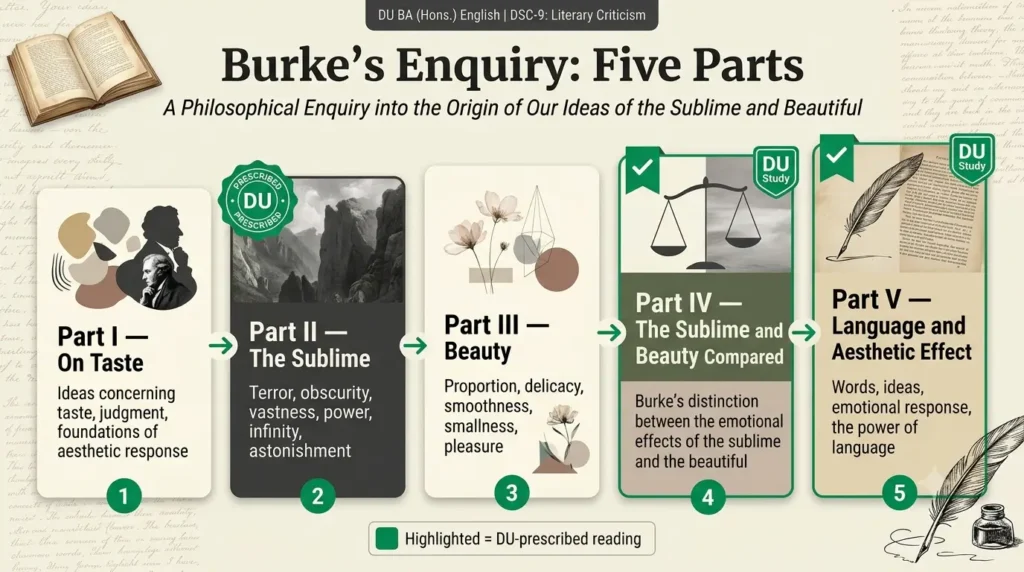
| Part | What it studies | Where DU enters |
|---|---|---|
| Part 1 | The basic passions: pain, pleasure, self-preservation, society, sympathy; defines the sublime (Sec VII) | Sec VII, Sec XVIII |
| Part 2 | The passion caused by the sublime and the qualities that produce it | Sec I–VIII |
| Part 3 | Beauty: what it is not, what it is, and its qualities; ends by comparing it to the sublime | Sec XXVII |
| Part 4 | The physical (“efficient”) causes of both, based on the body and the nerves | Not prescribed |
| Part 5 | Words, poetry and how language moves the passions | Not prescribed |
Key Terms Before You Begin
| Term | Burke’s use of it |
|---|---|
| Passion | An emotion or strong feeling (he does not mean only “romantic passion”) |
| Self-preservation | The instinct to protect life; it turns on pain and danger and gives rise to the sublime |
| Society | The instinct to bond with others (including the society of the sexes and general society); it gives rise to beauty |
| Delight | The feeling we get when pain or danger is imagined or seen from a safe distance; it is not pleasure |
| Pleasure | Positive enjoyment; for Burke it belongs to beauty and love |
| Astonishment | The highest effect of the sublime: the mind is suspended and filled with its object |
| Terror | Fear of pain or death; the common stock of the sublime |
| Obscurity | Darkness, dimness or uncertainty that hides the full extent of a danger |
| Privation | Absence: vacuity, darkness, solitude and silence |
| Vastness | Great size or extent (height, depth, length) |
| Sensible qualities | Qualities that can be perceived by the senses |
Part 1: Section VII and Section XVIII
1. Section VII: Of the Sublime
What is the sublime?
In Section VII, Burke gives his famous definition. Whatever is “fitted in any sort to excite the ideas of pain and danger” is a source of the sublime. He widens this at once: it includes whatever is terrible, whatever deals with terrible objects, and whatever acts in a manner similar to terror. The sublime, for Burke, is “productive of the strongest emotion which the mind is capable of feeling”.
Students often write that the sublime means “something grand and beautiful”. Burke would object. His sublime is first of all connected with pain and danger, not with prettiness.
Why “the strongest emotion”?
Burke gives a simple argument. Ideas of pain are, he says, much more powerful than ideas of pleasure. No pleasure, he claims, can match the effect of torment on the body and mind. He then adds that death is usually a more affecting idea than pain, because hardly any pain is not preferred to death. Pain is made worse by being seen as a messenger of what he calls “this king of terrors”.
How can terror be enjoyable? Distance and modification
Here is the point that examiners love. Burke says that when danger or pain “press too nearly”, they cannot give any delight and are “simply terrible”. But “at certain distances, and with certain modifications”, they may be delightful. This is the core of his paradox: we do not enjoy being in danger, but we can enjoy the idea or sight of danger when we are not actually in it, for example when we watch a storm from indoors or read a frightening description.
Burke promises to investigate the cause of this later. He does so in Part IV, where he argues that terror works on the nerves in a way that resembles exercise, which keeps the body and mind in good condition. That explanation is outside your prescribed text, but it helps you answer “why does the sublime please us?”.
A note on the old examples. Examples such as thunderstorms, mountains and the open sky are the ones students usually use to illustrate the sublime. Remember that they are illustrations. Burke’s own examples come in Part 2, where he uses the ocean, serpents, the lion and the tiger, Milton’s Death, and passages from the Book of Job.
2. Section XVIII: The Recapitulation
Section XVIII is the end of Part I. It is a summary of Burke’s argument so far, put “into a few distinct points”. It does not introduce new ideas, but it organises the whole foundation of his theory.
Main points of the Recapitulation
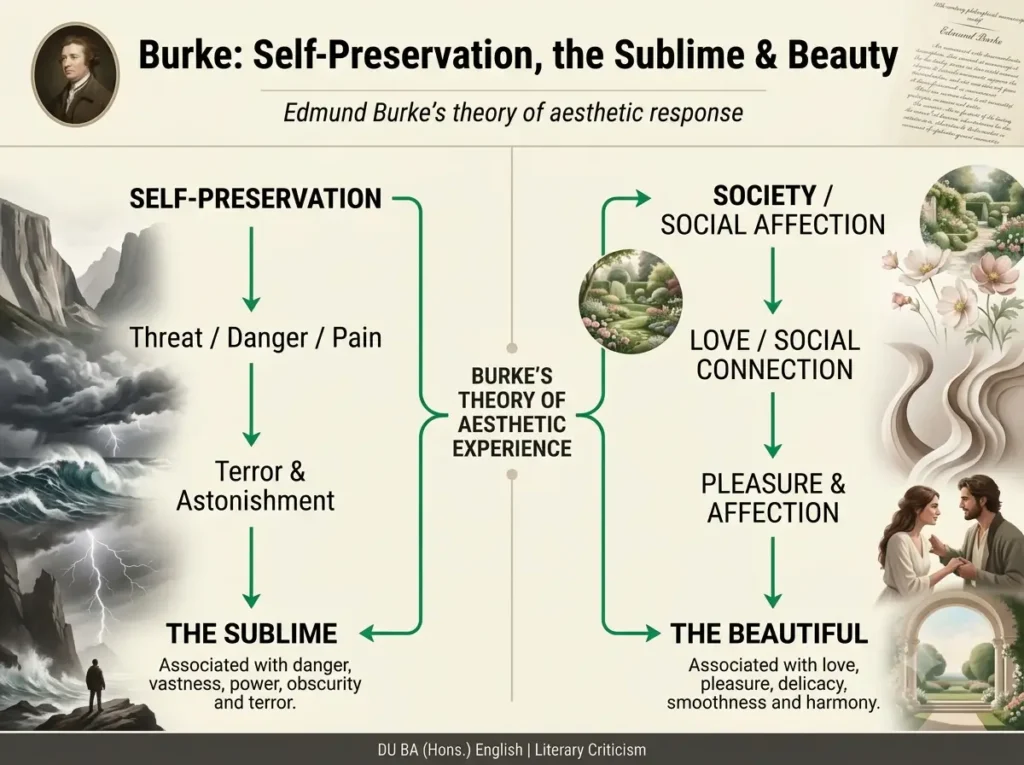
- Self-preservation and the sublime. The passions that belong to self-preservation turn on pain and danger. They are simply painful when their causes affect us directly, but they are delightful when we have an idea of pain and danger without being in actual danger. Burke refuses to call this delight “pleasure”, because it grows out of pain and is quite different from positive pleasure. “Whatever excites this delight, I call sublime.” These are the strongest of all the passions.
- Society and beauty. The second head is society, which has two kinds. One is the society of the sexes: its passion is love mixed with lust, and its object is the beauty of women. The other is the larger society with all men and animals: its passion is also called love, but without lust, and its object is beauty, which Burke uses as a name for qualities that produce affection and tenderness. Love arises from positive pleasure. If the thought of its object is mixed with the thought of having lost it, a mixed feeling arises (he does not call it pain).
- Sympathy. After the general passion for society, the particular passion of sympathy has the widest range. Sympathy puts us in another person’s place and affects us as they are affected, so it can turn on pain or pleasure depending on the occasion.
- Imitation and preference. Burke says only that nothing more needs to be said about these.
Why this section matters for exams
Section XVIII is where Burke’s two-column structure becomes clear: self-preservation → pain/danger → delight → sublime and society → pleasure → love → beauty. If a question asks “What is the basis of Burke’s distinction?”, you can answer from this single paragraph.
A common mistake. Many notes describe Section XVIII as a general repetition of “beauty versus sublime” and add vague remarks about “art and nature”. The text itself is about the passions and their sources. Stick to that.
Part 2: Sections I–VIII (The Sublime in Detail)
Part 2 is Burke’s catalogue of what produces the sublime. He begins with the feeling (astonishment), names its source (terror), and then lists the qualities that create it. Notice how every quality is tied back to terror.
3. Section I: Of the Passion Caused by the Sublime
Burke says the passion caused by great and sublime things in nature, when they act most strongly, is astonishment. He defines astonishment as the state of the soul in which “all its motions are suspended, with some degree of horror”.
Two consequences follow:
- The mind becomes so full of its object that it cannot take in anything else, and therefore cannot reason about what is in front of it.
- Hence, Burke says, the sublime “anticipates our reasonings” and carries us along by “an irresistible force”.
He then ranks the effects: astonishment is the highest degree; the lower degrees are admiration, reverence and respect. This ranking is a useful short answer.
4. Section II: Terror
“No passion so effectually robs the mind of all its powers of acting and reasoning as fear.” Burke says fear is an apprehension of pain or death, so it behaves like real pain.
Key points:
- Anything terrible to the sight is sublime, whether or not it is large. Serpents and poisonous animals can give ideas of the sublime although they are small.
- When something large is joined with an idea of terror, it becomes “without comparison greater”. His example: a vast level plain on land can be as wide as the ocean, but the ocean fills the mind more because it is “an object of no small terror”.
- This leads to his central statement: “terror is in all cases whatsoever, either more openly or latently, the ruling principle of the sublime.”
- He supports this with language. Several languages use one word (or closely related words) for fear and wonder: Greek, the Latin vereor and stupeo, the Latin attonitus (“thunder-struck”), French étonnement, and English “astonishment” and “amazement”.
Exam tip: the word “latently” matters. Burke does not say every sublime object looks frightening. He says terror is always present, openly or hidden.
5. Section III: Obscurity
“To make anything very terrible, obscurity seems in general to be necessary.” When we know the full extent of a danger and can get used to it, much of the fear disappears.
Burke’s illustrations:
- Night increases dread; ghosts and goblins, of which nobody can form clear ideas, affect the minds of those who believe the stories.
- Despotic governments, which depend on fear, keep their rulers away from the public eye.
- Religions use darkness: Burke says almost all heathen temples were dark, and the Druids held ceremonies in the darkest woods (this is his account, and it reflects his time’s knowledge, so treat it as his example rather than as established history).
- Milton understood “judicious obscurity” best. Burke praises Milton’s description of Death in Paradise Lost (Book II), a shape that is no shape, in which “all is dark, uncertain, confused, terrible, and sublime to the last degree”.
6. Section IV: Clearness and Obscurity with Regard to the Passions
This section makes a point that surprises first-time readers: a clear idea is not the same as an affecting idea.
- If you draw a palace, temple or landscape, you give a very clear idea, but the picture can only affect us as the real thing would.
- A lively verbal description gives a vague and imperfect idea, yet it can raise a stronger emotion than the best painting.
- Words are the best way of passing the affections of the mind from one person to another. Even music, without any image, can strongly affect the passions.
- Therefore, Burke says, great clearness “helps but little” and is “in some sort an enemy to all enthusiasms whatsoever”.
7. Section V: The Same Subject Continued
Burke now defends his claim against an apparent contradiction.
- Horace and Du Bos. Burke notes that two lines of Horace’s Art of Poetry (about things heard being less moving than things seen) seem to contradict him. The Abbé Du Bos argued, on this basis, that painting moves the passions better than poetry because its images are clearer. Burke disagrees: the people he knows who love painting often respond coolly to it, while ballads and fanatic preachers rouse ordinary people strongly.
- Ignorance and admiration. He gives a psychological reason: “It is our ignorance of things that causes all our admiration.” Familiar things stop affecting us. Infinity and eternity affect us most, yet we understand them least.
- Milton’s Satan. Burke quotes the description of Satan (a tower, an archangel ruined, the sun in a misty air, an eclipse). The picture works because the images are “crowded and confused”: separate them and the greatness fades; join them and clearness is lost.
- Job. He also cites the vision in the Book of Job, where a spirit passes before the face but its form cannot be made out. The terror comes from the uncertainty.
- A clear idea is “another name for a little idea”. Burke’s logic: nothing can strike us with its greatness unless it approaches infinity; nothing can do that while we can see its limits; and to see an object clearly is to see its limits.
- Painters often fail when they try to paint hell or the temptation of St Anthony; they tend to produce something grotesque or ludicrous. Poetry, by contrast, handles apparitions and allegorical figures (Virgil’s Fame, Homer’s Discord) well.
8. Section VI: Power
“Besides those things which directly suggest the idea of danger… I know of nothing sublime which is not some modification of power.” Burke says this branch grows out of terror, “the common stock of everything that is sublime”.
Why power gives terror. Pain is always inflicted by a power that is in some way superior, because we never submit to pain willingly. Pleasure, by contrast, does not need great force. So when we meet great strength, our first thought is not “this will serve me” but “this might be used to destroy”.
The key test: strength that cannot harm is not sublime.
| Animal | Burke’s point |
|---|---|
| Ox | Strong but harmless and useful, so the idea is not grand |
| Bull | Strong and often destructive, so the idea is great |
| Horse (useful) | Nothing sublime in the plough horse |
| Horse (in Job) | In Job’s description (“whose neck is clothed with thunder”) the useful character disappears and the terrible and sublime appear together |
| Lion, tiger, panther, rhinoceros | We find the sublime in the “gloomy forest” and “howling wilderness”, not among domestic animals |
| Dogs and wolves | Dogs are social and amiable, and “dog” is a term of contempt in every language; wolves are fierce and unmanageable, so they appear in grand descriptions |
Burke adds that institutional power works in the same way. Kings are addressed as “dread majesty”, and young people unused to the powerful feel awe.
The Deity. He extends the argument to God. Considered only as an abstract idea, the Godhead affects the imagination little. But when we imagine his attributes through “sensible images”, his power strikes us most, and we “shrink into the minuteness of our own nature”. He cites the Psalms and the prophets, where God’s presence is described through everything terrible in nature. He also discusses the maxim Primus in orbe deos fecit timor (fear first made gods in the world) and says it is probably false about the origin of religion, but true that dread follows once the idea of great power exists.
9. Section VII: Privation
This is a short section. “All general privations are great, because they are all terrible: Vacuity, Darkness, Solitude and Silence.” Burke illustrates it with Virgil’s invocation of the gods of the underworld, where silent shades, Chaos, darkness and empty realms are heaped together before the poet describes hell. The point to remember: absence can be sublime when it is the absence of light, company, sound or contents.
10. Section VIII: Vastness
“Greatness of dimension is a powerful cause of the sublime.” Burke then adds some careful observations about how size works:
- Extension can be in length, height or depth. Length strikes least: a hundred yards of flat ground is less impressive than a tower or mountain a hundred yards high.
- Height is probably less grand than depth; we are more struck looking down from a precipice than looking up at an equal height (Burke admits he is “not very positive” about this).
- A perpendicular has more force than an inclined plane, and a rugged, broken surface seems stronger than a smooth one.
- Even the extreme of littleness is somewhat sublime. When we think of the infinite divisibility of matter and the tiny creatures that escape our senses, “we become amazed and confounded”, and we cannot distinguish this effect from that of vastness.
What comes next (Infinity). In editions where Infinity is a separate section (Sec IX in the 1759 text; Sec VIII in the 1757 text), Burke links infinity to a “delightful horror”, which he treats as the most genuine effect and truest test of the sublime. Even if the section is not in your numbered range, the idea is worth using in an answer, as long as you say it comes from the section on Infinity.
Part 2 at a Glance
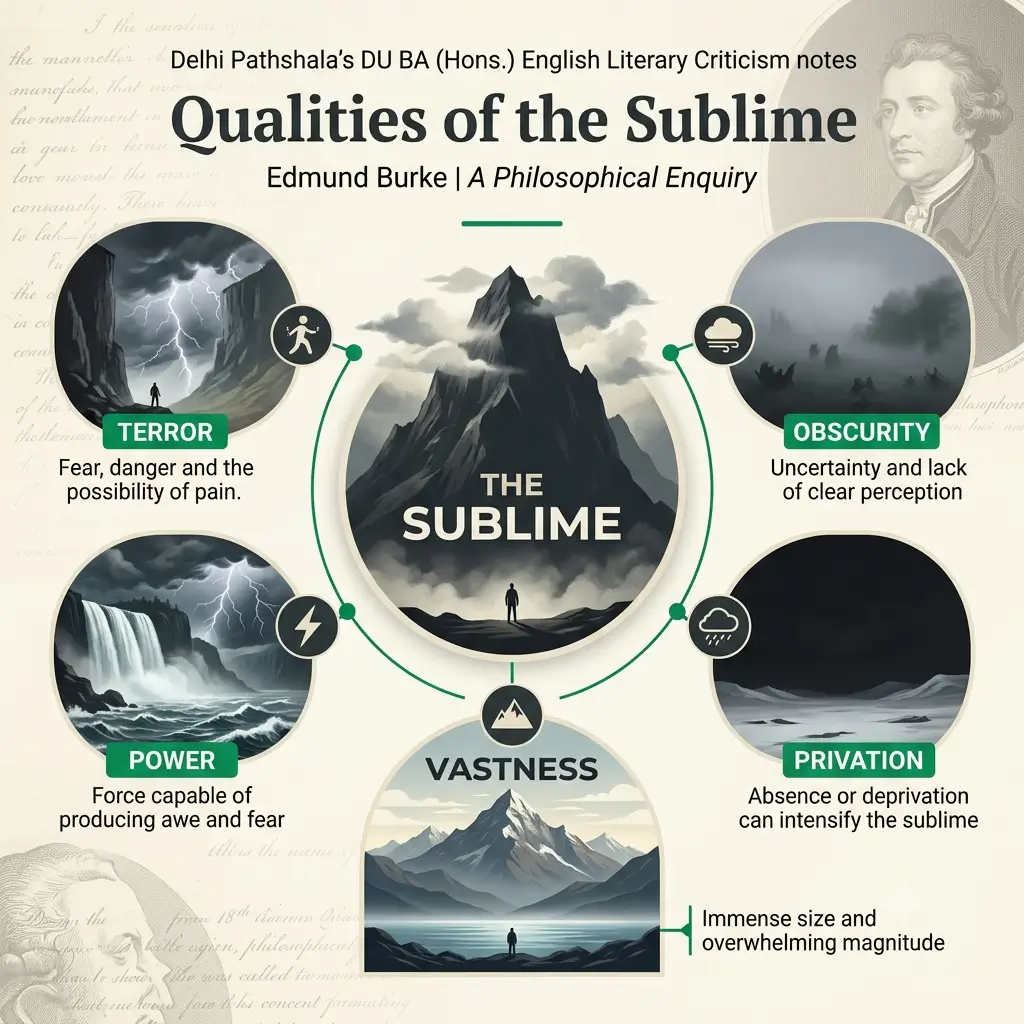
| Section | Quality | Core idea | Burke’s example |
|---|---|---|---|
| I | Astonishment | Mind suspended; reason cannot work | Great and sublime things in nature |
| II | Terror | Ruling principle of the sublime | Serpents, the ocean versus a plain |
| III | Obscurity | Hidden extent increases dread | Night, dark temples, Milton’s Death |
| IV | Clear vs affecting | A clear idea is not an affecting one | Palace drawing versus a description; music |
| V | Poetry vs painting | Obscure images move more | Milton’s Satan, Job, Du Bos |
| VI | Power | Sublime only if it can hurt | Bull and ox, horse in Job, kings, God |
| VII | Privation | Absence is terrible | Virgil at the mouth of hell |
| VIII | Vastness | Size, with depth, height and roughness | Towers, precipices, extreme littleness |
Part 3: Section XXVII (The Sublime and Beautiful Compared)
Section XXVII closes Burke’s long treatment of beauty in Part 3. To use it well in an answer, you need to know a little of what led up to it.
Background: Burke’s Theory of Beauty in Part 3 (Not Prescribed, but Useful)
Burke defines beauty at the start of Part 3: “that quality or those qualities in bodies, by which they cause love, or some passion similar to it.” He limits this to the merely sensible qualities of things, and he separates love (the satisfaction we feel in contemplating something beautiful) from desire or lust, which pushes us to possess an object.
Most of Part 3 then does two things: it rejects the usual explanations of beauty, and it lists what he thinks beauty really consists of.
What Burke says beauty is NOT caused by
| Section | Title | What Burke argues |
|---|---|---|
| III. 2–5 | Proportion not the cause of beauty (in vegetables, animals, the human species; “Proportion further considered”) | He doubts that beauty is “an idea belonging to proportion”. Beauty has usually been said to consist in the proportions of parts, but he tests this on plants, animals and human beings. In Section V he argues that deformity is opposed not to beauty but to the “complete common form”, so removing deformity does not produce beauty; the true opposite of beauty is ugliness. The usual proportions are common to most people and are often found without beauty |
| III. 6–8 | Fitness not the cause of beauty; the real effects of fitness; recapitulation | Being well suited to a purpose does not make an object beautiful. In Section VII Burke explains that proportion and fitness produce “approbation” (the understanding’s agreement), “but not love”. His example: we may admire the fitness of a watch’s works without seeing beauty in them, while an engraved case with no idea of use looks far more beautiful. He adds that proportion and fitness are valuable in works of art; they are simply not the same as beauty |
| III. 9 | Perfection not the cause of beauty | Burke argues that perfection is not the cause of beauty: in the female sex, he says, beauty at its highest “almost always carries with it an idea of weakness and imperfection”. Modern readers often question the assumptions behind this passage (see Criticism below) |
| III. 10–11 | How far the idea of beauty may be applied to the qualities of the mind and to virtue | Burke is cautious, not enthusiastic. In Section XI he says that applying “beauty” to virtue has a strong tendency “to confound our ideas of things” and has misled us in the theory of both taste and morals; he would rest our duties on reason, relations and necessities instead |
What Burke says beauty IS caused by
In “The Real Cause of Beauty” (III. 12), he explains that beauty acts by some mechanical power on the mind through the senses. He then lists the qualities of beautiful objects: a series of sections (III. 13–17) covers smallness, smoothness, gradual variation, delicacy and colour, and the recapitulation (III. 18) lists seven qualities of beauty: (1) comparatively small; (2) smooth; (3) a variety in the direction of the parts; (4) parts not angular but “melted as it were into each other”; (5) a delicate frame, without any remarkable appearance of strength; (6) colours clear and bright, but not very strong and glaring; (7) if there is a glaring colour, it is diversified with others. Later sections discuss features, grace, and beauty in feeling and sounds, before the comparison in Section XXVII.
Note for readers of the older version of this post: the earlier text described these Part 3 sections as “Part 2, Sections I–VIII” and some section titles and numbers were different from Burke’s. In Burke’s book, the sections listed above belong to Part 3, and Part 2 is about the sublime (as in the previous section of these notes).
11. Section XXVII: The Sublime and Beautiful Compared
Burke says that “on closing this general view of beauty”, it is natural to compare it with the sublime, “and in this comparison there appears a remarkable contrast”. He sets out the contrast in one long sentence:
| Quality | The sublime (“the great”) | The beautiful |
|---|---|---|
| Size | Vast in dimensions | Comparatively small |
| Surface | Rugged and negligent | Smooth and polished |
| Lines | Often loves the right line; when it deviates, it deviates strongly | Should shun the right line, yet deviate from it insensibly (gradually) |
| Light and dark | Dark and gloomy | Not obscure |
| Weight | Solid, even massive | Light and delicate |
| Foundation | Founded on pain | Founded on pleasure |
| Source (from Part 1) | Self-preservation | Society |
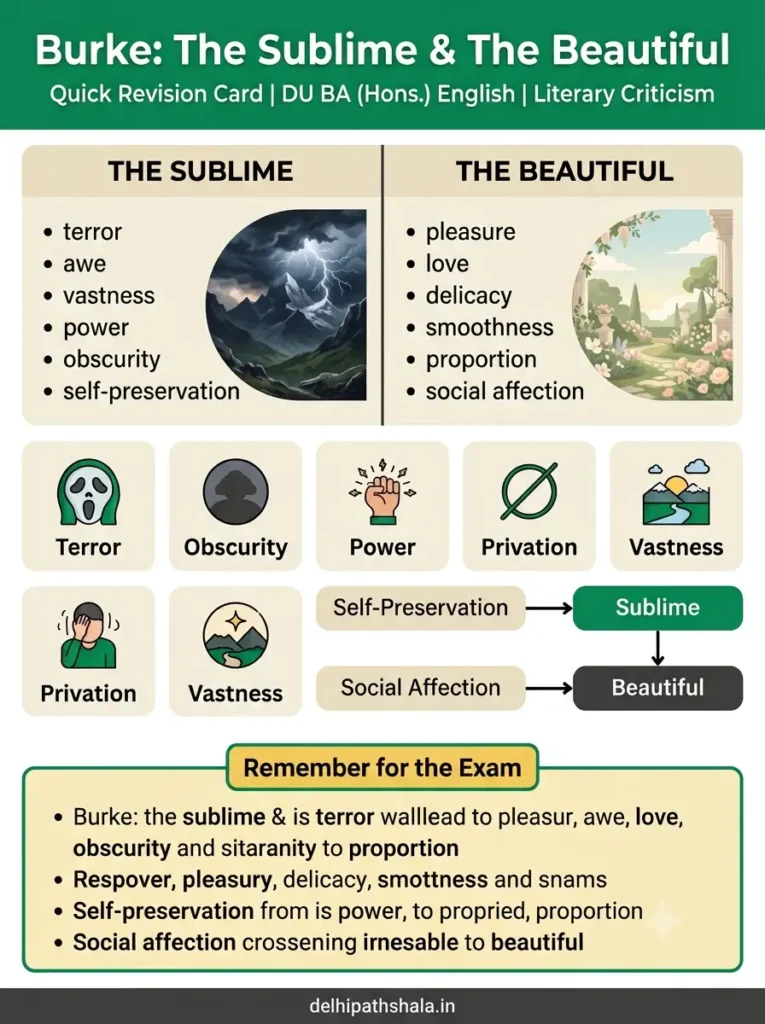
| Passion | Astonishment, terror | Love, affection, tenderness |
He adds that although these ideas may “vary afterwards from the direct nature of their causes”, the causes keep up “an eternal distinction” between them, which no one who aims to affect the passions should forget.
Can the two be combined?
Burke accepts that in the endless variety of nature and of art, qualities that are very far apart may be found united in the same object. But he asks a pointed question: if the sublime and beautiful sometimes appear together, does that prove they are the same, or even related, or that they are not “opposite and contradictory”? His analogy is black and white. They may blend and soften into each other, but they are not therefore the same, and when blended, the power of black as black or white as white is weaker than when each stands uniform and distinct.
A point about the old version. Earlier notes said that Burke “notes some similarities” between the two, using the example of a sunset. In Burke’s own text the idea is different: the two can be found together in one object, but he uses this to defend their difference, not to claim they are alike. When you write this section in an exam, say “co-existence, not similarity”.
A short rule for answers. Mixing qualities in a single object weakens the effect. Burke says that if something is meant to affect the mind through a predominant property, the effect is likely to be “more uniform and perfect” if all the other properties of the object tend to the same design.
Important Comparisons
Burke versus the Classical Idea of Proportion
The idea that beauty lies in the proportions of parts was widely held. Burke does not simply add a second theory; he attacks the foundation. For him, beauty is explained by the effect on the senses and passions (smoothness, smallness, delicacy), not by mathematical ratio. This move shifts the focus from the object’s form to the observer’s response.
Burke and Hume (Same Year, Different Questions)
Both Of the Standard of Taste (in Hume’s Four Dissertations) and Burke’s Enquiry appeared in 1757. Hume asks how we can reach a standard of taste when judgements vary; his answer is the joint verdict of qualified critics. Burke, in the part you study, asks what causes the sublime and the beautiful. Read together, the two give you the two main strands of eighteenth-century aesthetics: how we judge (Hume) and what we feel and why (Burke). You can revise the first in our notes on Hume’s “Of the Standard of Taste”.
Burke and Longinus
Burke mentions Longinus in the preface to the first edition, as someone who gathered very different things under the single name “sublime”. Longinus’s sublime is a quality of great writing; Boileau’s translation (1674) is usually credited with introducing it into modern critical discussion. Burke shifts the question from style to the psychology of terror and astonishment. Note that this comparison rests on the preface; Burke does not set out a point-by-point reply to Longinus in your prescribed sections.
Burke and Kant
Kant, in the Critique of Judgment (1790), engaged closely with Burke’s ideas. Kant’s criticism, as quoted in the First Introduction, is that Burke assembled psychological observations without explaining the causes of aesthetic judgement, work that Kant describes as material for a future systematic account. In broad terms, Kant moves the discussion from physiological and emotional effects towards the powers of the mind itself. Be careful with the common summary that Kant simply “expanded” Burke: he valued Burke’s observations but disagreed about method.
Burke and Eliot (A Contrast Worth Making)
Burke puts emotion and its causes at the centre of aesthetic experience. T.S. Eliot, in “Tradition and the Individual Talent”, argues for the poet’s impersonality: poetry, in his view, is an escape from personal emotion rather than a release of it. If your paper asks you to trace changing attitudes to emotion in criticism, this is a clean contrast. See our notes on Tradition and the Individual Talent by T.S. Eliot.
Selected Quotations and Analysis
The following lines are taken from Burke’s text. Quote them in short form in exams, and always name the section.
- “Whatever is fitted in any sort to excite the ideas of pain and danger… is a source of the sublime.” (Part 1, Section VII) Analysis: This is Burke’s working definition. Note how it makes the sublime depend on pain and danger, and how it includes anything that “operates in a manner analogous to terror”.
- “Whatever excites this delight, I call sublime.” (Part 1, Section XVIII) Analysis: He separates delight (from pain at a distance) from pleasure, so that the sublime has its own category of feeling.
- “Astonishment is that state of the soul, in which all its motions are suspended, with some degree of horror.” (Part 2, Section I) Analysis: The mind is so full of its object that reason has no room to work. This is why the sublime “anticipates our reasonings”.
- “Terror is in all cases whatsoever, either more openly or latently, the ruling principle of the sublime.” (Part 2, Section II) Analysis: The central claim of Part 2. Note “latently”: the terror may be hidden.
- “To make anything very terrible, obscurity seems in general to be necessary.” (Part 2, Section III) Analysis: This is the basis of his preference for suggestion over description, and the reason he admires Milton.
- “A clear idea is therefore another name for a little idea.” (Part 2, Section V) Analysis: A striking summary of why poetry’s obscure images can be more sublime than painting’s clear ones.
- “I know of nothing sublime which is not some modification of power.” (Part 2, Section VI) Analysis: Power becomes sublime only if it can hurt; useful, subservient strength is contemptible.
- “Sublime objects are vast in their dimensions, beautiful ones comparatively small.” (Part 3, Section XXVII) Analysis: The opening of his comparison, which you can build your answer around.
Critical Reception and Legacy
Influence. The Enquiry attracted the attention of major continental and British thinkers. Scholars of the book, including the editor of the Boulton edition, trace its influence on writers such as Samuel Johnson, Wordsworth and Thomas Hardy, on painters such as Fuseli and Mortimer, and on critics such as Diderot, Lessing and Kant. Burke’s preference for the sublime over the beautiful is often seen as part of the shift from Neoclassical to Romantic taste. In Britain the Enquiry also fed into eighteenth-century ideas about landscape and, through its emphasis on terror, obscurity and power, into Gothic fiction.
How Part 2 is used in literary study. Teachers of Gothic literature note that Part 2 has sometimes led students to treat Burke as a checklist (obscurity, power, vastness, and so on) to be ticked off against a Gothic novel. Use the list, but also remember Burke’s underlying argument: each quality is a route to terror.
Burke on his own method. In the preface Burke says an inquiry like his, even if it fails to find the truth, shows us “the weakness of our own understanding”, and that “if it does not make us knowing, it may make us modest”. This is a useful reminder that he presents his findings as an inquiry, not a final system.
Criticism and Limitations
Burke’s theory has been challenged on several grounds. When you write a critical paragraph, attribute each point:
- Kant’s objection. Kant treats Burke’s work as empirical psychology that gathers observations but does not explain why we judge as we do.
- A narrow base for the sublime. Because terror is the “ruling principle”, other sources of grandeur (moral or intellectual greatness, for example) are harder to fit. Burke himself admits he intended no “full dissertation” and only inquired into the origin of the ideas.
- The dependence on distance. The sublime works only “at certain distances, and with certain modifications”; his account does not tell us exactly where that line is.
- Gender associations. In Part 3, Section IX Burke links the highest beauty in women with “weakness and imperfection”, and in Part 2 he links the sublime with power. Some modern commentary therefore describes his scheme as pairing a masculine sublime with a feminine beautiful and questions the assumptions behind that pairing. (The Royal Collection Trust’s description of its copy of the book summarises it in those terms.)
- Poetry versus painting. His claim that obscure images affect us more than clear ones, and his critique of Du Bos, rest on his own observation of how people respond, and are open to dispute.
Contemporary Relevance
Burke’s observations about suspense, the unseen and the power of suggestion remain useful for reading Romantic nature poetry and Gothic fiction. The central idea, that we can take pleasure in imagined danger when we are safe, is also a helpful lens for discussing why readers and audiences are drawn to frightening stories.
Summary of Key Arguments
- Two sources of passion. Self-preservation (pain and danger) and society (pleasure and love) are the roots of the sublime and the beautiful respectively.
- Delight is not pleasure. The sublime gives delight, the relief of pain or danger felt at a distance. Beauty gives pleasure.
- Terror is the ruling principle of the sublime, openly or latently. Astonishment is its highest effect.
- Obscurity, power, privation and vastness are the main qualities producing the sublime in Part 2.
- A clear idea is not necessarily an affecting one; words and poetry can move the passions more than precise images.
- Beauty is not caused by proportion, fitness or perfection, but by sensible qualities such as smallness, smoothness and delicacy (Part 3).
- The two are distinct. Part 3, Section XXVII sets the sublime and the beautiful side by side as contrasts.
Conclusion
Burke’s Enquiry is short on reasoning from rules and long on observation of how the mind responds. In the sections DU prescribes, he defines the sublime through pain, danger and terror (Part 1), explains the qualities that excite it, from obscurity to vastness (Part 2), and finally sets it against the beautiful in a single, memorable comparison (Part 3, Section XXVII). If you remember that every quality of the sublime in Part 2 leads back to terror, and that every quality of beauty leads to love and tenderness, you have the shape of the entire unit. Practise the comparison table, learn the verified quotations, and be ready to say where Burke is persuasive and where later thinkers such as Kant disagree.
Continue Reading
University of Delhi Previous Year Questions
University of Delhi Previous Year Questions
Section A — Direct DU PYQs
1 Compare and contrast Burke and Hume’s ideas on taste. +
Year / Paper: Ramanujan College, B.A. (Hons.) English, UPC: 12037509, 2021–22
Hint: Compare Hume’s account of taste and the standard of taste with Burke’s understanding of taste, judgement and aesthetic response.
Suggested Answer Focus: Discuss Hume’s emphasis on delicacy, practice, comparison and the competent critic alongside Burke’s treatment of taste as a faculty or organ of the mind. Examine the possibility of a standard of taste, the role of experience and education, and the relationship between subjective response and general principles. Direct PYQ
2 Discuss the relationship between the Enlightenment emphasis on education and aesthetic theory with reference to any one philosopher in your course. +
Year / Paper: Ramanujan College, B.A. (Hons.) English, UPC: 12037509, 2021–22 — Burke/Hume option
Hint: Relate Enlightenment ideas of education, cultivation and reason to the development of aesthetic judgement.
Suggested Answer Focus: Explain how education, experience, cultivation and intellectual training contribute to aesthetic judgement. With reference to Burke or Hume, discuss the relationship between individual response, acquired judgement and broader eighteenth-century aesthetic thought. Direct PYQ
Section B — Official DU Question Bank: Hume & Burke
3 Discuss Burke’s understanding of ‘taste’ as disinterested appreciation, a function of an organ of the mind. +
Question Bank: SGND Khalsa / SOL — QB BAH Sem-5 DSE Literary Criticism and Theory
Hint: Explain Burke’s conception of taste as a faculty of judgement and examine the idea of disinterested aesthetic appreciation.
Suggested Answer Focus: Define taste, discuss its relation to the senses and the mind, and explain how Burke seeks to identify general principles underlying aesthetic judgement. Question Bank
4 Discuss the manner in which empirical science intersects with aesthetic criticism in Edmund Burke’s essay. +
Question Bank: SGND Khalsa / SOL — QB BAH Sem-5 DSE Literary Criticism and Theory
Hint: Examine Burke’s attempt to investigate aesthetic experience through observation, sensation and empirical analysis.
Suggested Answer Focus: Discuss Burke’s method of examining pleasure, pain, sensation, bodily response and the sources of aesthetic effects rather than relying only on abstract philosophical definitions. Question Bank
5 Discuss Burke’s understanding of imagination as outlined in the essay. Why can it not produce anything absolutely new? +
Question Bank: SGND Khalsa / SOL — QB BAH Sem-5 DSE Literary Criticism and Theory
Hint: Explain the operations of imagination and its dependence upon combinations and modifications of ideas already received through the senses.
Suggested Answer Focus: Discuss imagination as a faculty that combines, rearranges and modifies existing ideas. Explain why, for Burke, imagination does not create ideas entirely independent of previous sensory experience. Question Bank
6 With reference to Hume & Burke, is it correct to argue that “aesthetics was born in the mid-18th century as a discourse of the body”? +
Question Bank: SGND Khalsa / SOL — QB BAH Sem-5 DSE Literary Criticism and Theory
Hint: Examine the importance of sensation, bodily response, pleasure and pain in eighteenth-century aesthetic thought.
Suggested Answer Focus: Compare Hume and Burke on sensory experience and aesthetic response, while considering how the body, sensation and judgement participate in the formation of aesthetic experience. Question Bank
7 Critically evaluate the statement that “aesthetics in 18th C was more of a social intentionality than a language for aesthetics”. +
Question Bank: SGND Khalsa / SOL — QB BAH Sem-5 DSE Literary Criticism and Theory
Hint: Consider eighteenth-century aesthetic theory in relation to society, culture, manners, education and the cultivation of taste.
Suggested Answer Focus: Discuss aesthetic judgement not merely as an individual response but also as a socially cultivated practice shaped by education, conversation, experience and standards of judgement. Question Bank
8 Discuss the relationship established between reason/logic and aesthetics in Hume and Burke. Is it correct to argue that “aesthetics was born in this period as the ‘sister’ of logic”? +
Question Bank: SGND Khalsa / SOL — QB BAH Sem-5 DSE Literary Criticism and Theory
Hint: Examine the role of reason, judgement, sensation and principles in the aesthetic theories of Hume and Burke.
Suggested Answer Focus: Compare the relationship between rational judgement and sensory response in Hume and Burke, and assess the extent to which eighteenth-century aesthetics sought systematic principles comparable to those of logic. Question Bank
9 Discuss the significance of ‘beauty’ in Hume and Burke. +
Question Bank: SGND Khalsa / SOL — QB BAH Sem-5 DSE Literary Criticism and Theory
Hint: Compare the two philosophers’ approaches to beauty, taste and aesthetic judgement.
Suggested Answer Focus: Explain how beauty functions within Burke’s distinction between the beautiful and sublime and compare this with Hume’s account of beauty, taste and the role of sentiment and judgement. Question Bank
10 How far is training/practice/knowledge important to the idea of ‘taste’ in Hume and Burke? Why? +
Question Bank: SGND Khalsa / SOL — QB BAH Sem-5 DSE Literary Criticism and Theory
Hint: Discuss the cultivation of taste through experience, practice, comparison and knowledge.
Suggested Answer Focus: Compare Hume’s emphasis on practice and the qualified critic with Burke’s account of taste as a faculty whose operations can be examined through experience and principles. Question Bank
11 How do the two essays by Hume and Burke differ in their attempt to establish a universal standard of taste? +
Question Bank: SGND Khalsa / SOL — QB BAH Sem-5 DSE Literary Criticism and Theory
Hint: Compare Hume’s search for a standard of taste with Burke’s attempt to identify general principles of aesthetic response.
Suggested Answer Focus: Discuss the tension between subjective sentiment and general standards, the role of experience and judgement, and the different methods adopted by Hume and Burke in explaining aesthetic agreement. Question Bank
Section C — Unit 1 Burke: Prescribed-Section-wise PYQ Pattern
12 How does Burke distinguish the sublime from the beautiful on the basis of pain/pleasure, self-preservation and society? Why does he say they are mutually exclusive? +
Prescribed Text: Part 1, Section VII — The Sublime and Beautiful Compared
Hint: Focus on Burke’s distinction between the passions connected with self-preservation and those connected with society.
Suggested Answer Focus: Explain the relation of the sublime to terror, danger and self-preservation, and the relation of beauty to pleasure, love and society. Show why Burke treats the two aesthetic categories as distinct rather than interchangeable. Probable
13 Burke argues the experience of the sublime is linked to feelings of astonishment, awe, or even fear, arising from immense or overwhelming phenomena. Elaborate. +
Prescribed Text: Part 1, Section VII — The Sublime and Beautiful Compared
Hint: Explain how overwhelming objects and passions associated with self-preservation produce the characteristic effects of the sublime.
Suggested Answer Focus: Discuss astonishment, awe, terror, danger and the suspension or modification of ordinary judgement. Relate the emotional intensity of the sublime to Burke’s broader account of self-preservation. Probable
14 Why does Burke call beauty as “what is well-formed and aesthetically pleasing, whereas the Sublime is what has the power to compel and destroy us”? +
Prescribed Text: Part 1, Section XVIII — Recapitulation
Hint: Use Burke’s recapitulation of the principal differences between the beautiful and the sublime.
Suggested Answer Focus: Contrast proportion, smoothness, smallness and pleasure associated with beauty against vastness, obscurity, terror and power associated with the sublime. Probable
15 Discuss terror as the ruling principle of the sublime. How does Burke explain “delightful horror”? +
Prescribed Text: Part 2, Sections I–VIII
Hint: Explain terror as the primary passion associated with the sublime and distinguish delight from ordinary pleasure.
Suggested Answer Focus: Discuss danger, pain, terror, self-preservation and the peculiar pleasure or delight arising when terror is experienced without actual immediate danger to the observer. Probable
16 Why is obscurity essential to the sublime? Discuss with Burke’s examples of darkness, vastness and infinity. +
Prescribed Text: Part 2, Sections I–VIII
Hint: Examine Burke’s argument that clear and distinct perception can reduce the emotional force associated with sublime objects.
Suggested Answer Focus: Discuss obscurity, uncertainty, darkness, vastness and infinity as sources that limit precise comprehension and intensify the imagination and passions. Probable
17 Differentiate between pleasure and delight in Burke. How is delight related to self-preservation? +
Prescribed Text: Part 2, Sections I–VIII
Hint: Distinguish positive pleasure from the distinctive feeling that follows the removal or diminution of pain or danger.
Suggested Answer Focus: Explain Burke’s distinction between pleasure and delight and connect delight to the passions of self-preservation and the experience of terror without actual destruction. Probable
18 Comment upon the aesthetic importance of the Sublime on the basis of his division of its sources into content and style. +
Prescribed Text: Part 2, Sections I–VIII
Hint: Organise the answer around the principal sources of the sublime discussed by Burke.
Suggested Answer Focus: Discuss terror, obscurity, power, vastness and infinity and explain how qualities of objects and modes of representation contribute to sublime effect. Probable
19 What are the qualities of the beautiful according to Burke? How does it relate to love and society, not terror? +
Prescribed Text: Part 3, Section XXVII — Sublime and Beautiful Compared
Hint: Focus on Burke’s account of beauty and its relation to the passions of society and love.
Suggested Answer Focus: Discuss qualities associated with beauty and contrast them with the sources of the sublime. Explain why beauty produces affection and love rather than the terror and self-preservation response characteristic of the sublime. Probable
Section D — DSC-9 Unit 1 Exam Pattern
20 DSC-9 Literary Criticism — Unit 1: Expected Examination Pattern +
Course: DSC-9 Literary Criticism — Semester 3, UGCF 2022
Unit 1: Hume & Edmund Burke
Paper Pattern: 3 hours — 75 marks
Question Pattern: 6 questions, attempt any 4; each question carries 18.75 marks
Unit 1 Focus: Questions are expected to draw on Hume and Burke, with particular emphasis on comparison of taste, aesthetic theory, and Burke’s distinction between the Sublime and the Beautiful.
Preparation Focus: Prepare at least one comparative Hume–Burke answer on taste/aesthetic judgement and one detailed Burke answer on the Sublime and Beautiful. For Burke, give special attention to Part 1 Section VII and XVIII, Part 2 Sections I–VIII, and Part 3 Section XXVII. Exam Pattern
Frequently Asked Questions (FAQs)
What is the sublime according to Burke?
For Burke, the sublime is whatever excites ideas of pain and danger, or acts in a way similar to terror, and so produces the strongest emotion the mind can feel (Part 1, Section VII). It gives delight when the danger is felt at a distance, not pleasure.
Which sections of Burke’s Enquiry are in the DU syllabus?
DSC-9 (Literary Criticism, Unit I) lists Part 1: Section VII and Section XVIII; Part 2: Sections I–VIII; and Part 3: Section XXVII.
Why does Burke say terror is the “ruling principle” of the sublime?
Because, in Part 2, every quality he lists (obscurity, power, privation and vastness) acts by suggesting danger or by working in a similar way to terror. He says this holds “either more openly or latently”.
How can fear be enjoyable in Burke’s theory?
When danger or pain press too closely they are simply terrible. At a distance and with some modification, they can be delightful. Burke calls this feeling delight, to separate it from positive pleasure.
What is the difference between the sublime and the beautiful in one line?
The sublime is vast, rugged, dark and massive and rests on pain and terror; the beautiful is small, smooth, light and delicate and rests on pleasure and love (Part 3, Section XXVII).
Why does Burke prefer obscurity to clarity?
He argues that a clear idea is a limited idea, and what is limited cannot inspire the feeling of greatness that comes from approaching infinity. That is why a verbal description can move us more than a detailed picture.
Why do some books number Part 2 differently?
The 1759 text includes a section called “The Same Subject Continued” (Section V), which is not in the 1757 table of contents. Because of this, Power, Privation, Vastness and Infinity are numbered one place higher in the 1759 text. Check the edition you are using.
Does Burke say that proportion makes things beautiful?
No. In Part 3 he argues against the view that beauty comes from proportion, and also rejects fitness and perfection as causes. He says beauty is, for the greater part, some quality in bodies acting on the mind through the senses, and lists qualities such as smallness, smoothness and delicacy.
How did Kant respond to Burke?
Kant took Burke seriously but criticised his method, describing it as psychological observation that gathers material without explaining the causes of judgement. Kant’s own Critique of Judgment appeared in 1790.
Is Burke’s sublime only about nature?
No. Burke’s examples include natural objects (the ocean, precipices), animals (the bull, the lion), art and poetry (Milton, Virgil, Job), social power (kings) and religious ideas of God. For him, the sublime depends on the effect of terror, not on the kind of object.
Reading List and Primary Text
Reading List and Primary Text
Subscribe to keep reading
You've used your free notes for now. Get Delhi Pathshala Premium for unlimited access.
Subscribe — ₹29/30 days