

Contents
- 1. Introduction
- Who Was David Hume?
- Where Does “Of the Standard of Taste” Come From?
- Why This Essay Matters for DSC-8
- 2. What Is “Of the Standard of Taste” About?
- 3. Themes and Key Concepts
- What Is Taste, According to Hume?
- Bilingual Quick Note (for revision)
- 4. Structure and Style
- 5. Key Arguments
- Criteria for Judging Art
- Common Errors in Judging Art
- 6. The “True Critic” — Hume’s Central Idea
- 7. Critical Reception and Legacy
- 8. Selected Quotes and Analysis
- 9. Comparative Analysis: Hume vs Other Theorists
- 10. Previous Year Questions (DU DSC-8 — Literary Criticism)
- 11. FAQs
In this post: Complete notes on Unit 1: David Hume — “Of the Standard of Taste” from DSC-8: Literary Criticism, B.A. (Hons.) English, Delhi University. Covers Hume’s key arguments, the “true critic” concept, comparative analysis, previous year questions (PYQs), and exam-ready FAQs.
1. Introduction
Who Was David Hume?
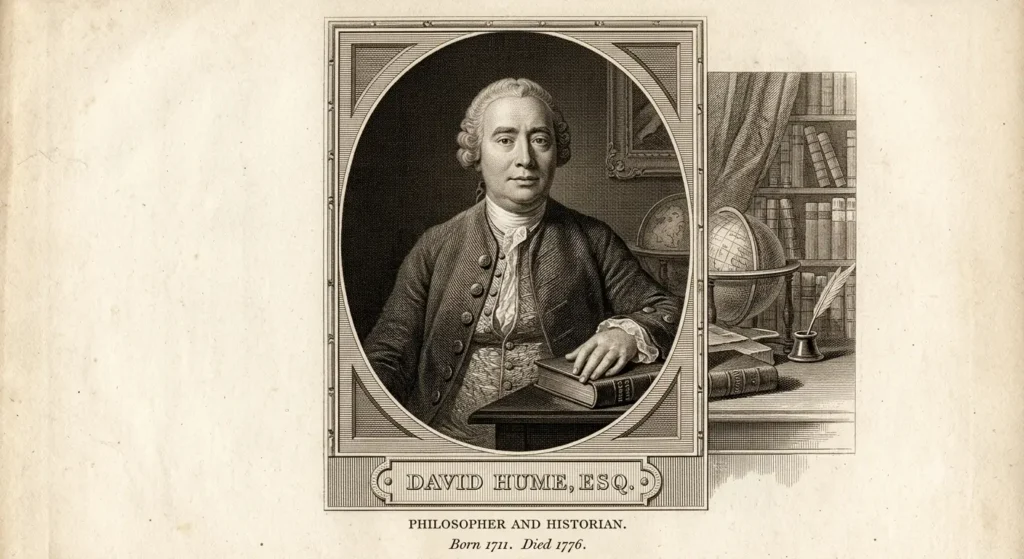
David Hume (1711–1776) was a Scottish philosopher, historian, and economist, and one of the central figures of the Scottish Enlightenment. Alongside John Locke and George Berkeley, Hume is counted among the great British empiricists — thinkers who held that all human knowledge comes from experience rather than pure reason. For a fuller biographical account, the Stanford Encyclopedia of Philosophy’s entry on Hume is a reliable academic reference if you want to go deeper than exam requirements.
Hume’s influence stretched across epistemology, ethics, and — most relevant to this unit — aesthetics: how we judge beauty, taste, and artistic value.
Where Does “Of the Standard of Taste” Come From?
The essay was published in 1757 as part of Hume’s collection Four Dissertations, alongside essays on the passions, tragedy, and the natural history of religion. Written during the high Enlightenment — an age obsessed with reason, order, and universal principles — the essay tries to answer a deceptively simple question: if beauty is a matter of personal feeling, can there still be a “correct” answer about what is beautiful?
Why This Essay Matters for DSC-8
“Of the Standard of Taste” is usually the entry point to your Literary Criticism paper because it raises the foundational question of the entire discipline: how do we evaluate, interpret, and judge a work of art? If you’re revising this unit alongside Edmund Burke’s ideas on the sublime and beautiful (also on your DSC-8 syllabus), you’ll notice both essays were published almost the same year — Hume in 1757, and Burke’s Philosophical Enquiry just a year earlier in 1756 — making them natural exam-comparison material.
2. What Is “Of the Standard of Taste” About?
At its core, the essay tackles a contradiction Hume himself notices: people’s tastes vary wildly from person to person and culture to culture — yet we also confidently say things like “Milton is a greater poet than a hack writer,” as if some judgments really are better than others. Hume’s essay tries to resolve this contradiction without abandoning either side of it.
He doesn’t try to define beauty itself. Instead, he asks: is there a standard by which we can settle disagreements about taste? His answer, in short: yes — but the standard isn’t a fixed rule written down anywhere. It emerges from the collective judgment of people with refined taste, gained through practice, comparison, and freedom from prejudice.
3. Themes and Key Concepts
What Is Taste, According to Hume?
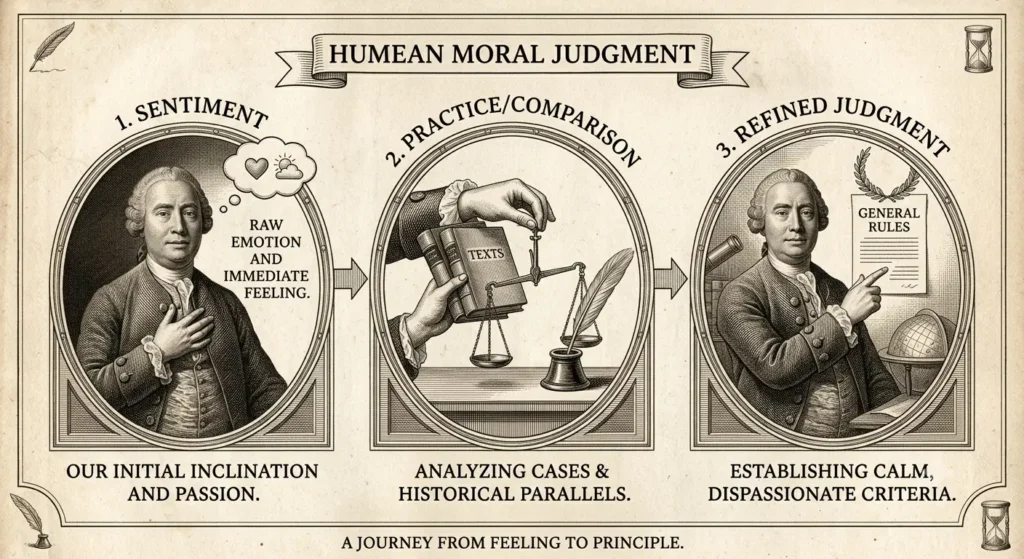
Hume treats taste as a sentiment — an emotional, felt response to art — but one that can be trained and improved, much like a skill. A person isn’t born with good taste; they develop it the way a wine-taster develops a palate, through repeated, attentive exposure.
- Subjectivity vs. objectivity in art judgment: Hume acknowledges genuine variation in personal taste, but argues that when we look at the judgments of qualified critics rather than untrained opinion, a working standard emerges — not absolute, but reliable enough to separate Milton from a forgotten hack.
- Sentiment and reason in art evaluation: Feeling gives us the immediate experience of beauty; reason helps us test whether that feeling holds up under scrutiny, comparison, and freedom from bias. The two work together rather than competing.
Bilingual Quick Note (for revision)
Hume ka main argument yeh hai ki taste poori tarah personal nahi hota — practice, comparison aur prejudice se free hoke dekha jaaye toh kuch judgments doosron se better hote hain. Isi wajah se ek “true critic” ki opinion zyada trustworthy mani jaati hai.
4. Structure and Style
Hume’s prose is famously accessible for an 18th-century philosophical essay — calm, logically sequenced, and light on jargon. He builds his case in stages: first laying out the problem of varying taste, then proposing criteria for judgment, and finally addressing objections and complicating factors (like age, culture, and individual temperament).
He frequently uses everyday analogies — most famously comparing the judgment of art to the judgment of food and wine, where a trained palate can detect qualities an untrained one misses. This comparison, later picked up by aesthetic philosophers, makes an abstract argument feel concrete and testable.
5. Key Arguments
Criteria for Judging Art
Hume proposes that good art tends to share certain qualities: it stirs genuine emotion, it is internally balanced and coherent, and it rewards deeper reflection rather than only surface pleasure. Crucially, he holds that art which has pleased across many cultures and long stretches of time (like Homer, still admired thousands of years later) offers strong evidence of real artistic merit — durability functions as a kind of natural test.
Common Errors in Judging Art
Hume flags several habits that distort taste:
- Chasing novelty — mistaking “new” for “better.”
- Mistaking personal preference for universal law — assuming your taste is the benchmark for everyone.
- Over-valuing technical polish — admiring craftsmanship while missing emotional depth or meaning.
6. The “True Critic” — Hume’s Central Idea
This is the concept examiners return to most often, so it deserves its own section.
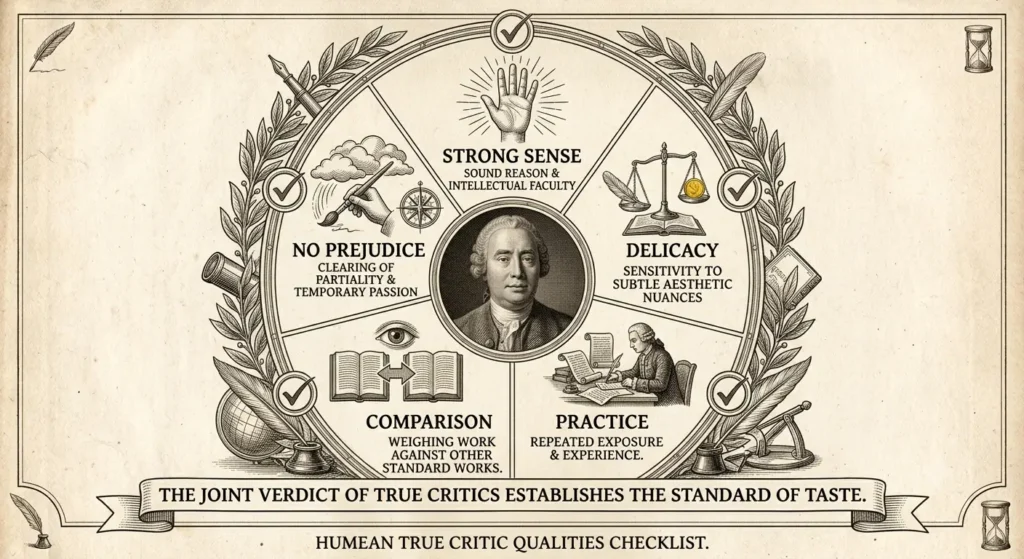
Hume argues that not all opinions on art carry equal weight. A “true critic” is someone who combines:
- Strong sense (sound judgment and intelligence)
- Delicacy of imagination (sensitivity to fine distinctions others miss)
- Practice (wide, repeated exposure to art)
- Comparison (the habit of judging one work against many others, not in isolation)
- Freedom from prejudice (setting aside personal bias, national loyalty, or fashion)
Where these five qualities converge, Hume says, the resulting judgment comes closest to an objective verdict — not because it’s infallible, but because it filters out the noise that distorts untrained opinion. The true critic doesn’t invent taste; they refine and clarify what’s already latent in shared human sentiment.
7. Critical Reception and Legacy
When published in 1757, the essay drew both interest and skepticism — critics questioned whether Hume could really rescue “universal standards” from something as personal as feeling. Still, its core move (grounding aesthetic judgment in refined sentiment rather than abstract rules) proved highly influential.
Its clearest legacy runs through Immanuel Kant, whose Critique of Judgment (1790) tackled the same problem — how can aesthetic judgments feel universal despite being subjective? — from a more systematic angle. Hume’s idea of the trained critic also echoes forward into later Romantic and Victorian debates about taste, and into 20th-century reader-response criticism, which similarly locates meaning in the informed reader’s encounter with a text.
8. Selected Quotes and Analysis
“Beauty in things, as in men, is more or less perfect according to the degree of their resemblance to the standard of excellence.”
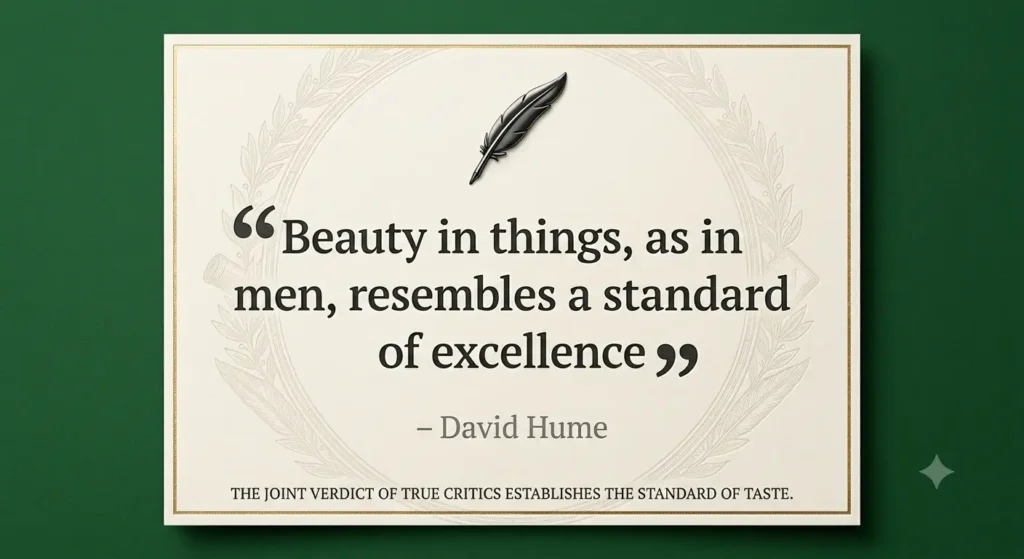
Analysis: Hume compares aesthetic beauty to human beauty, suggesting both are judged by degree of closeness to an ideal — implying a workable standard exists, even if it isn’t rigid or absolute.
“It is natural for us to seek a Standard of Taste; a rule, by which the various sentiments of men may be reconciled.”
Analysis: This line captures Hume’s central project in a single sentence — not to erase disagreement, but to find a workable way of settling it.
For the complete original text (public domain), students can consult primary sources like the Harvard Classics edition hosted via academic archives rather than relying only on paraphrased notes — useful if your exam requires direct textual reference.
9. Comparative Analysis: Hume vs Other Theorists
| Theorist | Core Idea on Taste/Beauty | Key Difference from Hume |
|---|---|---|
| David Hume | Taste is sentiment, refined by practice; “true critic” sets the standard | Grounds judgment in trained feeling, not abstract rules |
| Immanuel Kant (Critique of Judgment, 1790) | Aesthetic judgment is subjective but claims universal validity (“purposiveness without purpose”) | More systematic/a priori approach; less reliant on the authority of expert critics |
| Edmund Burke (Philosophical Enquiry, 1756) | Beauty and the sublime are rooted in physiological/emotional responses (terror, pleasure) | Focuses on the sublime as a distinct, more intense category than beauty |
| Joseph Addison (Spectator essays) | Taste can be cultivated through education and exposure to “the pleasures of imagination” | Less focused on resolving disagreement; more descriptive of taste’s pleasures |
For a deeper dive into Burke’s parallel essay on this same DSC-8 unit, see Our Ideas of the Sublime and the Beautiful by Edmund Burke on Delhi Pathshala.
10. Previous Year Questions (DU DSC-8 — Literary Criticism)
Based on recent Delhi University Literary Criticism (DSC) question papers, here are the question patterns most commonly asked on this unit:
- Discuss the role of sentiment in Hume’s “Of the Standard of Taste.” (Short answer)
- A passage on the “true critic” is given — comment critically on Hume’s conceptualization of a standard of taste. (Passage-based)
- Explain Hume’s concept of the “true critic.” How does this idea help resolve the problem of varying taste? (Long answer)
- “The principle of the natural equality of tastes is totally forgot” — explain this statement with reference to Hume’s essay. (Long answer)
- Compare Hume’s idea of taste as sentiment with Burke’s treatment of the sublime and beautiful. (Comparative)
- How does Hume address the influence of age and culture on individual taste? (Short answer)
11. FAQs
What is the main argument of Hume’s “Of the Standard of Taste”?
Hume argues that although personal taste genuinely varies, a workable standard of taste exists — one based on the collective judgment of “true critics” who combine strong sense, refined sensitivity, wide practice, comparison, and freedom from prejudice.
Who is a “true critic” according to Hume?
A true critic is someone whose taste has been trained through extensive exposure to art, who compares works rather than judging in isolation, and whose judgment is free from personal or cultural bias.
Is Hume’s theory of taste subjective or objective?
It’s a middle position. Hume accepts that taste begins as subjective sentiment but argues that, among qualified critics, a near-objective consensus reliably emerges — making his theory neither purely subjective nor strictly objective.
How is Hume’s essay different from Edmund Burke’s ideas on beauty?
Burke focuses on physiological and emotional responses that distinguish the sublime from the merely beautiful, while Hume is more concerned with whose judgment should count as authoritative when tastes conflict.
Why is this essay considered the starting point of DSC-8 Literary Criticism?
Because it directly raises the foundational question of literary criticism as a discipline — can artistic value be judged at all, and if so, by what standard — making it a natural entry point before moving to later theorists.
What year was “Of the Standard of Taste” published?
It was published in 1757, as part of Hume’s collection Four Dissertations.
Related Notes:
Subscribe to keep reading
You've used your free notes for now. Get Delhi Pathshala Premium for unlimited access.
Subscribe — ₹29/30 days