
Contents
- Background
- About the Poet: Ted Hughes
- About the Collection: Crow (1970)
- ‘Crow’s Fall’ in the DU Syllabus
- Crow’s Fall: Full Summary
- Major Concepts and Themes
- Detailed Discussion: Structure, Form and Poetic Devices
- Critical Appreciation
- Important Comparison: ‘Crow’s Fall’ and ‘Hawk Roosting’
- Criticism and Limitations
- Contemporary Relevance
- Conclusion
- Continue Reading
- University of Delhi Previous Year Questions
- Frequently Asked Questions
Notes for Unit 2D (ii): ‘Crow’s Fall’ by Ted Hughes, DSC-13: Twentieth Century Poetry & Drama, BA (Hons.) English, Semester 5, University of Delhi.
‘Crow’s Fall’ is one of the shortest and most quoted poems in Ted Hughes’s 1970 collection Crow: From the Life and Songs of the Crow. In just seventeen lines, Hughes rewrites the old fable of pride before a fall into a private myth that explains, half-seriously, why crows are black. For DU students, the poem is usually taught alongside ‘Hawk Roosting’ as a pair of contrasting animal monologues — one bird triumphant, the other humiliated — and examiners regularly ask students to read the two poems against each other. This page walks through the poem’s story, its themes and devices, its place in Hughes’s Crow sequence, and gives DU-specific previous year questions and FAQs for exam preparation.
Background
About the Poet: Ted Hughes
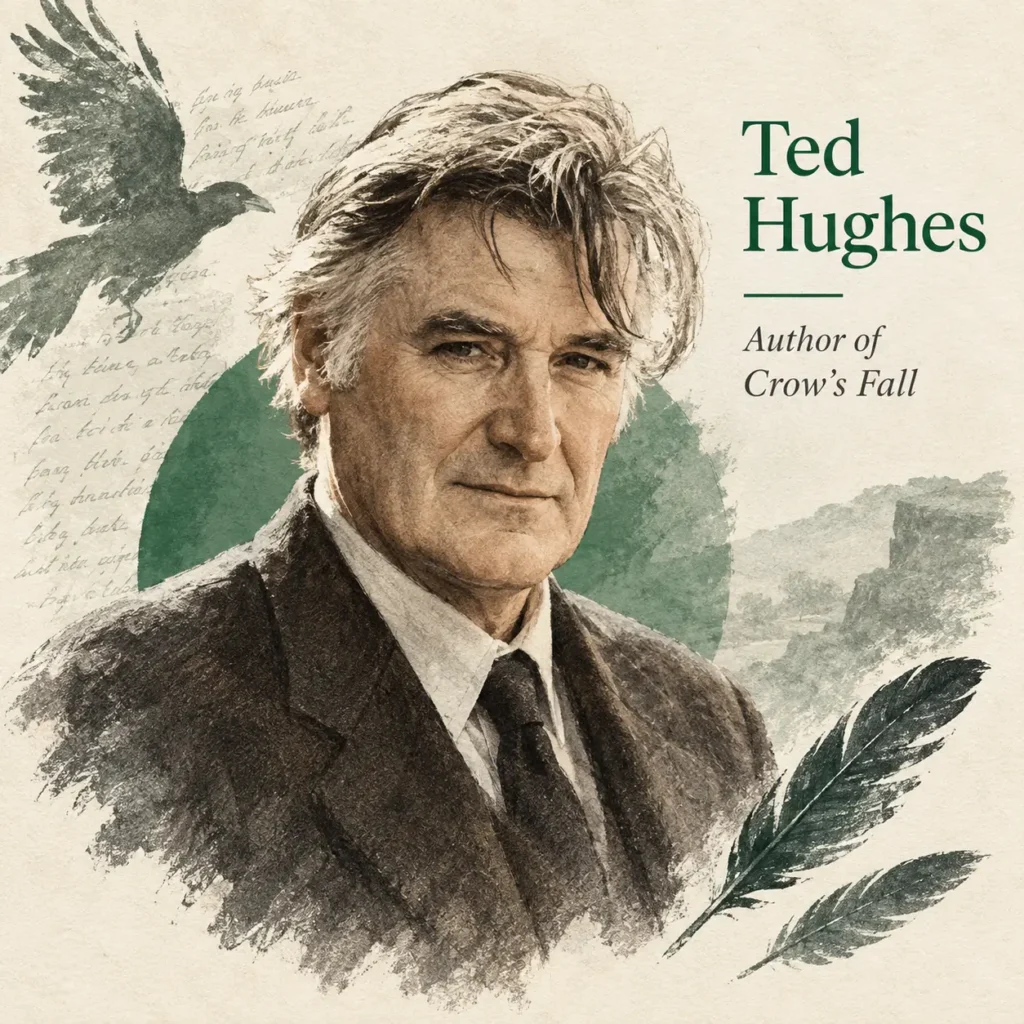
Ted Hughes (1930–1998) was born in Mytholmroyd, Yorkshire, and grew up close to the moorland landscapes that would later dominate his poetry. After national service in the Royal Air Force, he read anthropology and archaeology at Pembroke College, Cambridge, where he developed a lasting interest in myth, folklore and shamanic ritual — an interest that shapes Crow directly. His first collection, The Hawk in the Rain (1957), established him as a major new voice in English poetry, known for treating the natural world with a violence and precision that broke from the more genteel “Movement” poetry of the 1950s. Hughes married the American poet Sylvia Plath in 1956; her death in 1963, and the death in 1969 of his later partner Assia Wevill (who also killed their daughter Shura), were personal tragedies that critics frequently connect to the bleakness of his work from this period, including Crow. He was appointed Poet Laureate of the United Kingdom in 1984, a post he held until his death. (Source: Poetry Foundation — Ted Hughes)
About the Collection: Crow (1970)
Hughes wrote most of Crow between 1966 and 1969, in the years following Plath’s death, and later described this period as one of unusual creative freedom. The book was conceived, in part, as a collaboration with the artist Leonard Baskin, who had asked Hughes for poems to go with his crow engravings; it grew into what Hughes originally imagined as a full “epic folk-tale” of the crow figure, from the beginning to the end of the universe, though the project was never completed in that form. Crow takes on Christian and humanist assumptions directly: several poems rework Biblical material — the Creation, the Fall, the Crucifixion — through the lens of a trickster-crow who survives every catastrophe precisely because he lacks the moral pretensions of God or of man. According to Neil Roberts of the Ted Hughes Society, Hughes deliberately adopted a narrative style influenced by trickster mythology and oral storytelling devices such as repetition, while still working thoroughly modernist material into it. (Source: The Ted Hughes Society — Poetry by Ted Hughes: Crow) The collection was controversial on publication for its stripped-down language and its violence, but it is now widely regarded, alongside The Hawk in the Rain, as one of Hughes’s two most important books.
‘Crow’s Fall’ in the DU Syllabus
Under the current NEP/UGCF syllabus, ‘Crow’s Fall’ is prescribed in DSC-13: Twentieth Century Poetry & Drama (BA Hons. English, Semester 5), in Unit II, alongside Edith Sitwell’s ‘Still Falls the Rain’, Anne Michaels’s ‘Memoriam’, Philip Larkin’s ‘The Whitsun Weddings’ and ‘Church Going’, and Hughes’s own ‘Hawk Roosting’. (Source: University of Delhi, Academic Affairs — DSC-13 Syllabus PDF) The unit as a whole is concerned with how mid-to-late twentieth-century British poets used compressed, often anti-heroic forms to respond to a post-war world; Hughes’s two poems are usually the last texts covered before the unit moves to Samuel Beckett’s Waiting for Godot in Unit III.
Crow’s Fall: Full Summary
(Read the original poem in Ted Hughes, Crow: From the Life and Songs of the Crow, Faber & Faber, 1970. This page discusses and analyses the poem but does not reproduce its text, in line with copyright.)
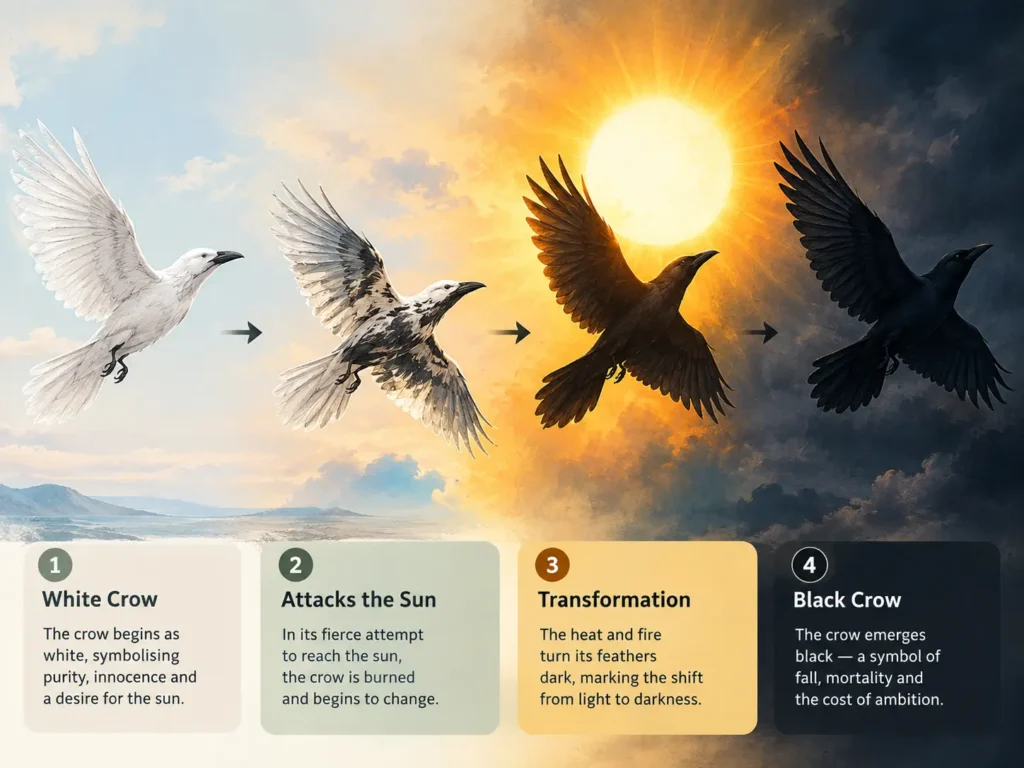
The poem opens with Crow in a state that will not last: he is white, not black. Looking at the sun, he decides — three times over, in short declarative steps — that its whiteness is a rival to his own, that it glares “too whitely,” and that he will attack and defeat it. He works himself into a battle-frenzy: puffing himself up, sharpening his aggression, and aiming his beak straight at the sun’s centre. The scale of his presumption is marked by the natural world itself — as he lets out his battle-cry, trees appear to age instantly and shadows go flat, as though creation itself flinches at his audacity.
But the attack fails completely. Instead of dimming, the sun brightens, and Crow is scorched — he returns from the encounter charred black, his white feathers gone for good. Even his voice is affected: when he tries to speak, only a blackened, damaged sound comes out. In the poem’s final, deliberately paradoxical lines, Crow does not admit defeat. Instead, he reframes what has happened to him as a kind of victory, declaring that in the new order he now inhabits — where white has become black and black white — he has won.
Read as a myth, the poem functions as an aetiological (origin) story: it explains why crows are black, in the same way that older fables explain how the leopard got its spots or the camel its hump. Read as psychology, it is a compact study of hubris — overreaching pride that brings about its own destruction — dressed up in the register of folk tale rather than tragedy, and delivered with Hughes’s characteristic dark humour.
Major Concepts and Themes
- Hubris and its consequences: Crow’s fall is triggered entirely by his own presumption, not by any external attack. His decision to fight the sun is made in three quick, almost childish steps — deciding, deciding again, deciding to attack — which makes his overconfidence look impulsive and unexamined rather than heroic.
- An origin myth for a “fallen” creature: The poem answers a factual-sounding question — why are crows black? — with an invented moral fable, in the tradition of trickster and creation myths that run through the whole Crow sequence.
- Reversal and paradox: The closing lines invert the normal relationship between victory and defeat. Crow’s insistence that he has “won” despite being visibly, physically defeated is the poem’s central irony, and it is exactly the kind of detail examiners ask students to unpack in a “critical appreciation” question.
- Anti-humanism and anti-idealism: Like much of Crow, the poem refuses a comforting or redemptive reading of failure. Crow does not learn humility from his defeat; he simply rewrites its meaning, which is consistent with Hughes’s broader project in the collection of denying his characters — and by extension, his readers — easy moral consolation.
- Colour as symbol: The white-to-black transformation is not decorative. Whiteness here stands for an untested, perhaps innocent, self-image; blackness is what remains once that self-image has been tested against something genuinely more powerful than the self.
Detailed Discussion: Structure, Form and Poetic Devices
Structure and form. The poem is written in free verse, with irregular, unrhymed lines of varying length — some as short as two or three words, others considerably longer. This unevenness is not accidental: the short, clipped opening statements mimic the rapid, almost compulsive escalation of Crow’s decision-making, while the poem’s two final, longer lines slow down to let the paradox of the ending land. Unlike ‘Hawk Roosting’, which is a first-person dramatic monologue, ‘Crow’s Fall’ is told mainly in the third person as a narrated fable, with Crow’s own voice breaking in only at the very end. This shift into direct speech at the close is itself significant — it is the one moment Crow gets to interpret his own defeat, and he immediately uses it to distort the meaning of what has happened.
Personification and anthropomorphism. Crow is given human motives — envy, ambition, wounded pride — while remaining recognisably a bird; this is standard practice across the Crow sequence, where the crow-figure repeatedly stands in for “Everyman” as well as for a trickster-antagonist of God.
Imagery. The poem’s imagery is built almost entirely around contrasts of light and colour: white feathers against the sun’s brightness, the sun’s undimmed glare against Crow’s scorched blackness. The trees “growing old” and the flattening of shadows at the moment of attack are compressed, almost cinematic images of cosmic disturbance, out of proportion to the smallness of the creature causing them — which is itself part of the poem’s dark comedy.
Repetition. Hughes uses repeated grammatical structures (a sequence of short “he decided” statements, and the doubled “it brightened” at the moment of failure) to build momentum and then mark reversal, a technique consistent with the oral, incantatory style Hughes borrows from folklore across Crow.
Tone and mood. The tone is dry, mock-heroic and understated even at its most violent moment; Hughes narrates a catastrophic defeat in almost matter-of-fact language, which is part of what gives the poem its dark humour. The mood shifts from mounting bravado to a flat, ironic anticlimax.
Critical Appreciation
Critics and scholars have generally read ‘Crow’s Fall’ in one of two overlapping ways. The first approach treats it as a compact fable of hamartia — the tragic flaw of overreaching pride — told without any of tragedy’s dignity or catharsis; Crow’s ambition simply “blinds” him to consequence, and his defeat is total and irreversible. The second approach places it within Hughes’s larger argument in Crow against both orthodox Christianity and secular humanism: as the Ted Hughes Society notes, Crow as a whole reworks core Christian narratives — Creation, the Fall, the Crucifixion — through a trickster figure who survives disaster precisely because he refuses the moral seriousness that Christianity and humanism both demand. Read this way, Crow’s refusal to accept his defeat as defeat — his insistence that “winning” and “losing” have simply swapped places — is not naive stubbornness but a small, bleakly comic model of how the Crow poems as a whole refuse to resolve suffering into meaning.
Where critics differ is on how seriously to take Crow’s closing claim. Some readers treat it as pure self-deception, a joke at the character’s expense. Others argue that Hughes is using Crow’s paradox to make a more serious point about how power reinvents its own rules after failure — a reading that lines up with the poem’s function as an origin myth: crows are, after all, still here, still black, still surviving, regardless of how their blackness came about. Both readings are defensible, and DU essay answers do well to acknowledge that the poem’s ending is genuinely ambiguous rather than picking one interpretation as definitively “correct.”
Important Comparison: ‘Crow’s Fall’ and ‘Hawk Roosting’
Because the two poems are taught back-to-back in DSC-13 Unit II, DU exams frequently set direct comparison questions. The table below summarises the main points of contrast.
| Point of Comparison | Hawk Roosting | Crow’s Fall |
|---|---|---|
| Speaker and voice | First-person dramatic monologue; the hawk speaks throughout | Mainly third-person narration; Crow speaks only in the final lines |
| Central emotion | Total, undisturbed confidence and control | Wounded pride collapsing into total defeat |
| Relationship to power | The hawk holds power and believes it is permanent and God-given | Crow tries to seize power he does not have, and loses everything in the attempt |
| View of the self | Self as absolute centre of creation, unquestioned | Self-image (whiteness) destroyed and has to be reinterpreted after the fact |
| Structure | Six even, tightly controlled stanzas, mirroring the hawk’s composure | Uneven, irregular free verse, mirroring Crow’s impulsiveness and chaos |
| Tone | Cold, assertive, chillingly calm | Dry, mock-heroic, ending in dark irony |
| Common critical reading | Often read as a study of dictatorship, absolute power and self-justifying violence | Often read as a fable of hubris and as an anti-humanist “origin myth” |
| What the ending affirms | The hawk’s confidence is never tested or broken within the poem | Crow is tested, broken, and responds by redefining what “winning” means |
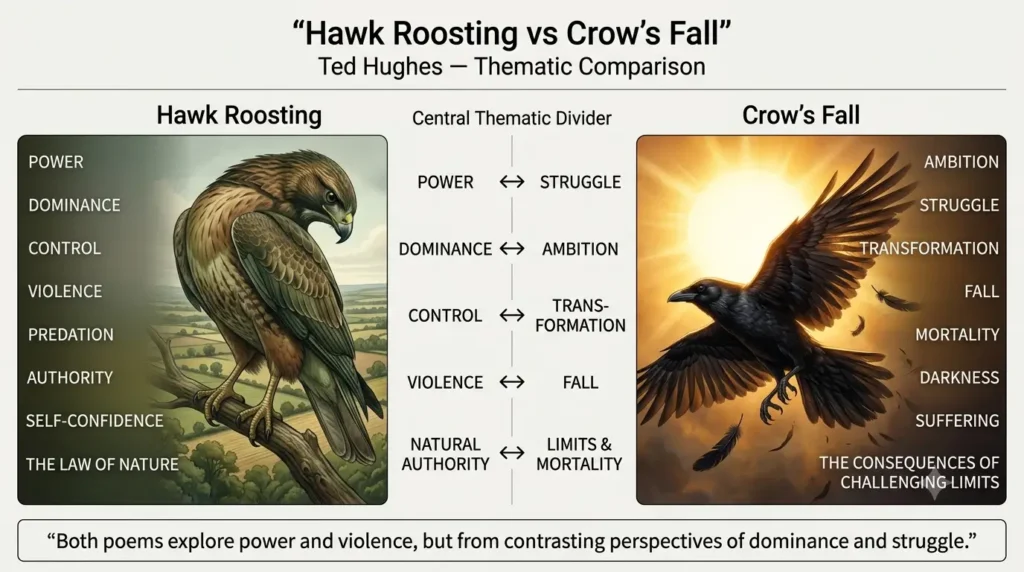
Both poems, taken together, dramatise a single question that runs through Crow as a whole: what happens to a being that believes itself to be the centre of its own world — one poem before that belief is tested, the other after it fails.
Criticism and Limitations
‘Crow’s Fall’ is sometimes criticised on exactly the grounds that make it useful for teaching: its extreme compression can feel slight next to the more sustained, structurally ambitious ‘Hawk Roosting’, and some readers find the closing paradox too neat, almost a punchline, compared to the darker unresolved poems elsewhere in Crow (such as ‘Crow’s Nerve Fails’, which sits immediately after it in the collection and offers a much bleaker meditation on guilt). Because the poem relies so heavily on its final twist, weaker classroom readings can reduce it to a single “gotcha” line rather than examining the myth-making and the anti-humanist argument built up around it. A stronger reading treats the compression as the point: Hughes is deliberately working in the register of the folk tale, where brevity and a hard moral turn are conventional features, not weaknesses.
Contemporary Relevance
Read outside its immediate literary context, ‘Crow’s Fall’ still speaks to a recognisable pattern: overconfidence that leads to public failure, followed by an attempt to redefine that failure as success rather than admit it plainly. Students preparing answers on the poem’s continuing relevance can draw on this without over-stretching the comparison — the poem’s point is precisely that this kind of self-justification is an old, almost mythic human habit, not a new one.
Conclusion
‘Crow’s Fall’ packs a complete fable — pride, overreach, catastrophic failure, and self-serving reinterpretation — into seventeen lines of plain, unornamented free verse. Its brevity is deceptive: read alongside ‘Hawk Roosting’, it forms one half of a deliberate contrast between untested power and power that has just been broken, and read within Crow as a whole, it is one of several places where Hughes rewrites inherited myth to argue against both Christian and humanist certainties. For DU students, the poem rewards close attention to two things above all: the mock-heroic escalation of Crow’s decision to attack, and the deliberate ambiguity of his final claim to have “won.”
Continue Reading
Continue Reading
University of Delhi Previous Year Questions
University of Delhi Previous Year Questions
Section A — Source-Attributed Questions
1 Write a brief essay on the symbolism in Crow’s Fall. (15 marks) +
Year / Paper: 2024 — B.A. 1st Semester English (Hons.), Paper DSCC-I / CCF scheme
Source: Loreto College, Kolkata, University question paper archive
Note: This belongs to the earlier Semester 1 DSCC-I / CCF scheme, not the current DSC-13 Semester 5 NEP/UGCF scheme. The poem has been taught under different paper codes across syllabus revisions, but the question is relevant to the study of the poem. Source-Attributed
2 What happened to the crow after he attacked the sun? (5 marks) +
Year / Paper: 2024 — B.A. 1st Semester English (Hons.), Paper DSCC-I / CCF scheme
Source: Loreto College, Kolkata, University question paper archive
Note: This belongs to the earlier Semester 1 DSCC-I / CCF scheme, not the current DSC-13 Semester 5 NEP/UGCF scheme. Source-Attributed
Section B — DU-Pattern / Probable Questions
1 What is the significance of the poem’s final paradoxical statement, “where white is black and black is white”? +
Suggested Answer Focus: Examine the paradox, reversal of conventional oppositions, and the poem’s transformation of moral and symbolic categories. Probable
2 Comment on the use of free verse and irregular line length in Crow’s Fall. +
Suggested Answer Focus: Discuss how Hughes’s irregular form, rhythm, and lineation contribute to the poem’s mythic and unsettling effect. Probable
3 What does the shift from white to black signify in the poem? +
Suggested Answer Focus: Explore the symbolic transformation, reversal of values, and connection between colour imagery and the poem’s vision. Probable
4 Why does Hughes have Crow speak only in the poem’s final lines? +
Suggested Answer Focus: Consider voice, dramatic effect, narrative structure, and the significance of Crow’s final assertion. Probable
Section C — Long Answer Questions
1 Critically analyse Crow’s Fall as an example of Hughes’s mythic and anti-humanist vision in Crow. +
Suggested Answer Focus: Discuss Hughes’s rewriting of myth, the figure of Crow, anti-humanist elements, violence, and the poem’s challenge to conventional moral perspectives. Probable
2 Compare and contrast Hawk Roosting and Crow’s Fall as two different explorations of power. +
Suggested Answer Focus: Compare the speakers, representations of dominance, violence, natural power, and Hughes’s use of animal perspectives. Probable
3 Discuss Crow’s Fall as an aetiological myth. How does Hughes use the fable form to comment on human pride? +
Suggested Answer Focus: Examine the poem’s myth-making structure, transformation narrative, fable-like elements, and treatment of pride and consequence. Probable
4 How does Ted Hughes depict the arrogance of the crow in Crow’s Fall? Do you think the poem is an allegory? Give reasons for your answer. +
Source Note: Based on a Prafulla Chandra College internal tutorial/assignment question sheet; this is a college-level exercise, not a confirmed University of Delhi end-semester paper.
Suggested Answer Focus: Analyse Crow’s arrogance, the poem’s symbolic dimensions, and the arguments for or against reading the poem as an allegory. Probable
Frequently Asked Questions
What is ‘Crow’s Fall’ by Ted Hughes about?
It tells the story of Crow, originally white, who grows resentful of the sun’s brightness, attacks it out of pride, and is scorched permanently black in the attempt — then reinterprets his defeat as a kind of victory.
Which collection does ‘Crow’s Fall’ belong to?
It is from Ted Hughes’s 1970 collection Crow: From the Life and Songs of the Crow, written mostly between 1966 and 1969.
Is ‘Crow’s Fall’ based on a real myth, or is it Hughes’s own invention?
It is Hughes’s own invented myth, written in the style and structure of a traditional origin (aetiological) tale, similar to folk stories that explain natural features of animals.
What is the main theme of ‘Crow’s Fall’?
Hubris — pride that leads directly to its own downfall — combined with the idea that the defeated will often rewrite the meaning of their own failure rather than accept it.
What poetic devices are used in the poem?
Free verse, personification/anthropomorphism, repetition of short declarative statements, and a sustained pattern of light-and-colour imagery (white versus black).
Is ‘Crow’s Fall’ a dramatic monologue, like ‘Hawk Roosting’?
No. It is told mainly in the third person as a narrated fable; Crow speaks in his own voice only in the poem’s closing lines, which is a key difference from the fully first-person ‘Hawk Roosting’.
How is ‘Crow’s Fall’ different from ‘Hawk Roosting’?
‘Hawk Roosting’ shows a bird whose absolute confidence is never tested within the poem; ‘Crow’s Fall’ shows a bird whose overconfidence is tested and completely broken. See the comparison table above for a fuller breakdown.
What does the ending of the poem mean?
After being scorched black by the sun, Crow claims that in the new order where opposites have reversed, he has actually “won.” Critics read this either as self-deceiving denial or as a bleakly comic comment on how power rewrites its own rules after failure.
Why is the poem called ‘Crow’s Fall’?
The title plays on the idea of a moral or physical “fall” — Crow literally falls (or is defeated) in his attack, echoing the language of the Biblical Fall, which fits the poem’s place in a collection that repeatedly reworks Christian material.
Which paper and unit is ‘Crow’s Fall’ part of at DU?
Under the current syllabus, it is in DSC-13: Twentieth Century Poetry & Drama, Unit II, BA (Hons.) English, Semester 5, alongside ‘Hawk Roosting’ and poems by Edith Sitwell, Anne Michaels and Philip Larkin.
What is “hamartia” and how does it apply here?
Hamartia is a tragic flaw or error that leads to a character’s downfall. In ‘Crow’s Fall’, Crow’s hamartia is his prideful decision to attack something far more powerful than himself, purely out of wounded vanity.
Do I need to read the rest of Crow to answer questions on this poem?
Not to answer a direct summary or analysis question, but knowing that the poem sits inside a larger sequence that reworks Christian and mythic material (see the Background section above) will strengthen any “critical appreciation” or “significance” answer.
External Resources
Subscribe to keep reading
You've used your free notes for now. Get Delhi Pathshala Premium for unlimited access.
Subscribe — ₹29/30 days