
Contents
- The Indian Subcontinent: Landscapes and Environments
- Geographical diversity and regional variations
- Natural resources and human adaptation
- Sources of Historical Reconstruction (Up to 750 CE)
- Archaeological evidence
- Literary evidence
- Comparative evidence
- Changing Historiography
- Colonial historiography (18th–early 20th century)
- Nationalist historiography (late 19th–mid 20th century)
- Marxist and subaltern approaches
- Postcolonial and feminist critiques
- Early Indian Notions of History
- Myth and legend
- Itihasa and Purana
- Chronology and genealogy
- Top DU Previous Year Questions (PYQs) — DSC-1 Unit 1
- FAQs
Quick Summary: This unit covers how historians reconstruct early Indian history up to 750 CE using archaeological evidence (excavations, inscriptions, coins), literary evidence (Vedas, epics, Puranas, Buddhist-Jain texts), and comparative evidence (linguistics, anthropology, genetics) — along with how the interpretation of this history has shifted from colonial to nationalist, Marxist, subaltern, postcolonial, and feminist historiography.
The Indian Subcontinent: Landscapes and Environments
Geographical diversity and regional variations
The Indian subcontinent’s vast and varied geography shaped how early societies settled, traded, and built their cultures. Understanding this landscape is the first step before looking at the sources of historical reconstruction below.
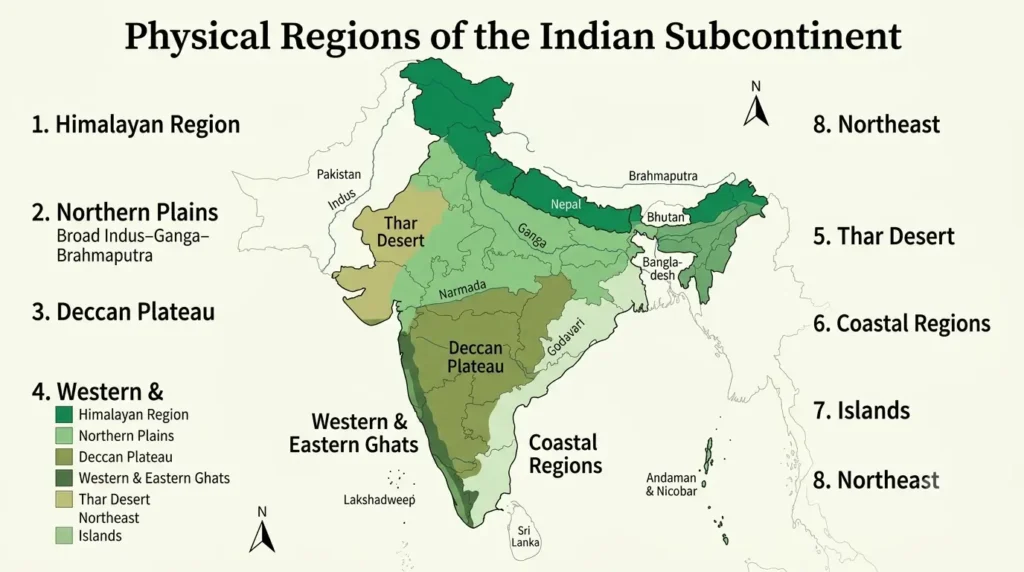
- Himalayan Region: Cold, high-altitude terrain in the north; historically tied to Tibetan culture, with Buddhism flourishing in Ladakh and Himachal Pradesh.
- Northern Plains (Indus–Ganges): Fertile alluvial plains that became the heartland of early urbanism — home to the Indus Valley Civilization’s cities like Harappa and Mohenjo-daro.
- Deccan Plateau: Rugged, mineral-rich terrain in peninsular India, home to sites such as the Ajanta Caves, a UNESCO World Heritage Site with some of the earliest surviving Buddhist rock-cut art.
- Western and Eastern Ghats: Mountain ranges parallel to the coasts, rich in biodiversity and rainfall-bearing forests.
- Thar Desert: Arid northwest region historically home to nomadic and semi-nomadic communities and trade routes.
- Coastal Regions: Ports like Lothal in Gujarat enabled maritime trade and cultural exchange with West Asia and beyond.
- Islands (Andaman & Nicobar): Unique biodiversity and indigenous communities.
- Northeastern Region: Hills and dense forests with distinct tribal cultures.
Natural resources and human adaptation
Human communities adapted to this geographic diversity in different ways — settled agriculture in the river plains, nomadic pastoralism in arid zones, and maritime trade along the coasts. Rivers (Indus, Ganges), monsoon patterns, and natural barriers (mountains, deserts) all directly shaped where — and how — early Indian civilizations emerged, which connects directly to the broader cultural developments throughout early Indian history.
Sources of Historical Reconstruction (Up to 750 CE)
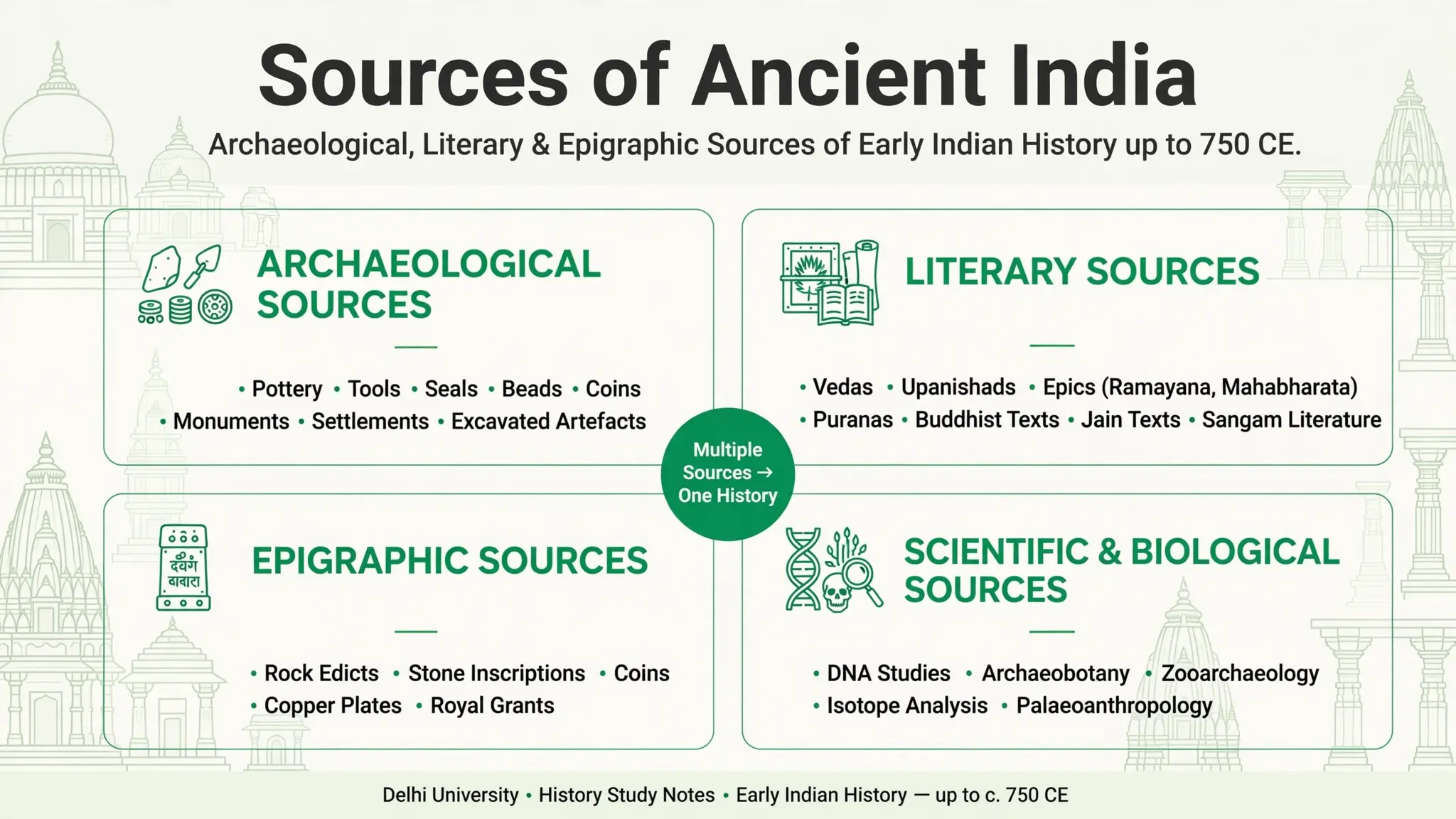
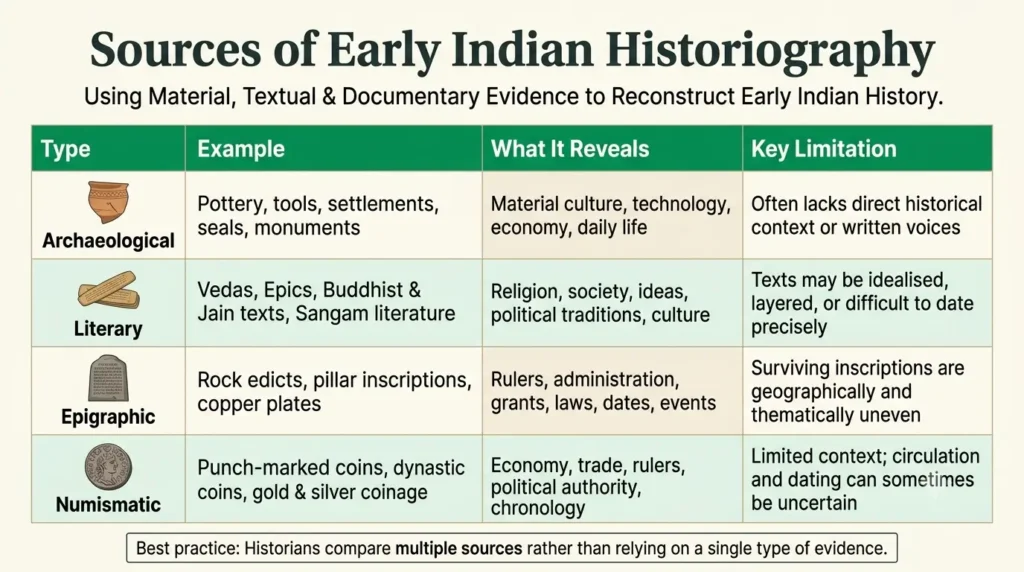
Historians reconstruct early Indian history using three broad categories of evidence: archaeological, literary, and comparative. No single source is complete on its own — historians cross-reference all three to build a reliable picture of the past.
Archaeological evidence
Material culture: Excavations across the subcontinent — studied through stratigraphy (layers of occupation) — have revealed pottery, metal tools, sculptures, seals, coins, and domestic artifacts that reveal technology, trade, craftsmanship, and daily life. Radiocarbon dating helps place these finds in a chronological sequence, though preservation issues and fragmentation remain major challenges.
Inscriptions: Rock edicts, pillar inscriptions, copper plates, and temple inscriptions are direct, dated sources. The rock edicts of Ashoka remain the single most important epigraphical source for the Mauryan period — recording royal policy, administrative divisions, and Ashoka’s Dhamma in Prakrit and Sanskrit. Gupta-period inscriptions similarly detail dynastic genealogies and achievements.
Coins: Punch-marked, cast, and dynastic coins (Satavahana, Gupta) reveal economic systems, trade routes, political authority, and artistic evolution. Coin hoards found in archaeological contexts also help establish trade circulation patterns.
Literary evidence
Vedic texts: The Rigveda (c. 1500–1200 BCE), Samaveda, Yajurveda, and Atharvaveda, followed by the Brahmanas, Aranyakas, Upanishads, and later Smritis and Puranas — together span nearly 1,800 years of composition and reflect evolving religious, social, and philosophical ideas.
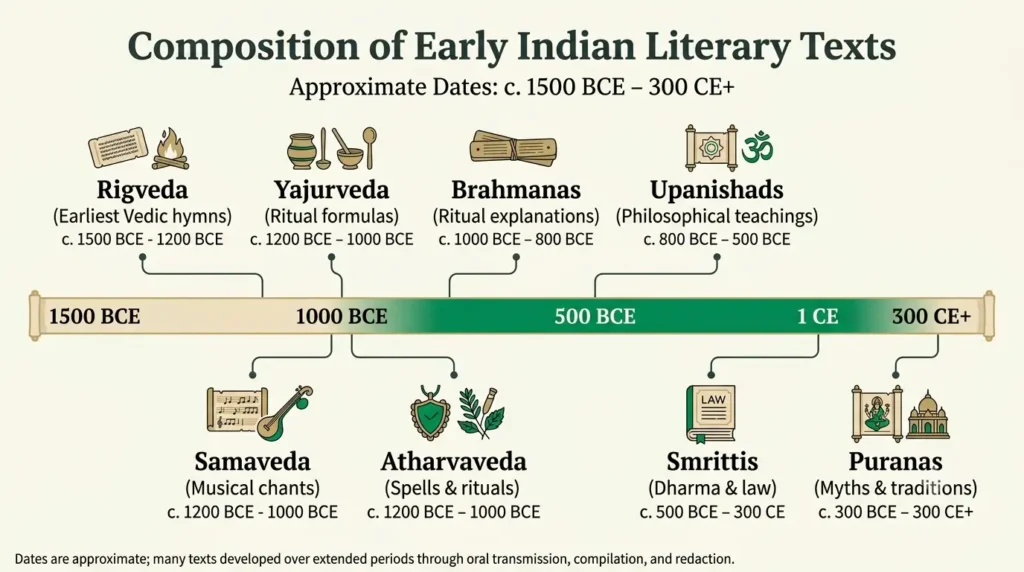
Epics: The Mahabharata (including the Bhagavad Gita, c. 200 BCE) and the Ramayana blend historical memory with mythology, offering insight into genealogies, social structure, and political landscape — though their historical accuracy is debated due to later interpolations.
Puranas: Composed between 300 CE and 1500 CE, the eighteen major Puranas contain cosmogony, genealogies of kings, and regional histories — valuable for chronology but not purely historical in intent.
Buddhist and Jain literature: The Pali Canon (Tipitaka), Jataka Tales, and the Mahavamsa/Dipavamsa provide historical detail on Buddha’s life and the spread of Buddhism, including under Emperor Ashoka. Jain Agamas and the Kalpasutra similarly document Mahavira’s life and early Jain communities.
Comparative evidence
- Linguistics: Tracing Indo-Aryan and Dravidian language evolution, the development of the Brahmi script, and Prakrit/Pali literature helps reconstruct cultural contact and migration.
- Anthropology: Skeletal analysis, burial practices, and ethnographic analogy help reconstruct social structure and daily life.
- Genetics: Ancient DNA (aDNA) studies are a recent but powerful addition, revealing population migration and admixture patterns that complement archaeological and linguistic evidence.
Changing Historiography
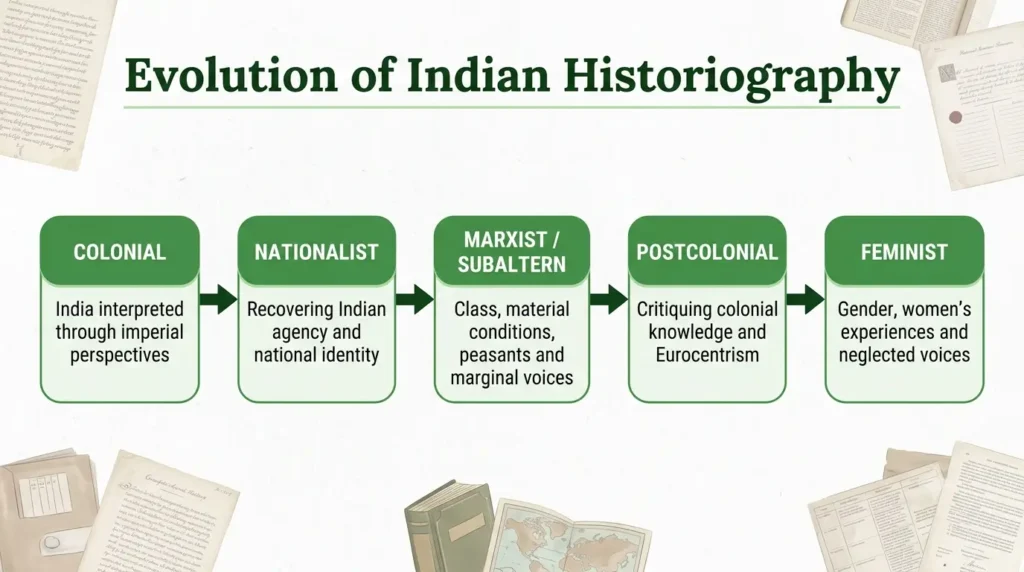
How historians interpret early Indian history has itself changed dramatically over two centuries. This section — often the most exam-relevant — traces that evolution. For a broader reference on this evolution, see the Wikipedia overview of Historiography of India.
Colonial historiography (18th–early 20th century)
European Orientalist scholars approached India through philology and translation, but colonial historiography also served imperial interests — often propagating “decline from a golden age” theories that nationalist historians would later contest.
Nationalist historiography (late 19th–mid 20th century)
Reacting to colonial narratives, nationalist historians emphasized indigenous sources and continuity rather than decline. Archaeological discoveries at Mohenjo-daro and Harappa were pivotal in this reassessment, as was the reevaluation tied to the Formation of the Indian National Congress.
Marxist and subaltern approaches
Marxist historians analyzed early India through class struggle, modes of production, and agrarian relations. The Subaltern Studies Group (formed in the 1980s) shifted focus to the agency and voices of marginalized groups, using oral histories and bottom-up narratives.
Postcolonial and feminist critiques
Postcolonial historians deconstruct Eurocentrism and explore hybridity and global connections in ancient India. Feminist historians recover women’s histories, examining gendered power structures and the intersection of caste and gender — building on debates already raised in Colonial Rule in India and its impact.
Early Indian Notions of History
Myth and legend
Early India blended history with myth through oral epics, Puranic genealogies, and the cyclical concept of Yugas — serving didactic and religious purposes alongside historical memory.
Itihasa and Purana
Itihasa (“so indeed it was”) refers to historical narrative — chiefly the Ramayana and Mahabharata. Purana (“ancient knowledge”) is a broader genre covering cosmogony, genealogy, and moral teaching. Both blend fact with myth, and both remain central to reconstructing early Indian chronology.
Chronology and genealogy
Early Indian societies tracked time through the cyclical Yuga system and dynastic succession, often tracing rulers to divine or semi-divine ancestry (Suryavansha, Chandravansha) to legitimize authority. Genealogies in the Puranas remain a key — if imprecise — chronological tool for historians even today.
Top DU Previous Year Questions (PYQs) — DSC-1 Unit 1
DU Previous Year Questions
Frequently asked questions from DU exam papers on this topic. Tap a question to view a quick-answer guide.
1 Discuss the various sources for the study of early Indian history up to 750 CE. +
2 Critically examine the colonial and nationalist historiography of early India. +
3 What is the significance of inscriptions as a source of early Indian history? +
4 Distinguish between Itihasa and Purana as genres of early Indian historical writing. +
5 Explain the contribution of the Subaltern Studies school to Indian historiography. +
6 How have genetics and linguistics contributed as comparative evidence in reconstructing early Indian history? +
Continue Reading — DSC-1 (History of India 1)
FAQs
What are the main sources of early Indian history up to 750 CE?
The main sources fall into three categories: archaeological evidence (excavations, inscriptions, coins), literary evidence (Vedic texts, epics, Puranas, Buddhist and Jain literature), and comparative evidence (linguistics, anthropology, and genetics).
What is the difference between Itihasa and Purana?
Itihasa refers to historical narratives — mainly the Ramayana and Mahabharata — presented in a mythological framework. Purana is a broader genre of ancient Indian literature covering cosmogony, genealogies of gods and kings, and regional legends, composed between 300 CE and 1500 CE.
Why are Ashoka’s edicts considered an important historical source?
Ashoka’s rock and pillar edicts are directly dated, first-person royal records written in Prakrit and Sanskrit, making them one of the most reliable sources for understanding Mauryan administration, policy, and the spread of Dhamma. Read more in our detailed guide to Ashoka’s Edicts.
What is the Subaltern Studies approach to Indian history?
Subaltern Studies, formed by South Asian scholars in the 1980s, is an approach that centers the experiences and agency of marginalized groups — challenging colonial, nationalist, and even Marxist grand narratives by using oral histories and bottom-up perspectives.
How did colonial historiography differ from nationalist historiography?
Colonial historiography, shaped by Orientalist scholarship, often framed Indian history through decline theories that served imperial interests. Nationalist historiography reacted against this, emphasizing indigenous sources, cultural continuity, and archaeological discoveries like Harappa and Mohenjo-daro to counter the “stagnant civilization” narrative.
Are the Puranas considered reliable historical sources?
Puranas are useful but not purely historical — they mix genealogies and chronological details of real dynasties with mythology and religious teaching. Historians treat them as supplementary evidence, cross-checked against archaeology and inscriptions.
Subscribe to keep reading
You've used your free notes for now. Get Delhi Pathshala Premium for unlimited access.
Subscribe — ₹29/30 days