
Contents
- Introduction to William Blake
- Biography and Historical Context
- Overview of His Literary Works
- Themes and Influence
- Songs of Innocence and Experience: Themes and Motifs
- The Contrast Between Innocence and Experience
- Main Themes
- 1. Innocence vs. Experience
- 2. The Role of the Child
- 3. Nature and the Divine
- 4. Social and Political Critique
- 5. The Fall and Corruption of Man
- 6. Redemption and Transcendence
- Key Takeaways: Innocence and Experience
- Social Criticism and the Vision of the Poet
- Key Takeaways: Social Criticism
- Analysis of Selected Poems — ‘The Lamb’ and ‘The Tyger’
- ‘The Lamb’
- Line-by-Line Explanation
- Themes of Innocence and Purity
- Symbolism and Imagery
- ‘The Tyger’
- Line-by-Line Explanation
- Themes of Creation and Destruction
- Symbolism and Imagery
- Key Takeaways: ‘The Lamb’ vs ‘The Tyger’
- ‘The Chimney Sweeper’ (Songs of Innocence)
- Line-by-Line Explanation
- Critique of Child Labor and Social Injustice
- Tone and Narrative Style
- Key Takeaways: ‘The Chimney Sweeper’ (Innocence)
- ‘The Chimney Sweeper’ (Songs of Experience)
- Line-by-Line Explanation
- Depiction of Despair and Corruption
- Symbolism and Imagery
- Key Takeaways: ‘The Chimney Sweeper’ (Experience)
- DSC-7 Previous Year Questions — William Blake
- FAQs
Introduction to William Blake
This unit is part of DSC-7: Romantic Literature, Semester 3, BA (Hons.) English, University of Delhi.
Biography and Historical Context
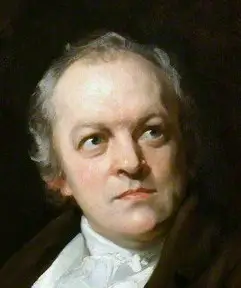
William Blake (1757–1827) was an English poet, painter, and printmaker, widely regarded as one of the most imaginative figures in Western literature and art. Blake was born in London during a period of tremendous upheaval — the Industrial Revolution alongside the American and French Revolutions — all of which shaped his worldview and work.
Blake was raised with strong spiritual beliefs and a deep interest in mysticism. Educated at home by his mother before attending the Royal Academy’s drawing schools, he drew heavily on literature, philosophy, and the Bible despite his unconventional schooling. His claimed spiritual visions profoundly shaped his poetry and art.
During his lifetime Blake was largely unrecognised and often dismissed as eccentric. Today, however, he’s regarded as a foundational figure of Romanticism — a movement centred on emotion and individual expression — and celebrated for uniquely fusing poetry with visual art through his own relief-etching printing technique (Poetry Foundation — William Blake biography).
Overview of His Literary Works
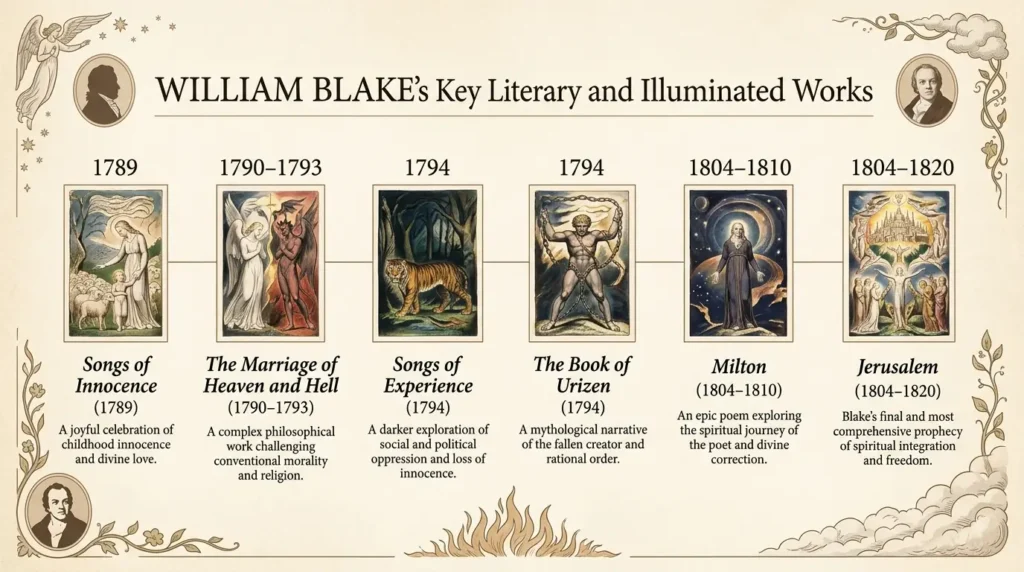
Blake’s major works include:
1. Songs of Innocence and of Experience (1789/1794) His most celebrated collection, split into Innocence and Experience. The Songs of Innocence view the world through a child’s eyes — pure and hopeful — while Songs of Experience expose life’s darker realities. Together they trace childhood, suffering, and the tension between innocence and experience.
2. The Marriage of Heaven and Hell (1790–1793) A critique of conventional morality and religion, arguing that good and evil are both necessary for human growth.
3. Jerusalem: The Emanation of the Giant Albion (1804–1820) Blake’s most ambitious long poem, addressing England’s moral condition and spiritual redemption through dense symbolism.
4. The Book of Urizen (1794) A prophetic book centred on Urizen — representing reason and law — critiquing rationalism and organised religion.
5. The Four Zoas (1797–1804) An unfinished, complex work exploring the fall of man and the conflict between spiritual and material forces.
Themes and Influence
- God and Religion — Blake criticised organised religion while promoting a personal connection with the divine.
- Innocence and Experience — the central preoccupation of his poetry: how childhood purity is damaged by life’s harsh realities.
- Visionary Experiences — Blake’s claimed visions of angels and spiritual beings infuse his imagery.
- Critique of Industrialization — Blake condemned how industrial growth dehumanised and exploited workers.
Blake’s influence has grown steadily since his death; he is now seen as central to Romanticism and later countercultural movements, inspiring generations of writers and artists with his ideas on freedom and mystical experience.
Songs of Innocence and Experience: Themes and Motifs
Songs of Innocence and of Experience, published in two parts (1789 and 1794), explores Innocence and Experience as two connected — not merely opposite — states of the human soul, through which Blake examines being human and society’s failures.
The Contrast Between Innocence and Experience
Blake shows the difference between the joy and simplicity of childhood (Innocence) and the sadness and harsh realities of adulthood (Experience).
| Aspect | Songs of Innocence | Songs of Experience |
|---|---|---|
| Worldview | Pure, joyful, close to nature and God | Marked by pain, doubt, and distrust |
| Child’s role | Symbol of purity and freedom | Vulnerable, affected by society’s harshness |
| Nature | Kind and nurturing (e.g., ‘The Lamb’) | Beautiful but dangerous (e.g., ‘The Tyger’) |
| Tone | Simple, hopeful, vulnerable | Direct, critical, disillusioned |
| Institutions | Called on for kindness | Criticised for suffering and corruption |
Main Themes
1. Innocence vs. Experience
Innocence is pure, joyful, and close to nature and God — untouched by life’s harsh realities. Experience marks the loss of that purity: pain, doubt, and distrust, with Blake criticising institutions like religion and government that harm the innocent. Blake presents the two as connected: innocence can turn into experience, and experience can lead to a deeper (if painful) understanding of life.
2. The Role of the Child
Children are central figures in both books. In Songs of Innocence, children symbolise purity and freedom — as in ‘The Lamb’. In Songs of Experience, children bear the brunt of society’s wrongs — as in ‘The Chimney Sweeper’.
3. Nature and the Divine
In Innocence, nature is kind and nurturing — ‘The Lamb’ presents it as a safe, godly world for children. In Experience, nature turns complex, embodying both beauty and danger, as ‘The Tyger’ shows through the union of creation and destruction.
4. Social and Political Critique
Innocence adopts a simple, vulnerable tone calling for kindness (e.g., the exploitation shown in ‘The Chimney Sweeper’). Experience is more direct — in ‘London’, Blake depicts a city of suffering where institutions perpetuate the exploitation of the innocent.
5. The Fall and Corruption of Man
The idea of losing innocence runs throughout. In ‘The Garden of Love’, Blake shows how religion and society corrupt what is pure. In ‘The Tyger’, the speaker questions how the same God who made the gentle lamb could also make the fearsome tiger — highlighting the complexity of creation.
6. Redemption and Transcendence
Despite his critique, Blake offers hope: through imagination and deeper understanding, redemption is possible. Poems like ‘The Marriage of Heaven and Hell’ suggest that reconciling innocence and experience is key to grasping human existence.
Key Takeaways: Innocence and Experience
The contrast between Innocence and Experience is central to the collection. Innocence represents childhood’s beauty and closeness to the divine; experience represents painful awareness of life’s complexities. Blake ultimately treats both states as necessary — together, they enable spiritual growth and a fuller understanding of the world.
Social Criticism and the Vision of the Poet
Blake criticises the social, political, and religious systems of his time as unjust and corrupt, particularly through industrialization and organised religion.
1. Critique of Institutionalized Religion Blake strongly opposed the Church of England’s controlling, hypocritical aspects. In ‘The Garden of Love’, a once-joyful place becomes a “tomb” under the church’s authority. In ‘The Chimney Sweeper’ (Experience), promises of heaven are shown as empty comfort rather than real change.
2. Social Criticism and the Industrial Revolution Blake was deeply troubled by industrialization’s toll on children and the working class. The Innocence version of ‘The Chimney Sweeper’ shows a child laborer finding comfort in dreams of heaven; the Experience version turns cynical about that same promise. In ‘London’, he depicts a city of distress where people lose their connection to nature and God.
3. The Poet as Visionary and Critic Blake saw poets as visionaries challenging readers to think differently. In ‘The Divine Image’ (Innocence), he calls for a vision of humanity defined by kindness and peace — a striking contrast to the suffering he critiques elsewhere.
Key Takeaways: Social Criticism
Blake’s social critiques target religion and industrial society while his poetic vision urges readers toward deeper truths — showing that innocence can be transformed, not simply destroyed, by life’s experiences.
Analysis of Selected Poems — ‘The Lamb’ and ‘The Tyger’
Two of Blake’s best-known poems, ‘The Lamb’ and ‘The Tyger’, embody the central tension between innocence and experience through vivid, contrasting imagery.
‘The Lamb’
Full Text — ‘The Lamb’ (Songs of Innocence, 1789)
Little Lamb, who made thee? Dost thou know who made thee? Gave thee life, and bid thee feed, By the stream and o’er the mead; Gave thee clothing of delight, Softest clothing, wooly, bright; Gave thee such a tender voice, Making all the vales rejoice? Little Lamb, who made thee? Dost thou know who made thee?
Little Lamb, I’ll tell thee, Little Lamb, I’ll tell thee: He is called by thy name, For He calls Himself a Lamb. He is meek, and He is mild; He became a little child. I a child, and thou a lamb, We are called by His name. Little Lamb, God bless thee! Little Lamb, God bless thee!
Line-by-Line Explanation
Stanza 1
- “Little Lamb, who made thee? / Dost thou know who made thee?” — The child-speaker opens with a gentle, repeated question, addressing the lamb directly. This sets the poem’s tone of innocent wonder and curiosity about creation.
- “Gave thee life, and bid thee feed, / By the stream and o’er the mead” — The speaker answers his own question: the Creator gave the lamb life and provides for it through nature — the stream (water) and the mead (meadow/grass).
- “Gave thee clothing of delight, / Softest clothing, wooly, bright” — Refers to the lamb’s wool, described as soft and radiant, symbolising purity and gentle care.
- “Gave thee such a tender voice, / Making all the vales rejoice” — The lamb’s bleating is described as tender, bringing joy to the valleys — nature responds happily to the lamb’s presence.
- “Little Lamb, who made thee? / Dost thou know who made thee?” — The refrain repeats, reinforcing the childlike, song-like structure typical of Songs of Innocence.
Stanza 2
- “Little Lamb, I’ll tell thee, / Little Lamb, I’ll tell thee” — The speaker now offers to answer his own question, shifting from questioning to teaching.
- “He is called by thy name, / For He calls Himself a Lamb” — A direct reference to Christ, who in Christian theology is called the “Lamb of God.” The lamb and Christ share the same name/identity.
- “He is meek, and He is mild; / He became a little child” — Describes Christ’s gentle nature and His incarnation as a child (the Nativity), linking Christ, the lamb, and the child-speaker as symbols of the same purity.
- “I a child, and thou a lamb, / We are called by His name” — The speaker identifies himself with both the lamb and Christ — child, lamb, and God are united through shared innocence.
- “Little Lamb, God bless thee! / Little Lamb, God bless thee!” — The poem closes with a blessing, reinforcing warmth, protection, and divine love — the emotional high point of Songs of Innocence.
Themes of Innocence and Purity
In ‘The Lamb’, Blake explores innocence, purity, and creation through a simple, childlike voice addressing the lamb directly. Part of Songs of Innocence, the poem celebrates the purity of childhood and life’s goodness before it meets hardship.
- Innocence: The lamb represents softness, vulnerability, and goodness. The speaker asks the lamb if it knows its maker — implying a loving God, also identified with the “Lamb of God” in Christianity.
- Purity and Divinity: The speaker’s wonder highlights the lamb’s purity; the poem’s simple, repetitive language reflects a childlike, hopeful view of the world.
Symbolism and Imagery
The lamb symbolises both the animal and Jesus Christ, tying purity and goodness to childhood.
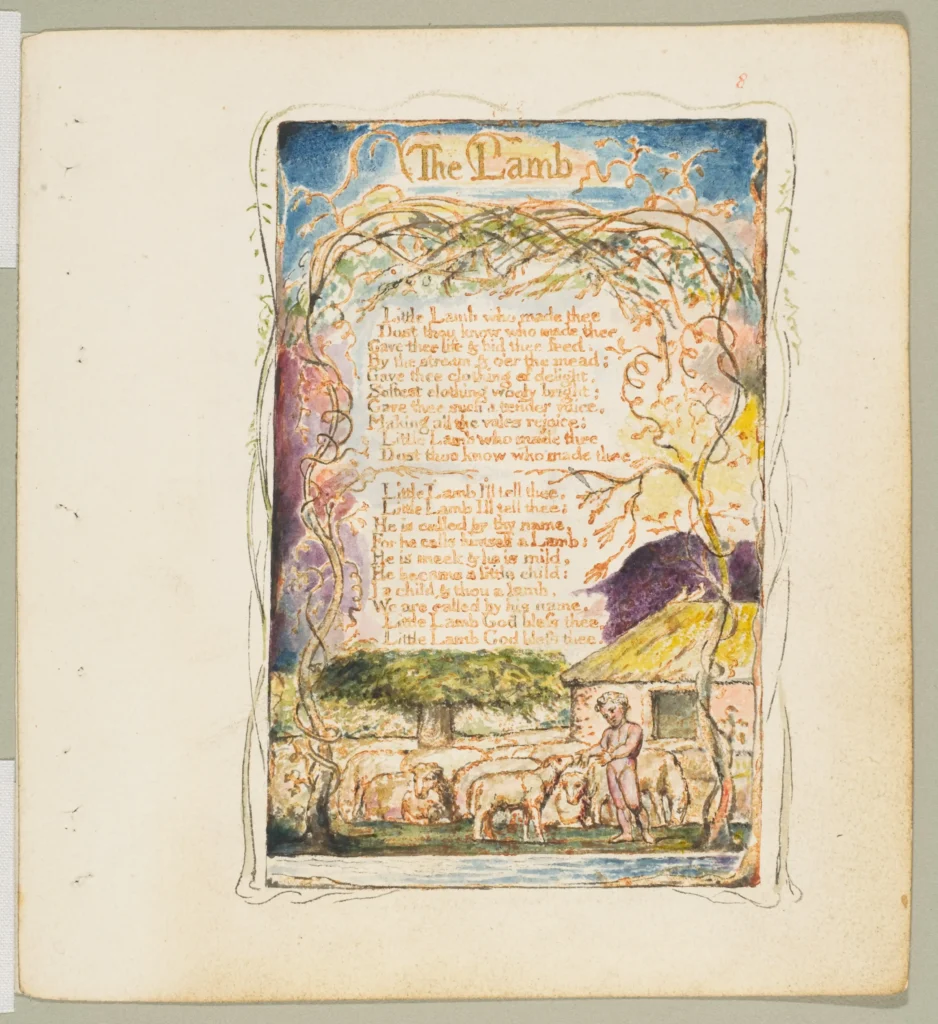
- Imagery of Nature: The lamb’s wool is described as “soft” and “tender” — peaceful imagery that contrasts sharply with ‘The Tyger’.
- The Divine Creator: The speaker links the lamb to Christ’s divine nature, suggesting innocence signals God’s presence in the world.
‘The Tyger’
Full Text — ‘The Tyger’ (Songs of Experience, 1794)
Tyger Tyger, burning bright, In the forests of the night; What immortal hand or eye, Could frame thy fearful symmetry?
In what distant deeps or skies, Burnt the fire of thine eyes? On what wings dare he aspire? What the hand, dare seize the fire?
And what shoulder, & what art, Could twist the sinews of thy heart? And when thy heart began to beat, What dread hand? & what dread feet?
What the hammer? what the chain, In what furnace was thy brain? What the anvil? what dread grasp, Dare its deadly terrors clasp?
When the stars threw down their spears And water’d heaven with their tears: Did he smile his work to see? Did he who made the Lamb make thee?
Tyger Tyger burning bright, In the forests of the night: What immortal hand or eye, Dare frame thy fearful symmetry?
Line-by-Line Explanation
Stanza 1
- “Tyger Tyger, burning bright, / In the forests of the night” — The tiger is introduced as a vivid, fiery image glowing in the darkness — instantly establishing awe and danger together.
- “What immortal hand or eye, / Could frame thy fearful symmetry?” — The speaker asks what divine being could design something so perfectly formed yet terrifying (“fearful symmetry” = beautiful but frightening balance/proportion).
Stanza 2
- “In what distant deeps or skies, / Burnt the fire of thine eyes?” — Questions where the tiger’s fierce, fiery gaze originates — heaven (skies) or hell (deeps)?
- “On what wings dare he aspire? / What the hand, dare seize the fire?” — Echoes the myth of Icarus/Prometheus — daring to fly too close to or steal divine fire — suggesting the creator’s audacity.
Stanza 3
- “And what shoulder, & what art, / Could twist the sinews of thy heart?” — Imagines creation as physical labour — twisting muscle and sinew like a craftsman.
- “And when thy heart began to beat, / What dread hand? & what dread feet?” — The repeated word “dread” builds fear and awe at the act of creation itself.
Stanza 4
- “What the hammer? what the chain, / In what furnace was thy brain?” — Blacksmith/forge imagery — the tiger is imagined as being forged like metal, industrial and violent.
- “What the anvil? what dread grasp, / Dare its deadly terrors clasp?” — Continues the forge metaphor; only a being of immense power could safely handle something this dangerous.
Stanza 5
- “When the stars threw down their spears / And water’d heaven with their tears” — A cosmic image, possibly referencing the stars’/angels’ surrender or grief — some readers link this to Satan’s fall from heaven.
- “Did he smile his work to see? / Did he who made the Lamb make thee?” — The poem’s central question: could the same gentle creator of ‘The Lamb’ also have made this fearsome tiger? This directly links the two poems.
Stanza 6 (Refrain)
- The opening stanza repeats almost exactly, except “Could” becomes “Dare” — a subtle but crucial shift from ability to audacity, deepening the poem’s unresolved awe and dread by the end.
Themes of Creation and Destruction
In contrast, ‘The Tyger’ — from Songs of Experience — explores creation, destruction, and the complexity of the divine. The speaker marvels at the tiger’s beauty while questioning how the same God who made the lamb could also make so fierce a creature.
- Creation: The tiger embodies the darker sides of creation — wild power and beauty that is both awe-inspiring and terrifying.
- Destruction: The tiger’s strength suggests danger even as it fascinates the speaker, reflecting Blake’s view that creation includes both life and suffering.
Symbolism and Imagery
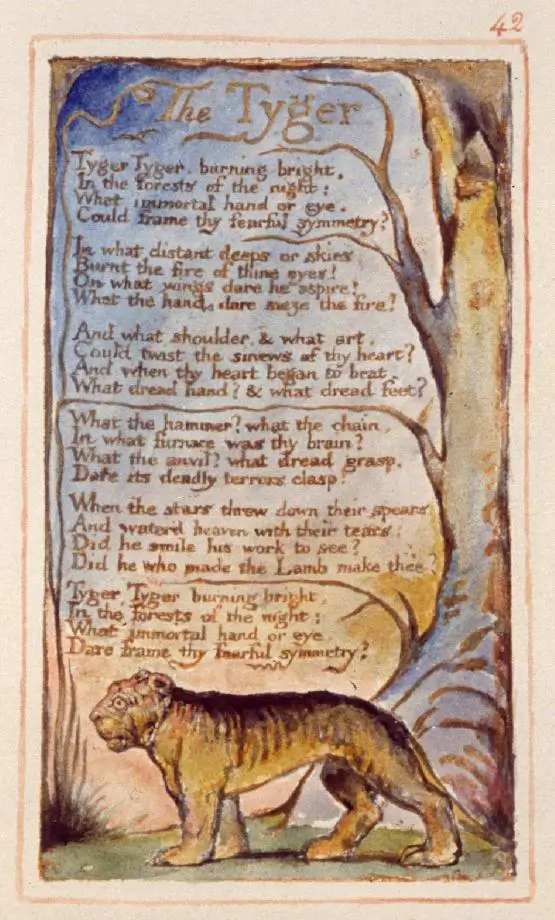
- The Tiger as a Symbol of Power and Fear: The repeated question “Did he who made the Lamb make thee?” captures the speaker’s awe. The tiger’s “fearful symmetry” suggests both beauty and danger.
- Imagery of Fire and Forging: “Burning bright” and creation in “the forests of the night” evoke danger; “hammer” and “chain” imagery suggests the tiger’s creation was a deliberate, forceful act.
- Contrast with the Lamb: The tiger’s power clashes with the lamb’s innocence, raising questions about how such opposite creatures share a single creator.
Key Takeaways: ‘The Lamb’ vs ‘The Tyger’
Both poems explore the tension between innocence and experience. The lamb stands for purity and simplicity; the tiger for the awe and fear of experience and creation. Though opposites, both are made by the same creator — showing that beauty and destruction coexist within Blake’s vision of divine creativity.
‘The Chimney Sweeper’ (Songs of Innocence)
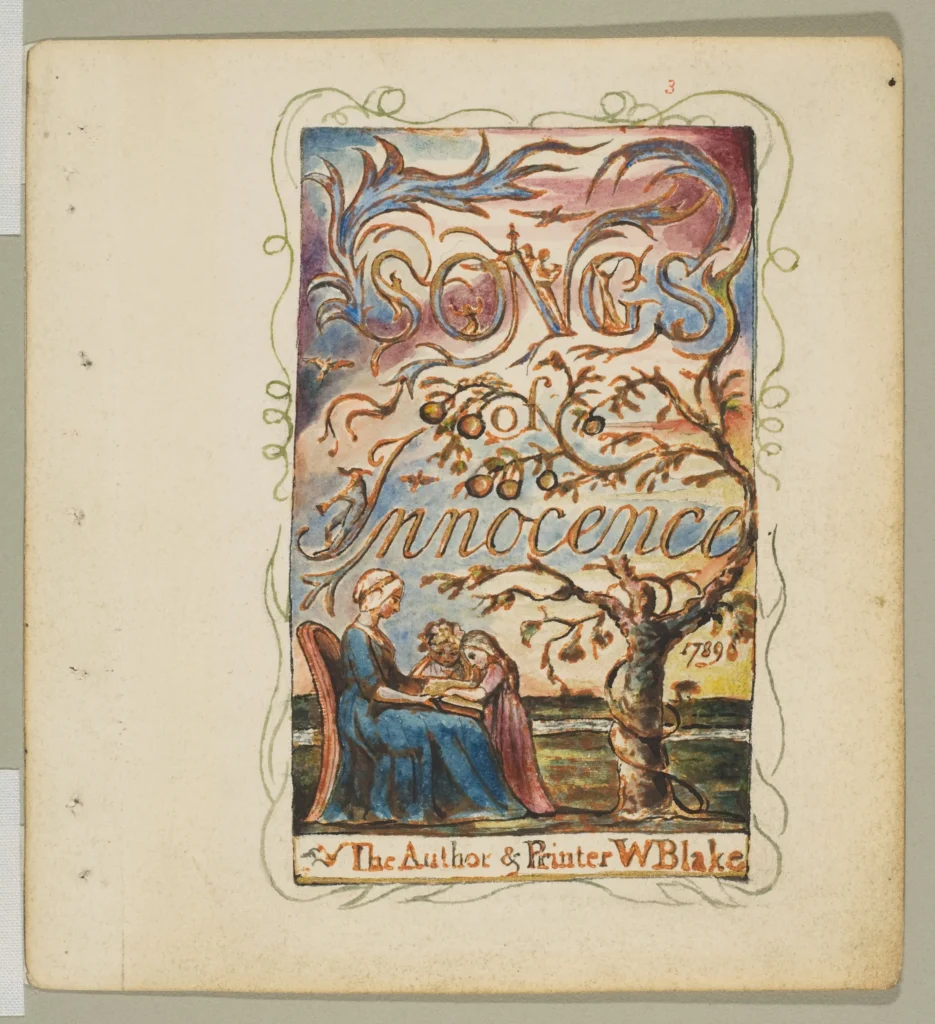
Full Text — ‘The Chimney Sweeper’ (Songs of Innocence, 1789)
When my mother died I was very young, And my father sold me while yet my tongue, Could scarcely cry “weep! weep! weep! weep!” So your chimneys I sweep & in soot I sleep.
There’s little Tom Dacre, who cried when his head That curl’d like a lamb’s back, was shav’d, so I said. “Hush, Tom! never mind it, for when your head’s bare, You know that the soot cannot spoil your white hair.”
And so he was quiet, & that very night, As Tom was a-sleeping he had such a sight! That thousands of sweepers, Dick, Joe, Ned & Jack, Were all of them lock’d up in coffins of black;
And by came an Angel who had a bright key, And he open’d the coffins & set them all free; Then down a green plain leaping, laughing they run, And wash in a river and shine in the Sun.
Then naked & white, all their bags left behind, They rise upon clouds, and sport in the wind. And the Angel told Tom, if he’d be a good boy, He’d have God for his father & never want joy.
And so Tom awoke; and we rose in the dark And got with our bags & our brushes to work. Tho’ the morning was cold, Tom was happy & warm, So if all do their duty, they need not fear harm.
Line-by-Line Explanation
Stanza 1
- “When my mother died I was very young, / And my father sold me while yet my tongue” — The speaker was orphaned/abandoned in early childhood, sold into labour by his own father — establishing immediate pathos and social injustice.
- “Could scarcely cry ‘weep! weep! weep! weep!'” — A child’s mispronunciation of “sweep! sweep!” (the chimney sweep’s street-cry), showing he was too young to even speak clearly when put to work.
- “So your chimneys I sweep & in soot I sleep” — Directly addresses the reader/society (“your chimneys”), implicating them in his suffering; he sleeps in soot — no proper home or care.
Stanza 2
- “There’s little Tom Dacre, who cried when his head… was shav’d” — Introduces a second child, Tom, whose head is shaved (practical for the job, but also stripping him of identity/comfort).
- “Hush, Tom! never mind it… the soot cannot spoil your white hair” — The speaker comforts Tom with dark irony — his white hair is already ruined by his circumstances, but the child rationalises it innocently.
Stanza 3
- “That thousands of sweepers… Were all of them lock’d up in coffins of black” — Tom’s dream: countless sweeper-children are trapped in coffins, a stark image equating their lives with living death.
Stanza 4
- “And by came an Angel who had a bright key… set them all free” — The Angel liberates the children — a moment of religious hope and divine intervention.
- “Then down a green plain leaping, laughing they run, / And wash in a river and shine in the Sun” — Vivid imagery of joy, freedom, and cleansing — everything denied to them in real life.
Stanza 5
- “Then naked & white, all their bags left behind, / They rise upon clouds, and sport in the wind” — The children ascend, freed of their tools of labour (“bags”), symbolising spiritual liberation from earthly toil.
- “if he’d be a good boy, / He’d have God for his father & never want joy” — The Angel’s promise: obedience and goodness will be rewarded with divine love — this is the poem’s central (and ambiguous) moral.
Stanza 6
- “And so Tom awoke; and we rose in the dark / And got with our bags & our brushes to work” — Harsh return to reality — the dream ends and the grinding labour resumes.
- “Tho’ the morning was cold, Tom was happy & warm, / So if all do their duty, they need not fear harm” — The final couplet is famously ambiguous: is Blake sincerely offering comfort through faith and duty, or ironically critiquing how religious consolation is used to keep exploited children compliant? Most modern readings favour the latter — an implicit critique beneath the surface comfort.
In Songs of Innocence, ‘The Chimney Sweeper’ addresses child labour and social injustice during the Industrial Revolution, narrated by a young chimney sweeper. The poem depicts children’s hard, dangerous working lives while offering a note of hope and spiritual relief.
Critique of Child Labor and Social Injustice
Blake criticises the tough lives of children — often orphans from poor families — forced into the dangerous chimney-sweeping trade, exposed to smoke, dirt, and injury.
- Child Labor as Exploitation: The poem opens with a young sweeper explaining how his poor parents sold him into the job — highlighting a lack of choice and society’s failure to protect vulnerable children. The line “When my head is bare, / I am a chimney-sweeper” shows children treated as workers rather than being cared for or educated.
- The Promise of Religious Salvation: An angel visits the boy in a dream, promising freedom and happiness after death. This vision comforts the child, but Blake critiques how religion sometimes soothes suffering rather than solving it — the promise of heaven becomes the child’s only real escape.
Tone and Narrative Style
1. Innocent and Childlike Voice: The boy’s simple, innocent voice fits Songs of Innocence, making the poem emotionally powerful through the contrast between his purity and his harsh circumstances. His account of the angel — “And by came an angel who had a bright key, / And he opened the coffins and set them all free” — shows his trust in a promised better future.
2. Hopeful Imagery and Spiritual Redemption: The poem ends on hope despite the boy’s bleak reality. The angel and the “green plain” offer spiritual comfort — but only after death, leaving his difficult present unchanged.
3. Narrative Technique: Blake mimics a child’s simple speech throughout, contrasting the boy’s hopeful dream with the harshness of his life, while subtly critiquing how religion can pacify suffering instead of challenging its causes.
Key Takeaways: ‘The Chimney Sweeper’ (Innocence)
Blake critiques the exploitation of children through chimney-sweeping labour, contrasting the boy’s innocence and religious hope with the harshness of his real circumstances — raising questions about how society treats its most vulnerable and how religion can be used to placate rather than confront injustice.
‘The Chimney Sweeper’ (Songs of Experience)
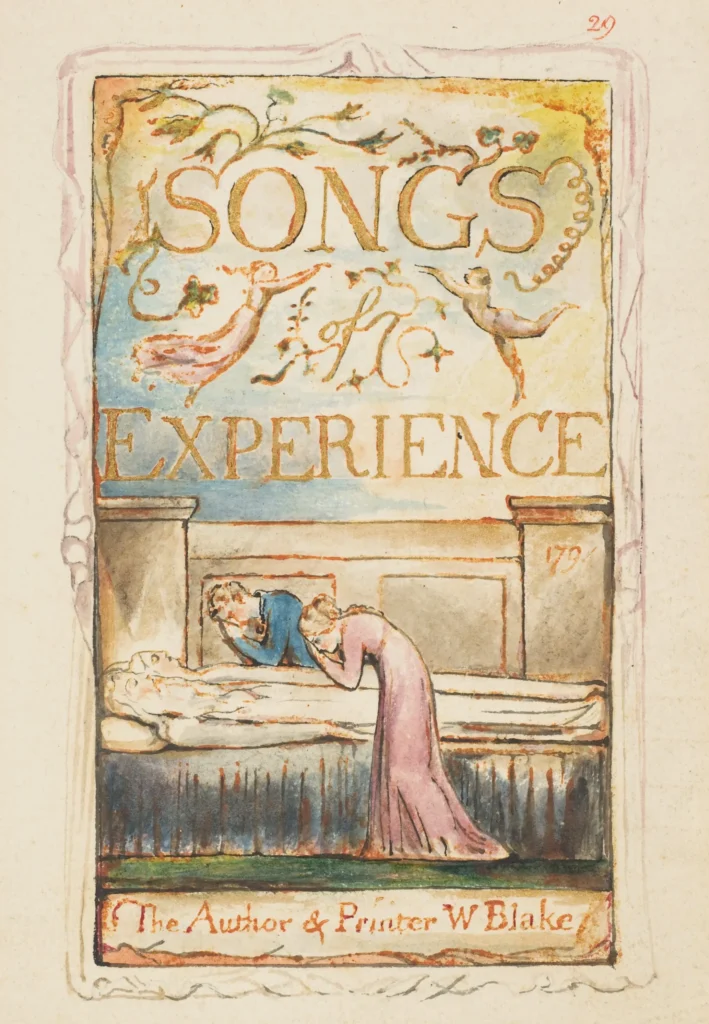
Full Text — ‘The Chimney Sweeper’ (Songs of Experience, 1794)
A little black thing among the snow: Crying “weep, weep,” in notes of woe! “Where are thy father & mother? say?” “They are both gone up to the church to pray.
Because I was happy upon the heath, And smil’d among the winter’s snow: They clothed me in the clothes of death, And taught me to sing the notes of woe.
And because I am happy, & dance & sing, They think they have done me no injury: And are gone to praise God & his Priest & King Who make up a heaven of our misery.”
Line-by-Line Explanation
Stanza 1
- “A little black thing among the snow: / Crying ‘weep, weep,’ in notes of woe!” — A striking, dehumanising opening — the child is called a “thing,” covered in soot (“black”), set against the harsh white snow, crying out in genuine sorrow rather than the innocent street-cry of the earlier poem.
- “‘Where are thy father & mother? say?’ / ‘They are both gone up to the church to pray.'” — A questioner (possibly the poet or a passerby) asks after the child’s parents; the child’s flat, matter-of-fact answer reveals they’ve abandoned him for religious duty instead of caring for him.
Stanza 2
- “Because I was happy upon the heath, / And smil’d among the winter’s snow” — The child recalls being naturally happy despite hardship — a natural, innocent joy.
- “They clothed me in the clothes of death, / And taught me to sing the notes of woe” — His parents/society forced him into the sweep’s dark, dangerous garb (“clothes of death”) and trained him into sorrow — his natural happiness was deliberately extinguished.
Stanza 3
- “And because I am happy, & dance & sing, / They think they have done me no injury” — Bitter irony: because the child still manages to appear content, the adults absolve themselves of guilt, believing no harm was done.
- “And are gone to praise God & his Priest & King / Who make up a heaven of our misery.” — The poem’s most damning line: God, the Church (“Priest”), and the State (“King”) are shown as complicit, building their idea of “heaven” on the suffering of children like him — a direct, unambiguous critique unlike the more ambiguous Innocence version.
In Songs of Experience, ‘The Chimney Sweeper’ presents a far darker view of child labour and social injustice, showing Blake’s disillusionment with both society and religion.
Depiction of Despair and Corruption
1. Loss of Innocence and Hope: Unlike the Innocence version, the child here finds no comfort in dreams of salvation. Found alone “among the snow,” crying “weep, weep” in “notes of woe,” the child reveals that his parents have “both gone up to the church to pray” — abandoning him to cold and misery while performing religious duty.
2. Corruption of Religion: Blake criticises how religion sustains oppression. Here, the child receives no vision of heaven — instead noting how “the priests of the Church” exploit the suffering of the poor. The line “And are gone to the grave with a prayer” shows religion’s empty, ineffective comfort.
3. Despair of the Child: The child in Experience understands the cruelty of his situation with clear-eyed realism — no promise of help from above, only recognition of a system that sells children into labour while society ignores their suffering.
Symbolism and Imagery
1. The Chimney as a Symbol of Oppression: A small, dark space the child must work within, symbolising how the poor are trapped and exploited.
2. The Imagery of the “Grave” and “Prayer”: Symbolising death and emptiness — the child’s suffering meets only empty prayer, not justice.
3. The Image of “Coffins of London”: Referring to the near-certain death awaiting children in dangerous trades — society treats them as already socially dead.
4. Contrast to the Innocence Version: Where Innocence offers an angel and hope, Experience replaces both with the grave and empty prayer — showing society’s systemic failure to protect its most vulnerable.
Key Takeaways: ‘The Chimney Sweeper’ (Experience)
The Experience version critiques the same exploitation shown in Innocence, but through dark imagery — the chimney, grave, and prayer — that captures despair and corruption instead of hope. The child’s lost innocence reflects Blake’s broader disappointment with a society and church that sustain injustice rather than confront it.
DSC-7 Previous Year Questions — William Blake
Frequently recurring question patterns across DU BA English Hons DSC-7 (Romantic Literature) exams and equivalent university papers on this unit. Use these for revision — exact wording may vary by year.
DU Previous Year Questions
Frequently asked questions from DU exam papers on this topic. Tap a question to view a quick-answer guide.
1 Why is the lamb a fitting symbol of innocence in Blake’s poem ‘The Lamb’? +
2 What does the “fearful symmetry” of the tiger suggest about Blake’s view of creation? +
3 How does the tone differ between the two ‘Chimney Sweeper’ poems? +
4 Identify and explain one instance of religious critique in ‘The Chimney Sweeper’ (Songs of Experience). +
5 What is the significance of the repeated question “Did he who made the Lamb make thee?” in ‘The Tyger’? +
6 Discuss William Blake’s treatment of innocence and experience as “two contrary states of the human soul,” with close reference to any two poems. +
7 Critically analyze ‘The Chimney Sweeper’ poems from Songs of Innocence and Songs of Experience as a critique of child labour and organised religion. +
8 “Blake’s poetry combines childlike simplicity of form with profound social and philosophical critique.” Discuss with reference to ‘The Lamb’, ‘The Tyger’, and ‘The Chimney Sweeper’ +
9 How does Blake use nature imagery differently in Songs of Innocence and Songs of Experience? Illustrate with examples. +
10 Examine the role of the child as a central figure in Blake’s Songs of Innocence and of Experience. +
Continue Reading — DSC-7 (Romantic Literature)
FAQs
What is the central theme of William Blake’s Songs of Innocence and of Experience?
The central theme is the contrast — and connection — between innocence and experience as “two contrary states of the human soul.” Blake explores how childhood purity is shaped and often corrupted by the harsh realities of adult life, society, religion, and industrialization.
Why are ‘The Lamb’ and ‘The Tyger’ often studied together?
Both poems ask who created their subject and question how a single creator could make both a gentle lamb and a fearsome tiger. Studied together, they capture Blake’s central innocence-versus-experience contrast through nature imagery.
What is the significance of the two ‘Chimney Sweeper’ poems?
The Innocence version shows a child sweep finding comfort in a religious vision of freedom after death, while the Experience version strips away that hope, showing a child fully aware of his exploitation by both society and the church. Together they critique child labour and the Church’s role in pacifying suffering.
When were Songs of Innocence and Songs of Experience published?
Songs of Innocence was published in 1789 and Songs of Experience followed in 1794, after which Blake combined both into a single volume titled Songs of Innocence and of Experience, Shewing the Two Contrary States of the Human Soul.
What DU course covers Songs of Innocence and Experience?
It is taught under DSC-7 (Romantic Literature), Unit I, in Semester 3 of the BA (Hons.) English syllabus at the University of Delhi, alongside Wordsworth, Coleridge, and Keats.
What literary devices does Blake commonly use in these poems?
Blake frequently uses simple, song-like structure, repetition, rhetorical questions, and vivid symbolism (the lamb, the tiger, the chimney, the grave) to convey complex social and spiritual ideas through deceptively simple language.
Subscribe to keep reading
You've used your free notes for now. Get Delhi Pathshala Premium for unlimited access.
Subscribe — ₹29/30 days