
Contents
- How to Read This Unit: A Quick Timeline
- Key Terms at a Glance
- Rajput State Formation and Negotiations
- Origins and Rise of Rajput States
- Historical Background
- Key Rajput Kingdoms
- Rajput-Mughal Relations
- Early Conflicts and Alliances
- Akbar’s Rajput Policy
- Negotiations and Diplomacy
- Cultural Syncretism and Influence
- Architectural Contributions
- Patronage of Art and Literature
- Challenges and Resistance
- Mughal Expansion Under Aurangzeb
- Internal Struggles
- Legacy of Rajput States
- Preservation of Rajput Identity
- Influence on Regional Politics
- Mughal State – Changes and Crises
- Growth Under Akbar and Successors
- Administrative Changes
- Religious and Cultural Policies
- Height Under Jahangir and Shah Jahan
- Stability and Prosperity
- Famous Buildings
- Problems During Aurangzeb’s Reign
- Expansionist Policies
- Religious Policies
- Administrative Problems and Corruption
- Economic Decline
- Rise of Regional Powers
- Sikh Resistance
- Jat and Satnami Uprisings
- Succession Crises and Decline
- Succession Wars
- Invasions and Threats
- Legacy and Impact
- Cultural Contributions
- Administrative Influence
- Maratha State Under Shivaji and Peshwas
- Shivaji Bhonsle: Builder of Maratha Power
- Early Life and Influences
- Establishment of Swarajya
- Administrative Skills of Shivaji
- Government Structure
- Revenue Systems
- Military Reforms and Navy
- Modernization of the Army
- Naval Strength
- Relations with the Mughals and Other Powers
- Conflicts and Treaties
- Diplomatic Efforts
- From Shivaji to Shahu: The Seventeenth-Century Crisis
- The Peshwa Era and Expansion
- Rise of the Peshwas
- Baji Rao I’s Military Campaigns
- Administrative Improvements
- Society and Culture Under the Marathas
- Social Reforms
- Religious Policies
- Challenges and Decline
- Internal Rivalries
- Third Battle of Panipat (1761)
- British Expansion
- Legacy of the Maratha Confederacy
- Influence on Future Resistance
- Cultural Contributions
- Important Comparisons
- The Three States Side by Side
- Akbar’s and Aurangzeb’s Dealings with the Rajputs
- Shivaji’s Swarajya and the Peshwa-Era State
- Criticism and Limitations: Sources and Biases
- Contemporary Relevance
- Conclusion
- Reading List from the DU Syllabus (Unit II)
- Continue Reading
- University of Delhi Previous Year Questions
- FAQs
In this post, notes of “Unit 2: Political Developments and State Formation: Rajput State Formation, Mughal State, Maratha State” from “DSC-1: History of India – VII: 1600 – 1750s” are given, which is helpful for the students doing graduation this year.
Unit 2 asks one large question: how was political power built, shared and fought over between the early seventeenth century and the mid-eighteenth? The University of Delhi syllabus describes the unit as one that “foregrounds issues in the formation and maintenance of political power and its challenges in the Mughal, Rajput and Maratha states”, and its reading list (Satish Chandra, J. F. Richards, Muzaffar Alam, Richard Eaton, Stewart Gordon, Andre Wink, G. D. Sharma, Norman Ziegler, Robert Hallissey, Ramya Sreenivasan) shows what examiners expect: arguments and historians, not only dates.
These notes keep the three-part order of the syllabus. Each part gives the events first, then the debates around them, because a DU answer that names who argued what usually scores better than one that narrates alone.
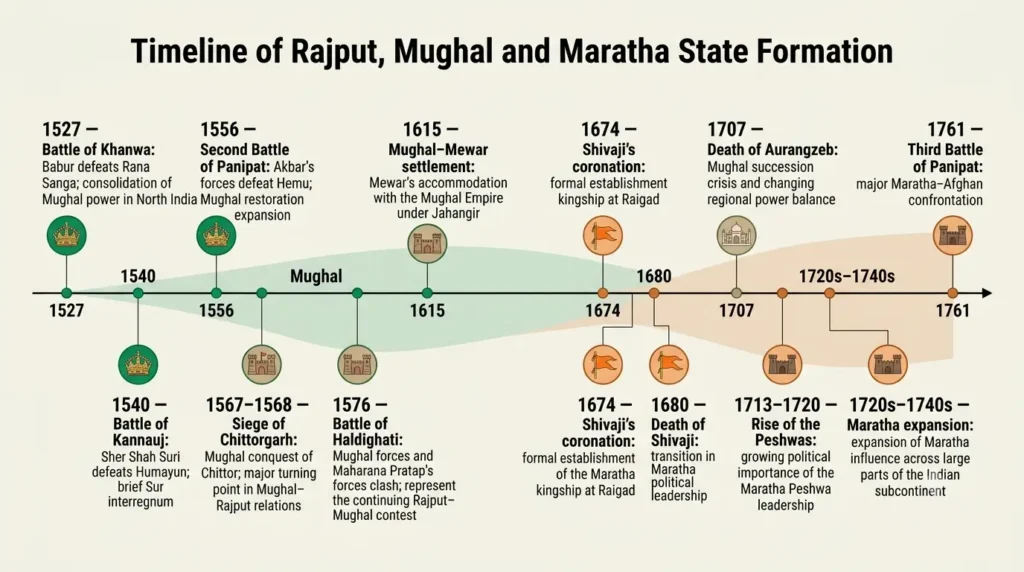
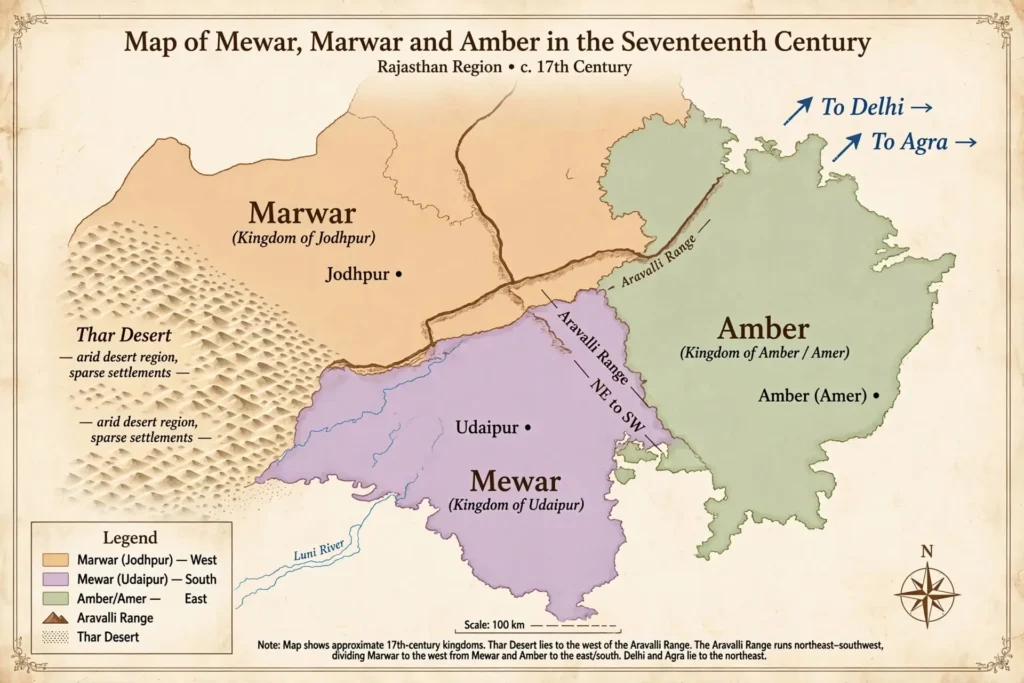
A note on search terms. Older DU teaching plans described the Rajput topic as “Rajput political culture and state formation: Eastern Rajasthan”, while the current syllabus says “Rajput State Formation and Negotiations”. Both are covered below, with Mewar, Marwar and Amber (Jaipur) treated as the core cases.
How to Read This Unit: A Quick Timeline
| Year | Event | Why it matters for the unit |
|---|---|---|
| 1527 | Battle of Khanwa: Babur defeats Rana Sanga | Ends the hope of a Rajput-led confederacy against the Mughals; Mewar does not submit |
| 1562 | Raja Bharmal of Amber gives his daughter to Akbar | First major Rajput house to enter Mughal service through marriage |
| 1564 | Akbar abolishes jizya (pilgrim tax abolished in 1563) | Part of the conciliatory framework that made Rajput service possible |
| 1567–68 | Siege and fall of Chittor | Shows the cost of resisting; Mewar’s capital shifts towards Udaipur |
| 1576 | Battle of Haldighati | Rana Pratap’s resistance; Mughal victory was not decisive |
| c. 1580 | Zabt/dahsala revenue settlement (Todar Mal) | Revenue base that supports the mansab–jagir system |
| 1615 | Mewar–Mughal treaty (Amar Singh and Jahangir/Khurram) | Mewar accepts suzerainty on unusually honourable terms |
| 1646 | Shivaji captures Torna | Start of the Maratha Swarajya project |
| 1658–59 | Mughal war of succession | Aurangzeb defeats Dara Shukoh at Samugarh (29 May 1658) |
| 1665 | Treaty of Purandar | Shivaji cedes 23 forts to Mirza Raja Jai Singh |
| 1678–79 | Death of Jaswant Singh; Marwar crisis | Opens the Rathore rebellion (1679–1707) |
| 1679 | Jizya reimposed | Most debated measure of Aurangzeb’s reign |
| 1681–1707 | Aurangzeb in the Deccan | Bijapur (1686), Golconda (1687), Sambhaji executed (1689) |
| 1707 | Death of Aurangzeb | Start of succession struggles and regional reconfiguration |
| 1708–10 | Rajput rebellion against Bahadur Shah I | Marwar and Amber act together |
| 1719 | Maratha right to chauth and sardeshmukhi recognised in the six Deccan subas | Mughal sanction for Maratha claims |
| 1728 | Battle of Palkhed | Baji Rao I defeats the Nizam |
| 1739 | Nadir Shah defeats the Mughals at Karnal and sacks Delhi | Exposes Mughal military weakness |
| 1761 | Third Battle of Panipat | Maratha northern expansion checked |
Key Terms at a Glance
| Term | Meaning in this unit |
|---|---|
| Mansab | A numerical rank in Mughal service fixing status, pay and military obligation |
| Zat / Sawar | Personal rank / number of cavalry the mansabdar had to maintain |
| Jagir | Assignment of the right to collect revenue from a territory, in place of cash salary |
| Watan jagir | A jagir in the holder’s home territory, often given to Rajput chiefs who served the Mughals |
| Khalisa | Land whose revenue went directly to the ruler or the imperial treasury |
| Jagirdari crisis | Shortage of usable jagirs compared with the number of mansabdars (Satish Chandra, M. Athar Ali) |
| Bejagiri | The condition of mansabdars waiting for a jagir that was not available |
| Sulh-i kul | “Universal peace” principle associated with Akbar’s court |
| Swarajya | Shivaji’s own territory and the political idea of self-rule |
| Chauth / Sardeshmukhi | Maratha levies of one-fourth and one-tenth of revenue on territories outside direct Maratha control |
| Ashtapradhan | Council of eight ministers under Shivaji |
| Peshwa | Originally Shivaji’s chief minister; from the eighteenth century the real head of Maratha government at Pune |
Rajput State Formation and Negotiations
The Rajput states were important in Indian history during the medieval period. Their development, and above all their political bargaining with the Mughal Empire, shaped much of north and western India. The Rajputs were known for bravery and honour and dealt with the Mughals in many ways, from fighting them to forming alliances, and these relations affected regional politics for a long time.
The syllabus phrase “state formation and negotiations” is worth reading carefully. It does not describe Rajput kingdoms simply as victims of Mughal expansion or as loyal junior partners. It asks how Rajput rulers used Mughal service, marriage, rank and ritual to build, expand and defend their own kingdoms while the Mughals used the same instruments to build an empire.
Origins and Rise of Rajput States
Historical Background
- Emergence of Rajput clans after the Gupta period: After the Gupta Empire declined (sixth century CE), north India saw the rise of many regional kingdoms. Between roughly the seventh and twelfth centuries, warrior lineages in Rajasthan, Gujarat, Malwa and the upper Gangetic plain began to claim the status of rajaputra (“king’s son”), later shortened to Rajput. They established themselves through military strength, land grants, marriage alliances and fortresses.
- The social structure of Rajput society: Rajput society valued honour, bravery and loyalty to the clan. It was divided into many clans, each led by its own chief, and was hierarchical: the ruler at the top, then kinsmen-nobles and warriors. Land was central, because it was both the reward for service and the basis of military power. Rajput rulers kept some land under their own direct control (khalisa) and granted other land to nobles (jagir) in return for military service, which made the relationship between ruler and clan nobles a constant political issue.
Where did the Rajputs come from? A debate, not a settled fact. Older textbooks said the Rajputs descended from Central Asian migrants. Historians now treat the question more carefully:
| View | Associated with | Core argument | Main criticism |
|---|---|---|---|
| Foreign origin | James Tod and other colonial writers | Rajputs descended from groups such as Scythians or Hunas absorbed into the Kshatriya order | Relies on analogy (customs, sun worship) rather than firm evidence |
| Agnikula myth | Medieval bardic tradition | Some clans arose from a sacrificial fire-pit on Mount Abu | A later legitimising story, not a historical account |
| Kshatriya or indigenous origin | Several Indian scholars of the colonial and early national period | Rajputs were descended from older Kshatriya lines | Hard to prove continuity across centuries |
| Processual view | B. D. Chattopadhyaya | “Rajput” was a status acquired through political success, landholding, fortification and claims to Kshatriya rank in early medieval Rajasthan | Debates continue on details and timing |
| Open military category | Dirk Kolff | Into the early modern period, “Rajput” covered many warrior groups of varied origins | Focuses on military labour more than ruling houses |
For Unit 2, treat this as background. The syllabus focus is the sixteenth to eighteenth centuries.
Key Rajput Kingdoms
Mewar (Sisodia dynasty, Udaipur): Mewar was the most prestigious Rajput kingdom, ruled by the Sisodias, and the one that held out longest against the Mughals.
- Rana Pratap and Haldighati. Rana Pratap (Maharana Pratap) refused to accept Akbar’s suzerainty. At Haldighati (1576) he faced a Mughal army led by Raja Man Singh of Amber and withdrew from the field, so the battle is usually described as a Mughal tactical victory but not a decisive one. Pratap kept fighting from the hills and recovered much of Mewar by the early 1580s (the Battle of Dewair, 1582 is the usual reference), though Chittor and Mandalgarh stayed under Mughal control. His resistance became a symbol of Rajput independence.
- Why Mewar is a special case. Almost every other Rajput clan accepted Mughal overlordship, and several gave daughters to the imperial household. Mewar’s Sisodias refused for decades. Even when peace came in 1615, the Maharana was excused from attending court in person and was not required to enter a matrimonial alliance with the Mughals (see “Negotiations and Diplomacy” below).
Marwar (Rathore dynasty, Jodhpur): The Rathores ruled Marwar from Jodhpur, founded by Rao Jodha in 1459, and became influential in Rajput politics under rulers such as Rao Maldeo. Marwar passed under direct Mughal control after the death of Chandrasen in 1581, and later Rathore rulers served the empire. Raja Jaswant Singh (r. 1638–78) served Shah Jahan and then Aurangzeb, and he died on imperial service at Jamrud in 1678. The succession crisis after his death led to the long Rathore rebellion (see “Challenges and Resistance”). The DU readings on Marwar by G. D. Sharma and Norman Ziegler study its administration and the part played by horses, warfare and structural change in the Rathor state.
Amber (Kachwaha dynasty, later Jaipur): The Kachwahas of Amber became the Mughals’ most prominent Rajput partners. Raja Bharmal’s decision in 1562 to give his daughter to Akbar, and to send his son Bhagwant Das and grandson Man Singh to court, began a relationship that lasted generations. Raja Man Singh I rose to a mansab of 7,000 and served as one of Akbar’s leading generals. Mirza Raja Jai Singh I later commanded Mughal forces against Shivaji (Treaty of Purandar, 1665). Sawai Jai Singh II founded the planned city of Jaipur in 1727 and shifted the political centre of the Kachwaha state there. Ramya Sreenivasan’s article on Amber, c. 1560–1615 (a DU reading) studies how kingship and authority were redefined in this period.
Comparing the three cases
| Feature | Mewar | Marwar | Amber (Jaipur) |
|---|---|---|---|
| Ruling dynasty | Sisodia | Rathore | Kachwaha |
| Capital | Chittor, then Udaipur | Jodhpur | Amber, later Jaipur (1727) |
| Early relation to Mughals | Armed resistance (Khanwa legacy, Haldighati) | Resistance, then Mughal control after 1581 and service | Early alliance (1562) |
| Treaty or turning point | 1615 treaty with Jahangir | Succession crisis of 1678–79 | Alliance with Akbar, Purandar 1665 |
| Marriage with Mughal house | Not required in 1615 | Yes (Rathore princesses entered the imperial household) | Yes (from 1562) |
| What the case shows | Honour and resistance, then a negotiated peace | How a Mughal service noble could become the centre of a revolt | How alliance could raise a clan above its rivals |
Rajput-Mughal Relations
Early Conflicts and Alliances
- Battles of Khanwa and Chittor: At Khanwa (17 March 1527) Rana Sanga of Mewar led a Rajput confederacy against Babur and was defeated, largely because of Babur’s artillery, field tactics and the weaknesses of a coalition. Sanga died in January 1528 while preparing to renew the struggle. Mewar did not submit to Mughal rule after Khanwa; it remained independent of the Mughals until the treaty of 1615. (A common mistake in answers is to write that Khanwa brought Mewar under Mughal authority.) The siege of Chittor (1567–68) in Akbar’s reign was the next major clash, and the fort fell, which became part of Rajput memory of resistance. Udai Singh had by then moved away from Chittor, and Udaipur became Mewar’s new capital.
- Strategic matrimonial alliances: Marriage was a political instrument. The flow ran in one direction: Rajput rulers gave their daughters to Mughal emperors and princes, making them in-laws of the imperial house; the reverse (Mughal princesses marrying Rajput rulers) is not part of the standard account. Bharmal’s marriage alliance of 1562 was followed by Rajput brides from Bikaner, Jaisalmer and Marwar in Akbar’s time. The marriages brought Rajput houses into the Mughal court and gave them access to rank and favour, while allowing them to keep their dynastic identity and kingdoms. Historians such as Frances Taft (on “honour and alliance”, a suggestive reading in the DU list) examine what these marriages meant for status on both sides.
Akbar’s Rajput Policy
- Integration of Rajputs into Mughal nobility: Akbar’s approach was cooperation. He recognised the Rajputs’ military value and gave many of them high rank, and he tried to win loyalty through respect and honour rather than only force. Man Singh’s rise to 7,000 shows how far this could go.
- Grant of jagirs and mansabs: Akbar gave Rajput chiefs ranks (mansabs) and revenue assignments (jagirs), often in their home territories (watan jagirs), which helped them keep control of their territories while remaining loyal to him. The Mughal ranking system became, in the words of recent research, the “bedrock” of this arrangement.
- Terms of the bargain: Akbar also abolished the pilgrim tax (1563) and jizya (1564), allowed Hindu wives in the imperial household to follow their own religion, and did not require Rajput chiefs to convert.
How do historians read this relationship? Recent research argues that Mughal expansion and Rajput state-building reinforced each other. Sourav Ghosh’s Berkeley dissertation on Rajput state formation and political culture in the Mughal Empire (c. 1583–1694) argues that the growth of Rajput “little kingdoms” under Mughal rank-holding helped the Mughals consolidate power in the hinterlands, and that Rajput kingship flourished under Mughal sovereignty (abstract available on eScholarship; the full text is under embargo).
A 2023 Jamia Millia Islamia thesis synopsis on Amber and Marwar in 1707–1750 similarly stresses that the Rajput kingdoms did not try to formally overthrow Mughal authority but used the empire’s weakness to restructure their own states (synopsis here). This is quite different from the older picture of a simple “Rajput resistance” story.
Negotiations and Diplomacy
- Role of Raja Man Singh and other Rajput nobles: Raja Man Singh of Amber was a trusted general and negotiator. His skills helped balance Rajput independence with loyalty to the emperor. He also commanded the Mughal force at Haldighati against Mewar, a reminder that Rajput nobles served on both sides of Rajput–Mughal conflicts.
- The Mewar treaty of 1615: After three Mughal campaigns, Rana Amar Singh opened negotiations. According to Britannica’s account of Jahangir’s reign, he recognised Jahangir as suzerain, territory held by the Mughals (including Chittor, though it could not be refortified) was restored, he was not obliged to attend court, and his son would represent him. He was not required to enter a matrimonial alliance with the Mughal family. This is a good example of negotiation: Mewar accepted suzerainty but kept dignity.
- Balancing autonomy with allegiance: Rajput rulers had to manage their independence while supporting the emperor in war. Succession to a Rajput throne generally needed imperial recognition, which gave the emperor leverage, and that leverage became the cause of the Marwar crisis in 1678–79.
What did each side gain?
| Rajput chiefs gained | Mughals gained | |
|---|---|---|
| Rank and income | High mansabs, jagirs and watan jagirs | Experienced cavalry commanders |
| Political security | Imperial backing against rivals inside the clan | Stable control over Rajasthan’s roads, forts and trade routes |
| Status | Kinship ties with the imperial house, recognised kingship | Legitimacy and loyal service from leading Hindu houses |
| Costs | Military service far from home; possible loss of autonomy | Concessions on religion, ritual and local autonomy |
Cultural Syncretism and Influence
Architectural Contributions
- Fusion of Mughal and Rajput styles: Rajput forts and palaces, known for strong defensive design, mixed with Mughal features such as Persian-influenced garden layouts, formal symmetry and open courtyards.
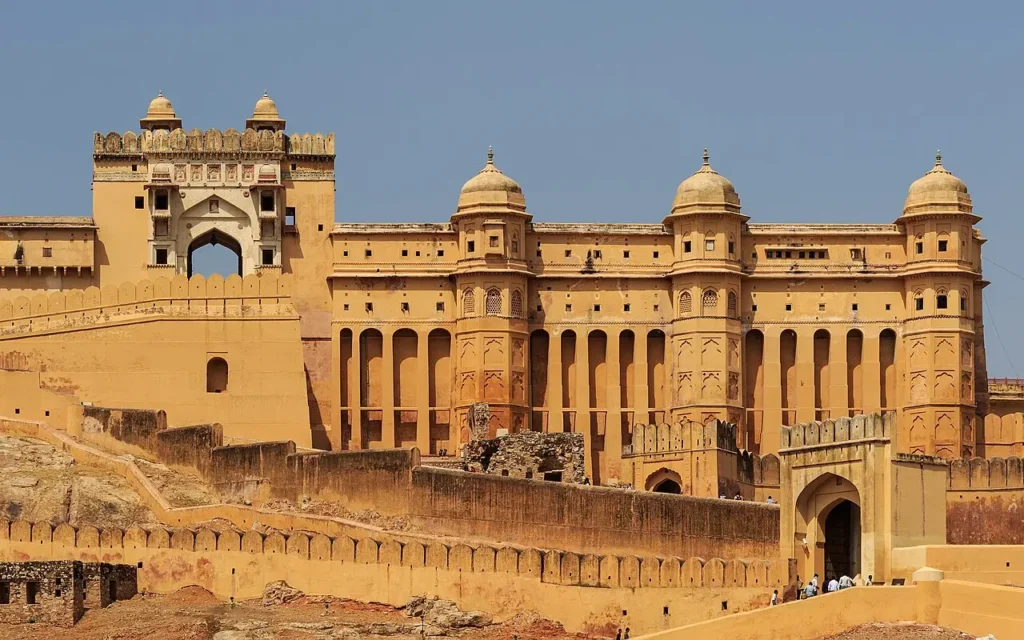
- Notable forts and palaces: The Amer Fort, begun by Raja Man Singh I in 1592 and extended by later Kachwaha rulers, combines Rajput features such as carved screens and frescoes with Mughal-influenced planning. The City Palace of Jaipur belongs to the later planned city of Sawai Jai Singh II (from 1727) rather than to Man Singh’s time, so do not date it to Akbar’s reign.
Patronage of Art and Literature
- Development of Rajput painting schools: Rajput courts supported miniature painting that blended local traditions with Mughal influence, with themes drawn from religious texts, court life and music. The syllabus returns to this in Unit III (painting and politics in Mewar, Bikaner and the Mughal court, a reading by Vishakha Desai).
- Promotion of regional literature and languages: Rajput courts supported poetry and chronicles in Hindi, Rajasthani, Braj and related literary languages. Rulers were often poets or patrons of poets, and bardic and chronicle traditions were used to record lineage and honour.
Challenges and Resistance
Mughal Expansion Under Aurangzeb
- The Marwar crisis (1678–79): Jaswant Singh died at Jamrud in 1678. Aurangzeb did not accept the infant Ajit Singh as successor in the way the Rathore nobles wanted and tried to divide or control Marwar. Durgadas Rathore and other nobles carried Ajit Singh away from Delhi, and the long Rathore rebellion (1679–1707) began. Mughal-side narratives, which Jadunath Sarkar used, claimed that the child Aurangzeb produced was not the real Ajit Singh; treat that story as a contested claim rather than a certainty.
- War in Mewar (1679–81): Maharana Raj Singh I gave refuge to Ajit Singh, which Aurangzeb treated as a serious provocation. Mughal forces entered Mewar and temples were demolished around Udaipur and Chittor in 1679–80. After Raj Singh’s death in 1680, his successor made peace on terms that included ceding some land and not assisting Ajit Singh, and Aurangzeb left for the Deccan in September 1681.
- The end of the story: After Aurangzeb died (3 March 1707), Ajit Singh recaptured Jodhpur on 12 March 1707.
- The Rajput rebellion of 1708–10: When Bahadur Shah I moved against Marwar and Amber, replacing Jai Singh at Amber, the two states acted together and Mewar supported them. They recaptured Jodhpur and Amber in 1708, and the emperor ended up restoring their holdings.
Interpreting the Rajput rebellion. Historians disagree about whether this was mainly a reaction to Aurangzeb’s religious policy, or a political struggle over succession, control of land and the rights of Rajput kingship. Robert Hallissey’s The Rajput Rebellion against Aurangzeb (a DU reading) is a full study of the episode. In an answer, state the two possibilities with evidence for each and say which is more convincing and why.
Internal Struggles
- Clan rivalries and succession disputes: Despite external alliances, Rajput states faced internal problems. Disputes over succession and conflicts between kinsmen and nobles weakened them. Mughal intervention could be a tool for one claimant against another, as the Marwar case shows.
- Rivalry between states: In the eighteenth century Rajput states sometimes cooperated (1708) and sometimes competed. Weakening of Mughal authority after 1707 revived inter-state rivalries and made them vulnerable to new powers, particularly the Marathas, who pressed chauth claims on Rajput courts during Baji Rao I’s time.
Legacy of Rajput States
Preservation of Rajput Identity
- Upholding traditions amidst external influences: Even with pressure from the Mughals and later the British, Rajput rulers kept their cultural identity: genealogies, court ritual, architecture and religious patronage remained important. Recent work argues that Rajput kingship was not weakened by Mughal service but reshaped by it.
Influence on Regional Politics
- Continuity into the colonial period: Several Rajput kingdoms survived the Mughal, Maratha and British empires as ruling houses. By 1818 the Rajput states had entered alliances with the East India Company, which left them as princely states under British paramountcy. It is more accurate to speak of continuity of dynasties than of the Rajput states “laying the foundation” of the princely order.
The rise of Rajput states, their negotiated relationship with the Mughals, their moments of revolt and their long survival are central to the unit. They show that Mughal power depended on partnerships with local rulers, and that those partners were themselves state builders.
Mughal State – Changes and Crises
The Mughal Empire was very powerful under Akbar and his successors, but by the end of Aurangzeb’s rule it faced serious problems. This section looks at the political, economic and religious changes in the Mughal state, from its high point to its crises, and at the historians’ debate on why the crises happened. Two points help in every answer: (1) the empire reached its largest extent under Aurangzeb, so “decline” cannot simply mean shrinking; (2) historians disagree sharply about the causes, so the debate matters as much as the chronology.
Growth Under Akbar and Successors
Administrative Changes
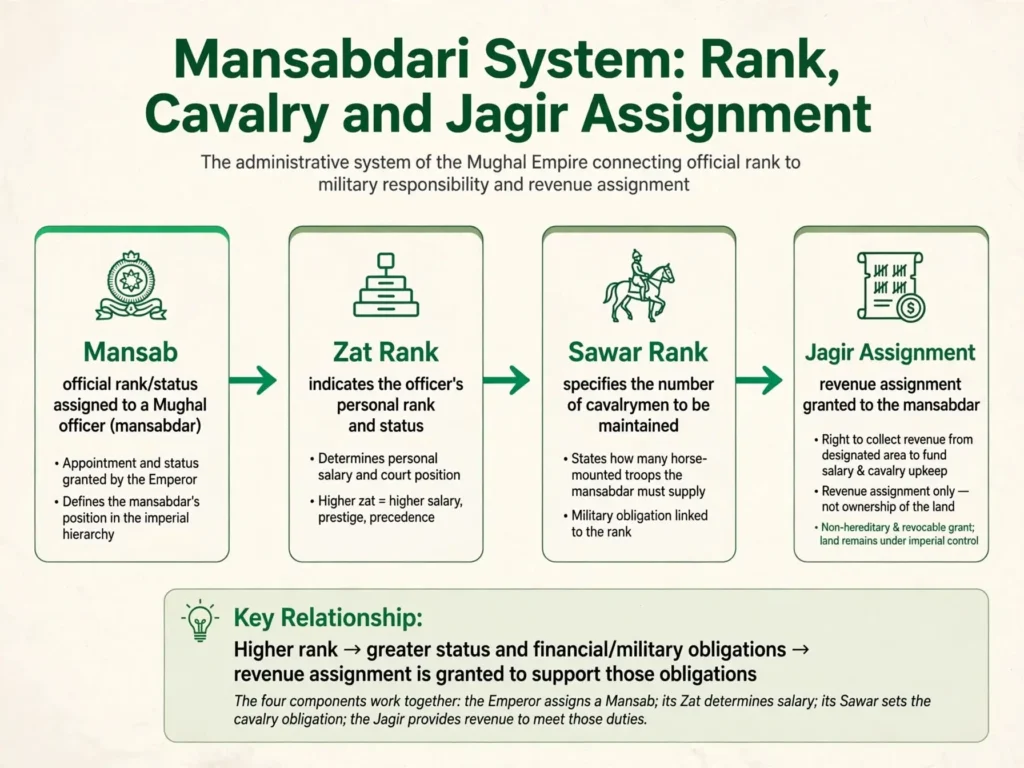
- Mansabdari System: Akbar created the mansab system, which graded every officer by rank. Each rank had two numbers: zat (personal rank, fixing status and salary) and sawar (the number of cavalry the officer had to maintain). Mansabdars were paid in cash or, more commonly, by jagirs, assignments of revenue from land. The system gave the emperor a single ranked nobility of Iranis, Turanis, Rajputs and Indian Muslims. Dating note: sources give different years for the introduction of the system (the 1570s is the safe range) and for the dual zat–sawar ranking, so avoid quoting one exact year unless your teacher does. Under Jahangir the du-aspa sih-aspa rank allowed the sawar obligation to be raised without changing zat, which shows the system being adjusted over time.
- Land Revenue Reforms by Todar Mal: Akbar’s finance minister, Raja Todar Mal, was central to the zabt or dahsala settlement completed around 1580. Land was measured and classified by productivity (polaj, parauti, chachar, banjar), and the state demand was fixed at about one-third of the average produce, calculated on the basis of a ten-year average and preferably collected in cash. It was not applied everywhere in the empire; other methods remained in use in many regions.
| Mansab and jagir in brief | |
|---|---|
| What the emperor gave | Rank (mansab) and the right to collect revenue (jagir) |
| What the mansabdar owed | Troops and horses according to sawar rank; service wherever posted |
| Built-in weakness | Jagirs were estimated by jama (assessed revenue), but real collection (hasil) could be much lower; if jagirs were scarce, nobles waited without income |
Religious and Cultural Policies
- Sulh-i Kul (Universal Peace): Akbar promoted the principle of sulh-i kul, which put peaceful coexistence of religions at the centre of state policy. He abolished the pilgrim tax (1563) and jizya (1564) and brought many Hindus, especially Rajputs, into high positions. This helped the empire govern a diverse population.
- Ibadat Khana and Discussions: Akbar built the Ibadat Khana at Fatehpur Sikri in 1575, where scholars of different religions discussed belief. It was first limited to Muslim scholars and later opened to other traditions, including Hindus, Jains, Zoroastrians and Jesuits. Historians disagree about how far the later Din-i Ilahi was a “religion” at all rather than a court-centred discipline of loyalty to the emperor.
Height Under Jahangir and Shah Jahan
Stability and Prosperity
- Political developments, not only art: Jahangir’s major political success was the Mewar settlement of 1615, mentioned above. His reign also saw Prince Khurram’s rebellion (1622) and the influence of Nur Jahan at court, and the Deccan frontier remained unsettled under pressure from Malik Ambar of Ahmadnagar. The execution of Guru Arjan in 1606, in Jahangir’s reign, is part of the long background to Sikh–Mughal tension.
- Arts Flourishing: The reigns of Jahangir and Shah Jahan were rich in painting, architecture and court ritual. Jahangir supported Mughal miniature painting, and Shah Jahan oversaw major buildings. Unit III of your syllabus (allegory and symbolism in painting, Shahjahanabad) explores why rulers used art as political language.
- Trade and Commerce Growth: During Jahangir and Shah Jahan’s rule, trade expanded greatly. The large empire allowed both local and international trade, connecting India with Europe and Asia. Unit IV of the syllabus covers this in detail; see our Unit 4 notes linked in “Continue Reading”.
- A caution on “golden age”: Historians use the term loosely. The same expansion that brought wealth also created expensive commitments (more mansabdars, larger armies) that the revenue system had to carry.
Famous Buildings
- Taj Mahal and Red Fort: Shah Jahan built the Taj Mahal at Agra, the tomb of Mumtaz Mahal, and the Red Fort in Delhi as part of his new capital city, Shahjahanabad (begun 1639). These are the best-known expressions of Mughal imperial architecture and are treated in Unit III.
Problems During Aurangzeb’s Reign
Aurangzeb ruled from 1658 to 1707. According to Britannica, the empire reached its greatest extent under him, even though his policies helped lead to its dissolution. That combination of apparent strength and real strain is the heart of the problem.
Expansionist Policies
- Warfare in the Deccan: Aurangzeb focused on expanding the empire, especially in the Deccan. He moved to the south in 1681 and stayed there until his death in 1707. Bijapur fell in 1686 and Golconda in 1687, and Shivaji’s son Sambhaji was captured and executed in 1689. But Maratha resistance continued under Rajaram, Tarabai and other leaders, and the war became a long drain on the empire.
- Financial Strain: The long Deccan campaigns strained the Mughal treasury. Aurangzeb himself is traditionally described as personally austere (a tradition says he met personal expenses by copying the Quran and making caps).
Religious Policies
- Jizya Tax Return: In 1679, Aurangzeb reimposed jizya, which Akbar had abolished in 1564. It was controversial and critics included Hindu rulers and some members of the court.
- Temple Destruction and the historiography: Temple demolitions in the Marwar and Mewar crisis (1679–80) were real, but the wider picture is debated. DU’s reading list includes Richard Eaton (on temple desecration), Satish Chandra, S. M. Azizuddin Husain on jizya and Katherine Butler Brown on music.
| Reading | Associated with | Main points |
|---|---|---|
| Orthodoxy and bigotry | Jadunath Sarkar, S. R. Sharma | Aurangzeb sought an Islamic state; jizya and temple policy were religious in motive; a “Hindu reaction” followed |
| Politics and pragmatism | Satish Chandra and later historians | Jizya came 22 years after accession, so political and fiscal factors must be considered; temple policy was selective and temples also received grants; no empire-wide ban on music |
| Selective desecration | Richard Eaton | Documented cases of destruction are limited and often linked to rebellion or royal temples; other orders protected temples and temples were built elsewhere |
| Music | Katherine Butler Brown | There was no complete ban; the “ban” was largely about performance before the emperor |
Verify the details of each argument in the original readings before using them in an answer. Unit III returns to Aurangzeb’s policy on jizya, temples and music, so use this table as a summary and not as the full treatment.
Administrative Problems and Corruption
- The jagirdari crisis: As the empire expanded into the Deccan, many Deccani nobles entered Mughal service and the number of mansabdars rose, but the supply of productive jagirs did not. M. Athar Ali argued that nobles competed for scarce good jagirs. Satish Chandra described this as the crisis of the jagirdari system, including the problem of bejagiri (nobles without assignments). The effect was pressure on the peasantry and instability among nobles.
- Provincial Governors Gaining Power: As central authority weakened after Aurangzeb, provincial governors began to act independently, raising their own armies and revenue systems. Nizam-ul-Mulk’s autonomous state in the Deccan (1724) is a standard example, alongside Awadh and Bengal.
Economic Decline
- Peasant Rebellions: High revenue demands and war led to agrarian unrest.
- Military Campaign Costs: Ongoing military expeditions drained resources and made it difficult to maintain control over the empire.
Why did the Mughal state enter crisis? The historiographical debate
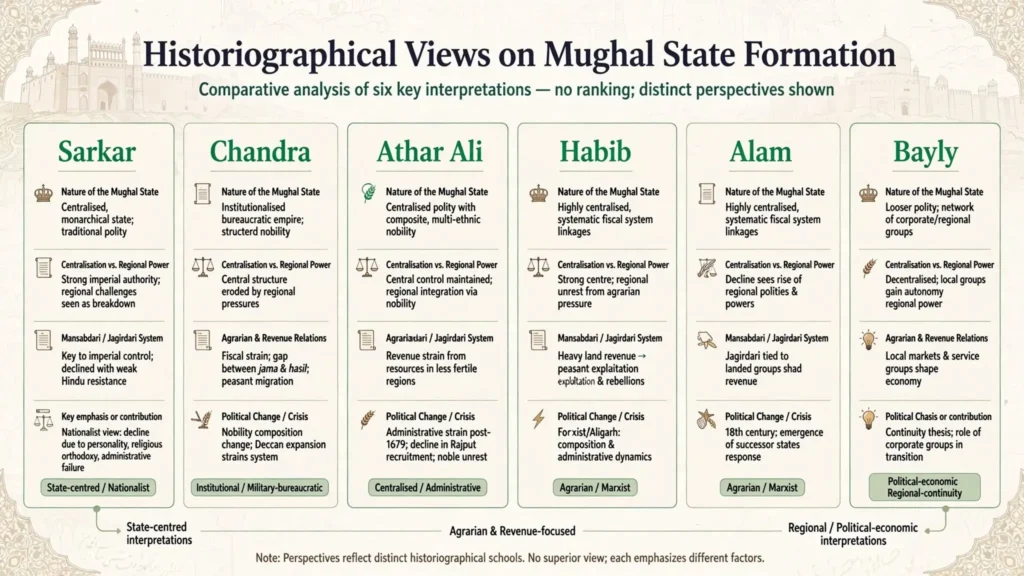
| Thesis | Historian | Core argument |
|---|---|---|
| Aurangzeb’s religious policy | Jadunath Sarkar | Intolerance provoked a “Hindu reaction” and weakened the empire |
| Jagirdari crisis | Satish Chandra; M. Athar Ali | Scarcity of jagirs relative to mansabdars and the failure of the mansab–jagir system |
| Agrarian crisis | Irfan Habib | Excessive revenue extraction produced peasant and zamindar revolts and undermined the empire |
| Regional reconfiguration | Muzaffar Alam | In Awadh and the Punjab, “crisis” at the centre looked like regional adjustment and recovery |
| Commercialisation and successor states | C. A. Bayly and others | The eighteenth century saw economic vitality and the rise of regional states; “decline” is a misleading frame |
| Synthesis | J. F. Richards | Combines fiscal, agrarian and Deccan-war pressures as overlapping explanations |
For fuller treatments, see the IGNOU/eGyanKosh units on the decline of the Mughal Empire and on the eighteenth century. Muzaffar Alam’s The Crisis of the Empire in Mughal North India (Introduction) is in the DU reading list for this unit.
Rise of Regional Powers
Sikh Resistance
- Chronology first: Guru Arjan was executed in 1606 (Jahangir’s reign). Guru Tegh Bahadur was executed in 1675 (Aurangzeb’s reign). Guru Gobind Singh founded the Khalsa in 1699 at Anandpur, and Banda Singh Bahadur led a Sikh uprising after Aurangzeb’s death.
- Khalsa Formation: The Khalsa created a disciplined community with a common identity, and the Sikh–Mughal conflict deepened in the late seventeenth and early eighteenth centuries.
- Interpretation: Sources and historians differ on how far these conflicts were religious, how far they were about political authority and local power in Punjab, and how far they reflected agrarian grievances.
Jat and Satnami Uprisings
- Agrarian Distress Causes: The Jat and Satnami uprisings were linked to economic hardship, local resentment and the role of local zamindars and sect leaders. Irfan Habib’s agrarian thesis treats them as peasant uprisings caused by economic oppression, while other scholars stress leadership, caste and local politics as well.
- Chronology and leaders: Gokula led the Jat rising of 1669 near Mathura and was executed in January 1670. The Satnami revolt broke out at Narnaul in 1672. A second Jat rising was led by Raja Ram of Sinsini from about 1685 to 1688; Churaman and later Jat leaders then built a regional power that eventually became the Bharatpur state.
Succession Crises and Decline
Succession Wars
- Why succession was dangerous: The Mughals had no fixed rule of primogeniture, so every prince could claim the throne. The war of 1657–59 began when Shah Jahan fell seriously ill in September 1657. Aurangzeb defeated Dara Shukoh at Dharmat and Samugarh (29 May 1658), and Dara was executed in 1659. Aurangzeb imprisoned Murad and Shah Jahan and crowned himself in 1658.
- After Aurangzeb (1707 onwards): Aurangzeb died on 3 March 1707, and his sons fought; Bahadur Shah I emerged as emperor. Later rulers (Jahandar Shah, Farrukhsiyar, Muhammad Shah) reigned amid noble factions, and the Sayyid brothers (Abdullah Khan and Husain Ali Khan) acted as “kingmakers” for a time.
- Power Struggles and Influence of Nobles: The power of nobles and military leaders grew, and the emperor’s control weakened.
Invasions and Threats
- Nadir Shah’s Invasion (1739): The Persian ruler Nadir Shah defeated Emperor Muhammad Shah at the Battle of Karnal on 24 February 1739 and then sacked Delhi, taking jewels including the Peacock Throne and the Koh-i-Noor. Muhammad Shah remained emperor, but the empire’s prestige and treasury were badly damaged.
- Afghan Attacks: From 1748, Ahmad Shah Abdali (Durrani) launched repeated invasions of north India, leading to the Third Battle of Panipat (1761) against the Marathas.
Legacy and Impact
Cultural Contributions
- Influence on Indian Culture: The Mughal Empire left a lasting impact on Indian art, architecture, language and court culture, blending Persian, Central Asian and Indian traditions.
Administrative Influence
- Impact on British Policies: Later regimes, including the East India Company, inherited much of the Mughal administrative vocabulary (zamindar, jagir, revenue terms) but changed its working. Do not claim a direct, unchanged continuity between Mughal revenue systems and colonial ones. Also remember the successor states view: the Mughal system continued in regional forms in Hyderabad, Awadh, Bengal, Rajput kingdoms and Maratha territories.
The rise and fall of the Mughal state were shaped by war, administration, religion and economy. It thrived under Akbar, Jahangir and Shah Jahan, and its crisis under Aurangzeb and after was real, but historians continue to debate whether the right word is “decline”, “crisis” or “reconfiguration”.
Maratha State Under Shivaji and Peshwas
The Maratha state, started by Shivaji Bhonsle, became a strong power in India, opposing the Mughal Empire and helping to weaken it. Its growth, along with its changes in administration, military organisation and culture, altered the political map of the seventeenth and eighteenth centuries. DU’s reading list pairs two kinds of work here: Stewart Gordon’s The Marathas, 1600–1818 (the overall story) and Andre Wink’s Land and Sovereignty in India (the Maratha claim to sovereignty over land and revenue). Gordon, Wink and Sumit Guha are also among the historians who studied the Mughal state’s relations with its regions through Maratha sources.
Shivaji Bhonsle: Builder of Maratha Power
Early Life and Influences
- Family and training: Shivaji was born in 1630 (some accounts give 1627) to Shahji Bhonsle, a commander in the service of the Deccan sultanates, and Jijabai. His father’s jagir at Pune was managed by Dadoji Konddev, who trained him in administration and military affairs and taught him the local geography that later helped him.
- Influence from local gods and saints: Shivaji’s idea of Swarajya (self-rule) drew on devotion to local deities, especially Bhavani, and on the religious climate of Maharashtra shaped by the Bhakti saints. His campaigns were presented as protection of the land and its people. Historians question how close his relationship with Samarth Ramdas actually was, since later Maratha tradition made the link stronger than contemporary evidence supports.
- Why the political setting matters: Shivaji grew up between the Deccan sultanates and the Mughals. Many Maratha families had served the sultanates, so Maratha state formation grew out of that service world as well as out of resistance.
Establishment of Swarajya
- First Success at Torna Fort: Shivaji’s first major success was the capture of Torna Fort in 1646, at about the age of sixteen. He then built up a chain of hill forts in the western ghats, including Rajgad.
- Afzal Khan (1659): When Bijapur sent Afzal Khan against him, Shivaji killed him in a meeting below the fort of Pratapgad on 10 November 1659, then defeated the Bijapuri army. Sources on the incident differ in who is blamed for treachery, so use neutral language.
- Use of Guerrilla Warfare: Shivaji is known for the effective use of what Marathi sources call ganimi kava: surprise attacks, rapid movement, use of hills and forts and avoidance of set-piece battles against larger armies. This was not a new invention in Indian warfare, but he organised it into a system tied to a state.
- Coronation (1674): Shivaji was crowned Chhatrapati at Raigad in June 1674. The ceremony was performed by Gaga Bhatt of Banaras, in part because some Brahmins questioned his Kshatriya status. This is important for a later section on society.
Administrative Skills of Shivaji
Government Structure
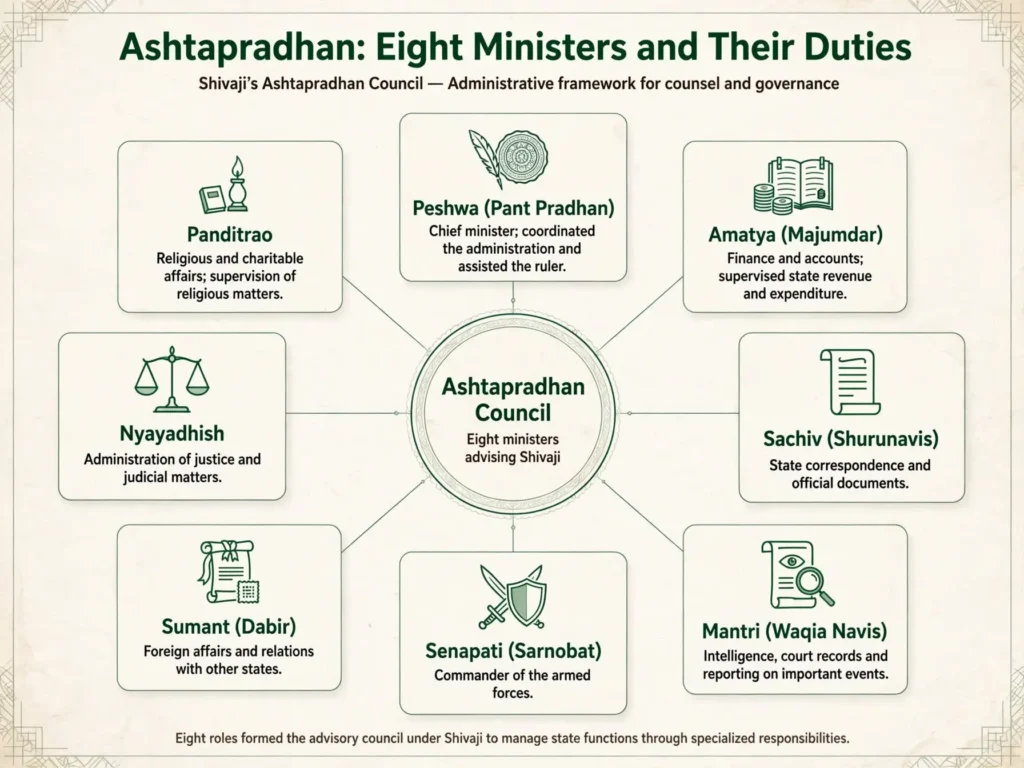
- The Ashtapradhan (Council of Eight Ministers): Shivaji organised a council of eight ministers to handle different branches of government. The ministers were advisers and heads of departments, not independent power-holders, and the king remained the final authority.
| Minister | Main responsibility |
|---|---|
| Peshwa (Mukhya Pradhan) | Prime minister, general administration |
| Amatya | Finance and revenue accounts |
| Sachiv | Royal correspondence and records |
| Mantri | Household and intelligence matters |
| Senapati | Command of the army |
| Sumant | Foreign affairs and diplomacy |
| Nyayadhish | Justice |
| Panditrao | Religious affairs and charity |
- Provinces and Local Administration: Shivaji divided his territory into provinces under trusted officials, which helped improve revenue collection and maintain order.
Revenue Systems
- Tax Collection Methods: The Marathas collected chauth (one-fourth of the revenue) and sardeshmukhi (an additional one-tenth) from territories outside their direct rule. These levies funded the military and extended Maratha influence.
- Direct dealing with cultivators: Shivaji’s administration is credited with reducing the power of hereditary local intermediaries and with discouraging excessive extra levies. How far this was applied across the territory is debated, and the older claims about irrigation works and road-building are not well documented in the sources consulted for these notes.
What was chauth? A debate. Earlier writers argued about whether chauth was a legitimate fee for protection or plunder under another name. Wink’s study (a DU reading) treats chauth and sardeshmukhi as part of a claim to sovereignty over territory, since the right to collect them implied political authority. The 1719 Mughal recognition of these rights in the six Deccan subas is therefore politically as well as financially important.
Military Reforms and Navy
Modernization of the Army
- Focus on Mobility and Intelligence: Shivaji’s army relied on speed, a network of spies and strongly held forts that served as bases, treasuries and refuges.
- Balanced Army Composition: It combined cavalry, infantry and fort garrisons with some artillery, which suited fighting in the Deccan’s hills and plains.
Naval Strength
- Building a Naval Force: Shivaji understood the importance of the Konkan coast and created a navy and sea forts such as Sindhudurg to protect trade routes and coastal territory.
- Coastline Protection and Rivalries: The Maratha navy operated in a coastal region shared with the Siddis of Janjira, the Portuguese and the English. The Maratha naval tradition continued after Shivaji, notably under Kanhoji Angre in the early eighteenth century.
Relations with the Mughals and Other Powers
Conflicts and Treaties
Taken in chronological order:
| Year | Event |
|---|---|
| 1659 | Killing of Afzal Khan at Pratapgad |
| 1663 | Night raid on the camp of the Mughal governor Shaista Khan at Pune |
| 1664 | First sack of Surat |
| 1665 | Treaty of Purandar with Mirza Raja Jai Singh: Shivaji gave up 23 forts and kept 12 |
| 1666 | Visit to Aurangzeb’s court at Agra, followed by Shivaji’s escape |
| 1670 | Second sack of Surat; recovery of many forts |
| 1674 | Coronation at Raigad |
| 1680 | Death of Shivaji (3 April) |
Note on order: the Treaty of Purandar (1665) came before the Agra visit and escape (1666), so the treaty was the reason he went to Agra, not an event after it.
- Fights with Aurangzeb’s Forces: Shivaji had many clashes with the Mughals, and the Agra episode showed both his diplomatic risk-taking and his skill at recovering from setbacks.
- Treaty of Purandar (1665): After Jai Singh’s siege pressure, Shivaji ceded forts to the Mughals but used the time to rebuild his strength for future campaigns, and he later recovered most of what he had given up.
Diplomatic Efforts
- Alliances with Deccan Sultanates: Shivaji dealt with the Deccan sultanates according to circumstance, including understanding with Golconda against the Mughal threat.
- Relations with the Portuguese and British: He kept practical relations with European trading powers, trading and negotiating where useful while protecting Maratha sovereignty.
From Shivaji to Shahu: The Seventeenth-Century Crisis
After Shivaji died, his son Sambhaji (r. 1680–89) held out against Aurangzeb until his capture and execution on 11 March 1689. His half-brother Rajaram continued the struggle from Jinji in the far south, and later Tarabai led resistance in Maharashtra. Sambhaji’s son Shahu was held in Mughal custody and released after Aurangzeb’s death in 1707, which led to a contest with Tarabai’s faction. This is where the Peshwas enter the story.
The Peshwa Era and Expansion
Rise of the Peshwas
- Balaji Vishwanath’s Power Consolidation: Balaji Vishwanath, appointed Peshwa in 1713, strengthened Shahu’s position and formed alliances with Maratha chiefs. His most important achievement was the 1719 arrangement with the Mughal side under the Sayyid brothers, by which the Mughal recognition of Shahu’s Swarajya and of chauth and sardeshmukhi in the six Deccan subas was secured.
- Pune as the Peshwa’s seat: The Chhatrapati remained at Satara, but Pune became the working political centre of the Peshwas, improving coordination of military and administrative tasks.
- Challenge to the Peshwa from within: Baji Rao I defeated the rebellion of Trimbak Rao Dabhade at Dabhoi in 1731, which strengthened the Peshwa’s hold over other Maratha leaders.
Baji Rao I’s Military Campaigns
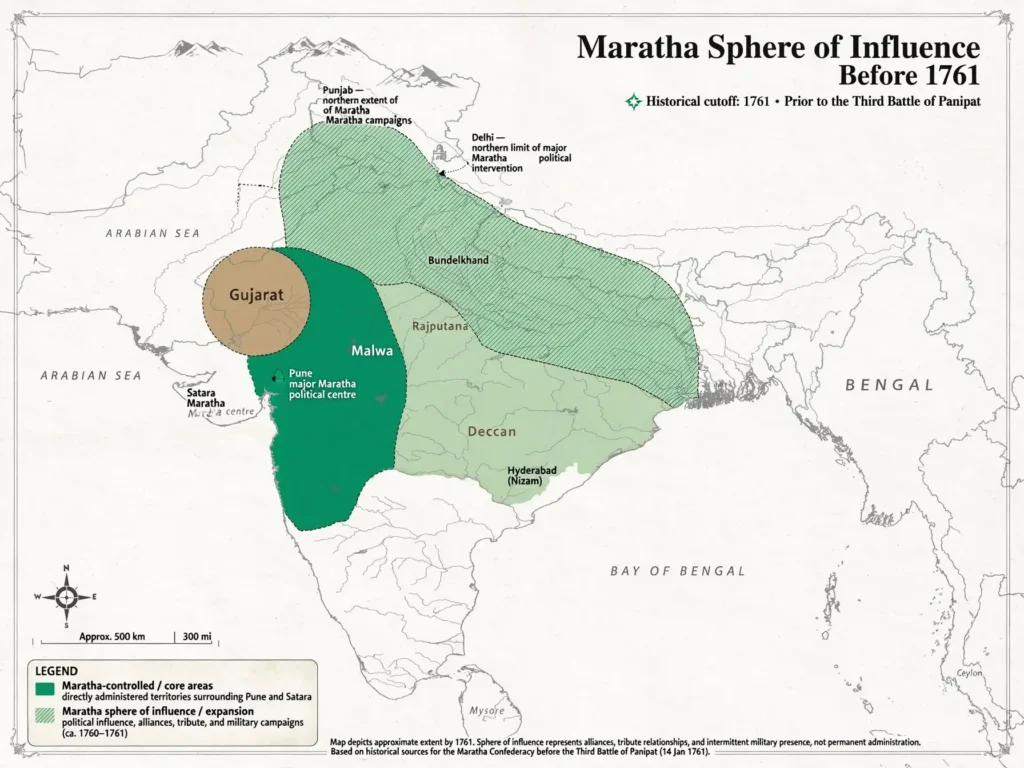
- Against the Nizam: Baji Rao I (Peshwa 1720–40) defeated Nizam-ul-Mulk at Palkhed in March 1728, forcing the Nizam to accept Maratha claims to chauth and sardeshmukhi in the Deccan.
- Expansion into Northern India: Maratha campaigns reached Malwa, Gujarat and Bundelkhand and, in 1737, Delhi, and the Marathas defeated Nizam-ul-Mulk again at Bhopal in 1737. The conquest of Vasai (Bassein) from the Portuguese came in 1739.
- Rajput courts: Maratha demands for chauth on Rajput states changed the political environment for Rajput rulers, linking the Rajput and Maratha sections of this unit.
Administrative Improvements
- Revenue and administration at Pune: Under the Peshwas, revenue management and administration became more elaborate and increasingly relied on bankers and officials such as mamlatdars and kamavisdars. Claims that the Peshwa government simply “reduced corruption” need evidence; use specific examples.
- The Maratha Confederacy: Alongside the Peshwa, leaders such as the Shindes, Holkars, Gaekwads and the Bhonsles of Nagpur built their own power bases. The empire was therefore a confederacy with a strong centre in Pune in some periods and considerable autonomy among leaders in others.
- Support for Arts and Education: The Peshwas promoted learning, religious patronage and the growth of Pune as a cultural centre.
Society and Culture Under the Marathas
Social Reforms
- Inclusion and its limits: Shivaji’s state recruited officials and soldiers from varied backgrounds. But social hierarchy remained strong: the need for Gaga Bhatt to certify Shivaji’s Kshatriya status in 1674 shows how caste and ritual ranking still shaped legitimacy.
Religious Policies
- Tolerance for Different Faiths: Historians point to grants and patronage across religious lines and to Muslim officers and soldiers in Maratha service (check specific examples in Gordon before citing them), while Shivaji’s ideology of Swarajya also drew on Hindu symbols.
- Influence of the Bhakti Movement: The Bhakti tradition in Maharashtra, with saints such as Eknath and Tukaram, shaped regional culture and language.
Challenges and Decline
Internal Rivalries
- Conflicts Among Maratha Leaders: Struggles between the Satara and Kolhapur lines, between the Chhatrapati and Peshwa, and among regional chiefs created instability.
Third Battle of Panipat (1761)
- Defeat by Ahmad Shah Abdali: On 14 January 1761 a Maratha army commanded by Sadashivrao Bhau and Vishwasrao met Ahmad Shah Abdali, who was supported by Najib-ud-daula and Shuja-ud-daula, and suffered a heavy defeat.
- Impact on Northern Ambitions: The defeat set back Maratha expansion in the north and weakened the Peshwa’s authority, though the Marathas later returned to Delhi politics.
British Expansion
- Conflicts with the British: The Marathas faced the East India Company in a series of wars (1775–82, 1803–05, 1817–19). The Peshwa Baji Rao II (1796–1818) lost the throne after the last of these wars.
Legacy of the Maratha Confederacy
Influence on Future Resistance
- Memory and politics: The Maratha struggle against Mughal power and later the British became part of nationalist memory, including the public use of Shivaji’s image in the nineteenth century. Historians distinguish between the evidence for Maratha state formation and the later uses of Shivaji as an icon. The works of Jadunath Sarkar and Stewart Gordon, and James Laine’s study of Shivaji’s image, are examples of different approaches.
Cultural Contributions
- Growth of Maratha Architecture and Literature: The period saw the building of forts, temples and palaces, and the growth of Marathi literature and chronicle writing (bakhars).
- Promotion of the Marathi Language: Maratha rule supported Marathi in administration and culture.
Important Comparisons
The Three States Side by Side
| Rajput states | Mughal state | Maratha state | |
|---|---|---|---|
| Basis of authority | Lineage, kingship rooted in clan and territory, imperial recognition | Emperor, ranked nobility, imperial ideology | Swarajya under a Chhatrapati; later the Peshwa and confederacy |
| Military base | Clan cavalry and forts; Mughal rank | Mansabdar cavalry and artillery | Light cavalry, forts, mobility |
| Revenue | Khalisa and jagir lands; Mughal watan jagirs | Land revenue (zabt/dahsala), jagir assignments | Land revenue plus chauth and sardeshmukhi |
| Relation to Mughals | Alliance and negotiation; revolts when succession and autonomy threatened | The centre | Rival and negotiating partner, later recognised by 1719 sanads |
| Major turning points | 1562, 1615, 1678–79, 1708–10 | 1580s, 1679, 1681, 1707, 1739 | 1646, 1665, 1674, 1719, 1761 |
| Key DU readings | Sharma, Ziegler, Hallissey, Sreenivasan | Richards, Alam, Chandra | Gordon, Wink |
Akbar’s and Aurangzeb’s Dealings with the Rajputs
| Akbar | Aurangzeb | |
|---|---|---|
| Method | Alliance, marriage ties, mansab and watan jagir | Direct intervention in succession (Marwar), warfare in Mewar |
| Religious framework | Jizya abolished, sulh-i kul | Jizya reimposed 1679; selective temple policy |
| Result | Strong Rajput service in the nobility | Rathore rebellion, Mewar war and, after 1707, the 1708–10 rebellion |
| Scholarly caution | Do not present the alliance as free of tension | Do not reduce the crisis to religion alone; consider succession, land and rank |
Shivaji’s Swarajya and the Peshwa-Era State
| Shivaji (1646–80) | Peshwas (1713–1818) | |
|---|---|---|
| Capital | Raigad | Satara (Chhatrapati) and Pune (Peshwa) |
| Territory | Core Swarajya plus conquests | Large confederacy across Deccan, Malwa, Gujarat and beyond |
| Instruments | Forts, Ashtapradhan, navy | Chauth/sardeshmukhi collection, bankers, confederate commanders |
| Main challenge | Mughals and Deccan sultanates | Nizam, Afghans, internal rivals, the East India Company |
Criticism and Limitations: Sources and Biases
- Whose voice survives? Persian chronicles tell the Mughal story; Rajput khyats and bardic works, Maratha bakhars and sanads give other perspectives. Each has its own purposes.
- Nationalist and communal readings: The older picture of Aurangzeb as villain and Shivaji or Rana Pratap as national heroes has been questioned by later scholarship, and the debates are still active.
- “Decline” as a frame: Muzaffar Alam and C. A. Bayly challenge the idea that regional power in the eighteenth century is simply evidence of decay.
- Sources for these notes: These notes summarise standard scholarship and the DU syllabus reading list; for exam answers, always follow the books your department recommends.
Contemporary Relevance
Public arguments about Aurangzeb, Shivaji, Rana Pratap and the Mughal–Rajput relationship show why historians distinguish evidence from memory. For a DU student the useful habit is to separate what the sources show, what later writers argued, and what is political rhetoric today.
Conclusion
Looking at these political changes shows that India in 1600–1750 was made up of many states, each contributing to the larger story. The Rajput states built and defended kingdoms through negotiation, service and, when necessary, rebellion. The Mughal state combined a strong administrative system with real structural pressures, and historians continue to argue about why it came under strain. The Marathas, led by Shivaji and later the Peshwas, built a state that challenged Mughal power, collected revenue beyond its borders and became a major force in the eighteenth century.
These states did not only fight. They also bargained, intermarried, traded and borrowed ideas and institutions from one another. Those changing relationships shaped the politics of the eighteenth century and the setting in which colonial power expanded. When you write an answer on this unit, keep three things together: the sequence of events, the institutions that made the states work (mansab and jagir, kingship and clan, chauth and Ashtapradhan), and the historians who disagree about what it all means.
Reading List from the DU Syllabus (Unit II)
The official DU syllabus lists these readings for Unit II. Use them for depth and for naming historians in your answers:
- Muzaffar Alam, Crisis of the Empire in Mughal North India (Introduction)
- J. F. Richards, The Mughal Empire (New Cambridge History of India)
- Richard Eaton, India in the Persianate Age, 1000–1765 (Introduction, Chapters 6 and 7)
- Satish Chandra, Mughal Religious Policies, the Rajputs and the Deccan (Chapters 1, 2 and 4)
- Meena Bhargava (ed.), The Decline of the Mughal Empire (Introduction, Chapters 2 and 3)
- G. D. Sharma, Rajput Polity: A Study of Politics and Administration of the State of Marwar
- Norman Ziegler, “Evolution of the Rathor State of Marwar: Horses, Structural Change and Warfare”; and “Some Notes on Rajput Loyalties during the Mughal Period”
- Robert Hallissey, The Rajput Rebellion against Aurangzeb
- Ramya Sreenivasan, “Honoring the Family” and “Rethinking Kingship and Authority in South Asia: Amber (Rajasthan), ca. 1560–1615”
- Stewart Gordon, The Marathas, 1600–1818
- Satish Chandra, Medieval India: Society, the Jagirdari Crisis and the Village (Chapters 8, 9 and 10)
- Andre Wink, Land and Sovereignty in India
- Hindi-medium readings include Satish Chandra, Madhyakalin Bharat (Part II) and H. C. Verma (ed.), Madhyakalin Bharat (Vol. II)
Continue Reading
- Economy and Society: Rural Society, Merchant Communities, India’s Oceanic Trade: Unit 4 of the same paper, a natural next step after the political story.
- BA History Notes – Delhi University: all history notes by semester, including Semester 6.
University of Delhi Previous Year Questions
University of Delhi Previous Year Questions
Section A — Rajput State Formation and Negotiations
1 Discuss Rajput polity in the 17th century. +
Year / Paper: Official Question Bank, SGND Khalsa College, University of Delhi
Hint: Examine the structure and functioning of Rajput polities in the 17th century and their relationship with the Mughal Empire.
Suggested Answer Focus: Rajput state formation, clan and kinship structures, local and regional authority, zamindars, Mughal-Rajput negotiations, political alliances, autonomy and regional variations. Question Bank
2 Discuss the reasons that led to a breach in the Mughal relations with the states of Marwar and Mewar in the last three decades of the 17th century. +
Year / Paper: DU Final Examination 2022, Sr. No. 4078C, UPC 12311504, History of India VII (c. 1600–1750)
Hint: Analyse the political developments that weakened Mughal-Rajput relations with Marwar and Mewar during the closing decades of the 17th century.
Suggested Answer Focus: Mughal-Rajput relations, succession and political intervention, imperial policy towards Marwar and Mewar, regional resistance, negotiations, autonomy and the wider consequences for Mughal-Rajput relations. Source-Attributed
Section B — Mughal State: Changes and Crises
3 Discuss the Deccan policy of the Mughal rulers. How did it impact the growth of political power of the state? +
Year / Paper: Official Question Bank, DU-affiliated college material
Hint: Examine the objectives, stages and consequences of Mughal expansion in the Deccan.
Suggested Answer Focus: Mughal expansion into the Deccan, Ahmadnagar, Bijapur and Golconda, imperial resources, military expansion, administrative pressures, Maratha resistance and the impact of Deccan campaigns on Mughal political power. Question Bank
4 Analyse various aspects of the crisis that developed in the Mughal Empire towards the end of the 17th century. +
Year / Paper: DU Paper, 2018/2019, Paper Code 3139 (UPC 12311502)
Hint: Analyse the crisis of the Mughal Empire as a complex political, fiscal, administrative and military development rather than as a single-cause decline.
Suggested Answer Focus: Deccan wars, fiscal and jagirdari pressures, administrative strain, regional powers, elite politics, military challenges and historiographical interpretations of the late 17th-century Mughal crisis. Source-Attributed
5 Was the ‘War of Succession’ (AD 1658) an outcome of conflict of ideology? +
Year / Paper: DU Paper, 2018/2019, Paper Code 3139 (UPC 12311502)
Hint: Assess whether ideological differences alone explain the Mughal war of succession of 1658.
Suggested Answer Focus: Dara Shikoh and Aurangzeb, Mughal succession practices, political and military interests, imperial factions, regional support, ideological differences and the interaction of political, dynastic and ideological factors. Source-Attributed
6 The historiography on Aurangzeb’s policy towards Jizya, temples and music has undergone significant revision in recent years. Discuss. +
Year / Paper: DU Nov–Dec 2021, SET-A, UPC 12311504
Hint: Examine how interpretations of Aurangzeb’s policies have changed and why individual policies need to be studied in their historical context.
Suggested Answer Focus: Jizya, temple policy and music; chronology and context of imperial decisions; political, administrative and religious considerations; changing historiographical interpretations and debates surrounding Aurangzeb’s rule. Source-Attributed
Section C — Maratha State under Shivaji and Peshwas
7 Trace the rise of Maratha power under Shivaji and the expansion of the Maratha hegemony under the Peshwas. +
Year / Paper: Question Bank, DU-affiliated college material
Hint: Trace the development of Maratha political power from Shivaji’s state-building to the expansion associated with the Peshwas.
Suggested Answer Focus: Deccan political context, Shivaji’s rise, forts and military organisation, revenue and administration, relations with Bijapur and the Mughals, emergence of Peshwa authority and expansion of Maratha power. Question Bank
8 Was the Maratha polity under Shivaji fundamentally different from the other contemporary Deccan states? +
Year / Paper: DU Nov–Dec 2021, SET-A, UPC 12311504
Hint: Compare Shivaji’s political organisation with contemporary Deccan states while identifying both continuities and differences.
Suggested Answer Focus: Political organisation, administration, revenue arrangements, military structure, forts, regional elites, legitimacy and the Deccan political context; assess continuity as well as distinct features. Source-Attributed
9 Did Maratha polity under the Peshwas mark a significant departure from the state organization established by Shivaji? +
Year / Paper: DU Final Examination 2022, Q3, UPC 12311504
Hint: Examine the institutional and political changes between Shivaji’s state organisation and the polity under the Peshwas.
Suggested Answer Focus: Chhatrapati-Peshwa relationship, central authority, administrative continuity and change, revenue and military organisation, role of sardars, territorial expansion and the development of a wider Maratha political structure. Source-Attributed
10 Discuss the political, social and ideological background to the rise of Marathas under Shivaji. +
Year / Paper: DU Paper, 2018, Paper Code 3139
Hint: Explain the wider Deccan conditions that facilitated the emergence of Maratha power under Shivaji.
Suggested Answer Focus: Deccan political situation, Bijapur and Mughal pressures, local elites, social and regional networks, military organisation, economic factors, ideological and political legitimacy, and Shivaji’s state-building process. Source-Attributed
Section D — Paper & Unit Reference
i DSC-1: History of India – VII: 1600 – 1750s — Unit II +
Unit II: Rajput State Formation and Negotiations; Mughal State — Changes and Crises; Maratha State under Shivaji and Peshwas
Exam Pattern: Attempt any four questions. All questions carry equal marks — 18.75 marks each.
The IGNOU course material for the same paper is on eGyanKosh.
FAQs
What does “Rajput State Formation and Negotiations” mean in the DU syllabus?
It asks how Rajput kingdoms such as Mewar, Marwar and Amber built and defended their states while bargaining with the Mughal Empire through service, marriage, rank and ritual. It is a study of two-way negotiation, not only of resistance or surrender.
Why did Mewar resist the Mughals when Amber allied with them?
Mewar’s Sisodias held the highest status among Rajput clans and refused for decades to accept Mughal overlordship. Amber’s ruler Bharmal, facing a rival inside his own clan and pressure from Mughal officers, allied with Akbar in 1562 for security and advancement. Their circumstances and priorities were different, and so were the outcomes.
Did Rajput rulers marry Mughal princesses?
The standard account is the reverse: Rajput rulers gave their daughters to Mughal emperors and princes. Mewar was an exception, and the 1615 treaty did not require a marriage alliance.
What were the terms of the 1615 treaty between Mewar and the Mughals?
Rana Amar Singh accepted Jahangir as suzerain; territory held by the Mughals, including Chittor, was restored but Chittor could not be refortified; the Rana did not have to attend court (his son represented him); and no marriage alliance was demanded.
Why did the Rathore rebellion begin in 1679?
Maharaja Jaswant Singh of Marwar died in 1678, and Aurangzeb did not accept the succession arrangement Rathore nobles wanted for his infant son Ajit Singh. Durgadas Rathore and others carried Ajit Singh away from Delhi, and Mewar’s Maharana Raj Singh I sheltered him. The conflict lasted until 1707
What is the jagirdari crisis and who proposed it?
It is the argument that the Mughal system broke down because jagirs were too few and too poor in income compared with the number and claims of mansabdars. M. Athar Ali developed the concept in his study of the Mughal nobility under Aurangzeb, and Satish Chandra connected it to the working of the mansab–jagir system. Irfan Habib’s agrarian crisis thesis and Muzaffar Alam’s regional approach complicate it.
Did Aurangzeb’s religious policy cause the decline of the Mughal Empire?
Jadunath Sarkar argued that it did. Satish Chandra, Richard Eaton, Katherine Brown and others argue that the evidence is more mixed (for example, jizya was reimposed 22 years into the reign, temple policy was selective, and there was no complete ban on music) and that fiscal and political pressures were at least as important.
What are chauth and sardeshmukhi?
Chauth was a levy of one-fourth of the revenue, and sardeshmukhi an additional one-tenth, collected by the Marathas from territories outside their direct rule. The Mughal sanads of 1719 recognised the right to collect them in the six Deccan subas, and Andre Wink reads them as part of a claim to sovereignty.
How did the Peshwas become more powerful than the Chhatrapati?
Balaji Vishwanath secured Mughal recognition of Shahu’s claims in 1719, and Baji Rao I won major victories (Palkhed 1728, Bhopal 1737) and defeated the Dabhade rebellion in 1731. The Chhatrapati stayed at Satara, while the Peshwa at Pune controlled the army, revenue and diplomacy.
Which dates should I memorise for this unit?
Start with 1527, 1562, 1564, 1567–68, 1576, 1615, 1646, 1658, 1665, 1674, 1679, 1681, 1707, 1719, 1728, 1739 and 1761. The timeline at the top of this page shows how they connect.
Which books are essential for Unit II?
The syllabus reading list includes Satish Chandra, J. F. Richards, Muzaffar Alam, Richard Eaton, Stewart Gordon and Andre Wink, plus Marwar studies by G. D. Sharma and Norman Ziegler and Robert Hallissey on the Rajput rebellion. The full list is above and in the DU syllabus PDF.
How should I structure a long answer on this unit?
Open with a two-line argument, give the chronology in a short paragraph or table, bring in two or three historians with their views, and end by weighing the evidence. Avoid unsupported claims, and be precise with dates and with who married whom.
Subscribe to keep reading
You've used your free notes for now. Get Delhi Pathshala Premium for unlimited access.
Subscribe — ₹29/30 days