
Contents
- Introduction to Bertolt Brecht and Epic Theatre
- Bertolt Brecht: Life and Influences
- Development of Epic Theatre
- The Alienation Effect (Verfremdungseffekt)
- Historical and Social Context
- Europe in the Early 20th Century
- The Thirty Years’ War as a Backdrop
- Brecht’s Exile and Anti-War Sentiments
- Mother Courage and Her Children: A Simple Overview
- Background of the Play
- Mother Courage and Her Children: Summary
- Structure and Style
- Mother Courage and Her Children: Characters
- Mother Courage (Anna Fierling)
- Eilif
- Swiss Cheese
- Kattrin
- Supporting Characters
- Mother Courage and Her Children: Themes
- The Harshness and Pointlessness of War
- Capitalism and Exploitation
- Motherhood and Sacrifice
- Silence and Voice
- Irony and Contradiction
- Dramatic Techniques and Innovations
- Epic Theatre vs. Realism vs. Absurdism
- Techniques used in Mother Courage and Her Children
- Brecht’s Impact on Modern Theatre
- Key Takeaways
- Previous Year Questions (PYQs) — DSC-16 Mother Courage and Her Children
- FAQs
In this post, you’ll find complete notes on Mother Courage and Her Children — the anti-war masterpiece by German playwright Bertolt Brecht — covering the full summary, character analysis, themes, and dramatic techniques, prepared specifically for DSC-16: Modern European Drama (Unit 2), B.A. (Hons.) English, Delhi University. Scroll down for PYQs and a complete FAQ section for last-minute exam revision.
Introduction to Bertolt Brecht and Epic Theatre
Bertolt Brecht: Life and Influences
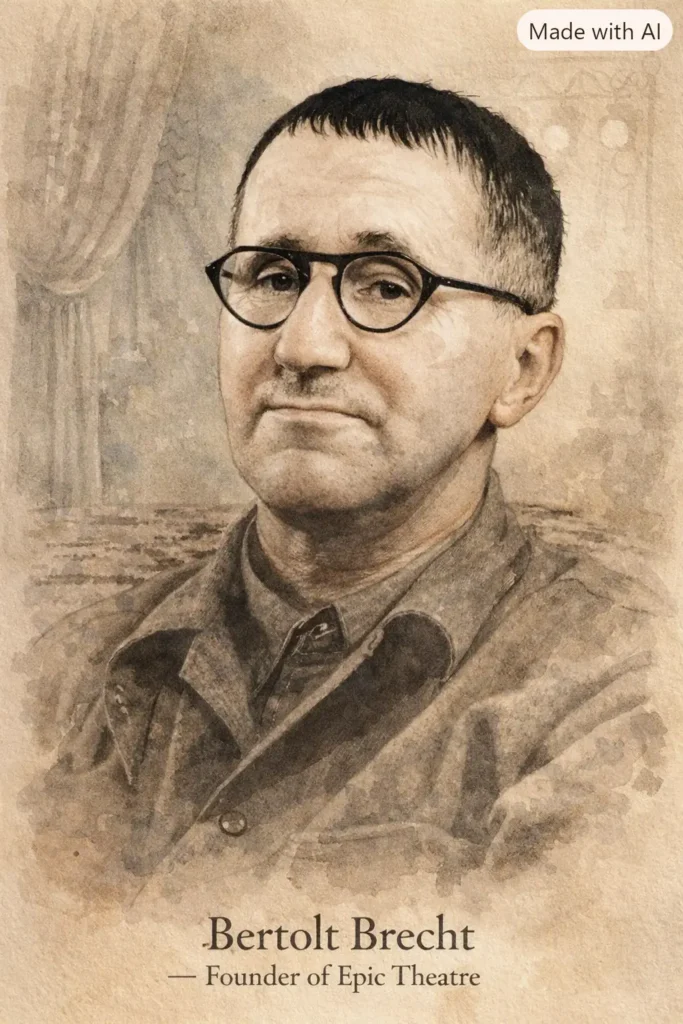
Bertolt Brecht was born on 10 February 1898 in Augsburg, Germany. His formative years unfolded against the backdrop of Germany’s turbulent post–World War I politics. He studied philosophy, literature, and history at the University of Munich, and both his academic exposure and the surrounding political turmoil shaped his creative vision profoundly.
The devastation of World War I fundamentally altered Brecht’s worldview. Witnessing widespread destruction, political instability, and the early stirrings of fascism made him deeply skeptical of conventional social norms — pushing him to search for theatrical forms that could confront inequality and social dysfunction head-on.
His subsequent engagement with Marxist thought — particularly the writings of Marx and Engels — convinced him that art had a duty to drive social transformation. For Brecht, theatre was not entertainment; it was a tool to interrogate capitalism and provoke the audience into critical reflection on class struggle and bourgeois society.
Development of Epic Theatre
Epic Theatre emerged as Brecht’s deliberate departure from classical drama reliance on emotional catharsis. Where traditional theatre sought to absorb the audience into the story, Epic Theatre aimed to hold them at arm’s length — encouraging analytical distance over emotional surrender.
Brecht wanted his audience to leave the theatre thinking, not just feeling. He structured his plays episodically rather than as a single continuous plot, using non-linear storytelling to let audiences view events from multiple angles and draw their own political conclusions.
The Alienation Effect (Verfremdungseffekt)
The Alienation Effect (German: Verfremdungseffekt) is Brecht’s signature theatrical device — designed to prevent emotional immersion so the audience could instead engage intellectually with the play’s social message. Key techniques include:
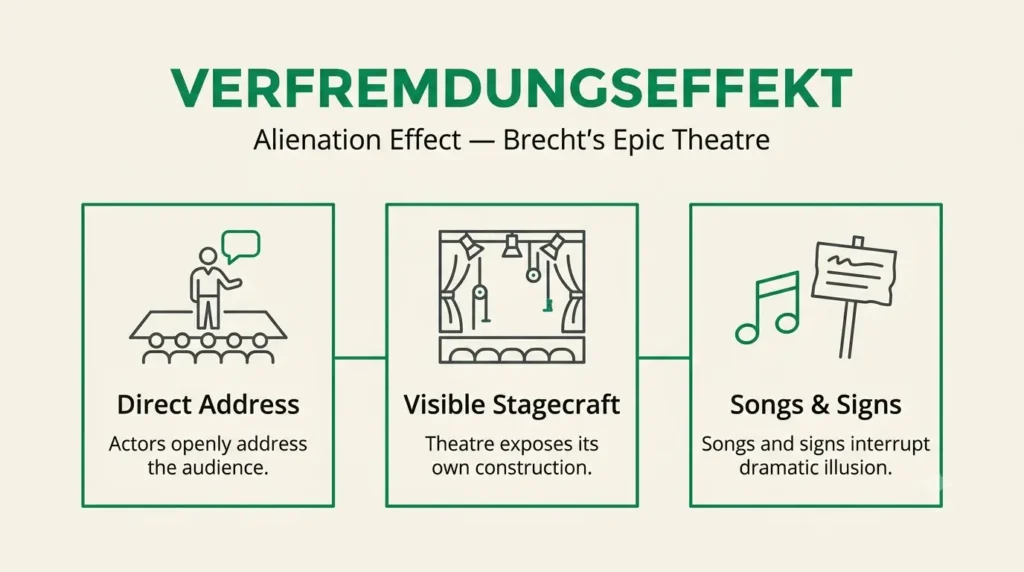
- Direct address: Actors speak straight to the audience, breaking theatrical illusion.
- Song interludes: Musical breaks interrupt the narrative to deliver political commentary.
- Minimalist staging: Simple sets keep focus on ideas, not spectacle.
Together, these techniques transformed the stage into a platform for political discourse rather than passive entertainment — a philosophy that runs through the entirety of Mother Courage and Her Children.
Historical and Social Context
Europe in the Early 20th Century
The aftermath of World War I left Europe scarred — the Treaty of Versailles (1919) imposed crushing penalties on Germany, deepening economic hardship and national humiliation. The collapse of the Austro-Hungarian and German empires triggered political upheaval that extremist movements, both left and right, exploited.
By the early 1930s, Germany’s economic collapse (worsened by the 1929 Great Depression) paved the way for Hitler’s rise; he became Chancellor in 1933, dismantling democratic institutions. Fascism simultaneously took root in Mussolini’s Italy. Brecht, watching these developments as a committed socialist, channeled his alarm directly into his dramatic work.
The Thirty Years’ War as a Backdrop
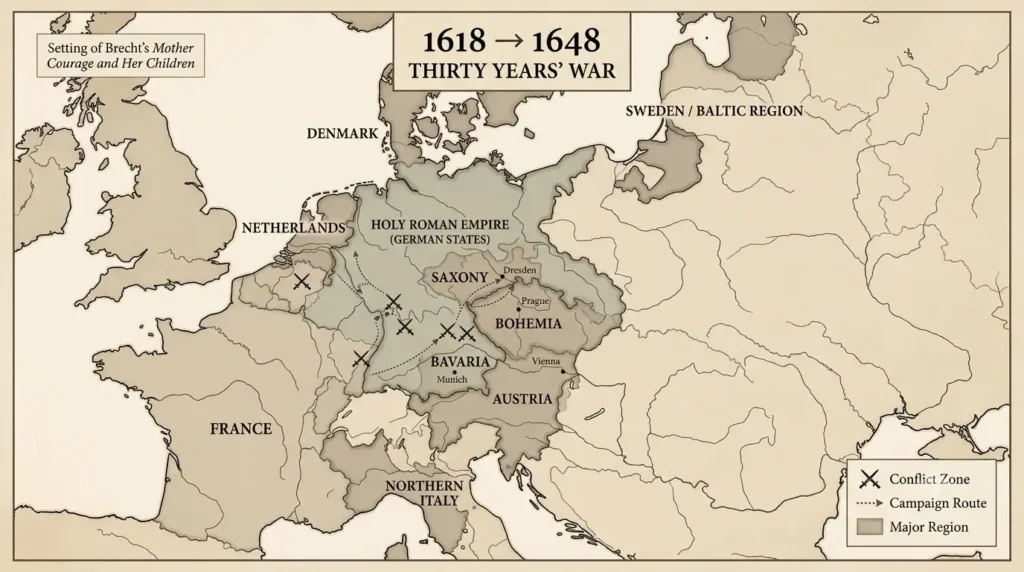
Brecht set his play during the Thirty Years’ War (1618–1648) — a catastrophic conflict that began as a religious struggle between Catholics and Protestants and escalated into a continent-wide political war involving Spain, France, and Sweden. It devastated the German-speaking lands, killing millions through combat, famine, and disease before ending with the Peace of Westphalia in 1648.
By setting his anti-Nazi allegory three centuries in the past, Brecht drew a direct parallel between the destruction of the 17th century and the looming catastrophe of his own time — using history as a mirror for the present.
Brecht’s Exile and Anti-War Sentiments
When the Nazis seized power in 1933, Brecht’s Marxist convictions made him a marked man. He fled Germany — first to Denmark, later to Sweden and the United States — and it was during this exile that he wrote Mother Courage and Her Children (1939), directly provoked by the Nazi invasion of Poland that same year. For Brecht, war was inseparable from capitalism: a system that profited the powerful while grinding down ordinary people. This conviction became the moral spine of the play.
Mother Courage and Her Children: A Simple Overview
Background of the Play
Brecht wrote Mother Courage and Her Children in Sweden between 1938–39, shortly before the outbreak of World War II. It premiered in Zurich in 1941, and its most celebrated production came in 1949 in East Berlin, starring Brecht’s wife Helene Weigel — a staging that led directly to the founding of the Berliner Ensemble.
Want to read the complete play? The full English translation is available through licensed publishers such as Concord Theatricals.
Mother Courage and Her Children: Summary
The play unfolds over twelve years (1624–1636) across twelve episodic scenes — one of Brecht’s clearest applications of Epic Theatre structure. It follows Anna Fierling, nicknamed “Mother Courage,” a canteen trader who pulls her wagon behind the Swedish army through war-ravaged Europe, selling supplies to soldiers on both sides of the conflict.
Key plot movements:
- Mother Courage’s eldest son, Eilif, is lured into enlisting a recruiting officer early in the play, despite her attempts to stop him.
- Years later, Eilif is celebrated for a brutal wartime raid — behaviour that is later punished, in peacetime, as murder.
- Her second son, Swiss Cheese, takes work as an army paymaster. When he is caught hiding the regiment’s cashbox to protect it, he is executed — Mother Courage’s prolonged bargaining over his ransom costs precious time, and he is shot before a deal is struck.
- Her mute daughter, Kattrin, is assaulted and disfigured while running an errand mid-play — a turning point that deepens the play’s critique of war toll on the powerless.
- In the final act, Kattrin sacrifices her life beating a drum to warn a sleeping town of an impending attack, saving its residents at the cost of her own life.
- Mother Courage, having lost all three children to the war she profits from, straps herself back into the wagon’s harness at the play’s close and continues onward — unable, or unwilling, to break from the system that destroyed her family.
Brecht deliberately denies the audience a conventional tragic catharsis: Mother Courage does not “learn” from her losses in any redemptive sense, which is precisely his point — the war economy consumes everyone who depends on it, and survival within it demands moral compromise without guarantee of safety.
Structure and Style
The play’s twelve independent scenes reject a traditional three-act arc. Each stands largely on its own, resisting a single emotional throughline — a structural choice that forces the audience to evaluate each episode analytically rather than get swept into a continuous story. Songs punctuate the action throughout, commenting on events rather than dramatizing them emotionally, and characters frequently address the audience directly, reinforcing the play’s refusal of illusionistic realism.
Mother Courage and Her Children: Characters
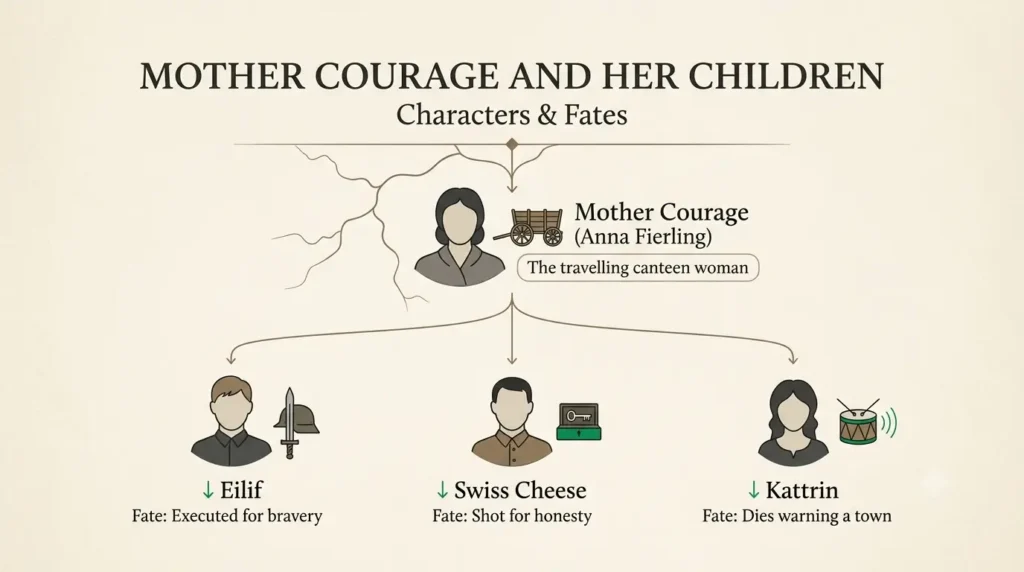
Mother Courage (Anna Fierling)
Mother Courage is Brecht’s “untragic heroine” — a mother and a profiteer simultaneously, whose livelihood depends on the very war that eventually claims her children. Her wagon is both her income and her prison: she cannot abandon it even after it costs her everything, and Brecht uses her contradictions to indict a system that rewards self-interest over solidarity.
Eilif
The eldest son, brash and eager for glory. His wartime “heroism” — praised when it serves the army — is punished as criminality once the war (temporarily) ends, exposing the arbitrary morality that governs a soldier’s fate.
Swiss Cheese
Honest to a fault, Swiss Cheese’s death results directly from his integrity: his refusal to abandon his duty as paymaster gets him captured, and his mother’s hesitation over the ransom price seals his fate.
Kattrin
Mother Courage’s mute daughter is the play’s moral center. Unable to speak, she communicates through action — culminating in her wordless, drum-beating sacrifice to save a town she has never met, the play’s most affecting scene precisely because Brecht otherwise works so hard to withhold sentimentality.
Supporting Characters
- The Chaplain — represents institutional religion’s complicity with power.
- The Cook — a pragmatic survivor, foiling Mother Courage’s business-first instincts.
- Yvette Pottier — a camp prostitute whose arc illustrates the gendered costs of war.
Mother Courage and Her Children: Themes
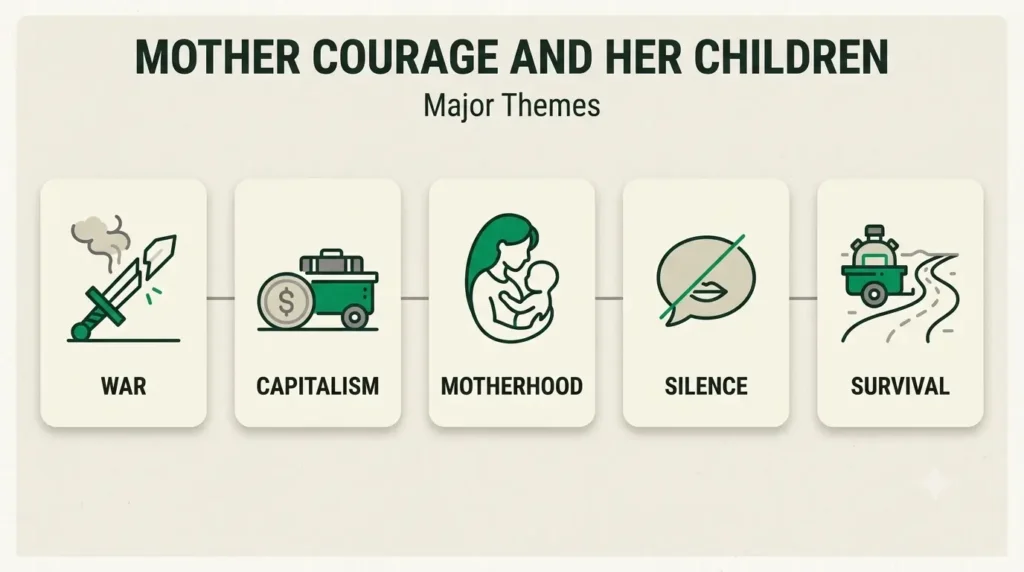
The Harshness and Pointlessness of War
War in the play is cyclical and self-perpetuating, consuming victims and profiteers alike without distinction.
Capitalism and Exploitation
Brecht frames the “war economy” as capitalism laid bare — Mother Courage’s business only exists because the war does, and her profit is inseparable from others’ suffering.
Motherhood and Sacrifice
Mother Courage’s love for her children is never in doubt, yet it is repeatedly subordinated to commercial survival — a contradiction of Brecht refuses to resolve neatly.
Silence and Voice
Kattrin’s muteness symbolises the voicelessness of ordinary people under systems of power — and her final act of “speaking” through a drum is the play’s clearest statement on how resistance can emerge even from silence.
Irony and Contradiction
Each child dies precisely because of the virtue associated with them — bravery, honesty, kindness — Brecht’s structural irony underlining that war punishes virtue as readily as vice.
Dramatic Techniques and Innovations
Epic Theatre vs. Realism vs. Absurdism
| Feature | Epic Theatre (Brecht) | Realism | Absurdism |
| Goal | Provoke critical/political thinking | Emotional identification | Expose meaninglessness of existence |
| Audience relationship | Deliberately distanced (alienation effect) | Immersive | Disorienting, often comic |
| Structure | Episodic, non-linear | Linear, cause-effect | Often circular/repetitive |
| Staging | Minimalist, symbolic | Detailed, lifelike | Sparse, surreal |
| Key aim | Social change | Believability | Existential reflection |
| Example playwright | Bertolt Brecht | Henrik Ibsen | Samuel Beckett |
Techniques used in Mother Courage and Her Children
- Song interludes ironic commentary rather than emotional release.
- Characters narrating their own motives, breaking the illusion of “showing not telling.”
- Simple, symbolic staging — the wagon itself functions as the play’s central, recurring symbol.
- Direct audience address, reinforcing Brecht’s demand for active, critical spectatorship.
Brecht’s Impact on Modern Theatre
Brecht’s Epic Theatre reshaped how playwrights and directors approach political material, influencing figures like Augusto Boal (Theatre of the Oppressed) and Peter Brook, both of whom expanded on Brecht’s belief that theatre should provoke reflection rather than mere emotional catharsis. His techniques — direct address, fragmented narrative, minimalist staging — remain foundational in political and community theatre worldwide.
Continue Reading — DSC-16: Modern European Drama
Key Takeaways
Mother Courage and Her Children remains one of the most powerful anti-war texts ever staged — its critique of profiteering, its structural innovations, and its refusal of easy catharsis continue to resonate with students and audiences alike. For DSC-16 exam purposes, focus your revision on: Brecht’s biography and Epic Theatre principles, the Alienation Effect, the twelve-scene structure, character motivations (especially the irony of each child’s death), and the five core themes listed above.
Previous Year Questions (PYQs) — DSC-16 Mother Courage and Her Children
DU Previous Year Questions — DSC-16: Mother Courage and Her Children
Frequently asked questions from DU exam papers on this topic. Tap a question to view a quick-answer guide.
1 Discuss Mother Courage and Her Children as an example of Epic Theatre. +
2 Critically analyse the character of Mother Courage. +
3 What is the Alienation Effect (Verfremdungseffekt)? Explain with examples from the play. +
4 Discuss the theme of war and capitalism in Mother Courage and Her Children. +
5 Write a short note on the significance of Kattrin’s silence. +
6 How does Brecht use irony in the play? Illustrate with reference to the fates of Eilif, Swiss Cheese, and Kattrin. +
7 Comment on the historical significance of the Thirty Years’ War as a setting for the play. +
8 Examine the role of songs in Mother Courage and Her Children. +
FAQs
Who wrote Mother Courage and Her Children?
Bertolt Brecht, a German playwright, wrote the play in 1939 while in exile in Sweden.
What is Mother Courage and Her Children about?
It follows Anna Fierling (“Mother Courage”), a canteen trader who profits from the Thirty Years’ War while losing all three of her children to that same war.
What is the Alienation Effect in Brecht’s theatre?
It’s a set of techniques (direct address, song interludes, minimal staging) designed to stop audiences from becoming emotionally absorbed, so they instead think critically about the play’s political message.
Is Mother Courage and Her Children part of the DU BA English syllabus?
Yes — it is taught under DSC-16: Modern European Drama, Unit 2, Semester 6, B.A. (Hons.) English.
How many scenes does the play have?
Twelve scenes, spanning the years 1624 to 1636.
What are the main themes of the play?
War and its futility, capitalism and exploitation, motherhood and sacrifice, silence and voice, and irony/contradiction.
Why doesn’t Mother Courage learn from her losses?
Because Brecht deliberately denies catharsis — her failure to change is the play’s argument that systems, not individual moral awakening, must be confronted to end cycles of war and exploitation.
Where can I read the full text of the play?
Delhi Pathshala doesn’t host or distribute full copyrighted play texts. You can access licensed editions through publishers like Concord Theatricals or your university library.
Subscribe to keep reading
You've used your free notes for now. Get Delhi Pathshala Premium for unlimited access.
Subscribe — ₹29/30 days