
Contents
- Who is Sharankumar Limbale?
- Background: Dalit literature and Poisoned Bread
- Why ‘White Paper’ matters in Dalit literature
- Which ‘White Paper’? Clearing up common confusions
- Summary of ‘White Paper’
- First movement: what the speaker gives up
- Second movement: from yearning to warning
- A quick reading guide
- What does the title ‘White Paper’ mean?
- Themes in ‘White Paper’
- The demand for recognition as a human being
- Renunciation as a form of argument
- From plea to assertion
- The power of the word
- Rights as a spreading force
- Challenging scripture and law
- Dignity over charity
- Form, tone and language
- Key terms for revision
- ‘White Paper’ compared with other Dalit texts
- Poetry and autobiography in Dalit writing
- Critical perspectives and debates
- Why the poem still matters
- Conclusion
- Continue Reading
- University of Delhi Previous Year Questions
- FAQs
In this post you will find notes on Unit III (a): ‘White Paper’ by Sharankumar Limbale from DSC-15: Dalit Literature (the University of Delhi syllabus lists this paper as Dalit Writings) for BA (Hons) English, Semester 5. The notes cover who Limbale is, where the poem comes from, what it says movement by movement, what its title means, the themes and the debates around it, and DU-style questions with hints.
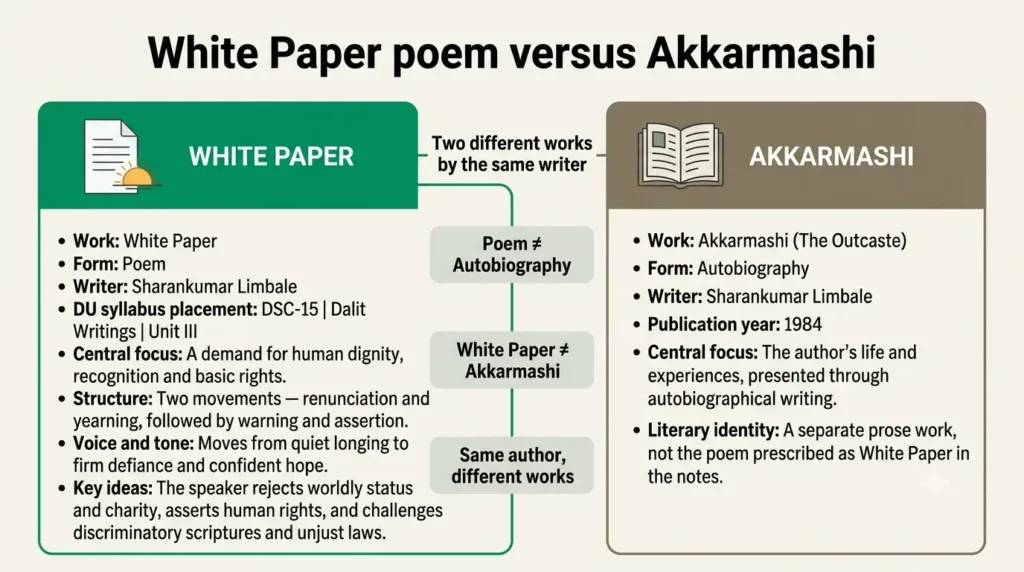
One point first, because it trips up many students: ‘White Paper’ is a short poem, not an autobiography and not a book with chapters. Limbale’s autobiography is a different text, Akkarmashi (The Outcaste). If your notes talk about “Chapter 1: childhood” or “Chapter 4: adulthood” in connection with ‘White Paper’, they are describing another work. The DU syllabus prescribes the poem as printed in Poisoned Bread, and the DU question papers we checked ask about it as a poem.
Quick summary
‘White Paper’ is a poem by the Marathi Dalit writer Sharankumar Limbale, available to DU students in English translation in Arjun Dangle’s anthology Poisoned Bread. In the first movement the speaker gives up every kind of gain a person might want (ambition, property, religious standing, even sensual pleasure) and asks for one thing only: to be treated as a human being. In the second movement the tone changes from yearning to warning. He says he is no beggar, that violence will not silence him, that his words will outlast the attempts to crush him, and that his rights will spread and rise like the sun.
| Quick facts | Details |
|---|---|
| Poet | Sharankumar Limbale (born 1 June 1956), Marathi poet, critic and autobiographer |
| Form | Poem (translated from Marathi into English) |
| Source text for DU | ‘White Paper’, in Poisoned Bread: Translations from Modern Marathi Dalit Literature, ed. Arjun Dangle (Orient Longman, 1992) |
| English translator | Priya Adarkar, according to a scholarly article on the poem (Silswal, 2018); check the credit in your own copy of the anthology |
| Syllabus slot | BA (Hons) English, Semester 5, DSC-15 Dalit Writings, Unit III, item 1 |
| Other Unit III texts | Jayant Parmar, ‘The Last Will of a Dalit Poet’; Ajay Navaria, ‘New Custom’; Sanjay Kumar, ‘Black Ink’ |
| Central idea | The demand to be recognised as a human being, made as an assertion of rights and not as a plea for favour |
| Related critical reading | Limbale, ‘Dalit Literature and Aesthetics’, in Towards an Aesthetic of Dalit Literature (listed under suggestive readings) |
Who is Sharankumar Limbale?

Sharankumar Limbale is one of the best-known voices in Marathi Dalit writing. He was born on 1 June 1956 and works as a poet, critic, editor and writer of fiction and life-writing. Publisher and library records describe him in connection with the Yashwantrao Chavan Maharashtra Open University in Nashik. Estimates of how many books he has written differ from source to source (one scholarly article says more than forty, a bookseller’s note says twenty-four), so it is safer to say “many books” than to quote a number in an exam.
Two of his works matter most for your paper:
- Akkarmashi (Marathi, 1984; second edition 1990), his autobiography, translated into English by Santosh Bhoomkar as The Outcaste (Oxford University Press, 2003). It is the work in which he writes about being born outside his community’s accepted order, the child of a Dalit mother and an upper-caste father. Scholars sometimes describe him as a Dalit among Dalits for this reason (Silswal, 2018).
- Towards an Aesthetic of Dalit Literature, his critical study, translated by Alok Mukherjee (Orient Longman, 2004). It argues that Dalit writing needs its own standards of judgement, and it gives a definition of Dalit consciousness that is very useful for reading ‘White Paper’.
Keep the two apart in your mind. Akkarmashi is a prose autobiography about his own life. ‘White Paper’ is a compact poem that speaks in a collective, public voice.
Background: Dalit literature and Poisoned Bread
What does “Dalit” mean? The word is usually traced to a Sanskrit root meaning “crushed” or “broken”. In modern usage it is a self-chosen political term for communities that were treated as untouchable and kept at the bottom of the caste order, and it is often extended to other oppressed groups such as landless labourers and workers (Silswal, 2018).
What is Dalit literature? It is writing that records the experience of caste oppression, protests against it, and insists on dignity and equality. Poetry, autobiography, short stories, novels and essays all belong to it, in many Indian languages. The modern movement grew most visibly in Maharashtra in the 1960s and 1970s, in the shadow of B. R. Ambedkar’s thought and the activism of groups such as the Dalit Panthers (founded in Bombay in 1972). Writers such as Namdeo Dhasal, Baburao Bagul, Daya Pawar, Arjun Dangle and Limbale himself are central to this phase.
What is Poisoned Bread? It is the anthology edited by the Marathi Dalit writer and activist Arjun Dangle (Orient Longman, 1992; later reprinted by Orient Blackswan). It brings together Marathi Dalit poetry, extracts from autobiographies, short stories, and essays and speeches in English translation, and it opens with Dangle’s introduction, ‘Dalit Literature: Past, Present and Future’. ‘White Paper’ appears in its poetry section. Baburao Bagul’s essay ‘Dalit Literature is but Human Literature’, which the DU syllabus lists as a suggestive reading, comes from the same anthology, so it is a natural companion text.
Dalit consciousness. Limbale’s own definition, in Towards an Aesthetic of Dalit Literature, treats Dalit consciousness as a revolutionary mentality tied to struggle: a belief in rebelling against the caste system, with the human being at its centre and with Ambedkar’s thought as its inspiration. Hold on to this definition. It is the key that opens ‘White Paper’, because the poem’s demand is made on exactly these terms.
Why ‘White Paper’ matters in Dalit literature
It is a good example of how Dalit poetry can be political without being decorative. The poem does not describe one incident or one life. It states a position and defends it. Its claim, that a person’s humanity is not something to be granted by others, is the same claim that runs through Dalit writing generally, and it is made in a form short enough to be quoted, argued over and learned. That is one reason it is taught as an entry point into Dalit poetry.
Which ‘White Paper’? Clearing up common confusions
Search results and student notes mix up several different things. This table separates them.
| What people call “White Paper” | What it actually is |
|---|---|
| The poem in your DU syllabus | A single poem by Limbale, translated in Poisoned Bread (1992) |
| White Paper (Authorspress, 2018) | A separate English collection of Limbale’s poems, translated by Mukta Mahajan; it is not the DU text |
| Akkarmashi / The Outcaste | Limbale’s autobiography (1984); sometimes wrongly called “White Paper” on the web |
| “White paper” as a policy term | An official report that explains a problem and proposes a solution; relevant only to the title’s meaning |
At least one online journal article treats “The White Paper” as another name for Akkarmashi. That conflicts with the DU syllabus, with library catalogue records and with the scholarly article on the poem, so do not follow it. The DU syllabus is the authority for your exam.
Summary of ‘White Paper’
The poem is short, so read it yourself first (from Poisoned Bread or the copy your college provides) and then use this summary to check your understanding. The summary below is written in our own words, following the reading offered by Silswal (2018). Different notes divide the poem slightly differently, so match the breaks to your printed text.
First movement: what the speaker gives up
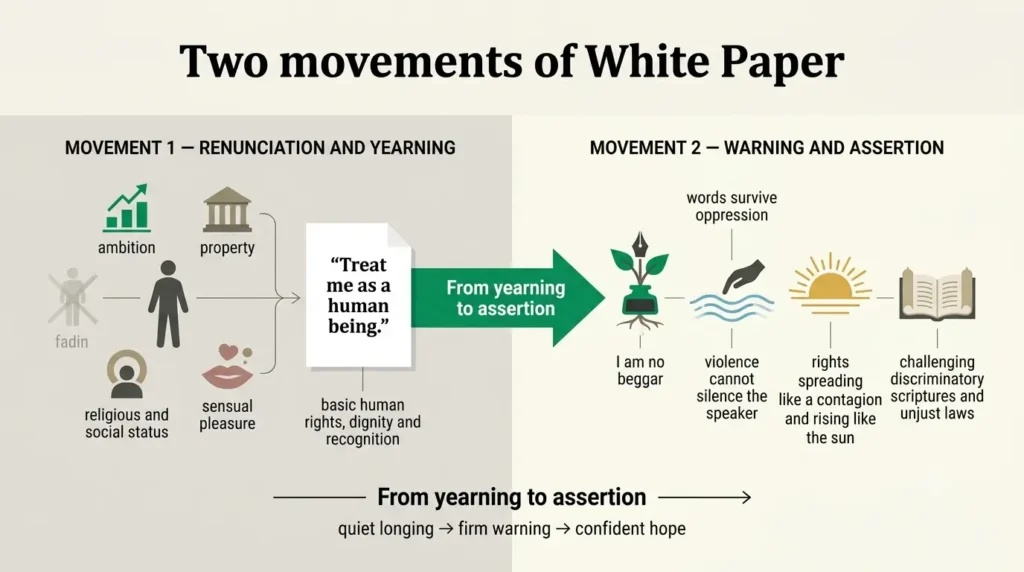
The poem opens with a series of refusals. The speaker says he wants none of the things people usually long for. He does not ask for the grand ambitions that the sun and moon stand for. He does not ask for land, fields, houses or mansions. He turns away from religious and social standing, the kind of status that has belonged to the upper castes for generations. He also sets aside sensual pleasure. After this long list of renunciations he arrives at the one thing he does want: to be treated as a human being, with the basic rights that belong to every person.
The effect is striking. By stripping his demand down to the minimum, the speaker shows how basic it is. A person who asks for nothing except to be counted as human cannot be accused of greed, and the refusal to grant even that exposes the system that denies it. For a community told that dreaming of more is a sin, this is also a comment on how narrow the permitted horizon was.
Second movement: from yearning to warning
The mood now changes. The first part sounded like a longing; the second sounds like a caution. The speaker makes clear that he is not a beggar asking for charity. He speaks as someone claiming what is his. He says that every breath from his lungs announces his rights, and that this claim echoes everywhere, in the scriptures, in tradition, and even in the imagined worlds of heaven and hell.
The people in power respond in the way oppressors often do. They try to break him with violence: houses are destroyed, people are beaten, belongings are looted. The speaker answers that this will not work, because his words cannot be destroyed in the same way. He has found in writing a means of making his voice last, and the words, like the sun, will not be put out.
He then claims that his rights are like a contagion, spreading from city to city, from village to village and from person to person. Dalit communities have become aware of their rights, and awareness does not go backwards. In Silswal’s reading he is ready to replace the old order: to pull up the scriptures that support discrimination the way one would pull up railway tracks, and to burn the unjust laws that deny equality. The poem closes with his rights as a rising sun, and the question of how anyone can deny it.
A quick reading guide
| Part of the poem | What happens | What to notice |
|---|---|---|
| Opening refusals | The speaker rejects ambition, wealth, religion and pleasure | The list is long and the demand at the end is very small |
| The one demand | He asks to be treated as a human being | The claim is moral, not material |
| The turn | Yearning becomes warning; he is no beggar | The poem becomes an assertion of rights |
| Violence and words | Oppressors burn, beat and loot; words survive | The power of the word against physical force |
| Spreading rights | Rights spread like contagion | Awareness is collective and cannot be undone |
| The sun | His rights rise like the sun | The sun image returns, now as a claim and not a renounced luxury |
What does the title ‘White Paper’ mean?
There is no single settled answer, and examiners like students who can give more than one reading.
- The official-document reading. In government and policy language a white paper is an authoritative report that explains a problem and recommends a solution. Silswal (2018) reads the title this way: the poem is the Dalit’s own authoritative document on his situation, written to replace the accounts produced by those in power. It states the problem (denial of human rights) and the remedy (recognition and equality).
- The protest-document reading. A white paper is also something an institution issues to answer for itself. By borrowing this form, Limbale turns the language of the state against the state: it is now the oppressed who issue the report, and the oppressors who must respond.
- The blank-page reading. Some students also read “white paper” as a clean sheet, a page on which a new social order can be written. This is an interpretation, not something established by critics, so offer it as your own idea and support it from the poem (for example, the speaker’s plan to replace the old order).
A strong answer names at least two readings, says which one it finds more convincing and ties it to the poem’s final movement.
Themes in ‘White Paper’
The demand for recognition as a human being
This is the poem’s centre. Everything else in the poem exists to support one request: to be treated as a person. The DU question paper picks out the line “I ask for my rights as a man”, which shows how directly examiners treat this as the heart of the poem. Note the word “rights”. The speaker does not ask for kindness, for reform from above or for a share of the privileges others hold. He asks for what a person is owed.
Renunciation as a form of argument
The opening refusals are not an expression of saintly detachment. They are a rhetorical strategy. By giving up everything that others might envy, the speaker removes every excuse for denying him the one thing he wants. You can make this point in an exam: the poem works like an argument in which the speaker lowers his claim until it cannot reasonably be refused.
From plea to assertion
Many Dalit texts record pain and plead for change. Silswal notes that this poem stands out because the speaker does not just regret his plight or make a request; he declares his rights and warns what refusing them will cost. This movement from plea to assertion is what makes the poem “revolutionary” in the sense Limbale gives that word in his definition of Dalit consciousness.
The power of the word
The second movement turns on writing. Violence can destroy houses, but it cannot destroy words that have been spoken and recorded. The speaker’s decision to speak through writing connects the poem to the whole project of Dalit literature, in which authorship is itself an act of resistance and a way of taking control of how Dalit life is represented.
Rights as a spreading force
The image of rights spreading like a contagion is unusual. Disease is normally something to fear, and here it describes the spread of awareness through a society that would like to contain it. The idea is that once people know their rights, nothing can make them forget. This links the poem to the collective nature of Dalit consciousness: the “I” of the poem speaks for a community.
Challenging scripture and law
The speaker is ready to uproot the scriptures and burn laws that discriminate. That is a direct attack on the religious and legal justifications for caste, and it echoes Ambedkar’s wider critique of the texts and customs that supported the hierarchy. Notice how the poem treats the sacred and the legal in the same breath: both are human-made structures that can be taken apart.
Dignity over charity
The poem consistently refuses the language of favour. In Silswal’s reading, the speaker wants his rights as someone entitled to them, not as a beggar waiting for a gift. This is one of the clearest differences between the voice of ‘White Paper’ and the more pleading voices of earlier reform literature.
Form, tone and language
Form. The poem is built on contrast. The first movement is a list of renunciations that narrows to one request, and the second turns that request into a warning and a claim. This two-part structure is the easiest way to organise an answer.
Tone. It moves from quiet longing to firm warning to confident hope. The final image is optimistic: the sun rises and cannot be stopped. Silswal describes the overall tone as optimistic and the feeling as sincere and unforced.
Language. The diction is plain. Silswal observes that the poem has little ornament and suggests that this simplicity is partly a natural result of translation. That is a fair caution to keep in mind, because we are reading Adarkar’s English version of a Marathi original. At the same time, the poem is not without imagery. The sun, which the speaker renounces in the first movement and then claims for his words and rights in the second, is its central image, and the contagion image is just as striking. A balanced answer can say: the poem avoids decorative language, but its few images are chosen with great precision.
Mode. The poem is autobiographical in a broad sense, since the “I” carries the weight of Limbale’s own and his community’s experience. It is also public and rhetorical, closer to a declaration than to a private confession.
Dalit aesthetics. Dalit writers often argue that literature should be judged by its truth to lived experience and its power to change things, not by traditional ideas of beauty. ‘White Paper’ fits this view: its value lies in the force of its claim. For a fuller discussion, see Limbale’s essay ‘Dalit Literature and Aesthetics’, which the DU syllabus lists as a suggestive reading.
Key terms for revision
| Term | Meaning in this context |
|---|---|
| Dalit | A self-chosen political term for communities treated as untouchable; traced to a root meaning “crushed” |
| Dalit consciousness | A revolutionary awareness connected with struggle, centred on the human being and inspired by Ambedkar (Limbale) |
| White paper | An authoritative report on a problem; here, the Dalit’s own document of protest and claim |
| Assertion | A confident claim of rights, as opposed to a plea |
| Renunciation | The speaker’s opening refusal of ambition, wealth, status and pleasure |
| Catharsis | The release of long-suppressed pain through expression, which scholars link with Dalit writing |
| Poisoned Bread | The 1992 anthology of Marathi Dalit writing in translation, edited by Arjun Dangle |
‘White Paper’ compared with other Dalit texts
The original page compared this text with several other works. That idea is worth keeping, but the comparisons must respect genre. A poem and an autobiography do different jobs.
| Text | Genre | How it handles protest | Link with ‘White Paper’ |
|---|---|---|---|
| ‘White Paper’ (Limbale) | Poem | Declares rights and warns the oppressor | The reference point |
| Akkarmashi / The Outcaste (Limbale) | Autobiography | Narrates a life and the pain of caste and illegitimacy | The same author; the poem is the public declaration, the autobiography is the personal record |
| Joothan (Omprakash Valmiki) | Autobiography, first published in Hindi | Shows humiliation through everyday detail such as food and school | Both link dignity to being heard; see our Joothan notes |
| ‘The Last Will of a Dalit Poet’ (Jayant Parmar) | Poem | Poetry as a statement of Dalit voice | The other Unit III poem; DU has asked how Parmar says Dalit poets do not attack with metaphors and symbols. See our notes on the poem |
| ‘New Custom’ (Ajay Navaria) | Short story | Dramatises protest in one scene (the broken glass) | Assertion shown in action; see our New Custom notes |
| The Grip of Change (P. Sivakami) | Novel | Looks at caste and patriarchy together | Widens the poem’s “I” to include questions of gender; see our Grip of Change notes |
Ambedkar’s writings are not a literary parallel but the intellectual background. Where Ambedkar argues the case analytically, the poem compresses it into image and demand. That difference between argument and poem is a useful point for a comparison question.
Poetry and autobiography in Dalit writing
Autobiography has a very large place in Dalit writing, because it lets a writer put a life on record against the stories others have told about Dalit people. Poetry plays a different role. A poem like ‘White Paper’ is shorter and more declarative: it does not build a life in detail, it states a position. Together the two forms cover both the personal record and the public claim. Limbale writes in both, which is why students sometimes mix up his texts. When you write an exam answer, say clearly which form you are discussing.
Critical perspectives and debates
Where scholars and students differ, present the disagreement with attribution. Here are the main debates.
- Plea or assertion? Silswal (2018) stresses that the poem is a bold assertion of rights, unlike texts that only lament suffering. A more cautious reader might note that the first movement still has the tone of yearning, and argue that the poem uses both modes, with the second movement answering the first. A good answer can acknowledge both.
- Plain language or poetic craft? Silswal reads the language as simple and unornamented, partly because of translation. Another way to read it is that the simplicity is itself a Dalit aesthetic choice. Since we read the poem in translation, be careful about claims regarding the Marathi sound or rhythm.
- Who speaks? The speaker says “I”, but the voice stands for a community. A critical question is whether a single voice can represent everyone. Feminist readers of Dalit writing have asked how Dalit women’s experiences fit into a voice described in terms of “man”; Sharmila Rege’s Writing Caste / Writing Gender (Zubaan, 2006), whose introduction appears on some university Dalit-writing syllabi, is a standard starting point for that debate. This is a question to raise with care, not a settled criticism of the poem.
- Hopeful or defiant? Some readers emphasise the optimistic ending; others emphasise the threat in the warning. The poem supports both, and the best answers show how the hope and the defiance depend on each other.
Why the poem still matters
The Constitution of India abolished untouchability in 1950, yet scholars and writers continue to point out that discrimination survives in practice. A poem that asks only to be treated as human therefore speaks to a gap that law has not fully closed. In the classroom, ‘White Paper’ helps you see how a very short text can carry a political argument, and it prepares you for the harder, longer Unit III texts such as ‘New Custom’ and ‘Black Ink’.
Conclusion
‘White Paper’ is a poem of renunciation and assertion. Limbale’s speaker gives up every ordinary ambition so that the only thing left is the plainest of claims: to be treated as a human being. He then turns that claim into a warning, answering violence with the survival of words and describing his rights as something that spreads and rises like the sun. For DU students the key points are these: it is a poem and not a prose autobiography; it comes from Poisoned Bread; it moves from yearning to assertion; its title borrows the authority of an official report; and it gives voice to Dalit consciousness as Limbale defines it. If you can state those points and support each with the poem, you have the core of a strong answer.
Continue Reading
More from DSC-15 (Dalit Writings):
- The Last Will of a Dalit Poet by Jayant Parmar: Summary (Unit 3B): the other poem in Unit III, best read alongside ‘White Paper’.
- New Custom by Ajay Navaria: Summary and Analysis (Unit 3C): protest shown through one scene in a short story.
- Black Ink by Sanjay Kumar: Summary (Unit 3D): the last text in Unit III, often paired with ‘New Custom’ in questions.
- Joothan by Omprakash Valmiki: Summary and Notes (Unit 1): a prose autobiography to compare with Limbale’s poem.
- The Grip of Change by P. Sivakami: Summary and Author’s Notes (Unit 2): caste and patriarchy in a novel.
University of Delhi Previous Year Questions
DU Previous Year Questions
Questions from available DU examination papers and DU SOL study material on Sharankumar Limbale’s poem “White Paper”. Tap a question to view a quick-answer guide. DU SOL practice questions are distinguished from verified examination questions.
1 “‘I ask for my rights as a man.’ Elaborate these expressions of Limbale in ‘White Paper’.” +
2 Explain with reference to context the lines about being beaten, broken, looted and burnt out, while the speaker’s words stay planted like a sun in the east. +
3 What does Sharankumar Limbale’s poem “White Paper” express about the Dalit community’s experience? +
4 What does the poet reject, and what do Dalits demand, in the poem “White Paper”? +
5 How does Limbale convey the impact of the rising consciousness and voices of Dalits on orthodox Hindu traditions? +
6 What literary techniques does Limbale employ in “White Paper,” and how does the poem contribute to Dalit resistance literature? +
7 What is Limbale’s position regarding the relationship between Dalit literature and traditional aesthetic principles? +
8 What are the new aesthetic criteria for Dalit literature proposed by Limbale? +
9 How does Limbale’s ideological and political philosophy contribute to the fight against caste-based discrimination in Indian literature and society? +
10 What privileges and status symbols does the poet reject in the first nine lines of “White Paper”? +
11 What does a Dalit seek by asking for “rights as a man”? +
12 How does the poet’s rejection of the caste system’s privileges and status symbols convey the injustice faced by Dalits? +
13 When and where did Dalit literature emerge in India? +
14 Who played a crucial role in inspiring the Dalit literary movement? +
15 What are the main characteristics of Dalit literature? +
16 Which political movement, established in 1972, marked a significant moment for Dalit writers? +
FAQs
Is ‘White Paper’ a poem or an autobiography?
It is a poem. The DU syllabus lists it as ‘White Paper’ from Poisoned Bread. Limbale’s autobiography is Akkarmashi (The Outcaste), a different work.
Who wrote ‘White Paper’ and when?
Sharankumar Limbale wrote the original in Marathi. Its English translation appeared in Arjun Dangle’s anthology Poisoned Bread in 1992. We could not verify the date of the Marathi original, so avoid stating one in an exam.
Who translated ‘White Paper’ into English?
A scholarly article on the poem names Priya Adarkar as the translator. Check the credit in your own copy of the anthology.
Where do I read the full poem?
Read it in Poisoned Bread: Translations from Modern Marathi Dalit Literature (ed. Arjun Dangle), or in the copy your college library and department provide. The poem is under copyright, so we summarise it here and do not reproduce it.
What are the main themes of ‘White Paper’?
The demand to be treated as a human being, renunciation as argument, movement from plea to assertion, the survival of the word against violence, rights as something that spreads, and a challenge to scripture and unjust law.
What does the title ‘White Paper’ mean?
Most commonly, an authoritative report on a problem and its remedy, taken over by the Dalit speaker as his own document of protest. Some readers also treat it as a blank page for a new social order, which is an interpretation and not an established critical reading.
How many stanzas does the poem have?
A scholarly article describes two movements, a yearning and a warning. Notes differ slightly in how they divide the poem, so follow the breaks in your printed text.
Is the poem a plea or a protest?
It begins in the tone of a plea but becomes an assertion of rights. Most readings stress the assertion, while acknowledging the yearning of the opening.
What is the difference between ‘White Paper’ and Akkarmashi?
‘White Paper’ is a short poem making a public demand. Akkarmashi is a prose autobiography of Limbale’s life. Both are by Limbale, but they are different texts and different forms.
Is the DU paper called “Dalit Literature” or “Dalit Writings”?
The university syllabus and question papers call it Dalit Writings. Students and websites often say “Dalit Literature”. They refer to the same paper (DSC-15, Semester 5).
What is Poisoned Bread?
It is the anthology of Marathi Dalit writing in English translation edited by Arjun Dangle (Orient Longman, 1992). It includes poems, autobiographical extracts, stories and essays and speeches.
Is the ‘White Paper’ book by Authorspress the same as the DU poem?
No. That is a separate English collection of Limbale’s poems translated by Mukta Mahajan. Your DU text is the single poem in Poisoned Bread.
| Source | Used for |
|---|---|
| University of Delhi syllabus extract (DSC-15 Dalit Writings) | Syllabus listing of the poem and the Unit III texts |
| Silswal, “Bold Assertion of Dalit’s Rights in the Poem ‘White Paper’ by Sharankumar Limbale”, IJELLH, vol. 6, issue 3, 2018 | Poem reading, translator credit, movements, title |
| DU question paper, Dalit Writings, Semester V (Sr. No. 5209) | Actual PYQ |
| DU question paper, Dalit Writings, Semester V (Sr. No. 1797) | Actual PYQ |
Subscribe to keep reading
You've used your free notes for now. Get Delhi Pathshala Premium for unlimited access.
Subscribe — ₹29/30 days