
Contents
- Tiruvalluvar in Brief
- Overview of Tiruvalluvar’s Significance in Indian Political Thought
- Historical Context and Background
- When did Tiruvalluvar live? A debate, not a date
- What was the political setting?
- Was Tiruvalluvar a Jain, a Hindu, or neither?
- Biography of Tiruvalluvar
- The Composition of the Tirukkural
- Structure and Themes of the Tirukkural
- Structure of the Tirukkural
- Key Themes in the Tirukkural
- Ethical Life in Tirukkural
- Core Ethical Teachings of the Tirukkural
- Concepts of Virtue (Aram), Wealth (Porul) and Love (Inbam)
- Importance of Personal Conduct and Morality
- Role of Ethics in Personal and Social Life
- Political Philosophy in Tirukkural
- Principles of Good Governance
- The Six Assets of a State (Kural 381)
- The Qualities and Duties of a Ruler
- The Role of Ministers and Advisors
- Justice and the Administration of Law
- Social and Economic Thought
- Views on Social Hierarchy and Caste
- Economic Policies and Management of Resources
- Welfare State Principles and Social Responsibility
- Importance of Education and Knowledge
- The Relationship between Ethics and Politics
- Integration of Ethical Principles in Political Governance
- The Moral Responsibility of Rulers and Citizens
- The Impact of Ethical Governance on Social Harmony
- Important Comparisons
- Tiruvalluvar and Kautilya
- Tiruvalluvar, Manu and the Aggannasutta
- Tiruvalluvar and Confucius
- Other Comparisons from the Original Notes
- Critical Evaluation
- Analysis of Tiruvalluvar’s Contributions to Ethical and Political Thought
- Criticism and Limitations
- Relevance of Tirukkural’s Teachings in Contemporary Society
- Summary of Key Points
- The Enduring Legacy of Tiruvalluvar and the Tirukkural
- Quick Revision Table
- Conclusion
- Continue Reading
- FAQs
- References and Further Reading
In this post, notes of “Unit 7: Tiruvalluvar: Ethical Life and Politics” from “DSC – 8: Ancient and Medieval Indian Political Thought” are given, which is helpful for the students doing graduation this year (BA (Hons.) Political Science, Semester 3).
A note on unit numbers. In the 11-unit version of DSC-8 (the original UGCF 2022 syllabus), Tiruvalluvar is Unit 7. In the revised 10-unit syllabus that the University of Delhi notified in 2026, Manu is no longer a separate unit, so the same topic becomes Unit 6. The content you need to study is the same either way. You can check the official text in the revised DSC-8 syllabus (University of Delhi, PDF).
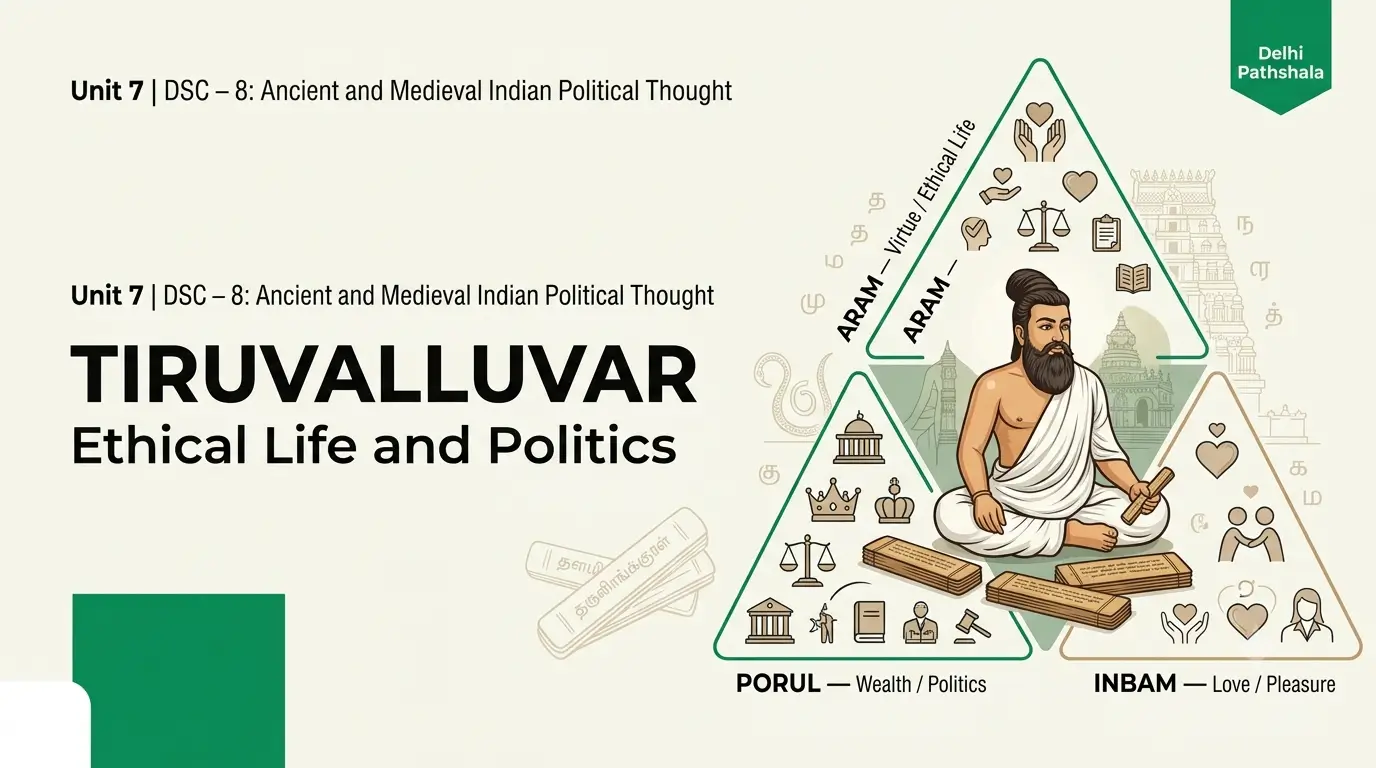
Tiruvalluvar (also spelled Thiruvalluvar, and often called simply Valluvar) is the Tamil poet-philosopher traditionally credited with the Tirukkural, a text on ethics, politics, wealth and love. The DU syllabus frames the unit with one question: what were Tiruvalluvar’s political and economic ideas, and what was his take on ethics? Everything below is arranged to answer that question step by step.
Tiruvalluvar in Brief
Quick definition: Tiruvalluvar is the Tamil poet-philosopher traditionally credited with the Tirukkural, a text of 1,330 couplets on virtue (Aram), wealth and polity (Porul) and love (Inbam). In political thought he is studied for a ruler-centred but morally grounded view of governance: a king earns legitimacy by just conduct, not by power alone.
| Point | Detail |
|---|---|
| Other names | Valluvar, Thiruvalluvar |
| Main work | Tirukkural (the “sacred couplets”), also called Muppal (“three divisions”) |
| Language and metre | Classical Tamil, in the kural venba metre |
| Size | 1,330 couplets in 133 chapters of 10 couplets each |
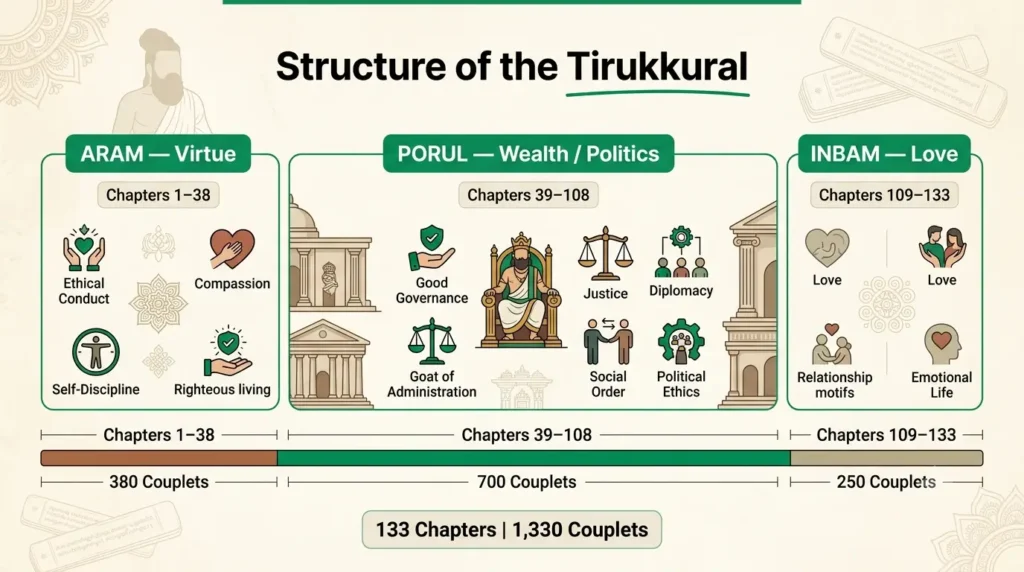
| Three parts | Aram (chapters 1–38, 380 couplets), Porul (chapters 39–108, 700 couplets), Inbam (chapters 109–133, 250 couplets) |
| Date | Debated: proposals range from about 300 BCE to the 5th–6th century CE. Tamil Nadu officially adopted 31 BCE as the “Valluvar year” (see the dating section) |
| DU position | DSC-8, Unit 7 (original syllabus) / Unit 6 (revised syllabus) |
| DU readings | Maharajan (2017); Nagarajan (2005); Srinivasachari (1949); Cutler (1992) – full details in the references |
The key points in one glance:
- Virtue (Aram) comes first, and wealth and love are meant to be pursued under its guidance.
- The ruler’s job is to protect and to do justice, and a ruler who fails at this loses moral standing.
- Ministers, spies, envoys, army, fort and treasury are treated as practical tools that still need ethical control.
- Birth does not decide worth; actions do (Kural 972–973).
- The text is monarchical in setting, so its “democratic” relevance today is an interpretation, not a claim the text makes.
Overview of Tiruvalluvar’s Significance in Indian Political Thought
Tiruvalluvar was an ancient Tamil thinker and poet, famous for his work, the Tirukkural. This important text talks about ethics, morality and governance. His ideas matter for Indian political thought, especially on leadership, fairness and social order, and he is a key figure when we ask how Indian thinkers joined ethics with statecraft.
Here are the main reasons he matters in political thought:
- Ethical leadership. Tiruvalluvar believed that leaders should be virtuous, disciplined and fair. Rulers must be just and care for the well-being of their people instead of being selfish. In the chapter on the greatness of a king (Kural 381–390) he lists what a ruler needs: courage, generosity, wisdom and energy, together with alertness, learning and valour. The same chapter adds that a king should be easy to approach, speak gently and bear harsh criticism.
- Focus on public welfare. Leaders must put the needs of the public first. This connects with dharma in Indian philosophy: rulers protect citizens and work for the overall good. Kural 388 says a king who rules justly and protects his people is regarded by them as godlike.
- Fairness and law. Justice should be fair and consistent for everyone, whatever their status or wealth. Laws should protect the vulnerable and help the state run smoothly. Two full chapters, “The Right Sceptre” (541–550) and “The Cruel Sceptre” (551–560), are devoted to the just and the unjust ruler.
- Good governance for a thriving society. Tiruvalluvar linked good leadership with a flourishing society. If leaders are truthful, kind and humble, prosperity and stability follow for everyone.
- Influence on later writers. The Tirukkural was quoted and echoed by later Tamil poets and commentators, and in the modern period it travelled far beyond Tamil Nadu through translation. Some accounts say Tolstoy read a German version and that his A Letter to a Hindu then reached Gandhi, which is a popular way of showing its reach (treat it as a reported chain of influence rather than a settled fact).
Correction for exam answers. An earlier version of this page said Tiruvalluvar inspired Kautilya. That order is wrong. Kautilya’s Arthashastra is traditionally placed in the 4th century BCE, well before any date proposed for the Tirukkural (the final shape of the Arthashastra is itself debated, but even so most scholars place Tiruvalluvar later). The better statement is that scholars see parallels between the two, and they disagree about whether Tiruvalluvar borrowed from Sanskrit sources (see the comparison section).
Historical Context and Background
When did Tiruvalluvar live? A debate, not a date
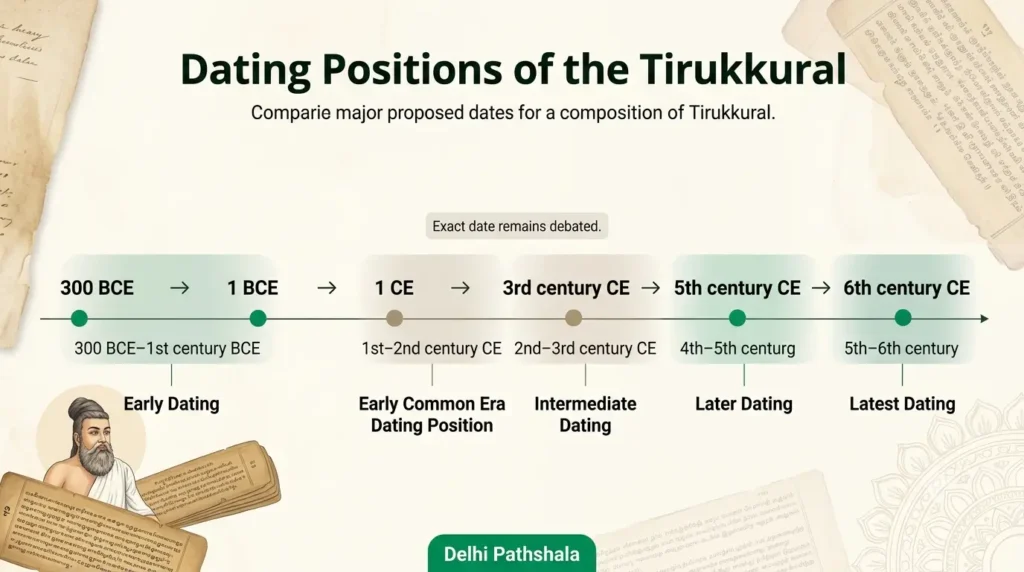
Tiruvalluvar is thought to have lived between the 2nd century BCE and the 1st century CE, according to many popular notes, including an earlier version of this page. That is only one position. Scholars actually disagree widely, because the text does not name its author, its ruler or its year:
| Position | Who holds it | Basis |
|---|---|---|
| About 300 BCE onwards | Traditional view, followed by scholars such as Somasundara Bharathiar and M. Rajamanickam | Tradition that the Kural was the last work of the Third Sangam at Madurai |
| 31 BCE | Maraimalai Adigal and the Tamil Nadu government (adopted in 1921; the Valluvar Year was added to the calendar in 1935) | A convention adopted after long debate, not a proven date |
| Early 1st century CE | K. K. Pillay | Historical arguments |
| About the 5th–6th century CE | Kamil Zvelebil | Language of the text, its allusions to earlier works, and its borrowing from Sanskrit treatises. Secondary sources quote his range as 450–500 CE or 500–600 CE, so check his book before quoting a figure |
| About 650 CE | S. Vaiyapuri Pillai | Believed the text borrowed from 6th-century Sanskrit works; Zvelebil disputes this because some alleged loanwords are now shown to be Dravidian |
For exam purposes, write “the date is contested” and then give two or three positions with names. Do not state one date as settled.
What was the political setting?
The Tamil country (Tamilakam) was home to kingdoms such as the Cheras, Cholas and Pandyas, and monarchy was the normal form of rule. Rulers often focused on military expansion. The Kural itself never names a particular king or country, and that is one reason its advice reads as general. Tradition says the work was presented at the court at Madurai, the seat of the Pandyas.
Four things help us understand the setting:
- Tamil culture. The Tamil-speaking world had a rich literary and philosophical tradition, and kings played a crucial role in maintaining order and prosperity. Tiruvalluvar’s ideas respond to the existing governance systems by calling for ethical, people-focused leadership.
- Earlier philosophies. Tiruvalluvar’s thought was likely shaped by the wider Indian ethical tradition, including texts such as the Upanishads, the Mahabharata and the Ramayana, which also discuss the duties of rulers. Scholars debate how much he drew on Sanskrit sources. Zvelebil argued that some teachings are “undoubtedly” based on works such as the Arthashastra and the Manusmriti, and he also described the author as part of “one great Indian ethical, didactic tradition” as well as the Tamil one. Others stress his independence and his roots in older Tamil poetry.
- Rise of ethical movements. Jainism and Buddhism had questioned social hierarchies and ritual. Tiruvalluvar did not mount a direct, organised attack on the caste order, but his insistence on fairness and ethical leadership implied the need for reform (more on this in the caste section).
- Impact of the Tirukkural. The text became a guide for ethical living and governance, valued by many thinkers for its principles of justice, morality and good leadership.
Was Tiruvalluvar a Jain, a Hindu, or neither?
Different readers have claimed the Kural for different traditions, and you should know the debate because it often appears in critical-evaluation questions.
- Jain reading: Zvelebil pointed out that the chapters on renouncing flesh-eating (chapter 26) and on not killing (chapter 33) match strict Jain precepts.
- Hindu / Vaishnava reading: Vishnu is mentioned in couplets 610 and 1103 and Lakshmi in several others, which some read as signs of Vaishnava belief. The three parts (Aram, Porul, Inbam) also match dharma, artha and kama.
- Christian reading: G. U. Pope compared the text to the Sermon on the Mount, but other scholars rejected this, partly because of the Kural’s strong emphasis on non-killing and vegetarian ethics.
- Universal / secular reading: Because religious references are limited and metaphorical, many scholars call it a text of secular ethics, and only a couple of introductory chapters sound religious.
In summary, Tiruvalluvar’s contributions to Indian political thought blend ethical governance, justice and public welfare. The sections below take each of these in turn.
Biography of Tiruvalluvar
Tiruvalluvar, or Valluvar, is an important figure in Tamil literature and philosophy. We know very little about his life. Most of what is said comes from tradition and later literature, and many details are unclear.
- Time period. Scholars are not sure about his exact dates (see the table above). Most agree that the text belongs to the period when Tamil literature was flourishing under the regional kingdoms.
- Name. The Kural names neither its author nor itself. The title Muppal (“three divisions”) is the oldest name. The name “Valluvar” appears for the first time in the Tiruvalluva Maalai, a collection of praise verses written several centuries later, and “Tirukkural” (with the honorific tiru) came into use over time. Some translators called it “the book without a name by an author without a name”.
- Origin. Tradition describes him as the son of a Brahmin father (Bhagavan) and a Pariah mother (Adi), which would make him an outcaste by birth. Others say he was a weaver. The word “Valluvar” is linked to a community that proclaimed royal orders by beating drums, although there is no clear evidence that he belonged to it. This is why the older line “he was a Tamil Brahmin or someone from a humble background” is better replaced with “tradition gives conflicting accounts of his birth”.
- Birthplace. Popular tradition places his birth in Mylapore (now part of Chennai), where a temple to him was built in the early 16th century. Some traditions say Madurai. There is no solid historical proof for either.
- Family. Tradition names his wife as Vasuki, but this comes from later legend rather than the text.
- The man and the myth. Even with so little information, Tiruvalluvar is known as a great philosopher and poet. Stories show him as a humble man giving advice on how to lead a good life. His influence goes beyond Tamil Nadu and touches Indian philosophy, especially ethics, governance and human relationships.
The Composition of the Tirukkural
The Tirukkural is a collection of 1,330 couplets (called kurals) in 133 chapters, written in classical Tamil. It is important not just in Tamil literature but in Indian and world literary traditions.
- Form. Each kural is a two-line verse in the kural venba metre. A couplet has exactly seven metrical units called cirs (four in the first line and three in the second). An earlier version of this page said each line has seven words; the correct statement is seven cirs per couplet. A cir may be one word or a combination of words.
- Topics. The couplets discuss life, morality, social behaviour, governance and spirituality. The text is seen as a guide for personal ethics and political wisdom.
- Authorship. Tradition attributes the whole work to Tiruvalluvar. Zvelebil argued that it shows a single structural plan and is not an anthology with later additions. Even so, medieval commentators show small variations in wording in about 900 couplets, which is why the commentary tradition matters (see the criticism section).
- Language. The language is compact and plain. Scholars disagree about how many Sanskrit loanwords it contains, with counts from a few dozen up to over a hundred, and this disagreement feeds the dating debate.
- Spread. It has been translated into Sanskrit and English and into dozens of other languages. The first printed Tamil edition appeared in 1812. Constanzo Beschi made a Latin translation of the first two parts in 1730, and G. U. Pope’s 1886 version was the first complete English translation. Its wide reach comes from the fact that the text is mostly non-sectarian.
- Commentaries. Ten medieval commentators are traditionally counted (10th–13th centuries). Parimelazhagar and Manakkudavar are the best known, and Parimelazhagar’s commentary has been the most widely published.
Structure and Themes of the Tirukkural
The Tirukkural has three main sections, each covering a different part of life. Together they match three of the four traditional aims of life (purusharthas): dharma, artha and kama. According to one standard reading, the fourth aim, moksha, is only hinted at in the last chapters of the first book.
| Part | Meaning | Chapters | Couplets | Focus |
|---|---|---|---|---|
| Aram | Virtue (dharma) | 1–38 | 380 | Personal and social ethics |
| Porul | Wealth, polity (artha) | 39–108 | 700 | Kingship, state, administration, society |
| Inbam | Love, enjoyment (kama) | 109–133 | 250 | Love and family life |
1. Aram (Virtue) has 38 chapters and focuses on ethics, virtue and moral values. It talks about truth, kindness, charity and personal integrity, and it shows how personal morals help create a fair society. A common way to group it is a prefatory section (chapters 1–4: God, rain, ascetics, the strength of virtue), domestic virtue (chapters 5–24) and higher virtues such as benevolence and non-killing, ending with fate (chapters 25–38).
- Themes: honesty and integrity; kindness and non-violence; humility and self-control; importance of learning; duties to family and society.
2. Porul (Wealth/Polity) has 70 chapters and looks at social life, wealth and public administration. It offers advice to leaders on governance and resource management. One common grouping is: royalty (chapters 39–63, 250 couplets), ministers and conduct in court (chapters 64–73, 100 couplets), the essentials of the state such as land, fort, army, friendship and enmity (chapters 74–95, 220 couplets), and morality and social life such as nobility, agriculture and poverty (chapters 96–108, 130 couplets). Grouping schemes differ across books, so use the chapter numbers rather than group names if you are unsure.
- Themes: justice and governance; economic management; leadership qualities; fairness in business; public administration.
3. Inbam (Love/Enjoyment) has 25 chapters and focuses on the emotional side of life, traditionally divided into secret love before marriage (chapters 109–115) and married love (chapters 116–133). It discusses romantic love and relationships and stresses respect and emotional fulfilment.
- Themes: love and family bonds; relationship dynamics; mutual respect and loyalty; ethics in love.
Structure of the Tirukkural
- Couplets. Each of the 1,330 couplets has seven cirs, expressing philosophical ideas in a poetic way. Each chapter (adhikaram) has exactly ten.
- Style. The couplets are short and memorable, which makes the wisdom easy to apply in daily life. Zvelebil noted that a couplet works both as a stand-alone proverb and as a part of a carefully planned structure.
- Language. The language is simple yet meaningful, and it combines deep ideas with practical advice.
Key Themes in the Tirukkural
- Ethics and morality. The text promotes a virtuous life built on truthfulness, honesty, justice and kindness.
- Good governance. It describes a wise and fair ruler who cares for the people’s welfare.
- Social justice and responsibility. It highlights fairness in all areas of life.
- Human relationships. Tiruvalluvar emphasises respect and affection in personal relationships.
- Spirituality. It does not favour any one religion, but it encourages virtuous living in a way that matches many Indian spiritual teachings.
Why does Aram come first? For Tiruvalluvar, wealth and love both follow from a virtuous life, and both need to be regulated by aram. This ordering is the structural reason why the Kural is a political text with an ethical spine.
Ethical Life in Tirukkural
The Tirukkural is an important book about ethics, good behaviour and living well. It highlights three main ideas, virtue, wealth and love, which help people lead a balanced and happy life that benefits themselves and society. The first book shows a pragmatic idealism: it asks for high standards but ties them to everyday conduct.
Core Ethical Teachings of the Tirukkural
- Moral integrity. The text stresses good character, with truth, honesty and kindness. A person of good character helps create a fair society. Chapters on gratitude (101–110), impartiality (111–120), self-restraint (121–130) and decorum (131–140) develop this.
- Non-violence (ahimsa). Tiruvalluvar promotes non-violence in action, thought and word. Chapters 32 and 33 (“Not Doing Evil”, “Not Killing”) are given to it, and Kural 323 ranks non-killing as the highest virtue, with truthfulness next. Chapter 26 argues against eating flesh.
- Self-control and humility. Self-control and humility lead to a better life, because humble people avoid pride and promote peace.
- Compassion and charity. Helping others is important, and the text treats helping the poor as a good and rewarding action. See the chapters on giving (221–230) and benevolence (241–250).
- Responsibility and duty. Everyone has a role in society. A good person takes care of family and community and contributes to the common good.
Concepts of Virtue (Aram), Wealth (Porul) and Love (Inbam)
- Aram (virtue). Aram means living rightly. It teaches that good behaviour, such as justice and non-violence, is essential for a good life, and it covers humility, helping others and being a good leader. Kural 31 says virtue brings both heaven and wealth, so ethics is not set against prosperity.
- Porul (wealth). Porul means earning and using wealth ethically. Wealth should come from honest work, should not harm others, and should be used to help society, not only for selfish ends.
- Inbam (love). Inbam focuses on love and relationships. It says love in family life should rest on respect and trust, and it warns against negative feelings such as jealousy.
Importance of Personal Conduct and Morality
How a person acts is crucial for a good life, and good behaviour leads to a peaceful society.
- Personal behaviour affects society. A society with honest people will thrive.
- Self-awareness. People should be aware of their actions and take responsibility.
- Link between personal and social ethics. Good personal ethics improve the community.
Role of Ethics in Personal and Social Life
Tiruvalluvar’s teachings go beyond personal life and cover society as a whole.
- Social harmony. Practising justice and kindness leads to a fair society.
- Ethical leadership. Leaders should act justly for the good of their people.
- Family and community welfare. Personal ethics strengthen family bonds and community stability.
- Public and private morality. Good behaviour should guide both personal and public actions.
In summary, the Tirukkural offers lessons on virtue, wealth and love for a balanced life. Good personal conduct is vital for the health of society, so ethics matters for individuals and communities alike.
Political Philosophy in Tirukkural
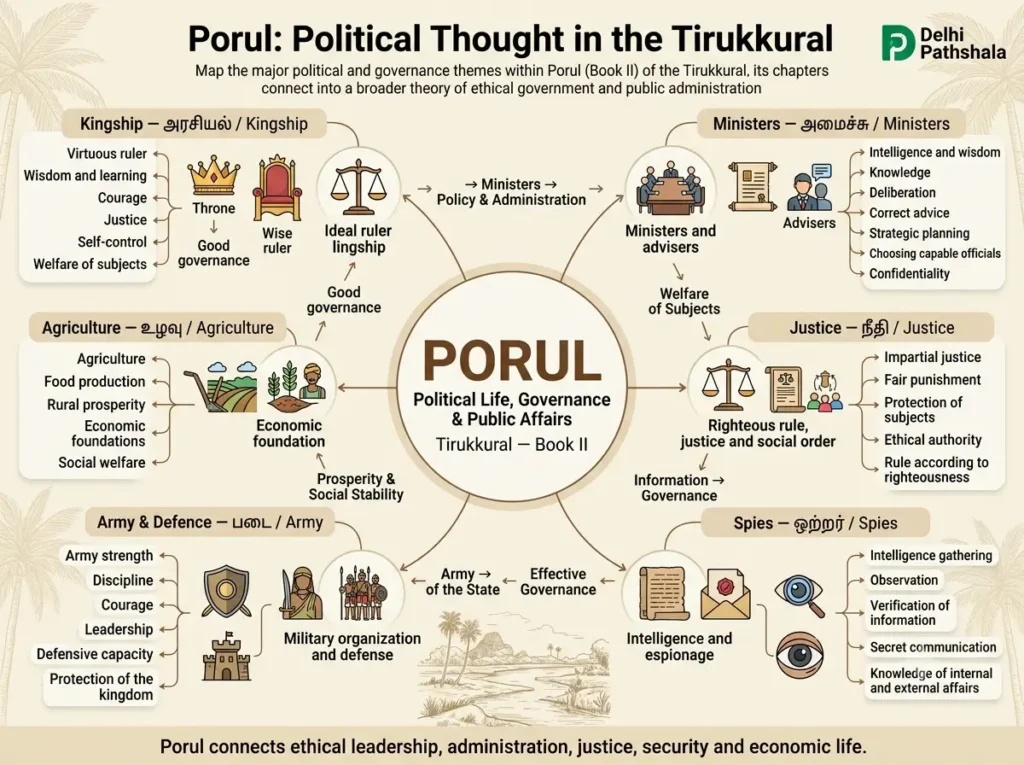
The Tirukkural is not just about morals. It also gives important ideas about politics: good governance, the qualities of leaders, the need for justice and the management of law. Most of this is in Porul (chapters 39–108).
Principles of Good Governance
Tiruvalluvar believes good governance is crucial for both leaders and the people. His ideas focus on virtue, justice and the responsibilities of leaders.
- Justice and fairness. A ruler’s main job is to ensure justice, equal for all regardless of wealth or status. The Right Sceptre chapter (541–550) is the text’s core statement on this.
- Helping the people. A good ruler cares about the needs of the people, working on their economic and social well-being and using resources wisely to reduce poverty and suffering.
- Wisdom and knowledge. Effective governance needs wisdom. The text gives early chapters of Porul to learning (391–400) and the value of hearing and learning from others (411–420), and Kural 411 calls the wealth of the ear the greatest wealth.
- Virtue and self-control. A ruler should be a role model, and by showing self-discipline, honesty and humility, he encourages the same in others.
- Dharma (righteousness). Governance should follow dharma, which means it should be based on ethical principles, with the ruler acting as a protector of law and justice.
The Six Assets of a State (Kural 381)
Kural 381 says a king who has an army, people, wealth, ministers, allies and forts is a “lion among kings”. This is often compared with Kautilya’s seven-limbed state (saptanga).
| Tirukkural 381 (six assets of the king) | Arthashastra (seven elements of sovereignty) |
|---|---|
| Army | Army |
| People | Territory and people (janapada) |
| Wealth | Treasury |
| Ministers | Minister |
| Allies | Ally |
| Fort | Fort |
| (The king is the possessor of the six) | King (counted as an element of the state) |
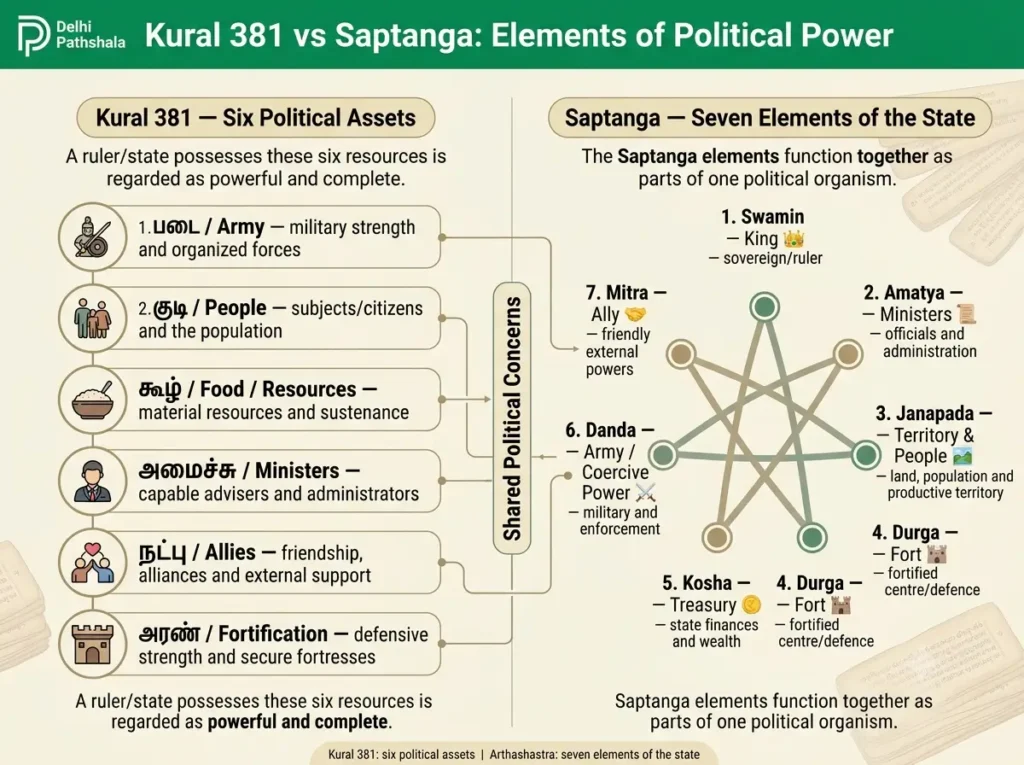
The commentator Parimelazhagar discusses why Tiruvalluvar lists the six in this order, and later scholars use the list to show the shared stock of ideas between the Tamil and Sanskrit traditions. The difference to note is the framing: Kural 381 describes what a king has, while the Arthashastra describes the elements that constitute the state.
The Qualities and Duties of a Ruler
The Tirukkural describes what makes a good ruler and treats leadership as a moral duty, not just a position of power. Chapter 39 (Kural 381–390) is the key source.
- Virtue and morality. A ruler should be truthful, just, kind and generous. A good ruler earns the trust of the people and leads well.
- Wisdom and intelligence. A ruler needs to think strategically to make informed decisions and manage complex issues. Kural 383 names alertness, learning and valour as three traits that must never fail in a ruler.
- Courage and strength. Kural 382 lists fearlessness, generosity, wisdom and energy as four qualities a king cannot lack. A good ruler should be brave enough to make tough choices and uphold justice.
- Commitment to the people. A ruler should always prioritise the welfare of the citizens and work for the kingdom’s prosperity. Kural 386 says a country praises the king who is easy to approach and does not speak harshly.
- Self-discipline and moderation. A ruler should show self-control in personal and public life, avoiding excess and setting an example. Kural 389 praises the king who can endure bitter words, meaning criticism.
- Promoting peace and stability. A ruler must strive to maintain peace and resolve conflict, ensuring justice and protecting the nation. Kural 385 describes the economic side of kingship: to create wealth, protect it, and spend it wisely.
The Role of Ministers and Advisors
Tiruvalluvar highlights the importance of ministers and advisers (see chapter 64, “The Office of Minister of State”, 631–640, and the following chapters on speech, action and the council). A ruler’s effectiveness depends on the advice he receives.
- Wisdom and expertise. Ministers should know governance and give clear advice that helps the ruler decide well.
- Loyalty and integrity. Good ministers should be loyal and act with integrity, putting the needs of the state above their own.
- Ability to dispute. Ministers should speak the truth even if it goes against the ruler’s wishes, as long as it benefits the greater good.
- Efficiency and diligence. Ministers should work hard and efficiently so that the state runs smoothly.
- Counsel on justice. Ministers help the ruler with laws and justice, ensuring fair implementation and settlement of disputes.
Other parts of the machinery of the state are also covered in separate chapters, which is useful for “scope of Porul” questions: spies or detectives (chapter 59, 581–590), envoys (chapter 69, 681–690), the land (chapter 74), fortification (chapter 75), the army (chapters 77–78), and friendship and enmity (chapters 79–90).
Justice and the Administration of Law
Justice is a key part of the Tirukkural’s political ideas. It promotes a fair and effective justice system where laws apply equally to everyone.
- Impartial justice. The ruler must ensure justice is given fairly, with no bias, and laws should be followed by everyone, including those in power.
- Integrity of the judiciary. Judges and law officials must be honest and fair, and a ruler needs to ensure the system is transparent and accountable.
- Punishment and mercy. Punishment is needed for order, but the ruler should also show mercy when right. Justice should help society, not just punish. Chapter 58 (“Benignity”) and chapter 57 (“Absence of Terrorism”) balance the Right Sceptre chapter.
- Law as a tool for social good. Laws should protect the weak and promote fairness, and a just ruler must uphold the rights of the poor.
- Ethical lawmaking. Laws should rest on righteous principles. Unfair laws harm the ruler’s legitimacy and society’s stability. The Cruel Sceptre chapter (551–560) warns what happens to a king who rules by fear.
Key takeaways on political philosophy: Tiruvalluvar’s political ideas offer lessons on governance, justice and ethical leadership. The ruler must be virtuous, wise and just, ministers must give honest guidance, and fair administration of law protects people’s rights. His vision of governance aims at justice, prosperity and social harmony, and it leads to a stable and virtuous society.
Social and Economic Thought
The Tirukkural shares important thoughts on society and the economy, with a focus on justice, fairness and human welfare. It addresses social structure, the management of money, helping others and the value of education. Its teachings aim at a fair society and a successful economy that care for everyone, whatever their background.
Views on Social Hierarchy and Caste
The Tirukkural was written at a time when caste divisions were common, yet it challenges strict divisions by promoting equality and fairness. Tiruvalluvar encourages a society in which people are valued for character and actions, not birth.
- Everyone is equal. All people have equal potential for goodness. Kural 972 says that all are alike by birth and differ in worth by their deeds. Kural 973 adds that high birth does not make a person high if the conduct is low, and low birth does not make a person low if the conduct is high. He criticises discrimination and suggests that character and actions should define a person’s role in society. Original Tamil of Kural 972: பிறப்பொக்கும் எல்லா உயிர்க்கும் சிறப்பொவ்வா செய்தொழில் வேற்றுமை யான்
- Value based on actions. A person’s worth should come from character and good behaviour, not family background, and people should be able to rise through effort.
- Respect for all jobs. Every job is important for society. Tiruvalluvar values those who contribute positively and recognises dignity in all kinds of work, including farming and trade.
- Opposing unfair treatment. He speaks against unfair actions that hurt others. He wants a society where the weak and poor are not mistreated and where those with power do not exploit others.
How to present this in an exam. Scholars read this material in different ways, so show both sides:
- Some writers stress passages like Kural 972–973 and 37 (which says aram is common to all, whether one carries the palanquin or rides in it) and contrast them with the varna-based duties of the Manusmriti.
- Others note that the Kural does not call for an organised campaign against the caste system, and that it also has a chapter on family nobility (chapter 96, 951–960). So “anti-caste reformer” is a claim you should make with care and with reference to the verses.
- Cutler’s article in the DU readings (on the role of commentary in creating the text) is a reminder that the meaning of a couplet is often shaped by the commentator who explains it.
Economic Policies and Management of Resources
The Tirukkural highlights the importance of managing money and resources fairly.
- Honest wealth creation. Wealth should be earned through honest means, rejecting cheating and exploitation. Tiruvalluvar believes in hard work, integrity and fair trade as keys to economic success. The chapter on the way of accumulating wealth (751–760) is the main source.
- Fair distribution of wealth. He warns against both extreme wealth and extreme poverty, and he believes wealth should be shared so that everyone benefits. A separate chapter, “Wealth without Benefaction” (1001–1010), criticises the person who hoards wealth and does no good with it.
- Self-sufficiency. He promotes self-sufficiency, urging people to work hard and manage resources wisely. He also believes leaders should aim at regional self-reliance in food and materials.
- Importance of farming. The text treats agriculture as essential. Chapter 104 (1031–1040) is devoted to farming, and Tiruvalluvar advises leaders to support agricultural development and treat farmers fairly because their work sustains everyone.
- Avoiding waste. The text encourages careful spending and resource use, urging individuals and governments to focus on what benefits society, especially those in need. Chapters on poverty and begging (1041–1070) show how seriously he takes deprivation.
For a deeper look at the economic side, read V. Nagarajan’s paper on Tiruvalluvar’s vision of polity and economy in the DU reading list.
Welfare State Principles and Social Responsibility
Tiruvalluvar’s thoughts on social welfare centre on social responsibility: everyone has a role in helping others and in ensuring the well-being of those in need. Be careful with the label “welfare state”, which is a modern term. It is a useful comparison, but Tiruvalluvar speaks about the king’s and the community’s duties, not about a modern welfare administration.
- Protecting the needy. The text stresses care for the poor, the elderly, the disabled and the needy, and it teaches that it is everyone’s duty to ensure no one is left without support.
- Ruler’s role. Leaders have the main responsibility to care for the people. The government should provide for the poor and protect the rights of the disadvantaged.
- Encouraging charity. Helping others through charity and kindness is seen as important for building a caring society.
- Social justice. He calls for fairness, aiming to eliminate inequality and oppression, including that based on caste, and he believes a just society allows everyone equal chances.
- Cooperation. The text envisions a society where people work together and share resources for the common good.
Importance of Education and Knowledge
Tiruvalluvar values education and knowledge as crucial for personal and societal growth.
- Knowledge builds virtue. Knowledge leads to personal growth and moral development, and an educated person makes better choices.
- Education for everyone. He argues that education should be accessible to all regardless of social status.
- Practical knowledge. He values practical knowledge in areas like farming and trade.
- Role of teachers. The text honours teachers as essential to society’s growth, because educators develop virtue and wisdom in future generations.
The relevant chapters are Learning (391–400), Ignorance (401–410), Hearing (411–420) and The Possession of Knowledge (421–430).
Key takeaways on social and economic thought: The Tirukkural presents a vision of a fair, successful and harmonious society. Its teachings promote equality and merit, its economic views stress fairness and ethical practice, social responsibility highlights the duty to care for the vulnerable, and education drives progress.
The Relationship between Ethics and Politics
In the Tirukkural, ethics and politics are closely linked. Tiruvalluvar believes that good governance must be based on moral values and that the success of a state depends on the ethical behaviour of both leaders and citizens. The structure of the text shows this: the book on politics sits inside a work organised around aram.
This is where the DU unit title makes sense. Compare it with the realist tradition: Kautilya also discusses dharma, but the Arthashastra is mainly a manual of statecraft, whereas for Tiruvalluvar the moral conduct of the ruler is the basis of his legitimacy (see the comparison table below).
Integration of Ethical Principles in Political Governance
For Tiruvalluvar, politics is not just about ruling or gaining power, but about applying goodness and fairness in running the state.
- Righteousness (dharma) as the foundation of governance. Rulers should make decisions based on fairness, truth and the well-being of all. Political choices must reflect ethical values.
- Virtue of the ruler. A ruler who shows integrity, compassion and wisdom sets a positive example. Good leadership creates a fair and orderly society where people feel safe and encouraged to act ethically.
- Justice as a political duty. Rulers must apply justice fairly, treating everyone equally under the law, whatever their social status.
- Ethics in decision-making. Every law or policy should be judged on its moral value: whether it helps people, keeps justice and promotes harmony.
The Moral Responsibility of Rulers and Citizens
The link between ethics and politics involves both rulers and citizens having moral duties that help the state thrive. This shared ethical responsibility ensures a fair and honest political system.
- Moral duty of rulers. Rulers must uphold justice and care for their people, leading with truth, honesty and compassion. If a ruler acts immorally, this undermines authority and harms society.
- Protecting the weak: Rulers must protect the poor and vulnerable and prevent exploitation.
- Leading by example: Rulers should show the values they want citizens to follow. Self-discipline, moderation and justice influence the behaviour of the people.
- Moral duty of citizens. Citizens should act in ways that support the common good. Being honest and respectful is crucial for a functioning society, and citizens should obey the law and work for the state’s welfare.
- Support for good governance: Citizens should back the just actions of rulers, uphold righteous laws and take part in community welfare.
- Role of the family: Tiruvalluvar sees the family as the basic unit of society and stresses the teaching of moral values at home.
- Awareness of social responsibilities: Citizens must be aware that their actions should not harm others.
The Impact of Ethical Governance on Social Harmony
When both rulers and citizens follow ethical principles, this creates justice, peace and respect.
- Peace and stability. Ethical governance leads to fair laws, and citizens feel safe.
- Trust between ruler and people. Ethical rulers earn trust, and citizens in turn support them and follow the law.
- Promotion of collective well-being. Ethical governance reduces inequality and fosters shared responsibility.
- Reduction of conflict. Ethical leadership and fair justice reduce conflict based on class or wealth and encourage unity.
- Moral education for future generations. When rulers and citizens behave ethically, they set an example for the next generation.
Key takeaways on ethics and politics: Tiruvalluvar weaves ethics into politics. The well-being of the state relies on the moral actions of both rulers and citizens, and ethical governance fosters social harmony.
Important Comparisons
Tiruvalluvar and Kautilya
| Point | Tiruvalluvar (Tirukkural) | Kautilya (Arthashastra) |
|---|---|---|
| Form | 1,330 compact couplets in verse | Long, systematic treatise on statecraft |
| Starting point | Aram comes first; wealth and love must be regulated by it | Artha (material well-being and power) is central to the state’s survival |
| Basis of the ruler’s standing | Just conduct and care for the people (Kural 388; chapters 55–56) | Strength, strategy and effective administration, within dharma |
| State elements | Six assets of the king (Kural 381) | Seven elements of sovereignty (saptanga) |
| Spies, ministers, envoys | Yes: chapters 59, 64, 69 | Yes: treated in much greater detail |
| Relationship | Scholars such as Zvelebil and Nagaswamy find close parallels. Others stress that morality and benevolence, rather than subtle statecraft, are the cornerstones of Porul | Traditionally placed earlier |
You can cross-read this with our notes on Kautilya: Theory of State.
Tiruvalluvar, Manu and the Aggannasutta
- Manu: Tiruvalluvar holds that aram is common to all, whether one rides in the palanquin or carries it, and this is often contrasted with the varna-based duties of the Manusmriti. Zvelebil also notes that some verses seem to echo Manu, so the relationship is a mixed one, not simple opposition.
- Aggannasutta: The Buddhist text explains kingship through the choice of a ruler by the people to keep order. Tiruvalluvar gives no origin story for kingship and instead tests the king by his conduct. See our notes on the Aggannasutta (Digha Nikaya): Theory of Kingship.
Tiruvalluvar and Confucius
Both focus on the conduct of the ordinary person, and both stress justice, courtesy, benevolence and trustworthiness. Two differences are usually noted: Tiruvalluvar is a poet and not only a teacher, and he devotes an entire division of the work to conjugal love (Inbam), a subject Confucius did not discuss.
Other Comparisons from the Original Notes
- Comparison with Indian thinkers
- Kautilya: Kautilya’s Arthashastra is more about practical governance and gaining power, while the Tirukkural focuses on the ethical side of governance. Tiruvalluvar balances Kautilya’s practical approach with an idealistic view based on virtue (see the table above).
- Bhagavad Gita: The Gita discusses dharma and moral duty, focusing on personal struggles. Tiruvalluvar’s work is more practical, addressing social behaviour, governance and community harmony.
- Buddhist ethics: Both value non-violence and compassion, but the Tirukkural offers a wider view that includes both personal and political ethics.
- Comparison with Western thinkers (these are comparison devices; Tiruvalluvar did not respond to these writers)
- Plato: Both care about moral rulers, but Tiruvalluvar focuses on justice and the responsibilities of rulers to the people in a practical way, while Plato’s approach is more idealistic.
- Aristotle: Both value justice and moral growth, and Tiruvalluvar extends his ideas to the welfare of society as a whole.
- Immanuel Kant: Both stress moral duty, but Tiruvalluvar puts more emphasis on community welfare and social harmony, while Kant focuses on individual action.
For the wider frame of ideas such as dharma, karma, moksha and ahimsa that help in these comparisons, see Distinctive Features of Indian Political Thought.
Critical Evaluation
The Tirukkural is an important and influential book in Indian philosophy. It gives a clear guide on ethics and politics that has inspired many people over the years, and its ideas continue to influence India and other parts of the world.
Analysis of Tiruvalluvar’s Contributions to Ethical and Political Thought
- Ethics
- Complete ethical system. Tiruvalluvar’s ethics rest on Aram, Porul and Inbam, which cover all aspects of life from personal morals to social duties. Integrity, righteousness, humility and self-control make the system broad and relevant.
- Focus on personal morality. Good personal morals lead to a better society. His thoughts on self-control and virtue are an early form of what we now call individual ethical responsibility.
- Moral equality. In a time of rigid social classes, he argued that a person’s value should rest on actions and morals, not birth or class. This idea of moral equality is among his most important contributions to social ethics.
- Politics
- Ethical governance. He mixes ethics with politics, which was distinctive for his time. Good governance should rest on justice, compassion and wisdom, and rulers should govern with integrity and fairness.
- Caring ruler. The Tirukkural says rulers should look after the people and ensure justice and fairness. This idea of compassionate governance supports protection of the vulnerable and matches modern values of human rights and social justice.
- Citizen responsibility. Citizens also have a role in creating a just society: following laws, contributing to the common good and upholding ethical standards.
Criticism and Limitations
A balanced answer should also say where the text is limited:
- Monarchical setting. The Kural gives advice to kings and ministers. It does not offer a theory of popular sovereignty, elections or institutional checks. When we call it “democratic”, we are reading a modern value into an ancient text.
- Uncertain author and date. Because we cannot date the text or identify the author with certainty, we cannot link its ideas to a particular state or ruler.
- Aphoristic form. Couplets can be quoted selectively, which allows different readers to build very different pictures of Tiruvalluvar, so check a claim against the chapter as a whole.
- Textual variation and commentary. The medieval commentaries show spelling and other variations in about 900 couplets, and the meaning of a verse often reaches us through its commentator, which is the point of Cutler’s reading in the DU list.
- Caste and gender. Verses like 972–973 are egalitarian, but the text does not set out a programme to change the caste order, and chapters such as 91 and 92 (“Being led by Women”, “Wanton Women”) reflect the assumptions of their time. A modern reader should note this.
- Idealism vs. practice. The text trusts the moral example of the ruler a great deal. Students often ask what happens if the ruler is not virtuous. The text’s answer is mostly moral (loss of legitimacy and the suffering of the people), not institutional.
Relevance of Tirukkural’s Teachings in Contemporary Society
The teachings of the Tirukkural remain relevant today. Its ideas on ethics and politics inspire people, especially on personal morals, good governance and social justice.
- Ethical leadership. In today’s political environment, where corruption is a concern, the call for ethical governance is valuable. Rulers should lead with virtue and justice to build trust and fairness.
- Social justice. The focus on equality and protection of the vulnerable matches modern discussions on human rights and social justice.
- Personal responsibility. The emphasis on personal virtue helps individuals handle ethical challenges.
- Global relevance. The teachings on virtue and social harmony can inspire efforts to promote human rights, sustainable development and peace.
The Kural is also a living public text. It is widely quoted in Tamil Nadu’s political life, and journalists have noted that parties and leaders across the spectrum invoke it, which is one reason it is sometimes claimed as a political symbol. Thiruvalluvar Day is observed in January, and a 133-foot statue (one foot for each chapter) stands at Kanyakumari. These are cultural facts for context, and they are not needed for a standard DU answer.
Key takeaways on critical evaluation: Compared with other Indian and Western thinkers, Tiruvalluvar’s ideas stand out for their practicality and social relevance. At the same time, a good answer recognises the monarchical frame and the interpretive debates around the text.
Summary of Key Points
- Ethical framework. The Tirukkural rests on Aram, Porul and Inbam. Tiruvalluvar encourages a moral life in which personal goodness leads to happiness and a peaceful society, with truth, kindness, self-control and honesty as core values.
- Political philosophy. Tiruvalluvar connects ethics with politics, saying that a fair and caring ruler is key to good government. Rulers should act with justice, wisdom and virtue and protect everyone, especially those in need. Citizens should act ethically and help their community.
- Social and economic thought. His ideas promote moral equality and social justice. He calls for a government that balances the need for wealth with social responsibility and highlights education and the careful use of resources.
- Integration of ethics and politics. The main idea of the Tirukkural is the strong link between the two. Good governance relies on the moral quality of both rulers and citizens.
The Enduring Legacy of Tiruvalluvar and the Tirukkural
The Tirukkural has a wide and lasting impact, influencing India and also ideas around the world. Its focus on personal morality, ethical governance and social justice is still useful for modern issues such as human rights, social equality and care for the environment.

- Universal relevance. Although it comes from Tamil culture, its lessons apply everywhere. Honesty, kindness, fairness and equality make it relevant to global discussions on ethical leadership, social justice and peace.
- Influence on Indian thought. In India, the Tirukkural has shaped ideas about ethics and politics, and its messages resonate with thinkers who support social equality, human rights and moral leadership.
- A blueprint for social harmony. Tiruvalluvar believed both rulers and citizens have a moral duty, which creates a vision for a just and peaceful society.
- Relevance to modern society. The core ideas of the Tirukkural are as important as ever in a world where ethical leadership, social justice and environmental issues are critical.
Quick Revision Table
| Term | Meaning | One-line use in the answer |
|---|---|---|
| Aram (aṟam) | Virtue, righteousness (dharma) | The base on which wealth and love rest |
| Porul (poruḷ) | Wealth, polity (artha) | Contains all the political chapters (39–108) |
| Inbam (inbam) | Love, enjoyment (kama) | Final book on love and family life |
| Muppal | “Three divisions” | Oldest name of the text |
| Kural | A seven-cir couplet | Unit of composition; 1,330 in all |
| Adhikaram | Chapter of ten couplets | 133 chapters in all |
| Sengonmai | The Right Sceptre (541–550) | Just rule |
| Kodungonmai | The Cruel Sceptre (551–560) | Tyranny and its consequences |
| Kannottam | Benignity (571–580) | Mercy and consideration in rule |
| Amaichu | Ministers (631–640) | Counsel and the council |
| Uzhavu | Agriculture (1031–1040) | Farmers as the base of the economy |
Conclusion
Tiruvalluvar’s Tirukkural is a powerful work in ethics and politics. It offers insights on governance, justice and personal conduct, and it argues that the well-being of the state depends on the moral actions of both rulers and citizens. Compared with other Indian and Western thinkers, his ideas stand out for their practicality and social relevance, even though his political world was monarchical and the exact date of the text is uncertain.
For your DU answers, remember three things. First, Aram comes first, so ethics frames politics. Second, a ruler’s legitimacy rests on just conduct, which is why the Right Sceptre and Cruel Sceptre chapters matter. Third, claims about caste, Kautilya and dates are debates, so name the scholars and present both sides.
Continue Reading
Continue reading (same paper, DSC-8: Ancient and Medieval Indian Political Thought):
- Kautilya: Biography and Theory of State – compare Kural 381 with the seven-limbed state.
- Aggannasutta (Digha Nikaya): Theory of Kingship – another view of how a ruler gets legitimacy.
- Shukra: Authenticity of Shukra Niti and Kingship and Statecraft – statecraft and moral kingship in another Niti text.
- Brihaspati: Statecraft, Justice, Inter-state Relations – justice and realism in the Barhaspatya tradition.
- Distinctive Features of Indian Political Thought – the ideas of dharma, karma, moksha and ahimsa behind these comparisons.
University of Delhi Previous Year Questions
Section A — Direct DU PYQs
1 Examine Tiruvalluvar’s ethical framework and its relevance for political authority and social harmony. +
Year / Paper: 2023–24 Main Paper, Sr. No. 6491 — Paper Code 2322102301
Hint: Explain Tiruvalluvar’s ethical conception of life and connect it with political authority, justice and social harmony.
Suggested Answer Focus: Introduce Tiruvalluvar and the Tirukkural; discuss Aram as ethical life, truth, non-violence, hospitality, gratitude and self-control; then connect ethical conduct with the qualities of the ruler, just governance, welfare and social harmony. Direct PYQ
2 Examine the contribution and relevance of Thiruvalluar in ancient Indian Political thought. +
Year / Paper: 2023 Paper, Sr. No. 857 — Paper Code 2322102301
Hint: Assess Tiruvalluvar’s contribution to Indian political thought through the ethical, political and social ideas expressed in the Tirukkural.
Suggested Answer Focus: Discuss the relationship between Aram and Porul, ethical rulership, justice, qualities of the king, statecraft, social welfare and the continuing relevance of Tiruvalluvar’s political thought. Direct PYQ
3 “Among the ancient ethical writings of the world that have come down to us is Thirukkural” — discuss the above statement. +
Year / Paper: 2023–24 Paper, Sr. No. 523 — Ramanujan College Library official PDF
Hint: Examine the Thirukkural as a major work of ethical thought and explain the universal character of its moral teachings.
Suggested Answer Focus: Discuss the structure of the Tirukkural, its treatment of Aram, Porul and Inbam, and its emphasis on universal ethical values such as truth, compassion, non-violence, self-control, gratitude and social responsibility. Direct PYQ
Section B — DU SOL / Unit-wise Practice Question
4 Examine Tiruvalluvar’s views on ethical life and politics as reflected in the Tirukkural. +
Source: DU SOL solved / practice bank framing for Unit VII
Hint: Examine ethical life and political life together rather than treating them as separate spheres.
Suggested Answer Focus: Explain Aram and Porul, the moral qualities expected of individuals and rulers, justice, good governance, welfare, social responsibility and the relevance of Tiruvalluvar’s ethical politics. Practice
Section C — What DU Repeatedly Tests from Unit VII
5 Discuss Tiruvalluvar’s concept of ethical life and its universal character. +
Unit: Unit VII — Tiruvalluvar: Ethical Life and Politics
Hint: Focus on Aram and the ethical virtues emphasised in the Tirukkural.
Suggested Answer Focus: Dharma/Aram, non-violence, truth, hospitality, gratitude, self-control and compassion. Emphasise the universal ethical character of these values beyond narrow caste or religious boundaries. Probable
6 Examine Tiruvalluvar’s conception of political authority and the qualities of an ideal ruler. +
Unit: Unit VII — Tiruvalluvar: Ethical Life and Politics
Hint: Explain the moral foundations of political authority in the Porul section of the Tirukkural.
Suggested Answer Focus: Qualities of the ideal king, including freedom from arrogance, learning, courage and generosity; the importance of justice and the idea that political authority must be exercised for the welfare of society rather than for exploitation. Probable
7 Discuss the relationship between ethical life, good governance and social harmony in Tiruvalluvar’s political thought. +
Unit: Unit VII — Tiruvalluvar: Ethical Life and Politics
Hint: Show how personal virtue and political justice together contribute to a harmonious social order.
Suggested Answer Focus: Ethical conduct, just rule, welfare of subjects, social responsibility and agriculture as the foundation of prosperity. Explain why political order cannot be separated from moral responsibility. Probable
8 Discuss the relevance of Tiruvalluvar’s ethical and political thought for contemporary governance. +
Unit: Unit VII — Tiruvalluvar: Ethical Life and Politics
Hint: Connect Tiruvalluvar’s moral conception of political authority with contemporary ideas of ethical governance.
Suggested Answer Focus: Ethical leadership, justice, welfare, accountability, social harmony and public responsibility. Conclude by explaining why Tiruvalluvar can be read as an important thinker of applied ethics and morally grounded governance. Probable
Section D — DU Exam Pattern & Answer Focus
9 DSC-8 Unit VII — Tiruvalluvar: Ethical Life and Politics — Examination Pattern +
Paper Code: 2322102301
Recent Pattern: The paper held on 20.12.2024 for the 2024–25 session followed the format: Attempt Any Five Questions; all questions carry equal marks; 3 hours; maximum 90 marks; 18 marks per question.
Unit VII Pattern: Tiruvalluvar commonly appears towards the later part of the paper, generally around Question 6 or Question 7, following questions on Kautilya and the Aggannasutta.
18-Mark Answer Structure:
1. Introduction: Introduce Tiruvalluvar as the author of the Tirukkural, traditionally associated with the Tamil ethical and political tradition. Mention the 1330 couplets and the three broad divisions — Aram, Porul and Inbam.
2. Ethical Life: Explain Aram through values such as non-violence, truth, hospitality, gratitude, self-control and moral conduct. Emphasise the universal character of the ethical framework.
3. Political Authority: Discuss the Porul section, qualities of the ideal ruler, justice, learning, courage and generosity, along with the importance of the political institutions and resources necessary for effective governance.
4. Social Harmony: Connect ethical governance with welfare, justice, agriculture and social prosperity.
5. Conclusion: Present Tiruvalluvar as a thinker of applied ethics in which political authority is a moral enterprise. Conclude with the contemporary relevance of ethical and welfare-oriented governance. Exam Pattern
FAQs
Which unit is Tiruvalluvar in DU’s DSC-8 syllabus?
It is Unit 7 in the original 11-unit syllabus and Unit 6 in the revised 10-unit syllabus notified in 2026, because Manu is no longer a separate unit. The title is “Tiruvalluvar: Ethical Life and Politics” in both.
When did Tiruvalluvar live?
Nobody knows for certain. Tradition and the Tamil Nadu convention (31 BCE) place him early, while Kamil Zvelebil’s linguistic argument places the text around the 5th–6th century CE. In an exam, say the date is contested and name the positions.
Why is a Tamil poem part of a political thought paper?
Because Porul (chapters 39–108) contains a detailed account of kingship, ministers, justice, the army, the fort and the economy, all set inside an ethical frame. It is also a key example of a non-Sanskrit tradition of Indian political thought.
Is the Tirukkural mainly a religious book?
No. Only a couple of introductory chapters sound religious, and the text avoids sectarian claims. That is why it has been claimed by Jain, Hindu and other readers, while many scholars call it a secular ethical text.
Which chapters should I know for the political part?
At minimum: chapter 39 (the greatness of a king, 381–390), chapters 55–56 (Right and Cruel Sceptre), chapter 59 (spies), chapter 64 (ministers), chapter 69 (envoys), chapters 74–78 (land, fort, wealth, army) and chapter 104 (agriculture).
How is Tiruvalluvar’s king different from Kautilya’s?
Both want a strong, well-advised ruler, but Tiruvalluvar builds his picture on moral conduct and care for the people (the king is godlike only if he rules justly), while the Arthashastra is a far more detailed manual of statecraft. Scholars also disagree about how much Tiruvalluvar borrowed from Sanskrit works.
Did Tiruvalluvar oppose the caste system?
He said clearly that birth does not decide worth (Kural 972–973), and he held that aram is common to all (Kural 37). But the text has no organised programme against caste, and it also speaks of family nobility. Present it as a debate and cite the verses.
What do Aram, Porul and Inbam correspond to?
Dharma, artha and kama. The fourth aim of life, moksha, is not given its own book; according to one standard reading, it is hinted at in the last chapters of the first book.
Was Tiruvalluvar a Jain or a Hindu?
That is debated. Zvelebil sees Jain influence in the chapters on non-killing and vegetarianism, while others point to references to Vishnu and Lakshmi. For exams, you only need to show that the text is claimed by many traditions and that it is widely read as universal.
Is the Tirukkural’s politics democratic?
No. It is written for a monarchical world. Its relevance for democracy lies in its values (accountability, justice, welfare and ethical leadership), not in a democratic theory. Say this clearly in a “relevance” answer.
What are the official DU readings for this unit?
S. Maharajan (2017), Makers of Indian Literature: Tiruvalluvar (Sahitya Akademi); V. Nagarajan, “Thiruvalluvar’s Vision: Polity and Economy in Thirukkural” (History of Political Economy 37:1, 2005); C. S. Srinivasachari, “The Political Ideology of the Kural” (Indian Journal of Political Science, Oct–Dec 1949); Norman Cutler, “Interpreting Thirukural: The Role of the Commentary in the Creation of a Text” (Journal of the American Oriental Society, 1992).
How should I structure a long answer on Tiruvalluvar?
Open with a two-line introduction (who he is, what the Kural is). Then cover the structure (Aram–Porul–Inbam), the ruler and the state (Kural 381–390), ministers and justice, caste and economy, one comparison (Kautilya is the safest), and end with limits and relevance.
References and Further Reading
Official DU readings for this unit (as listed in the revised DSC-8 syllabus)
- Maharajan, S. (2017). Makers of Indian Literature: Tiruvalluvar. New Delhi: Sahitya Akademi.
- Nagarajan, V. (2005). Thiruvalluvar’s Vision: Polity and Economy in Thirukkural. History of Political Economy, 37(1). Duke University Press.
- Srinivasachari, C. S. (1949). The Political Ideology of the Kural. Indian Journal of Political Science, Oct–Dec 1949, pp. 15–23.
- Cutler, Norman (1992). Interpreting Thirukural: The Role of the Commentary in the Creation of a Text. Journal of the American Oriental Society, 112(4), pp. 549–556.
Free resources (verified links)
- University of Delhi: revised syllabus of DSC-8, Ancient and Medieval Indian Political Thought (PDF)
- Indian Council of Philosophical Research: theme note on the Tirukkural (PDF)
- K. Appadurai, The Mind and Thought of Tiruvalluvar (1966), Tamil Digital Library (PDF)
- V. V. S. Aiyar’s English translation of the Kural (public domain), Standard Ebooks
- Dating the Tirukkural (Wikipedia overview of the scholarly positions)
Subscribe to keep reading
You've used your free notes for now. Get Delhi Pathshala Premium for unlimited access.
Subscribe — ₹29/30 days