
Contents
- Learning Goals for “Locating Global Politics”
- Introduction
- What is Global Politics?
- Why Study Global Politics?
- Development of Global Politics
- History of Global Politics
- Important Events in Global Politics
- Eastern Influence on Western Civilization
- Thesis Summary
- Eastern Civilizations’ Impact on Global Politics
- Eurocentric vs. Non-Eurocentric Views
- Importance of Non-Eurocentric Views
- Oriental Globalization: An Overview
- What is Oriental Globalization?
- Effects of Oriental Globalization
- World Order After Empire and Global Politics
- Post-Colonial World Order
- Former Colonies’ Role in Global Politics
- Key Takeaways: Global Norms
- Norm Makers at the Global Level
- Key Players in Global Politics
- Their Roles in Setting Global Norms
- Conclusion
- Summary of Key Points
- Why Understanding Global Politics Matters
- Glossary
- DU Previous Year Questions (DSC-12: Global Politics)
- FAQs
In this post, notes of “Unit 1: Locating Global Politics” from “DSC 12: Global Politics“ are given — useful for DU BA (Hons.) Political Science, Semester 4 students. For the next unit, see our notes on the Changing Nature of Global Politics.
Learning Goals for “Locating Global Politics”
- Understanding Global Politics
- Global politics looks at how power and decisions affect more than just one country.
- It includes the relationships between countries, international groups, businesses, and others.
- Important global issues are human rights, safety, trade, the environment, and how countries are run.
- It helps us see how world events and rules impact local and national situations.
- Recognizing Key Ideas in Global Politics
- State Sovereignty: A country’s right to rule itself without outside help.
- Global Governance: The rules and systems that manage how countries interact (like the UN, WTO, IMF).
- Power and Influence: Hard power (military, economic) compared to soft power (diplomacy, culture, ideas).
- Interdependence: How countries rely on each other economically and politically.
- Non-State Actors: The influence of groups like NGOs, big companies, and international organizations in global politics.
- Globalization: The growing connection between economies, cultures, and political systems around the world.
Introduction
What is Global Politics?
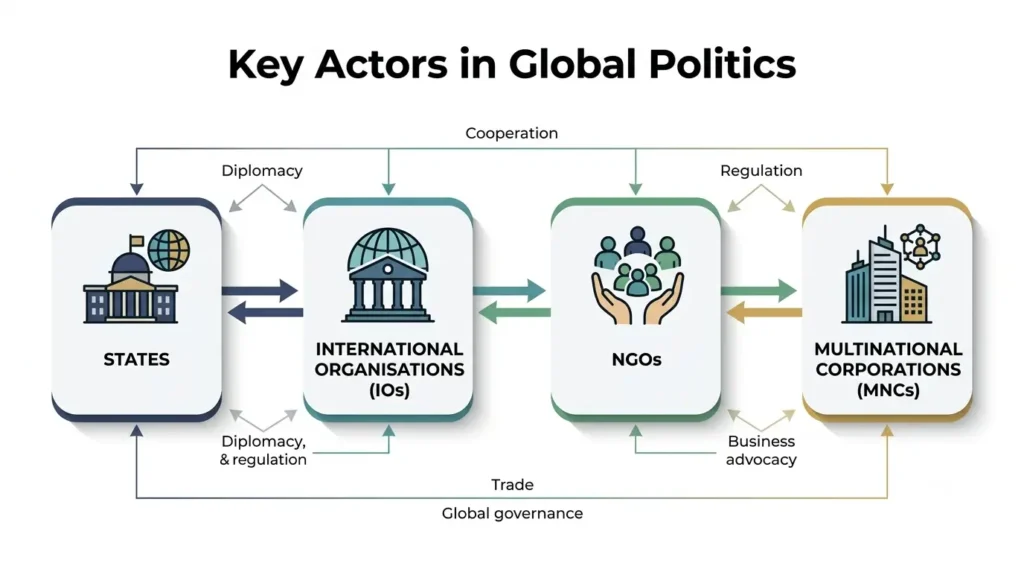
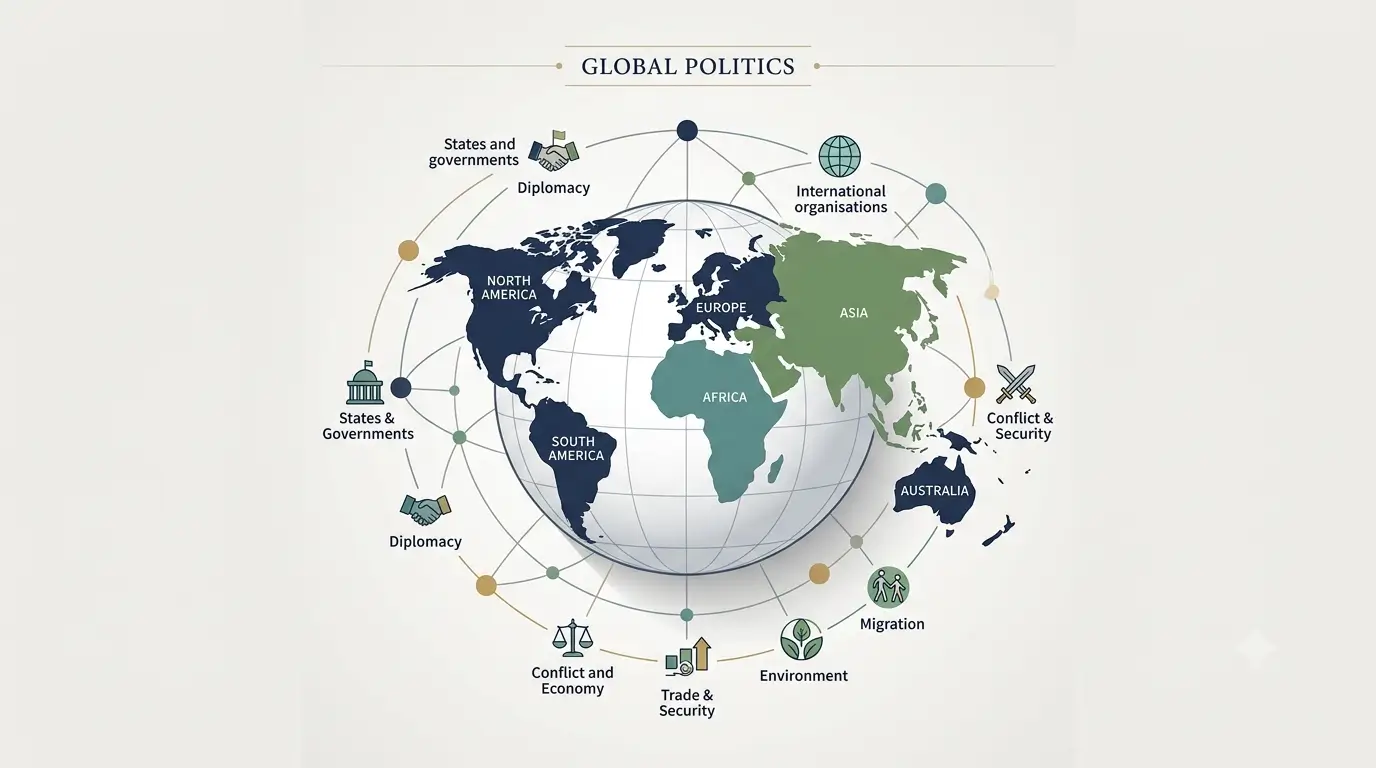
Global politics is about how countries and other groups interact and share power across borders. It includes:
- Countries and governments
- Other groups like NGOs, big companies, international organizations, and social movements
- Global issues such as security, trade, human rights, climate change, and diplomacy
Unlike regular political studies that focus on a single country, global politics looks at how international decisions affect everyone around the world. (For a broader academic framing, see Wikipedia’s overview of global politics.)
Why Study Global Politics?
Studying global politics is important because:
- It helps us understand how power and decisions work globally.
- It shows how international conflicts and teamwork affect the world.
- It explains the effects of globalization, technology, and economic policies on different areas.
- It prepares people for jobs in international fields, policymaking, and solving global problems.
Development of Global Politics
History of Global Politics
Global politics has changed over time through wars, diplomacy, colonization, and globalization. Important stages include:
- Early International Relations (Before 1648)
- Empires like the Roman and Ottoman influenced early political connections.
- Trade routes such as the Silk Road linked different areas.
- Westphalian System (1648–19th Century)
- The Treaty of Westphalia (1648) created the idea of modern nation-states.
- Countries gained sovereignty, meaning they could govern themselves.
- Colonialism grew as European nations took control of parts of Africa, Asia, and the Americas.
- Global Politics in the 20th Century
- World Wars I & II (1914–1945): Led to the creation of global organizations like the United Nations (UN) in 1945.
- Cold War (1947–1991): The U.S. and the Soviet Union competed ideologically, militarily, and economically.
- Decolonization (1945–1980s): Many African and Asian countries became independent.
- Global Economic Institutions: Groups like the IMF and World Bank were formed to manage the global economy.
- Post-Cold War and 21st Century (1991–Present)
- The end of the Soviet Union (1991) led to the U.S. being a leading power in global politics.
- The rise of countries like China and India changed global relationships.
- Issues like terrorism (e.g., 9/11 attacks), climate change, and technology became major topics.
- The world is more connected now because of globalization and digital technology.
Important Events in Global Politics
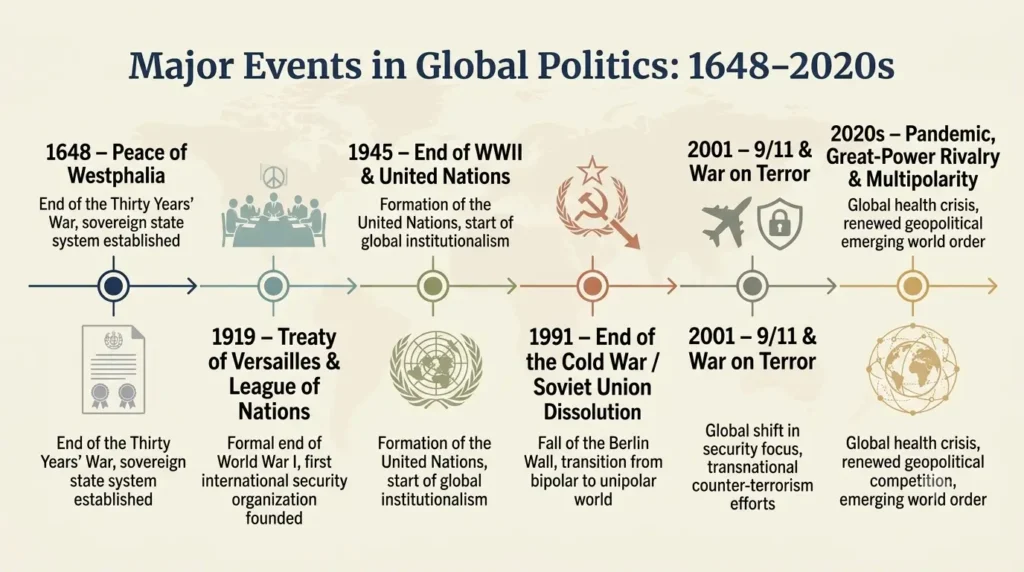
| Year | Event | Significance |
|---|---|---|
| 1648 | Treaty of Westphalia | Start of modern nation-states |
| 1919 | Treaty of Versailles | End of World War I; creation of the League of Nations |
| 1945 | Formation of the United Nations | Aimed to keep global peace and security |
| 1947–1991 | Cold War | U.S.–Soviet rivalry shaped global alliances (NATO vs. Warsaw Pact) |
| 1991 | End of the Cold War | U.S. became the leading global power |
| 2001 | 9/11 Attacks | Led to the War on Terror and changed global security policies |
| 2010s | Rise of China and Emerging Economies | Shift in global power |
| 2020s | COVID-19 Pandemic | Showed the need for worldwide cooperation in health and economics |
Eastern Influence on Western Civilization
Thesis Summary
The Eastern Influence on Western Civilization thesis disputes the common belief that Western civilization grew on its own and is superior. Instead, it claims that:
- Many important ideas, technologies, and systems in Western civilization were affected by Eastern civilizations (like China, India, and the Islamic world).
- The Renaissance, scientific progress, and economic systems in Europe were partly formed by knowledge from the East.
- Global trade, connections, and cultural exchanges greatly influenced what we now call “Western” civilization.
This thesis argues against the idea that Europe was the only source of progress, highlighting the impact of non-European societies.
Eastern Civilizations’ Impact on Global Politics
- China: Created paper, gunpowder, the compass, and printing, which greatly influenced the world. Confucian philosophy affected politics and government. Early trade routes, like the Silk Road, linked Asia, Africa, and Europe.
- India: Introduced important math concepts (like zero and the decimal system). Buddhism and Hinduism shaped global beliefs and philosophies. Engaged in ancient trade and knowledge sharing with the Middle East and Europe.
- Islamic Civilization (Middle East, North Africa, and Spain): Kept and expanded Greek and Roman knowledge in science, medicine, and philosophy. Developed advanced banking and trade systems. Influenced European political ideas through scholars like Ibn Khaldun.
- Africa: Ancient Egypt influenced the architecture, science, and governance of Greece and Rome. The Mali Empire and other African kingdoms were key players in global trade.
These contributions show that global politics and civilization have always been connected, not just driven by European progress.
Eurocentric vs. Non-Eurocentric Views
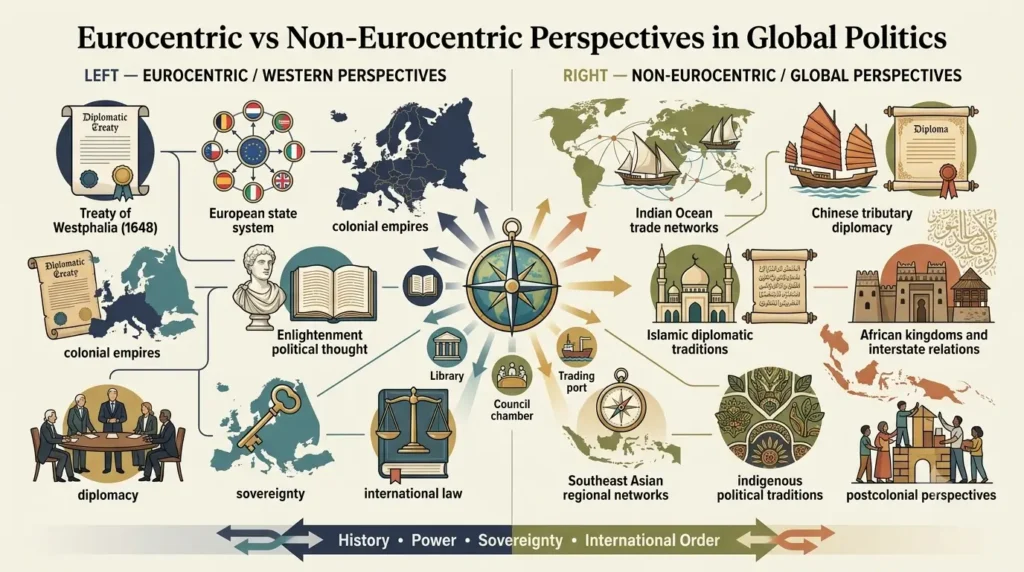
| Aspect | Eurocentric View | Non-Eurocentric View |
|---|---|---|
| Origin of Progress | Credits Europe as the sole engine of world history and politics | Recognizes China, India, Islamic world, and Africa as co-contributors |
| Colonialism | Framed as a “civilizing mission” | Seen as exploitation that harmed local economies and political systems |
| Industrial Revolution & Democracy | Presented as purely Western achievements | Understood as built on Eastern trade, knowledge, and resources |
| Political Systems | Western democracy/capitalism seen as universally best | Local governance (African communalism, Native American structures) valued equally |
| Why It Matters | Can create biased, incomplete history | Offers a more accurate, inclusive account and encourages global cooperation |
Importance of Non-Eurocentric Views
- They offer a more accurate and inclusive understanding of history and global politics.
- They help in removing biases in knowledge and policy.
- They encourage global cooperation by valuing different political traditions and contributions.
Oriental Globalization: An Overview
What is Oriental Globalization?
Oriental Globalization is the period when Asian, Middle Eastern, and other Eastern cultures were central to global trade, culture, and politics before European countries took control. It shows that globalization started earlier with Eastern countries, not just with European explorers.
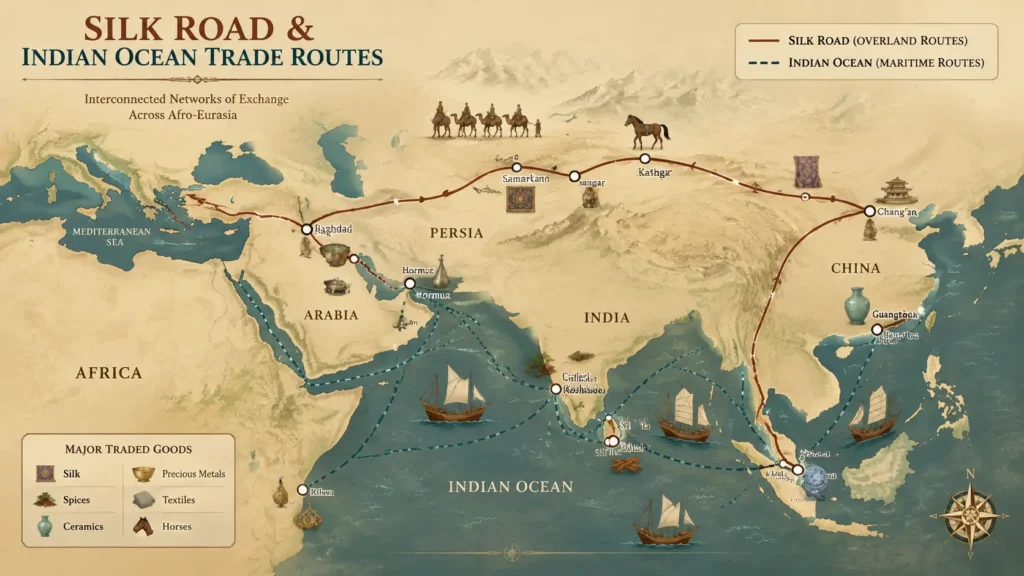
Key points of Oriental Globalization include:
- Silk Road Trade (200 BCE–1400s CE): A trade route connecting China, India, the Middle East, Africa, and Europe.
- Indian Ocean Trade Network (1000s–1500s CE): A trade system connecting Africa, the Middle East, India, and Southeast Asia before European sea exploration.
- Islamic Golden Age (8th–14th Century): Cities like Baghdad, Cordoba, and Cairo were centers of learning and trade.
- Chinese Naval Power (Ming Dynasty, 1405–1433): Admiral Zheng He led voyages that linked China with Africa and the Middle East.
Effects of Oriental Globalization
- Economic Effects: Asian and Middle Eastern economies were key to world trade before European control. Trading goods like silk, spices, and gold created early global markets.
- Cultural and Knowledge Sharing: Asian societies gave important inventions like gunpowder and the printing press to the world. Scholars from Islamic and Indian cultures kept and advanced Greek and Roman knowledge.
- Political Influence: Eastern empires (like the Ottoman, Mughal, and Ming) affected trade and diplomatic relations worldwide.
- Change in Global Power: Oriental Globalization faded as European colonialism grew in the 16th century. In the 21st century, the growth of China and India suggests a possible return to a multipolar world.
World Order After Empire and Global Politics
Post-Colonial World Order
After World War II, countries in Asia, Africa, and the Caribbean became independent from European empires. This changed global politics in several ways:
- New Countries: Many former colonies became independent between the 1940s and 1970s (like India in 1947 and Ghana in 1957).
- Cold War Tensions: The U.S. and the Soviet Union competed for influence over these new countries; some formed the Non-Aligned Movement (NAM) to stay independent.
- Economic Challenges: Many former colonies still depended on former rulers for economic support due to neo-colonialism. Global organizations like the IMF and World Bank influenced their economies.
Former Colonies’ Role in Global Politics
- Non-Aligned Movement (NAM) (1955): Leaders like Jawaharlal Nehru (India) and Gamal Abdel Nasser (Egypt) supported an independent stance during the Cold War.
- South-South Cooperation: Countries in Asia, Africa, and Latin America worked together to trade and reduce reliance on Western countries.
- United Nations and Global Governance: Former colonies used the UN General Assembly to support decolonization and human rights. The G77 (Group of 77 developing countries) was formed in 1964 to promote fair global trade.
- Emergence of New Economic Powers: China, India, Brazil, and South Africa have become key global players. Groups like BRICS challenge Western economic power.
Key Takeaways: Global Norms
The post-colonial world shows a move away from Western control to a more balanced global system, where former colonies actively influence international politics, trade, and diplomacy.
Norm Makers at the Global Level
Key Players in Global Politics
- Countries (e.g., the U.S., China, India) — governments make foreign policies, sign agreements, and work with other nations.
- International Organizations — United Nations (UN): sets rules for peace, security, and human rights worldwide. World Trade Organization (WTO): creates guidelines for international trade. International Monetary Fund (IMF) & World Bank: affect global financial policies.
- Regional Organizations — European Union (EU), African Union (AU), Association of Southeast Asian Nations (ASEAN).
- Non-Governmental Groups — Multinational Corporations (Apple, Google), NGOs (Amnesty International, Greenpeace), Media and Think Tanks (BBC, CNN).
- Social Movements and Community Groups — Activists and groups (climate change protests, feminist movements) advocate for changes in policies. See our detailed notes on Global Social Movements (Unit 4).
Their Roles in Setting Global Norms
- Human Rights: The UN’s Universal Declaration of Human Rights (1948) set global standards for rights.
- Economic Rules: The WTO creates trade rules, while the IMF sets financial policies for poorer countries.
- Environmental Agreements: Deals like the Paris Climate Accord guide global actions on the environment.
- Security Regulations: NATO and the UN Security Council manage military actions and peacekeeping.
Conclusion
Summary of Key Points
- Global politics goes beyond borders, involving countries, international groups, and non-governmental organizations.
- History is important: the development of global politics from trade routes to colonial times shapes our world today.
- Eastern influence: Eastern cultures have greatly impacted Western development, challenging Eurocentric views.
- Post-colonial roles: Former colonies are now important players in international groups and trade.
- Creating norms: Organizations like the UN, WTO, and NGOs shape global policies on rights, safety, and the environment.
Why Understanding Global Politics Matters
- It helps us see how power works worldwide.
- It explains global conflicts, diplomacy, and cooperation.
- It allows us to discuss important global issues (like climate change and human rights) knowledgeably.
- It prepares people for jobs in international relations, policy-making, and activism.
For the next stage of this unit, continue to Changing Nature of Global Politics — DSC-12 Unit 2, and explore Contemporary Global Issues — Unit 3 and Global Social Movements — Unit 4.
Glossary
- Global Politics: The study of political relations and power beyond national borders.
- Sovereignty: A country’s right to govern itself without outside interference.
- Globalization: The growing connection of economies, cultures, and political systems.
- Eurocentrism: A viewpoint that focuses on European history and values, often ignoring non-European influences.
- Oriental Globalization: The leading role of Asian and Middle Eastern cultures in trade and culture before European expansion.
- Colonialism: The act of taking control of lands for economic and political gain.
- Neo-Colonialism: Ongoing influence of former colonial powers over newly independent nations.
- Non-Aligned Movement (NAM): A group of countries that did not side with the U.S. or the Soviet Union during the Cold War.
- Multinational Corporation (MNC): A business that operates in several countries, affecting international trade and labor.
- Non-Governmental Organization (NGO): A non-profit group that works on global social, political, or environmental issues.
- Paris Climate Accord: An agreement aimed at lowering carbon emissions and fighting climate change.
DU Previous Year Questions (DSC-12: Global Politics)
Compiled from actual DU BA (Hons.) Political Science Semester 4 papers — useful for exam prep on Unit 1 concepts.
- What is globalization? How has the concept of state sovereignty undergone a change in the process of globalization? (2023, Unique Paper Code 2463)
- How far do you think that the concept of sovereignty is relevant in the age of globalisation? (2023, Unique Paper Code 4014)
- Identify the major changes in global political economy in the post-Cold War period. (2023, Unique Paper Code 4014)
- “Globalisation is a declaration of war upon all other cultures. And in cultural wars, there is no exemption for civilians: there are no innocent bystanders.” Evaluate this statement. (2023, Unique Paper Code 4014)
- Define globalisation. Explain its various approaches. (2023, Unique Paper Code 4295)
- Explain the various perspectives on globalization. (2023, Unique Paper Code 4295)
- Write short notes on: Globalisation and Technology / Cultural Dimension of Globalisation. (2023, short-note choices)
For more solved papers, check our full DU BA Political Science PYQs 2023–2024 and 2024–2025 archives.
FAQs
What is global politics in simple words?
Global politics is the study of how countries, international organizations, businesses, and other groups interact and share power across borders, going beyond the politics of a single nation.
What is the difference between international relations and global politics?
International relations traditionally focuses on relationships between governments (state-to-state), while global politics includes a wider set of actors — NGOs, corporations, and social movements — and looks at global governance beyond just intergovernmental ties.
What is Eurocentrism in global politics?
Eurocentrism is the belief that European history, values, and systems are the most important in shaping world politics, often downplaying the contributions of non-European civilizations like China, India, and the Islamic world.
What is Oriental Globalization?
Oriental Globalization refers to the era before European colonial expansion when Asian and Middle Eastern civilizations — through networks like the Silk Road and Indian Ocean trade — were the leading forces in global trade, culture, and politics.
Which topics are covered in DSC-12 Unit 1: Locating Global Politics?
Unit 1 covers the meaning and scope of global politics, Eurocentric vs. non-Eurocentric perspectives, Oriental Globalization, the post-colonial world order, and the key actors (states, IOs, NGOs) that set global norms.
Is this DSC-12 Global Politics or Political Science topic important for DU exams?
Yes — sovereignty, globalization, and the role of international institutions (UN, WTO, IMF) are recurring themes across multiple years of DU Semester 4 question papers.
Subscribe to keep reading
You've used your free notes for now. Get Delhi Pathshala Premium for unlimited access.
Subscribe — ₹29/30 days