
Contents
- Unit 1 at a Glance: Timeline for Revision
- 1. Crisis of the Tokugawa Bakuhan System
- 1.1 What Was the Tokugawa Bakuhan System?
- 1.2 Establishment and Administration
- 1.3 Social Hierarchy and the Samurai Class
- 1.4 Economic Challenges and the Decline of the Tokugawa Shogunate
- 1.5 Political Unrest and External Pressure
- 1.6 Intellectual Currents: Kokugaku, Rangaku and Mito Thought
- 1.7 Historians on the Crisis: Internal Decay or External Shock?
- 2. The Meiji Restoration: Nature and Significance; Early Meiji Reforms
- 2.1 What Was the Meiji Restoration?
- 2.2 Overthrow of the Tokugawa Shogunate
- 2.3 Restoration of Imperial Rule
- 2.4 Key Figures and Ideologies
- 2.5 Nature of the Restoration: A Historiographical Debate
- 2.6 Early Meiji Reforms: Political and Administrative
- 2.7 Social and Cultural Change
- 2.8 Significance and Limits of the Restoration
- 3. Economic Development in the Meiji Era
- 3.1 The Starting Point: What Did the Meiji Government Inherit?
- 3.2 Agrarian Settlement
- 3.3 Industrialisation: From State-Led to Private Enterprise
- 3.4 Money, Banking and Finance
- 3.5 Zaibatsu and the Rise of Capitalism
- 3.6 Key Industries
- 3.7 Labour and Workforce Changes
- 3.8 Foreign Trade and the Treaty Question
- 3.9 Important Comparison: Tokugawa Economy vs Meiji Economy
- 3.10 Assessment: How Should We Judge Meiji Economic Development?
- Conclusion
- Continue Reading
- University of Delhi Previous Year Questions (PYQs)
- Frequently Asked Questions (FAQs)
- Essential Readings from the DU Syllabus (Unit 1)
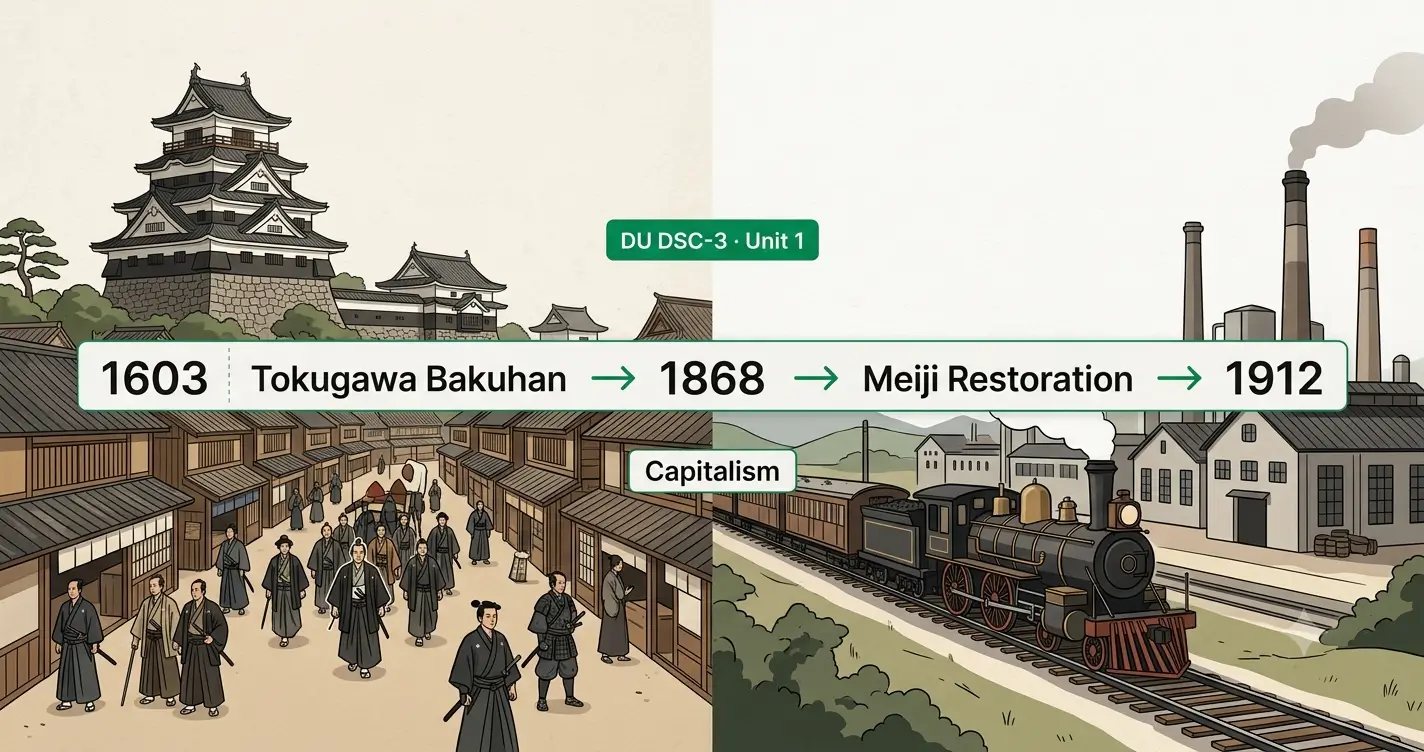
This post covers Unit 1: Transition from Feudalism to Capitalism of DSC-3: History of Modern Japan (c. 1868 – 1950s), taught in Semester 4 of the BA (Hons.) History programme at the University of Delhi. The syllabus asks you to study three things in this unit: the crisis of the Tokugawa bakuhan system, the Meiji Restoration (its nature and significance, and the early Meiji reforms), and economic development in the Meiji era (agrarian settlement, industrialisation and capitalism). The official wording is available in the University of Delhi syllabus document for the History department, and the other units of this paper are collected on our History of Modern Japan category page.
The notes below follow that order. Each part ends with a short Key Takeaways box, and the historians’ disagreements are marked clearly, because DU papers on this course regularly ask you to analyse a debate and not only to narrate events.
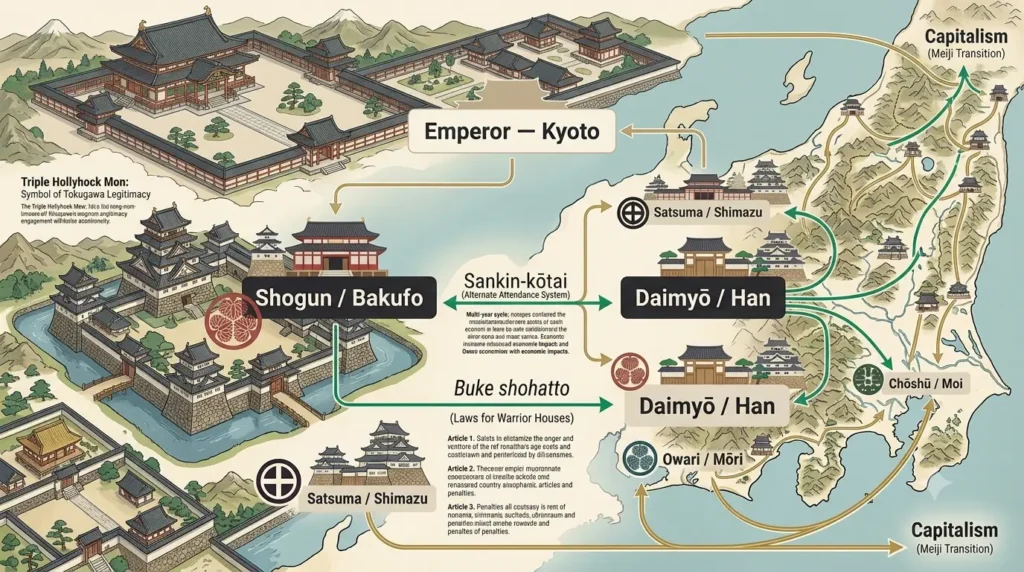
Quick answer: what was the bakuhan system? The bakuhan system (bakuhan taisei) was the political order of Tokugawa Japan (1603–1868). It combined the shogun’s central government, the bakufu, with roughly 250–270 semi-autonomous domains, the han, each ruled by a daimyō. The word itself joins baku (from bakufu) and han. Historians, not the Tokugawa rulers themselves, coined the term to describe how national authority and local lordship were balanced.
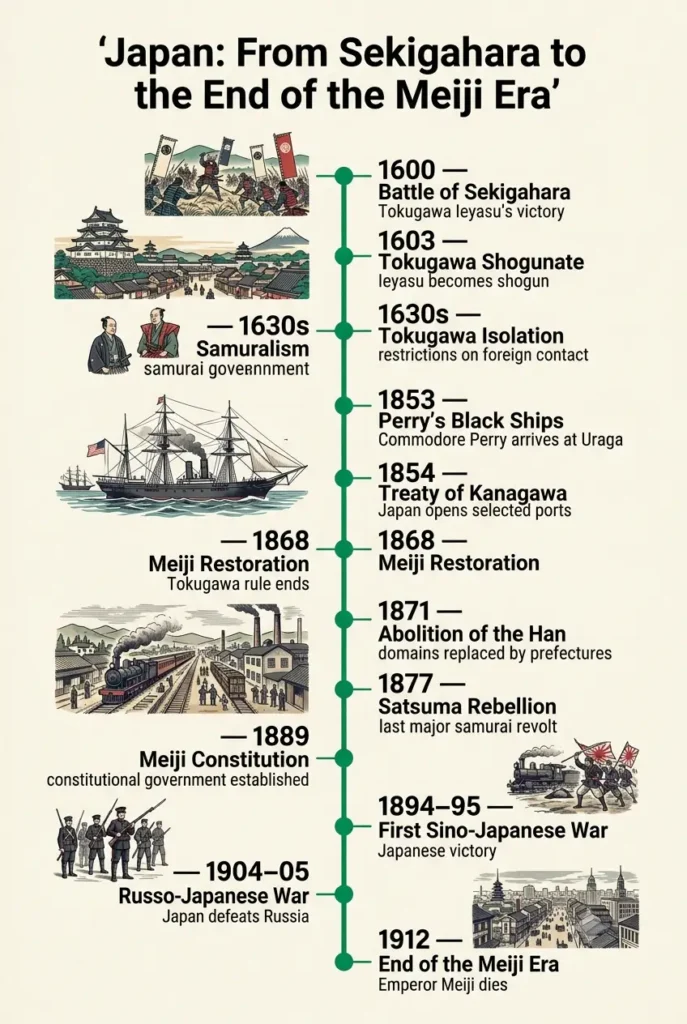
Unit 1 at a Glance: Timeline for Revision
| Year | Event | Why it matters for the unit |
|---|---|---|
| 1600 | Battle of Sekigahara | Tokugawa Ieyasu defeats rival lords and becomes the leading power in Japan |
| 1603 | Ieyasu receives the title of shōgun | The Tokugawa shogunate (the Edo bakufu) begins |
| 1615, 1635 | Buke shohatto (Laws for the Military Houses) issued and reissued | Rules for daimyō conduct; sankin-kōtai set out in detail in 1635 |
| 1630s–1640s | Rule of the third shogun Iemitsu | The bakuhan system reaches its stable form |
| 1837 | Ōshio Heihachirō’s uprising in Osaka | A sign of the Tempō-era social crisis |
| 1853–1854 | Perry’s arrival; Convention of Kanagawa | Japan’s seclusion policy ends |
| 1858 | Harris Treaty and the other Ansei treaties | Unequal treaties; the bakufu’s legitimacy is damaged |
| 1866–1867 | Satsuma–Chōshū alliance; Yoshinobu agrees to return power to the court | Opposition domains and the court align against the bakufu |
| Jan 1868 | Imperial restoration decree; Boshin War begins | The Restoration, politically and militarily |
| April 1868 | Charter Oath | Statement of the new government’s aims |
| 1869–1871 | Return of domains to the emperor, then abolition of the han | End of the bakuhan structure |
| 1872 | Education System Order; Shimbashi–Yokohama railway; Tomioka Silk Mill | Beginning of state-led modernisation |
| 1873 | Conscription Ordinance; Land Tax Reform | Core of the agrarian and military settlement |
| 1876–1877 | Stipends commuted; sword ban; Satsuma Rebellion | End of samurai privilege |
| c. 1880–1896 | Privatisation of state enterprises | Rise of the zaibatsu |
| 1897 | Gold standard adopted; first unions formed | Capitalist institutions deepen |
1. Crisis of the Tokugawa Bakuhan System
1.1 What Was the Tokugawa Bakuhan System?
After the Battle of Sekigahara in 1600, Tokugawa Ieyasu emerged as the strongest lord in Japan, and in 1603 he took the title of shōgun. The system he founded lasted until 1868, which is why this is called the Edo period (Edo, today’s Tokyo, was the shogun’s capital).
It is worth knowing that the term bakuhan is a modern historians’ label. The Cambridge History of Japan chapter on the subject notes that the phrase was coined by modern Japanese historians, that the system’s institutions had begun to appear under Oda Nobunaga and Toyotomi Hideyoshi, and that it reached its stable form only under the third shogun, Iemitsu, in the 1630s and 1640s. Many historians now speak of a bakuhan state to emphasise that this was a whole form of government and not only a set of offices. You can read the summary of that chapter on the Cambridge University Press page for “The bakuhan system”.
Put simply, power was divided:
- The bakufu (shogunate) in Edo handled national matters. Standard accounts list these as foreign relations, national security, coinage, weights and measures, and transport. (For a short definition, see the Encyclopaedia Britannica entry on bakuhan.)
- The han (domains) ran their own administration, taxation and local law under the daimyō, in return for loyalty to the shōgun.
- The emperor stayed in Kyoto with a ceremonial role and no military or financial power.
This is why textbooks, including the DU-prescribed Fairbank, Reischauer and Craig, describe Tokugawa Japan as a “centralized feudal state”. The phrase tries to capture something unusual: a feudal order (lords, vassals, land held for service) that was nonetheless held together by a very strong central authority.
1.2 Establishment and Administration
After his victory at Sekigahara in 1600, Ieyasu became shōgun in 1603. The aim of the Tokugawa settlement was to strengthen the shogunate’s power while keeping the feudal structure of lords and domains in place.
The shogunate (bakufu). The shōgun was the military ruler, and the bakufu in Edo controlled the army, the finances and foreign affairs, while the Emperor in Kyoto remained a symbolic head with ceremonial duties. The Britannica account of the bakuhan system describes how, by reorganisations in the 1630s and 1640s, the bakufu executive took its mature form: senior councillors (rōjū), junior councillors (wakadoshiyori) and three commissioners (bugyō) for temples and shrines, the city of Edo, and the treasury. The samurai class supplied the officials and soldiers who staffed this system.
Control over the daimyō. About 250 to 270 domains existed, depending on the year counted (261 domains survived to be abolished in 1871). The shogunate controlled the daimyō through several devices:
- Buke shohatto (Laws for the Military Houses). First issued in 1615 and reissued by successive shoguns, these edicts set out proper conduct for daimyō. Reissued in 1635 under Iemitsu, they set out the sankin-kōtai system in detail.
- Sankin-kōtai (alternate attendance). Daimyō had to spend alternate years in Edo, and their wives and children lived there permanently, effectively as hostages. Britannica notes that this forced especially the distant tozama lords to bear the heavy cost of two administrations and of long journeys. Beyond control, it also pushed money into the road, post-station and Edo economies.
- Construction and other levies. The shogunate drew on daimyō funds, labour and materials for large projects, a point made in the Japan Society’s essay on the Tokugawa polity.
- Surveillance and seclusion. The bakufu monitored the daimyō through officials and informants. It also controlled foreign contact: after the 1630s, trade was restricted largely to the Dutch and the Chinese, and Britannica notes the temple-registration system (danna-dera) by which every household had to prove it was not Christian.
Three kinds of daimyō. Daimyō were classified by their relationship to the Tokugawa house:
| Category | Meaning | Position in the system |
|---|---|---|
| Shinpan | Collateral lords, relatives of the Tokugawa | Trusted, but kept away from top bakufu posts |
| Fudai | Hereditary vassals who had served the Tokugawa before Sekigahara | Supplied most senior bakufu officials |
| Tozama | “Outside” lords who submitted only after Sekigahara | Often large domains (e.g. Satsuma, Chōshū, Tosa), kept at a distance, excluded from the bakufu’s inner circle |
The classification matters for the end of the story. As the Japan Society essay puts it, the polity was balanced against the tozama from the beginning, and it was the intrusion of a few powerful tozama domains into national politics that finally upset the balance and brought the system down.
Land and rank: the kokudaka principle. Lords were ranked by the assessed yield of their land, measured in koku of rice (one koku is roughly 150 kg of rice). A daimyō was a lord with a domain assessed at 10,000 koku or more. Scholars working on the bakuhan system, including the Kyushu University study of its structure, treat the kokudaka system and the separation of samurai from the land (samurai lived in castle towns, peasants on the land) as foundations of the whole order.
1.3 Social Hierarchy and the Samurai Class
Tokugawa society was officially ordered into four classes, called shi-nō-kō-shō, a Confucian-inspired ranking:
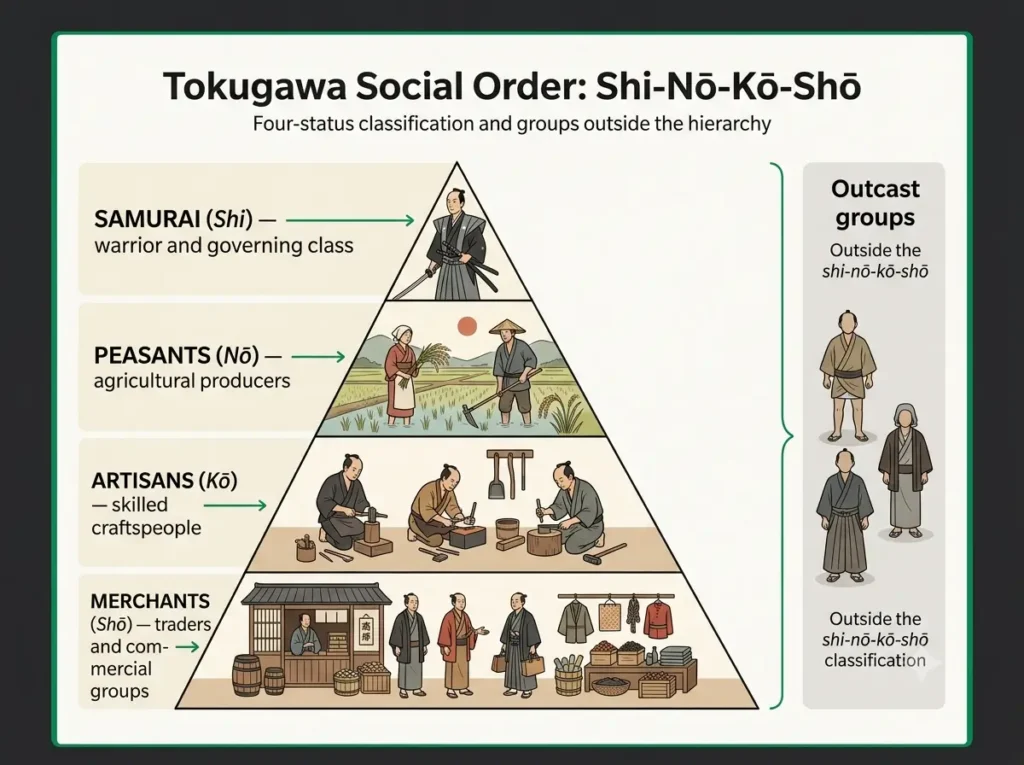
| Rank | Class | Role | Note |
|---|---|---|---|
| 1 | Samurai (shi / bushi) | Warriors turned administrators; expected to follow the bushidō ideal of loyalty and honour | Included the shōgun’s direct retainers, the daimyō’s samurai, and rōnin (lordless samurai) |
| 2 | Peasants (nō / hyakushō) | Produced food; paid land tax, mostly in rice | Roughly four-fifths of the population by common estimates |
| 3 | Artisans (kō / kōnin, shokunin) | Crafts such as carpentry and pottery; lived in towns | Ranked above merchants in theory |
| 4 | Merchants (shō / shōnin, chōnin) | Trade and finance | Lowest in status, though often richest, especially in Edo, Osaka and Kyoto |
Outside the four classes were outcast groups such as the hinin, who were legally excluded from the ordinary status order. (Note: an earlier version of this article gave the artisans’ term as “Kōmin”; the usual term is kōnin or shokunin.)
Two cautions are useful for exam answers. First, the four-class scheme was an ideal, borrowed from Confucian thinking, and reality was more fluid, for example when wealthy merchants lent to samurai and daimyō. Second, the samurai’s role changed: in a long peace, most became bureaucrats and clerks rather than fighters. Their stipends were fixed in rice, while the economy around them became more commercial, so many fell into debt and dependence on merchants. This tension between status and wealth is one of the structural weaknesses discussed below.
1.4 Economic Challenges and the Decline of the Tokugawa Shogunate
The Tokugawa shogunate ruled for over two and a half centuries and created a stable, peaceful society. But by the late eighteenth and nineteenth centuries, several economic and political problems were wearing it down.
Agriculture.
- Growth slows. Early in the period, agricultural output rose through land reclamation and extended cultivation, and the surplus produced by peasants was large. Later, growth levelled off, population stagnated at a high level and good new land was scarce.
- Heavy taxation. The shogunate and domains relied mainly on land tax in rice. Pressure on the peasantry grew in bad years, and poor harvests could mean famine and unrest.
- Famine cycles. Three great famines are usually named: Kyōhō (1732), Tenmei (1786–87) and Tempō (c. 1832–37). Each brought hardship and disorder. The Tempō famine produced the largest wave of disturbances, because years of repeated crop failure exhausted relief resources and rice hoarding pushed prices higher.
- Complicated landholding. Land was assessed and managed through layers of lords, retainers and village officials, and was not owned in a modern sense. This made reform difficult and later forced the Meiji government to create a new system of land title (see Part 3).
Finance.
- Samurai debt. Fixed rice stipends lost purchasing power as the money economy grew and living costs rose, leaving many samurai in debt to merchants.
- Daimyō and bakufu debt. Domains were burdened by castle upkeep, military obligations and the costs of sankin-kōtai, and borrowed heavily. The wealthy merchant houses grew more powerful as creditors. The bakufu itself faced repeated deficits and responded with reform programmes, notably the Kansei reforms (Matsudaira Sadanobu, after the Tenmei famine) and the Tempō reforms (Mizuno Tadakuni, early 1840s). These achieved only partial success.
- The merchant paradox. The merchant class was officially lowest, yet its money kept the system running. Thus the economy had outgrown the social theory on which the political order was built.
Key Takeaways (1.1 – 1.4): The bakuhan system divided power between the bakufu and the han, controlled daimyō through sankin-kōtai and the Buke shohatto, and rested on a Confucian status order. Over time, rice-based finance, famines, samurai and daimyō debt, and the rising power of merchants strained the system from within.
1.5 Political Unrest and External Pressure
By the nineteenth century the shogunate faced growing challenges both at home and from abroad.
Unrest at home.
- Samurai discontent. Many lower-ranking samurai, squeezed by fixed incomes, wanted reform, and some began to look beyond the bakufu for leadership.
- Peasant and urban protest. Peasants rebelled against heavy taxes and local misgovernment, and cities saw riots over rice prices. A well-known case is the Ōshio Heihachirō uprising of 1837 in Osaka. Ōshio was a former city police official and Neo-Confucian scholar who tried to rally townspeople and villagers against the officials and rich merchants he blamed for ignoring the Tempō famine. It was crushed quickly and he took his own life, but the fact that a bakufu official had led it provoked wide debate about Tokugawa rule. (Note: this was an urban uprising in Osaka, and earlier descriptions of it as a simple peasant revolt are inaccurate.)
- Sonnō jōi. The slogan “Revere the Emperor, Expel the Barbarians” (sonnō jōi) came out of late Tokugawa intellectual circles, especially the Mito school, and grew popular as the foreign threat intensified. Its political effect was to shift loyalty from the shogun to the emperor.
The Western challenge.
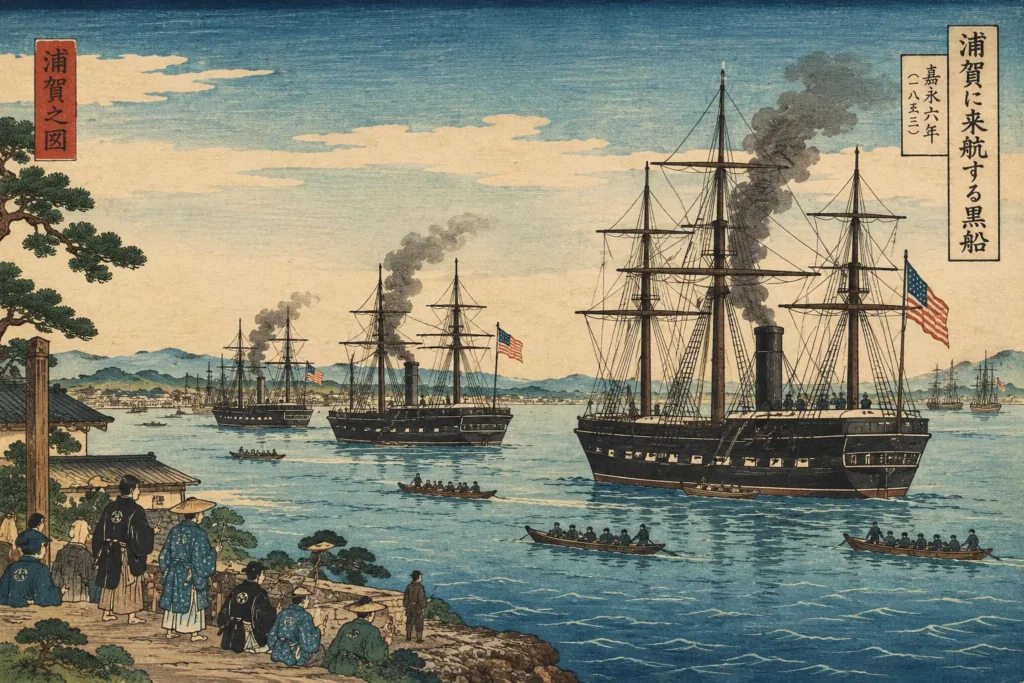
- Perry’s arrival and the Convention of Kanagawa. On 8 July 1853 Commodore Matthew Perry arrived at Uraga with four warships and a letter from the US President. He returned in 1854, and on 31 March 1854 the Convention of Kanagawa (the Japan–US Treaty of Peace and Amity) was signed under threat of force. It opened the ports of Shimoda and Hakodate to American ships, provided for care of shipwrecked sailors, and allowed an American consul. It effectively ended the seclusion policy but was not yet a trade treaty.
- The Harris Treaty and the unequal treaties. On 29 July 1858, the Treaty of Amity and Commerce (Harris Treaty) opened more ports to trade and gave Americans extraterritoriality (they were tried in their own consular courts). Japan also lost tariff autonomy: it could not freely set import duties. The senior official Ii Naosuke accepted it without imperial approval, and similar treaties followed with Russia, the Netherlands, Britain and France (together the Ansei treaties). These treaties reduced Japan’s sovereignty for the first time in its history.
- Economic fallout. Trade at fixed terms disrupted the economy. Because Japan’s gold–silver ratio differed from the international one, foreigners exchanged silver for gold at a profit and large amounts of gold left the country, adding to inflation and hardship.
- A crisis of legitimacy. The bakufu was supposed to be Japan’s protector. When it signed treaties under foreign pressure and without the court’s sanction, critics could say that it had failed its first duty. The treaties also strengthened the sonnō jōi movement.
The final phase is often called the Bakumatsu (the end of the bakufu). In the 1860s Satsuma and Chōshū, two powerful tozama domains, moved from opposing the foreigners to opposing the bakufu itself, and by 1866 they had formed an alliance against it. In 1867 the last shōgun, Tokugawa Yoshinobu, agreed to return political authority to the imperial court, but the conflict continued into 1868 (see Part 2).
1.6 Intellectual Currents: Kokugaku, Rangaku and Mito Thought
| Current | Core idea | Importance for the crisis |
|---|---|---|
| Kokugaku (National Learning) | Study of ancient Japanese texts and culture, rejecting Chinese influence; scholars such as Motoori Norinaga | Strengthened pride in Japan’s own tradition and the idea of the emperor as the centre of the nation |
| Rangaku (Dutch Learning) | Study of Western medicine, science and military technique through Dutch books (the Dutch being the only Europeans allowed to trade) | Created a group of scholars and officials aware of Western strength, open to reform |
| Mito school and sonnō jōi | Loyalty to the emperor and defence of Japan against foreign threat; the New Theses of 1825 are a well-known text of this anti-foreign thinking | Supplied the political slogan that opposed the shogunate |
1.7 Historians on the Crisis: Internal Decay or External Shock?
Historians do not agree on why the system fell, so exam answers gain by presenting the debate.
- External shock. Some accounts, including summaries in DU notes that cite Andrew Gordon, stress the crisis created by Perry’s arrival and the opening of Japan. On this view, a system that might have survived for longer was fatally damaged by the treaties and the questions about sovereignty they raised.
- Internal strain. Others emphasise long-term weaknesses: samurai impoverishment, daimyō and bakufu debt, famine, and the contradiction between the status order and the commercial economy. Study-notes on Delhi University’s reading list often connect this to ideas associated with Barrington Moore Jr. (the breakdown of the rigid hierarchy as discontented samurai, commoners and commercial interests found common cause) and to Fairbank’s “centralized feudalism.”
- Political process. Conrad Totman’s The Collapse of the Tokugawa Bakufu, 1862–1868, which is on the DU reading list, follows the political manoeuvring of the 1860s in detail and treats the collapse as a result of choices made in those years, not only of long-term structural decay.
- A positive reading of the Tokugawa legacy. T. C. Smith and others have argued that late Tokugawa society had already developed commerce, literacy and administrative skill that helped the later transition (this argument returns in Part 3).
A balanced conclusion is that long-term weakness made the system vulnerable, and the foreign intrusion made it impossible to repair. For an excellent open-access overview, see the Japan Society essay on the polity of the Tokugawa era and the IGNOU eGyanKosh unit on the Tokugawa period.
Key Takeaways (1.5 – 1.7): Internal unrest (samurai discontent, famine, uprisings such as Ōshio’s) joined with the foreign challenge (Perry, the Kanagawa Convention, the Harris Treaty and the unequal treaties). Kokugaku, Rangaku and the sonnō jōi ideology gave the opposition ideas and a slogan. Historians debate how far the fall was structural and how far it was a result of events from 1853 to 1868.
2. The Meiji Restoration: Nature and Significance; Early Meiji Reforms
2.1 What Was the Meiji Restoration?
The Meiji Restoration (Meiji Ishin) is the name for the events of 1867–1868 and the wider process that followed, in which the Tokugawa shogunate was overthrown and political authority was proclaimed to be restored to the emperor. The new era was named Meiji (“enlightened rule”), and the reign of Emperor Meiji lasted from 1867 to 1912.
The Restoration ended over 250 years of Tokugawa rule and the system of domains, and led within a few decades to a centralised state, a conscript army and a capitalist economy. Remember the double meaning: it was a restoration in the language of the time (power returned to the emperor), but in its effects it was a transformation of Japan’s political and social order. How revolutionary it really was is a central question for historians (see 2.5).
2.2 Overthrow of the Tokugawa Shogunate
By the mid-nineteenth century the shogunate was losing power for four connected reasons:
- Economic and social strain. Low agricultural growth, mounting debts and discontent among samurai and peasants (Part 1).
- Political weakness. Perry’s arrival in 1853 and the unequal treaties of 1858 showed that the bakufu could not protect Japan, which damaged its legitimacy.
- Anti-bakufu movements. Samurai, scholars and merchants rallied around sonnō jōi. In the 1860s the movement turned from expelling foreigners to replacing the bakufu, and the powerful tozama domains of Satsuma, Chōshū and Tosa took the lead. The Satsuma–Chōshū alliance of 1866, in which Sakamoto Ryōma is traditionally credited with a mediating role, was a turning point.
- A decisive sequence of events. On 3 January 1868, supporters of the restoration seized the imperial palace in Kyoto and issued a decree restoring imperial rule (ōsei fukko). The last shōgun, Tokugawa Yoshinobu, who had already agreed to return authority to the court, then marched against the new regime, and the Boshin War began with the Battle of Toba–Fushimi on 27 January 1868, where a smaller but more modernised imperial force defeated the shogunate’s troops.
The Boshin War (1868–1869). After Toba–Fushimi, imperial forces moved on Edo. In the spring of 1868, negotiations between Saigō Takamori for the imperial side and Katsu Kaishū for the shogunate led to the peaceful surrender of Edo Castle. Fighting continued in the north, and the last Tokugawa loyalists, led by Enomoto Takeaki, surrendered at Goryōkaku in Hakodate in 1869. (A common mistake in answers is to describe the Boshin War as a single event of 1868; it lasted from January 1868 to mid-1869.) Edo was renamed Tokyo in September 1868, and the emperor moved his residence to Edo Castle, which became the Imperial Palace.
2.3 Restoration of Imperial Rule
The Restoration put the emperor at the centre of politics, but real power lay with a group of leaders (the Meiji oligarchs), mostly former samurai from Satsuma, Chōshū, Tosa and Hizen, who ruled in the emperor’s name. Key features of the early regime:
- Charter Oath (April 1868). Drafted with the participation of Kido Takayoshi and Fukuoka Takachika, this five-article statement pledged that policy would be decided by public discussion, that all classes would cooperate, that outdated customs would be abandoned, and that knowledge would be sought from around the world. It is remembered more for its inspirational value than as a governing document.
- Centralisation. The new leaders abolished the feudal system of domains (see 2.6). The capital shifted from Kyoto to Tokyo.
- Modernisation and “Westernisation”. Under the slogans of fukoku kyōhei (“enrich the country, strengthen the army”) and bunmei kaika (“civilisation and enlightenment”), the government built new schools, an army, railways and industries and adopted Western legal and technical models, while taking care to keep the emperor central to national identity.
- A constitution, later. The Meiji Constitution was promulgated on 11 February 1889 and came into force in 1890. It was drafted under Itō Hirobumi, largely on a Prussian-German pattern, and was presented as a gift from the emperor and not as an agreement with the people. It created a bicameral Imperial Diet (an elected House of Representatives and a House of Peers made up largely of the nobility), but sovereignty rested with the emperor. The constitution and its working are a separate part of the syllabus (Unit 2: Democracy and Militarism), so this unit only needs you to place it as the end point of the early Meiji state-building.
2.4 Key Figures and Ideologies
| Figure | Background | Role |
|---|---|---|
| Emperor Meiji (r. 1867–1912) | Imperial House | Symbolic centre of the new state; the oligarchs governed in his name |
| Sakamoto Ryōma | Tosa samurai | Helped bring Satsuma and Chōshū together; often linked with proposals for a more open, deliberative government; he was assassinated in late 1867, before the Restoration decree |
| Saigō Takamori | Satsuma | Military leader of the imperial side in the Boshin War; later broke with the government and led the Satsuma Rebellion (1877) |
| Ōkubo Toshimichi | Satsuma | Architect of early centralisation; finance minister and a leader of the Iwakura Mission |
| Kido Takayoshi | Chōshū | Co-author of the Charter Oath; supporter of reform and a member of the Iwakura Mission |
| Iwakura Tomomi | Court noble | Led the Iwakura Mission (1871–1873) that toured the United States and Europe |
| Itō Hirobumi | Chōshū | Leading oligarch; later the main drafter of the Meiji Constitution |
| Yamagata Aritomo | Chōshū | Central figure in building the modern army |
| Fukuzawa Yukichi | Intellectual | Leading voice of bunmei kaika; wrote and taught widely on Western civilisation |
Key ideologies.
- Sonnō jōi (“Revere the Emperor, Expel the Barbarians”): helped overthrow the shogunate, then gave way in practice to a policy of learning from the West.
- Kokugaku and imperial ideology: supplied the idea of the emperor as the symbol of a unique national tradition, later used in state education and State Shinto.
- Fukoku kyōhei and bunmei kaika: the programme of national wealth and military strength, and the cultural movement for “civilisation and enlightenment”.
2.5 Nature of the Restoration: A Historiographical Debate
The syllabus asks about the nature and significance of the Restoration, so you should know the interpretations. Treat them as arguments, and avoid presenting any single one as settled fact.
| Interpretation | Associated with | Main argument | Common criticism |
|---|---|---|---|
| A modified bourgeois revolution | E. H. Norman, Japan’s Emergence as a Modern State (1940; on the DU reading list) | The Restoration was a class conflict in which lower samurai allied with merchants against the feudal Tokugawa order, and the result was a “modified” bourgeois revolution | Later historians doubted that merchants and lower samurai acted as a class in this way, and stressed that many leaders came from ruling-class backgrounds |
| Absolutism (Kōza-ha) | Japanese Marxists such as Noro Eitarō and Hirano Yoshitarō | The Meiji state was an absolutist regime that kept feudal remnants (especially in the countryside and the emperor system) | Critics argued that this understated how capitalist the economy had become |
| Bourgeois revolution already complete (Rōnō-ha) | Marxists such as Yamakawa Hitoshi and Inomata Tsunao | The Restoration was a bourgeois revolution, so the next step could be socialist | Critics argued that it ignored the strength of authoritarian and semi-feudal features |
| A shift within the old ruling class | The Cambridge History of Japan’s chapter on the Restoration | The events of 1868 changed who held power within the warrior elite, but the longer process ended warrior dominance and created a central state under a modernised monarchy | Does not explain by itself why the change went so deep |
| Foreign pressure and lower-samurai leadership | W. G. Beasley, The Meiji Restoration (1972; suggested DU reading) and DU study notes that cite him | Western pressure pushed the elite toward centralisation and growth; leaders were mostly lower-ranking samurai | Sometimes underplays internal social change |
The Kōza-ha and Rōnō-ha argument is known as the “debate on Japanese capitalism” of the 1920s–1930s and was really about politics in the present as much as history. For a clear, free overview, see the Cambridge University Press chapter summary on the Meiji Restoration and the IGNOU eGyanKosh unit on the Meiji Restoration and the creation of modern Japan, which reviews the scholarly approaches.
2.6 Early Meiji Reforms: Political and Administrative
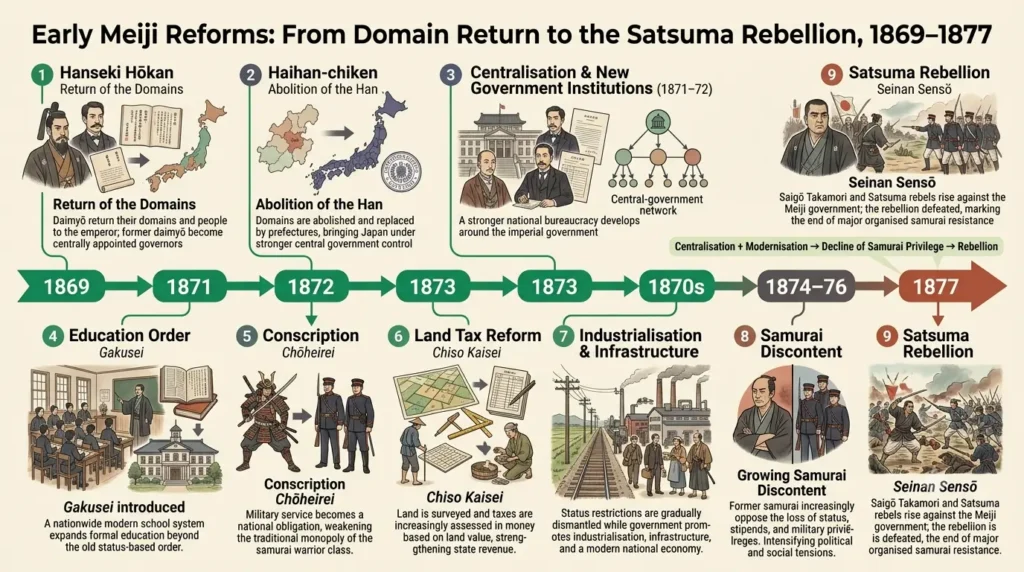
| Year | Reform | What it did |
|---|---|---|
| 1868 | Charter Oath; capital moved to Tokyo | Set out the new regime’s aims; shifted the centre of power |
| 1869 | Return of the domains (hanseki hōkan) | Daimyō were asked to return their domains and registers to the emperor |
| 1871 | Abolition of the han (haihan-chiken) | The 261 surviving domains were reorganised into prefectures (three urban fu and 302 ken at first), run by governors sent from the centre |
| 1871 | Status system dismantled; outcast status abolished | The four-class order was legally ended by about 1871 |
| 1871–1873 | Iwakura Mission | Studied institutions in the US and Europe; returned convinced of the need for domestic strengthening |
| 1872 | Education System Order; first railway (Shimbashi–Yokohama, opened 14 October 1872) | Start of national schooling and modern transport |
| 1873 | Conscription Ordinance (January) | Universal male conscription, ending the samurai monopoly on military service |
| 1873 | Land Tax Reform (July) | A new land tax paid in cash by landowners (see Part 3) |
| 1876 | Stipend commutation and sword ban | Samurai stipends were converted into interest-bearing government bonds; carrying swords in public was prohibited (28 March 1876) |
| 1877 | Satsuma Rebellion | Saigō Takamori’s rebellion was defeated by the conscript army |
Why these reforms mattered. The abolition of the han removed the territorial basis of daimyō power and made a single tax and administrative system possible. The conscript army replaced the samurai’s military monopoly, which meant that samurai privileges, stipends and even the right to wear swords could be phased out, as the stipend commutation of 1876 and the sword ban did. The government also faced resistance: the conscription law, which the Japanese often called the “blood tax” (a translation of a French expression), provoked riots, and wealthy citizens could buy exemptions, which made the burden fall on the poor. Samurai resentment finally erupted in a series of rebellions that ended with Saigō’s defeat in 1877.
2.7 Social and Cultural Change
Education. Education reform is one of the best-known Meiji changes, but the story is more complicated than “compulsory education from 1872 raised literacy”. The key steps are:
- 1872 Education System Order (Gakusei): an ambitious plan, influenced largely by the French model, to set up a national school system and to require all children to attend elementary school regardless of sex or class.
- 1879 Education Order: the government reversed course and decentralised, because the earlier plan had been unrealistic and attendance suffered.
- 1886 School Orders (Mori Arinori): set up the structure of elementary, middle and normal schools and the Imperial University on a Prussian-style, two-track system; four years of elementary schooling were required.
- 1890 Imperial Rescript on Education: stated the moral basis of schooling around loyalty to the emperor.
- 1900: tuition fees were abolished for compulsory elementary schooling, and 1907: compulsory schooling was extended to six years.
Enrolment rose from under 30 per cent in the 1870s to over 90 per cent by about 1900 in most accounts (sources give slightly different figures for particular years). So the literacy gains came gradually, and not in a single step in 1872.
Western influences. Fashions, architecture, medicine and technology were adopted, and foreign experts were hired for industry and education while Japanese students were sent abroad. Thinkers such as Fukuzawa Yukichi argued for “civilisation and enlightenment”, while others warned about the loss of national identity.
Samurai and commoners. The samurai lost their legal status, stipends and swords. Many became shizoku (former samurai) with reduced incomes and had to find new jobs, as officials, police, army officers, teachers or entrepreneurs, while others rebelled or fell into poverty. Meanwhile new groups appeared: landlords, industrialists, bankers and a growing urban working class.
Women and gender roles (a point the DU syllabus highlights). The course objectives for this paper give special attention to the role of women in late nineteenth and early twentieth century Japan. For this unit, note that the 1872 plan formally included girls in schooling and that educational opportunities for girls grew over time. At the same time, historians generally stress that the Meiji state also reinforced patriarchal structures, for instance through the household (ie) system in the Civil Code of 1898 and restrictions on women’s political activity in the early 1900s. So “Westernisation improved women’s rights” is too simple; the better formulation is that women gained educational openings while legal and political subordination was reinforced.
2.8 Significance and Limits of the Restoration
Significance.
- It ended feudalism and samurai political power and replaced the han with a centralised state.
- It started rapid modernisation (army, schools, transport, industry), which made Japan the first non-Western power to industrialise successfully.
- It created a new national identity centred on the emperor, which could unify people but also later served nationalist and militarist purposes.
Limits and criticisms.
- The change came from above. Ordinary people bore many of its costs: conscription, new taxes and the loss of village customs, and they rebelled in many places.
- The new regime was dominated by a narrow oligarchy, and political participation was limited.
- The emperor-centred ideology was both a source of unity and a risk, a point developed in Unit 2.
Key Takeaways (Part 2): The Restoration was set in motion by the collapse of the bakufu’s authority and finalised through the Boshin War (1868–1869). Early reforms (return and abolition of the han, conscription, status reform, stipend commutation, schooling) dismantled the feudal order. Historians differ on whether to call it a bourgeois revolution, an absolutist settlement, or a transfer of power within the ruling elite, and most agree that it was a “revolution from above” with real costs for peasants and samurai.
3. Economic Development in the Meiji Era
The Meiji era (1868–1912) is the period in which Japan changed from a mainly agrarian economy into an industrialising capitalist one. The DU syllabus divides this theme into agrarian settlement and industrialisation and capitalism, and the two are linked: the countryside supplied much of the revenue and labour on which industry was built.
Quick answer: how would you describe Japan’s economy during the Meiji period? It was a state-guided transition to capitalism. The government first financed itself largely through a reformed land tax, then built infrastructure and model factories, and from about 1880 sold many enterprises to private businessmen, which gave rise to the family-controlled business groups called zaibatsu. Agriculture, silk and textile exports, and cheap factory labour carried the early growth.
3.1 The Starting Point: What Did the Meiji Government Inherit?
The new government inherited an unfinished fiscal and monetary system, heavy debts, a patchwork of currencies and local taxes, and unequal treaties that limited its control over tariffs. But it also inherited some things that helped. Historians such as T. C. Smith (as DU study notes commonly cite him) argue that late Tokugawa Japan already had a commercialised rural economy, skilled artisans, urban merchants with considerable financial experience, and relatively high literacy. Other scholars point out that Tokugawa peasants produced the agricultural surplus that let the Meiji state finance its first steps in industrialisation. So there is a debate between those who stress Tokugawa preconditions and those who stress Meiji state action; a good answer usually combines both.
3.2 Agrarian Settlement
At the start of the period agriculture dominated the economy, and the government’s revenue depended mainly on the land. Its first priority was to turn feudal dues into a modern, predictable tax.
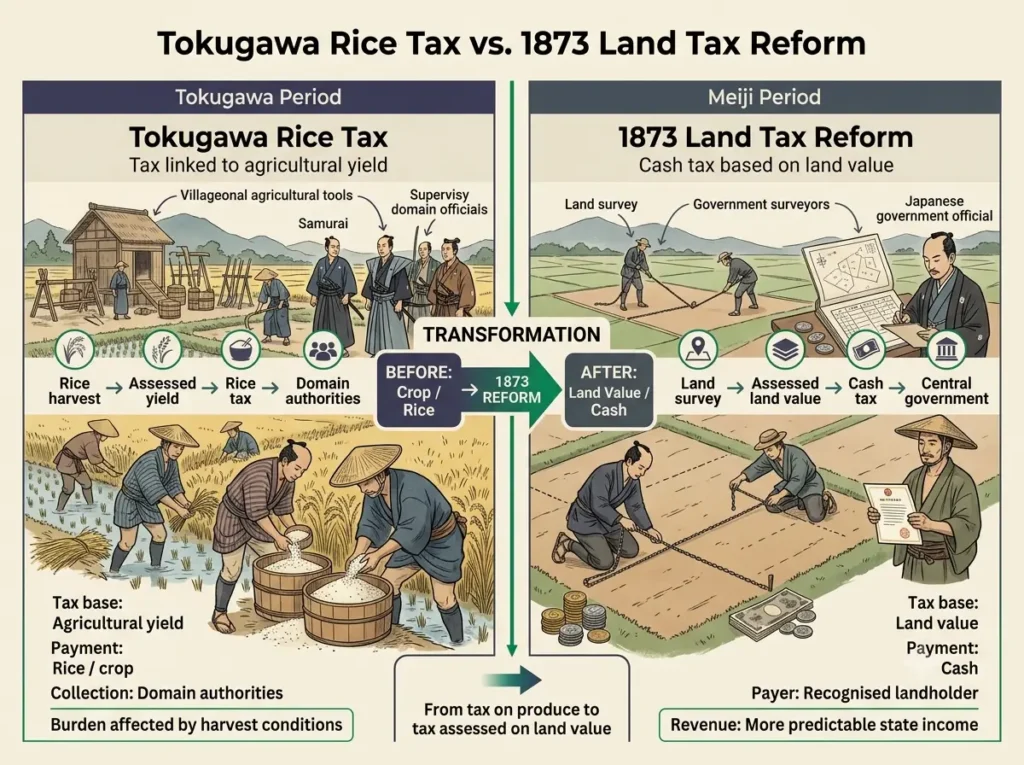
The Land Tax Reform of 1873. The reform was proclaimed in July 1873 and carried out over several years through land surveys.
| Feature | Under the Tokugawa system | After the 1873 reform |
|---|---|---|
| Basis | Estimated rice yield of the village or plot | Assessed value of the land |
| Rate | Varied, often a high share of the harvest | A uniform 3 per cent of assessed value at first |
| Form of payment | Mostly in rice (in kind) | In cash |
| Who paid | The village, as a unit | The individual landowner, named on a land certificate (chiken) |
| Land rights | Held within feudal obligations; sale of farmland restricted | Private ownership recognised; land could be bought, sold and mortgaged |
Effects of the reform.
- Fiscal stability. The assessment was designed so that government revenue would not fall, so the reform’s main achievement was to make revenue regular and cash-based and not to raise it sharply. (An earlier version of this article said it simply “increased government revenue”; scholars describe it as largely revenue-neutral at first.) After protests, the rate was later reduced.
- Land as a commodity. One of the most important effects was that land became a capital asset which could be bought and sold, an essential condition of capitalism.
- Pressure on farmers. The cash payment forced farmers to sell crops on the market, whatever the price, and made them vulnerable to bad harvests and falling prices. There were many local protests, including the Ise and Makabe revolts, and the most frequent complaint was about how officials fixed land values.
- Tenancy and landlordism. In the early 1880s the finance minister Matsukata Masayoshi carried out a severe deflationary policy. Crop prices fell, many farmers went bankrupt, and some wealthier owners bought their land and rented it out, so tenancy and a new landlord class grew. In 1884 the Chichibu incident, the largest popular uprising of the Meiji period, was an expression of rural distress, though it is also linked to the Freedom and People’s Rights movement.
- Agricultural improvement. Alongside this, the government encouraged new seed, fertilisers, tools and farm education, and more farmers grew commercial crops such as silk cocoons and tea. These raised output and supplied exports.
Link to industrialisation. The land tax was the government’s main source of revenue in the early decades, so it financed the army, the railways and the model factories. The agrarian settlement was therefore the financial base of industrialisation, though at a social cost to farmers.
3.3 Industrialisation: From State-Led to Private Enterprise
Industrialisation under the slogans fukoku kyōhei and “promote industry” (shokusan kōgyō) had three overlapping phases.
Phase 1 (c. 1868–1880): the state as pioneer. The government invested in the things private capital was not yet ready to build:
- Infrastructure. Japan’s first railway, between Shimbashi (Tokyo) and Yokohama, opened on 14 October 1872, with telegraph lines, lighthouses, ports and mail services following. These helped to create a national market and also served military needs.
- Model factories. The state set up modern factories to demonstrate foreign technology. The best-known is the Tomioka Silk Mill, begun with French technology and operating from 1872. It stood for the policy of improving the quality of silk, which was a key export.
- Support for private firms. Favoured businesses received government backing. For example, Mitsubishi received subsidies and privileges in shipping.
- Technology transfer. The government hired foreign advisers and sent students and officials abroad.
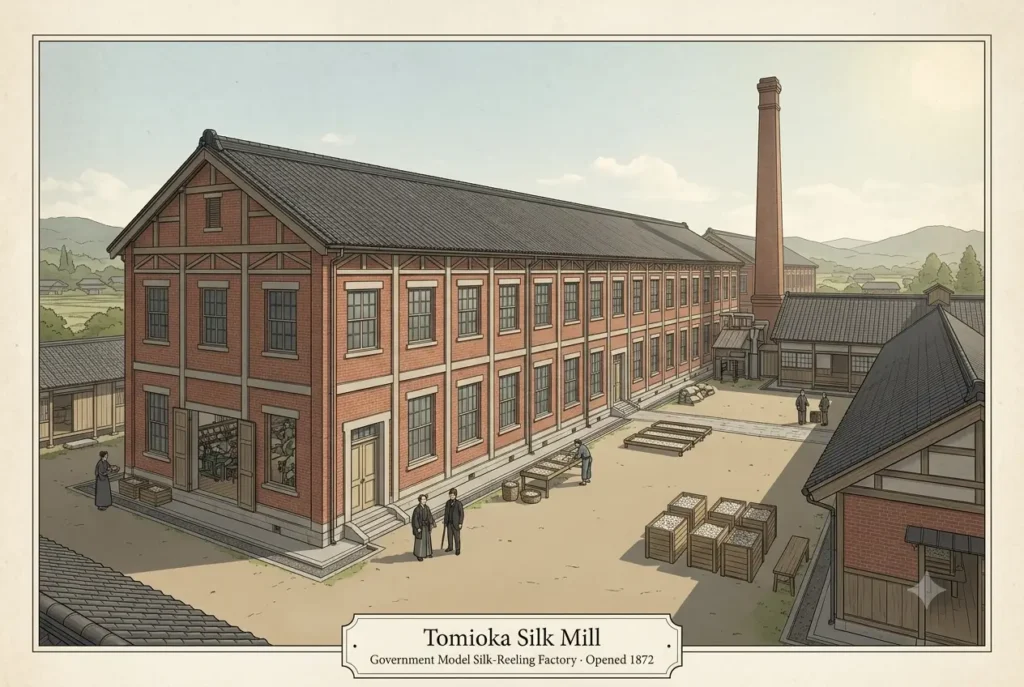
Phase 2 (c. 1880–1890s): privatisation. Government finances were strained, partly because of the costs of the 1877 rebellion and the inflation that followed, and many state enterprises were running at a loss. From about 1880 the state began selling its factories, mines and shipyards to private buyers, often on favourable terms. By 1896, according to an NBER working paper on the subject, twenty-six large state-owned enterprises had been privatised. The Tomioka mill itself was sold to Mitsui in 1893.
Phase 3 (1890s onward): private growth and heavy industry. After the wars with China (1894–1895) and Russia (1904–1905), heavy industries such as steel, shipbuilding and machinery expanded, often with strong state support, and the economy became more integrated with world trade.
3.4 Money, Banking and Finance
A stable financial system was essential for growth.
| Year | Development |
|---|---|
| 1871 | New Currency Act: the yen (divided decimally into 100 sen and 1,000 rin) replaced the confusing Tokugawa coinage. On paper the system was based on gold (1.5 g of gold to the yen), but in practice silver was widely used |
| 1870s | National banks and government bonds were introduced; samurai stipends were commuted into bonds (1876) |
| Early 1880s | Matsukata’s deflationary policy reduced inflation and balanced the budget, at a heavy cost to farmers |
| 1882 | The Bank of Japan was set up as a central bank |
| 1885 | Convertible banknotes were based on silver; Japan was effectively on a silver standard |
| 1897 | Japan adopted the gold standard (with 0.75 g of gold to the yen) |
(Note: an earlier version of this article said the yen was “pegged to the gold standard” in 1871. That is only partly right: the act was gold-based on paper, but Japan moved to a real gold standard in 1897. The Bank of Japan’s Currency Museum has a clear illustrated history of Japanese currency.)
3.5 Zaibatsu and the Rise of Capitalism
A zaibatsu was a large family-controlled business group, usually organised as a pyramid with a holding company at the top and subsidiaries in finance, trade, mining, shipping and manufacturing. The best-known were Mitsui, Mitsubishi, Sumitomo and Yasuda.
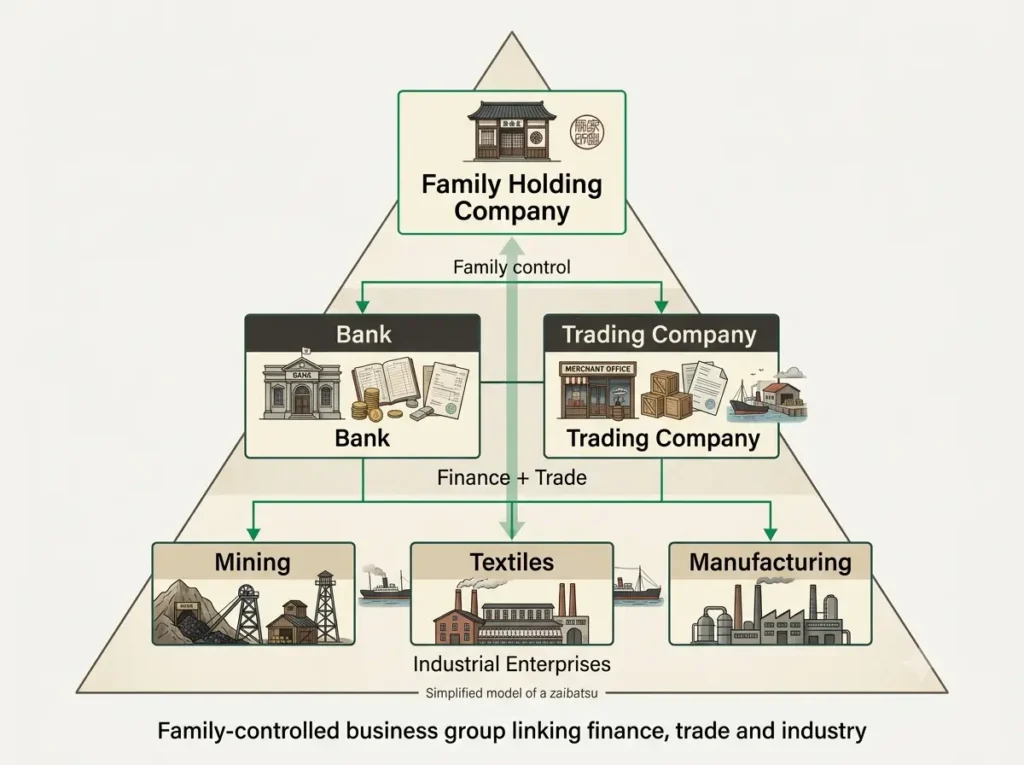
How did they grow?
- Some already had commercial wealth before 1868 (Mitsui and Sumitomo were old merchant houses).
- Others rose through government connections: Mitsubishi, led by Iwasaki Yatarō, grew through shipping and state contracts.
- Many acquired mines and factories when the state privatised them in the 1880s and 1890s.
- Each group combined a bank, a trading company and industrial firms, which let it raise capital and share risk.
Debate. Historians disagree about how to judge this arrangement. Some stress favouritism and the concentration of wealth in a few families. Others argue that the zaibatsu supplied the management, finance and coordination that a poor, late-developing economy needed. It is worth remembering that the occupation authorities after 1945 identified the zaibatsu as a pillar of the old order and tried to dissolve them (see our notes on the American occupation of Japan and post-war reconstruction).
3.6 Key Industries
- Silk and textiles. Raw silk and silk products were the leading exports in the early decades, and cotton spinning grew quickly after the 1880s. Textile firms employed large numbers of young women.
- Shipbuilding and shipping. Linked to defence and to trade; heavily subsidised in the early period.
- Mining and metals. Coal and iron were basic inputs for railways, ships and later steel.
- Heavy industry. Steel and machinery expanded after about 1900, with significant state involvement.
3.7 Labour and Workforce Changes
Industrialisation changed how people lived and worked.
- Urbanisation. People moved from rural areas to centres such as Tokyo and Osaka. Many factory workers, especially in textiles, were young women recruited from rural families and housed in dormitories.
- Working conditions. Long hours and low pay were common. Scholarly accounts describe workdays of roughly 14 hours in many cotton mills, and sometimes even more in the early decades, until the Factory Act limited hours.
- Labour organisation. In 1897 Takano Fusatarō and Katayama Sen and others formed an association to promote unions (Rōdō Kumiai Kiseikai), and the Iron Workers’ Union, often called Japan’s first modern trade union, was formed in December 1897. The government responded with the Public Order and Police Law of 1900, which restricted organising and strikes. A Factory Act was passed in 1911 and came into force only in 1916, limiting working hours (12 hours for the covered workers) and regulating child and female labour.
3.8 Foreign Trade and the Treaty Question
The unequal treaties continued to shape economic policy. Revising them (restoring Japan’s legal jurisdiction and tariff control) was a main aim of Meiji diplomacy, and this was one reason the government wanted a modern legal system, army and industry. In standard accounts, extraterritoriality was ended around 1899 and full tariff autonomy was regained in 1911. Some historians, including Beasley as cited in DU notes, argue that the unequal treaties, by exposing Japan to world markets and the threat of colonisation, in fact helped push the elite toward centralisation and rapid industrialisation, while the economic costs were also real.
Economic strength later fed into the expansion of Japan’s empire in Korea, Manchuria and China, which is the subject of Unit 3 (see our notes on Japanese expansion in Korea, Manchuria and China).
3.9 Important Comparison: Tokugawa Economy vs Meiji Economy
| Feature | Tokugawa economy | Meiji economy |
|---|---|---|
| Political framework | Bakuhan system; domains with own taxes and currencies | Centralised state with a single national tax and the yen |
| Land | Held within feudal obligations; sale restricted | Private ownership; land a tradable asset |
| Tax | Mostly in rice, assessed on yield | Cash tax on assessed land value |
| Social order | Four-class status order | Legal equality in principle; new classes of landlords, industrialists, workers |
| Industry | Mostly handicrafts and commercial agriculture | Railways, mechanised factories, heavy industry |
| Finance | Rice-based stipends; merchant lenders | Modern currency, banks, central bank, bonds |
| Foreign trade | Strictly limited until the 1850s | Open, though initially under unequal treaties |
3.10 Assessment: How Should We Judge Meiji Economic Development?
A strong DU answer usually weighs three arguments:
- A state-led success. The government created the institutions (currency, banks, schools, transport) and removed feudal barriers, which made rapid growth possible.
- Rooted in earlier developments. Commercial agriculture, merchant capital and literacy from the Tokugawa period provided the foundation.
- A costly transition. Farmers, factory workers and former samurai bore much of the burden, and the system created concentrated business power and a dual economy of modern industry alongside small-scale farming.
Key Takeaways (Part 3): The 1873 land tax reform created private landownership and a cash tax and financed early modernisation, while shifting risk onto farmers. The state built infrastructure and model factories, then privatised many enterprises from about 1880, which helped the zaibatsu to grow. Monetary reform (the yen in 1871, the Bank of Japan in 1882, the gold standard in 1897) supported capitalism, while labour conditions led to the first unions and, much later, factory legislation.
Conclusion
The bakuhan system held Japan together for over two and a half centuries by dividing power between the shogunate and the domains, but its financial base in rice, its rigid status order and its dependence on seclusion made it fragile. Famine, debt, samurai discontent and then the shock of Perry and the unequal treaties turned that fragility into a crisis. Out of the Meiji Restoration came a centralised state that abolished the domains, ended samurai privilege, built a conscript army and national schools, and reformed land and money. These steps, together with state-led and then private industrial growth, moved Japan from feudalism to capitalism within a generation, but at real social cost and under an oligarchic, emperor-centred political order whose weaknesses are examined in later units of this paper.
If you are preparing for exams, a useful exercise is to take any question on this unit and answer it in three parts: structure (what the system or reform was), causes and effects (why it changed or what it changed), and historians’ views (who disagrees, and why).
Continue Reading
Next in the DSC-3 History of Modern Japan series
- Japanese Expansion in Korea, Manchuria and China: Unit 3 notes on how the Meiji state’s power was turned outward.
- American Occupation of Japan and Post-War Reconstruction: Unit 4 notes, including what happened to the zaibatsu and the Meiji political legacy after 1945.
- All History of Modern Japan (c. 1868 – 1950s) notes: every unit of DSC-3 in one place.
University of Delhi Previous Year Questions (PYQs)
University of Delhi Previous Year Questions
Section A — Meiji Restoration and the Tokugawa Crisis
1 Analyse the nature of the Meiji Restoration. In what ways was it anti-feudal? +
Year / Paper: B.A. (Hons.) History, 6th Semester, 2018, Deshbandhu College — older syllabus
Hint: Define the Meiji Restoration and examine the measures that dismantled the Tokugawa feudal order.
Suggested Answer Focus: Abolition of the han system, status reforms, conscription, land-tax reforms and the dismantling of feudal privileges; also discuss continuities such as oligarchic rule and emperor-centred ideology. Include the Norman, Kōza-ha and Rōnō-ha interpretations where relevant. Source-Attributed
2 What was the Meiji modernisation programme (1868–1894)? Assess its impact. +
Year / Paper: B.A. (Hons.) History, 6th Semester, 2018, Deshbandhu College — older syllabus; question stem partially legible in the source
Hint: Organise the answer around political, military, educational and economic modernisation.
Suggested Answer Focus: Centralisation, military reforms, education, industrialisation, infrastructure and state-building; balance achievements against the social and economic costs borne by peasants and former samurai. Source-Attributed
3 Examine the crisis of the Tokugawa bakuhan system. How far was it caused by internal weaknesses and how far by foreign pressure? +
Year / Paper: Probable — based on the syllabus and DU-style examination themes
Hint: Balance internal weaknesses such as debt, famine and social tensions against external pressures from Western powers.
Suggested Answer Focus: Tokugawa fiscal and political weaknesses, samurai and domain finances, peasant unrest, Perry’s arrival, the Harris Treaty, foreign pressure and the debate between foreign-shock and internal-structural explanations. Probable
4 Discuss the nature and significance of the Meiji Restoration with reference to historians’ interpretations. +
Year / Paper: Probable — based on the historiographical themes of the syllabus
Hint: Compare major interpretations of the Restoration rather than presenting it as a simple political transfer of power.
Suggested Answer Focus: Meiji Restoration as revolution, elite-led transformation, anti-feudal change and capitalist transition; use contrasting historians and explain the strengths and limitations of their interpretations. Probable
5 Assess the early Meiji reforms (1868–1877) in dismantling the feudal order. +
Year / Paper: Probable — based on the syllabus
Hint: Trace the reforms chronologically from the return of domains to the abolition of feudal privileges and the Satsuma Rebellion.
Suggested Answer Focus: Return of domains, abolition of han, conscription, commutation of stipends, sword restrictions, new administrative structures and the Satsuma Rebellion; conclude with an assessment of the extent of anti-feudal transformation. Probable
Section B — Agrarian Change and Industrialisation
6 Examine agrarian settlement in Meiji Japan. How did the 1873 Land Tax Reform contribute to industrialisation? +
Year / Paper: Probable — based on the syllabus
Hint: Explain the basis of the new land-tax system and connect it with state finance and industrialisation.
Suggested Answer Focus: Land valuation, private landownership, cash taxation, the 1873 Land Tax Reform, state revenue, investment in industrialisation, and the burden placed on cultivators and tenants. Probable
7 Trace the stages of industrialisation in Meiji Japan. What was the role of the state and of the zaibatsu? +
Year / Paper: Probable — based on the syllabus
Hint: Explain the movement from state-sponsored industrialisation to increasing private-sector participation.
Suggested Answer Focus: Early state enterprises, infrastructure, industrial policy, transfer or privatisation of enterprises, emergence of major zaibatsu and the changing relationship between the state and private capital. Probable
8 “The Meiji period saw the transition from feudalism to capitalism.” Discuss. +
Year / Paper: Probable — based on the syllabus
Hint: Compare the Tokugawa and Meiji economic structures and assess how far the transition to capitalism was complete.
Suggested Answer Focus: Transformation of land relations, market expansion, wage labour, industrialisation, state intervention, private capital and zaibatsu; also address regional inequalities and the costs of capitalist transformation. Probable
Section C — Short Answer Questions and Short Notes
9 Write a short note on Bunmei Kaika (Civilisation and Enlightenment). +
Year / Paper: B.A. (Hons.) History, 6th Semester, 2018, Deshbandhu College — older syllabus
Hint: Discuss Fukuzawa Yukichi, the adoption of Western ideas and debates over the extent of Westernisation.
Suggested Answer Focus: Meaning of Bunmei Kaika, Western education and ideas, social and cultural changes, Fukuzawa’s role and criticisms of excessive Westernisation. Source-Attributed
10 Sankin-kōtai +
Hint: Explain alternate attendance, the presence of daimyō families in Edo and the financial consequences.
Suggested Answer Focus: Tokugawa control over daimyō, political surveillance, hostage-like residence arrangements, travel obligations, expenditure and the wider economic effects. Probable
11 Shinpan, Fudai and Tozama daimyō +
Hint: Define the three categories according to their relationship with the Tokugawa house.
Suggested Answer Focus: Shinpan, Fudai and Tozama classifications, their political position, access to office and significance for the political crisis of the late Tokugawa period. Probable
12 Sonnō jōi +
Hint: Trace its origins, the Mito intellectual context and its transformation from anti-foreignism to anti-bakufu politics.
Suggested Answer Focus: “Revere the Emperor, expel the barbarians,” Mito School, imperial ideology, political mobilisation and its role in the fall of the Tokugawa shogunate. Probable
13 Kokugaku and Rangaku +
Hint: Define the two intellectual traditions and explain their contribution to late Tokugawa intellectual and political change.
Suggested Answer Focus: Study of Japanese classics and indigenous traditions through Kokugaku; Dutch learning and Western knowledge through Rangaku; their intellectual influence on the crisis of the Tokugawa order. Probable
14 Harris Treaty and the unequal treaties +
Hint: Explain extraterritoriality, tariff restrictions and the political controversy surrounding the treaty.
Suggested Answer Focus: Treaty provisions, unequal treaty system, loss of tariff autonomy, extraterritoriality, Ii Naosuke and the impact on bakufu legitimacy. Probable
15 Charter Oath +
Hint: Discuss the five articles of April 1868 and their significance for the new Meiji state.
Suggested Answer Focus: Political participation, public discussion, social mobility, rejection of outdated customs and the broader statement of Meiji reform objectives. Probable
16 Boshin War +
Hint: Trace the conflict from Toba–Fushimi to Hakodate during 1868–1869.
Suggested Answer Focus: Civil war between forces supporting the shogunate and the imperial government, major military stages, defeat of the bakufu and consolidation of the Meiji regime. Probable
17 Land Tax Reform of 1873 +
Hint: Explain land valuation, cash payment, the original 3 per cent rate and the chiken system.
Suggested Answer Focus: Creation of a stable tax base, recognition of private landownership, state revenue, agricultural burden and the relationship between the reform and Meiji industrialisation. Probable
18 Zaibatsu +
Hint: Discuss Mitsui, Mitsubishi, Sumitomo and Yasuda and the process through which large business groups expanded.
Suggested Answer Focus: State-sponsored industrialisation, privatisation, family-controlled business groups, banking and industrial expansion, and the debate over their role in Meiji capitalism. Probable
19 Fukoku kyōhei +
Hint: Explain the principle of “Enrich the country, strengthen the army” and its place in Meiji state-building.
Suggested Answer Focus: Economic development, military strengthening, conscription, industrialisation, fiscal reforms and the connection between national wealth and military power. Probable
20 Iwakura Mission +
Hint: Cover the 1871–1873 mission and the roles of Iwakura, Ōkubo and Kido.
Suggested Answer Focus: Diplomatic objectives, observation of Western political and economic institutions, lessons for Japanese modernisation and the mission’s influence on subsequent Meiji reforms. Probable
Frequently Asked Questions (FAQs)
Why is it called the “bakuhan” system, and who coined the term?
The word combines baku (from bakufu, the shogunate) and han (the domains). Modern historians coined the term to describe how the shogunate and the domains shared power; the Tokugawa rulers did not use it themselves.
Was Tokugawa Japan really “feudal”?
It is described as “centralized feudalism” in the textbook by Fairbank, Reischauer and Craig, which is on the DU reading list. The label fits in the sense of lords, vassals and land held for service, but it hides important differences from medieval Europe, such as the very strong central bakufu and the separation of the samurai from the land. Many historians therefore prefer to speak of the bakuhan system or the bakuhan state.
Did the Tokugawa shogunate fall because of Perry or because of internal weakness?
Both mattered. Debt, famine and samurai discontent had weakened the system, but Perry’s arrival and the unequal treaties turned that weakness into a crisis of legitimacy. Historians differ on how much weight to give each, and Totman’s study of the 1860s shows how political choices decided the outcome.
What is the difference between the Convention of Kanagawa (1854) and the Harris Treaty (1858)?
The 1854 convention opened Shimoda and Hakodate to American ships and provided for shipwrecked sailors and a consul, but it was not a trade treaty. The 1858 Harris Treaty opened more ports to trade, gave Americans extraterritoriality and removed Japan’s control over tariffs, which is why it is called an unequal treaty.
Why were Satsuma and Chōshū so important in 1868?
They were large tozama domains kept at a distance from the bakufu’s inner circle, and they had the resources and military strength to challenge it. As the Japan Society’s essay on the Tokugawa polity argues, their intrusion into national politics upset the old balance and led to the fall of the bakuhan system.
Was the Meiji Restoration a revolution?
There is no single answer. Norman called it a modified bourgeois revolution, the Kōza-ha called the new state absolutist, the Rōnō-ha called it bourgeois, and the Cambridge History of Japan describes it as a shift of power within the old ruling class that nevertheless transformed the state. A good exam answer sets these views side by side and offers a reasoned judgement.
What happened to the samurai after 1868?
They lost their legal status, their stipends were converted into government bonds in 1876, and they lost the right to carry swords in public. Some entered government, the army or business, others fell into poverty, and some rebelled, most famously in the Satsuma Rebellion of 1877.
What exactly did the 1873 Land Tax Reform change?
It replaced taxes in rice based on estimated yield with a cash tax of 3 per cent (at first) on the assessed value of land, paid by the individual owner named on a land certificate. This created private landownership and a reliable state income, but also exposed farmers to market and price risks.
How did Meiji Japan finance its industrialisation?
Mainly through the land tax in the early decades, supplemented by loans, bonds and later by private capital. The state built infrastructure and model factories first, and from about 1880 sold many enterprises to private buyers.
Is the Meiji Constitution part of Unit 1 or Unit 2?
The DU syllabus places the Meiji Constitution in Unit 2 (Democracy and Militarism). In Unit 1 you only need to place it as the end point of early state-building, as done in Section 2.3.
Essential Readings from the DU Syllabus (Unit 1)
The University of Delhi syllabus for DSC-3 lists these for Unit 1 (see the official syllabus PDF for the full list and suggested readings):
- Andrew Gordon, A Modern History of Japan: From Tokugawa Times to the Present (2003), Chapter 3 (The Intellectual World of Late Tokugawa) and Chapter 4 (Overthrow of the Tokugawa)
- J. W. Hall (ed.), Cambridge History of Japan, Volume IV: Early Modern Japan
- M. B. Jansen, The Making of Modern Japan; and Jansen and Rozman (eds.), Japan in Transition: From Tokugawa to Meiji
- J. L. McClain, Japan: A Modern History, Chapter 3
- Conrad Totman, The Collapse of the Tokugawa Bakufu, 1862–1868
- Suggested: W. G. Beasley, The Meiji Restoration; E. H. Norman, Japan’s Emergence as a Modern State (Chapter III, “The Restoration”); G. C. Allen, A Short Economic History of Modern Japan; W. W. Lockwood, The Economic Development of Japan; Fairbank, Reischauer and Craig, East Asia: Tradition and Transformation (Chapters 15, 17 and 18)
Subscribe to keep reading
You've used your free notes for now. Get Delhi Pathshala Premium for unlimited access.
Subscribe — ₹29/30 days