
Contents
- 1. The Revolution of 1911: Context, Nature and Significance
- 1.1 Background Before the Revolution
- 1.2 Key Events Before the Revolution
- 1.3 Political and Social Changes
- 1.4 Key Leaders of the Revolution
- 1.5 Role of Social Groups and Changing Gender Roles
- 1.6 Major Events of the 1911 Revolution
- 1.7 Importance and Significance of the Revolution
- 2. Sun Yat-sen: Ideology and the Three Principles of the People
- 2.1 Early Life and Formation of Revolutionary Thought
- 2.2 The Three Principles of the People (Sanmin Zhuyi)
- 2.3 Significance of Sun Yat-sen’s Ideology
- 3. The May Fourth Movement of 1919
- 3.1 Background and Causes
- 3.2 Ideological Foundations of the Movement
- 3.3 Major Events and Activities
- 3.4 Significance and Impact
- 4. Previous Year Questions (DU History Hons.)
- 5. FAQs
- Related Notes
- further reading
In this post, complete notes of Unit 3: Emergence of Nationalism in China from DSC-3: History of Modern China (1840s–1950s) are given, covering all three parts of the official syllabus — the Revolution of 1911, Sun Yat-sen’s ideology and the Three Principles of the People, and the May Fourth Movement of 1919. These notes are helpful for B.A. (Hons.) History students at Delhi University preparing for semester exams.
1. The Revolution of 1911: Context, Nature and Significance
1.1 Background Before the Revolution
The Revolution of 1911, also known as the Xinhai Revolution, ended over 2,000 years of imperial rule in China under the Qing dynasty and led to the establishment of the Republic of China.
- Weakness of the Qing Dynasty: By the late 1800s, the Qing dynasty was in deep crisis. Foreign powers had gained control over parts of China through unequal treaties following events like the Opium Wars and the Boxer Uprising, exposing the government’s weakness.
- Internal Problems: The Qing dynasty faced widespread corruption and repeated uprisings. Its defeat in the First Sino-Japanese War revealed how far China had fallen behind in technology and military strength compared to Japan.
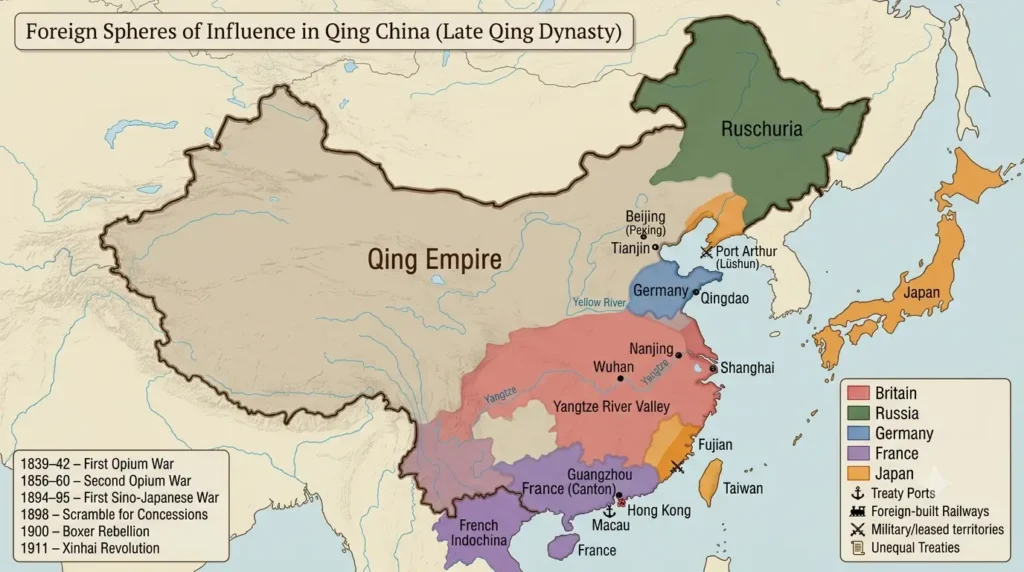
- Foreign Control: China was carved into spheres of influence controlled by foreign powers, who dominated trade and enjoyed extraterritorial privileges — fuelling public anger.
- New Ideas: Western ideas about democracy and modernization began influencing Chinese thinkers. Reformers like Kang Youwei and Liang Qichao pushed for change, but conservative Qing leaders resisted.
- Economic Struggles: Widespread poverty, hunger, and natural disasters, combined with high taxation, deepened popular discontent.
- Rise of Revolutionary Groups: Secret societies and organisations such as the Tongmenghui, led by Sun Yat-sen, emerged to push for the overthrow of Qing rule and the founding of a republic.
1.2 Key Events Before the Revolution
- First Sino-Japanese War (1894–95): China’s humiliating defeat by Japan triggered widespread calls for reform.
- Boxer Uprising (1899–1901): This nationalist but ultimately failed uprising invited foreign military intervention, further weakening the Qing state.
- Late Qing Reforms: Reforms introduced after the Boxer Uprising were too slow and limited to address the underlying crisis.
- Rise of Revolutionary Action: Secret societies and revolutionary cells multiplied across the country, leading to frequent local uprisings against Qing authority.
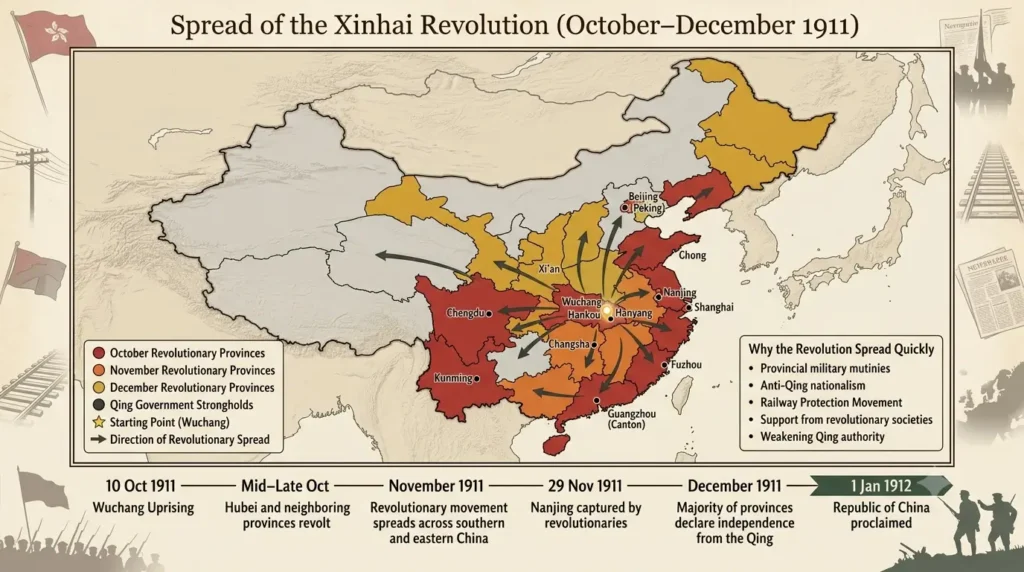
- Wuchang Uprising: On 10 October 1911, army officers in Wuchang rebelled, igniting the revolution that quickly spread across China.
1.3 Political and Social Changes
- Weak Imperial Rule: By 1911, the Qing court had lost effective control; local leaders and military commanders held more real power than the increasingly out-of-touch central government.
- Social Change: A growing desire for reform and unity spread among students, intellectuals, and the emerging middle class. The traditional Confucian order faced mounting challenge, while peasants grew restless over social inequality.
- Military’s Role: Many army officers, disillusioned with the Qing, became key actors in the revolution, often siding with local leaders or revolutionary groups instead of the imperial government.
1.4 Key Leaders of the Revolution
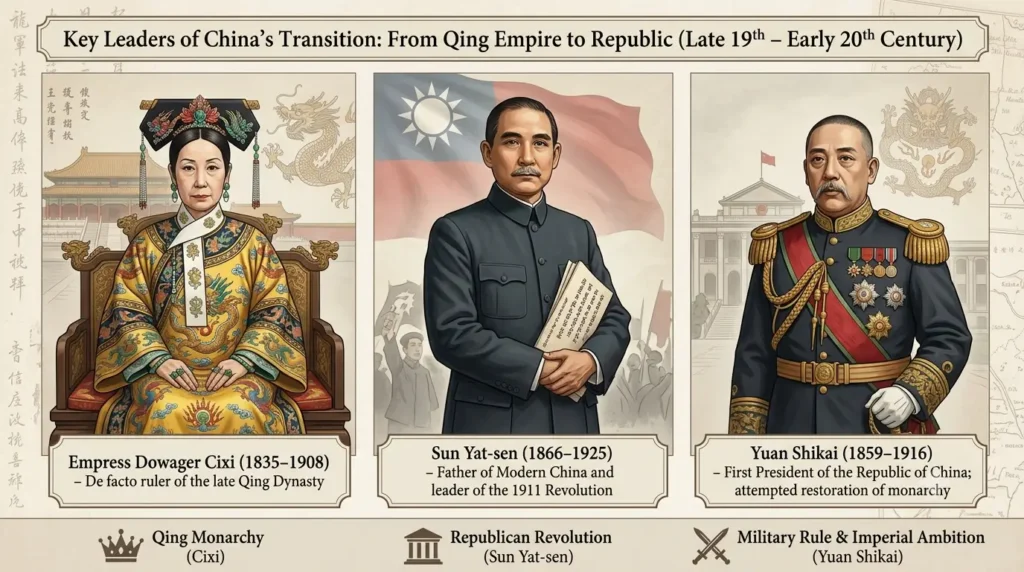
- Sun Yat-sen: Regarded as the father of modern China, Sun Yat-sen led the revolutionary movement in exile, advocating a republic built on nationalism, democracy, and people’s welfare. (See Section 2 for his full ideology.)
- Yuan Shikai: A powerful military commander who initially supported the Qing but later switched allegiance, becoming a central figure in the new republic — though his later ambition to declare himself emperor caused fresh instability.
- Empress Dowager Cixi: China’s long-time de facto ruler, she died in 1908, leaving the young and inexperienced Puyi as the last emperor — accelerating the dynasty’s collapse.
1.5 Role of Social Groups and Changing Gender Roles
- Students and Intellectuals: Overseas Chinese students, particularly those studying in Japan, formed the intellectual backbone of the revolutionary movement, spreading nationalist and republican ideas back home.
- The New Army: Ironically, the modernised Qing military — created to strengthen the dynasty — became a hotbed of revolutionary sentiment and delivered the fatal blow at Wuchang.
- Merchant and Gentry Classes: Provincial assemblies dominated by local gentry and merchants withdrew support from the Qing once it became clear the dynasty could not protect their commercial and political interests.
- Changing Gender Roles: The revolutionary period saw early stirrings of women’s participation in politics — including women’s military units and calls for female suffrage — as traditional Confucian gender hierarchies were questioned alongside imperial authority. This would expand further during the May Fourth era (see Section 3).
1.6 Major Events of the 1911 Revolution
Wuchang Uprising
- Date: 10 October 1911
- What began as a reaction against corrupt local officials among army units quickly escalated into a nationwide revolution, marking a decisive break between the military and the Qing state.
Spread of the Revolution
- Following Wuchang, province after province declared independence from Qing rule through October 1911.
- In December 1911, revolutionaries formed a provisional government in Nanjing and named Sun Yat-sen its provisional president, despite his being abroad at the time.
Establishment of the Republic of China
- In early 1912, the Qing dynasty formally abdicated; Puyi, the last emperor, stepped down, ending over two millennia of imperial rule.
- On 1 January 1912, the Republic of China was proclaimed, opening a new — though unstable — chapter in Chinese history.
1.7 Importance and Significance of the Revolution
- End of the Qing Dynasty: The Xinhai Revolution ended imperial rule in China, fostering a new sense of national unity.
- Impact on Society and Government: The new Republic introduced a modern political framework, though instability and factional conflict persisted. It also reshaped social attitudes toward rights and citizenship.
- Inspiration for Future Movements: The 1911 Revolution laid groundwork for later movements, including the rise of the Kuomintang and the Chinese Communist Party — explored further in Communist Movement in China.
The 1911 Revolution marked a major turning point in Chinese history — but the ideology that shaped its republican vision came chiefly from one figure: Sun Yat-sen.
2. Sun Yat-sen: Ideology and the Three Principles of the People
(DSC-3, Unit 3, Part b — Sun Yat-sen / Sun Zhong Shan: Ideology and Three People’s Principles)
2.1 Early Life and Formation of Revolutionary Thought
- Background: Sun Yat-sen (孫中山, also known as Sun Zhongshan) was born in Guangdong province in 1866 and received part of his education in Hawaii and Hong Kong, exposing him early to Western political thought.
- Revive China Society (1894): Sun’s first revolutionary organisation, formed with the initial goals of nationalism and democracy, aimed at overthrowing Qing rule.
- Formation of the Tongmenghui (1905): In Tokyo, Sun merged several revolutionary groups into the Tongmenghui (Revolutionary Alliance), giving the movement an organised structure and a unifying ideology for the first time.
- Years in Exile: Sun spent much of the pre-1911 period abroad, raising funds and support among overseas Chinese communities while organising repeated armed uprisings, most of which failed but kept revolutionary momentum alive.
2.2 The Three Principles of the People (Sanmin Zhuyi)
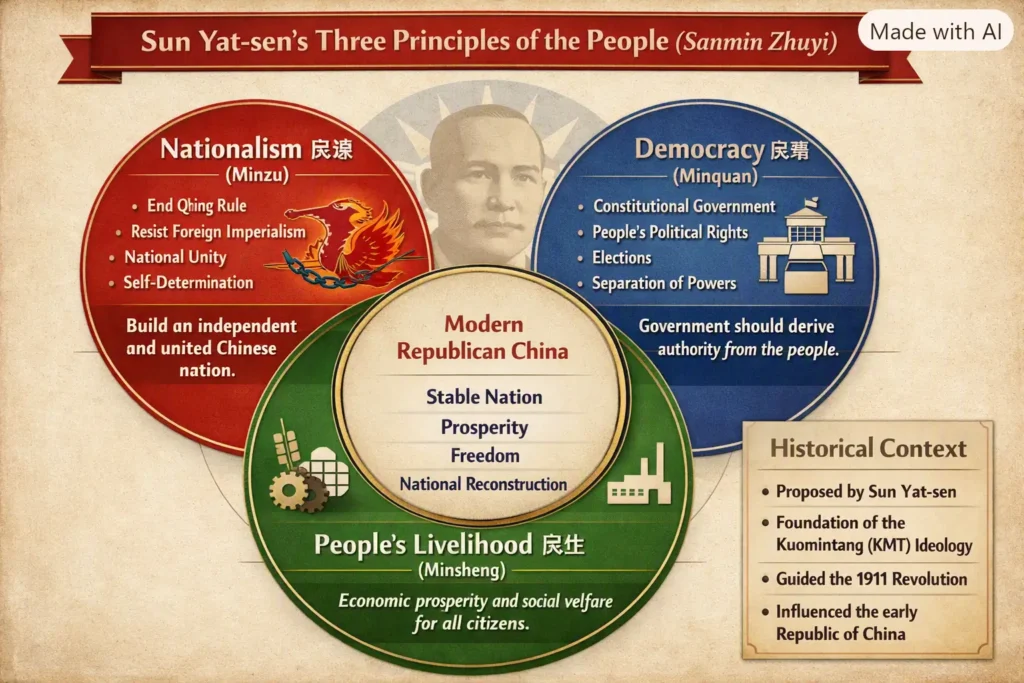
Sun Yat-sen’s political philosophy rested on three interlocking principles, first fully articulated around 1905:
- Minzu (Nationalism): Called for uniting the Han Chinese and other ethnic groups while ending Qing “foreign” rule and resisting Western and Japanese imperialism. It evolved from an early “anti-Manchu” position into a broader vision of a unified multi-ethnic Chinese nation.
- Minquan (Democracy): Envisioned a republican government accountable to the people, with Sun proposing a distinctive five-branch system — adding examination and censorial branches to the standard Western executive, legislative, and judicial model.
- Minsheng (People’s Livelihood): Focused on economic and social reform, including land equalisation and regulation of capital, to address poverty and inequality — drawing loosely on Western social-reform ideas while rejecting outright class warfare.
2.3 Significance of Sun Yat-sen’s Ideology
- The Three Principles became the ideological foundation of the Kuomintang (KMT) and are still referenced in the Republic of China’s (Taiwan) national anthem today.
- Sun’s insistence on a unified, sovereign nation-state gave the 1911 Revolution its guiding vision, even though he did not personally lead the Wuchang Uprising.
- His ideas later split into competing interpretations — the KMT’s more conservative reading versus the CCP’s later “New Three Principles” reinterpretation — a divide that shaped Chinese politics for decades, discussed further in Communist Movement in China.
- Despite the Republic’s early instability, Sun Yat-sen’s framework of nationalism, democracy, and livelihood remained the central reference point for Chinese political thought through the Republican era.
3. The May Fourth Movement of 1919
3.1 Background and Causes
Treaty of Versailles and Chinese Territorial Issues
The May Fourth Movement (1919) was a landmark event in modern Chinese history, driven by both international humiliation and domestic discontent.
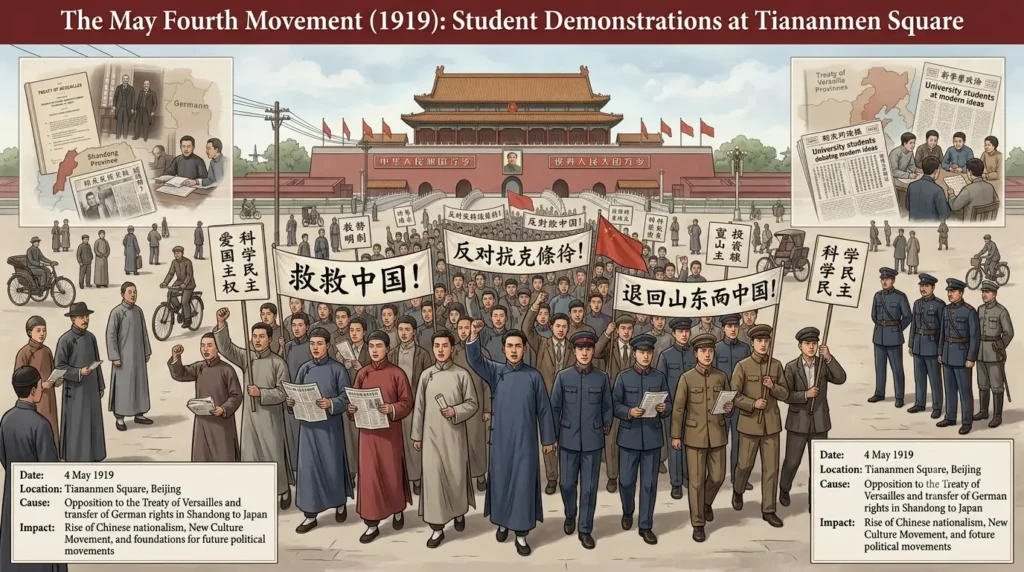
- The Treaty of Versailles (1919): After World War I, the treaty transferred Germany’s former territorial rights in Shandong Province to Japan instead of returning them to China — despite China’s contribution to the Allied war effort. This decision was widely seen as a national humiliation.
- Territorial and Sovereignty Concerns: The Shandong decision exposed the broader problem of continued foreign control and China’s struggle to assert real sovereignty. The weak central government was seen as unable to stand up to foreign powers.
- Widespread National Discontent: Protests reflected deeper anger over foreign exploitation, government corruption, and the unfinished promise of the 1911 Revolution.
Intellectual and Cultural Awakening
- Instability After 1911: The early Republic struggled with weak central authority and regional fragmentation under competing warlords.
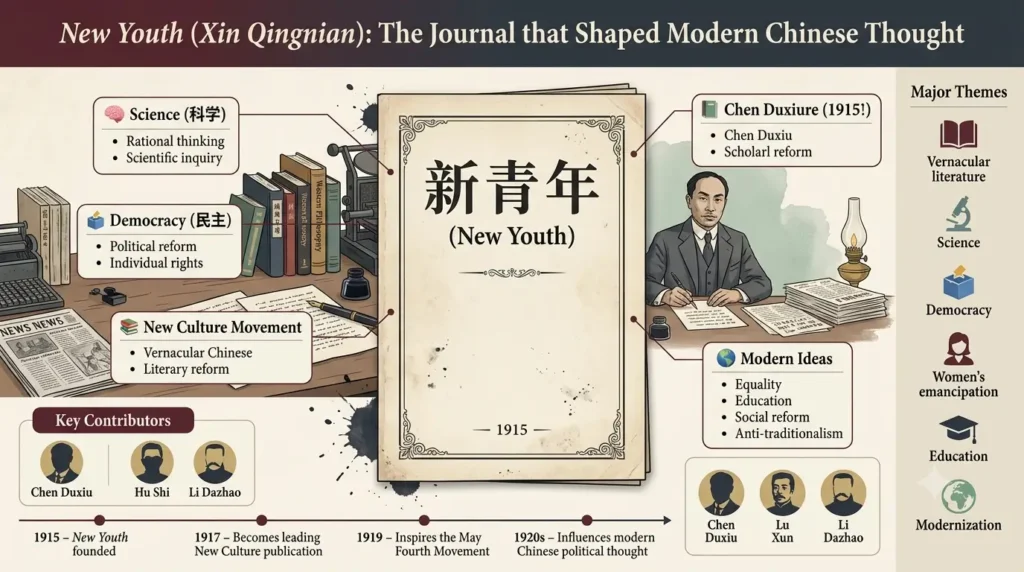
- The New Culture Movement (1915–1921): Closely linked to May Fourth, this movement — led by figures like Chen Duxiu and Lu Xun — rejected traditional Confucian values in favour of Western ideas of democracy and science, setting the intellectual stage for the 1919 protests.
- Social Reform and Modernization: Intellectuals demanded change to China’s political and cultural systems, criticising practices such as foot binding, arranged marriages, and patriarchal family structures.
3.2 Ideological Foundations of the Movement
Science, Democracy, and Modernity
- Leaders like Chen Duxiu championed “Mr. Science” and “Mr. Democracy” as twin pillars of national renewal, advocating Western-style education while rejecting traditional metaphysics.
- The movement drew on Enlightenment-era Western political ideas, aiming to replace the imperial mindset with an accountable, rights-based government.
Critique of Confucianism
- Intellectuals argued that rigid Confucian hierarchy had held China back and left it vulnerable to foreign domination.
- The critique extended to gender roles and family structures, with growing calls for women’s rights and an end to child marriage and foot binding.
Influence of New Intellectual Trends
- Thinkers such as John Dewey and Herbert Spencer were widely read, reinforcing themes of democracy, individual rights, and scientific reasoning.
- Marxism and socialism gained ground among movement leaders — Li Dazhao’s role in spreading Marxist ideas directly fed into the founding of the Chinese Communist Party in 1921.
3.3 Major Events and Activities
- 4 May 1919: Thousands of students gathered at Tiananmen Square to protest the Treaty of Versailles decision and the government’s weak response, demanding China reject the treaty.
- National Strikes and Boycotts: Protests spread to Shanghai, Nanjing, and other cities, accompanied by boycotts of Japanese goods and citywide strikes.
- Role of Intellectuals: Writers like Lu Xun, Chen Duxiu, and Hu Shi used their work to promote modernization, science, and democracy.
- New Youth Journal: Chen Duxiu’s magazine became the movement’s key publishing platform, promoting vernacular Chinese, democratic ideals, and scientific thinking.
3.4 Significance and Impact
- Political and Social Reforms: The movement fuelled the rise of the Chinese Communist Party and generated lasting calls for constitutional and civil rights reform.
- Spread of Nationalist Sentiment: Rejection of the Versailles terms and the anti-Japanese boycotts strengthened national unity and resistance to foreign influence.
- Long-term Influence: The May Fourth Movement is widely regarded as the intellectual foundation for both the Nationalist and Communist movements that would shape China through 1949 and beyond.
In summary, the 1911 Revolution dismantled the old imperial order, Sun Yat-sen’s Three Principles gave the new republic its ideological compass, and the May Fourth Movement of 1919 radicalised a generation of students and intellectuals — together forming the complete arc of China’s emergence of nationalism in the early twentieth century.
4. Previous Year Questions (DU History Hons.)
Typical question patterns based on past DSC-3 (History of Modern China) examinations — practice these for exam preparation:
- Critically evaluate the nature and significance of the Revolution of 1911.
- Analyse the political and cultural background of the May Fourth Movement of 1919.
- Examine the major trends in the emergence of nationalism in early twentieth-century China.
- Discuss Sun Yat-sen’s Three Principles of the People (Sanmin Zhuyi) and assess their significance for modern China.
- To what extent did the May Fourth Movement mark a turning point in modern Chinese history?
- Write short notes on: (a) Wuchang Uprising (b) Tongmenghui (c) New Culture Movement.
- Compare the causes and consequences of the 1911 Revolution and the May Fourth Movement of 1919.
5. FAQs
What are Sun Yat-sen’s Three Principles of the People?
They are Minzu (Nationalism), Minquan (Democracy), and Minsheng (People’s Livelihood) — Sun Yat-sen’s political framework for building a unified, democratic, and economically fair China.
When did the May Fourth Movement start?
It began on 4 May 1919, when students in Beijing protested against the Treaty of Versailles decision to give Shandong Province to Japan.
What caused the 1911 Revolution?
Key causes included Qing dynastic weakness, foreign control through unequal treaties, internal corruption, economic hardship, and the rise of revolutionary groups like the Tongmenghui.
Who led the Wuchang Uprising?
The Wuchang Uprising on 10 October 1911 was led by disaffected officers of the New Army, not directly by Sun Yat-sen, who was abroad at the time.
How is the 1911 Revolution connected to the May Fourth Movement?
The 1911 Revolution ended imperial rule but left the Republic unstable and dominated by warlords; this unresolved instability, combined with the Versailles humiliation, directly fuelled the May Fourth protests in 1919.
Which DSC paper covers Emergence of Nationalism in China?
This topic is Unit 3 of DSC-3: History of Modern China (1840s–1950s), part of the B.A. (Hons.) History syllabus at Delhi University, Semester 3.
Related Notes
- Late Imperial China and Western Imperialism
- Political System of China
- Communist Movement in China
- Popular Movements and Reforms in the 19th Century
- Democracy: Idea and Practice
further reading
Subscribe to keep reading
You've used your free notes for now. Get Delhi Pathshala Premium for unlimited access.
Subscribe — ₹29/30 days