
Contents
- Part 1: Concept of Obligations
- 1.1 What is an Obligation?
- 1.2 Types of Obligations
- 1.3 Relationship Between Rights and Obligations
- Part 2: Theories of Rights and Obligations
- 2.1 Deontological Perspectives
- 2.2 Consequentialist Perspectives
- 2.3 Deontological vs Consequentialist — Comparison
- Part 3: Rights and Duties in Society
- 3.1 Individual vs Collective Rights
- 3.2 Case Studies
- Part 4: Balancing Rights and Obligations
- Part 5: Debate — Human Rights: Universalism or Cultural Relativism
- 5.1 Introduction to Human Rights
- 5.2 Universalism
- 5.3 Cultural Relativism
- 5.4 Universalism vs Cultural Relativism — Comparison
- 5.5 Key Debates and Case Studies
- Practice Questions
- FAQs
- Further Reading
Notes for Unit 4: Rights (b) Rights and Obligations | Debate: Human Rights — Universalism or Cultural Relativism, from DSC-7: Political Theory: Concepts and Debates, B.A. (Hons.) Political Science, Semester 3, University of Delhi.
Quick Summary (30-second read): This unit has two parts — (1) how rights and obligations relate to each other, seen through deontological and consequentialist lenses, and (2) the central human rights debate: are rights universal (the same for everyone, everywhere) or culturally relative (shaped by each society’s own values)? Jump to practice questions · Jump to FAQs
Part 1: Concept of Obligations
1.1 What is an Obligation?
An obligation is a duty to act, or not act, in a certain way — a kind of promise between people, where one party must perform (or avoid) an action and the other can rightfully demand it. Obligations arise from contracts, laws, agreements, or social norms.
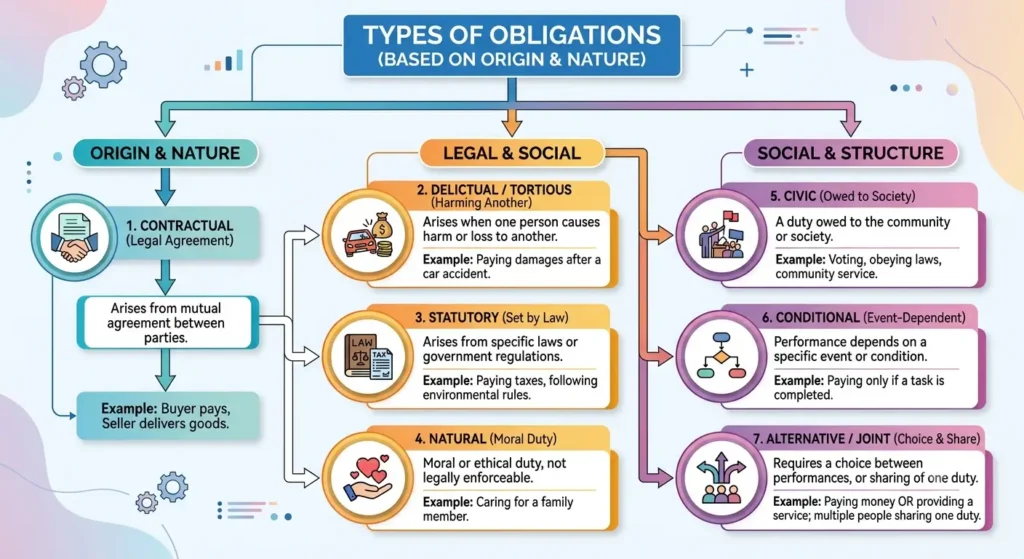
1.2 Types of Obligations
| Type | Description | Example |
|---|---|---|
| Contractual | Arises from a legal agreement | Buyer pays, seller delivers goods |
| Delictual/Tortious | Arises when one person harms another | Paying damages after a car accident |
| Statutory | Set by law | Paying taxes, following environmental rules |
| Natural | Moral, not legally enforceable | Caring for a family member |
| Civic | Owed to society | Voting, obeying laws, community service |
| Conditional | Depends on a prior event | Paying only if a task is completed |
| Alternative/Joint | Choice in fulfilment, or shared duty | Paying money or providing a service; multiple people sharing one duty |
1.3 Relationship Between Rights and Obligations
Rights and obligations are interdependent — every right implies a corresponding duty on someone else. A right is a claim that others must respect (e.g. property rights obligate others not to interfere); an obligation is the duty to fulfil someone else’s right (e.g. paying tax funds the government’s obligations to citizens). In contract law, one party’s right to receive goods is matched by the other’s duty to deliver them — and rights are generally enforceable by law, meaning unmet obligations can be challenged legally.
Part 2: Theories of Rights and Obligations
2.1 Deontological Perspectives
Deontological ethics judges actions by whether they follow moral rules and duties — not by their outcomes.
- Moral duty: People must follow universal duties (fairness, respect) regardless of consequences. Immanuel Kant argued people should be treated as ends in themselves, never merely as tools — a foundation for human dignity in rights theory.
- Intrinsic value: Rights (like life and freedom) exist independently of their benefits — they are inalienable and can’t be traded away for a “greater good.”
- Absolute obligations: Some duties (e.g. not lying, not stealing) bind everyone, always.
- In practice: Constitutional free-speech protections and the Universal Declaration of Human Rights (UDHR) both reflect deontological thinking — rights that must be protected regardless of consequence.
2.2 Consequentialist Perspectives
Consequentialism judges rights and obligations by their outcomes.
- Utility: Actions (and rights) are justified by the happiness or well-being they produce. John Stuart Mill valued free speech because it leads to greater overall happiness — but a right could, in principle, be overridden if breaking it produced a better outcome.
- Instrumental value: Rights (like property rights) matter because of what they achieve (security, investment) — not as ends in themselves.
- Context-dependent obligations: Duties can shift based on likely consequences.
- In practice: Public health measures (e.g. quarantines) that limit individual rights for collective benefit reflect consequentialist reasoning.
2.3 Deontological vs Consequentialist — Comparison
| Aspect | Deontological | Consequentialist |
|---|---|---|
| Basis of judgment | Rules and duties | Outcomes and results |
| View of rights | Inherent, non-negotiable | Instrumental — tools for good outcomes |
| Flexibility | Strict, treats some rights as absolute | Flexible, situation-dependent |
| Key thinker | Immanuel Kant | John Stuart Mill |
| Real-world example | UDHR — rights protected regardless of cost | Lockdown policy — rights limited for public benefit |
Part 3: Rights and Duties in Society
3.1 Individual vs Collective Rights
Individual rights belong to a person simply by being human — freedom of speech, religion, privacy, property, fair trial. They are inalienable, largely negative (protecting people from interference), and universal.
Collective rights belong to groups or communities — self-determination for nations, a clean environment, cultural preservation. They are often context-specific, positive (requiring government action, like healthcare provision), and group-oriented.
Tension arises when one clashes with the other — e.g. free speech versus public safety, or individual freedom versus pandemic-era public health measures.
3.2 Case Studies
| Case | Context | Tension |
|---|---|---|
| Charlottesville Rally (USA, 2017) | Free speech vs public safety | Courts balance expression against incitement to violence |
| Indigenous Land Rights (Canada) | Collective rights vs economic development | Pipeline disputes test how far indigenous land claims are honoured |
| NSA Surveillance (USA) | Privacy vs national security | Mass data collection challenged as a rights violation |
| Pollution Control (China) | Environmental rights vs economic growth | Stricter regulation attempts to balance both |
Part 4: Balancing Rights and Obligations
Balancing rights and obligations draws on three ethical lenses — deontological (duties are fixed, must be honoured regardless of outcome), consequentialist (rights may be limited if it produces a greater good, e.g. pandemic lockdowns), and virtue ethics (balancing rights should also cultivate fairness and compassion in individuals and institutions).
Legally, constitutions guarantee rights like free speech and fair trial, but courts use the principle of proportionality — any restriction on a right must be proportionate to the goal it serves (e.g. limiting hate speech to protect public order). Real-world tensions show up in public health (lockdowns vs personal freedom), corporate responsibility (profit vs labour/environmental duties), and environmental law (growth vs sustainability) — each requiring case-by-case judgment rather than a fixed formula.
Part 5: Debate — Human Rights: Universalism or Cultural Relativism
5.1 Introduction to Human Rights
Human rights are basic entitlements every person holds regardless of nationality, gender, or religion — indivisible, inalienable, and interconnected.
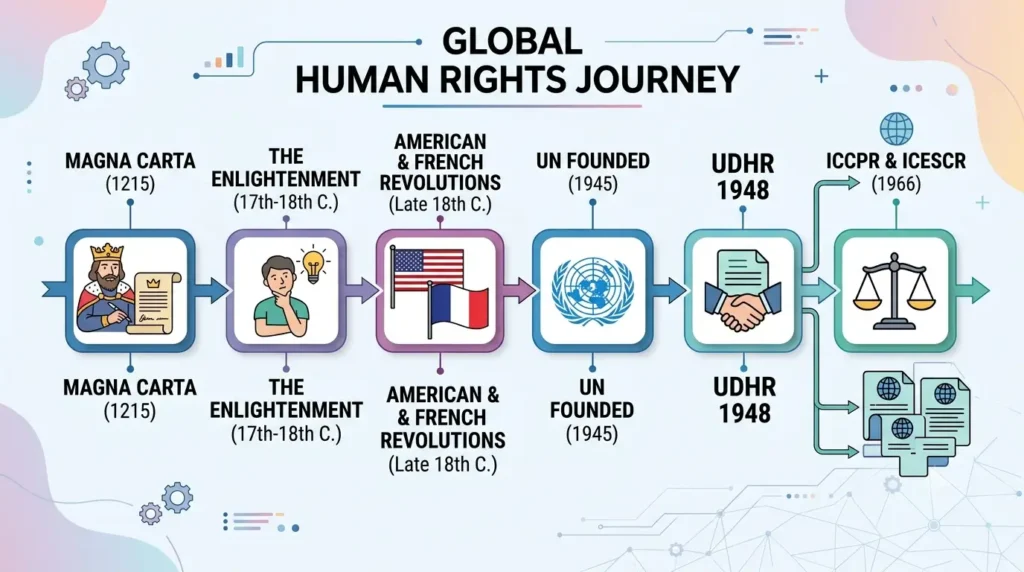
Historical development:
- Early ideas: Greek and Roman natural-law thought (Socrates, Aristotle); Enlightenment thinkers John Locke and Jean-Jacques Rousseau on liberty and equality.
- Revolutions: The French Declaration of the Rights of Man and Citizen and the U.S. Bill of Rights formalised early rights language.
- Post-WWII: The Holocaust’s horrors led to the UN’s founding (1945) and the Universal Declaration of Human Rights, UDHR (1948) — Article 1: all humans are born free and equal in dignity and rights.
Key instruments: The ICCPR and ICESCR (both 1966, legally binding), regional bodies like the ECHR (1950), ACHR (1969), and ACHPR (1981), and anti-discrimination treaties like CERD (1965) and CEDAW (1979).
5.2 Universalism
Universalism holds that human rights apply to everyone, everywhere, regardless of culture or nationality.
- Human dignity: Every person’s inherent worth transcends borders (UDHR, Article 1).
- Moral equality: All humans deserve equal respect — Kant’s “humanity as an end in itself.”
- Global interconnectedness: Shared challenges (climate change, pandemics) make universal standards practical, not just ideal.
- Prevention of abuse: Clear universal standards make it harder for states to justify violations.
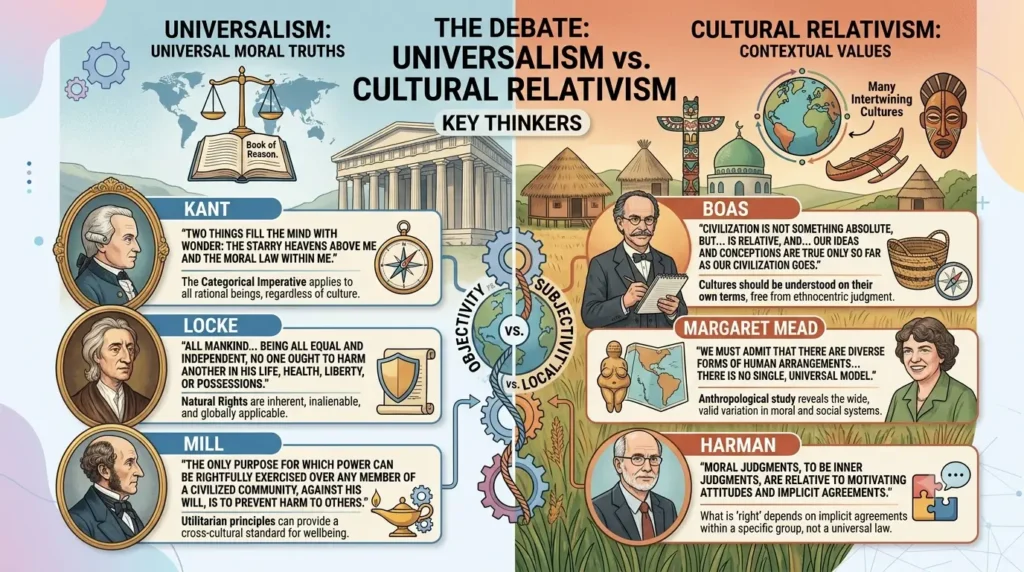
- Philosophical roots: Natural law theory (Locke), Enlightenment reason (Kant, Rousseau), utilitarianism (Mill), Aristotelian flourishing, and shared moral themes across major religions (the Golden Rule).
5.3 Cultural Relativism
Cultural relativism argues that rights and morality are shaped by specific cultures, histories and societies — and that imposing one culture’s standards on another can be unjust.
- Cultural diversity: Practices viewed critically in one culture (e.g. arranged marriage) may be normal or valued in another.
- Ethical pluralism: No single moral code fits all societies; respecting differing values means accepting multiple valid ways of living.
- Critique of Western imperialism: Universal rights frameworks often reflect Western liberal values and can function as a form of cultural imposition.
- Contextual understanding: Practices should be judged within their own social and historical context rather than against an outside standard.
- Philosophical roots: Anthropologists Franz Boas and Margaret Mead; moral relativism (Gilbert Harman); feminist critiques of Western intervention; religious relativism.
5.4 Universalism vs Cultural Relativism — Comparison
| Aspect | Universalism | Cultural Relativism |
|---|---|---|
| Core claim | Rights apply to all humans, everywhere | Rights/morality vary by culture and context |
| Source of rights | Human dignity, reason, natural law | Cultural tradition, social context |
| Key thinkers | Kant, Locke, Mill, Rousseau | Franz Boas, Margaret Mead, Gilbert Harman |
| Key document | UDHR (1948) | — (no single document; a critical stance) |
| Main strength | Protects individuals from state/cultural abuse | Respects cultural diversity and self-determination |
| Main criticism | Can reflect Western bias, ignore local context | Can excuse serious rights violations as “cultural” |
| Example issue | Torture, slavery — treated as always wrong | Practices like FGM debated within cultural context |
5.5 Key Debates and Case Studies
- Universal vs cultural: Should human dignity override cultural specificity, or must standards be locally interpreted?
- Civil/political rights vs economic/social rights: Free speech and fair trial vs healthcare, education, and work — which deserves priority in development policy?
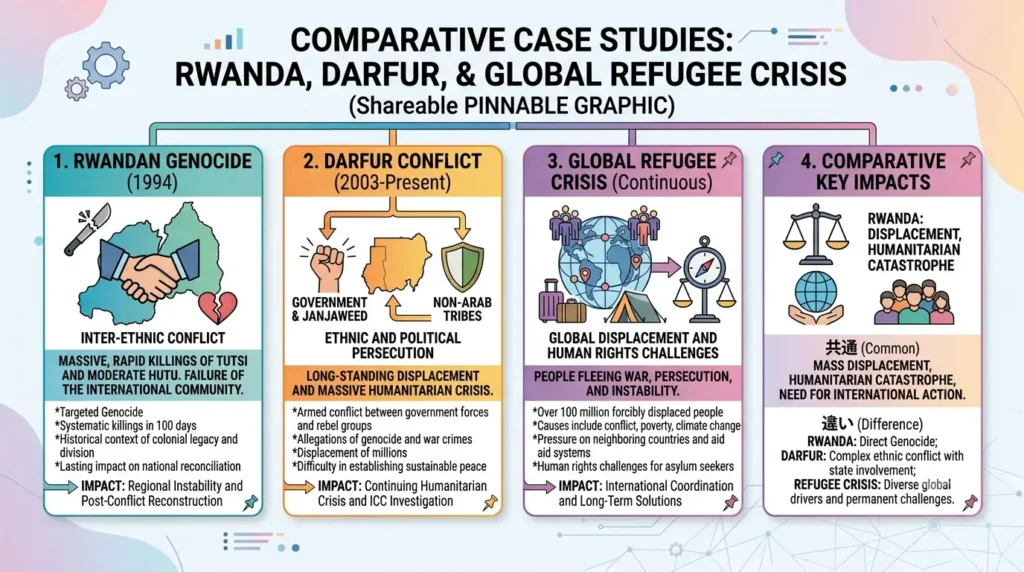
- State sovereignty vs Responsibility to Protect (R2P): Should the international community intervene when a state fails to protect its people (e.g. Rwandan Genocide, 1994; Darfur, 2003–present)?
- Rights vs national security: Post-9/11 surveillance and detention policies tested how far security concerns can limit rights.
- Business and human rights: Corporate Social Responsibility (CSR) debates over labour and environmental practices in weakly regulated states.
Case studies worth remembering for exams: the Rwandan Genocide (1994), the Darfur conflict (2003–present), the #MeToo movement (2017–), China’s treatment of Uyghur Muslims, and the global refugee crisis.
For deeper reading on how this debate connects to state sovereignty, see our notes on International Relations Theories and Approaches. For the constitutional angle on rights, see Fundamental Rights and Rights: Natural, Moral and Legal — DSC-7. This debate also connects directly to Democracy: Idea and Practice later in the same unit.
For primary-source grounding, the UN’s official UDHR text and history and the UN Office of the High Commissioner for Human Rights on universalism and cultural diversity are strong authoritative references.
Practice Questions
Framed on the DSC-7 syllabus pattern (Unit IV: Rights). Since this is a newer NEP-syllabus paper, verified past-year question papers aren’t yet publicly archived — these are representative long-answer/short-note style questions matching how DU papers are typically structured for this unit:
- Explain the relationship between rights and obligations with suitable examples.
- Distinguish between deontological and consequentialist perspectives on rights.
- “Human rights are universal, not culturally relative.” Critically examine this statement.
- Discuss the main arguments in favour of cultural relativism in the human rights debate.
- Write a short note on the tension between individual and collective rights.
- Examine the role of the UDHR (1948) in shaping the modern human rights framework.
- How should conflicting rights and obligations be balanced in a democratic society?
FAQs
What is the difference between a right and an obligation?
A right is a claim a person is entitled to, which others must respect; an obligation is the duty to act (or not act) in a way that fulfils someone else’s right. The two are always linked — every right implies a corresponding obligation.
What is the deontological view of rights?
The deontological view, associated with Immanuel Kant, holds that rights are inherent and inalienable, and must be respected as a matter of moral duty regardless of the consequences.
What is the consequentialist view of rights?
Consequentialism, associated with thinkers like John Stuart Mill, judges rights by their outcomes — a right is valuable because of the good it produces, and can, in principle, be limited if doing so leads to a better overall result.
What is human rights universalism?
Universalism is the position that human rights belong to every person simply by virtue of being human, regardless of culture, nationality, or religion — as expressed in the UDHR.
What is cultural relativism in the human rights debate?
Cultural relativism argues that rights and moral values are shaped by specific cultures and histories, and that imposing one culture’s standards (often Western) on another can be a form of cultural imposition.
What is the Responsibility to Protect (R2P)?
R2P is the principle that the international community has a duty to intervene when a state is unable or unwilling to protect its own population from serious harm, such as genocide or mass atrocities.
What are examples of collective rights?
Collective rights include a nation’s right to self-determination, indigenous communities’ rights to ancestral land, and a community’s right to a clean environment — rights held by groups rather than individuals alone.
Why is the UDHR important even though it isn’t legally binding?
The UDHR (1948) set the first internationally agreed standard for human rights and has since inspired binding treaties like the ICCPR and ICESCR, shaping both international law and national constitutions worldwide.
Further Reading
Subscribe to keep reading
You've used your free notes for now. Get Delhi Pathshala Premium for unlimited access.
Subscribe — ₹29/30 days