
Contents
- Quick Facts: An Introduction by Kamala Das
- Kamala Das Biography
- Historical and Cultural Context of Her Poetry
- Themes and Motifs in Das’s Poetry
- Full Text of the Poem: An Introduction by Kamala Das
- An Introduction by Kamala Das Summary
- 1. Politics, Naming and the First Self-Portrait
- 2. The Quarrel About English
- 3. Growing Up, Love and an Early Marriage
- 4. Short Hair, Brother’s Trousers and the “Categorizers”
- 5. The Man Who Is “Every Man” and the Closing Claim
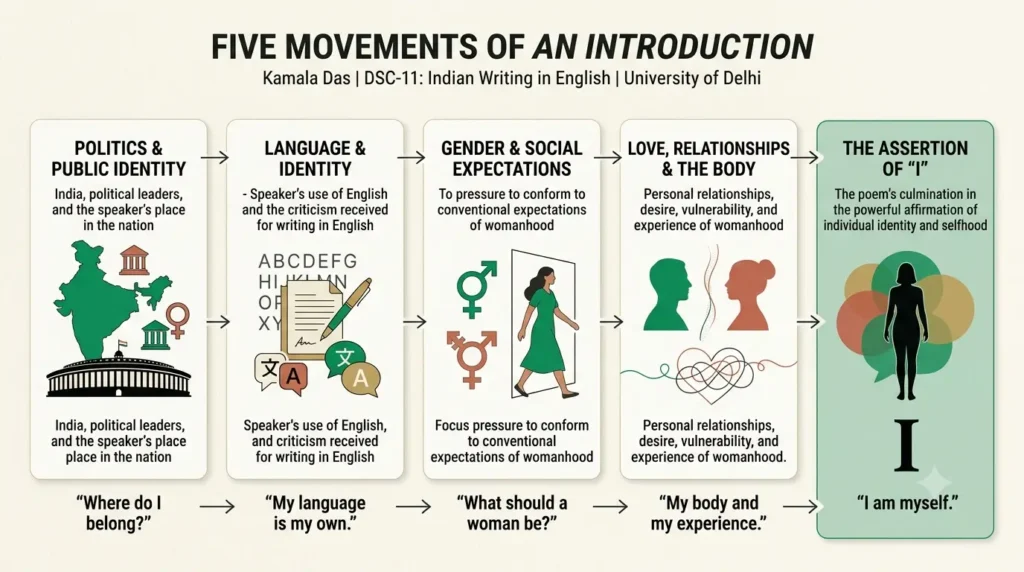
- Summary in Five Revision Points
- Key Phrases to Remember
- An Introduction by Kamala Das Themes
- Identity
- Self-Expression and the Right to Speak
- Patriarchy
- Language and Postcolonial Identity
- The Body, Marriage and Female Desire
- The Universality of “I”
- Literary Techniques
- Confessional Poetry and “An Introduction”
- The Language Debate: Why Write in English?
- Where Readers and Critics Differ
- Important Comparisons
- “Introduction” and “My Grandmother’s House”
- Das and the Earlier Romantic Idiom
- Key Terms
- Importance in Feminist Literature
- Why the Poem Still Matters
- Conclusion
- Continue Reading
- University of Delhi Previous Year Questions
- FAQs
In this post, you will find notes on Kamala Das’s poem “Introduction” (printed in most books as “An Introduction”), prescribed in Unit II of DSC-11: Indian Writing in English. The University of Delhi’s official syllabus lists it as the first of two Kamala Das poems in that unit, the other being “My Grandmother’s House”. These notes are meant for students preparing this year. They cover the poet’s life, the world the poem came out of, a section-by-section summary, themes, techniques, the debates critics have had about it, and exam-style practice.
One small note on the title: the DU syllabus says “Introduction”, while the poem is usually printed as “An Introduction” in Summer in Calcutta (1965) and in anthologies. Both names point to the same poem. This guide uses “An Introduction”.
In short: “An Introduction” is a free-verse, confessional poem by Kamala Das, first collected in Summer in Calcutta (1965). The speaker introduces herself as an Indian woman, brown-skinned and multilingual, who will not write in only one approved language or live in only one approved role. She defends her use of English, recalls an early marriage that crushed her, refuses the labels society hands her, and ends by claiming the right every person has to say “I”.
Quick Facts: An Introduction by Kamala Das
| Point | Detail |
|---|---|
| Poet | Kamala Das (1934–2009), also known as Madhavikutty and, after 1999, Kamala Surayya |
| Poem | “An Introduction” (listed as “Introduction” in the DU syllabus) |
| First collected in | Summer in Calcutta, 1965 |
| Form | Free verse, no fixed rhyme scheme or metre |
| Mode | Confessional, strongly autobiographical (see the debate on this below) |
| Speaker | A woman who closely resembles Das herself |
| Central concerns | Identity, the right to write in English, patriarchy, the female body, marriage, naming |
| DU placement | DSC-11: Indian Writing in English, Unit II, Kamala Das (i) |
| Companion poem in the same unit | “My Grandmother’s House” |
Kamala Das Biography
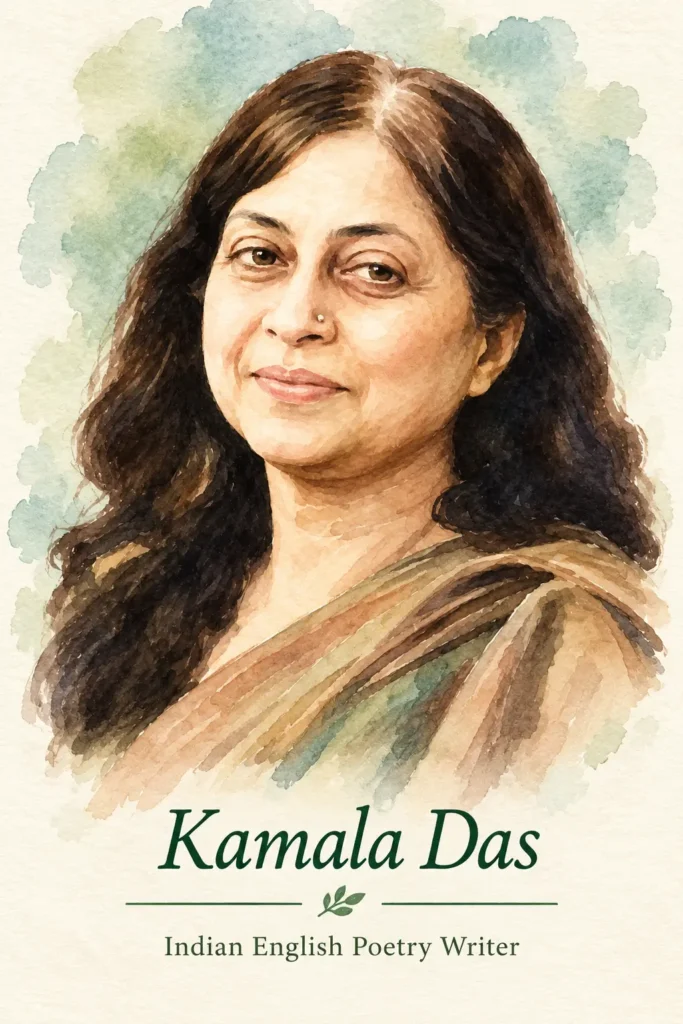
Kamala Das (1934–2009), also called Madhavikutty, was an Indian poet and writer known for her honest and personal writing. She was born on 31 March 1934 in Punnayurkulam, in what is now Thrissur district, Kerala, into a family of high social standing and literary interests. Her mother, Nalapat Balamani Amma, was a well-known Malayalam poet; her father, V. M. Nair, worked for an automobile company and also wrote as a journalist. Much of her childhood was divided between Calcutta, where her father worked, and the family’s ancestral home in Punnayurkulam, a house that returns again and again in her poetry. By her own account, as recorded in a doctoral study of her work, she began writing poems as a child.
At fifteen she was married to Madhava Das, a banking executive many years older than she was, and the couple moved to Bombay. She had three sons and did much of her writing at night. Her work in both English and Malayalam made her a key figure in Indian literature after independence. In English she wrote mostly poetry; in Malayalam, under the pen name Madhavikutty, she wrote short stories, columns and her celebrated autobiography. Her reputation in Kerala rests largely on the Malayalam prose, while elsewhere in India she became known first as an English poet.
Kamala Das often wrote about love, sexuality, identity, and women’s roles in society. Her poetry is emotional and personal, and keeps returning to the expectations placed on women. She spoke openly about female desire, marriage, and the difficulties women face in a male-dominated society.
Her poetry books include Summer in Calcutta (1965), The Descendants (1967), and The Old Playhouse and Other Poems (1973). Her prose in English includes the novel Alphabet of Lust (1976) and several short stories. She is also the author of the autobiography My Story, published in English in 1976 and known in Malayalam as Ente Katha, which gained attention for its frankness about her life. Students should note that My Story is an autobiography, not a work of fiction in the usual sense, though Das herself said in later life that parts of it were fictionalised. That remark matters for how we read “An Introduction”, and we return to it in the section on critical debates.
In 1999 she converted to Islam and took the name Kamala Surayya, a decision that drew heated public debate. She died on 31 May 2009 in Pune.
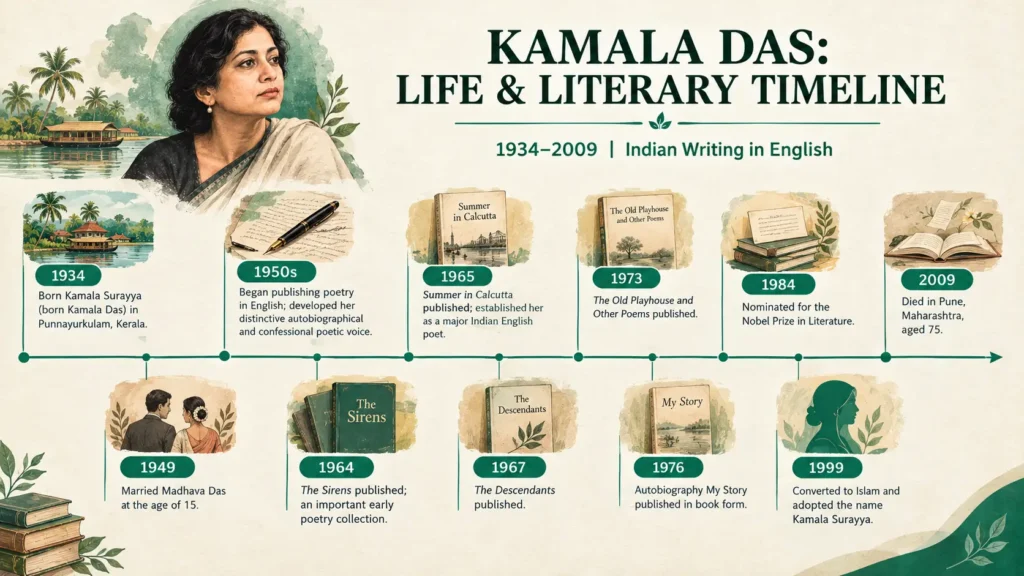
Key dates at a glance
| Year | Event |
|---|---|
| 1934 | Born on 31 March in Punnayurkulam, Kerala |
| c. 1949 | Married to Madhava Das at the age of fifteen; moves to Bombay |
| 1965 | Summer in Calcutta, her first major English collection, containing “An Introduction” |
| 1967 | The Descendants |
| 1973 | The Old Playhouse and Other Poems |
| 1976 | My Story (English autobiography) and the novel Alphabet of Lust |
| 1999 | Converts to Islam and takes the name Kamala Surayya |
| 2009 | Dies on 31 May in Pune |
For further reading, see the Encyclopaedia Britannica entry on Kamala Das and the Wikipedia article on Kamala Surayya. For a longer academic account of her life and poetic tradition, there is a University of North Bengal doctoral thesis, Kamala Das: A Study of Her Poetic Pilgrimage.
Historical and Cultural Context of Her Poetry
Kamala Das’s poetry came out during a time of big social and political changes in India. The country had become independent from British rule in 1947, and by the time Summer in Calcutta appeared in 1965, the Nehru era was over: Jawaharlal Nehru, India’s first Prime Minister, had died the year before. That is why it is not an accident that the poem’s very first political reference is to him.
Indian society, however, remained conservative, especially regarding gender, family and sexuality. Education and city life were opening new possibilities for women, but marriage at a young age and the expectation that a woman would be a wife, a daughter-in-law and a mother first were still widely accepted, particularly in families like the one Das came from.
Literary taste was also in transition. Earlier Indian poetry in English had often leaned on an inherited, nineteenth-century English idiom of romance and high diction. In the 1960s a younger generation, working in cities such as Calcutta, began to use a more direct, colloquial voice, and Das was one of the voices that defined that shift. Her work is important in post-colonial India, where traditional values and modern ideas mixed, and she challenged both the conservative views of Kerala and broader Indian norms.
Her poetry confronts issues like patriarchy, women’s roles in marriage, and the struggle between personal freedom and social respectability. It also shows the emotional strain on people who live under these pressures.
A caution on chronology: feminist movements were rising in the West in the 1960s and 1970s, but the organised women’s movement in India gathered pace mostly in the 1970s, after this poem was published. It is therefore more accurate to see “An Introduction” as an early act of individual speaking out than as a product of a movement. This distinction is worth making in an exam answer.
Themes and Motifs in Das’s Poetry
Kamala Das’s poetry includes themes of love, desire, loneliness, identity, memory and gender roles. Some common themes in her work are:
- Love and Sexuality: She openly explores female desire and love, showing it as complex and often painful. Love in her work is not perfect; it is raw and frequently disappointing, and many poems express deep longing.
- The Role of Women: She focuses on women’s roles in society, especially the pressures they face in marriage and family life. Her poems give voice to women who feel trapped by social norms and question traditional roles.
- Identity and Self-Expression: Much of her poetry reflects a journey of self-discovery. She examines her own feelings and desires, her vulnerabilities and her wish for freedom from social limits. “An Introduction” is the clearest example.
- Nature and the Body: She uses nature and vivid descriptions of the body to express emotional experience. Her images of physical and emotional feeling carry closeness and longing.
- Loneliness and Alienation: A sense of being alone runs through her work, along with a search for connection. The loneliness may come from society’s rules or from her own feeling of being different.
- Memory and Home: Houses, childhood and the lost warmth of the past recur, most memorably in “My Grandmother’s House”, the other Kamala Das poem in your unit.
Through these themes, Kamala Das created a distinct literary voice that remains relevant, especially in discussions about feminism, gender identity, and the link between personal and social life.
Full Text of the Poem: An Introduction by Kamala Das
Kamala Das’s poem “Introduction” boldly expresses self-identity and challenges societal expectations for women, especially in India. It is written in a direct, conversational tone, and shows the poet’s fight to be heard and to be herself despite the roles society tries to force on women. It stresses the importance of female independence and the universal wish for selfhood and freedom in a male-dominated society.
A note on the text itself: the poem is still under copyright, so it is not reproduced in full here. Please read it in the edition recommended by your college or teacher and keep it open beside these notes. We quote only short phrases, to point you to the exact places in the poem that are being discussed. If you are reading it for the first time, read it aloud once without stopping. The poem is built as one long run of speech, and it makes most sense when you hear its pace.
An Introduction by Kamala Das Summary
“An Introduction” is a personal poem in which the speaker introduces herself directly. She does not offer a list of achievements or a family tree. She offers a set of facts that society has tried to make awkward: she is Indian, she is “very brown”, she was born in Malabar, and she speaks, writes and dreams in different languages. The poem then moves through her struggle over the language she writes in, her early experience of love and marriage, her rebellion against the roles prepared for her, and finally her claim that she is as much an “I” as any man.
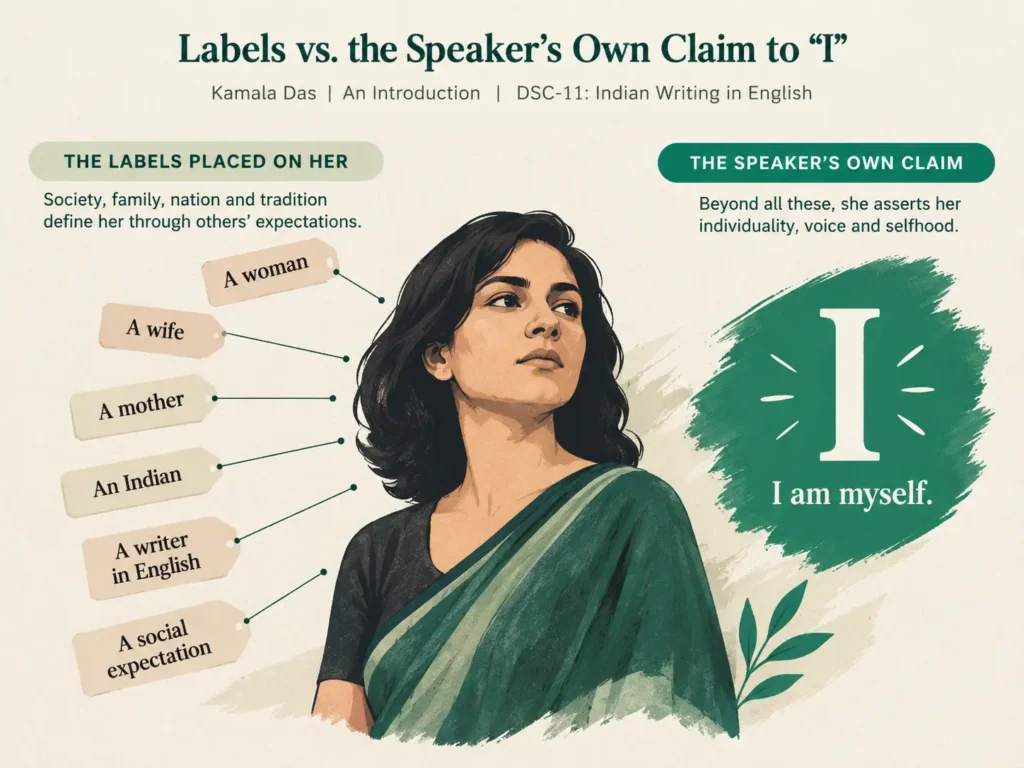
She rejects the labels society presses on women, the roles that define a woman only through her duties to others: wife, cook, embroiderer, someone who dresses and behaves as expected. She does not accept that one name or one role should describe her. Her language struggle is not simply “Malayalam at home, English on paper”. It is a quarrel with people who tell her which language she is allowed to own, and her answer is that the language she speaks becomes hers, imperfections and all.
1. Politics, Naming and the First Self-Portrait
The poem opens with an ironic confession: the speaker says she knows nothing about politics, yet can recite the names of those in power as easily as the days of the week or the months of the year, beginning with Nehru. Readers take this in different ways. Some see sarcasm about a political world that is male and learned by rote; others see a deliberate contrast between public power, which everyone can name, and the speaker’s own lack of power. Either way, the opening sets up the poem’s main contrast between those who hold authority and those who are told what to be.
She then turns to herself. She is Indian, very brown, born in Malabar. She speaks three languages, writes in two, and dreams in one. The poem does not name the languages. Teachers often assume they are Malayalam, English and Hindi, but that is an inference rather than something stated in the text, and it is safer to say so in an exam answer.
2. The Quarrel About English
Next comes the language argument. The speaker is told, by critics, friends and “visiting cousins”, not to write in English because it is not her mother tongue. She asks to be left alone and asks why she should not speak in any language she likes. The language she speaks, she says, becomes hers, with its distortions and its “queernesses”. She calls it half English, half Indian, perhaps funny, but honest and as human as she is. Human speech, she suggests, is to people what roaring is to lions, and it expresses a mind that sees, hears and is aware. The point of the passage is that authenticity lies in honesty of expression, not in using a language by right of birth.
3. Growing Up, Love and an Early Marriage
The poem then moves from public arguments to the private body. As a child she was told that she was growing because she was getting taller, her limbs swelling and hair appearing in places. She asked for love, not knowing what else to ask for, and was taken into a bedroom by someone and the door was closed. The poem mentions the age sixteen here, while biographers record that Das was married at fifteen; treat this gap as an open question rather than an error to correct (see the debates section). Her husband did not beat her, yet she says her “sad woman-body” felt beaten. The weight of her breasts and womb crushed her, and she shrank in a pitiful way. This is the poem’s most painful passage: it shows how a girl’s body became the reason for her early marriage and, in her telling, her loss of freedom.
4. Short Hair, Brother’s Trousers and the “Categorizers”
After that, the mood turns defiant. She cuts her hair short and wears her brother’s trousers, refusing the sari and the roles that go with it. The poem imagines a chorus of “categorizers” telling her what to do: fit in, belong, be a quarreller with servants, do not sit on walls or peep through lace-draped windows, do not play-act or make a scene when abandoned in love. They also tell her to settle on one name and one role. Her names are Amy, Kamala and Madhavikutty: Amy a childhood nickname, Kamala her given name and Madhavikutty the pen name under which she wrote in Malayalam. The poem’s point is that a person cannot be pinned down to one label.
5. The Man Who Is “Every Man” and the Closing Claim
She then speaks of meeting a man and loving him. He is not named, because he stands for every man who wants a woman, just as she stands for every woman who seeks love. The poem gives them contrasting images, with the man linked to the hurry of rivers and the woman to the patient waiting of the ocean. She asks who he is, and he answers, “It is I.” Everywhere she looks she sees men who call themselves “I”, with freedoms she is denied, such as drinking, travelling and putting up in hotels in strange towns.
The ending is a series of paired claims. She is sinner and saint, beloved and betrayed. Her joys and aches are not different from anyone else’s. The last line is the poem’s thesis: she too calls herself “I”. She does not ask for special treatment. She asks to be counted as a full person.
Summary in Five Revision Points
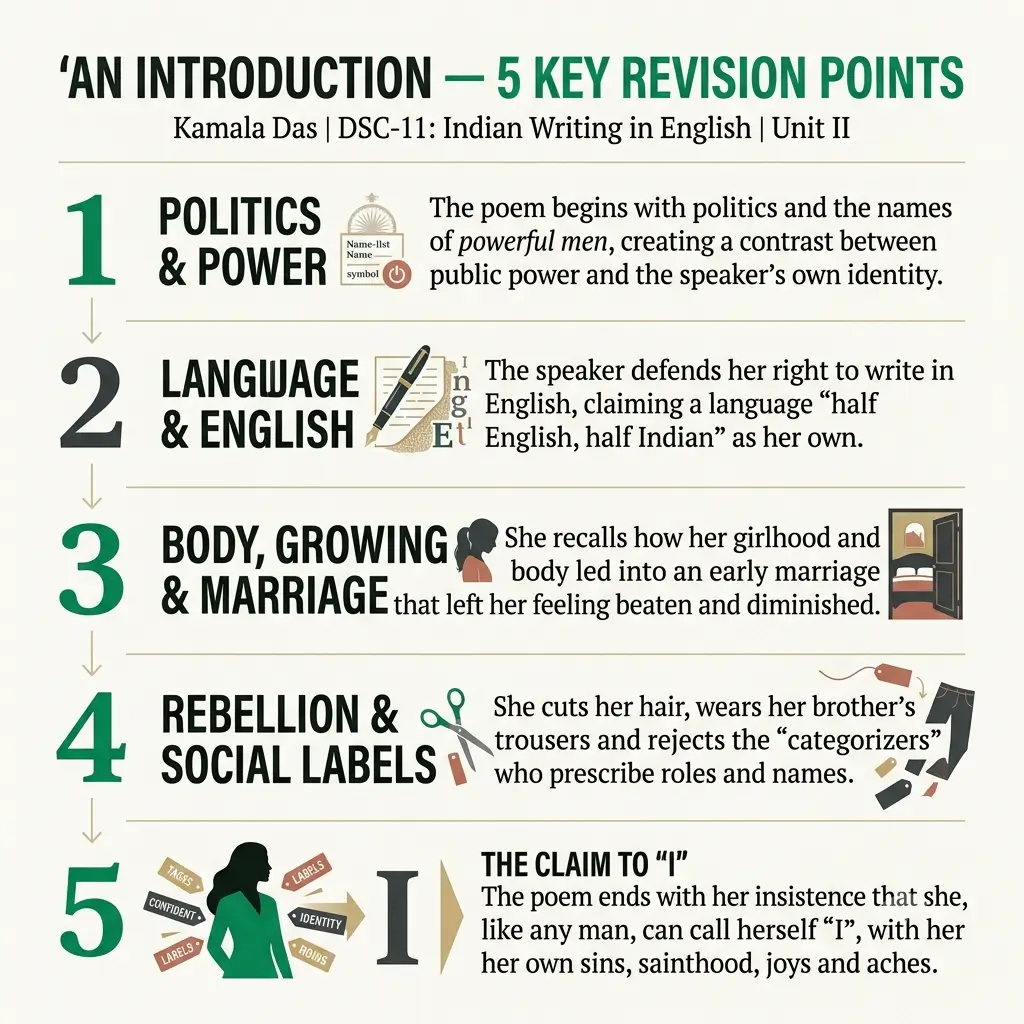
- The poem begins with politics and names of powerful men, setting up the contrast between those who hold power and those who are told what to be.
- The speaker defends her right to write in English, claiming a language “half English, half Indian” as her own.
- She recalls a girlhood in which her body led to an early marriage that left her feeling beaten and shrunken.
- She rebels by cutting her hair, wearing her brother’s trousers and refusing the “categorizers” who prescribe roles and names.
- She ends by insisting that she, like any man, can call herself “I”, with her own sins, sainthood, joys and aches.
Key Phrases to Remember
Please check each phrase against your own copy of the poem, and use these only as markers for your answers.
| Phrase | Where it appears | What it shows |
|---|---|---|
| “beginning with Nehru” | Opening lines | Irony about power; politics as a list of male names |
| “very brown” | Opening self-portrait | Plain, unromantic self-description; pride in colour and place |
| “three languages” | Opening self-portrait | Multilingual identity; the writer’s divided loyalties |
| “queernesses” | Language passage | She owns the oddness of her English instead of apologising for it |
| “categorizers” | Rebellion passage | Society as a force that sorts women into roles |
| “lace-draped windows” | Rebellion passage | Respectable, enclosed, watched domestic life |
| “I too call myself I” | Final line | The poem’s thesis: a woman’s claim to full personhood |
An Introduction by Kamala Das Themes
Identity
A main theme in “An Introduction” is the search for identity. The speaker rejects social roles, suggesting these labels do not capture her true self. The poem argues that a person’s identity should not be reduced to categories like wife, daughter or poet, but should be allowed to grow and express itself freely. Her three names, Amy, Kamala and Madhavikutty, show that identity can be plural without being false.
Self-Expression and the Right to Speak
The poem is a strong call for self-expression. Kamala Das stresses the importance of personal freedom, especially for women who are so often silenced. The right she defends is concrete: to speak in the language she chooses and to describe her own body, marriage and desire without apology. By writing at all, and by writing in English, she challenges the cultural norm that tells women, and “Indian” writers, what they may say and how.
Patriarchy
The poem criticises the male-dominated systems that create social expectations. The speaker describes being pushed into roles defined by others, which limit her individuality. By rejecting the labels, she challenges the power of patriarchy over women’s identities. Notice that patriarchy appears in three forms in the poem: political (the male names of those in power), domestic (the husband and the bedroom) and linguistic (those who tell her what to write in).
Language and Postcolonial Identity
For a DU Indian Writing in English paper this is an essential theme. English reached India through colonial rule, and the debate about whether Indians can truly write in it is as old as the tradition. Das does not argue that English is neutral. She argues that it becomes hers by use. The poem is therefore as much about the right of Indians to remake English as about gender. (See the section on the language debate below.)
The Body, Marriage and Female Desire
Das treats the female body as a place where social control becomes personal. The body is first the subject of other people’s remarks, then the reason for her early marriage, then a source of shame, and finally, in the closing section, the place from which she claims love and desire as legitimate. This is why the poem scandalised and attracted readers in the 1960s.
The Universality of “I”
The ending turns the personal into the universal. Having shown that men freely say “I”, she insists that she has the same right, and that her joys and aches are shared. The poem is not only about one woman’s life; it is an argument about who counts as a full person.
Literary Techniques
- Free Verse: “An Introduction” uses free verse, meaning it does not follow regular rhyme or metre. This matches the theme of breaking free from social restrictions and lets the poet express herself in a natural, speaking rhythm. The lines vary widely in length and run on like a stream of speech.
- Colloquial Diction and Confiding Tone: The language is plain, direct and conversational, as if the speaker were arguing with an unseen audience. It uses everyday words, questions and commands, which fit the poem’s insistence on honesty over polish.
- Repetition and Anaphora: Repetition emphasises the speaker’s need to assert her identity. The pronoun “I”, the pattern “I am”, and the commands beginning “Don’t” and “Be” all recur and build the poem’s argument. The final line returns to “I” to close the circle.
- Symbolism and Imagery: The poem uses symbols throughout. Language is a symbol of authority and belonging: the dispute over English stands for the tension between tradition and modernity. Clothing carries meaning too, with saris standing for expected womanhood and her brother’s trousers for refusal. Names (Amy, Kamala, Madhavikutty) stand for the roles others assign. The river and the ocean give a natural image for the contrast between male haste and female waiting.
- Enjambment: Sentences spill across line breaks, so that thought runs on without full stops. This gives the poem urgency and makes it hard to pause, like an argument that cannot be stopped.
- Irony and Allusion: The opening reference to Nehru and the list of those in power is ironic, and relies on the reader’s knowledge of post-independence India.
- Tone: Defiant, ironic and confiding by turns, shifting to wounded and then to assertive. Tracing the tone changes is a good way to structure a long answer.
Confessional Poetry and “An Introduction”
Confessional poetry is verse in which the speaker draws on intimate, personal experience, often including subjects society prefers to keep private, such as sexuality, family conflict and distress. “An Introduction” fits the mode through its first-person voice, its frankness about the body and marriage, and its refusal to flatter the speaker. Das is often described as a confessional poet; Wikipedia notes that her poems have often been compared with those of the American poets Anne Sexton, Robert Lowell and Sylvia Plath.
That comparison is itself a matter of debate. Some critics place Das within the American confessional movement; others, such as the University of North Bengal thesis cited above, trace her ancestry to a much older line of Indian women’s poetry that includes Akka Mahadevi and her own mother, Balamani Amma. A careful answer can say that the poem is confessional in manner while rooted in an Indian and Malayalam literary background.
The Language Debate: Why Write in English?
Das’s defence of English is one of the best-known passages in Indian poetry in English, and it connects directly to the course. DSC-11 asks students to understand the “distinctively Indian qualities” of Indian literature in English, and the DU syllabus lists several suggestive readings that speak to this debate: Raja Rao’s foreword to Kanthapura, Salman Rushdie’s essay “Commonwealth Literature Does Not Exist”, Meenakshi Mukherjee’s “Divided by a Common Language” and Bruce King’s introduction to Modern Indian Poetry in English. You do not need to cite all of them, but reading even one alongside the poem will strengthen your answers.
Das’s position can be summed up in three steps. First, she admits that English is not her only language and that critics resent her choice. Second, she argues that language is ownership by use: what she speaks becomes hers. Third, she shifts the test of a language from origin to honesty. Notice that she does not say English is innocent of colonial history; she says it can be remade.
Where Readers and Critics Differ
A good exam answer does not present every reading as settled. These are the main points where sources disagree.
- Autobiography or constructed persona? Most study guides treat the speaker as Das herself, and the poem’s details (Malabar, the three names, an early marriage) invite that reading. But Britannica notes that Das later said parts of her autobiography My Story were fictional, and the Emory University postcolonial studies page records Das describing her husband as understanding and proud of her. Together, these suggest the poem is better read as a heightened, shaped self-portrait than as a literal record.
- Is it a feminist poem? Many readers see it as a feminist statement, and the Emory page discusses her view of womanhood in feminist terms. Yet one biographical profile notes that although feminists championed her, Das declined to be identified as one. A safe formulation is that the poem is widely read as feminist, even though the poet resisted the label.
- What does the opening mean? Some commentators read the Nehru lines as sarcasm about a broken political scene; others read them as anger at male dominance in politics. Both readings fit the text.
- Sixteen or fifteen? The poem speaks of a sixteen-year-old, while biographies record that Das married at fifteen. One online study guide links the age to the age of consent in India before 2012; a reader’s comment on the same page suggests an ironic echo of “sweet sixteen”. Neither is a settled scholarly finding, so present this as an open question.
- How long is the poem? Study guides disagree: one describes it as a sixty-line poem in a single stanza, another as a fifty-nine-line poem in two stanzas. The difference probably comes from how the lines are set in different printings. Do not give a line count in an exam unless your own text supports it.
Important Comparisons
“Introduction” and “My Grandmother’s House”
Your syllabus pairs the two Kamala Das poems, and a comparison is a natural exam question.
| Point | “An Introduction” | “My Grandmother’s House” |
|---|---|---|
| Mood | Defiant, argumentative, ironic | Quiet, elegiac, longing |
| Focus | Self, language, body, roles | A childhood home and the love once received there |
| Time | Moves from childhood to the present | Looks back from the present |
| Voice | Addresses critics, categorizers and men | Speaks inwardly, to no audience |
| Idea of love | Sought, mismatched, betrayed | Remembered, lost, still craved |
| Shared ground | Autobiographical voice, plain diction, the search for love and belonging | Same |
Das and the Earlier Romantic Idiom
Early Indian poetry in English is often described as drawing on the idiom of English Romanticism. Place Das beside a poem like Sarojini Naidu’s “An Indian Love Song”, also in Unit II, and the difference is clear. Naidu’s lyric works in a more formal, musical register; Das speaks in everyday cadences, argues openly, and writes about the body without ornament. This contrast is a good way to show how Indian poetry in English changed by the 1960s.
Key Terms
| Term | Meaning in this poem |
|---|---|
| Confessional poetry | Verse drawing on intimate personal experience, often socially taboo |
| Free verse | Poetry without fixed rhyme or regular metre |
| Anaphora | Repeating a word or phrase at the start of successive lines, as with “I” and “Don’t” |
| Enjambment | Carrying a sentence over the end of a line without a pause |
| Persona | A speaking voice created by the poet, which may or may not equal the poet |
| Patriarchy | A social order in which men hold most power and authority |
| Postcolonial | Concerned with the legacy of colonial rule, including questions of language |
Importance in Feminist Literature
“An Introduction” is an important work in feminist literature, especially in India. The poem challenges male-dominated systems and makes a strong statement about female independence, breaking away from the traditional roles of marriage and motherhood. Kamala Das’s honest discussion of her desires and experiences as a woman has made her a key figure in feminist readings of Indian writing.
The poem shows how women are often silenced and pushed into passive roles, and it encourages them to speak for themselves and reject what society dictates. By choosing to write, Kamala Das reclaims the written word as a tool for freedom. Her exploration of identity and self-expression has made the poem significant in feminist discussions, especially for those wanting to find their voices in restrictive societies.
Two cautions keep this answer accurate. First, as noted above, Das herself did not accept the feminist label, so say “feminist reading” rather than “Das’s feminist manifesto”. Second, the poem asks for more than rights: it asks for the right to be contradictory, “sinner” and “saint” together, which is a stronger claim than a simple call for equality.
Why the Poem Still Matters
Few debates in the poem have gone away. Questions about who may write in English, how multilingual people choose a language for different parts of their lives, and how women’s bodies and choices are policed all remain live in India today. For a student, the poem is also a lesson in how a personal voice can become a public argument, which is why it continues to be taught in the DU programme.
Conclusion
In summary, Kamala Das’s “An Introduction” is not only about a woman claiming her voice. It is also a strong argument that no one should be reduced to the labels, names and languages others assign. Through free verse, repetition, a colloquial tone and bold imagery, it makes the case for selfhood, honest expression and the right to say “I”. It remains a major poem in discussions of Indian feminism, confessional writing and post-colonial identity.
Continue Reading
University of Delhi Previous Year Questions
University of Delhi Previous Year Questions | दिल्ली विश्वविद्यालय पिछले वर्ष के प्रश्न
Long Answer | दीर्घ उत्तर | 10–20 Marks
1. Bring out the appropriateness of the title of Kamala Das’s “An Introduction”. +
Year / Paper: Vidyasagar University, Paper C14-T Indian Writing in English, 2022 — 10 Marks
Hint: Title, identity, language, self-expression and the poet’s introduction of herself as an Indian English poet.
Suggested Answer Focus: शीर्षक की सार्थकता को Kamala Das की व्यक्तिगत पहचान, भारतीयता, अंग्रेज़ी भाषा के चयन, स्त्री-अस्मिता और आत्म-अभिव्यक्ति से जोड़कर समझाएँ।
Direct PYQ 10 Marks
2. Comment, using the two prescribed poems, how Kamala Das establishes her identity as an Indian English writer and poet. +
Year / Paper: University of Delhi, GE Indian English Literatures, Paper 3139 — Part B, 20 Marks
Hint: Both prescribed poems — “An Introduction” and “My Grandmother’s House”.
Suggested Answer Focus: भारतीय पहचान, अंग्रेज़ी भाषा, आत्म-अभिव्यक्ति, स्मृति, स्त्री-अनुभव, निजी और सांस्कृतिक पहचान तथा Kamala Das की विशिष्ट poetic voice का तुलनात्मक विश्लेषण करें।
Direct PYQ 20 Marks
3. Discuss Kamala Das as a confessional poet with reference to the poems prescribed in your syllabus. +
Year / Paper: Practice / repeated examination theme
Hint: Confessional poetry, personal experience, identity, sexuality, loneliness, love and female subjectivity.
Suggested Answer Focus: Kamala Das की निजी और आत्मपरक अभिव्यक्ति, व्यक्तिगत अनुभवों को poetic material बनाने की प्रवृत्ति तथा “An Introduction” और “My Grandmother’s House” में confessional voice का विश्लेषण करें।
Probable Practice 10–15 Marks
4. Critically analyse Kamala Das’s understanding of women’s experience with reference to her poetry. +
Year / Paper: M.A. I Semester Indian Writing in English, April/May 2023 — theme reused for BA DSC-11 preparation
Hint: Women’s experience, patriarchy, gender roles, identity and feminist voice.
Suggested Answer Focus: Kamala Das की कविताओं में स्त्री की व्यक्तिगत स्वतंत्रता, सामाजिक अपेक्षाएँ, gender roles, आत्म-पहचान और patriarchal व्यवस्था के प्रति प्रतिरोध को “An Introduction” तथा “My Grandmother’s House” के संदर्भ में समझाएँ।
Exam Pattern Practice
Short Answer | लघु उत्तर | 5 Marks
5. “I too call myself I”—Bring out the significance of the quoted line. +
Year / Paper: Question Bank / examination practice
Hint: Individual identity, self-assertion, female subjectivity and resistance to imposed identity.
Suggested Answer Focus: “I” के माध्यम से आत्म-पहचान, व्यक्तिगत agency और सामाजिक/लैंगिक पहचान के imposed categories के विरुद्ध Kamala Das के self-assertion को स्पष्ट करें।
Practice 5 Marks
6. “Kamala Das is known as a Confessional writer.” Discuss elaborately. +
Year / Paper: Indian Writing in English, Unit 4, Question Bank 23BAEN404
Hint: Confessional mode, autobiography, personal experience and emotional candour.
Suggested Answer Focus: Kamala Das की confessional poetry की विशेषताओं को निजी अनुभव, प्रेम, अकेलापन, स्त्री-अनुभव, identity और आत्म-अभिव्यक्ति से जोड़ें।
Probable 5 Marks
7. Discuss the central themes of Kamala Das’ poem “An Introduction” and how they reflect her views on identity and societal expectations. +
Year / Paper: Indian Writing in English, Unit 4, Question Bank 23BAEN404
Hint: Identity, language, gender, societal expectations, self-expression and Indian English.
Suggested Answer Focus: कविता में identity crisis, language choice, gender expectations और poet’s self-assertion को प्रमुख themes के रूप में समझाएँ।
Probable 5 Marks
8. Discuss the style and themes of the poems of Kamala Das with special reference to the poems prescribed in your course. +
Year / Paper: Syllabus-based examination practice
Hint: Confessional style, conversational tone, free verse, imagery, personal voice and feminist concerns.
Suggested Answer Focus: “An Introduction” और “My Grandmother’s House” के आधार पर Kamala Das की भाषा, शैली, imagery, emotional intensity, confessional mode और प्रमुख themes का विवेचन करें।
Probable Practice 5 Marks
Very Short Answer | अति लघु उत्तर | 2 Marks
9. How and why did the speaking subject in “An Introduction” ignore her “womanliness”? +
Year / Paper: IWE examination pattern
Hint: Gender identity, imposed femininity and the speaker’s rejection of conventional expectations.
Suggested Answer Focus: “Womanliness” को सामाजिक रूप से निर्धारित gender role के रूप में समझाते हुए speaker के उससे दूरी बनाने और individual identity पर जोर देने की व्याख्या करें।
Practice 2 Marks
10. What does Kamala Das mean by “Don’t write in English, they said, English is not your mother tongue”? +
Year / Paper: Syllabus-based examination practice
Hint: Language, linguistic identity, postcolonial India and resistance to cultural expectations.
Suggested Answer Focus: अंग्रेज़ी में लेखन को लेकर समाज की आपत्ति तथा Kamala Das द्वारा English को अपनी poetic expression का माध्यम बनाने के आत्मविश्वास को स्पष्ट करें।
Practice 2 Marks
11. What is the significance of “I am Indian, very brown, born in Malabar…”? +
Year / Paper: Syllabus-based examination practice
Hint: Indian identity, colour, place, nationality and cultural self-identification.
Suggested Answer Focus: speaker द्वारा अपनी Indian identity, Malabar origin और physical/cultural identity को स्वीकार करते हुए colonial linguistic/cultural assumptions को चुनौती देने की व्याख्या करें।
Practice 2 Marks
Objective / MCQ | वस्तुनिष्ठ प्रश्न
12. In which poem does Kamala Das express her rejection of societal expectations and her search for individual identity? +
Year / Paper: DU-affiliated MCQ / Question Bank pattern
Hint: Identity and rejection of conventional social expectations.
Suggested Answer Focus: Answer: “An Introduction”
Practice MCQ
13. In “An Introduction,” which aspect of language does Kamala Das most strongly critique? +
Year / Paper: DU-affiliated MCQ / Question Bank pattern
Hint: Language choice and postcolonial linguistic expectations.
Suggested Answer Focus: Answer: The dominance of English in postcolonial India
Practice MCQ
14. The poem ‘An Introduction’ is written by — +
Year / Paper: DU-affiliated MCQ / Question Bank pattern
Hint: Identify the poet.
Suggested Answer Focus: Answer: Kamala Das
Practice MCQ
High-Priority Preparation | सबसे महत्वपूर्ण तैयारी
15. Title justification of “An Introduction” + Kamala Das as a confessional poet. +
Year / Paper: Repeated examination theme
Hint: Title, self-introduction, confessional mode, identity and feminist voice.
Suggested Answer Focus: Title की appropriateness और Kamala Das की confessional poetic identity को एक साथ तैयार करें। Personal voice, gender, language और Indian identity को answer के मुख्य आधार बनाएँ।
Probable High Priority
16. Identity, language choice and feminism in “An Introduction” — with reference to the speaker’s assertion of selfhood. +
Year / Paper: Repeated examination theme
Hint: “I am sinner, I am saint, I am the beloved and the betrayed.”
Suggested Answer Focus: Selfhood, contradictory identities, linguistic freedom, gender expectations और feminist self-assertion को एक integrated answer में विकसित करें।
Probable High Priority
17. Explain the significance of “womanliness” and “I too call myself I” in “An Introduction”. +
Year / Paper: Repeated examination themes
Hint: Gender expectations, individual identity and self-assertion.
Suggested Answer Focus: “Womanliness” के माध्यम से imposed femininity और “I too call myself I” के माध्यम से individual selfhood तथा agency को समझाएँ।
Probable High Priority
FAQs
When was “An Introduction” published, and in which collection?
It was first collected in Kamala Das’s Summer in Calcutta, published in 1965.
Is the poem called “An Introduction” or “Introduction”?
Both names refer to the same poem. The DU syllabus lists it as “Introduction” under Kamala Das in Unit II of DSC-11, while books and anthologies usually print “An Introduction”.
Is the poem really autobiographical?
It is closely tied to Das’s life, but it is safer to call it a shaped, confessional self-portrait. Das herself said that parts of her autobiography My Story were fictionalised, so the poem should not be treated as a literal record.
What are the “three languages” in the poem?
The poem does not name them. Teachers often suggest Malayalam, English and Hindi, but that is an inference, and it is wise to say so in an answer.
Who is “Amy”, and why does the poem mention three names?
Amy was a childhood nickname, Kamala her given name and Madhavikutty her pen name. The names show how others try to fix her in one role, and how she refuses.
Why does Kamala Das write in English if it is not her mother tongue?
In the poem she answers that the language she speaks becomes hers, with all its oddities, and that honesty of expression matters more than origin. She also wrote in Malayalam, under the name Madhavikutty.
Why does the poem begin with Nehru and politics?
The opening lines ironically show that the speaker can recite the names of those in power without knowing politics. Readers disagree on whether the tone is sarcasm about politics or anger at male dominance, but both readings connect to the poem’s theme of power.
What does “I too call myself I” mean?
It is the poem’s closing claim that she has the same right to selfhood as any man, and that her joys and aches are shared with others.
Is “An Introduction” a feminist poem?
It is widely read as one, but Das herself declined the label. In an exam, write “feminist reading” and support it with the text.
What makes it confessional poetry?
The first-person voice, the frankness about the body, marriage and desire, and the refusal to present the speaker as flawless.
How many lines does the poem have?
Sources differ, with one giving sixty lines in one stanza and another fifty-nine lines in two stanzas. Check your own printed text before giving a number.
Does the poem have its own Wikipedia article?
The poem is discussed within the Wikipedia article on Kamala Surayya, linked above, but for exams you should rely on the poem itself and on critical readings recommended by your teachers.
Subscribe to keep reading
You've used your free notes for now. Get Delhi Pathshala Premium for unlimited access.
Subscribe — ₹29/30 days