
Contents
- Two Ways Students Read “Sources,” and Why Both Matter Here
- Introduction to Indian Political Thought
- Epistemological Foundations: Pramana (Sources of Knowledge)
- Nyaya School of Thought
- Charvaka School of Thought
- Nyaya vs Charvaka: Quick Comparison
- The Concept of Self (Atman)
- Basic Premises: Political Ideas in the Ramayana, the Mahabharata and the Arthashastra
- The Ramayana
- The Mahabharata
- The Arthashastra
- Rajdharma Across the Three Texts
- Other Foundational Textual Sources
- Secondary Sources: Commentaries and Modern Scholarship
- Open Debates Worth Knowing for Exams
- Significance of Indian Political Thought
- Conclusion
- Continue Reading
- University of Delhi Previous Year Questions
- Frequently Asked Questions
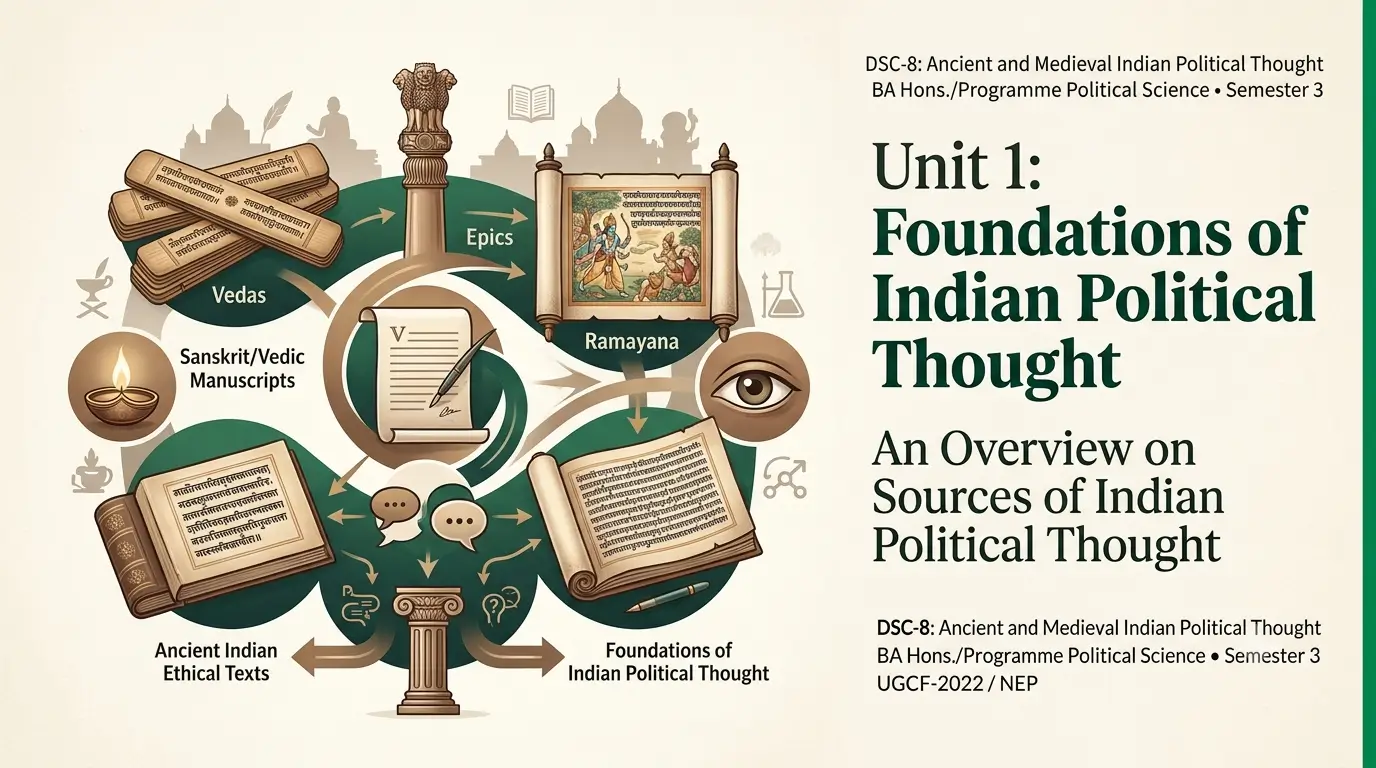
These are notes on “Unit 1: Foundations of Indian Political Thought – An Overview on Sources of Indian Political Thought,” from DSC-8: Ancient and Medieval Indian Political Thought (BA Hons./Programme Political Science, Semester 3, UGCF-2022/NEP syllabus). They are meant to help you build a complete, exam-ready answer to “what are the sources of Indian political thought” — not just a list of old texts.
Two Ways Students Read “Sources,” and Why Both Matter Here
Before getting into the content, it helps to clear up a genuine confusion that trips up a lot of students on this exact topic, and that shows up differently depending on which teacher or which year’s reading list you follow.
“Sources of Indian political thought” can mean two different things:
- Sources of knowledge (epistemology) — how do we know anything at all, and what counts as valid knowledge (pramana)? This is the sense used in the University of Delhi’s own School of Open Learning study material for this lesson, which builds the unit around epistemology (pramana), the Nyaya and Charvaka schools, and the idea of the self.
- Sources as texts (documentary sources) — which books, scriptures and treatises — the Vedas, the epics, Kautilya’s Arthashastra, the Dharmashastras — do scholars actually draw on when they reconstruct Indian political thought? This is the sense most students first think of, and it is also the sense used by several other DU papers on Indian political thought (such as the Semester 1 Generic Elective, Ideas and Institutions in Indian Political Thought).
(If you want to read the official lesson this article is based on directly, it is publicly available as a University of Delhi School of Open Learning study material PDF — official university source.)
Because different colleges and teachers emphasise one sense or the other, this article covers both, but it leads with the epistemological sense first, since that is what the official DSC-8 Unit 1 lesson actually tests, and then moves to the textual sources that most other reading lists and coaching notes focus on.
Introduction to Indian Political Thought
Indian political thought refers to the body of ideas about governance, justice, power, law, and the relationship between the ruler and the ruled that developed on the Indian subcontinent from the Vedic age onward. It is not a single, settled doctrine; it is a long, layered conversation shaped by Vedic and Upanishadic thinking, the epics, Buddhist and Jain (Shramanic) traditions, Islamic political ideas in the medieval period, and colonial and post-colonial reform movements.
A useful way to hold this together is Professor Bhikhu Parekh’s observation that Indian political thought is not monolithic: it has historically been egalitarian in its moral vision even where society remained hierarchical, pluralistic in recognising the autonomy of social groups, self-critical of its own established order, and largely practical and didactic, written to guide rulers rather than as abstract theory. Keep this in mind as you read the sections below — Indian political thought is a debate across schools and centuries, not a single fixed answer.
Epistemological Foundations: Pramana (Sources of Knowledge)
Since much of Indian political thought is inseparable from Indian philosophy, the DSC-8 syllabus treats “sources” first in the epistemological sense: what is knowledge, and how is it validly acquired? The term comes from the Greek episteme (knowledge) and logos (reason); in the Indian tradition, the equivalent idea is called Gyanmimansa.
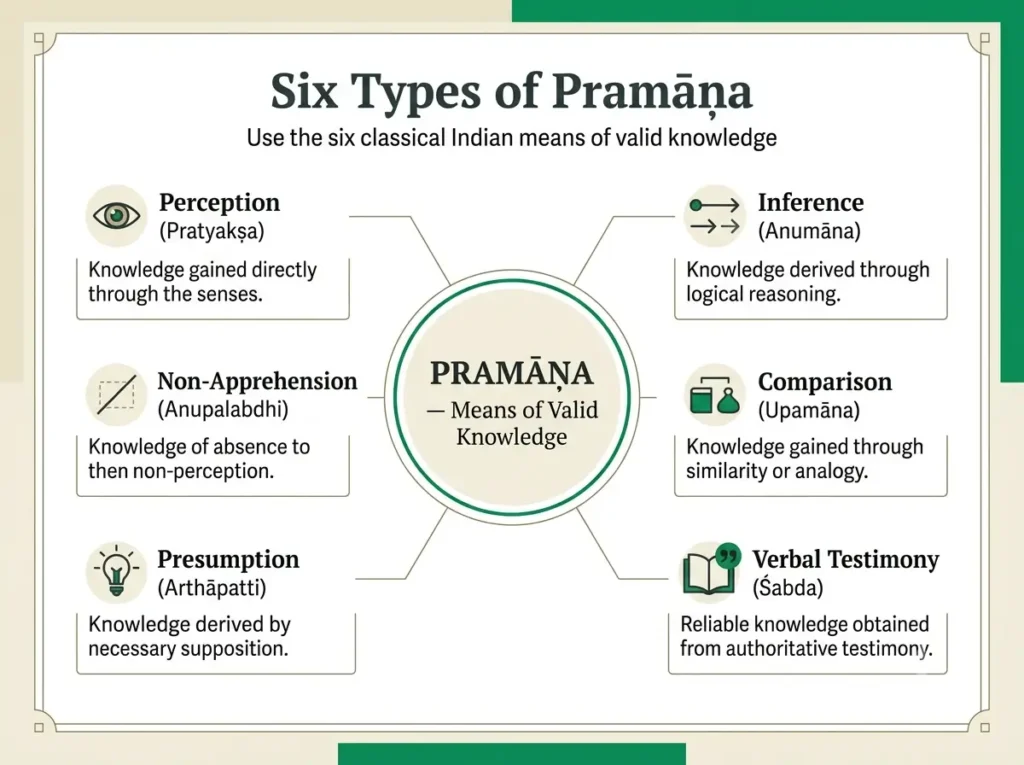
In Indian epistemology, valid knowledge is called pramana — literally, a means of arriving at correct, verifiable cognition, as opposed to guesswork or whim. Classical thinkers recognised up to seven possible pramanas, though schools disagreed on which ones were genuinely valid. The Mimamsa school played a central role in this debate: the scholar Kumarila Bhatta accepted six pramanas, while Prabhakara Mishra accepted only five, rejecting anupalabdhi (non-apprehension) as an independent source of knowledge.
| Pramana (Means of Knowledge) | What It Means | Illustrative Example |
|---|---|---|
| Pratyaksa (Perception) | Direct knowledge through contact between a sense organ and its object | Seeing a table in front of you |
| Anumana (Inference) | Indirect knowledge derived from a known relationship between two things | Inferring fire from smoke seen on a distant hill |
| Upamana (Comparison) | Knowledge gained by analogy with something already known | Recognising a wild ox because it resembles a cow you have seen |
| Sabda (Verbal Testimony) | Knowledge from the reliable speech of a trustworthy person, or scripture | Learning a fact because a trusted teacher states it |
| Arthapatti (Presumption) | Resolving an apparent contradiction between two known facts by presuming a third | A person is heavy but doesn’t eat by day, so he must eat at night |
| Anupalabdhi (Non-apprehension) | Knowledge of an object’s absence, from its non-perception | Knowing a chair is missing from a room because you don’t see it |
These pramanas are not just abstract logic exercises — in Indian political thought they underpin how kingship, dharma, and authority were justified: through direct observation of social order, through analogy with cosmic or bodily order, and above all through sabda — the authoritative word of scripture and trusted teachers, which legitimised the ruler’s duties.
Indian moral philosophy built on this epistemic base also organised life around the purusharthas — dharma (duty), artha (material well-being), kama (desire) and moksha (liberation) — together with the doctrine of karma. On the basis of whether a school accepted the authority of the Vedas, thinkers classified schools of thought as orthodox (Astika) or heterodox (Nastika). The Nyaya school is the key orthodox example for this unit; the Charvaka school is the key heterodox one.
Nyaya School of Thought
The Nyaya school is traditionally attributed to Sage Gautama, author of the Nyaya Sutra. “Nyaya” itself can be translated as logic, justice, or rule-based reasoning, and the school is also called Tarkashastra or Anvikshiki. It is both a religious and a philosophical system: it holds that human suffering arises from ignorance, and that liberation comes through right knowledge, pursued via disciplined logic.
Nyaya accepts four independent pramanas — perception, inference, comparison and verbal testimony — and it works these out in considerable technical detail. The Nyaya Sutra identifies sixteen categories (padartha) of philosophical analysis, of which the most important for a political-thought reading are:
- Pramana — the means of valid knowledge (discussed above)
- Prameya — the twelve objects of true knowledge, including the self (atma), the body, the senses, the mind, and the states of bondage and liberation
- Samsaya (doubt), Prayojana (purpose), and Vada (genuine debate aimed at truth) — as opposed to Jalpa (debate aimed only at winning) and Vitanda (debate aimed only at refutation)
Nyaya also works out a careful theory of perception, distinguishing an initial, indeterminate contact with an object (nirvikalpaka cognition) from the fuller, determinate recognition that follows (savikalpaka cognition) — the difference, roughly, between merely registering shape and colour, and recognising “this is a mango, and it is edible.”
Charvaka School of Thought
The Charvaka school (also called Lokayata) is the principal heterodox, materialist school in this unit. Tradition attributes its origin to Brihaspati; Charvaka himself is said to have been Brihaspati’s disciple. The name is popularly explained two ways — from charva (“to eat,” reflecting the school’s hedonistic reputation for prioritising worldly enjoyment) and from charu + vaka (“pleasant words”).
Charvaka philosophy accepts only pratyaksa (perception) as a valid pramana. It explicitly rejects anumana (inference), arguing that a general rule like “wherever there is smoke, there is fire” cannot be established with certainty for all cases, and it rejects sabda (verbal testimony), including the authority of the Vedas — dismissing ideas like an afterlife, karma and moksha as unverifiable by the senses. For Charvakas, the universe and the human body are both reducible to four elements — earth, water, fire and air — and consciousness is simply a by-product of their combination, much as fermentation produces intoxication from otherwise non-intoxicating ingredients.
A genuine scholarly caution is worth flagging here: almost no independent Charvaka text has survived — the only work attributed to the school that we still have is the fragmentary Tattvopaplavasimha. Most of what we “know” about Charvaka doctrine comes from hostile summaries in rival texts written to refute it, which means the popular caricature of Charvaka as pure “eat, drink and be merry” hedonism should be treated with some caution rather than taken at face value. For a fuller academic treatment of this reconstruction problem, see the Internet Encyclopedia of Philosophy’s entry on Indian Materialism (Lokayata/Carvaka).
Nyaya vs Charvaka: Quick Comparison
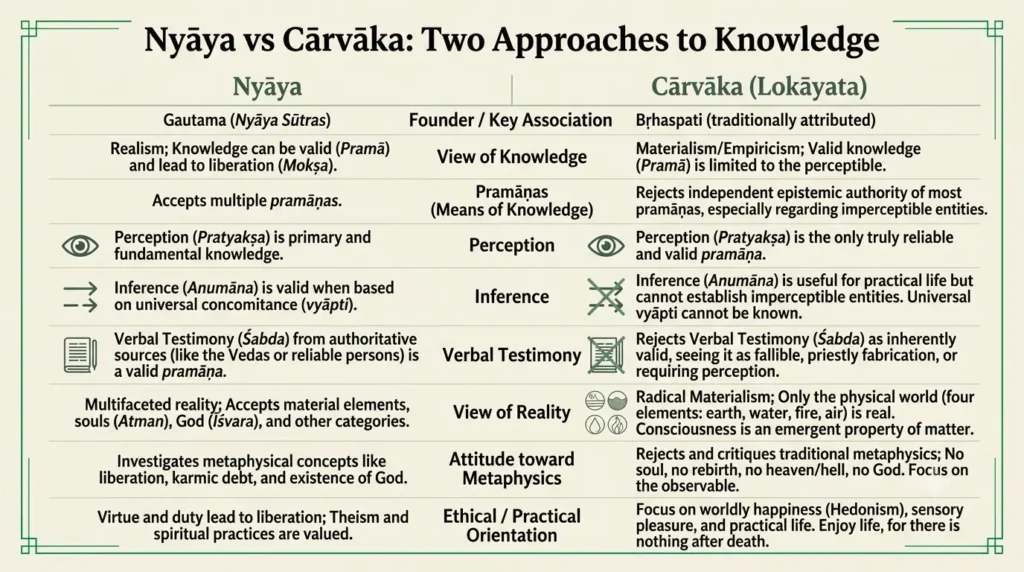
| Point of Comparison | Nyaya School | Charvaka School |
|---|---|---|
| Classification | Orthodox (Astika) | Heterodox (Nastika) |
| Attributed founder | Sage Gautama | Brihaspati (traditionally) |
| Pramanas accepted | Perception, inference, comparison, verbal testimony (4) | Perception only (1) |
| View of the Vedas | Accepts scriptural authority (as sabda) | Rejects Vedic authority |
| View of the self (atman) | Exists independently of body, mind and senses; eternal | The self is simply the living body; no independent soul |
| Ultimate elements | Recognises a wider metaphysics, including God (Nyaya theism) | Everything reduces to earth, water, fire, air |
| View of moksha | A real, attainable liberation of the soul from rebirth | Rejected as unverifiable by perception |
The Concept of Self (Atman)
Indian political thought’s emphasis on dharma and rajdharma rests on an underlying view of the self, and the two schools above disagree sharply here. In the Nyaya view, the self (atman) is distinct from the body, senses, mind and even consciousness itself — consciousness is a quality the self acquires through contact with the mind, not something it possesses inherently (a sleeping person, Nyaya argues, still has a self even while not conscious). The self is eternal, and it can, through right knowledge, meditation and detachment, achieve moksha — freedom from the cycle of rebirth. The Charvaka school, by contrast, denies any such independent soul: the “self” is nothing more than the conscious, living body, and there is no survival beyond it. This disagreement is not a side issue — it is precisely what underlies the deeper debate over whether a ruler’s authority rests on a transcendent moral order (dharma) or on purely worldly considerations.
Basic Premises: Political Ideas in the Ramayana, the Mahabharata and the Arthashastra
Beyond formal epistemology, Unit 1 also asks students to trace core political ideas — especially Rajdharma, the duty of a king — through three foundational texts.
The Ramayana
Attributed to the sage Valmiki, the Ramayana illustrates Rajdharma primarily through the conduct of Rama:
- Duty over personal desire: Rama’s acceptance of fourteen years’ exile, to honour a promise his father had made, is read as the model of a ruler who keeps his word regardless of personal cost.
- Protector-king ideal: Rama’s rule (Ram Rajya) became the enduring symbol of a just and welfare-oriented monarchy, in which the king’s legitimacy rests on caring for his subjects.
- Moral integrity: the epic ties legitimate rule to personal righteousness (dharma), truthfulness and compassion, not merely to power.
The Mahabharata
Attributed to Vyasa, the Mahabharata presents Rajdharma through moral conflict rather than a single ideal figure:
- Yudhishthira’s dilemma personifies the tension between strict moral duty and political necessity, showing that righteous rule is rarely free of hard trade-offs.
- Bhishma’s teachings to Yudhishthira, in the Anushasana Parva, lay out the king’s responsibilities in detail: protecting the weak, delivering justice, and promoting the prosperity of the realm.
- Krishna’s counsel to Arjuna in the Bhagavad Gita (embedded within the Mahabharata) extends this into political ethics more broadly — action performed as duty, without attachment to its results (nishkama karma), is presented as the correct basis for a ruler’s or a warrior’s conduct.
The Arthashastra
Attributed to Kautilya (Chanakya), the Arthashastra is a comprehensive and unusually practical treatise on statecraft, economics and military strategy:
- Realism over idealism: the king’s central duties are protecting the state, administering justice, and securing the welfare of subjects — pursued through practical strategy rather than moral abstraction alone.
- Administrative detail: the text lays out the roles of ministers and officials, taxation and revenue policy, and internal security measures in considerable depth.
- The Mandala theory of foreign policy: neighbouring states are treated as natural rivals, while more distant states are potential allies — a genuinely geopolitical way of thinking about diplomacy, alliance and war that predates similar Western ideas by centuries.
- Espionage and diplomacy: the Arthashastra is candid about the use of intelligence-gathering and strategic alliance-building to secure the state’s interests, alongside its emphasis on economic prosperity through sound revenue and trade policy.
Rajdharma Across the Three Texts
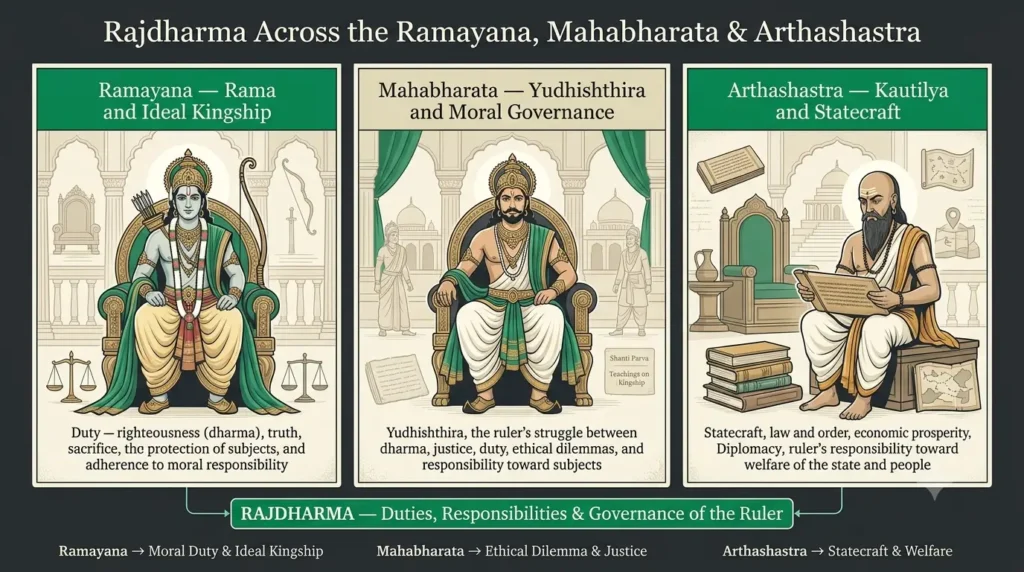
| Text | Central Political Idea | Key Illustration |
|---|---|---|
| Ramayana | The king as moral exemplar and protector | Rama’s exile and Ram Rajya |
| Mahabharata | The difficulty and complexity of righteous rule | Yudhishthira’s dilemma; Bhishma’s Rajdharma teachings; Krishna’s counsel |
| Arthashastra | Practical statecraft grounded in realism | Mandala theory; administrative and economic detail |
Other Foundational Textual Sources
Several other DU papers on Indian political thought (and many coaching/notes sites) treat “sources” in the documentary sense described earlier — as the body of ancient texts scholars draw on. These remain genuinely useful background even where they sit outside DSC-8 Unit 1’s specific epistemological focus, so they are covered briefly here.
Vedic Texts. The four Vedas (Rig, Yajur, Sama, Atharva) are not political treatises, but they lay early groundwork for Hindu political thinking: the king (raja) as protector and upholder of dharma, and a social order (the varna system) that structured governance long before formal political theory existed.
The Upanishads. Primarily spiritual-philosophical texts, the Upanishads extend the idea of Rajadharma into a more explicitly ethical register — kingship as a role with spiritual as well as material responsibility, where governance must serve both the material and moral welfare of subjects.
The Dharmashastras (especially the Manusmriti). These texts codify social and legal norms, including the duties of rulers. The Manusmriti in particular:
- Grounds the king’s authority in a divine theory of the state’s origin, describing the king as composed of elements drawn from eight deities (Indra, Vayu, Yama, Surya, Agni, Varuna, Chandra and Kubera).
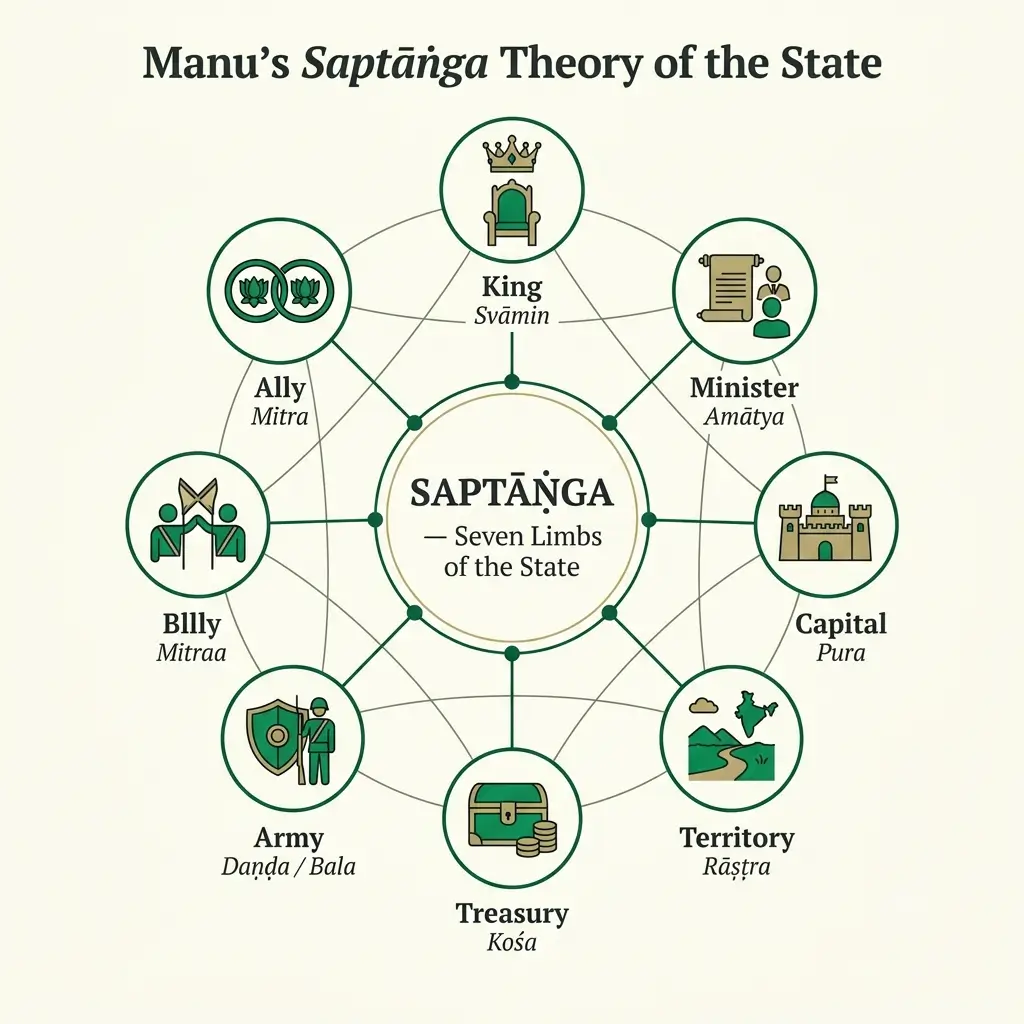
- Sets out the influential Saptanga (seven-limb) theory of the state: Swami (the king), Amatya (ministers), Pur (the fortified capital), Rashtra/Janapada (territory and people), Kosha (the treasury), Danda (military force/punishment), and Mitra (allies) — a strikingly systematic account of what makes a functioning state, one still cited for its resemblance to modern accounts of statehood.
A note on dating, presented as a live scholarly debate: sources disagree considerably on when the Manusmriti was composed. Some traditional accounts and older Indological estimates place it as early as 600 BCE to 200 BCE; a widely cited modern critical edition by the Indologist Patrick Olivelle instead dates the text to roughly the 2nd–3rd century CE. Because there is no surviving original manuscript, and the text shows signs of composite authorship over time, treat any single date you see in notes (including this one) as one scholarly position among several, not a settled fact — and expect your own paper’s “Talking Point: Authenticity of Manusmriti” (Unit 2) to engage with exactly this debate.
Secondary Sources: Commentaries and Modern Scholarship
Secondary sources — commentaries, translations, and modern academic studies — are how later generations have interpreted and debated the primary texts above.
On the Vedas and Upanishads: Adi Shankaracharya’s commentaries on the Upanishads, the Bhagavad Gita and the Brahma Sutras remain foundational for understanding their ethical and political implications. In the colonial period, Ralph T.H. Griffith’s English translation of the Rig Veda (published in the late 19th century) made these ideas accessible to a wider, English-reading audience for the first time.
On the epics: The Bhagavad Gita has drawn commentary from Swami Vivekananda, Sri Aurobindo and Mahatma Gandhi, each reading its teaching on duty and detachment somewhat differently. Valmiki’s Ramayana, too, has been read in markedly different ways by different scholars — notably by A.K. Ramanujan, whose work on India’s many regional Ramayana traditions is a reminder that even a single epic is not read identically across the subcontinent.
On the Arthashastra: The modern rediscovery of the Arthashastra owes a great deal to R. Shamasastry, who located, translated and published the text in the early 20th century, and to R.P. Kangle, whose three-volume critical edition and English translation (published 1960–1965) remains a standard scholarly reference.
On the Dharmashastras: The Manusmriti was first translated into English by Sir William Jones in 1794, shaping colonial-era British engagement with, and legal use of, Hindu law. In the 20th century, B.R. Ambedkar offered a sharp and influential critique of the text’s caste hierarchy and its implications for social justice — a critique that remains central to how the Manusmriti is read academically today. Feminist scholars, including Uma Chakravarti, have separately examined its treatment of gender.
On modern political thought: Later scholars have connected these ancient debates to modern Indian politics — for instance, work on Raja Ram Mohan Roy’s synthesis of Indian and Western liberal ideas, biographies of Nehru’s and Gandhi’s political thought, and Rajeev Bhargava’s and Partha Chatterjee’s work on secularism, democracy and nationalism in a diverse society. These modern debates draw on, but are not the direct subject of, DSC-8 Unit 1.
Open Debates Worth Knowing for Exams
A strong answer on this topic doesn’t just list facts — it shows awareness that scholars disagree. Three debates are especially worth citing:
- How reliable is our picture of Charvaka? Since almost no independent Charvaka text survives, most of what is taught about the school is reconstructed from the arguments of its opponents — a real methodological problem, not a settled account.
- When was the Manusmriti actually composed, and by whom? As discussed above, estimates range from roughly 600 BCE to the 3rd century CE, and there is no consensus on whether it was authored by one person or compiled by different jurists over time.
- Is there a single, unified “Indian political thought,” or many traditions in tension? Bhikhu Parekh’s account of the tradition as pluralistic and self-critical is itself a scholarly position — you can note that Brahminical, Shramanic (Buddhist/Jain), Islamic and syncretic (Bhakti/Sufi) traditions often disagreed sharply with one another, rather than forming one smooth continuous narrative.
Significance of Indian Political Thought
Within Indian society, this tradition shaped the caste-based social order and much of the reform movement against it (Ambedkar, Raja Ram Mohan Roy and Swami Vivekananda all drew on, and argued against, elements of this same tradition); it grounded the ethical expectation that rulers govern with moral responsibility, an ideal invoked by figures from the epics’ model kings to Gandhi; and it shaped India’s approach to religious pluralism and secularism, building on older traditions of tolerance associated with figures like Ashoka.
Globally, Gandhi’s ideas of ahimsa (non-violence) and Swaraj (self-rule) influenced the American civil rights movement and the anti-apartheid movement, and are widely cited as an influence on Martin Luther King Jr. and Nelson Mandela. Ambedkar’s arguments against caste-based discrimination continue to inform global debates on social justice and affirmative action. Buddhist political philosophy, rooted in Indian thought, shaped ideas of governance and non-violence across South and Southeast Asia. And the idea of Swaraj more broadly has been cited as a distinct, community-oriented contribution to global thinking about democracy, alongside — not simply copying — Western liberal traditions.
Conclusion
“Sources of Indian political thought” is really two related questions in one: how did Indian thinkers claim to know anything about right rule (the epistemological question of pramana, and the Nyaya–Charvaka debate), and from which texts do we actually reconstruct their political ideas (the Vedas, epics, Dharmashastras and Arthashastra, and the long tradition of commentary on them). DSC-8 Unit 1 is built around the first question; most general reading on the subject assumes the second. A strong exam answer briefly signals that you know the difference, engages with pramana and the two schools in some depth, and then grounds the discussion in Rajdharma as it appears in the Ramayana, Mahabharata and Arthashastra.
Continue Reading
- BA Political Science Notes – Delhi University — the full hub of DSC-wise notes for every semester of the BA Political Science programme, including the rest of DSC-8.
- DU BA Political Science PYQs: 2023–2024 and 2024–2025 — previous year question paper collections across DSC papers, useful for practising the exam pattern for this course.
University of Delhi Previous Year Questions
University of Delhi Previous Year Questions
Section A — Source-Attributed Question
1 Evaluate the distinctive features of ancient and medieval Indian political thought. +
Year/Paper: B.A. Programme Political Science, DSC – Ancient and Medieval Indian Political Thought; Unique Paper Code 2322102301. Exact session/year not independently confirmed.
Hint: Use Bhikhu Parekh’s four features — egalitarian, pluralistic, self-critical, and practical/didactic — as your backbone, then illustrate each with a textual example.
Suggested Answer Focus: Define “distinctive,” give 3–4 features with one textual example each, and close by contrasting briefly with Western political thought. Source-Attributed
Section B — Short Answer Questions
2 What is meant by “pramana” in Indian epistemology? Explain any three types with examples. +
Hint: Focus on definitions and one clear example per pramana, not exhaustive detail.
Suggested Answer Focus: Define pramana, then explain three of pratyaksa, anumana, upamana, and sabda with a short example each. Probable
3 Distinguish between the Nyaya and Charvaka schools of thought. +
Hint: A comparison table format scores well here.
Suggested Answer Focus: Contrast accepted pramanas, view of the Vedas, and view of the self. Probable
4 Mention any two textual sources of ancient Indian political thought. +
Hint: Keep it brief — name and one line each.
Suggested Answer Focus: Any two of: Vedas, Upanishads, Ramayana, Mahabharata, Arthashastra, and Dharmashastras. Probable
5 What is the significance of the Mandala theory in Kautilya’s Arthashastra? +
Hint: Focus on the “enemy’s enemy is a friend” logic.
Suggested Answer Focus: Explain neighbouring versus distant states and link the theory to realist approaches to foreign policy. Probable
Section C — Long Answer Questions
6 Discuss the concept of Rajdharma as presented in the Mahabharata. +
Hint: Use Yudhishthira’s dilemma and Bhishma’s teachings as your two anchors.
Suggested Answer Focus: Explain Rajdharma, then Yudhishthira’s conflict, Bhishma’s teachings in the Anushasana Parva, and Krishna’s counsel. Probable
7 Critically examine the Charvaka school’s theory of knowledge. +
Hint: Do not forget the methodological caution — most surviving sources on Charvaka are hostile or written by opponents.
Suggested Answer Focus: Explain Charvaka’s acceptance of pratyaksa as the primary/only reliable pramana, its rejection of anumana and sabda as independent means of knowledge, and the problem of source reliability. Probable
8 Explain Manu’s Saptanga theory of the state. +
Hint: List all seven limbs with a one-line role for each.
Suggested Answer Focus: Define Saptanga, list the seven angas, and briefly explain the function of each while noting its relevance to theories of statehood. Probable
Frequently Asked Questions
What are the main sources of Indian political thought?
Depending on which sense of “source” your teacher means, the answer is either the means of valid knowledge — pramana (perception, inference, comparison, verbal testimony, and so on) — or the body of texts scholars draw on, chiefly the Vedas, Upanishads, the epics (Ramayana and Mahabharata), the Dharmashastras, and Kautilya’s Arthashastra.
Why does the official DU syllabus focus on epistemology rather than just listing texts?
Because Unit 1, Lesson 1 of the DSC-8 study material is specifically about how Indian thinkers justified claims to knowledge (pramana) before those claims were applied to questions of governance — it is a philosophical foundation, not a reading list.
What is the difference between Nyaya and Charvaka?
Nyaya is an orthodox (Vedic-affirming) school that accepts four pramanas and holds that the self is eternal and distinct from the body. Charvaka is a heterodox, materialist school that accepts only perception as valid knowledge and holds that the self is nothing but the living body.
Are the Vedas really “political” texts?
Not directly — they are religious and ritual texts. But they contain early ideas about the king as protector of dharma and about social order, which later political thought built on.
Is the Manusmriti a reliable historical source?
It is an important primary source for understanding ancient ideas of kingship, law and social order, but its date of composition and authorship are genuinely disputed among scholars, and its content — especially on caste — has been strongly criticised, notably by B.R. Ambedkar.
What is Rajdharma?
Rajdharma is the specific duty of a king: to protect subjects, uphold justice, and rule according to dharma rather than mere self-interest. It is illustrated differently in the Ramayana (through Rama’s example), the Mahabharata (through Yudhishthira’s and Bhishma’s teachings), and the Arthashastra (through practical statecraft).
What is the Saptanga theory?
It is Manu’s seven-limb theory of the state, identifying the king, ministers, capital, territory/population, treasury, military/punishment, and allies as the seven essential components of a functioning state.
Is “Sources of Indian Political Thought” the same as the DSC-2 paper “Ideas and Institutions in Indian Political Thought”?
No — they are different papers with overlapping subject matter. DSC-8 Unit 1 (this article) is about foundational epistemology and Rajdharma; DSC-2 is a separate Semester 1 course with its own distinct syllabus. Check your own semester’s course code before using notes from either.
Did the Charvaka school leave behind its own texts?
Almost none survive. The only text directly attributed to the school is the fragmentary Tattvopaplavasimha; most of what is known about Charvaka comes from the writings of rival schools that argued against it, so its ideas should be read with that caveat in mind.
How should I structure a long-answer exam response on this topic?
Briefly define what “sources” means in this unit, cover 2–3 pramanas with examples, contrast Nyaya and Charvaka in a short table or list, then illustrate Rajdharma using at least one epic and the Arthashastra — this covers both halves of what examiners typically expect.
What is the “chief source of political power” in India today, and is that the same question as this unit?
No — that is a modern constitutional-law question (the Constitution and the sovereignty of the people), quite different from this unit’s historical and philosophical question about ancient epistemological and textual sources. Don’t confuse the two in an exam answer.
Where can I find previous year question papers for DSC-8?
See the linked PYQ hub pages above; also check with your own college, since question banks can vary slightly by college even under the same university-wide syllabus.
Subscribe to keep reading
You've used your free notes for now. Get Delhi Pathshala Premium for unlimited access.
Subscribe — ₹29/30 days