
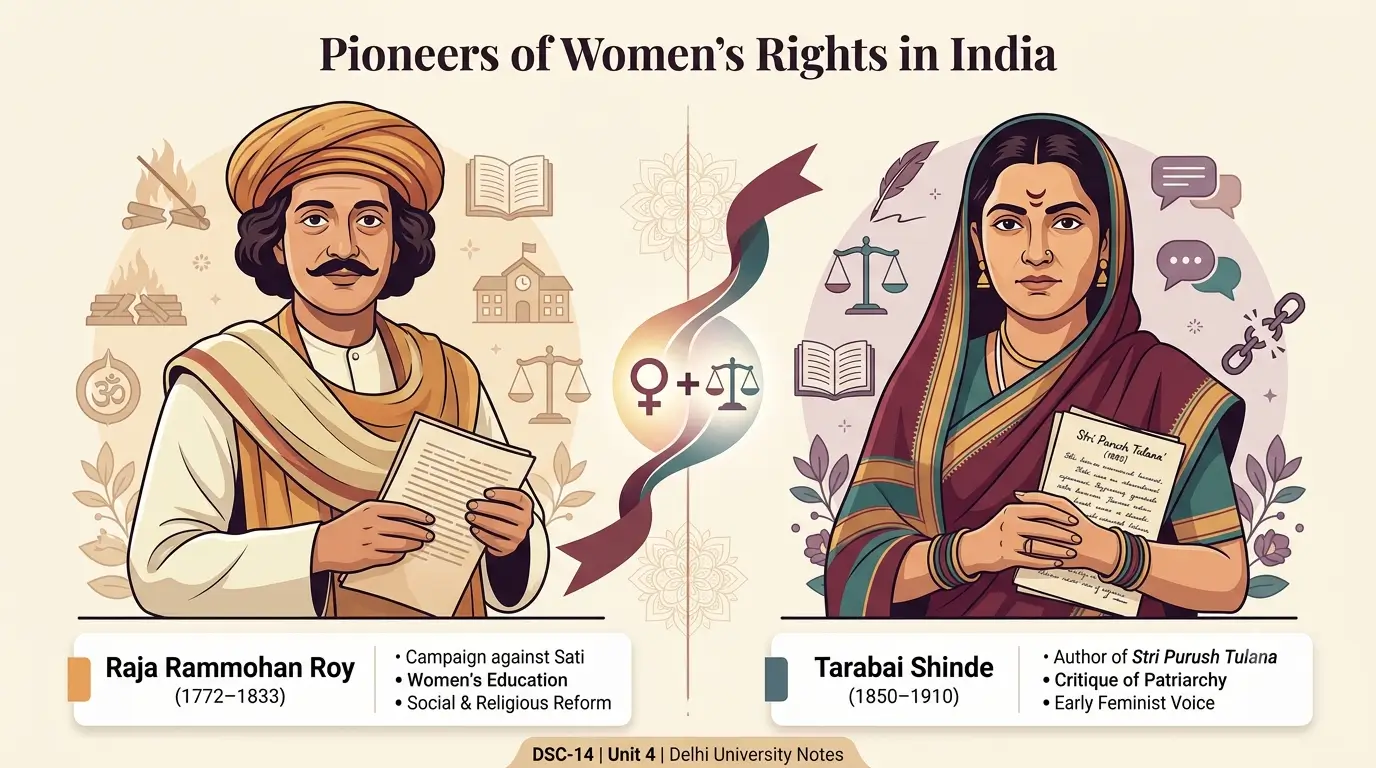
Contents
- 1. Introduction to Rights
- Definition and Concepts
- Historical Evolution of Rights in India
- Importance in Modern Indian Political Thought
- 2. Rammohan Roy
- Early Life and Influences
- Advocacy for Social and Religious Rights
- Key Reforms and Contributions
- Writings and Speeches
- Impact on Indian Society and Rights Discourse
- 3. Tarabai Shinde
- Early Life and Background
- Advocacy for Women’s Rights
- Key Work: “Stri Purush Tulana” (1882)
- Contributions to Feminist Thought in India
- Impact on Gender Equality and Social Reforms
- 4. Comparing Their Views on Rights
- Main Ideas and Differences
- Social and Cultural Factors
- Their Contributions to Rights in India
- Relevance Today
- 5. Previous Year Questions (PYQs)
- 6. Conclusion
- Key Points Summary
- Ongoing Importance of Their Ideas
- Legacy of Rammohan Roy and Tarabai Shinde Today
- 7. FAQs
In this post, notes of Unit 4: Rights — Rammohan Roy, Tarabai Shinde from DSC 14: Modern Indian Political Thought (B.A. Hons. Political Science, Semester 5, DU) are given below — covering the full syllabus, a comparison table, previous year exam questions, and FAQs for quick revision.
New to this paper? Start with our Unit 1: Understanding Modern Indian Political Thought notes before this unit, and once you’re done here, move on to Unit 5: Swaraj — Tilak, Gandhi.
1. Introduction to Rights
Definition and Concepts
- Rights are basic freedoms or entitlements that every person has simply by being human.
- They can be natural, legal, social, or political and are essential for ensuring justice, equality, and dignity.
- The Indian Constitution (1950) guarantees Fundamental Rights (Articles 12–35), influenced by global movements and Indian reformers like Rammohan Roy and Tarabai Shinde.
Historical Evolution of Rights in India
- Ancient India: Rights were linked to Dharma (duty and justice) rather than personal freedoms.
- Medieval Period: Rights were restricted under kings and feudal systems, often based on caste and religion.
- Colonial Era:
- Thinkers like Rammohan Roy opposed social evils (Sati, caste discrimination, lack of women’s rights) and demanded civil liberties.
- Early national movements focused on political rights, self-rule, and legal equality.
- Pre-Independence:
- Leaders like Ambedkar, Gandhi, and the Indian National Congress fought for equal rights, abolition of untouchability, and gender equality.
- The Government of India Acts (1909, 1919, 1935) provided some rights but lacked full democracy.
- Post-Independence:
- The Indian Constitution (1950) established Fundamental Rights, blending Western democratic principles with Indian social reforms.
- Key reforms included women’s rights, Dalit empowerment, and minority protections.
Importance in Modern Indian Political Thought
- Social Reforms: Thinkers like Rammohan Roy and Tarabai Shinde played a vital role in gender equality, freedom of speech, and religious reforms.
- Foundation of Indian Democracy: Rights uphold individual freedom, justice, and equality, forming the base of a democratic government.
- Empowerment of Marginalized Groups: Rights movements have helped Dalits, women, and minorities gain legal and social justice.
- Constitutional Protection: The Indian government is responsible for protecting and enforcing citizens’ rights.
The concept of rights in India has evolved from traditional duties to modern democratic entitlements, shaped by social reformers, independence movements, and constitutional guarantees. Thinkers like Rammohan Roy and Tarabai Shinde played a crucial role in advocating for gender rights and social justice.
2. Rammohan Roy
Early Life and Influences
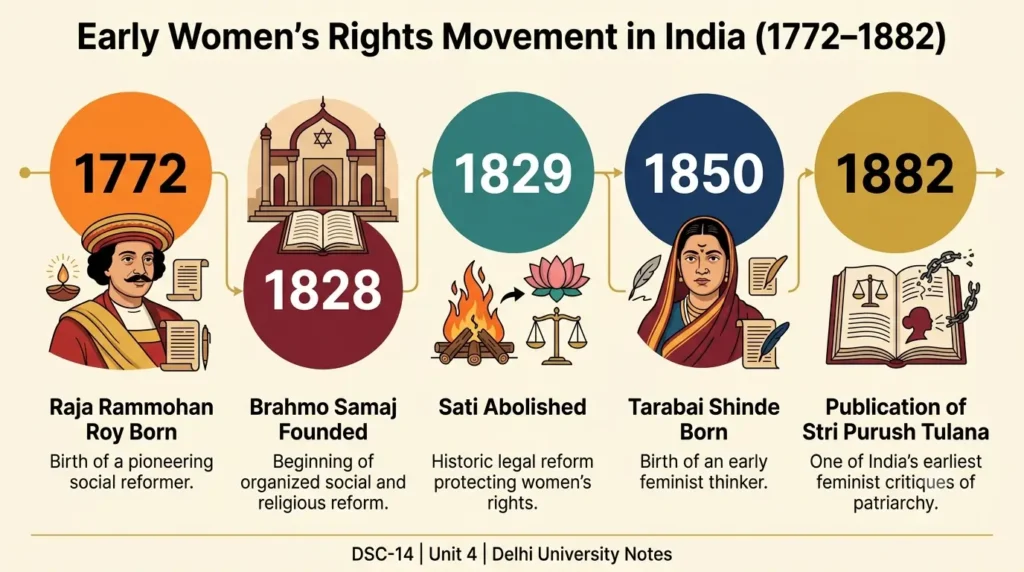
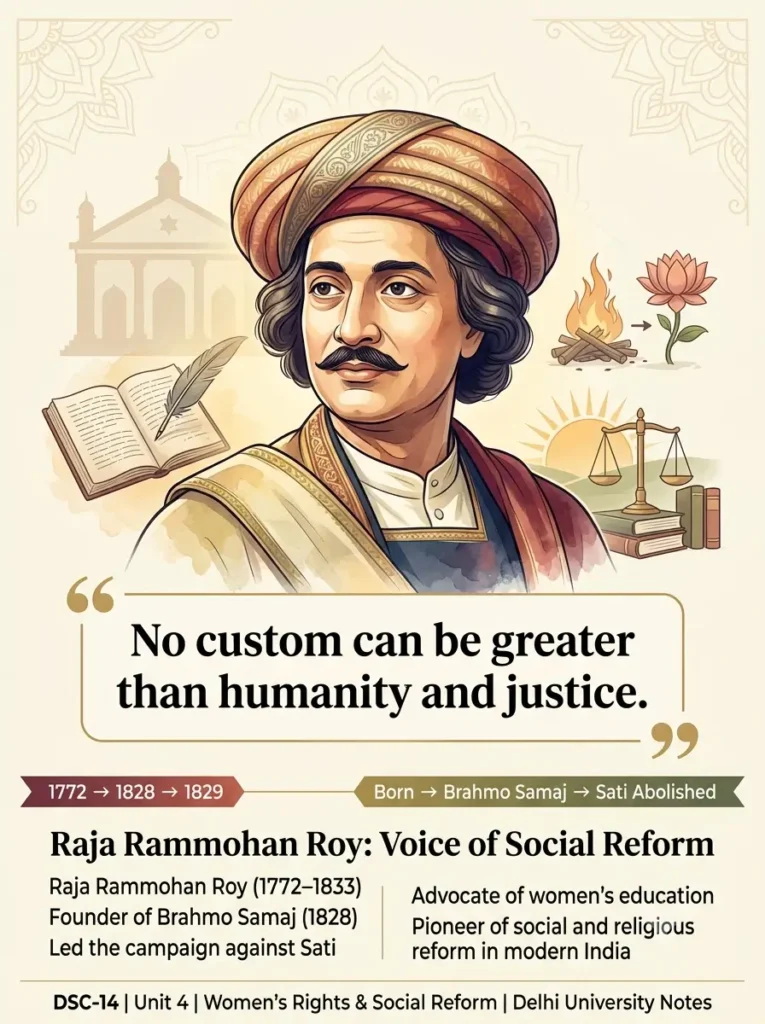
- Born in 1772 in Radhanagar, Bengal, in a Brahmin family.
- Learned Persian, Arabic, Sanskrit, and later English, gaining knowledge from Islam, Hinduism, and Western thought.
- Influenced by Vedantic philosophy, Sufism, Christianity, and Enlightenment ideas from Europe.
- Spoke out against superstitions, caste oppression, and strict religious traditions.
Advocacy for Social and Religious Rights
- Women’s Rights:
- Led the fight to end Sati (widow burning), calling it a violation of women’s dignity.
- Supported women’s education, widow remarriage, and property rights.
- Religious Rights:
- Opposed idol worship, caste discrimination, and priestly dominance.
- Promoted monotheism (belief in one God), influenced by the Upanishads and Western rationalism.
- Founded the Brahmo Samaj (1828) to promote progressive and inclusive Hinduism.
- Freedom of Speech and Press:
- Strongly advocated for press freedom as essential for democracy.
- Opposed British colonial restrictions on free speech.
Key Reforms and Contributions
- Ending Sati (1829):
- Successfully persuaded Governor-General William Bentinck to pass a law banning Sati.
- Education Reforms:
- Established Hindu College (later Presidency College, Kolkata) to promote Western education and scientific learning.
- Argued that English education was more beneficial than traditional Sanskrit studies for modern India.
- Legal and Political Reforms:
- Demanded equal legal rights for Indians under British rule.
- Called for judicial reforms, including the separation of executive and judicial powers.
Writings and Speeches
- “A Gift to Monotheists” (1809) – Criticized idol worship and called for rational Hinduism.
- “Brief Remarks on Ancient Female Rights” – Defended women’s inheritance and legal rights.
- “Statement on the Present System of Hindu and Mohammedan Law” – Advocated for fair and equal laws for all.
- Wrote letters and essays urging British leaders to protect civil rights, freedom of speech, and press freedom.
Impact on Indian Society and Rights Discourse
- Leader of the Indian Renaissance – Inspired later reformers like Ishwar Chandra Vidyasagar, Swami Vivekananda, and Rabindranath Tagore.
- Influence on the Indian Constitution – His ideas on civil liberties, religious reform, and gender equality helped shape India’s democratic values.
- First Modern Indian Thinker – Promoted rational thinking, human rights, and democracy, laying the foundation for Indian nationalism.
- Legacy in Women’s Rights and Social Reform – His advocacy continues to influence women’s rights movements in India.
Rammohan Roy was a visionary reformer who championed women’s rights, religious freedom, and civil liberties. His ideas played a major role in shaping modern Indian society, human rights, and democratic thought.
3. Tarabai Shinde
Early Life and Background
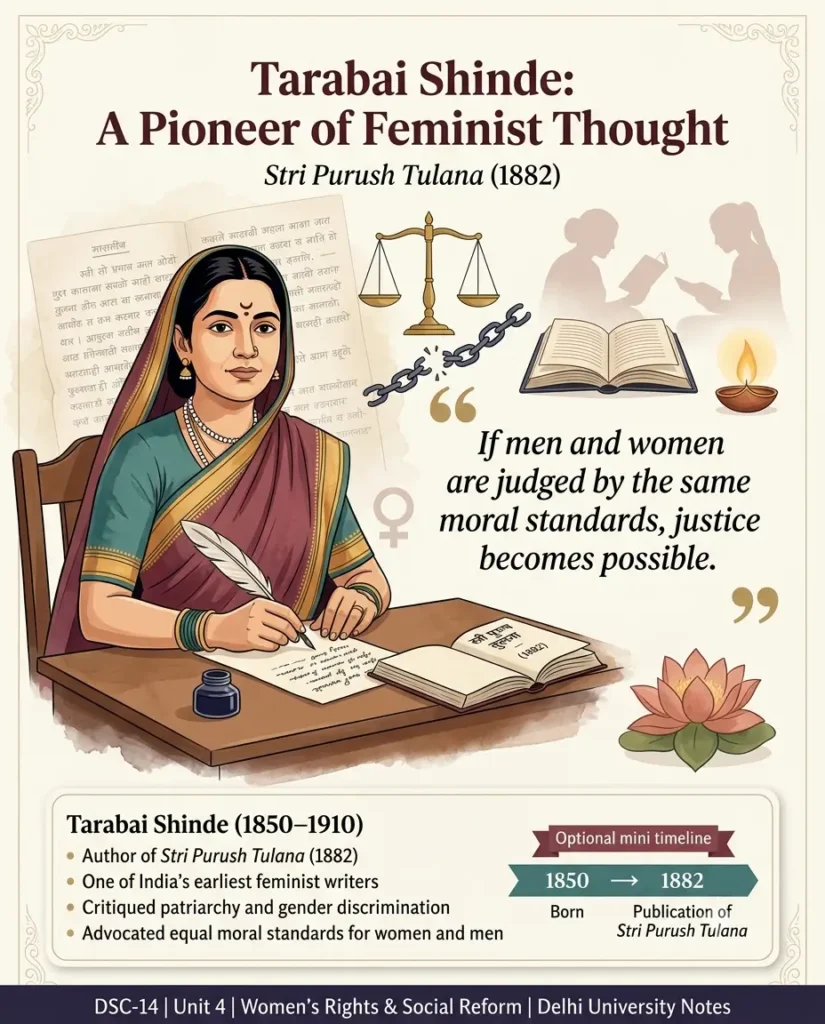
- Born in 1850 in Buldhana, Maharashtra, in a progressive Maratha family.
- Had access to education when most women were denied it.
- Inspired by Jyotirao Phule and Savitribai Phule, pioneers of women’s education and social reform.
- Deeply disturbed by women’s oppression, caste discrimination, and gender injustice.
Read our detailed notes on her broader contribution to gender discourse in Gender: Tarabai Shinde — GE notes.
Advocacy for Women’s Rights
- One of India’s first feminist thinkers, challenging gender inequality in Hindu society.
- Criticized male privilege and how society blamed women for moral and social issues.
- Opposed child marriage, widow mistreatment, and the denial of education to women.
- Advocated for women’s education, economic independence, and dignity.
Key Work: “Stri Purush Tulana” (1882)
- Considered the first feminist book in modern India.
- Written in response to the unjust punishment of a widow, while men committing similar acts went unpunished.
- Main arguments of the book:
- Women face unfair treatment and are blamed for society’s moral failures.
- Religious texts and traditions reinforce male dominance.
- Men enjoy sexual freedom, while women face harsh restrictions.
- Women need education and opportunities equal to men.
- The book sparked outrage and faced harsh criticism from conservative society.
Contributions to Feminist Thought in India
- A pioneer of feminist writing, questioning social norms and gender roles.
- Influenced later reformers like Pandita Ramabai and Dr. B.R. Ambedkar, who fought for women’s rights.
- Critiqued religion’s role in patriarchy and called for justice and equality.
- Connected caste and gender oppression, promoting an intersectional feminist perspective.
Impact on Gender Equality and Social Reforms
- A key figure in the early Indian women’s movement, laying the foundation for later feminist struggles.
- Helped shape debates on widow remarriage, women’s education, and legal rights in colonial India.
- Inspired Dalit-Bahujan feminist movements, which continue to challenge caste and gender oppression.
- Her work remains a vital influence in modern feminist discourse, particularly in critiquing patriarchal structures.
Tarabai Shinde was a bold and revolutionary feminist thinker. Her book “Stri Purush Tulana” challenged patriarchy, religious dogma, and social injustice. She remains a symbol of resistance against gender and caste oppression, making her a pioneer in India’s feminist movement.
4. Comparing Their Views on Rights
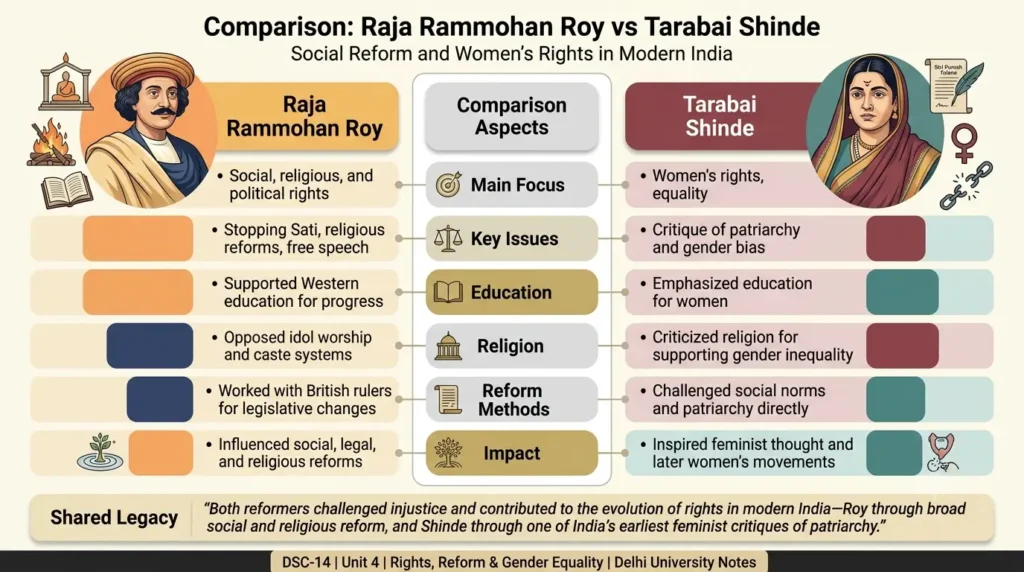
Main Ideas and Differences
| Aspect | Rammohan Roy | Tarabai Shinde |
|---|---|---|
| Main Focus | Social, religious, and political rights | Women’s rights and equality |
| Key Issues | Stopping Sati, religious reforms, free speech | Critique of patriarchy and gender bias |
| Education | Supported Western education for progress | Emphasized education for women |
| Religion | Opposed idol worship and caste systems | Criticized religion for supporting gender inequality |
| Reform Methods | Worked with British rulers for changes | Challenged social norms and patriarchy directly |
| Impact | Influenced rights and religious changes | Inspired feminist movements |
Social and Cultural Factors
- Rammohan Roy was shaped by Western ideas, the Bengal Renaissance, and British rule. His work was influenced by Enlightenment thinking and Christian views on justice.
- Tarabai Shinde came from Maharashtra’s reform movement, influenced by Phule’s fight against caste and women’s oppression. Her feminist views came from her own experiences with discrimination.
- While Roy sought help from colonial rulers for reforms, Shinde’s approach was more direct and critical of patriarchy.
Their Contributions to Rights in India
- Rammohan Roy: Set the groundwork for civil rights, religious freedom, and women’s rights in India; pushed for democracy, free speech, and legal changes; his ideas shaped India’s Fundamental Rights.
- Tarabai Shinde: Led feminist ideas in India, questioning traditional gender roles; advocated for equal rights for women in education, marriage, and society; inspired future feminist movements.
Relevance Today
- Rammohan Roy’s ideas appear in secularism and religious freedom in India’s Constitution, the ongoing fight for freedom of the press, and efforts for scientific education and social progress.
- Tarabai Shinde’s feminist ideas are relevant in gender justice movements (honour killings, dowry, violence), discussions on women’s rights, equal pay, and inheritance rights, and conversations about intersectional feminism.
For a related unit on state institutions in the same paper, see our Unit 3: State and Democracy — Nehru, Upadhyay, Lohia, Ambedkar notes.
5. Previous Year Questions (PYQs)
Below are commonly repeated exam-style questions on this unit’s thinkers, compiled from past DU Political Science papers (IPT-II / DSC-14 pattern). Practice these along with the notes above:
On Rammohan Roy
- Evaluate the impact of the West on the thought of Raja Ram Mohan Roy.
- Do you agree that Raja Ram Mohan Roy was the father of the Indian Renaissance? Explain.
- Evaluate Ram Mohan Roy’s contribution to political and religious beliefs.
- Critically examine Raja Ram Mohan Roy’s views on civil and religious rights.
- Do you agree that Raja Ram Mohan Roy is the father of Modern India?
On Tarabai Shinde
- Tarabai Shinde’s concept of gender equality was way ahead of its time. Critically evaluate the statement.
- Discuss Tarabai Shinde’s critique of patriarchy in “Stri Purush Tulana.”
- Examine Tarabai Shinde’s contribution to the early feminist movement in India.
Comparative / Essay-type
- Compare and contrast the approaches of Rammohan Roy and Tarabai Shinde toward social reform in colonial India.
- “Roy sought reform through legal-political channels, while Shinde confronted patriarchy directly.” Discuss.
6. Conclusion
Key Points Summary
- Rammohan Roy promoted religious freedom, press rights, and women’s empowerment, laying the base for rights in India.
- Tarabai Shinde was a leading feminist, challenging gender norms and patriarchy, impacting women’s rights movements.
- Both focused on social reform and justice, but Roy worked on legal changes, while Shinde was a strong critic of patriarchy.
Ongoing Importance of Their Ideas
- Their ideas still influence current discussions on freedom of speech, religious reforms, and gender justice.
- The fight for women’s rights, caste equality, and secularism in India owes much to their work.
- Their critiques are relevant in movements against gender violence, caste discrimination, and limits on free speech.
Legacy of Rammohan Roy and Tarabai Shinde Today
- Rammohan Roy’s legacy is seen in India’s democratic framework, press freedoms, and legal changes.
- Tarabai Shinde’s legacy is evident in feminist movements, gender equality efforts, and activism for women’s rights.
- Both thinkers shaped modern rights discussions, influencing figures like Ambedkar, Periyar, and Savitribai Phule.
Rammohan Roy and Tarabai Shinde fought against unfair traditions and created a basis for rights discussions in India. Their forward-thinking ideas on justice, equality, and empowerment are essential in today’s efforts for social and gender justice.
7. FAQs
Which unit is “Rights: Rammohan Roy, Tarabai Shinde” a part of?
It is Unit 4 of DSC-14: Modern Indian Political Thought, B.A. (Hons.) Political Science, Semester 5, University of Delhi.
What is Rammohan Roy famous for?
He is best known for leading the campaign to abolish Sati, founding the Brahmo Samaj in 1828, and advocating for press freedom, women’s rights, and rational religious reform.
What is Tarabai Shinde’s most important contribution?
Her 1882 book “Stri Purush Tulana” (“A Comparison Between Women and Men”) is widely regarded as the first feminist text of modern India, directly critiquing patriarchy and gender double standards.
How do Rammohan Roy and Tarabai Shinde differ in their approach to rights?
Roy largely worked through legal and political channels, engaging with British colonial authorities to pass reform laws. Shinde took a more direct, confrontational approach, critiquing patriarchal social norms and religious justifications for gender inequality.
Why are Roy and Shinde studied together in DSC-14 Unit 4?
Because together they represent two complementary strands of 19th-century Indian rights discourse — Roy on religious, civil, and political rights, and Shinde on gender rights — both foundational to the rights framework later enshrined in the Indian Constitution.
Are these notes sufficient for DU semester exams?
These notes cover the complete syllabus for Unit 4 with a comparison table and PYQs, but should be supplemented with your prescribed readings and class notes for full-length answer writing practice.
Subscribe to keep reading
You've used your free notes for now. Get Delhi Pathshala Premium for unlimited access.
Subscribe — ₹29/30 days