
Contents
- Introduction of John Donne
- Biography of John Donne
- Famous Works of John Donne
- Metaphysical Conceit in John Donne’s Poetry
- Full Text of the Poem
- Rhyme Scheme and Meter
- Stanza-wise Summary
- Critical Interpretations
- History of the Poem
- Modern Views on the Poem
- Analysis of The Sun Rising
- Theme of Love and Relationships
- The Role of the Speaker
- Metaphysical Elements
- Literary Devices Used
- Use of Conceit
- Imagery and Symbolism
- Paradox and Hyperbole
- Personification and Apostrophe
- Assonance
- Summary of Key Literary Devices
- Comparative Analysis
- Comparison with Other Poems by Donne
- Common Themes and Motifs
- Impact and Legacy
- Influence on Later Poets
- Relevance in Modern Literature
- Previous Year Questions
- FAQs
- Conclusion
In this post, notes of Unit 2 (John Donne: The Sun Rising / Sunne Rising) from DSC – 4 (14th to 17th Century English Poetry) are given, useful for DU BA (Hons) English Semester 2 students. This guide covers the full summary, stanza-wise explanation, rhyme scheme & meter, poetic devices, themes, previous year questions (PYQs), and FAQs.
For the complete DSC-4 paper structure, check the BA English Notes Delhi University hub page.
Introduction of John Donne
Biography of John Donne
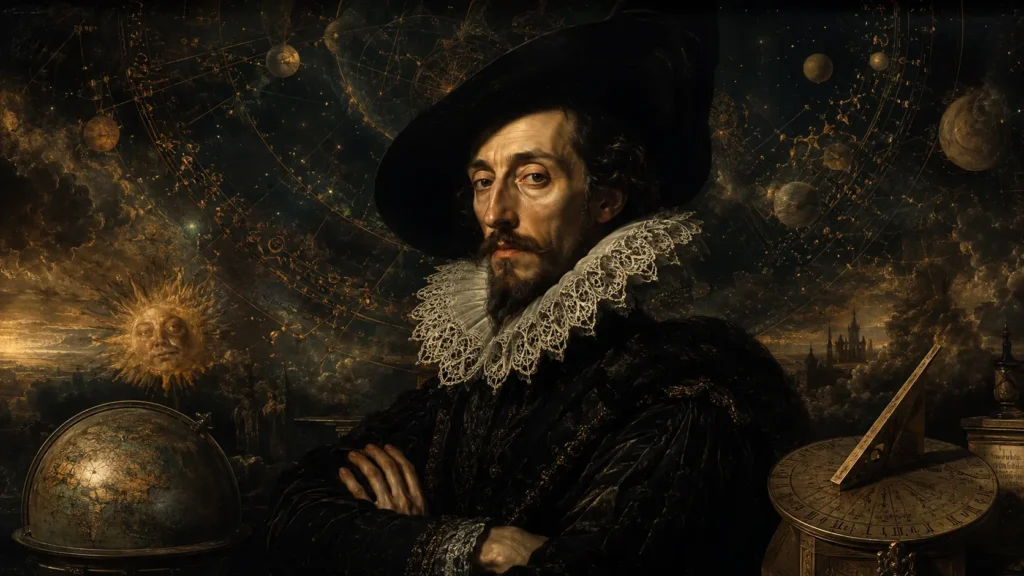
John Donne (1572–1631) was a well-known English poet, scholar, soldier, and church leader.
He was born in London to a Catholic family during a time of religious conflict, which caused him some difficulties.
He studied at Oxford and Cambridge but did not earn degrees because of his background. Later, he changed to the Church of England, which helped him in his career.
His personal life included passionate relationships, especially his secret marriage to Anne More, which led to him being briefly imprisoned.
He eventually became the Dean of St. Paul’s Cathedral in London. You can read a more detailed scholarly biography at the Poetry Foundation’s John Donne page.
Famous Works of John Donne
John Donne’s writing career is usually split into two parts: his early poems, which focus on love and other topics, and his later poems, which show his spiritual concerns after he became a clergyman. Some of his important works are:
- Songs and Sonnets: A collection of love poems showing his cleverness and deep feelings.
- The Holy Sonnets: Religious poems that express his strong faith and struggles with belief and death.
- Devotions upon Emergent Occasions: A prose work that reflects on life, especially sickness and death.
Donne’s poetry is known for being original, thoughtful, and emotionally rich, mixing themes of love, religion, and human experience.
Metaphysical Conceit in John Donne’s Poetry
John Donne is seen as one of the founders of metaphysical poetry, a type of poetry known for its clever and often surprising imagery. Key features include:
- Conceits: Extended metaphors that create surprising links between different things, like Donne comparing lovers to a compass in A Valediction: Forbidding Mourning.
- Complexity of Thought: Metaphysical poets like Donne often think deeply about love, faith, and life’s big questions.
- Intellectual Playfulness: Donne’s poetry is clever, with playful language and logical ideas.
- Emotional Intensity: Even with its intellectual side, Donne’s poetry expresses strong personal feelings, especially in his love and religious poems.
| Related | You can also read |
|---|---|
| Geoffrey Chaucer: ‘General Prologue’ and ‘Pardoner’s Tale’ from Canterbury Tales | Social Movements |
| Summary of The Canonization by John Donne | Philip Sidney: ‘Sonnet I’ Summary |
Full Text of the Poem
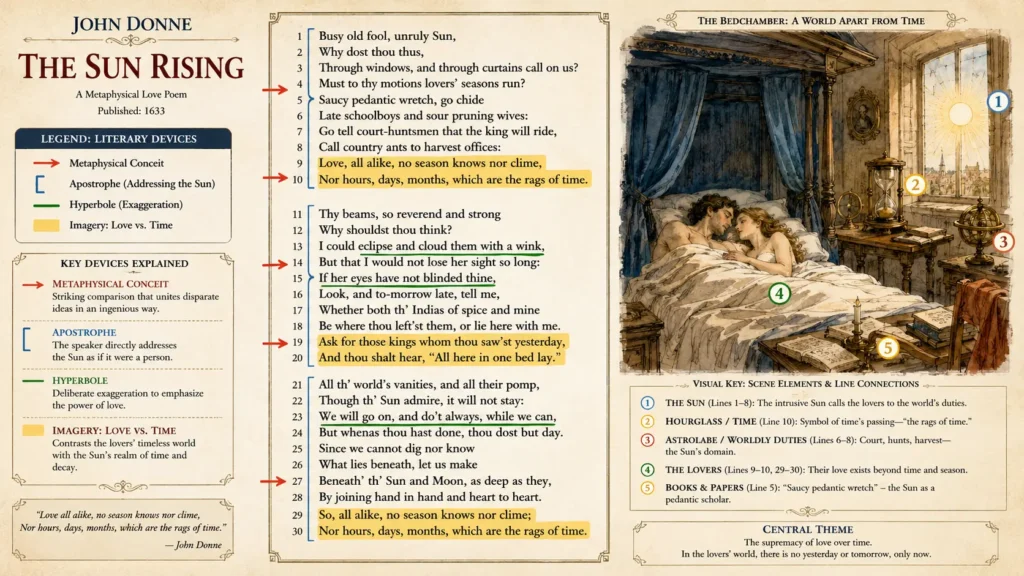
Busy old fool, unruly Sun, Why dost thou thus, Through windows, and through curtains call on us? Must to thy motions lovers’ seasons run? Saucy pedantic wretch, go chide Late school boys and sour prentices, Go tell court huntsmen that the king will ride, Call country ants to harvest offices, Love, all alike, no season knows nor clime, Nor hours, days, months, which are the rags of time.
Thy beams, so reverend and strong Why shouldst thou think? I could eclipse and cloud them with a wink, But that I would not lose her sight so long: If her eyes have not blinded thine, Look, and tomorrow late, tell me, Whether both the Indias of spice and mine Be where thou left’st them, or lie here with me. Ask for those kings whom thou saw’st yesterday, And thou shalt hear, All here in one bed lay.
She’s all states, and all princes, I, Nothing else is. Princes do but play us; compared to this, All honour’s mimic, all wealth alchemy. Thou, Sun, art half as happy as we, In that the world’s contracted thus; Thine age asks ease, and since thy duties be To warm the world, that’s done in warming us. Shine here to us, and thou art everywhere; This bed thy center is, these walls, thy sphere.
By – John Donne
| Related | You can also read |
|---|---|
| Philip Sidney: ‘Sonnet I’ | Reformism and Anti-Reformism in the Nineteenth Century |
Rhyme Scheme and Meter
The Sun Rising consists of three stanzas of ten lines each (30 lines total).
- Rhyme scheme: Each stanza follows the same pattern — ABBACDCDEE.
- Meter: The meter is irregular and varies line by line within each stanza:
- Lines 1, 5, and 6 → iambic tetrameter (four stressed beats)
- Line 2 → dimeter (a short two-beat line, giving a punchy, interruptive effect)
- Lines 3, 4, and 7–10 → iambic pentameter (five stressed beats)
This irregular, speech-like rhythm mimics natural conversation — as though the speaker is genuinely arguing with the sun in real time, which suits the poem’s dramatic, monologue-like tone.
Stanza-wise Summary
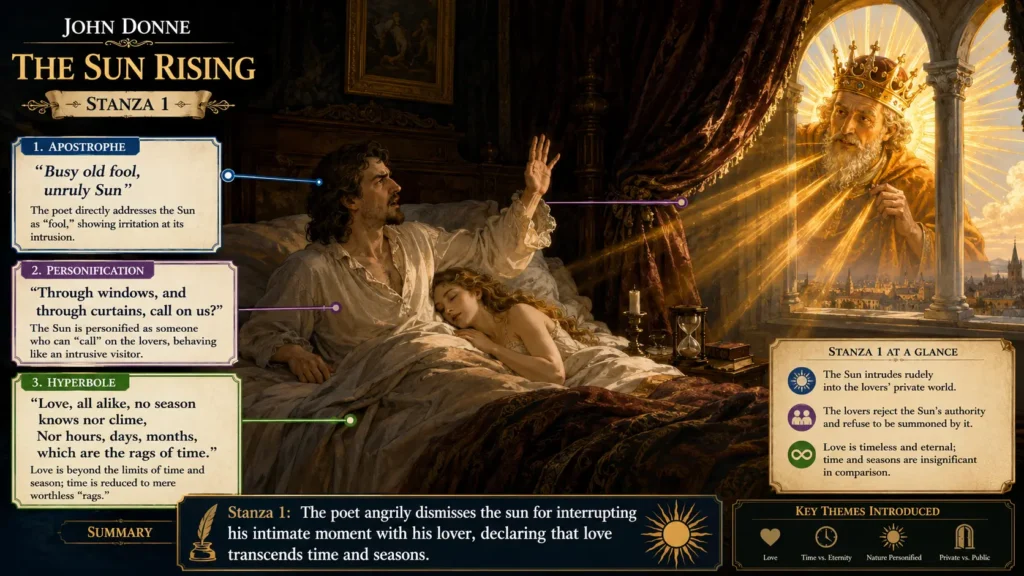
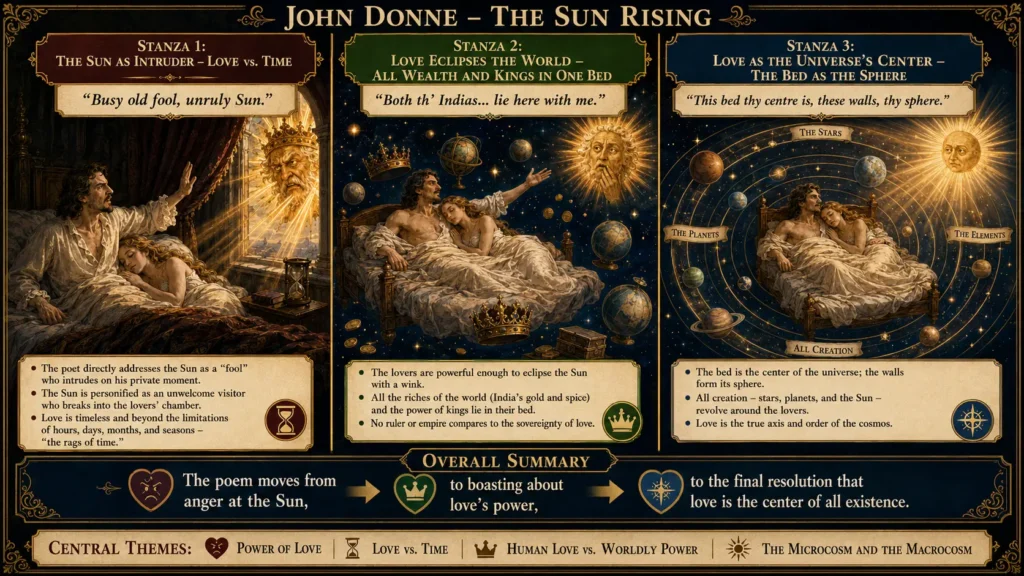
Stanza 1: The speaker talks to the Sun, calling it a “busy old fool” for shining into his room and interrupting him and his lover. He thinks the Sun is annoying and questions why it gets to decide when they spend time together. He jokingly suggests the Sun should wake up schoolboys or hunters instead, showing that love is not bound by time like everyday chores. This stanza highlights that love is more important than the passing of time.
Stanza 2: The speaker continues to tease the Sun, saying he could block its light just by closing his eyes, but he doesn’t want to because he wants to see his lover. He tells the Sun to look around and see if the world’s treasures, like spices and gold, are still where they belong or if they are now in his bedroom. He believes that kings and their kingdoms don’t matter anymore because what truly matters is in their bed.
Stanza 3: In the last stanza, the speaker says his lover is as important as all the countries in the world, and he sees himself as their ruler. He thinks traditional signs of power, like money and status, are not important compared to their love. The speaker claims that the Sun is less happy than them because their love is all that matters. He tells the Sun that it can fulfill its job of warming the world just by shining on them, as their bed is the most important place in the universe.
| Related | You can also read |
|---|---|
| Walter Raleigh: ‘The Passionate Man’s Pilgrimage’ | Partition, Independence and Integration of States |
Critical Interpretations
History of the Poem
John Donne wrote The Sun Rising in the early 1600s, a period of great intellectual change in England. This era saw the rise of metaphysical poetry, which mixed deep thoughts about love, religion, and science.
During Donne’s life, England was moving away from old beliefs, especially with scientific discoveries like Copernicus’ idea that the Earth revolves around the Sun. Donne’s poetry reflects this clash between old and new ideas, teasing the Sun — a symbol of power and time — and claiming that love is stronger than these cosmic forces.
Modern Views on the Poem
Today, critics appreciate The Sun Rising for its cleverness, playful tone, and intellectual depth.
| Modern Criticism of “The Sun Rising” | Key Points |
|---|---|
| Clever Comparisons | Donne uses creative comparisons, such as likening the lovers’ bed to the whole world. Critics admire the originality of these comparisons, which reveal deeper truths about love. |
| Challenging Power | The poem questions traditional authorities like the Sun and the universe, offering a new perspective on love’s role in the world. |
| Gender and Control | Feminist critics focus on the portrayal of the woman, noting that she is significant to the speaker but remains voiceless and inactive — read as reflecting traditional male control of the narrative voice. |
| Existential Ideas | Some critics connect the poem’s focus on personal experience as the primary source of meaning to modern existentialist thought. |
Analysis of The Sun Rising
Theme of Love and Relationships
The main idea in The Sun Rising is that love is more important than anything else. The speaker believes that his love is timeless and greater than the natural world, like the Sun, time, and seasons. He sees his relationship as the most important thing in the universe, making other worries — like money and power — less important.
The Role of the Speaker
The speaker is confident and bold as he addresses the Sun directly. His strong claims about love are both serious and playful, putting his personal feelings at the center of everything — a direct, conversational address typical of metaphysical poets.
Metaphysical Elements
As a metaphysical poem, The Sun Rising includes clever ideas and deep thoughts, linking the physical and spiritual worlds. It blends everyday things (sunshine, a bed) with big concepts (love, eternity), showing how personal love can be used to understand the universe.
Literary Devices Used
Use of Conceit
A conceit is a creative, extended comparison between two very different things. In The Sun Rising, Donne compares the lovers’ bed to the whole world and the lover’s eyes to the Sun, arguing that love is greater than money, power, and even the Sun itself.
Imagery and Symbolism
The Sun symbolizes time and power, but Donne subverts this — making the Sun seem unimportant to the lovers. The bed becomes a symbol of the lovers’ own self-contained universe, and images of world wealth (spices, gold, the “Indias”) suggest that material riches are nothing compared to love.
Paradox and Hyperbole
Donne uses paradox — the small bed becomes the entire universe — to show how love feels all-encompassing. Hyperbole (claiming he can block the Sun with a wink) exaggerates the speaker’s power over time and space, intensifying the emotional stakes.
Personification and Apostrophe
The Sun is directly addressed as if it were a person (“Busy old fool, unruly Sun”) — this is apostrophe (speaking to something that cannot answer) combined with personification (giving the Sun human traits like foolishness and nosiness).
Assonance
Notice the repetition of the “oo” sound in “Busy old fool, unruly Sun” — this creates a musical, mocking rhythm that reinforces the speaker’s playful contempt.
Summary of Key Literary Devices
- Conceit — the lovers’ bed compared to the whole world
- Imagery & Symbolism — the Sun as time/power; the bed as the lovers’ universe
- Paradox — private experience becomes the whole world
- Hyperbole — love’s power is exaggerated to overshadow everything else
- Apostrophe & Personification — the Sun addressed and humanized
- Assonance — repeated vowel sounds for musicality and mockery
Comparative Analysis
Comparison with Other Poems by Donne
| Aspect | Key Points |
|---|---|
| Metaphysical Features | Like Donne’s other poems, “The Sun Rising” blends complex ideas with personal feeling. In A Valediction: Forbidding Mourning, Donne compares lovers to a compass — a similar device to how love overpowers the Sun and time here. |
| Focus on Love | “The Sun Rising,” The Good-Morrow, and The Canonization all present love as a powerful, transformative, timeless force. |
| Physical and Spiritual Mix | In The Flea, physical union represents a deeper spiritual bond; here, the bed symbolizes the entire universe. |
| Tone and Attitude | “The Sun Rising” is light and playful, unlike the serious, existential tone of The Holy Sonnets. |
| Subject Matter | Donne’s later religious poems (post-ordination) shift from earthly love to spiritual themes, unlike this poem’s celebration of present, physical love. |
Common Themes and Motifs
- Enduring Love — Present across The Sun Rising, A Valediction: Forbidding Mourning, and The Canonization.
- Control of the Speaker — The speaker defies external forces, similar to how the speaker challenges death in Death, Be Not Proud.
- Use of Conceit — Donne’s signature device, from the compass in A Valediction to the bed-as-world here.
Impact and Legacy
Influence on Later Poets
John Donne influenced many later poets, especially fellow metaphysical writers like George Herbert, Andrew Marvell, and Henry Vaughan.
- George Herbert: Poems like The Collar and Love (III) reflect Donne’s blend of personal thought and religious complexity.
- Andrew Marvell: To His Coy Mistress echoes The Sun Rising‘s exploration of love and time, though with a more urgent, serious tone.
Donne’s influence also reached modernists — T.S. Eliot praised him for merging thought with feeling, an approach visible in Eliot’s own The Love Song of J. Alfred Prufrock.
Relevance in Modern Literature
Donne’s ideas about love overriding time and authority still resonate today — his playful defiance of “the rules” foreshadows themes of resistance found throughout modern literature.
Previous Year Questions
(Representative DU BA (Hons) English DSC-4 exam-pattern questions for this unit. Always cross-check the exact wording against your latest official DU question paper/college notice before an exam.)
- Critically analyze John Donne’s use of conceit in The Sun Rising. (Long answer, 10 marks)
- How does Donne present the theme of love transcending time and space in The Sun Rising? Discuss with textual references. (10 marks)
- Comment on the significance of the title The Sun Rising in relation to the poem’s central argument. (5 marks)
- Discuss The Sun Rising as a representative metaphysical poem, with reference to wit, conceit, and paradox. (10 marks)
- Explain the poetic devices used by Donne in The Sun Rising with suitable examples. (5–10 marks)
- “The speaker’s arrogance in The Sun Rising is both playful and profound.” Discuss. (Short/long answer)
- Bring out the significance of the sun as a symbol in the poem. (5 marks)
- Write a short note on the tone and structure of The Sun Rising. (5 marks)
FAQs
Why is John Donne called a metaphysical poet?
Donne is called a metaphysical poet because his poetry uses extended conceits (like comparing lovers to a compass in A Valediction: Forbidding Mourning), explores deep themes of love, death, and existence, blends physical and spiritual ideas, uses conversational wit and paradox, and draws heavily on personal experience — all defining features of metaphysical poetry.
What is the theme of The Sun Rising?
The central theme is that love is more powerful than time, the Sun, and worldly authority. The poem also explores the mixing of the physical and spiritual, and maintains a witty, self-assured tone throughout as the speaker mocks the Sun for interrupting his time with his lover.
What is the rhyme scheme of The Sun Rising?
Each of the poem’s three ten-line stanzas follows an ABBACDCDEE rhyme scheme, with an irregular meter mixing dimeter, iambic tetrameter, and iambic pentameter.
What type of poem is The Sun Rising?
It is an aubade — a poem about lovers parting (or resisting parting) at dawn — written in the metaphysical style, characterized by wit, conceit, and direct address (apostrophe) to the Sun.
What are the major literary devices in The Sun Rising?
The poem’s key devices are conceit, personification, apostrophe, hyperbole, paradox, imagery/symbolism, and assonance.
Conclusion
John Donne’s The Sun Rising embodies many themes and techniques common in his poetry: clever comparisons, deep thinking, and a focus on love’s power over time and space. Compared to his other works, like A Valediction: Forbidding Mourning and The Canonization, the poem reflects his recurring themes of love, power, and breaking free from traditional limits. Donne’s impact continues through his influence on later poets and his ongoing relevance in modern literature.
Read Next:
Subscribe to keep reading
You've used your free notes for now. Get Delhi Pathshala Premium for unlimited access.
Subscribe — ₹29/30 days