
Contents
- Introduction: The Building Blocks of Research
- Why Clear Concepts Matter
- Why Hypotheses Are Essential
- How They Work Together as the Foundation
- 2. Understanding Concepts
- What Is a Concept?
- What Makes a Good Concept? (Three Key Qualities)
- Types of Concepts
- Examples in Indian Society
- Why This Matters for Your Research
- 3. Concept Formation
- Step 1: Observation of Social Reality
- Step 2: Abstraction and Categorization
- Step 3: Refinement Through Comparison
- Step 4: Operationalization — Making It Measurable
- Example: Turning “Poverty” into Measurable Indicators
- Why Concept Formation Matters
- 4. The Role of Hypotheses
- What Exactly Is a Hypothesis? (Simple Definition)
- Why Are Hypotheses So Important? (Three Main Functions)
- Example: A Hypothesis in the Indian Context
- A Gentle Reminder
- In a Nutshell
- 5. Types of Hypotheses
- Type 1: Descriptive Hypotheses
- Type 2: Relational Hypotheses
- Type 3: Causal Hypotheses
- Quick Comparison Table
- A Friendly Reminder
- 6. Criteria of a Good Hypothesis
- Criterion 1: Testability and Falsifiability
- Criterion 2: Clarity and Specificity
- Criterion 3: Consistency with Existing Knowledge
- Criterion 4: Relevance to Social Problems
- Summary Checklist for a Good Hypothesis
- Final Thought
- 7. Interplay Between Concepts and Hypotheses
- Concepts Provide the Vocabulary of Research
- Hypotheses Link Concepts into Testable Statements
- Why the Interplay Matters
- A Simple Analogy
- Another Indian Sociology Example
- The Circular, Ongoing Dance
- Key Takeaway
Core Reading: WE Goode & PK Hatt. ‘Methods in Social Research’, McGraw Hill. CH 5&6, Pp 41-73.
Introduction: The Building Blocks of Research
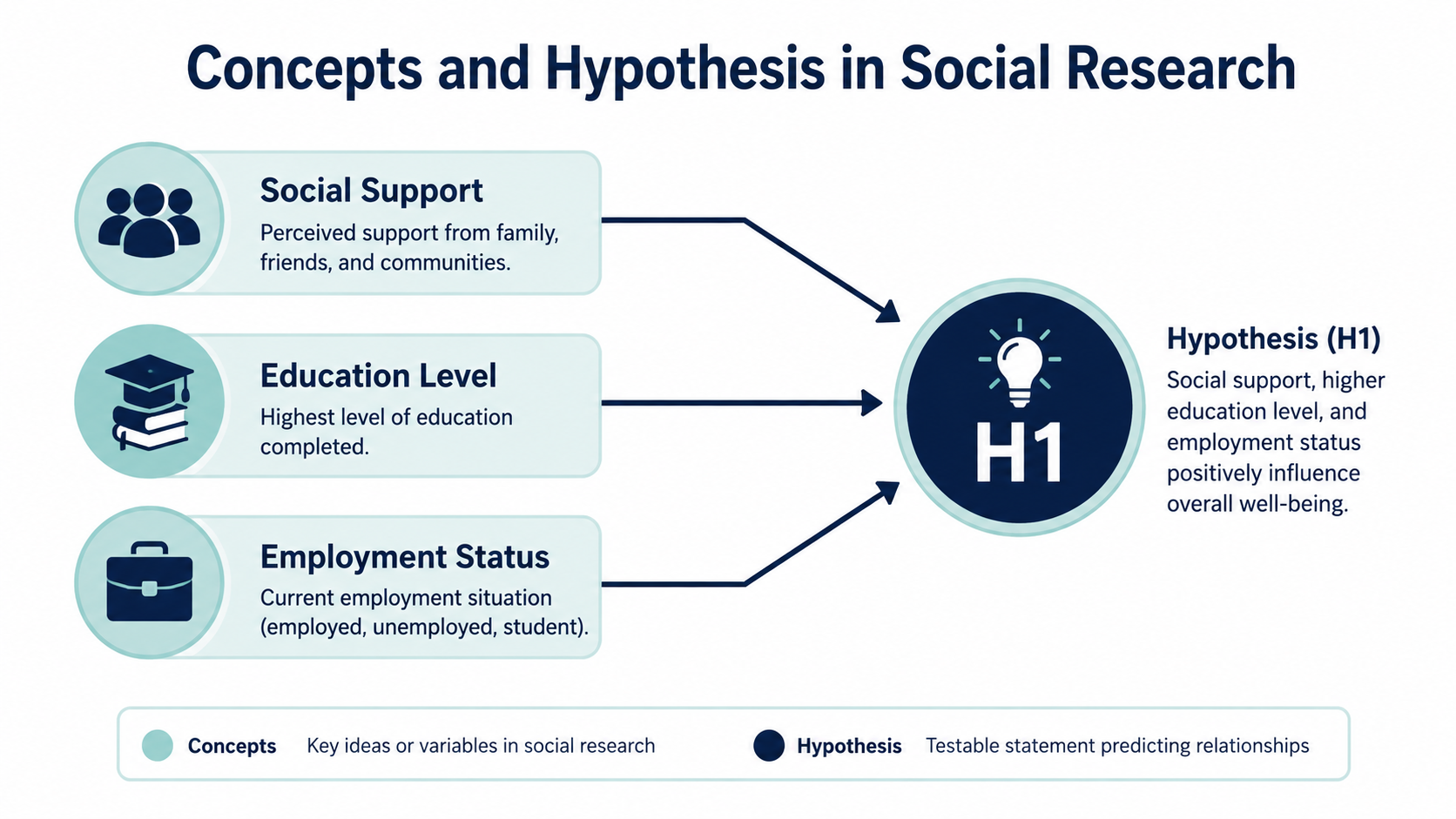
Think of doing social research like building a house. You wouldn’t just start hammering nails into random pieces of wood. First, you need a clear plan, a blueprint, and a set of solid building blocks. In the same way, Goode and Hatt argue that sociological research can’t just be a bunch of random observations. You need two key ingredients from the very start: clear concepts and testable hypotheses.
Why Clear Concepts Matter
A concept is just a fancy word for an idea or a label we give to something in the world—like “friendship,” “poverty,” “education,” or “crime.” But here’s the catch: if different people understand the same concept differently, your research will be a mess.
For example, if you want to study “happiness,” does that mean smiling a lot? Having lots of money? Feeling peaceful inside? Goode and Hatt say you have to be crystal clear about what exactly you mean. That way, anyone reading your research knows exactly what you’re talking about, and other researchers could even measure it the same way you did. Clear concepts turn unclear, everyday ideas into something you can work with.
Why Hypotheses Are Essential
A hypothesis is simply an educated guess about how two or more things are connected. It’s a “maybe this happens because of that” statement. For example: “Students who eat breakfast get better test scores than those who don’t.”
But a good hypothesis isn’t just any guess. It must be:
- Clear – so everyone understands what’s being tested.
- Testable – meaning you can actually go out and collect real-world information to check if it’s true or false.
Without a hypothesis, you’re just gathering facts randomly, with no real direction. With a hypothesis, you know exactly what to look for and why.
How They Work Together as the Foundation
Concepts and hypotheses are the foundation of any solid study. First, you define your key concepts (e.g., “what do we mean by ‘breakfast’ and ‘test scores’?”). Then, you state your hypothesis as a clear, testable relationship between those concepts.
Once you have that, you’re not just wandering around collecting data aimlessly. You have a real plan. You know what information to collect, how to organize it, and how to make sense of it. In other words, clear concepts and strong hypotheses turn social research into a systematic, trustworthy investigation.
So, before you ever hand out a survey or interview someone, Goode and Hatt would say: Get your building blocks ready. Be clear about your concepts and your hypotheses. That’s how real science begins.
2. Understanding Concepts
Now that we know concepts are the building blocks of research, let’s dig deeper. What exactly is the concept? And how do you tell a good one from a bad one?
What Is a Concept?
A concept is just an abstract idea that stands for something in the real world. You can’t touch or see a concept directly—it lives in your mind. But it helps you make sense of the messy reality around you.
For example, you can’t hold “family” in your hand, but you can point to a group of people living together, caring for each other, and sharing meals. “Family” is the concept that wraps up all those real-life observations into one handy label. So, concepts are like mental shortcuts: they take complex social stuff and give it a name so we can talk about it, study it, and compare it.
What Makes a Good Concept? (Three Key Qualities)
Not all concepts are useful for research. Goode and Hatt say a strong concept have three qualities:
- Clarity – Everyone knows roughly what you mean. If you say “caste,” people shouldn’t be guessing whether you mean acting in a play or India’s social hierarchy. Be sharp, not fuzzy.
- Precision – You can draw a clear boundary around it. For example, “urbanization” is more precise than just “city growth” because you can decide to measure it exactly—like “percentage of people moving from villages to towns each year.”
- Relevance – The concept actually matters to your research question. If you’re studying poverty, measuring “hair color” wouldn’t be relevant. But measuring “income” or “access to clean water” would be.
Types of Concepts
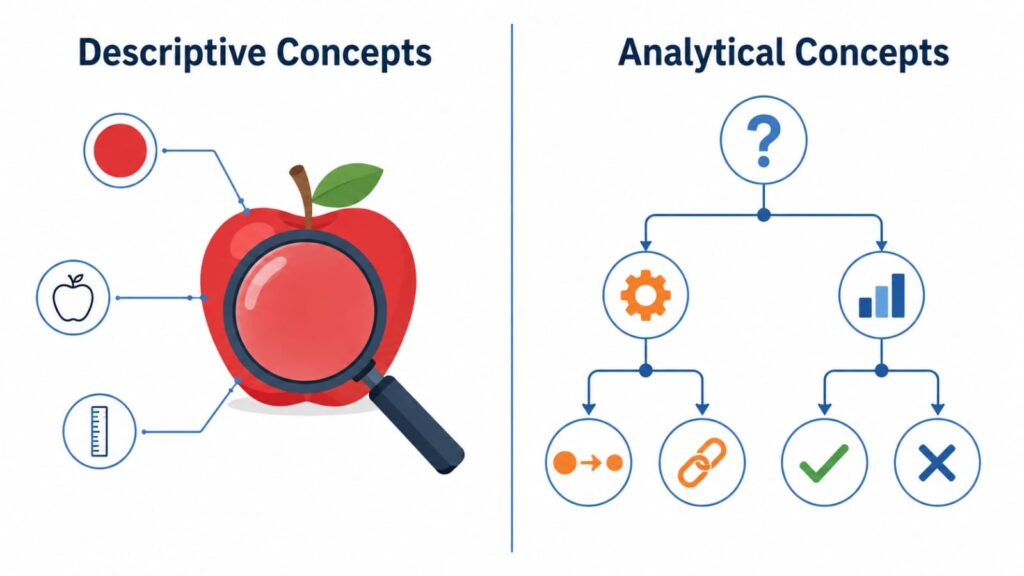
Goode and Hatt point out that concepts come in different flavors. Here are the two main types they discuss:
1. Descriptive Concepts
These simply describe something you can observe. They answer the question “What is it?” Without explaining why.
- Example: “Family” – you can see who lives together and calls themselves a family.
- Example: “Education” – you can count years of schooling or degrees earned.
- Example in Indian society: “Joint family” – you can describe how grandparents, parents, and children share a home and kitchen.
2. Analytical Concepts
These go a step further. They don’t just describe—they help you analyze relationships, patterns, or hidden social structures. They answer, “How does this work?” or “What does this mean?”
- Example: “Social stratification” – not just “rich and poor people exist,” but how society ranks people into layers (like upper, middle, lower classes) and how that affects their opportunities.
- Example: “Role conflict” – when a person must juggle two different expectations at once, like a woman who is expected to be a caring mother at home and a strict boss at work.
Examples in Indian Society
To make this real, Goode and Hatt would encourage you to look at your own surroundings. Here’s how these concepts play out in India:
- Caste – This is a powerful concept in Indian sociology. As a descriptive concept, you can observe caste-based surnames, marriage patterns, and temple entry rules. As an analytical concept, you can study how caste influences politics, jobs, and social mobility.
- Kinship – A descriptive concept that refers to blood and marriage relationships (like cousins, uncles, in-laws). But analytically, you can study how kinship rules in India determine who you can marry, who inherits property, and who you celebrate festivals with.
- Urbanization – Descriptively, this means more people move to cities and towns. Analytically, it lets you ask deeper questions: Does urbanization weaken caste ties? Does it change how a family functions? Does it create new kinds of slum communities?
Why This Matters for Your Research
If your concepts are vague or sloppy, your whole study will be shaky. But if you take time to understand what a concept really is, check its clarity and precision, and pick the right type (descriptive vs. analytical). You’ll be able to describe social life accurately and dig into the “why” behind it. Good concepts turn ordinary observations into real sociological insight.
3. Concept Formation
So, we know what concepts are and what makes a good one. But how do researchers actually create a concept? They don’t just pop out of thin air. Goode and Hatt explain that forming a useful concept is a step-by-step process. Think of it like carving a statue: you start with a rough block of stone (the real world), and with each step, you shape it into something clearer and more useful.
Here are the four main steps.
Step 1: Observation of Social Reality
Everything starts with looking, listening, and experiencing the real world. You notice something happening around you—maybe in your neighborhood, your family, or the news. This step is pure observation, without any fancy theories yet.
For example, you might see that some children in your city go to bed hungry, while others have full meals. Or you might notice that some families live in pukka houses with running water, while others live in makeshift shanties. That’s your raw material: real-life social reality.
Goode and Hatt say: don’t start with books or theories. Start with what you can actually see, hear, or experience. That’s where meaningful concepts are born.
Step 2: Abstraction and Categorization
Now comes the thinking part. You take all those messy, individual observations and ask: What do these things have in common? You pull out the shared feature or essence, ignoring the unique details. That’s an abstraction.
Then, you give that shared feature a label and put similar things into a group. That’s categorization.
Example: You see five different families struggling to pay rent, buy medicine, and afford school fees. Each family’s story is different, but they all share something: a lack of money for basic needs. You abstract that common thread and call it “poverty.” Now “poverty” is a category that holds many different individual cases together.
Step 3: Refinement Through Comparison
You don’t stop after making one category. Goode and Hatt say you sharpen your concept by comparing it to other similar or opposite ideas. Ask yourself:
- Is this concept distinct from others? (Is “poverty” different from “hunger” or “homelessness”?)
- Does it work across different situations? (Does “poverty” mean the same thing in a village and in a big city?)
For example, you compare a poor farmer in rural Bihar with a poor daily-wage worker in Mumbai. You realize that “poverty” might need different indicators for each—lack of land in one case, lack of stable employment in another. So, you refine the concept to be flexible enough to cover both, but clear enough not to be vague.
This comparison step saves you from creating fuzzy or misleading concepts.
Step 4: Operationalization — Making It Measurable
This is where the rubber meets the road. An abstract concept like “poverty” is great for thinking, but how do you actually measure it? How do you count it, see it, or prove it exists? That’s operationalization: turning your abstract idea into concrete, real-world indicators that you can observe, count, or ask about.
Without operationalization, your concept stays in your head. With it, you can go out and do research.
Example: Turning “Poverty” into Measurable Indicators
Let’s walk through the whole process for the concept of “poverty”:
- Observe reality – You see families skipping meals, children wearing torn uniforms, people sleeping on pavements.
- Abstraction – You realize all these share a lack of basic resources. You call this “poverty.”
- Refine by comparing – You compare rural and urban poverty and see they differ. So, you decide your concept should include both income and access to services.
- Operationalize – Now you ask: What specific, measurable things will tell us someone is in poverty?
- Income levels – Earning less than, say, ₹500 per day.
- Access to housing – Living in a kutcha house or sharing one room with six people.
- Nutrition – Eating fewer than two full meals a day or having a child who is underweight.
Now, instead of just saying “poverty is bad,” you have clear, measurable indicators. Any other researcher can pick up your definition and check the same things. That’s the power of operationalization.
Why Concept Formation Matters
Without following these steps, your concepts might be vague or personal. With them, you build shared, testable ideas that any sociologist can use. Goode and Hatt emphasize that concept formation isn’t just for textbooks—it’s what separates casual opinions from real, systematic social research. You start with the real world, build a clear idea, and end up with something you can measure. That’s how good science gets done.
4. The Role of Hypotheses
Now we move from concepts to something even more exciting: hypotheses. If concepts are your building blocks, hypotheses are the blueprint that tells you which blocks go where and how they fit together.
What Exactly Is a Hypothesis? (Simple Definition)
A hypothesis is just an educated guess about how two or more things are connected. It’s a “maybe this leads to that” statement that you haven’t proven yet—but you’re going to check it out.
The key word here is tentative. That means temporary, not final. You’re saying, “I think this might be true, but let me gather evidence and see.”
In technical terms, a hypothesis predicts a relationship between variables (things that can change or vary, like age, income, education, or attitudes).
For example: “People who exercise daily sleep better than people who don’t.” That’s a hypothesis. You’re guessing there’s a relationship between exercise (one variable) and sleep quality (another variable). Now you go test it.
Why Are Hypotheses So Important? (Three Main Functions)
Goode and Hatt say hypotheses aren’t just fancy guesses. They do real, practical work for researchers. Here’s how:
1. Hypotheses Guide Data Collection
Imagine walking into a giant library and being told, “Find everything about India.” You’d be lost, right? But if someone says, “Find everything about how education affects caste attitudes in Mumbai,” now you know exactly where to look.
That’s what a hypothesis does. It tells you: Don’t collect random information. Focus only on data that helps you test this specific guess. It saves time, energy, and confusion.
2. Hypotheses Provide Focus for Analysis
Once you’ve collected your data, you’ll have piles of numbers, interview notes, or survey responses. Without a hypothesis, you’d stare at all that information with no idea what to do next.
A hypothesis gives you a lens. You ask: Does my data support my guess or not? You’re not distracted by irrelevant patterns. You stay focused on the relationship you set out to explore.
3. Hypotheses Enable Testing of Theories
Big theories—like “social class determines life chances” or “modernization weakens traditional authority”—are too large to test directly. But a hypothesis breaks a big theory into a small, bite-sized piece you can actually check.
For example, a big theory might say: “Education promotes social equality.” A hypothesis derived from that theory could be: “Village girls who finish high school are more likely to marry outside their caste than those who drop out after primary school.” If you test that hypothesis and find it true, you’ve just given support to the bigger theory. If it’s false, maybe the theory needs tweaking.
So, hypotheses are like bridges connecting abstract theories to real-world evidence.
Example: A Hypothesis in the Indian Context
Let’s take a hypothesis that Goode and Hatt might appreciate from an Indian sociology perspective:
“Higher education reduces traditional caste barriers in urban India.”
Let’s break this down:
- Variables involved:
- Variable 1 (cause or predictor): Higher education (measured as, say, having a college degree or more)
- Variable 2 (effect or outcome): Reduction in traditional caste barriers (measured by things like willingness to share meals with other castes, support for inter-caste marriage, or having close friends from different castes)
- Is it testable? Yes. You could survey two groups of people in a city like Pune or Chennai—one group with degrees, one without—and ask them questions about their daily interactions, attitudes, and behaviors regarding caste.
- What would you compare? You might find that 70% of college graduates say they would accept a Dalit neighbor, compared to only 30% of non-graduates. That would support your hypothesis. If there’s no difference, your hypothesis might be wrong—and that’s fine too, because you learned something.
A Gentle Reminder
A hypothesis is not a fact. It’s not even a strong belief. It’s a tentative, testable guess. And here’s the beautiful thing about science: It’s perfectly okay to be wrong. If your data shows no relationship or the opposite of what you guessed, that’s still useful knowledge. You’ve ruled something out and can refine your ideas.
Goode and Hatt emphasize that hypotheses keep research honest. Instead of starting with a conclusion and hunting evidence to support it (that’s bias), you start with a guess and let the evidence speak for itself.
In a Nutshell
| What? | A tentative statement predicting a relationship between variables. |
| Why? | To guide what data you collect, focus on your analysis, and test theories. |
| Example | “Higher education reduces traditional caste barriers in urban India.” |
With a good hypothesis, you’re no longer wandering in the dark. You have a clear question, a clear direction, and a fair way to find an answer.
5. Types of Hypotheses
Not all hypotheses are the same. Some simply describe what exists. Others try to connect two things together. And the boldest ones claim that one thing actually causes another. Goode and Hatt break hypotheses into three main types. Let’s walk through each one with everyday examples.
Type 1: Descriptive Hypotheses
A descriptive hypothesis simply states that something exists or that a certain pattern is happening. It doesn’t try to explain why or connect it to anything else. It just says, “Here’s a fact about the world.”
- What it does: Describes a situation, trend, or characteristic.
- What it doesn’t do: Explain causes or relationships.
Example from sociology:
“Urban migration is increasing among youth.”
This hypothesis just claims that more young people are moving to cities than before. It doesn’t matter why. It doesn’t say what causes it. It’s simply a statement about what exists. You could test it by looking at census data over ten years or surveying villages to see how many young people have left.
Another example: “Most working mothers in Mumbai experience sleep deprivation.” Again, just describing a situation.
Type 2: Relational Hypotheses
A relational hypothesis goes a step further. It suggests that two things are connected or related to each other—but it doesn’t necessarily say that one causes the other. Maybe they just move together, or one changes when the other changes.
- What it does: Says “When X happens, Y also happens” or “X and Y are linked.”
- What it doesn’t do: Prove which one caused which.
Example from sociology:
“Caste influences occupational choices.”
This hypothesis claims there’s a relationship between caste (one variable) and the kind of job a person chooses or ends up in (another variable). It doesn’t say caste forces someone into a job. It just says caste plays a role—maybe through family pressure, social networks, or discrimination. You can test this by comparing the occupations of people from different caste groups while keeping other factors like education roughly equal.
Another example: “Higher income is related to better health outcomes.” Related? Yes. But does money directly cause health? Maybe, maybe not. That’s why it’s relational, not necessarily causal.
Type 3: Causal Hypotheses
The causal hypothesis is the strongest type. It claims that one thing directly causes another. That means if you change the first thing, the second thing will change as a result. Cause and effect.
- What it does: Says “X produces Y” or “X leads to Y.”
- What it requires: Stronger evidence than relational hypotheses.
Example from sociology:
“Economic liberalization leads to rising inequality.”
This hypothesis claims that when India opened its economy in the 1990s (cause), income gaps between rich and poor grew wider (effect). It’s not just saying they’re related—it’s saying one brought about the other. To test this, you’d need to compare inequality levels before and after liberalization, while trying to rule out other possible causes.
Another example: “Being laid off from work causes depression.” Not just linked causes.
Quick Comparison Table
| Type | What it claims | Example |
| Descriptive | Something exists or is happening | “Urban migration is increasing among youth.” |
| Relational | Two things are connected | “Caste influences occupational choices.” |
| Causal | One thing causes another | “Economic liberalization leads to rising inequality.” |
A Friendly Reminder
Most beginners want to jump straight to causal hypotheses because they sound exciting. But Goode and Hatt advise starting simpler. First, describe what is happening. Then, establish that two things are related. Only after that, if the evidence is strong, make a causal claim. Good research builds step by step.
6. Criteria of a Good Hypothesis
Now that you know the different types, here’s the big question: How do you tell a good hypothesis from a bad one? You can’t just guess anything. A strong hypothesis must meet four key criteria, according to Goode and Hatt.
Criterion 1: Testability and Falsifiability
This is the most important rule. A good hypothesis must be testable—you have to be able to collect real-world evidence to check if it’s true or false. And it must be falsifiable, meaning you can imagine evidence that would prove it wrong.
- Testable: Can you measure the variables? Can you get data?
- Falsifiable: Could you prove it wrong? If no possible evidence could ever contradict it, it’s not a real hypothesis.
Bad example: “Invisible ancestors guide our destiny.”
- Why it’s bad: You can’t see, measure, or test for invisible ancestors. No evidence could ever disprove it. It’s a belief, not a hypothesis.
Good example: “Daily wage workers who attend a financial literacy class save more money than those who don’t.”
- Why it’s good: You can run a class, track savings, and compare groups. And you could find evidence against it (if savings don’t increase; the hypothesis is false).
Criterion 2: Clarity and Specificity
A good hypothesis doesn’t matter. It says exactly what it means. Vague words like “some,” “often,” “many,” or “significant” without definition make it untestable.
Bad example: “Education does something to caste attitudes.”
- What’s wrong? “Does something” is too vague. What kind of something? Positive? Negative? No direction.
Good example: “People with college degrees are more likely to support inter-caste marriage than people with only primary education.”
- Why it’s good: It’s clear (college vs. primary), specific (support for inter-caste marriage), and directional (more likely).
Criterion 3: Consistency with Existing Knowledge
A good hypothesis doesn’t have to be brand new, but it shouldn’t completely ignore what is already known. It should fit—or at least engage with—established theories and past research.
- What this means: If everyone knows that something is already proven false, don’t hypothesize the opposite without a very good reason. Build what’s there.
- But caution: Don’t be so consistent that you never challenge old ideas. Good science balances respect for prior work with curiosity to question it.
Example: If decades of research show that poverty and poor nutrition are strongly linked, a hypothesis saying “Poverty has no effect on nutrition” would need extraordinary justification. It’s not impossible, but it goes against a mountain of evidence.
Criterion 4: Relevance to Social Problems
Finally, Goode and Hatt argue that the best hypotheses matter. They connect to real social issues, not just abstract curiosities. Sociology, after all, is about understanding and improving society.
- Relevant hypothesis: “Living in a slum without access to municipal water increases the risk of waterborne diseases in children under five.”
- Irrelevant (but possibly interesting) hypothesis: “People who prefer tea over coffee have slightly different pinky finger lengths.”
The second one might be testable, but so what? It doesn’t help anyone understand poverty, inequality, family conflict, or any meaningful social problems. Good sociology chooses questions that matter.
Summary Checklist for a Good Hypothesis
| Criterion | Ask yourself |
| Testable & Falsifiable | Can I actually check this with real evidence? Could I prove it wrong? |
| Clear & Specific | Are my variables exactly defined? Is the direction of the relationship clear? |
| Consistent with existing knowledge | Does this fit with what we already know, or if it challenges it, do I have a good reason? |
| Relevant to social problems | Does this help us understand or address a real issue affecting people’s lives? |
Final Thought
A good hypothesis isn’t just a guess. It’s a carefully crafted, testable, clear, grounded, and meaningful prediction. When you get all four of this right, you’re not just doing research—you’re doing good research. And that’s exactly what Goode and Hatt want for you.
7. Interplay Between Concepts and Hypotheses
By now, you’ve learned about concepts (the building blocks) and hypotheses (the testable guesses). But here’s the thing: they don’t live in separate worlds. In real research, they work together constantly, like dance. Goode and Hatt emphasize that understanding how concepts and hypotheses interplay or talk to each other is what turns scattered ideas into real science.
Let’s break this down simply.
Concepts Provide the Vocabulary of Research
Think of concepts as your words. Without words, you can’t form a sentence. Without concepts, you can’t form a hypothesis.
Every hypothesis is made up of concepts. Concepts name the things you’re interested in—like “education,” “caste,” “income,” “family,” “migration.” They give you a shared language, so you and other researchers know exactly what you’re talking about.
For example, if you want to study whether city life changes traditional values, your key concepts might be:
- Urbanization
- Traditional values
- Family structure
Without these clear labels, you’d just be waving your hands saying, “You know, that thing where villages become cities and people start thinking differently…” Concepts make that fuzzy idea sharp.
Hypotheses Link Concepts into Testable Statements
If concepts are individual words, a hypothesis is a sentence that connects those words into a meaningful, testable claim. A hypothesis takes two or more concepts and says, “Hey, I think these are related or cause each other.”
So, a hypothesis is not just a random thought. It’s a specific, clear, and checkable link between your concepts.
Example of the link:
- Concepts you have: “Social mobility” + “Urban education” + “Lower castes”
- Hypothesis you build: “Urban education increases upward mobility among lower castes.”
Let’s see what happened here:
- You took the concept of social mobility (moving up or down the social ladder in terms of income, status, or occupation).
- You took the concept of urban education (schooling and college in cities, not villages).
- You took the concept of lower castes (historically disadvantaged caste groups).
- Then you linked them into a testable statement: urban education increases upward mobility (makes it more likely) for lower castes.
Now you have something you can actually go to study. You can survey people, compare those who studied in cities vs. villages, and see if their jobs or incomes have improved.
Why the Interplay Matters
Goode and Hatt point out that neither concepts alone nor hypotheses alone are enough.
- Concepts without hypotheses are just a list of interesting words. You can define “caste,” “poverty,” and “education” beautifully, but if you never link them into a hypothesis, you’re not doing research—you’re just making a dictionary.
- Hypotheses without clear concepts are hollow. If you say, “Something good leads to something better,” that’s not a real hypothesis. What is “good”? What is “better”? Without solid concepts, your hypothesis is just hot air.
But when you put them together:
- Clear concepts + Testable hypotheses = Real, systematic, meaningful investigation.
A Simple Analogy
Imagine you’re making a recipe.
- Concepts are your ingredients: flour, sugar, eggs, butter. You need to know what each is and have it measured clearly.
- Hypotheses are the instructions: “If I mix these and bake at 350°, I will get a cake.” That’s a testable guess.
Without ingredients, instructions are useless. Without instructions, ingredients are just a pile of food. You need both.
Another Indian Sociology Example
Let’s walk through a full example from start to finish.
Step 1 – Identify concepts:
- Caste-based discrimination
- Higher education
- Urban workplace
Step 2 – Define them clearly:
- Caste-based discrimination: Treating someone unfairly for a job, promotion, or daily interaction because of their caste.
- Higher education: Having a bachelor’s degree or above.
- Urban workplace: An office, factory, or shop in a city with more than 100,000 people.
Step 3 – Link them into a hypothesis:
“Higher education reduces the experience of caste-based discrimination in urban workplaces.”
Step 4 – What does this hypothesis do?
- It connects three concepts into one clear, testable sentence.
- It predicts a relationship (higher education → less discrimination).
- It gives you direction for data collection: interview or survey urban workers with and without degrees, ask about their experiences of discrimination.
Step 5 – What have the concepts contributed?
- They made sure everyone knows exactly what “higher education” means (a degree vs. no degree).
- They made “caste-based discrimination” measurable instead of vague.
Step 6 – What has the hypothesis contributed?
- It turned those clean concepts into an actual research question you can answer with evidence.
The Circular, Ongoing Dance
Goode and Hatt also note that this interplay isn’t a one-time thing. It’s circular. Sometimes you start with a hypothesis, then you realize your concepts are fuzzy—so you go back and sharpen them. Other times, you start with beautiful clean concepts, but then you can’t figure out a testable hypothesis—so you rethink your concepts.
Research is messy and alive. Concepts and hypotheses grow together. You refine one, and the other improves. They lean on each other.
Key Takeaway
| Concepts | Hypotheses |
| Give you the vocabulary | Give you the sentences |
| Name the things | Link the things |
| Answer “What are we talking about?” | Answer “What do we think is happening?” |
| Without concepts, hypotheses are vague | Without hypotheses, concepts are just labels |
Final thought from Goode and Hatt:
Don’t fall in love with only concepts or hypotheses. A good researcher learns to dance with both. Let your concepts inspire your hypotheses and let your hypotheses send you back to clarify your concepts. That interplay—that back-and-forth—is the heartbeat of real sociological research.
Subscribe to keep reading
You've used your free notes for now. Get Delhi Pathshala Premium for unlimited access.
Subscribe — ₹29/30 days