

Contents
- Introduction to Basic Data Analysis
- What is data analysis, and why does it matter in sociology?
- Classification of Data
- What does classification mean in plain language?
- Different ways to classify data
- Tabulation of Data
- Frequency Distribution
- What is frequency, and why does it matter?
- Graphical Representation of Data
- Why use pictures to show data?
- Different types of graphs and diagrams
- Practical Applications in Sociology
- Using classification and tabulation in census data
- NSS data analysis through frequency distributions
Refrence: SP Gupta. ‘Elementary Statistical Methods’ Ch. 7 ‘Classification and Tabulation‘ Pp 65-100.
Introduction to Basic Data Analysis
What is data analysis, and why does it matter in sociology?
Think of data analysis as the bridge between messy, real-world information and clear, useful answers. In sociology, researchers often collect tons of raw material—like survey answers, interview responses, or census numbers. But by itself, that pile of data doesn’t tell us much. Data analysis is the process of cleaning, organizing, and summarizing that information, so we can understand what’s going on in society—for example, spotting patterns in income inequality, voting behavior, or family structures.

How does statistics help?
Statistics is like a toolkit that helps sociologists make sense of social data. It turns chaos into clarity. Instead of just guessing, researchers use simple statistical tools (like averages, percentages, or tables) to summarize large groups of people. Statistics also helps them see whether a pattern they notice is real or just a coincidence. Without stats, we’d be lost in a sea of individual stories and numbers.
From raw data to real insights
Imagine you have 500 filled-out questionnaires from a neighborhood study. Right now, they’re just paper or a spreadsheet full of numbers. The journey from raw data to meaningful insight happens in steps: first, you classify the answers into categories (like age groups or income levels). Then, you tab them — meaning you count how many people fall into each category. Finally, you interpret those counts. For instance, you might realize that “70% of young adults in this area feel unsafe at night.” That’s not just a number anymore; it’s an insight that can guide policy or community action. In short, this section teaches you how to turn scattered facts into a story that makes sense.
Classification of Data
What does classification mean in plain language?
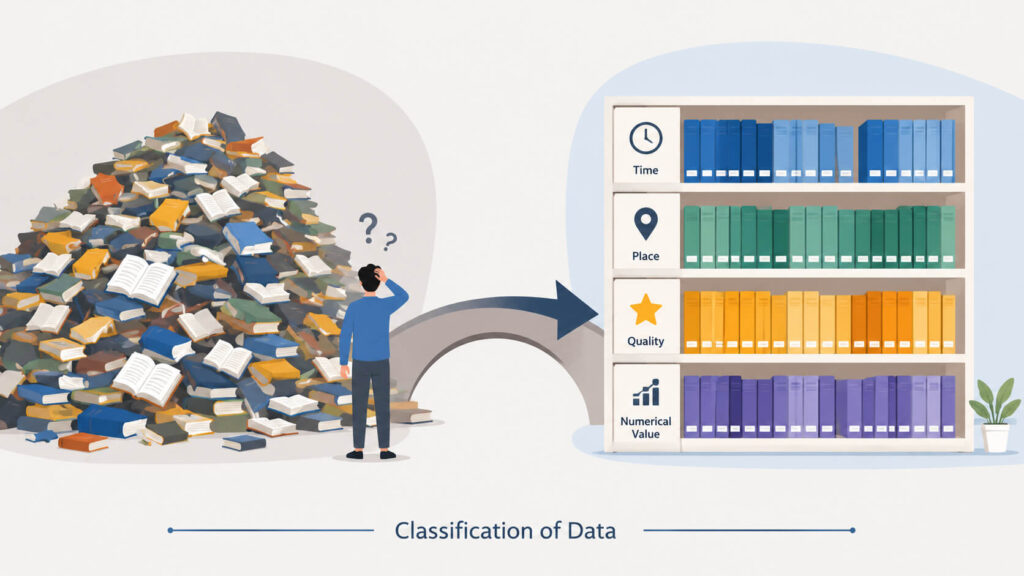
Imagine you walk into a huge library, but instead of being organized into sections like “History,” “Science,” or “Fiction,” all the books are just piled up randomly in the middle of the floor. You’d be lost, right? Classification is exactly the opposite of that mess. In data analysis, it means taking a big, chaotic collection of raw information and sorting it into neat, meaningful groups or “categories.” This simple act of grouping makes the data much easier to understand and work with.
Different ways to classify data
S. P. Gupta explains four main types of classification, depending on what you’re trying to see:
- Chronological classification (by time)
- This is when you arrange data according to when it happened — for example, year by year, month by month, or even hour by hour. Think of India’s census data arranged as 1991, 2001, 2011, 2021. This helps you see trends and changes over time, like whether a city’s population is growing or unemployment is falling.
- Geographical classification (by place)
Here, you group data based on location — by state, district, village, or any geographic area. For instance, comparing literacy rates in Kerala vs. Bihar, or rainfall in different regions. This type of classification helps answer questions like, “Where is the problem most serious?”
- Qualitative classification (by quality or attribute)
This is for data that can’t be measured with numbers — things like gender (male/female/other), caste, religion, marital status, or type of occupation. These categories are based on characteristics or attributes. You simply ask: does a person have this trait or not? Then you count how many falls into each group.
- Quantitative classification (by numerical value)
This is for data that can be measured in numbers, like age, income, exam scores, or number of children. But instead of listing every single number separately, you create ranges or “classes” — for example, income groups like ₹10,000–20,000, ₹20,001–30,000, and so on. This makes a long list of numbers much simpler to digest.
Why is classification so important?
Simply put, classification turns confusion into clarity. Without it, a researcher might stare at hundreds of ungrouped survey responses and see nothing but noise. With classification, patterns begin to pop out — you can see briefly which age group buys a certain product, which state has the highest crime rate, or how a community’s habits have changed over the decades. It’s the first real step toward making sense of your data before any fancy math or graphs are even used.
Tabulation of Data
What is tabulation in everyday words?
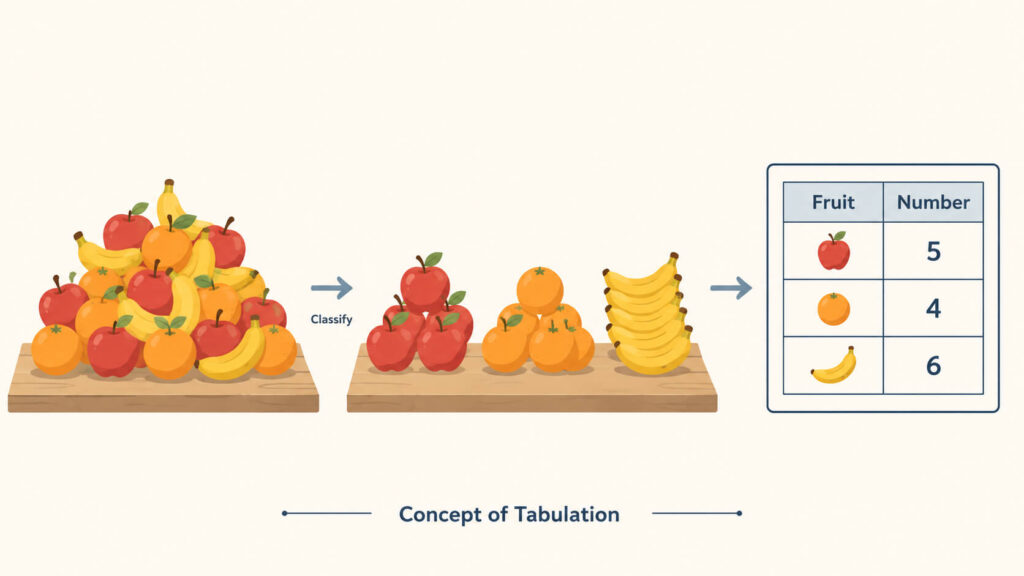
If classification is about sorting data into groups, then tabulation is about taking those groups and presenting them in a neat, structured chart — specifically, in rows and columns. Imagine you’ve sorted a bunch of fruits into apples, oranges, and bananas. Tabulation is like drawing a simple table where the left column lists the fruit names, and the next column shows how many of each you have. It turns a pile of information into something you can read at a single glance.
Why do we even need tabulation?
S. P. Gupta gives three main reasons:
- Clarity – A well-made table removes all the clutter. Instead of reading fifty sentences of numbers, you just look at rows and columns, and things become crystal clear.
- Comparison – Tables make it super easy to compare numbers side by side. For example, you can put male and female literacy rates in two neighboring columns and instantly see the gap.
- Ease of analysis – Once data is in a table, you can quickly spot highs, lows, averages, or unusual values. It’s like having a clean desk instead of a messy pile of paper — you can actually work.
Different types of tables
Not all tables are the same. Depending on what you want to show, you can choose:
- Simple tables (one variable) – These are the most basic. They show just one characteristic at a time. Example: a table that only lists the number of people in different age groups (young, middle, old). Nothing else. Clean and straightforward.
- Complex tables (multiple variables) – These tables juggle two or more characteristics together. For example, a table that shows, at the same time, age groups and gender and income levels. These are more detailed and help you see relationships — like “Are young women earning less than young men?”
- Frequency distribution tables – This is a special type of table commonly used in statistics. It shows how often each value or value range occurs in your data. For example, if you asked 100 people about their shoe sizes, a frequency table would tell you: size 6 appears 10 times, size 7 appears 25 times, and so on. It’s a very practical way to summarize a long list of numbers.
Simple rules for making a good table
Gupta emphasizes that a table isn’t helpful if it’s muddy. He gives a few common-sense rules:
- Clarity – Keep it clean and easy to read. Don’t cram too much into one table.
- Accuracy – Double-check your numbers. A small mistake can waste the whole analysis.
- Logical arrangement – Put things in a sensible order. For example, arrange age groups from youngest to oldest, or income from lowest to highest, not randomly.
- Proper headings – Every table needs clear title and labels for each row and column. A reader should understand the table without having to guess what the numbers mean.
In short, tabulation is the art of turning classified data into a readable, trustworthy table — and that table becomes the foundation for almost all further analysis, from drawing bar charts to calculating averages.
Frequency Distribution
What is frequency, and why does it matter?
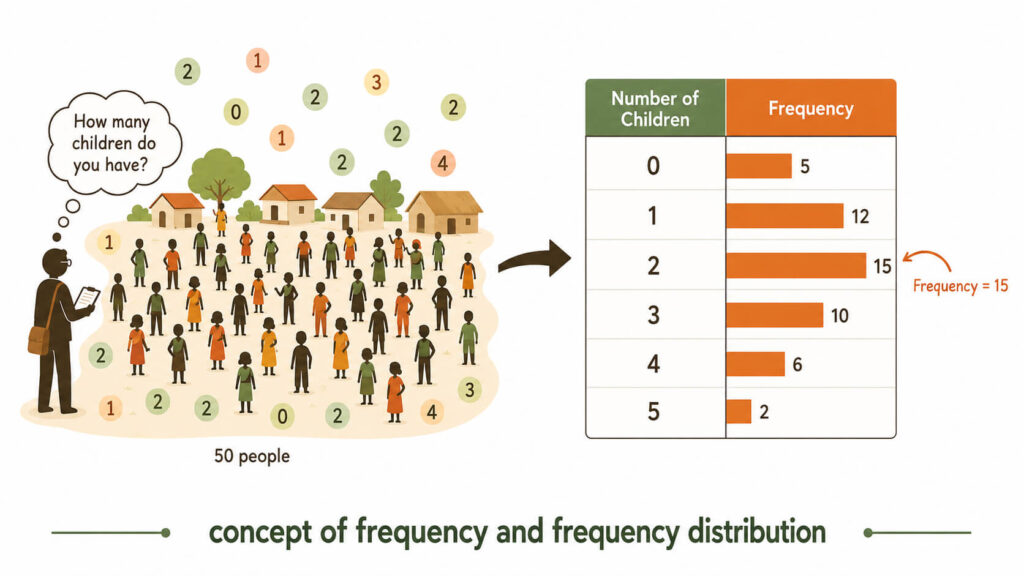
Let’s start with a simple idea. Suppose you ask 50 people in a village, “How many children do you have?” Some will say 0, some 1, some 2, and so on. Now, if 15 people say, “2 children,” then the frequency of the answer “2” is 15. That’s all frequency means — how many times a particular value or event occurs in your data.
But here’s the magic: once you list each possible answer alongside its frequency, you’ve created what’s called a frequency distribution. Rather than looking at 50 separate answers, you now see a clear picture briefly: most people have 2 children, very few have 5, and so on. Frequency distribution is simply a way of summarizing a large set of data by showing how often each value happens.
How do you build a frequency table? (Step by step)
Gupta explains it like a simple recipe:
- List all possible values – For example, if you’re looking at family size, list 0, 1, 2, 3, 4, 5+.
- Go through your raw data – Take each answer from your survey or records and put a tally mark next to the matching value.
- Count the tally marks – That count is your frequency.
- Optional: Add a percentage column – This helps compare groups of different sizes.
- Give your table a clear title and labels – Done.
For larger data sets with many different numbers (like ages from 0 to 100), you can group values into ranges — for example, 0–10 years, 11–20 years, etc. That’s called a grouped frequency distribution.
Real-life examples in sociology
Gupta makes sure you see how this isn’t just abstract math. Sociologists use frequency distributions all the time. Here are a few examples:
- Literacy rates – A researcher might collect literacy data from 200 villages. A frequency table would show: 30 villages have 0–20% literacy, 55 villages have 21–40% literacy, 70 villages have 41–60% literacy, and so on. Instantly, you see that most villages fall in the middle range, and only a few have very low or very high literacy.
- Income groups – Instead of listing the income of 1,000 households one by one, you group them into ranges like ₹5,000–10,000, ₹10,001–15,000, etc. The frequency distribution then tells you how many households fall into each income bracket. This helps policymakers see where poverty is concentrated or where the middle class is growing.
- Caste categories – In a sociological survey about social mobility, you might ask respondents to identify their caste categories. A frequency table would then show, for example: Scheduled Caste – 120 people, Scheduled Tribe – 85 people, Other Backward Class – 200 people, General – 95 people. Even without any complex analysis, you immediately understand the composition of your sample.
Why these matters
Frequency distribution takes a chaotic list of numbers or answers and transforms it into something your brain can easily understand. It’s the difference between looking at a thousand scattered dots and seeing a clear shape emerge. Once you have that shape — whether it’s a peak around middle incomes or a spread across age groups — you’re ready to ask deeper sociological questions, like “Why does this pattern exist?” or “Which groups are different from the norm?”
Graphical Representation of Data
Why use pictures to show data?
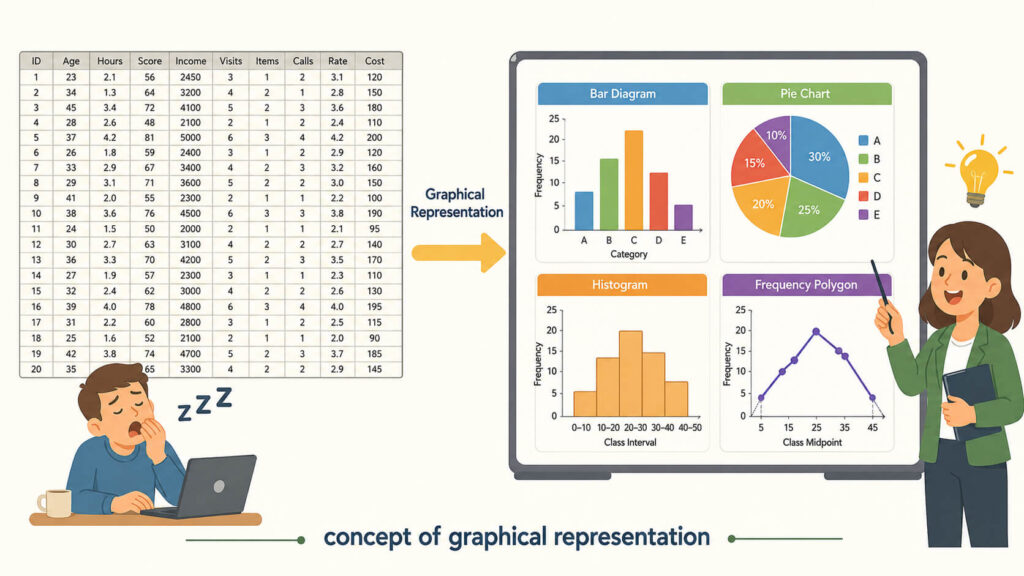
Let’s be honest — rows and tables full of numbers can make your eyes glaze over. But show someone a colorful bar chart or a pie diagram, and suddenly they get it in seconds. That’s the power of graphical representation. Graphs and diagrams take dry, abstract numbers and turn them into shapes, sizes, and colors that our brains process almost instantly. In sociological research, visual tools aren’t just for decoration — they help you spot patterns, grab attention, and make your findings memorable.
Different types of graphs and diagrams
Gupta introduces several common types, each with its own strength:
- Bar diagrams – These are probably the most familiar. You draw rectangular bars of different heights (or lengths) to represent different values. For example, if you want to compare the population of five Indian states, you draw five bars — taller bar means larger population. Bar diagrams are excellent for side-by-side comparisons. You can even stack bars or cluster them to show subgroups (like male and female bars next to each other).
- Pie charts – Imagine cutting a round pizza into slices. Each slice represents a category, and the size of the slice shows its percentage of the whole. For instance, a pie chart of a village’s occupation might show farming taking up 60% of the pie, teaching 10%, shopkeeping 20%, and other jobs 10%. Pie charts are perfect when you want to show how parts make up a whole.
- Histogram – At first glance, a histogram looks like a bar diagram, but there’s a difference. Histograms are used specifically for grouped frequency distributions — like age groups (0–10, 11–20, etc.). The bars touch each other because the groups are continuous (no gaps between age ranges). Histograms help you see the shape of your data — for example, whether most people cluster in middle age groups or spread out evenly.
- Frequency polygons – This is a simpler, cleaner cousin of the histogram. Instead of drawing bars, you put a dot at the top center of each bar of a histogram, then connect those dots with straight lines. The result looks like a multi-sided shape (a polygon). Frequency polygons are especially useful when you want to compare two or more distributions on the same graph — for example, the age distribution of two different villages drawn as two overlapping lines.
Why go through all this trouble? Advantages of graphs
Gupta highlights two major benefits:
- Easy interpretation – A well-made graph tells a story without needing long explanations. You can show your graph to a community member, a policymaker, or a student — and within seconds, they’ll understand the basic message. “Oh, I see — more young people are moving to the city than staying here.”
- Comparative analysis – Graphs make comparisons effortless. Instead of juggling numbers in your head, you just look at bar heights, slice sizes, or polygon peaks. Which state has higher literacy? The taller bar wins. Which age group has the most unemployed youth? The highest point on the frequency polygon tells you. This makes graphs incredibly powerful for spotting differences, trends, and outliers.
A final thought
Graphs are like a translator — they take the formal, sometimes intimidating language of numbers and turn it into shapes everyone can understand. Whether you’re presenting research findings at a conference or explaining community data to a local group, a good graph often speaks louder than a page full of tables. And as Gupta shows, learning to choose the right type of graph — bar, pie, histogram, or polygon — is a skill every sociologist should have.
Practical Applications in Sociology
So far, we’ve talked about what classification, tabulation, and frequency distributions are. But you might be wondering — does anyone actually use these things in real life? The answer is a strong yes. In fact, every major sociological study in India relies on these basic tools. Let’s look at how, using examples from Gupta’s chapter.
Using classification and tabulation in census data
You’ve previously heard of India’s Census, which happens once every ten years. But have you ever thought about what happens after millions of families fill out those forms? Raw data comes in as thousands of pages of individual answers — ages, occupations, religions, languages, and more. Without classification and tabulation, that data would be useless.
Here’s how it works in practice:
- Classification – First, census officials group the data. For example, all “farmers” go into one occupational category; all “teachers” into another. Age is classified into ranges (0–14, 15–59, 60+). Marital status is classified as single, married, widowed, or divorced.
- Tabulation – Then, they create massive tables. One table might show, for each state, how many people belong to each religion. Another table might cross-tabulate age with literacy — showing literacy rates for young, middle-aged, and elderly people separately. Once these tables are published, sociologists can download them and immediately start analyzing patterns, like “Which states have the fastest-growing elderly population?”
NSS data analysis through frequency distributions
The National Sample Survey (NSS) is another goldmine for Indian sociologists. Every year, NSS teams visit thousands of households across the country and ask detailed questions about spending, employment, health, education, and more.
Now imagine you want to study income inequality in rural Maharashtra. You get NSS data on 10,000 households. Each household has a monthly income figure. What do you do next?
You build a frequency distribution:
- Step 1: Group incomes into ranges — say, ₹0–5,000, ₹5,001–10,000, ₹10,001–15,000, and so on.
- Step 2: Count how many households fall into each range (that’s the frequency).
- Step 3: Look at the table. If you see most households crowded into the lowest income ranges and very few in the higher ranges, you’ve just uncovered evidence of deep inequality — all using nothing more than a frequency table.
This is exactly how real sociologists and economists’ work. No fancy math required at this stage — just honest counting and grouping.
Case study: tabulating caste and occupation in urban Delhi
Let’s bring this closer to home with a concrete example Gupta might use. Suppose you are a sociology student, and you decide to study whether caste still influences occupation in modern urban Delhi. You survey 500 families in a mixed neighborhood. You ask two simple questions:
- Caste category (Scheduled Caste, Scheduled Tribe, OBC, General)
- Main occupation (government job, private job, business, daily wage labor, unemployed)
Now you have raw data — 500 rows, each with two answers. What next?
You create a two-way or complex table (also called a contingency table). The table might look like this:
| Caste Category | Govt Job | Private Job | Business | Daily Wage | Unemployed | Total |
| SC | 20 | 30 | 10 | 40 | 15 | 115 |
| OBC | 35 | 55 | 25 | 20 | 10 | 145 |
| General | 60 | 70 | 50 | 10 | 5 | 195 |
| ST | 5 | 10 | 5 | 15 | 10 | 45 |
Now, just by looking at this table, you can start answering your research question:
- Do you see more General category people in government and private jobs? Yes.
- Do you see more SC and ST people in daily wage labor? Yes.
- Who has the highest unemployment numbers? SC and ST show higher counts relative to their total.
From here, you might conclude that even in urban Delhi, caste still shapes job opportunities. You haven’t done any advanced statistics — just honest tabulation. But that table is powerful evidence.
Why this matters for you
These practical applications show that classification, tabulation, and frequency distributions aren’t just textbook exercises. They are the actual tools used by the Census of India, the NSS, and thousands of researchers every day. Once you learn to make a frequency table or a two-way classification, you can start answering real questions about your own community — no PhD required, just careful thinking and a little patience.
Subscribe to keep reading
You've used your free notes for now. Get Delhi Pathshala Premium for unlimited access.
Subscribe — ₹29/30 days