
Contents
- Introduction: Why Ethics Matter
- Understanding Plagiarism
- The different faces of plagiarism
- Why should you care? The real consequences
- Ethical Principles in Social Research (ASA Guidelines)
- Respect for participants: informed consent and voluntary participation
- Confidentiality and anonymity: protecting identities and sensitive data
- Avoiding harm: physical, psychological, or social risks
- Transparency: honesty in reporting methods and findings
- Accountability: responsibility to academic institutions and wider society
- Creswell’s Perspective on Ethics in Research Design
- Ethics embedded in every stage: planning, data collection, analysis, and reporting
- Importance of Institutional Review Boards (IRBs) or ethics committees
- Balancing qualitative sensitivity with quantitative rigor
- Ethical dilemmas in mixed-methods research
- Plagiarism Prevention Strategies
- Proper citation and referencing (APA, MLA, Chicago styles)
- Using plagiarism detection tools responsibly
- Developing original arguments through critical engagement with sources
- Encouraging collaborative learning while maintaining individual accountability
Introduction: Why Ethics Matter
When we step into the world to study other people, we aren’t just neutral observers collecting data. We are guests, listeners, and sometimes even a source of disruption. This is why ethics—the moral compass of research—is so important.
So, what are ethics in social research? Think of it as a framework of integrity, honesty, and responsibility that guides how we treat the people who agree to share their lives with us. It is a promise to do no harm and to be transparent about who we are and what we are doing.

However, doing good research is a balanced act. On one hand, we have a dual challenge: we must protect the participants from any potential harm—whether physical, social, or emotional. On the other hand, we must maintain our scholarly credibility. If we cut corners or misrepresent people, our findings become worthless, and we damage the trust that future researchers rely on.
As the Association of Social Anthropologists reminds us, our “paramount obligation” is always to the people we study. Even if a sponsor or a boss wants a specific result, or if the truth is uncomfortable, our first duty is to safeguard the well-being and rights of those who trusted us enough to let us in.
To put it simply: We cannot let the desire for a “good story” or an easy publication come at the cost of someone else’s safety or dignity.
Understanding Plagiarism
Let’s be honest—we all stand on the shoulders of others when we do research. But there’s a huge difference between learning from someone and stealing from them. That difference is called plagiarism.
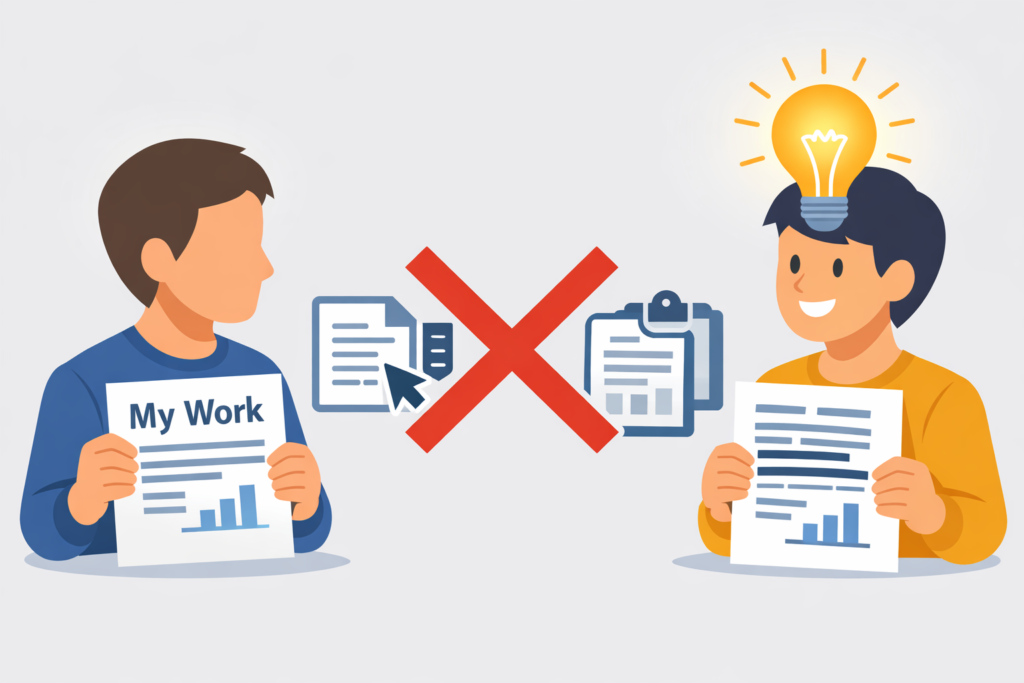
So, what is plagiarism? Simply put, it is presenting someone else’s ideas, words, data, or even their unique way of expressing a thought as if it were your own original work. It doesn’t matter if you did it on purpose or by accident—the result is the same: you’re taking credit for something you didn’t create.
The different faces of plagiarism
Plagiarism isn’t always about copying an entire paragraph. It comes in several forms:
- Direct copying without citation. This is the most obvious one. You find a perfect sentence in a journal article or on a website, and you paste it straight into your paper without quotation marks or a reference. That’s a clear violation.
- Paraphrasing without acknowledgment. Many students fall into this trap. You read a passage, rewrite it in your own words, but don’t tell the reader where the original idea came from. Even though the words are yours, the idea belongs to someone else. Without a citation, it’s still plagiarism.
- Self-plagiarism (reusing your own work without disclosure). This one surprise people. “How can I steal from myself?” You might ask. But when you submit an assignment, your university expects fresh, original work for that specific task. If you take a paper you wrote for another class and turn it in again without permission, that’s self-plagiarism. You’re recycling past credit as if it were new.
Why should you care? The real consequences
Plagiarism isn’t just a “student mistake.” It carries serious weight:
- Academic penalties. Depending on the severity, you could fail the assignment, fail the course, or even face suspension or expulsion. Many universities have strict honor codes, and they enforce them.
- Loss of credibility. Once you’re caught plagiarizing, people will question everything you write afterward. Trust once broken, is very hard to rebuild.
- Ethical violations. The ASA guidelines are clear: research is built on honesty and respect for others’ intellectual labor. When you plagiarize, you disrespect the work of fellow scholars and undermine the very foundation of academic inquiry.
Examples in student research (real scenarios you want to avoid)
- You have a friend who took the same class last semester. They share their old assignments. You copy a few of their sentences and change a couple of words. That’s plagiarism.
- You find a great source online—maybe a blog, a study guide, or even Wikipedia. You paraphrase its main point but don’t include a citation. That’s plagiarism.
- You wrote a brilliant discussion post for another course last year. It fits perfectly with your current assignment, so you copy-paste most of it. Without disclosure from your instructor, that’s self-plagiarism.
The bottom line: When in doubt, cite it out. Giving credit costs you nothing but saves you from losing everything—your grade, your reputation, and your future as a researcher.
Ethical Principles in Social Research (ASA Guidelines)
Think of these principles as your moral compass in the field. They aren’t just abstract rules to memorize a test—they are practical promises you make to the real people who open their doors, share their stories, and trust you with their lives.
The Association of Social Anthropologists (ASA) makes it very clear: your first and deepest duty is to the people you study, not to your research question, not to your professor, and not even to your own career.
Let’s break down what that actually looks like in practice.
Respect for participants: informed consent and voluntary participation
Imagine someone knocking on your door and asking to observe your most private moments. You’d want to know who they are, what they’re doing, and whether you can say “no” without any bad feelings, right?
That’s exactly what informed consent means. Before any research begins, you must clearly explain to potential participants:
- Who you are and why you’re doing this research
- What will participate involve (interviews, observations, surveys, etc.)
- Any potential risks or benefits
- That they can withdraw at any time, for any reason, with no consequences
And here’s the key: participation must be completely voluntary. No pressure, no manipulation, no “but my professor needs this.” A head nod from someone who feels trapped isn’t consent—it’s a problem.
Confidentiality and anonymity: protecting identities and sensitive data
People tell researchers things they wouldn’t tell their own family. That’s a gift, but it’s also a heavy responsibility.
- Anonymity means you don’t even know who the person is. No names, no identifying details. Even you can’t connect the data back to a specific individual.
- Confidentiality means you know who they are, but you promise—legally and morally—never share that information with anyone else. You change names in your notes. You store data on encrypted drives. You don’t gossip about that shocking interview over coffee.
The ASA guidelines stress that protecting identities isn’t just polite—it’s essential. A broken promise of confidentiality can ruin reputations, relationships, and even put someone in physical danger.
Avoiding harm: physical, psychological, or social risks
Here’s where ethics become real. Harm isn’t always a punch or a scream. Sometimes it’s quieter but just as damaging.
- Physical harm is the most obvious: never put anyone in a situation where they could be hurt.
- Psychological harm includes shame, distress, re-traumatization, or anxiety triggered by your questions.
- Social harm happens when participation leads to someone being ostracized, laughed at, fired, or rejected by their community.
The ASA guideline is straightforward: do no harm. And if you can’t guarantee that, you don’t do the research. Period. Even if the topic is fascinating. Even if you’ve already started.
Transparency: honesty in reporting methods and findings
Nobody is perfect. Research gets messy. You might lose participants, change your questions halfway through, or find results that completely surprise you.
Transparency means you admit all of that. You don’t hide your mistakes. You don’t cherry-pick only the data that supports your argument. You clearly explain exactly what you did, how you did it, and what limitations your study has.
The ASA puts it simply: be honest. Misleading your readers—even by omission—is a form of deception. And deception erodes trust in all social research.
Accountability: responsibility to academic institutions and wider society
You don’t do research in a vacuum. You answer multiple audiences.
- To your university or institution: They gave you permission to do this work. You owe them honest reporting, ethical conduct, and respect for their policies. If you break the rules, you don’t just hurt yourself—you put future researchers at risk too.
- To wider society: Your findings could influence policies, shape public opinion, or represent entire communities. That’s a serious responsibility. Are you fair? Are you amplifying voices respectfully? Are you thinking about how your work might be used—or misused?
The ASA reminds researchers that accountability doesn’t end when you submit your final paper. Your ethical responsibility follows your work wherever it goes.
In simple terms: Treat people like people, not like data points. Be honest. Do no harm. And remember that every signature on a consent form is a person trusting you with a piece of their life. Don’t break that trust.
Creswell’s Perspective on Ethics in Research Design

If the ASA guidelines tell you why ethics matter, John Creswell tells you how to weave them into every single step of your research. His core message is simple: ethics aren’t just a box to check at the beginning—they are a living, breathing part of your entire project, from the first spark of an idea to the final full stop of your conclusion.
Ethics embedded in every stage: planning, data collection, analysis, and reporting
For Creswell, thinking about ethics only at the start is like putting on a seatbelt after you’ve already crashed. Instead, he argues that ethical considerations should be present in every phase:
- Before: you even recruit a single participant, you ask yourself—is my research question respectful? Am I choosing a group that might be harmed by this study? Have I designed something that treats people fairly?
- During data collection: This is where many ethical challenges pop up in real time. Someone seems uncomfortable but won’t say no. A participant shares something deeply personal and then looks worried. Creswell reminds you to stay alert, be flexible, and prioritize the person over the data.
- During analysis: This is a tricky one. You might find a piece of data that perfectly supports your argument but could embarrass or expose someone. What do you do? Creswell says your ethical duty is to protect identities, even if that means leaving a “perfect” quote.
- During reporting: How you write matters. Do you use respectful languages? Do you avoid stereotypes? Do you honestly acknowledge your own biases and limitations? Ethical reporting means representing people as they are, not as convenient examples for your argument.
Importance of Institutional Review Boards (IRBs) or ethics committees

You’ve probably heard of the IRB (or whatever your institution calls its ethics committee). Many students see it as a hurdle—boring forms, annoying delays, picky reviewers asking for changes.
Creswell wants you to see it differently. Think of the IRB as your ethical safety net, not your enemy. These committees exist because history is full of examples where researchers harmed people in the name of knowledge. The IRB’s job is to ask the hard questions you might have missed:
- Have you really minimized risks?
- Is your consent form written in plain language people can actually understand?
- What’s your plan if someone gets upset during an interview?
Submitting an IRB isn’t a sign of weakness or bureaucracy. It’s a sign that you take responsibility seriously. And honestly? Their feedback often makes your study better, clearer, and more thoughtful.
Balancing qualitative sensitivity with quantitative rigor
This is where Creswell gets really practical. Different types of research come with different ethical flavors:
- Qualitative research is close, personal, and messy. You build rapport. You earn trust over cups of tea and long conversations. Participants become more than “subjects”—they become human beings with names, stories, and feelings. The ethical challenge here is avoiding over-familiarity. When you genuinely like someone, it’s harder to be objective. When someone trusts you deeply, betraying that trust cuts even deeper.
- Quantitative research is more distant. You deal with numbers, variables, and statistical significance. The ethical challenge here is different: you must protect validity and reliability while still treating people like humans, not just data points. It’s easy to think, “Well, it’s just a survey, no big deal.” But every checked box represents a real person who took time to answer you honestly.
Creswell says you need both. Be sensitive enough to earn trust, but rigorous enough to produce credible findings. Lean too far one way, and you risk manipulation. Lean too far the other way, and you risk cold detachment.
Ethical dilemmas in mixed-methods research
Mixed-methods research (combining numbers and stories) sounds great in theory—you get the best of both worlds. But Creswell warns that it also doubles your ethical responsibilities.
Here are some real dilemmas you might face:
- Conflicting promises: What if your quantitative survey promised complete anonymity, but your qualitative interviews require you to know who said what? How do you reconcile that?
- Unequal weight: What if your quantitative results say one thing, but your qualitative stories say something completely different? Do you trust numbers or people? Creswell argues that you have an ethical duty to report both honestly, even if they don’t line up neatly.
- Participant burden: Asking someone to fill out a long survey and sit through two interviews and attend a focus group is a lot. Are you taking too much of their time? Are you exhausting their goodwill? Mixed methods can easily become mixed exploitation if you’re not careful.
- Integration challenges: When you mix your data together for analysis, how do you ensure that individual voices don’t get lost on average? The ethical choice is to find ways to honor both the patterns and the exceptions.
In plain terms: Creswell wants you to see ethics not as a rulebook you grudgingly follow, but as a mindset you carry with you. Ask yourself at every stage, “Am I treating these people the way I would want to be treated?” If the answer is ever “not really,” stop and change course. That’s what good research looks like.
Plagiarism Prevention Strategies
Okay, so we’ve talked about what plagiarism is and why it’s a serious problem. But here’s the more useful question: how do you actually avoid it? The good news is that plagiarism is completely preventable. It just takes a few smart habits, some basic tools, and a shift in how you think about writing.
Think of these strategies as your safety net—not a burden, but a set of skills that will make you a stronger, more confident researcher.
Proper citation and referencing (APA, MLA, Chicago styles)
At its simplest, citation is just telling your reader where you found something. “This idea came from this person, in this book, on this page.” That’s it. It’s not punishment—it’s basic honesty and professional courtesy.
Different academic fields prefer different citation styles, but they all do the same job:
- APA style (American Psychological Association) is common in psychology, education, and social sciences. It emphasizes the date of research because currency matters in these fields. Example: (Creswell, 2013)
- MLA style (Modern Language Association) is used mostly in literature, arts, and humanities. It focuses on the author and page number because close reading of texts is key. Example: (Creswell 45)
- Chicago style offers two systems: notes and bibliography (common in history) or author-date (like APA). It’s flexible and widely used across many disciplines.
Which one is right for you? Check your syllabus or ask your professor. But here’s the bigger point: knowing how to cite matters less than having the habit of citing. Get into the habit early. When in doubt, cite it out. A citation you didn’t need is harmless. A citation you missed could be plagiarism.
Using plagiarism detection tools responsibly
You’ve probably heard of Turnitin, Grammarly, or other plagiarism checkers. These tools can be really helpful, but only if you use them the right way.
The right way: Run your draft through a checker before you submit it. Look at the report honestly. Did it flag a passage you forgot to put in quotation marks? Did it show a sentence that’s too close to your source? Use that feedback as a learning opportunity—fix your mistakes before they become problems.
The wrong way: Relying on the tool as a crutch. A low similarity score doesn’t automatically mean your work is original or good. You could have zero matched text but still commit intellectual dishonesty by poorly paraphrasing or misrepresenting ideas. Also, never upload someone else’s work (like a friend’s paper) into a checker without permission—that’s a privacy violation and honestly just awkward.
The ASA guidelines remind us that technology is a tool, not a moral compass. Use checkers to catch your slip-ups, but don’t let them replace your own good judgment.
Developing original arguments through critical engagement with sources
This is the heart of real academic writing, and it’s also your best defense against plagiarism. Here’s the secret: plagiarism happens most often when students don’t have anything original to say. If you’re just stitching together other people’s sentences, of course you’ll be tempted to copy.
So how do you develop your own voice?
- Read actively, not passively. Don’t just highlight. Ask questions: Do I agree with this author? Where do they fall short? What’s missing from this argument?
- Take notes in your own words. After reading the passage, close the book. Write down what you learned without looking at. That messy, imperfect sentence? That’s your voice starting to emerge.
- Look for connections and tensions. Does Author A agree with Author B? Does this study contradict that one? Your original argument lives in those spaces—in the dialogue you create between sources.
- Start with a question you genuinely care about. When you’re curious, you’re less likely to copy. You’ll want to wrestle with ideas, not just report them.
Creswell would say that good research isn’t about piling up what others have said. It’s about entering a conversation, adding your own perspective, and moving the discussion forward. That’s not plagiarism—that’s a scholarship.
Encouraging collaborative learning while maintaining individual accountability
Group work gets complicated when it comes to plagiarism. On the one hand, learning with others is valuable. On the other hand, your professor needs to know what you can do on your own.
Here’s how to walk that line:
Healthy collaboration looks like:
- Discussing ideas with classmates before you write
- Reading each other’s drafts and giving feedback
- Studying together and sharing study guides
- Brainstorming research questions as a group
Unacceptable collaboration (which becomes plagiarism) looks like:
- Splitting up a paper and each writing different sections separately, then pasting them together
- Sharing your completed paper with someone who then submits it (even with changed words)
- Writing a group paper for an assignment meant to be individual
- Using a friend’s old assignment as a template while changing just a few sentences
The ASA and Creswell both emphasize that academic integrity doesn’t mean working alone. It means being clear about what work is yours, what work is shared, and what work belongs to others. Your professor wants you to collaborate—just with transparency.
A simple rule of thumb: If you’re unsure whether something counts as collaboration or cheating, ask yourself: “If I showed my process to my professor right now, would I feel proud or embarrassed?” Your gut usually knows the answer.
In plain terms: Cite your sources, use checkers as a second pair of eyes, find your own voice by wrestling with ideas, and collaborate openly but honestly. These aren’t just rules—they’re skills that will serve you long after this assignment is over.
References:
Association of Social Anthropologists of the UK and the Commonwealth. (2021). Ethical Guidelines for Good Research Practice.
Subscribe to keep reading
You've used your free notes for now. Get Delhi Pathshala Premium for unlimited access.
Subscribe — ₹29/30 days