
Contents
- Welcome, Future Sociologists!
- Course Info – At a Glance
- Why Does This Course Even Matter?
- Syllabus Breakdown – Unit by Unit
- Unit 1: Thinking Sociologically (16 hours)
- Unit 2: Emergence of Sociology and Social Anthropology (16 hours)
- Unit 3: Basic Sociological Concepts (28 hours)
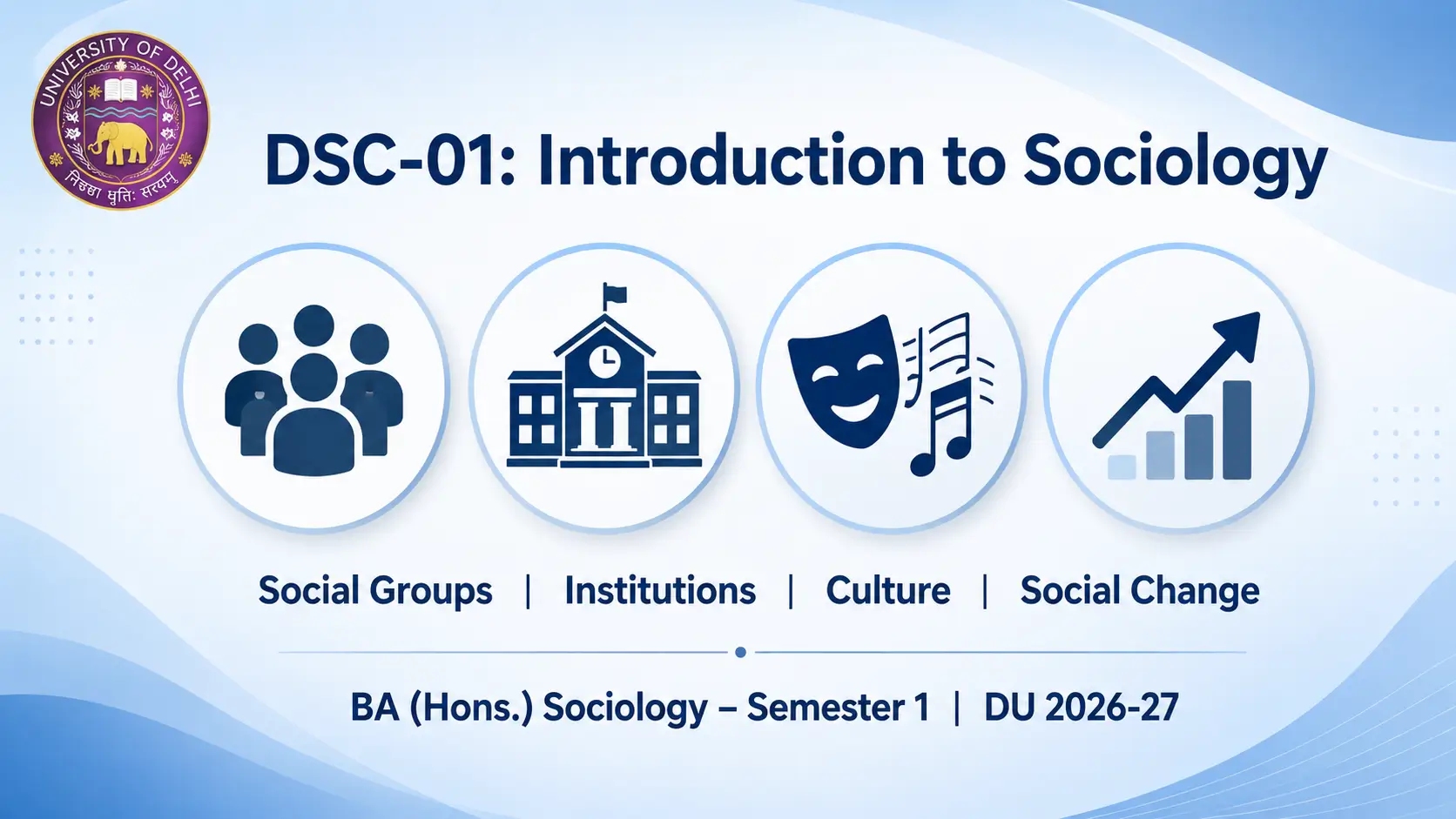
- a. Social Groups
- b. Social Institutions
- c. Culture
- d. Social Change
- Extra Readings – Delhi Pathshala Recommends
- Exam Tips – From Delhi Pathshala to You
- Frequently Asked Questions (FAQs)
- Final Word
Welcome, Future Sociologists!
If you’ve just stepped into BA (Hons.) Sociology at Delhi University, the first paper waiting for you is DSC-1 Introduction to Sociology. And trust us – this is not just another theory of paper. This is where your sociological imagination awakens.
Under the latest NEP (National Education Policy) 2020 framework, DU has completely revamped its undergraduate curriculum. The CBCS (Choice Based Credit System) has been replaced with a more flexible, interdisciplinary structure – and this DSC-01 is the cornerstone of your entire Sociology Honours journey.
This 4-credit course is your foundation stone. It’s designed to make you see the world differently – to understand that your personal life is deeply connected to larger social forces. Whether it’s your career choices, relationships, or even your daily habits – society shapes them all.
We at Delhi Pathshala have gone through the official DU Sociology syllabus (2022 revision, applicable for 2026-27) and created this complete guide for you. No fluff – just what you need to know.
Course Info – At a Glance
| What? | Details |
| Course | DSC-01: Introduction to Sociology |
| Programme | BA (Hons.) Sociology – Semester I |
| Credits | 4 (3 Lectures + 1 Tutorial) |
| Eligibility | No specific requirement |
| Exam Body | Examination Branch, University of Delhi |
Why Does This Course Even Matter?
Let’s be honest – most of us enter college with some “common sense” ideas about how society works. This course shatters that. And under the new NEP-aligned syllabus, the focus has shifted from rote memorization to critical thinking, application, and reflexivity.
Here’s what it does:
- It teaches you to think sociologically – not just “what” but “why”.
- It shows you that individual problems (like unemployment or stress) are often public issues (like economic policies or social inequality).
- It introduces you to key thinkers – Mills, Berger, Beteille – who changed how we understand society.
- It builds your foundation for all future sociology papers – from Gender Studies to Political Sociology.
Delhi Pathshala says: Yeh paper sirf rattne ka nahi hai. Isko samjho, everyday life mein apply karo – marks apne aap aa jayenge.
Syllabus Breakdown – Unit by Unit
Unit 1: Thinking Sociologically (16 hours)
This unit shakes up your common sense. It forces you to ask: “Is this really true, or is this just what I’ve been told?”
| Thinker | Reading | Chapters / Pages | Main Idea |
| C.W. Mills | “The Promise” | The Sociological Imagination. Oxford: Oxford University Press, 6th Edition (2000) (pp. 3–24) | Personal troubles ≠ public issues. Example: One person losing a job is personal trouble – but when thousands lose jobs, it’s a public issue. |
| Peter Berger | “Sociology as Consciousness” | Invitation to Sociology: A Humanistic Perspective. New York: Anchor Books (1963) (pp. 25–53) | Sociology is not just a subject – it’s a way of seeing the world. It makes the familiar strange. |
| André Beteille | “Sociology and Common Sense” | Sociology: Essays in Approach and Method. Delhi: Oxford University Press (2009), Chapter 1(pp. 13–27) | Common sense works for people in similar situations. Sociology goes beyond that – it’s scientific and systematic. |
Tip: Mills sabse important hai. Yeh reading har exam mein aati hai. Acche se padhna.
Unit 2: Emergence of Sociology and Social Anthropology (16 hours)
Ever wondered – where did sociology even come from?
This unit answers that. It traces the birth of sociology as a scientific discipline and shows how it’s connected to – but different from – social anthropology.
| Thinker | Reading | Chapters / Pages | Main Idea |
| Giddens & Griffiths | “What is Sociology?” | Sociology. Cambridge: Polity, 5th Edition (2006) (pp. 2–29) | Sociology studies human society – its patterns, institutions, and changes. |
| André Beteille | “Sociology and Social Anthropology” | Six Essays in Comparative Sociology. New Delhi: Oxford University Press (1985), Chapter 1(pp. 1–20) | Sociology focuses on modern, complex societies; anthropology traditionally studied simpler, non-Western societies – but today, they overlap a lot. |
Tip: Don’t memorize this history. Understand why sociology emerged – it was a response to rapid changes like the Industrial Revolution.
Unit 3: Basic Sociological Concepts (28 hours)
This is the biggest unit – and it’s your toolkit for understanding society.
a. Social Groups
| Reading | Chapters / Pages | Key Idea |
| MacIver & Page – “Types of Social Groups” | Society: An Introductory Analysis. New York: Holt, Rinehart and Winston (1962), Chapter 10 (pp. 213–237) | Primary groups (family, friends) – small, intimate. Secondary groups (office, college class) – larger, formal. In-groups’ vs out-groups – “we” vs “they”. |
b. Social Institutions
| Reading | Book | Key Idea |
| Horton & Hunt – “Social Institutions” | Sociology. New Delhi: Tata McGraw Hill (2004), Chapter 9 (pp. 210–229) | Institutions are like the “organs” of society – family, education, religion, economy, state. Each has a function. |
c. Culture
| Reading | Book | Key Idea |
| Neubeck & Glasberg – “Culture” | Sociology: Diversity, Conflict, and Change. McGraw-Hill (2005), Chapter 5 | Culture = values + norms + symbols + language + material objects. It’s what gives meaning to our lives. |
| Sharmila Rege – “Conceptualizing Popular Culture” | Economic and Political Weekly, 37(11), 2002 (pp. 1038–1047) | Lavani and Powada in Maharashtra – how folk traditions reflect caste, gender, and class realities. |
d. Social Change
| Reading | Books | Key Idea |
| Horton & Hunt – “Social and Cultural Change” | Sociology. New Delhi: Tata McGraw Hill (2004), Chapter 9 | Societies never stay still. They change – sometimes slow, sometimes fast. Factors: technology, ideas, conflict, environment. |
| George Ritzer – “The McDonaldization of Society” | The McDonaldization of Society: An Investigation into the Changing Character of Contemporary Social Life. Pine Forge Press, 5th Edition (1993), Chapter 1 | Fast-food principles – efficiency, calculability, predictability, control – are taking over every part of life. |
Tip: Ritzer ka example bahut relatable hai – socho kaise ab college, healthcare, education sab “McDonaldized” ho raha hai.
Extra Readings – Delhi Pathshala Recommends
These aren’t mandatory, but they’ll make you fall in love with sociology:
| Book | Author | Why Read? | Chapters/Pages |
| The Forest and the Trees | Allan G. Johnson | The best beginner book – connects personal life to social structures. | The forest, The trees & the one thing, |
| Politically Correct Bedtime Stories | James Finn Garner | Fun and funny – shows how even stories reflect social norms. | Introduction, Little red riding hood, Rumpelstiltskin |
| Sociology: A Guide to Problems and Literature | T.B. Bottomore | Classic text – for when you want to go deeper. | The social science, history & Philosophy |
| Classical Sociological Theory (Chapter 1) | George Ritzer | Historical background – good for understanding the emergence of sociology. | A historical sketch of sociological theory |
Exam Tips – From Delhi Pathshala to You
- Mills ka “sociological imagination” – isko apni writing mein baar baar lao. Yeh show karta hai ki tumne paper samjha hai.
- Examples do – sociology mein examples hi marks laate hain. Apni life, college, family, social media se examples do.
- Compare karo – common sense vs sociology, sociology vs anthropology, primary vs secondary groups – yeh comparisons easy marks hain.
- Sharmila Rege ko seriously lo – Indian sociologist + Indian context = examiner impressed.
- Tutorials miss mat karo – wahan practice hoti hai. Mock answers likho, feedback lo.
Frequently Asked Questions (FAQs)
Q1. Is this syllabus applicable for the 2026-27 academic session?
✅ Yes. The DSC-01 syllabus was revised in 2022 under the NEP framework and remains the official DU syllabus for 2026-27.
Q2. How many credits does this course carry?
✅ 4 credits – 3 for lectures and 1 for tutorials.
Q3. Is there any practical components?
✅ No. There is no practical/practice component for DSC-01.
Q4. What is the most important reading in this course?
✅ C.W. Mills’ “The Promise” – it introduces the core concept of sociological imagination.
Q5. Where can I find the official exam pattern?
✅ The examination scheme is prescribed by the Examination Branch, University of Delhi. Keep checking the official DU website or stay tuned to Delhi Pathshala for updates.
Final Word
Doston – sociology padhna matlab apni aankhon ka chashma badalna. Yeh paper sirf syllabus nahi – yeh sochne ka naya tareeqa hai.
Delhi Pathshala par hum regularly DU ke latest syllabus, notes, aur exam guides update karte hain. Is page ko bookmark karo aur apne doston ke saath share karo.
Koi doubt ho? Comment karo – hum reply karenge.
Disclaimer: This post is for informational and academic guidance purposes only. For the official examination scheme and latest updates, refer to the Examination Branch, University of Delhi.
This post is curated by the Delhi Pathshala Academics Team – your trusted companion for DU Sociology, English, Political Science, History, and more. We provide 100% accurate, exam-oriented content as per the latest University of Delhi norms.
Subscribe to keep reading
You've used your free notes for now. Get Delhi Pathshala Premium for unlimited access.
Subscribe — ₹29/30 days