
Contents
Introduction: The Birth of Sociology
When we talk about the birth of sociology, we’re really talking about a moment in history when the world was changing faster than people could make sense of it. The Industrial Revolution transformed Europe—factories replaced farms; cities grew crowded, and traditional ways of life were shaken. Alongside urbanization came poverty, inequality, and new forms of social conflict. Old frameworks like philosophy or history could describe aspects of these changes, but they couldn’t fully explain the everyday realities of modern life. That gap created the need for a new discipline.
Sociology emerged as a discipline. As Anthony Giddens and S. Griffiths put it, sociology is the systematic study of human societies. It doesn’t just look at individuals in isolation but at the web of institutions, relationships, and collective behaviors that shape how people live together. Whether it’s the family, the economy, or political systems, sociology tries to understand how these structures both hold society together and create tensions that drive change.

The key distinction here is crucial: sociology is not just common sense. Common sense is fragmented, culture-bound, and often uncritical—it tells us what “seems obvious” from our own limited perspective. Sociology, on the other hand, is a science of society. It asks deeper questions, challenges assumptions, and uses evidence to uncover patterns that aren’t immediately visible. In this way, sociology was born as a discipline that could help people make sense of the modern world, offering tools to see beyond appearances and understand the forces shaping everyday life.
Sociology as a Discipline
Once sociology took shape as a new way of looking at society, the next question was: what exactly does this discipline do? Anthony Giddens reminds us that sociology is not just about collecting facts—it’s about asking fundamental questions. How do societies hold together despite differences? And how do they change when conflicts, revolutions, or new ideas disrupt the old order? In other words, sociology is always balancing two concerns: stability and transformation.
At its core, sociology studies the big structures that shape our lives—social institutions like the family, the economy, and political systems. But it doesn’t stop there. It also looks at the small, everyday interactions—the way people talk, behave, and relate to one another in daily life. This dual focus makes sociology unique: it connects the micro (our personal experiences) with the macro (the larger social order).
Another central theme is power and inequality. Sociology asks why some groups have more privilege, wealth, or influence than others, and how these differences are maintained or challenged. Concepts like social stratification—class, caste, race, gender—help us see patterns of inequality that might otherwise feel “natural” or invisible.
The real promise of sociology lies in its ability to act as a lens. It allows us to connect what feels like purely personal troubles—say, unemployment or family conflict—to wider social structures like economic policies or cultural norms. This connection between biography and society is what makes sociology empowering: it helps individuals see that their struggles are not just private misfortunes but part of larger social dynamics.
In short, sociology as a discipline is both a mirror and a window—a mirror that reflects our own lives in relation to society, and a window that opens broader perspectives on how the world works.
Anthropology and Its Relationship with Sociology
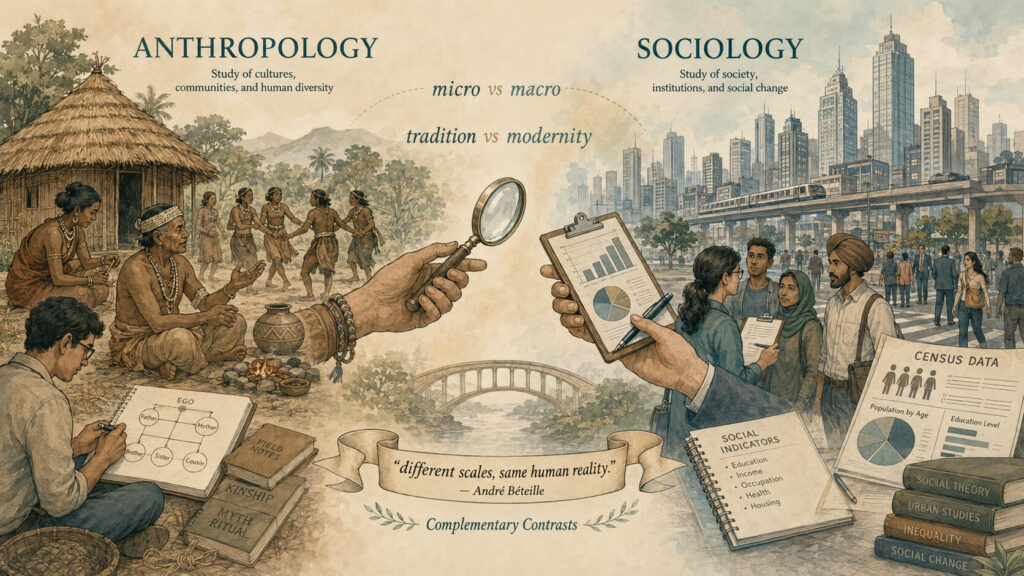
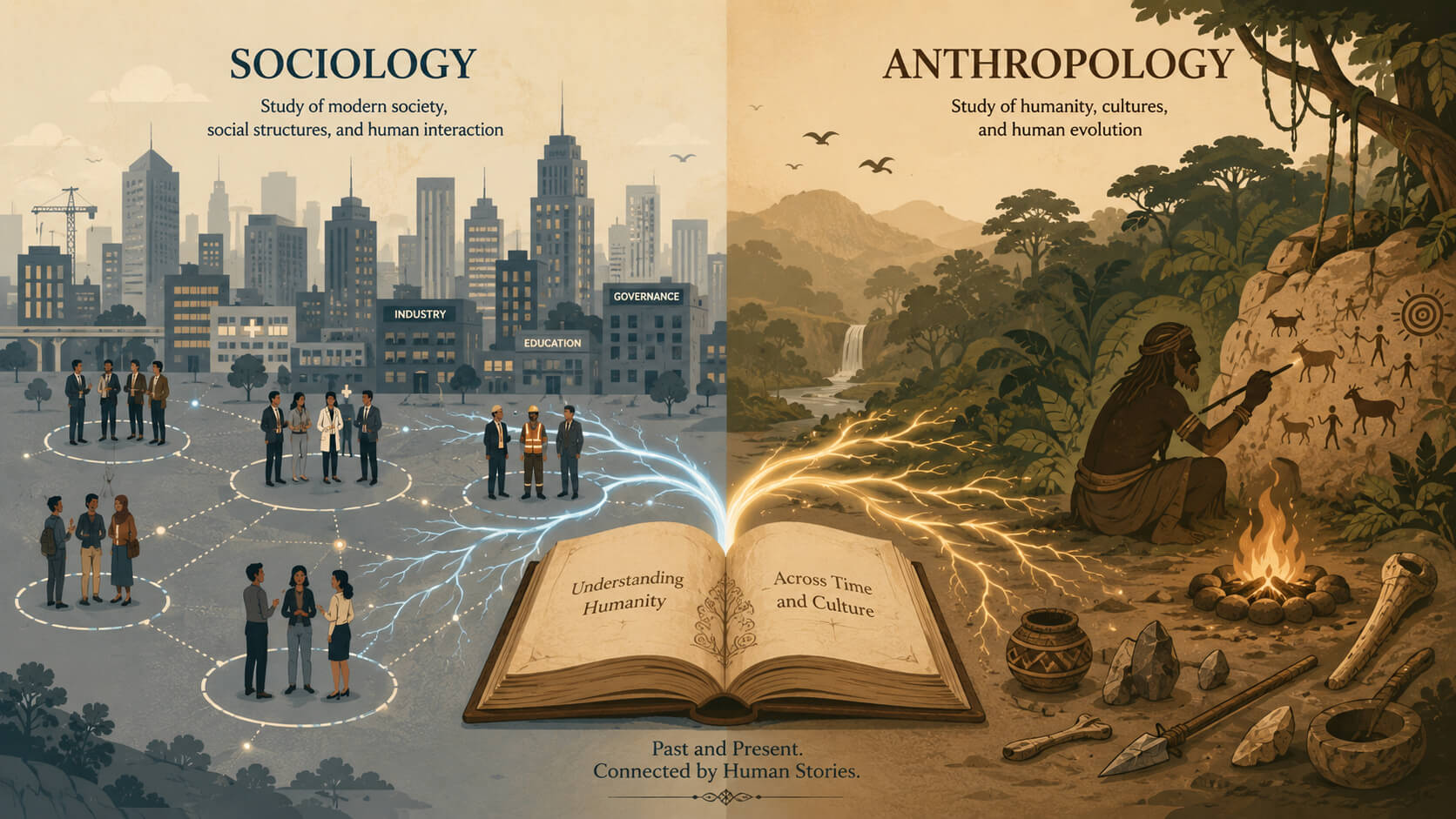
To understand how sociology grew, we also need to see how it stood alongside another discipline—anthropology. Anthropology first took shape during the colonial period, when European scholars began studying societies that were very different from their own. These were often small-scale communities, and the focus was on things like kinship systems, rituals, myths, and everyday cultural practices. The idea was to document and understand the richness of human diversity.
Now, here’s where sociology and anthropology meet. As André Béteille points out, both disciplines are concerned with human society, but they emphasize different aspects. Sociology tends to look at modern, complex, industrial societies—how cities function, how institutions like the state or economy shape people’s lives, and how inequality plays out in large populations. Anthropology, on the other hand, traditionally concentrated on traditional, small-scale, non-Western societies, where kinship, community ties, and cultural rituals were central.
But the boundary between the two is not rigid. In fact, anthropology often enriches sociology by reminding us that there isn’t just one way of living or organizing society. By highlighting cultural diversity, anthropology challenges sociology to avoid narrow, Eurocentric assumptions. For example, studying kinship in Indian villages or tribal communities can deepen sociological insights into family and caste structures.
In short, sociology and anthropology are like two siblings: one looking at the big, modern picture, the other at the intimate, cultural details. Together, they give us a fuller, more human understanding of society.
André Béteille: Sociology and Social Anthropology

André Béteille helps us see clearly how sociology and anthropology are related yet distinct. He draws an analytical distinction between the two: sociology is more concerned with institutions, structures, and the forces of modernity, while anthropology emphasizes culture, tradition, and community life. In simple terms, sociology looks at how societies are organized on a large scale, while anthropology zooms in on the cultural meanings and practices that shape everyday life.
The two disciplines also differ in their methods. Sociology often relies on surveys, statistics, and large-scale analysis to understand patterns across big populations. Anthropology, by contrast, is rooted in fieldwork—living among communities, observing rituals, and practicing participant observation and ethnography. This close, immersive approach allows anthropologists to capture the texture of cultural life in ways that numbers alone cannot.
In the Indian context, Béteille points out that the boundaries between sociology and anthropology blur. When we study caste, kinship, or village life, we cannot separate institutions from culture—they are deeply intertwined. For example, caste is both a social structure (sociology’s concern) and a cultural system of rituals and meanings (anthropology’s concern). Béteille emphasizes that both disciplines complement each other in making sense of Indian society.
So, rather than seeing sociology and anthropology as rivals, Béteille encourages us to see them as partners. Sociology gives us a big picture of institutions and inequality, while anthropology adds depth by showing how culture and tradition shape lived experience. Together, they provide a richer, more human understanding of society.
Comparative Insights
When we place Anthony Giddens and André Béteille side by side, we see two slightly different but complementary ways of thinking about sociology. Giddens views sociology as a broad discipline designed to explain modernity—how societies adapt to industrialization, globalization, and rapid social change. His lens is wide, capturing the big transformations that shape everyday life.
Béteille, on the other hand, is more precise in drawing boundaries. He emphasizes that sociology and anthropology are distinct traditions, though they often overlap. Sociology, for him, is about institutions and structures in modern societies, while anthropology is about culture, tradition, and community life, especially in smaller or non-Western contexts.
The strengths of each discipline complement one another. Sociology provides structural analysis—it helps us understand how systems like the economy, politics, or caste hierarchies organize society. Anthropology provides cultural depth—it reveals the meanings, rituals, and everyday practices that give life to those structures.
When these two perspectives enter dialogue, they enrich our understanding of society. Sociology gives us scaffolding; anthropology fills in the texture. Together, they remind us that society is not just about rules and institutions, but also about lived experiences, cultural meanings, and human diversity.
Conclusion
The story of sociology and anthropology is really the story of how human beings tried to make sense of a rapidly changing world. Sociology emerged out of modernity—industrialization, urbanization, and the social upheavals of Europe—while anthropology grew out of colonial encounters, as scholars sought to understand societies that seemed very different from their own. Both disciplines were born in response to new realities, and both shared a common goal: to understand human societies in all their complexity and diversity.
In today’s world, their relevance is even sharper. Sociology helps us grasp globalization, inequality, and social change—why economies shift, why social movements rise, and how institutions shape our lives. Anthropology reminds us of cultural variation and lived experiences, showing us that there are many ways of being human, and that traditions, rituals, and everyday practices matter just as much as structures and systems.
For students, the real gift of these disciplines is the way they train us to think critically. They push us to question assumptions, to see beyond what feels “obvious,” and to connect our personal experiences with wider social forces. In doing so, sociology and anthropology encourage us to look at society with fresh eyes—to see not just what is, but what it could be.
In essence, both disciplines are not just academic subjects; they are tools for awareness and liberation. They help us understand the world more deeply, and in that understanding, they open possibilities for change.
Suggested Readings
Giddens, Anthony, & S. Griffiths, (2006). ‘What is Sociology?’ in Sociology. Pp.2-29.
Subscribe to keep reading
You've used your free notes for now. Get Delhi Pathshala Premium for unlimited access.
Subscribe — ₹29/30 days